A passage from our work-in-progress for September 4, 1921

The following begins another part in our biblical-length book with the appropriately apocryphal title of The Apocrypha of Maude: September 1921.


To Selma

I do not believe that Virginia Rappe was a conscious factor in any maneuver directed against Mr. Arbuckle. If there were a deliberate plot against him, I do not think that she knew anything about it. She was in Los Angeles, financially hard up, out of work and unable to get help from her friends.

Minta Durfee

When he spoke before a grand jury and testified for the first time in a courtroom, Al Semnacher casually said he had met Maude Delmont no more than three or four times since 1917.[1] Yet, when they encountered each other outside the Hollywood Pig ‘n Whistle restaurant, they were far better acquainted. He had her telephone number. Delmont knew of his youngest son by name. She spoke of little Gordon Semnacher as though she babysat for him.

Delmont had long since ceased running her salon business on Captiva. With the end of the summer season in 1919, as “Madam Delmont,” she ran a help-wanted ad in the Los Angeles Times, a business offer for an “EXPERIENCED BEAUTY PARLOUR operator” who knew “the hairdressing business and all its branches.” This “grand opportunity for the right person” meant Delmont wanted another woman to assume her lease adjacent to the Avalon Casino Ballroom. As it came out later, unpaid rent and other bills forced her creditors to seize her luggage until her debts were paid.

By the spring of 1920, Delmont lived in East Los Angeles at 725 S. Bernal Avenue. She had moved into a rented house with her younger sister Lucile, a practical nurse and divorcée.[2] The census that year lists Delmont’s occupation as a “corsetier.” But so was her neighbor, suggesting some mutual cottage industry.

A year later Delmont found a new job as an advertising and subscription collector for the Labor Journal, a Fresno-based periodical for agricultural employers and workers in the San Joaquin Valley. In this new line of work, she met her third husband, who also worked for the Labor Journal, Cassius Clay Woods, named for the abolitionist Cassius Clay—still an admired figure in the late nineteenth century.

Called a “publicity man” in newspaper accounts, Woods had been selling advertising for publishers since 1912, when he lived in Bakersfield. Like Delmont, he had territories covering the rural towns of the San Joaquin Valley, including Kern, Madera—where the couple were married—as well as Fresno and Selma. One thing the newlyweds had in common was drinking, but their marriage became a part-time affair, like their work, and they drifted apart.

For much of the spring and summer of 1921, Maude Delmont had no fixed address. She either stayed with friends in the Fresno area or with an aunt at the Windsor Apartments at 970 Orange Street in Los Angeles. She lived like a traveling saleswoman. She dressed well and occasionally supplemented her income as a gown model. To get such work at thirty-nine was unusual and more so because Delmont was an alcoholic, albeit one who could comport herself and could pretend to be “sober.”

Drinking wasn’t a pastime Delmont shared with Al Semnacher, and the real nature of their acquaintance was never disclosed. She might have been a business associate of sorts, seeking work as an extra or providing Semnacher with leads to undiscovered new, pretty faces on the sidewalks of Hollywood, an extra set of eyes at lunch counters, at train and bus stations, wherever a young, obviously out-of-town woman needed someone to show her the ropes, the same ones Delmont climbed when she arrived so long ago. We only know that Delmont made a good, quick friend for a friend in need.

Of course, Virginia Rappe was hardly an ingenue. She knew the ropes and got farther up than Maude Delmont ever did. But propriety required that Semnacher provide a chaperone in order for her to make the Labor Day trip and the gregarious “beauty specialist” fit the role.

In courtrooms, Al Semnacher and Maude Delmont told much the same story of how their chance trip came to be on or about August 31, the day Helen Hansen refused to go despite Rappe’s entreaties. Delmont had finished her breakfast in the Pig ‘n Whistle’s at 224 S. Broadway, next to City Hall. A respectable establishment, the Pig ‘n Whistle was where so many women shoppers from the nearby department stores brought their children for its ice cream, confections, and pastries.

From the window, Delmont easily recognized Semnacher and his ten-year-old son Gordon. They were in Semnacher’s Stutz Model H touring sedan, which was easy to spot as was he, wearing his houndstooth Gatsby cap and a tie knotted with a four-in-hand and pinned with an ankh symbol. She went outside to talk to him.[3] They were both on familiar terms, but much of their real conversation was lost in their signed statements.

“What are you doing?” Semnacher asked.

Delmont said she wanted to go to Fresno for the weekend, which included visiting and staying with a friend in the nearby town of Selma. She wanted to hitch a ride with someone going north, friendly people who might make for a “pleasure trip.” Semnacher offered her a ride without any quid pro quo.

“Why, I think I can drive you Saturday,” he said, meaning September 3.

The peculiar requisite for “friendly people” should have sounded suspicious to detectives and district attorneys, for the term meant people who could be trusted, complicit. Semnacher obliged.

He telephoned Delmont the next day, September 1, to tell her the trip was on with two of his clients joining.

“Certainly not,” she responded, “but bring your baby,” meaning Gordon Semnacher.

 “I will if he will come,” Semnacher said.

“Who are your girlfriends,” asked Delmont, “anyone I know?”

Semnacher told her she didn’t. He “represented” them, leaving it to be understood that they were actresses.

“Are they good fellows?” Delmont inquired, using another loaded meaning: were they willing to play along, play the “game” if one was in mind. “Good fellows” also meant would the pair have no objections to an older woman in their company.

Semnacher promised both women were “the sweetest and best fellows I ever knew—perfect little ladies, and you will like both of them very much.”

Delmont agreed to the arrangements. Later in the day he telephoned again and informed her that his “baby did not want to come.” This may have come as a disappointment. But it also meant that All Semnacher wouldn’t be under any time constraints to get the boy back to his estranged wife and her boyfriend.

Outside of some mountain scenery along the way and the simple joys of picnics, barbecues, and square dances, fair booths, and rides, Fresno and nearby Selma would seem to offer little in the way of diversion. For casts and crews driving out of Los Angeles to film on location in the Sierra Nevadas and other points north, Fresno was a layover, where the entourage filled their gas tanks and had a decent breakfast.

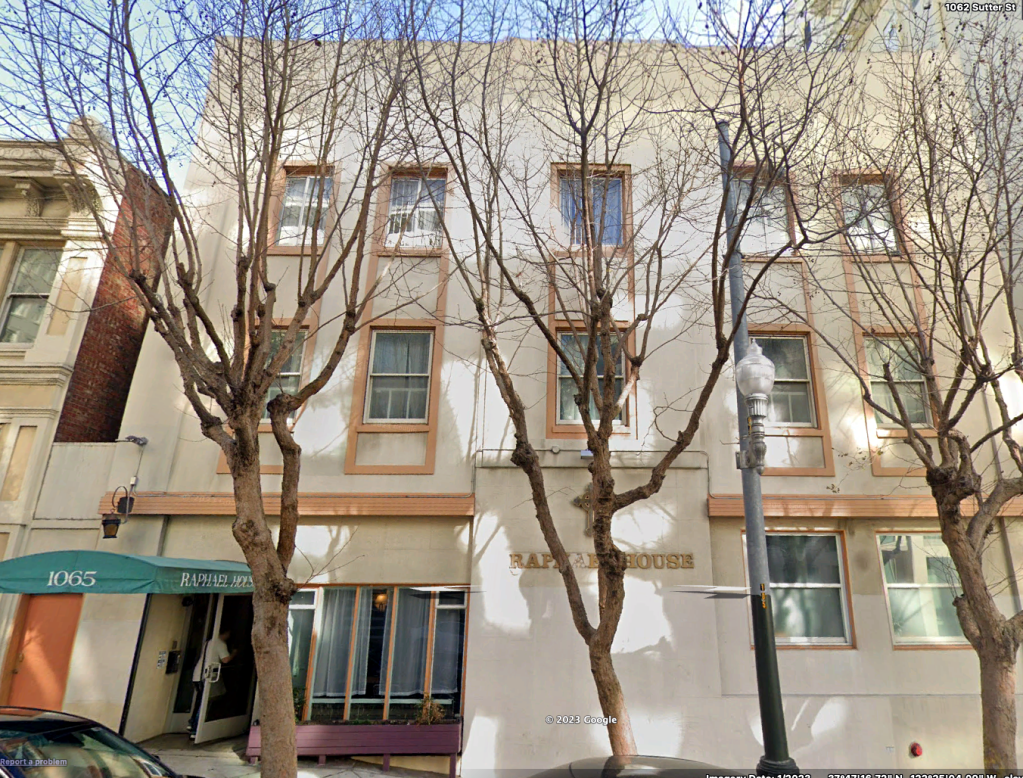
Semnacher pulled up outside Rappe’s home at 504 N. Wilton Place early on Saturday morning, September 3, just before sunrise. Her adoptive aunt, Kate Hardebeck, expressed no concern about the absence of Helen Hansen or that her “niece” might go somewhere alone with a married man regardless of his status as her agent. But Rappe was also Aunt Kate’s employer, the “lady of the house.” So, looking the other way was part of the job. But Rappe reassured Aunt Kate that only a weekend in Selma was planned, so, no worries. And another woman would be joining them before they left Los Angeles.

What didn’t look right was the sight of Rappe packing her bags. “She, for some reason or other took an unusually large supply of clothing,” Hardebeck recalled, “a whole suitcase full.”

“Tootie” was taking far more clothes than needed for a little outing to the Fresno area, as Rappe told her. There this other woman, a Mrs. Delmont, had a home where they would stay overnight on Saturday and Sunday and return some time on Labor Day.

For the long drive, Rappe had pulled on her black boots, silk breeches, as well as the rest of her “riding habit”—which was then in fashion for active young women. Before she skipped down the sidewalk and down steps to Semnacher’s car, Aunt Kate followed with two picnic baskets. These contained thermos bottles of coffee and tea, sandwiches, and other delicacies. When these and the rest of her luggage were stowed, Rappe threw her dog “Jeff” and Aunt Kate kisses good-bye.

Minutes later, in another part of Los Angeles, Semnacher pulled up in front of Delmont’s apartment house around 7:20 in the morning “with Miss Rappe,” as she recalled. After introductions were made, the three boarded the Stutz, with the two women sitting side by side in the back seat as a matter of propriety.

There Rappe and Delmont got to know each better, their voices a little raised to hear each other above the chattering of the motor and the wind through the open sides. At some point, to be a “good fellow” herself, Delmont offered the flask she kept in her purse.

Rappe politely refused.

Semnacher’s inland route north took the recently completed California Highway 4, the precursor of U.S. Route 99 and present-day Interstate 5. By the late summer of 1921, the entire way was concrete-paved and designed for the top speeds of trucks and automobiles or 40 to 50 MPH, respectively. Compared to the slower and longer winding coastal route, Highway 4 was now the preferred way to get to San Francisco in a day.

Highway 4 burrowed through the Newhall Tunnel and then up into the mountains past old Fort Tejon and then on to the oil fields and farmland of Kern County before riding along the Castaic-Tejon Ridge then twisting down to the first major town, Bakersfield. The rest of the way to Fresno traversed the so-called “Garden of the Sun” of California’s prime, irrigated farmland, the San Joaquin Valley, where, to either side of the road, were miles and miles of croplands, producing raisins, grapes, peaches, figs, nuts, olives, oranges, and other crops. The distance between Selma and Los Angeles is a little over 200 miles or almost halfway to San Francisco. The traffic would have been light in the morning, with occasional trucks and horse-drawn wagons, which Semnacher could easily pass in his Stutz, which shared the same engine with the two-seater Bearcat. Even though the first rains of the dry California summer had recently fallen, the weekend weather was expected to be fair with temperatures in the upper 70s.

What was there to do in Selma? On Saturday evenings, the town’s band gave concerts in the park. Tonight’s rather eclectic program included the region’s anthem, the “Raisin King” march, the vocal trio from Verdi’s Attila, a “yodel” song, a scared melody, and the “National Anthem.”

Delmont, however, had a friend in Selma proper, Mrs. Anna L. Portnell. At forty, she was a society woman by Fresno County standards and a member of the Woman’s Relief Corps, a charitable organization for war veterans. She and her husband Jesse lived at 2336 Chandler Street and were negotiating for the purchase of a thirty-acre ranch outside of town. Perhaps much to Rappe’s delight, Mrs. Portnell was also a bridge player.

If Mrs. Portnell expected Delmont and her companions to arrive on Saturday, September 3, or if their visit took her by surprise, it went unreported. We only know what happened from her point of view she took the stand in Arbuckle’s defense in January. Mrs. Portnell recalled taking her visitors sight-seeing around Selma and nearby Kingsburg in her car. During this excursion, Rappe had a crisis.

“Please stop the car if you do not want me to die,” she begged. Then she got out and doubled up. Mrs. Portnell saw Rappe drink “a quantity of dark colored liquid from a gin bottle, claiming it was an herb tea.”

Mrs. Portnell kept the bottle and offered it as evidence, having kept this strange souvenir of Rappe’s visit for nearly five months. Delmont, however, recalled a different Saturday evening.

“Why, Virginia danced for an hour without stopping at my friend’s in Selma, where we spent the night on the way up,” she said in the San Francisco Call. “When the hour was over, she was as fresh as when we started.”

The next day, on Sunday morning, September 4, Semnacher and his companions departed Selma for the drive to San Francisco. He testified on more than one occasion that the trip to Selma had been the only destination and he, Rappe, and Delmont intended to return to Los Angeles. Rappe, however, suggested that they drive on to San Francisco.

Semnacher gave no reason why and various theories began to fill this void. But later, much later, after the first two Arbuckle trials, Delmont, in an interview with the Kansas City Post, said Rappe, on the spur of the moment, thought it would be splendid idea if she could visit her friend Sidi Spreckels in San Francisco. She was a young widow now and had just returned from France with their four-year-old daughter Gertrude to fight for her share of her late husband Jack’s estate. But that wasn’t the only reason that Rappe might want to give comfort to an old girlfriend. Sidi had been under a cloud that loomed over her well before Jack Spreckels died last July. When the couple had their falling out in 1920, Sidi got herself involved with an old acquaintance from her days as a cabaret artiste.

His name was William “Diamond Bill” Barrett, a notorious “soldier of fortune” known for cheating a string of jewelry stores and gullible young women. His most recent exploit, eloping with a Philadelphia heiress, Alice Gordon Drexel, however, didn’t result in any largesse. Her parents refused to underwrite their living together in Paris and forced him to foot the bills. Desperately in need of cash, he went to London and found Sidi in a troubled marriage with an absent husband.

Sidi either fell for his charms or agreed to his latest grift during their brief affair, which she said was purely social. On Barrett’s advice, she entrusted jewels to him worth $125,000 (or $2 million adjusted for inflation). He promised to have the lot appraised and insured—which may have been some sweet revenge on Jack Spreckels, for Sidi gave Barrett her engagement ring and a pearl necklace made by Tiffany’s of London, which she purchased on a line of credit extended to her father-in-law, John Spreckels Sr.

For a time, Barrett lived off selling pieces to pawn shops and second-hand jewelers, one of which tried to sell the pearl necklace back to Tiffany’s. This alerted Scotland Yard and its detectives returned the necklace and a few other pieces to Sidi. Subsequently, Barrett fled to Mexico. As for the only other wronged party, if one excludes Sidi’s late husband, Tiffany’s requested the balance due on the pearl necklace, said to be $80,000. Jack either didn’t or refused to pay for the bauble and, after his death, a suit was filed against his widow to recover the money.

With her legal woes and mounting debts, Sidi was still in the newspapers a year later, not only because she wore very stylish widow’s weeds, but to put her furs, including her precious Russian sables, up for public auction to pay her creditors and keep her penthouse in the Palace Hotel. Although such an event might have attracted Rappe—some of her designs were likely in Sidi’s closet—she could hardly afford to place a bid.

According to Delmont, Rappe dearly wanted to surprise her friend with a telephone call at least. Semnacher acquiesced to the impulsive request. But this this was a special favor. He had to drive an extra 200 miles north. He had to pay for the gasoline and any unforeseen repairs, such as blown tire. He had to travel from Oakland to San Francisco by ferry and arrive late at night—and he was either expected or had offered to cover their expenses. But it wasn’t an inconvenience as to time.

The threesome intended to stay for just one night and then leave San Francisco during the afternoon of Labor Day, returning to Los Angeles via the coastal road (later called California SR 1) through Monterey and on to Del Monte to spend the night—where one of Rappe’s friends was staying, possibly two. Vacationing at Carmel-on-the Sea was only a stone’s throw and vacationing there over the Labor Day holiday and into the following week were Grace Darmond and her lover, Jean Acker, still married to Rudolph Valentino. If Rappe knew of their itinerary, in one great arc, taking her across a broad swath of California, she may have had it mind to see three girlfriends, not one: first Sidi, then Grace and Jean.

Before leaving Selma, Rappe dropped a postcard into a mailbox addressed to Aunt Kate on Sunday morning. It read “having a lovely time” and the change of plans.

“Never having tried to curb Virginia and always trying to make things comfortable for her,” Aunt Kate said, recalling the postcard, “I didn’t feel alarmed and didn’t think it so unusual that she had decided to go to San Francisco.”

Virginia Rappe, 1918 (Nelson Evans)

[1] pp. 000–000: Maude Delmont, qtd. in “Film World Is Rended,” Los Angeles Times, 12 September 1921, I:1; Minta Durfee Arbuckle, “The True Story about My Husband,” Movie Weekly, 24 December 1921, https://www.silentera.com/taylorology/issues/Taylor28.txt; “Wanted EXPERIENCED BEAUTY PARLOUR operator,” Los Angeles Times, 31 August 1919, IV:3; U.S. Census, 1920, California, Los Angeles County, Los Angeles Assembly District 66, ED 262, lines 37–38; “Arbuckle to be Held Pending Probe of Death,” Fresno Morning Republican, 11 September 1921, 1; “B. M. Delmont, “Mrs. Delmont Gives Detailed Account of Rappe Tragedy,” San Francisco Chronicle, 12 September 1921, 4; “Lauds Character of Miss Rappe,” Philadelphia Evening Ledger, 13 September 1921, 2; “Selma Woman Testifies at Actor’s Trial: Mrs. Anne Portwell Tells of a Visit of Party During Trip,” Fresno Morning Republican, 26 January 1922, 1; Ernestine Black, “Arbuckle Dances While Girl Is Dying: Joyous Frolic Amid Death Tragedy,” San Francisco Call, 12 September 1921, 1, 2; Charles Hoke, “Carmel News Notes,” Monterey Cypress and American, 9 September 1921, 3.

[2] Delmont’s sister went by her middle and married name at the time, “Helen Woods.”

[3] “Portions of the statement,” according to the editor of the San Francisco Chronicle, “have been omitted as unfit for publication.”

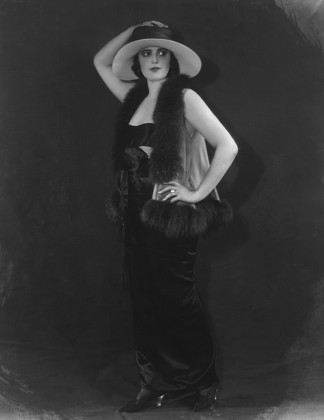
A fashion illustration featuring Virginia Rappe?

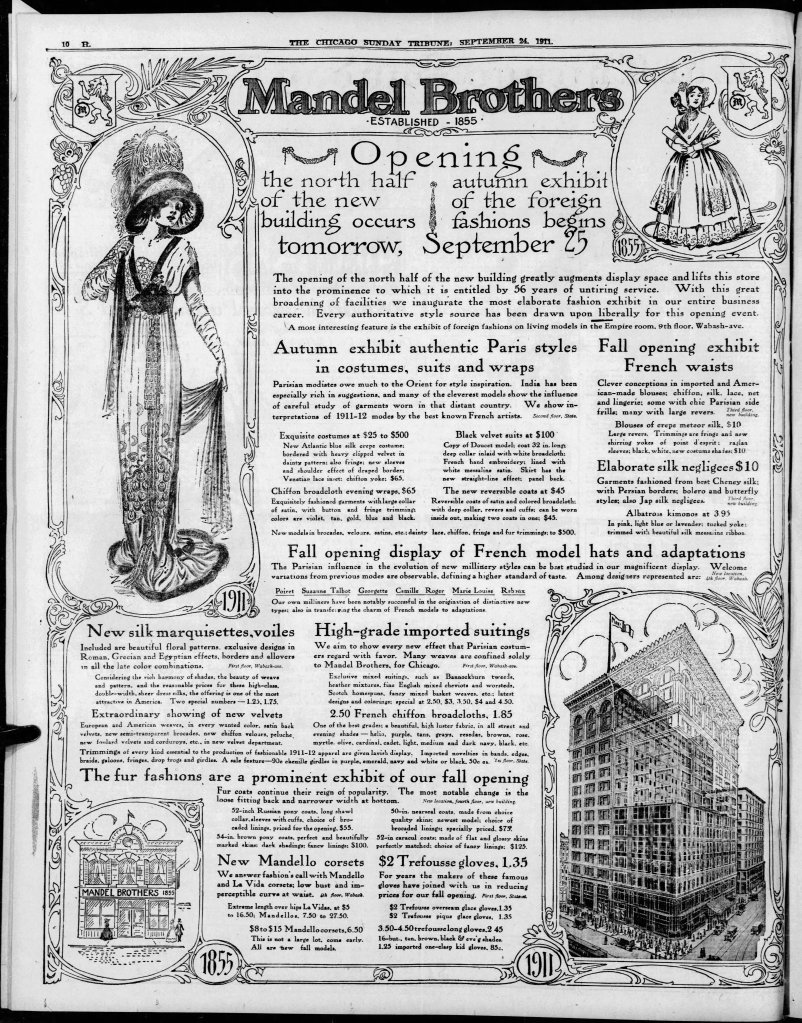
Mrs. Frances Bates served as one of Arbuckle’s defense witnesses in all three trials. Mrs. Bates, a resident of Santa Ana, California, in 1921, had been located by Arbuckle’s personal lawyer, Milton Cohen. She testified that in October 1913, while a sales clerk at Mandel Brothers Department Store in Chicago, she witnessed Virginia Rappe, working as a live model, tear up one of her gowns and going into hysterics, clutching her abdomen, weeping, and so on. She had to be treated in the store hospital.

Such episodes were intended to prove that Rappe had a history of illnesses that resembled what the defense said occurred on September 5, 1921, while she was a guest at a Labor Day party in Arbuckle’s 12th floor suite at the St. Francis Hotel. Milton U’Ren, a prosecutor, however, suspected Mrs. Bates was lying and that she had never crossed paths with Rappe. He eventually procured store records that suggested Mrs. Bates and Miss Rappe weren’t employed by Mandel Brothers at the same time.

In March 1922, at the third trial, U’Ren called William F. De Rose to the stand. He was an assistant superintendent of the department store. He took the stand and shared store records with the jury that showed that Mrs. Bates had worked at Mandel Brothers for a few months between September 1909 and January 1910 before she was let go for insufficient references.

As for Rappe, she had worked between September 1911 and September 1912.

Although Mrs. Bates claimed her signature on the employment forms wasn’t hers, a handwriting expert confirmed that the signature was hers. Her testimony wasn’t stricken from the court record, but it was certainly moot and she potentially could be charged with perjury.

Rappe, however, wasn’t alive to substantiate her employment. In fact, she was in in New York City in the autumn of 1912. But Mandel Brothers did have a significant fashion show of French gowns and Japanese-inspired kimonos to inaugurate a new wing of the store with an expanded women’s department. We wondered if there was any graphical evidence of Rappe’s modeling work. It’s hard to say, but there is one illustration that could be based on Rappe. She had a certain beauty that obviously worked well for pen-and-ink fashion illustrators of the day. But it’s all in the eye of the beholder.

Full-page ad for Mandel Brothers, September 1911 (Newspapers.com)

A passage from the epilogue in which we introduce one last “character”

Our epilogue follows the lives and fates of the various “players” in the Arbuckle case. There are a few happy endings. Zey Prevost got married and lived an uneventful life. But most are rather tragic. Alice Blake died in a car wreck. Al Semnacher’s career was effectively over and he died of a heart attack a year after the trial. He was followed by Rappe’s “Uncle Joe” Hardebeck, who locked himself in his bathroom and shot himself. Maude Delmont lived as a recluse in Southern California under her maiden name. And so on.

There is almost an Arbuckle curse. But most of the epilogue is a survey of Arbuckle’s life after he was acquitted and it begins with this novel way of looking at the abortive attempt to reinstate the comedian and an “exposé” that was very much believable in regard to Arbuckle’s conduct.

Most books about the Arbuckle case—and those that devote chapters to it, like William J. Mann’s Tinseltown—seem to treat the resistance to Arbuckle’ return with disdain, as if they were nothing but “church ladies” to use Mann’s term for a very diverse group of women. Such writers assume that the majority of Americans wanted to see Arbuckle on screen again. What is more evident is that they didn’t care. They didn’t miss him. And one has to consider, in all fairness, that letting Arbuckle out of his box required real denial.


On December 20, 1922, Will H. Hays, while in Los Angeles, issued a statement in the Yuletide spirit. He intended to pardon the comedian, reinstate him as a film actor, and eventually lift the ban on his films. Arbuckle welcomed the news and expressed his gratitude. Naturally, he felt he deserved such Christian charity and, as yet, no one had noticed that for all those weeks and months since September 1921, no one observed him “darken the door” of any congregation. He had long ago maintained the separation of church and stage.

The blowback from clergymen was swift. They felt Hays should have consulted them. The Women’s Club of Hollywood, the National Committee for Better Films and the National Federation of Women’s Clubs demanded that Hays to take his Christmas gift back. The Rev. Dr. Wilbur Crafts surely knew of this outrage. But his voice was silenced by his untimely death “after a shockingly brief illness,” according to one Washington newspaper mourning his loss to the cause of the suppression of immorality.

The mayor of Los Angeles, who understood the lingering “disgust” for the debauchery revealed in People vs. Arbuckle, telegrammed Hays as he distanced himself from the controversy, en route to his home in Sullivan, Indiana. By the time he arrived, he had stacks of such wires from other mayors and every kind of prominent citizen. He now had to deal with the fact that Arbuckle’s innocence was never wholly accepted in Hollywood and his preexisting reputation never went away, even in the film colony, many of whom saw the comedian as liability.

Indeed, Hays proved to be remarkably tone-deaf to the real situation, made all the more real by the inopportune federal indictment in Los Angeles of one Ed Roberts a few days before Hays arrived on December 13, waxing with bonhomie and compassion for such artists as Wallace Reid and Roscoe Arbuckle.

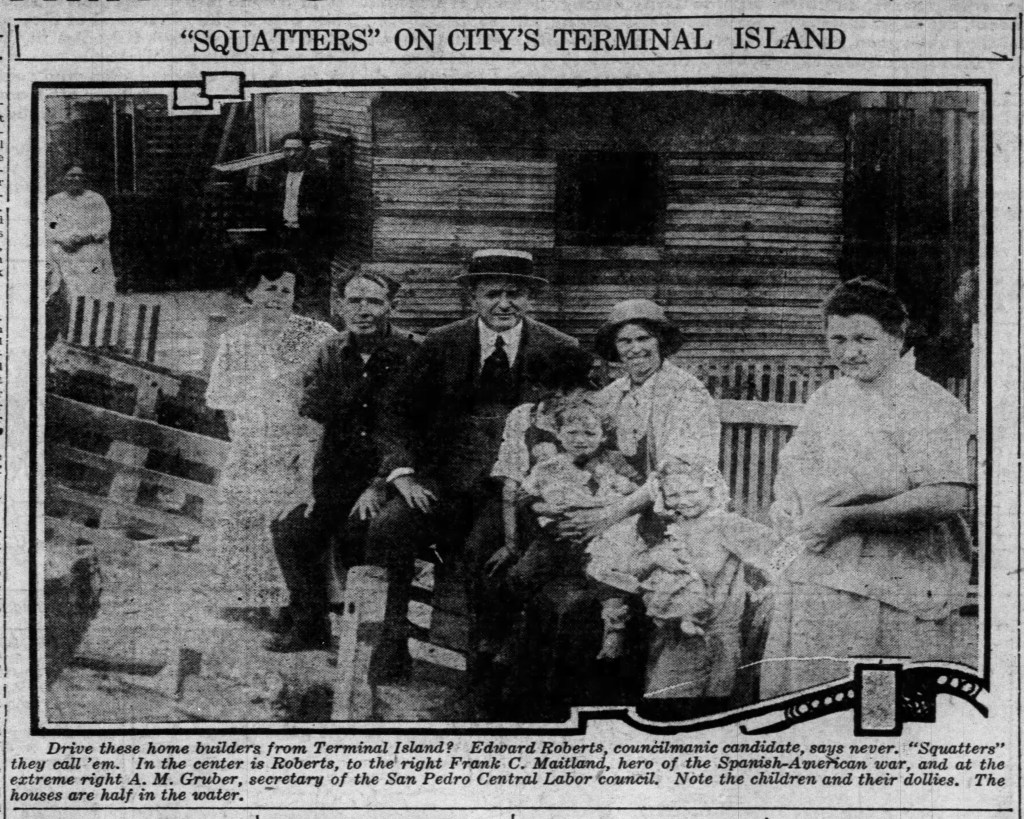
Roberts, who managed such two film magazines, it and the Motion Picture Magazine of Joy, was also a spokesperson for the Affiliated Motion Picture Interests. This organization, which included the late William Desmond Taylor on its board, represented not only producers but rank-and-file actors, workers, and other employees of the motion picture industry and flourished until it ceded its mission—to disassociate its members from the industry’s black sheep—to Hays and the Motion Picture Producers and Distributors of America. Roberts was also a political activist in Los Angeles. He headed the Tenants Protective Association and sought the arrest of landlords whom he considered “rent-profiteers” and backed a citywide rent strike. He also organized the resistance to evict the so-called “squatter” families on Terminal Island and ran an unsuccessful campaign for city council on platform against blue laws and censorship. In other words, he wasn’t afraid of being controversial or contradictory.

Before the third Arbuckle trial began in March and before Hays took the reins of the MPPDA, Roberts put the finishing touches on The Sins of Hollywood, an eighty-page pamphlet published anonymously in May. In his introduction, piquantly dated April 1, 1922, Roberts stated, “Eight months before the crash that culminated in the Arbuckle cataclysm, they knew the kind of parties Roscoe was giving—and some of them were glad to participate in them—”

In October 1921, weeks before the first Arbuckle trial, Matthew Brady had come to Los Angeles on a fact-finding mission to learn first-hand about such gatherings. That he may have spoken to Roberts or those who could vouch for his veracity is unknown. But ultimately Brady agreed with Gavin McNab not to resort to such character defamation and thus tied a hand behind the prosecution’s back.

Copies of The Sins of Hollywood were scarce and it never saw anything like a national distribution. Even so, a deputy U.S. attorney in Los Angeles branded the book as “scurrilous” and the city’s chief post office inspector promised to ban the book from the mails as well as find and prosecute the author. In any event, someone with influence, someone in the motion picture industry, saw the book, saw that it sent the wrong message with Will Hays in place, and complained—perhaps all the way up to Hays himself.

Roberts was hardly graphic. But he was a good writer and knew how to be shamelessly suggestive in describing the party and sex subculture of Hollywood. His real offense was that he made it very easy to guess the names of the actors and actresses whose names he barely disguised along with their transgressions. “Jack” was Mack Sennett. “Molly” was Mabel Normand. The 1916 love triangle between her, Sennett, and Mae Busch and the “battle royale” between the two actresses wasn’t hard to miss. “Walter,” the dope fiend, was Wallace Reid. “Adolpho” was obviously Rudolph Valentino and “Rostrand” was Roscoe Arbuckle.

Recall that Virginia Rappe said, before she took the elevator up to twelfth floor of the St. Francis Hotel, that she hoped Arbuckle’s party wasn’t a “bloomer”—a disappointment. Did she expect something like the following entertainment, the arousal, the bad taste? “Not so long ago a certain popular young actress returned from a trip,” Roberts began.

She had been away for ten days. Her friends felt that their ought to be a special welcome awaiting her. Rostrand, a famous comedian; decided to stage another of his unusual affairs. He rented ten rooms on the top floor of a large exclusive hotel and only guests who had the proper invitations were admitted.

After all of the guests—male and female—were seated, a female dog was led out into the middle of the largest room. Then a male dog was brought in. A dignified man in clerical garb stepped forward and with all due solemnity performed a marriage ceremony for the dogs.

It was a decided hit. The guests laughed and applauded heartily and the comedian was called a genius. Which fact pleased him immensely. But the “best” was yet to come.

The dogs were unleashed. There before the assembled and unblushing young girls and their male escorts was enacted an unspeakable scene. Even truth cannot justify the publication of such details. (p. 74)

In late July, Hays traveled to Los Angeles and couldn’t avoid The Sins of Hollywood, with its lurid red Mephistopheles and his camera on a startled flapper and her beau. A respected Los Angeles minister handed him a copy at the behest of the author. Hays was appalled but he didn’t change his message before an enormous crowd that filled the new Hollywood Bowl. Hays had cover for the motion picture industry and declared, “The one bad influence in Hollywood is talk. And for the life of me I cannot see the horrors of Hollywood.”

In mid-December, Ed Roberts was finally identified as the author and indicted by a federal grand jury for having distributed over 10,000 copies of The Sins of Hollywood. For Hays, who only wanted to play Santa Clause for Arbuckle, an overzealous federal prosecutor had, perhaps, presented him with a very inopportune gift, ill-timed given the Arbuckle pardon. Indeed, the ministers and clubwomen who swore by Roberts would want Hays to act more like a moral policeman.

In the end, two of the latter put up the bail of $5,000—and Roberts said that he could name names and substantiate every one of his salacious claims, such that federal investigators wanted his cooperation in busting a dope ring. With the new year, Robert’ trial was postponed and eventually disappeared from the federal docket.

Notice that the girl is depicted in her undergarments (i.e., a teddy). (Internet Archive)

Although Ed Roberts had no real shot at a seat on the LA City Council, the Los Angeles Record endorsed his candidacy and published this photograph in May 1921. (Newspapers.com)

Update: The photo insert . . .

. . .  is no less a work-in-progress for Spite Work. Procuring rare contemporary photographs of the various personages in the case of Virginia Rappe and Roscoe Arbuckle requires constant vigilance, especially now as we prepare a manuscript for potential publishers. That said, we still hope to find the impossible, such as illustration art for which Rappe modeled.

We also search for rarer images of Rappe’s mother, Mabel Rapp.

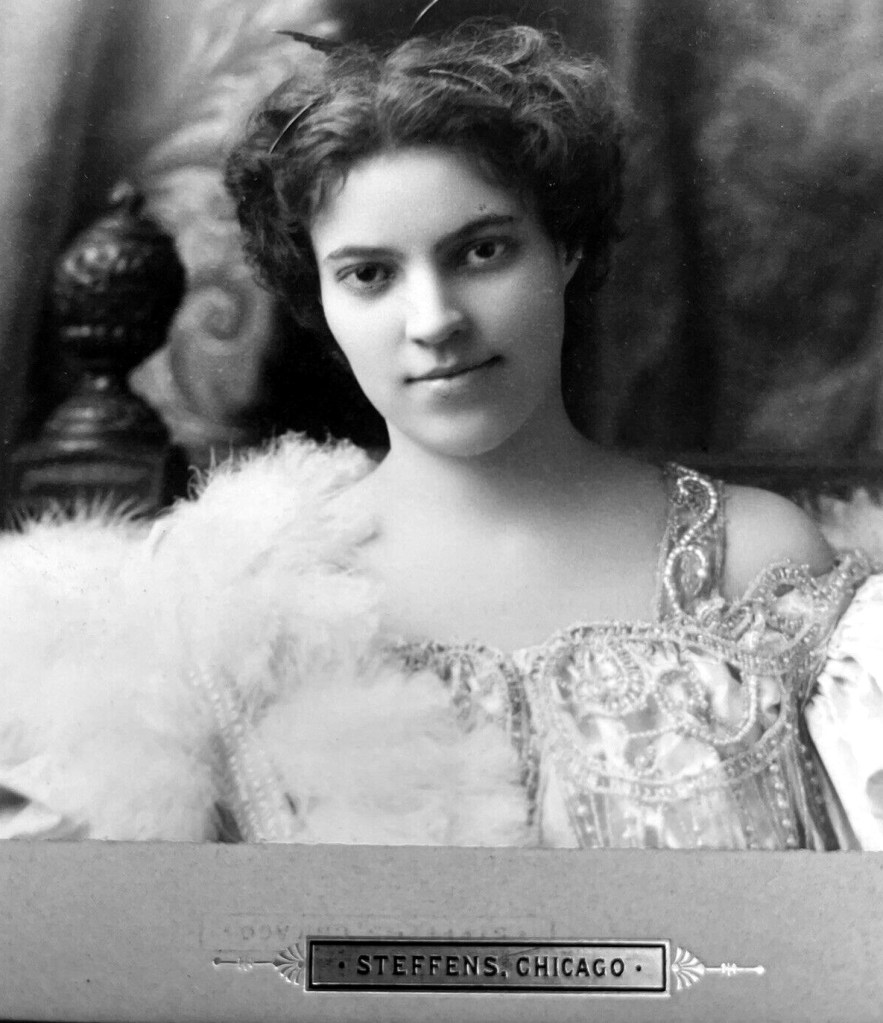
We know that she posed for the Chicago photographer Matthew “Commodore” Steffens during the 1890s, especially around the time of the Columbian Exposition of 1893. He used her cabinet cards, which he displayed in his studio window, as samples of his talent—and her beauty.

A few possibilities have come to light, including images from the same period taken at other studios. But the detective work has to be conclusive. We only share these because Mabel (and her daughter) could have some resemblance or fit the context.

Mabel Rapp? We only know that she, too, will be an anonymous Chicago
beauty in a similar pose and found with a Steffens stamp.
Rappesque? An unidentified “mother and child” looking at other cabinet cards.

More recent acquisitions are rare too, especially for minor and peripheral figures in the Arbuckle case. But news photos always have the identity and caption supplied on the reverse. The only doubt is whether to use them or another.

Minnie Neighbors, a witness for the defense. She claimed to have discovered Rappe in a way curiously not unlike Arbuckle did in his trial testimony. Mrs. Neighbors testified that she cared for Rappe after finding her doubled up in pain on a bathroom floor at Wheeler Hot Springs just weeks before the events of Labor Day 1921. Eventually, Neighbors found herself arrested for perjury. We provide a fairly detailed account of her sideshow in our book.

Minnie Neighbors. This news photo wasn’t used. Here she is too young
and her matronly appearance, intended for a jury, just isn’t “there.”

Although the San Francisco District Attorney wanted Arbuckle charged with murder for the death of Virginia Rappe, he had to be satisfied with manslaughter. The judge who decided on the lesser charge was San Francisco Police Judge Sylvain Lazarus.

The photograph below is from the mid-1920s, when Judge Lazarus was seen as a real “character” for his way of injecting comedy into his courtroom. He certainly did so in the preliminary investigation into Rappe’s death, which took place in late September 1921. The transcripts of this proceeding are the
only ones to survive. Although Lazarus had yet to install a photograph in his court room, he did so in January 1922, while the second Arbuckle trial was in session. Perhaps some of its spectators could hear from afar “Hail! Hail! The Gang’s All Here” and other recordings that complemented the judge’s docket.

Sylvain Lazarus, a judge and master-of-ceremonies in one person.

This is a relatively new image of Arbuckle’s lead counsel Gavin McNab during the three trials. This one betrays his height, dignity, and rather menacing demeanor when facing the comedian’s prosecutors, who were both a head shorter if not more.

The glowering Gavin McNab, who pulled Fatty out of the fire.

If any of our readers have photographs to share, we are both receptive and grateful.

Vamps! Fitting a bête noire of the motion picture industry into a work-in-progress

The following passage is from our work-in-progress. It is a preamble to a section titled “Fatty’s in Town” and introduces a person—a caricature really—found in William J. Mann’s bestselling Tinseltown (2014), an entertaining book about the unsolved murder of the actor and director William Desmond Taylor, which occurred two days before the second Arbuckle trial ended in a hung jury. Although Mann misidentifies the Rev. Dr. Wilbur Crafts as the leader of the Lord’s Day Alliance—who, for the record, was Rev. Harry L. Bowlby—Crafts did play a role in the crusade to regulate motion picture content.

In 1895, Crafts and his wife, Sara Jane Crafts, founded the International Reform Bureau in Washington, D.C. as a platform from which to lobby on behalf of Christian values. Over the years, they were primarily concerned with temperance, though also campaigned against smoking, gambling, drugs, divorce, and the Ku Klux Klan. They also lobbied for suffrage and the education of children. Late in his career, after the 21st Amendment (Prohibition) was passed, Dr. Crafts turned his attention to Hollywood.

Mann describes Crafts as Adolph Zukor’s bête noire. That designation gives Crafts too much credit, Zukor, the president of Famous Players-Lasky/Paramount, the biggest studio in Hollywood, wasn’t so easily intimidated, and this self-appointed crusader didn’t have the political muscle to force a change. Crafts’s campaigns against Hollywood did make the news though and Zukor didn’t ignore the message. He sensed that a change would soon be needed to protect the industry from government interference.

service-pnp-hec-30500-30501v

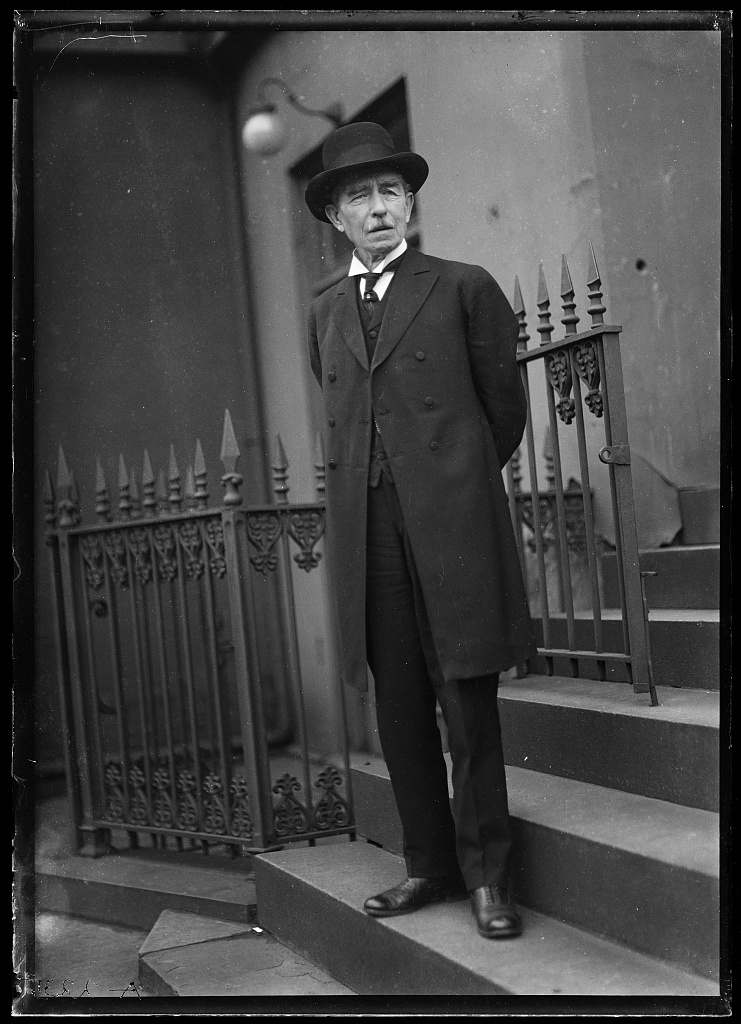
Rev. Dr. Wilbur F. Crafts (Library of Congress)


Fatty’s in Town

The Rev. Dr. Wilbur Fisk Crafts, superintendent of the International Reform Bureau, virtually anticipated the arrival of Virginia Rappe and Roscoe Arbuckle. The great man went to San Francisco for its lifestyle and to save people like themselves from themselves.

Dr. Crafts was the veteran of many hard campaigns to establish blue laws throughout the United States and the Volstead Act. Indeed, the old gentleman with his trim gray beard and mustache considered Prohibition a lifetime achievement. Then he embarked on a renewed campaign—to regulate the offensive content of motion pictures, including the posters outside theaters.

Such activism brought in the donations that funded the Reform Bureau and Dr. Crafts now had the time to take on the motion picture industry in earnest. In 1916 he had lobbied the House Committee on Education for a federal censorship of motion pictures. But Mutual and other studios had better lobbyists and Wilbur was frustrated. He also wanted to ban newsreels of boxing matches, not only for their violence but the way they incited race hatred when the bout was between Jack Johnson and a white boxer. Then, between Thanksgiving and Christmas 1920—and in recognition of the tercentennial of the Mayflower landing—the man of faith forced himself to attend one motion picture after another in the theaters of Washington, D.C. and came away appalled by the “criminal and vicious tendencies” he witnessed firsthand, and the “sex thrill” taking the place of the “alcoholic kick.”

The depictions of women and their effect on young people were particularly offensive. “I would rather have my son stand at a bar,” he said, “and drink two glasses of beer than have him see the vampire woman that I saw. He may get over the effects of the beer in a week, but he could not forget that vampire woman until he was eighty years old.”

Dr. Crafts promised to rescue “rescue the motion pictures from the Devil and 500 un-Chrisitan Jews.” Then he came to many of the latter in the motion picture capital of the world, Los Angeles, in April 1921. There, he would speak to studio executives about the need “to reform and uplift the character of film productions” and to sell his idea of an interstate motion picture commission, which entailed hiring devoted men and women like himself. But he only met with one producer, Benjamin B. Hampton, whose westerns didn’t have any vamps. Then Crafts boarded a train for San Francisco.

He had two objectives. First, to protest the showing of a new film, Fate (1921). Its ingenue star, Clara Smith Hamon, was seen as exploiting the story of her life as the teenage mistress of the late Jake Hamon, the Oklahoma oilman—and friend of President Warren Harding—whom she had killed in self-defense, a plea her lawyers cleverly used to beat a murder charge. Second, Dr. Crafts intended to establish a branch of the Anti-Saloon League in the “wickedest and wettest” city in the nation and launch a campaign to “clean up” San Francisco to be launched in the fall of 1921. And here Dr. Crafts met his real match—modern women—a “pernicious evil.”

“Women of today have only two objects in life,” he said to the San Francisco Examiner,

to vamp and be vamped. We intend to change that [. . .] The only way to keep the girls of today straight is to make them fear the consequences of wrongdoing. There is no such thing as a prodigal daughter, and there shouldn’t be.

He went on. A certain leniency toward the “fallen woman” was not just a grave mistake, it was criminal. Crafts didn’t like “movie queens,” the “chic” and “baby doll” type on the cover of so many magazines and now everywhere in every American city. He preferred the pert breasts and arm freedom of the Venus de Milo—this even though the man of the cloth a month earlier decried a nude statue by Charles Cary Ramsey in New York for not being draped enough). But many clubwomen were no less appalled by his obvious misogyny and the mischaracterization of their city.

“Contempt is the proper spirit in which to treat such utterances as Crafts is quote as making,” said Mrs. Frank G. Laws, president of the California Civic League. Mrs. Carrie Hoyt, a Berkeley feminist and political worker, was more vocal. I think it is a crime for a man to make such statements as he is quoted as saying,” she said in the Oakland Tribune.

What he needs is a deputation of California women to demonstrate to him that they neither have time nor inclination to “vamp or be vamped.” He needs to be shown what manner of women we of the west are. [. . .] A man has no right to come and advertise to the world that San Francisco is the wickedest city of the nation. We are not so wicked as many other cities. What vice we have is not hid. Our women may go anywhere they please and if the go right, they are not insulted.

There was no deputation. Dr. Crafts initiative against motion pictures, pretty young women, and San Francisco faded away. The Zeitgeist that made the city such an attractive destination for sinners, especially the sinners of the film colony in Los Angeles, who opened their arms to him, or so he thought, were glad to see their gadfly gone. Dr. Crafts spoiled no one’s fun for the time being and the prodigal daughters of San Francisco awaited.

* * *

Arbuckle and his companions, the director Fred Fishback and the actor Lowell Sherman, set out from Los Angeles on Friday, September 2,  [to be continued ]


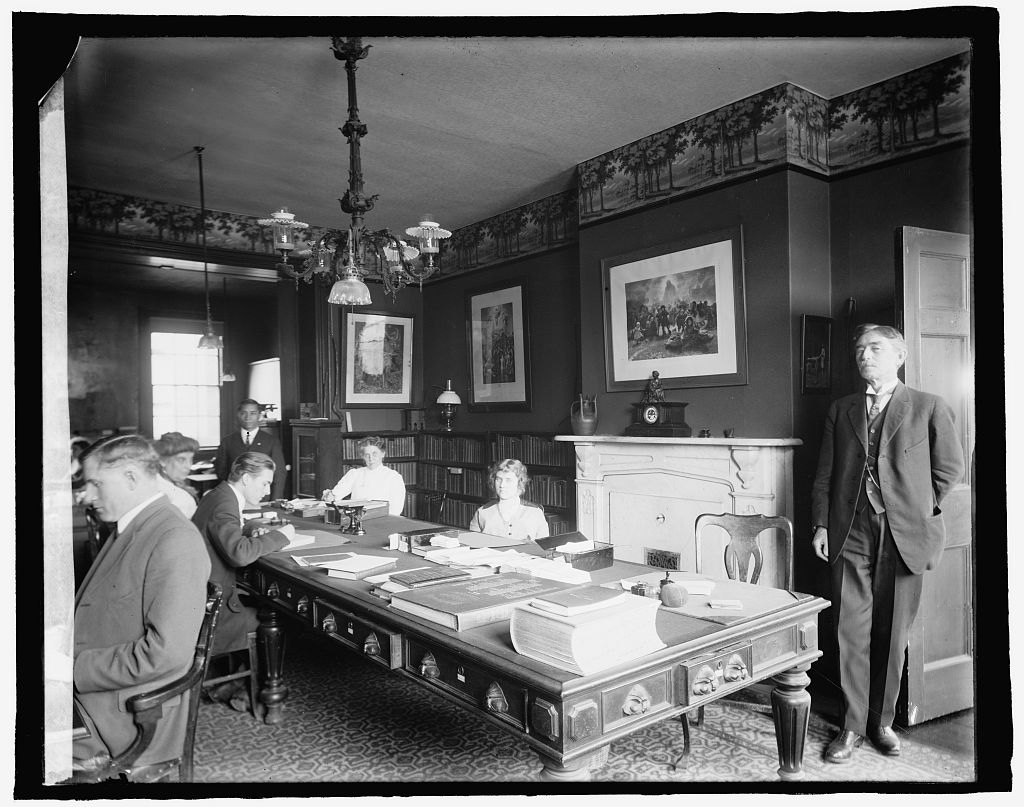
service-pnp-npcc-31600-31661vThe Rev. Dr. Crafts and the staff of the International Reform Bureau. The African American man in the background ran the organization’s printing press. (Library of Congress)
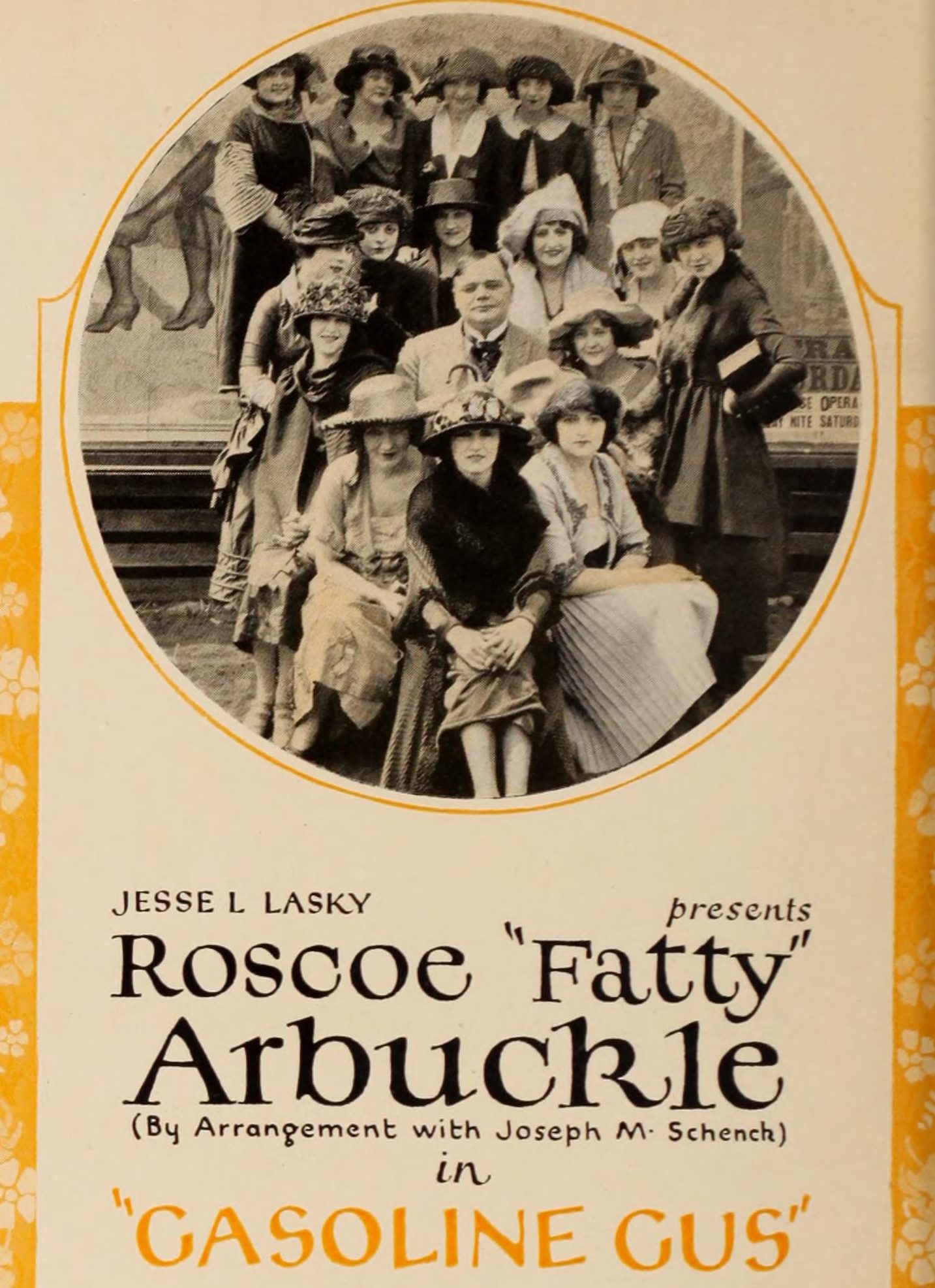
Did Virginia Rappe “help” cancel Arbuckle?

What was always difficult to reconcile about Zukor in his lifelong quest for greatness was his intractable moral authority,
which he evidently identified with the genteel, and his lust for power, which was anything but genteel.

—Neal Gabler, An Empire of Their Own: How the Jews Invented Hollywood

When I see myself on film, I can’t laugh from the heart. There is always too much that’s disturbing [. . .]

—Roscoe Arbuckle, “Fatty über sich selbst,” Kino-Journal, 1923

As another thought experiment for our work-in-progress, we considered the factors that led Adolph Zukor of Paramount Picturesand Famous Players–Lasky Company, to cancel the release of three finished Arbuckle motion pictures. 

In the wake of Arbuckle’s acquittal for having caused the death of Virginia Rappe on April 12, 1922, the press began to quote Zukor and Arbuckle’s manager, Joseph Schenck, that the three Arbuckle films that had been withdrawn when the scandal erupted in September 1921 would soon be released to American theaters. In the case of the New Garrick Theater in Los Angeles, posters were ready to go up overnight.

But within days, that decision was reversed. A permanent ban was announced by Will H. Hays, the new chairman of the Motion Picture Producers and Distributors of America. It was done at the behest of Zukor, according to Hays’ autobiography, and it was a business decision that Zukor made without much resistance from his partner Jesse Lasky and other stakeholders in the comedian. To abandon three completed films ready for release at a time when Arbuckle films were earning millions at the box office sounds counterintuitive, but as it will become clear, Zukor was no fool.

One of these films, Gasoline Gus, was to usher in Paramount Week on September 4, a week of major new releases that began at the start of the Labor Day weekend. Zukor, as president of the studio, counted on actors and actresses, especially those in California and New York City, to make themselves available for personal appearances.

Arbuckle, possibly feeling he had earned a reprieve from the publicity campaign, didn’t appear at Grauman’s Million Dollar Theater in downtown Los Angeles for the world premiere of Gasoline Gus. Instead, he hosted two private partiesin his San Francisco hotel suite. The first was on Sunday, September 4, a more sedate affair, and the next day, Labor Day, September 5, an all-day affair that promised food, alcoholic beverages, and young showgirls from San Francisco’s demimonde.

Arbuckle had arrived in San Francisco on September 3 and, given his testimony from his first and third manslaughter trials, he had a purpose in mind. The first was to test out a new car on a long-distance journey. But his famous Pierce-Arrow was hardly new. He had taken delivery of it a year earlier. He changed his story. He was in San Francisco to meet up with a catered dinner cruise aboard the SS Harvard on its voyage to Los Angeles, a cruise that was loosely tied to Paramount Week. Arbuckle claimed he purchased his tickets soon after he took his rooms at the St. Francis Hotel. But in a cross-examination, he had yet another itinerary. Arbuckle wanted to drive on from San Francisco on September 6 to attend the California State Golf Championship, which began that week in Del Monte. 

Had Virginia Rappe not fallen ill at his Labor Day party, she would have been in Del Monte a day ahead of him. But Arbuckle did sail on the SS Harvard along with his automobile prominently parked on the promenade deck. He made no public appearances in Los Angeles during the rest of the week. However he did make it to Grauman’s theater by Friday night, September 9, for an emergency meeting in Sid Grauman’s office. The news had broken that morning that Rappe had died and there was a need to meet with his lawyer and the other men who attended the ill-fated party to decide how to approach the matter.

The Arbuckle case soon began to make headlines and Gasoline Gus was withdrawn as were Freight Prepaid and Leap Year, which still had working titles and release dates in the future. All three were longer, romantic comedies and, for Arbuckle, a departure from his energetic “Fatty” character. There would still be a fat man, still be some physical comedy. But now the comedy was built on gags related to a philandering man and his pursuit of young women. Naturally, he would eventually marry the girl. This had been a common theme of his comedies from 1920, after he parted ways with Buster Keaton.

Meanwhile, the September 1921 issue of Photoplay hit the stands. One of the feature articles took on a whole new meaning. Adela Rogers St. John and Arbuckle collaborated on an interview, “Love Confessions of a Fat Man,” a publicity piece to display his intelligence and sophistication which we featured in an earlier blog post). The photograph that went with this piece, which was published in depicted Arbuckle with his hair combed over, looking up, as though into a woman’s eyes, as though he might present her with an engagement ring. Another photograph, that was published in trade magazines aimed at motion picture distributors and theater owners, showed Arbuckle surrounded by young women, not as a clownish innocent but as a ladies’ man.

Roscoe Arbuckle’s rakish image in “Love Confessions of a Fat Man” (Lantern)
Arbuckle in his element? (Lantern)

We looked at this new, carefully crafted, image that was folded into the real person accused of murder at an “orgy” in the St. Francis Hotel, whose indiscretions threatened an entire industry. The sudden change of Arbuckle’s public persona from light to dark is the one obvious reason for Adolph Zukor to withdraw his motion pictures and disassociate Arbuckle from Paramount entirely. Though the comedian had been handed an unprecedented apology from the jurors for what the prosecutors had done to his reputation, the gesture was wasted on Zukor. 

This brings us back to Will Hays. Zukor and his peers felt it was necessary that Hays be seen as an authority to be feared. Hays was to police the content of movies as well as the personal lives of actors. That he was essentially an employee of Adolph Zukor didn’t mean that he was subservient. Zukor delegated responsibility and Hays provided the proper image and insight to not only manage the morality of Hollywood but promote its image among the various women’s clubs and religious communities across the country. He was a church deacon from Indiana and , as such, he was the antidote for any blatant (or latent) antisemitism that might be felt toward the men who ran the studios. 

The timing of Arbuckle’s trials couldn’t have been worse. Hollywood scandals in one form or another had been mounting and concerns were growing among politicians and investors that it was an industry getting out of hand. The need for a powerful spokesperson had become obvious. So when Hays was hired, he needed to set an example and Arbuckle served that purpose. Hays knew that a large contingent of American pastors and clubwomen weren’t happy with the acquittal. They had to be appeased—but it wasn’t to honor the memory of Virginia Rappe. Though she was the victim, she was also seen as a symbol of Hollywood’s immorality. The prosecutors didn’t succeed in their effort to present her as a sympathetic and innocent victim. As one doctor said, she had the sexual organs of a “married woman”—a euphemism meaning she wasn’t a virgin.

In Arbuckle’s eyes, Rappe was the antithesis to the roles played by his recent co-stars, like Lila Lee and Mary Thurman. Rappe, like the other women at the Labor Day party, was attainable, consumable, and off-screen, where making eyes, honeymoons, flirting, and a little spooning wasn’t consummation, but rather coitus. Rappe may not have realized that her status changed the moment she walked into the Arbuckle suite. She was undoubtedly there to get back on-screen. But off-, she was a creature of other possibilities not limited to talking and dancing with her host, possibilities the other young women at the party were expected to service. Rappe also had to know she had as good a chance as any of being Arbuckle’s girlfriend, with all its rewards, even being the next Mrs. Arbuckle, since his publicity as this eligible bachelor might need to be grounded in fact one day. 

While his career may have required that he stick with the body-shaming moniker “Fatty,” Arbuckle had contemplated losing weight. He was also no longer directing his own films. His past specialty, the frenetic succession of dazzling, often acrobatic, sight gags, appealed to all ages. But audiences were becoming more sophisticated and wanted to see longer films, five to six reels, and the sweet, naïve, fat boy character was aging well enough, the boy had to grow up and Arbuckle knew it. Scripts and direction were being handed specialists, like the seasoned director James Cruze, whose work on the latest Arbuckle vehicles was intended to keep the comedian a close second to Charlie Chaplin, whose latest film, The Kid (1921), was the bar to meet, and ahead of Keaton, Harold Lloyd, and other rivals.

Then there was the growing perception that Arbuckle’s work in 1921 suffered from uneven quality. This had to trouble Paramount’s executives, all the way up to Adolph Zukor in his Manhattan skyscraper. In speculating what Arbuckle and Rappe might have talked about if they talked shop during the early afternoon of September 5, she had to be aware of the comedian’s immediate situation. She had a good source of information: her manager, Al Semnacher, who drove her to San Francisco. He was a veteran press agent and knew Arbuckle was getting panned on a regular basis. The Dollar a Year Man (1921) was called a “dismal effort,” “hokum,” “weak humor,” and so on in Motion Picture News for weeks in the spring. Theater owners said it fell short of fans’ expectations. Ticket sales were off. The Traveling Salesman (1921), which didn’t have the slapstick and chase scenes, made up for this lapse. But Arbuckle, in Crazy to Marry (1921), according to Wid’s Daily in early August, opined that he “seemed to be getting away from the sort of stories necessary to make his five-reel comedy offerings go over the way they should.” There wasn’t “sufficient genuine comedy” to make the laughs consistent or frequent enough. Such an overview cast a pall on everything. It didn’t bode well for the future, when his contract came up for review.

Arbuckle’s next film, had the Labor Day party not ended the way it did, was to have been Thirty Days, after a popular 1915 Broadway play. This was Jesse Lasky’s project, to be directed by Cruze. Arbuckle would have played a character in keeping with the new image, this composite of on- and off-screen—a wealthy, young society lion. But, in Thirty Days, his philandering becomes the central plot driver. The thirty days was a probation period requested by his fiancé, to be played by Wanda Hawley, in which Arbuckle’s character would work alongside her in a settlement house. The role might have opened opportunities for dramatic roles. Unfortunately, his ongoing trials forced Lasky to cast Wallace Reid, a true dramatic lead with an athletic build. Reid managed to play the comedic role but without Arbuckle’s deft touch. Thirty Days (1922) would be his last film, but not because it was panned. Reid had a morphine addiction that resulted in his death in January 1923—yet another problem for Paramount to contend with.

That same month, songwriter and theater owner Arthur Hammerstein offered a million dollars for the last three completed Arbuckle films—Gasoline GusFreight Prepaid, and Leap Year—but Zukor refused. Gasoline Gus had proved itself during its aborted run in late August/early September 1921 and for a brief run in April 1922. In the January 1922 issue of Paramount Pep, a special west coast representative M. H. Lewis reported screening Freight Prepaid. He called it Arbuckle’s “best picture since Brewster’s Millions.” But he cautioned that this would be the case “under ordinary circumstances.” He noted it would be a “knockout” in event of an acquittal. A film about Arbuckle and Lila Lee as newlyweds on a boxcar honeymoon was, to the Paramount stringer, a “great comedy” and “absolutely clean [. . .] Mr. Lasky deserves great credit for uniform high-quality present and future releases.”

Despite the glowing endorsement from inside Paramount, Freight Prepaid (1922) was only released in 1923 in France, Germany, and other European countries. The titles, unlike the intended American releases, almost always included the inescapable “Fatty.” A handful of other Arbuckle vehicles, both released or unreleased, were also exported. So, if Americans traveling in Europe during the Roaring Twenties weren’t discomfited by, say, the German, they could have seen Gasoline Gus as Der Benzinkönig. But comedy aside, part of the experience of seeing these films was what Hays and Zukor didn’t want: to feed a kind of morbid fascination in a man’s downfall. Hays was there for the moral argument and Zukor the law of diminishing returns, for a large proportion of Arbuckle’s audience would walk away once they had enough of his train wreck. 

To the Weimar film journalist Egon Jacobsohn, writing in his aptly titled magazine Filmhölle (Film Hell) after the second trial’s hung jury of ten to two for conviction in February 1922, the lust murder dynamic of Arbuckle’s case was a given. Rappe was perceived as the victim of a rape (“Notzucht”), a sex killer (“Lustmörder”) by the lack of proof itself that by the same token made him an innocent bystander, a victim of circumstances.

“Fatty is already finished,” Jacobsohn observed from Berlin. “American motion picture audiences are shouting we don’t want to have to watch a murderer! Every comedy in which Fatty appears lies unexploited, like garbage. Even if he is acquitted, if his innocence is proven: Fatty, the beloved movie star, is dead, remains dead!” Zukor didn’t need this prophetic pronouncement from abroad. He could be on the same page of Filmhölle—which he could read in the original—the moment Arbuckle turned himself into police. Other stakeholders held out hope and a lot of money was spent to defend the comedian.

French and German posters for the export version of Fast Freight (1922),
which didn’t need a train wreck scene but it did need a scarlet lady.

Nothing would shake Zukor from sitting on Arbuckle’s films. Even the classic Keystone shorts with Mabel Normand, which still got laughs in 10-cent movie houses, were pulled from distribution after a few trial runs. In December 1922, Hays lifted the ban to at least allow Arbuckle the opportunity to work behind the camera rather than in front of it. But the films remained in their cans.

So, was this a marketing decision on Zukor’s part? Milton U’Ren grandstanded repeatedly during jury selection that Arbuckle was washed up in November 1921. Since assistant district attorneys aren’t film critics but rather the “bad cops” of their high-toned district attorneys—we had to consider whether U’Ren had evidence of his claim, that Arbuckle’s popularity was declining. Was he just predisposing the jury to view Arbuckle as a decadent entitled has-been? U’Ren’s animus toward Arbuckle probably began the night Arbuckle turned himself into police. Arbuckle was evasive in answering his questions and finally assented to his lawyer’s request that he say nothing more. U’Ren visibly scoffed during Arbuckle’s courtroom testimony.

Adolph Zukor trusted his instincts for making financial decisions but he also had accountants who could reassure him he was doing the right thing. Arbuckle’s salary was in the stratosphere and though he had earned his employers exponentially more he had the potential for trouble. He had a drinking problem and was a womanizer. He was also rumored to have a drug addiction. 

Zukor, going by his balance sheets, knew that if the law in San Francisco didn’t catch up with Arbuckle’s indiscretions, the law of diminishing returns could. As gifted as Arbuckle was, would a character actor with limited range survive as a leading man in feature films? Would he be able to keep up with audience tastes? Zukor wasn’t ignorant of the risks Arbuckle posed and he wasn’t sentimental about the salad days of the past. 

Although Arbuckle wasn’t directly involved in the 1917 Mishawum Manor scandal. It was, to use a contemporary phrase, a “girl-and-wine” afterparty that followed a formal dinner given in a Boston hotel in honor of Arbuckle. He had just joined Paramount. Zukor and his top brass spent the night in a brothel and the underage girls who entertained the men talked. This led to hush money, a corrupt prosecutor, a trial, and years later, just weeks before the Labor Day party, it finally surfaced in the press. Zukor, a man who had been meticulous about his public reputation for propriety, was embarrassed by the attention he was getting. The Mishawum scandal sent a message of caution to everyone at Paramount. Everyone save Arbuckle. So when he flaunted his entitlement as one of Paramount’s moneymakers by hosting an afternoon party with booze and showgirls, just weeks after Zukor’s public shaming, he crossed a line. 

Virginia Rappe just wanted her hospital bills paid. There was pathos in that. Would a little kindness and what was probably a $75 hospital bill have saved Arbuckle’s career? By the time of the trials, all the world had discovered that Arbuckle still had a wife, Minta Durfee. Durfee would stand by him throughout the trials and until the Hays ban at which point she promptly returned to New York City. Durfee didn’t leave him because they had another falling out or because he could no longer be the highly-paid star he had been. She was under no delusions about the state of their relationship, though she continued to defend Arbuckle for attention in her dotage. As for Arbuckle, upon Durfee’s departure, he picked up where he left off with Doris Deane, the young actress he had met aboard the Harvard twenty-four hours after he had been seen tête-à-tête with Rappe. 

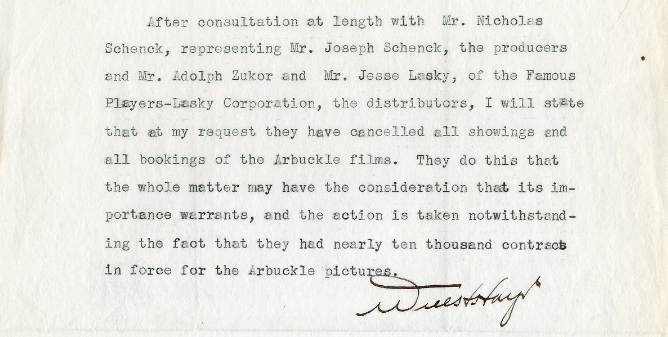
Just prior to the Labor Day party, Zukor and Paramount had agreed to a multimillion dollar multiyear contract with Arbuckle and cancelling it after Arbuckle had been acquitted would pose legal problems. Yet Zukor, who had felt squeezed by Arbuckle’s lawyers during the contract negotiations, had had enough. He needed to cut his losses and protect the Paramount brand. Hays was well aware of this contract and 10,000 others with companies and individuals who had a stake in making good on the banned motion pictures. He mentioned this sacrifice when he made the ban public one week after Arbuckle was acquitted.

Will Hays’ press release of April 19, 1922 (Margaret Herrick Library)

Paramount, the biggest studio at the time, had scores of actors and actresses under contract and all posed an existential threat to his company. What better way to get their attention than to erase one of them off the books with a mysterious, indefinable, legally defensible blackballing—where the economic rationale could be concealed behind the moralistic kabuki of Will Hays. And was there a moral or sentimental one on the part of Zukor that made it difficult for him to square Arbuckle? Perhaps. Zukor had a daughter. She was the mogul’s favorite.


P.S. Zukor’s problem with Arbuckle does have its book. But the problem isn’t quite the one imagined in Andy Edmond’s 1991 tell-all, Frame Up! That book is unsourced and what is quoted in her text has a lot of fairy dust and special sauce that makes it yet another “good read,” which it is. There is a lot about Zukor’s motivations, a lot of his wires and letters, but without sources—sources that we have to think are factoids at best—Edmonds is a dead end for us, a bad influence like many good reads on the Arbuckle shelf.

A Note on the Virginia Rappe’s genealogy

We have left as much doubt in the wake of writing Spite Work as there was in the beginning. This is true of Virginia Rappe’s roots. We hoped to discover evidence in her family history of how her life had been influenced by her forbears–forcing us to consider abusive relationships, the death of a parent, and, even possibly, incest given the mother–daughter–sister paradox described below.

In the soon-to-be-released monograph-length version of our research, speculations of this sort have largely been avoided. But we did have to dive into the wreck, as it were, of her family to make some sense of who she was. So, relying on databases that became available in the 2010s, the same ones that Greg Merritt used to posit the date of Rappe’s birth of 7 July 1891 (i.e., Cook County records made available by FamilySearch.com, a genealogical service provided by the Church of Jesus Christ of Latter-day Saints.), we agree with him, that Rappe was older than the age that is usually associated with her.[1] She was 30, not 26, when she left Los Angeles for San Francisco and the fated Labor Day party in September 1921.

The record of her birth indicates her mother was named Mabel Rapp, age 15. The document also indicates that Virginia’s birthplace was a private hospital operated by a professional midwife, one who advertised her services in Chicago’s newspapers and seems not to have gotten in trouble for performing abortions. Though midwives of that era were known to assist girls in trouble.

From there we began to look at any extant record and newspaper sources related to Mabel’s world and her family, before she evolved into a South Side “tough girl” in Gay Nineties Chicago.

The first piece of the puzzle was an application for a “permit to wed,” i.e., a marriage license, issued on December 26, 1891.[2] The husband, Oluf C. Madison, 32, and bride, Mabel Rapp, 18. Was this a gentleman doing the right thing and agreeing to make an “honest woman” of Mabel? Was this the elusive father of Virginia Rappe? Other “Mabel Rapps” existed at the time—but none who quite pulled us away from thinking this was an event in her life.

In any event, Madison or, more likely, Madsen, wasn’t the person Virginia Rappe considered her father. She either believed or was told to say she had been born in 1894, the result of a love affair that took place when her mother met a man at the 1893 Columbian World Fair in Chicago. She believed she was born the following year and might have celebrated her birthday on a day other than July 7. During the Arbuckle trials, the father was variously described as some wealthy personage, from an English lord to a person who was somewhere listed in the Chicago Blue Book. Such stories would have lessened the onus of being illegitimate and provided cover for any unconventional family dynamics, even possibly incest which was being posited by sociologist Richard Dugdale and other Social Darwinists as a cause of low morals and weak intellect. But Virginia Rappe hardly belonged to the Jukes Family. Nevertheless, Mabel was very unconventional. She passed herself off as an older sibling to Virginia, which freed her to enjoy a reputation as the “Queen of the Night” and the “Queen of Chinatown” in the demimonde of Chicago’s South Side.

As often happened when records were spotty, family lore confused the truth. As described in court by the neighbors who served as foster mothers to Virginia, the woman who was regarded as her grandmother/mother/aunt at various times wasn’t actually related to her. As for the identity of her birth mother, these neighbors testified that Rappe only knew of Mabel as her older sister.

This white lie was a common ruse to cover for illegitimate children, especially resulting from rape. Parents of the rape victim would simply claim the grandchild as their own. A daughter borne of incestuous rape could, in effect, be the sister of her mother if they shared the same father, the niece if the father were a brother. The former scenario may not apply to Virginia Rappe. It is a thought experiment at this writing. But this situation was not that unusual in the 1890s.

We could have stopped there and left Mabel Rapp and her daughter. We could have been satisfied with a family tree that began and ended with them.[3] But not all the limbs had disappeared from the family tree and our intuition told us that something unusual had caused the disintegration of the family.

There is an entry for a Mabel Rapp in Chicago in the 1880 census.[4] There are two entries for Virginia Rappe in the U.S. Census: 1910 and 1920. The 1910 entry was likely filled out by the person indicated as the head of household, the putative grandmother. As for her, she entered herself as a forty-nine-year-old widow named Virginia Rappe![5] She entered who we know as Virginia Rappe as a daughter but using the name Zelliene V. Rappe, aged 16.[6]

So out of the blue there were now two Virginia Rappes. And the younger one going by a rather unique appellation. We will discuss that in another note. For the present, however, the V surely stood for Virginia. As for the extra e and syllable added to the family name, that had been done by Mabel Rappe after she relocated to New York City. She had become known in Chicago for passing bad checks and being an accomplice of a longtime boyfriend, Frank A. Parker, the leader of a forgery ring and the black sheep son of a wealthy Chicago stockbroker. Her death certificate listed her as Mabel Rappé. In keeping with this decision, her daughter and “mother” assumed the name as well and kept it after her death in 1905.

The 1910 census form included a question for female correspondents regarding their number of live births. Virginia Rappe the Elder listed three. She also indicated that she was born in Kentucky and that her father and mother came from West Virginia and Tennessee, respectively. Zelliene, who is listed as sixteen years old, was born in Illinois in, approximately 1894. Her mother’s birthplace was listed as Kentucky and her father New York.

The only census entry that was authored by Virginia Rappe the Younger was the next one, the 1920 census.[7] This entry lists her as a boarder in the Los Angeles home of the comedy director Henry Lehrman. Her vocation is motion picture actress and, like many women in that profession, she has subtracted from her real age for Uncle Sam. She lists herself as 22, making for an approximate birth year of 1898. Her mother’s birthplace becomes Virginia rather than Kentucky. But her father’s birthplace remains New York.

Now we turn to the death certificates of Virginia’s mother and grandmother, which make for puzzle pieces that don’t fit well.

Mabel Rappé, as she styled herself in her final years, died in a New York City hospital on January 7 1905. Her death certificate is handwritten and one can easily see an accented é but it was transcribed later as a lowercase i. For that reason, New York City health department records have her listed as Rappi. Thus, Mabel Rapp’s father is recorded as Henry Rappi of New York, New York, and her mother as Virginia McPheadridge of St. Louis, Missouri. (Mabel Rapp’s age is indicated as 23 and her birth year as 1882. That made her a closer “sister” to her daughter, of course, but also meant a nine-year-old mother or bride in 1891!) The 1911 death certificate for Virginia Rappe the Elder, however, is at odds with this information.[8] This document was informed by the Younger, who listed the birth year of her putative grandmother to be 1851 and her age to be 60—hardly close to the 45 years of age that the deceased gave as her age in 1910 census. Virginia the Younger also indicated that the deceased was born in Virginia. The death certificate lists Virginia the Elder’s father as John Gallagher. That may lead to other truths. But for now, we will focus on a limb or two of the family tree of Virginia Rappe.

Whoever was the informant for Mabel Rapp’s death certificate pointed us in the right direction. One Henry H. Rapp and a Miss Virginia McPheetridge (sic) were married on 26 May 1864 in St. Louis, Missouri.[9] The bride’s name was spelled out phonetically by the minister who conducted a ceremony that required the payment of a five-cent federal stamp tax levied to prosecute the ongoing Civil War. Furthermore, 1850 and 1860 census data revealed that the Virginia McPhetridge—the preferred spelling of the family—came from Virginia and that her grandfather was a veteran of the Revolutionary War.[10]

Entry for the marriage of Henry Rapp and Virginia McPhetridge (FamilySearch)

The Rapps seemed to have been living a normal life in Chicago, where Henry Rapp had been a railroad freight agent listed in Chicago business directories at least since 1862—a vocation that, incidentally, kept him from being drafted. When we scoured the 1870 census for this couple, only Henry Rapp appears in the population schedule for that year, with an approximate age of 28, and born in Indiana—a curious mistake since other records consistently indicate New York.[11]

The 1870 census included little else about him. He owned $10,000 in real estate. He appeared to be a bachelor living in a boarding house in the 2nd Ward, within walking distance of the railroad yards. Despite his real estate holdings, he remained a renter and the business directories up until 1880 continue to list him as a hotel and boarding house resident, moving from such establishments as the Howard House, the Bishop Court Hotel, and the Burdick House. He also moved from one freight office to another (the Rock Island, the Diamond Line, the B&O), where he was known as “Hank.”

What happened to his wife? Did they have children?

The answer begins in the 1880 census, which lists Mabel and an Earle Rapp as the residents of a Chicago boarding house on Michigan Avenue. At first glance, they seem to be orphaned. The nine-year-old Mabel is listed as the “head” of household, perhaps only because she answered the door when the enumerator arrived. When asked where she was born, however, for herself and her five-year-old brother, she answered “Maine.”

There were also other residents of the boarding house, which was located at 256 Michigan. Flanked by townhouses and hotels, the large, private house had been subdivided. A woman named Helen Rapp was listed as a resident of the same building, right after the landlady. She was 27, married, and a boarder. She was born in New York.[12]

Entries for Helen, Mabel, and Earle Rapp in the 1880 census (FamilySearch)

Helen Rapp proved to be a dead end as far as census data goes. But that isn’t the case for Earle Griffith Rapp.[13] The younger brother’s life was well-documented and his records began in 1891, when he was listed in a Chicago business directory as a bookbinder. And the most valuable record concerning him was his 1898 marriage license.[14] There we find that his parents and those of Mabel Rapp correlate. His father is identified as Henry H. Rapp. His mother is identified as Virginia McPheatridy. Although the latter’s surname is garbled or phonetically spelled, it is the same woman who married Henry Rapp in 1864.

His age in the 1900 census indicates he was born in Kentucky in 1871. His father’s birthplace is New York, his mother’s Kentucky.[15] These two data points for Earle Rapp are repeated in the 1910 census.[16] His birthplace, interestingly, was always given as Kentucky. His death certificate, however, throws a little dust in our eyes.[17] The informants, Earle Rapp’s adult daughters—Virginia Rappe’s cousins—confirm his earlier official information except his mother’s maiden name which is given as Virginia Griffith, which explains his middle name.

A Chicago directory entry for Henry Rapp, mid-1870s (Ancestry.com)

Now let’s return to the pater familias, Henry Rapp. Despite the lack of census data after 1870, evidence of his residence in Chicago can be found in brief notices in Chicago newspapers of a lawsuit, a promotion, and his long railroad career. There is no evidence that he himself lived in Kentucky, but rather lived a prosperous middle-class life in Chicago, where he died on 7 January 1901, at the age of 63.[18] His death certificate indicates he was born in New York in 1838 and that he was widowed. This and an obituary in the Chicago Tribune show that was buried in Chicago’s Rosehill Cemetery in what became a family plot, for Earle Rapp is buried there as well. (The obituary also provided his middle name: Hoisington, a surname that surely belonged to his mother and one fairly common in Vermont and well into western New York in nineteenth-century census data.[19])

So, how and when did Henry Rapp become a widower? For now, like the identity of his granddaughter’s biological father, that detail remains unsolved. We could find nothing to indicate what happened to Virginia McPhetridge Rapp. Perhaps she died before 1880. Perhaps she abandoned her family. As for the mother and grandmother in the 1911 death certificate and the 1910 census, her data reveals that her husband preceded her in death—and that she is in Rosehill, too. But she wasn’t buried near Henry and Earle Rapp. Nor is Mabel Rapp interred in that family’s plot. Indeed, Rosehill’s administration doesn’t have any plot numbers for the family Rappe.

Then there is Helen Rapp. A sister-in-law to Henry Rapp? Helen and Virginia Rappe the Elder are close in age if the age of 27 in 1880 is correct. That would have made her 57 in 1910. If they are two separate people, that could mean that Helen Rapp is the first of two or more foster mothers for Mabel, Earle, and, eventually, Virginia. The three children in the 1910 census. Presumably, only two should have the same father.

Earle Rapp lived in Chicago. He was a respectable stock broker in 1899 when his sister’s name appeared in newspapers across the country as the moll in a ring of check forgers. That must have been embarrassing—but it wouldn’t compare to the shock he must have felt when he opened the Chicago Tribune in September 1921 and saw his niece’s death had become the center of a national scandal. He apparently watched her notoriety and that of “Fatty” Arbuckle rise to a fever pitch and said nothing to draw attention to himself.


[1] “Illinois, Cook County Birth Registers, 1871-1915,” database, FamilySearch (https://familysearch.org/ark:/61903/1:1:N7WC-FZB: 10 March 2018), Rapp, 07 Jul 1891; citing p.254 no.12677, Chicago, Cook, Illinois, Cook County Courthouse, Chicago; FHL microfilm 1,287,737.

[2] “Marriage Licenses,” Chicago Tribune, 27 December 1891, 8.

[3] Unfortunately, there are no records for the 1890 census. The vast majority of the population schedules were destroyed in a fire in the basement of the U.S. Department of Commerce building in Washington, D.C. in 1921.

[4] “United States Census, 1880,” database with images, FamilySearch (https://www.familysearch.org/ark:/61903/1:1:MXNX-BJ5: 13 January 2022), Mabel Rapp, Chicago, Cook, Illinois, United States; citing enumeration district, sheet, NARA microfilm publication T9 (Washington, D.C.: National Archives and Records Administration, n.d.), FHL microfilm.

[5] “United States Census, 1910,” database with images, FamilySearch (https://www.familysearch.org/ark:/61903/1:1:MKZ5-PZV: accessed 13 June 2023), Virginia Rappe, Chicago, Cook, Illinois, United States; citing enumeration district (ED) ED 1199, sheet, family, NARA microfilm publication T624 (Washington D.C.: National Archives and Records Administration, 1982), roll ; FHL microfilm.

[6] “United States Census, 1910,” database with images, FamilySearch (https://www.familysearch.org/ark:/61903/1:1:MKZ5-PZK: accessed 13 June 2023), Zelliene V Rappe in household of Virginia Rappe, Chicago, Cook, Illinois, United States; citing enumeration district (ED) ED 1199, sheet, family, NARA microfilm publication T624 (Washington D.C.: National Archives and Records Administration, 1982), roll ; FHL microfilm.

[7] “United States Census, 1920”, database with images, FamilySearch (https://www.familysearch.org/ark:/61903/1:1:MHQF-VFK: 31 January 2021), Virginia Rappe, 1920.

[8] “Illinois, Cook County Deaths, 1871-1998,” database, FamilySearch (https://familysearch.org/ark:/61903/1:1:Q2M7-FWC2: 8 March 2018), Virginia Rappe, 22 Nov 1911; citing Chicago, Cook, Illinois, United States, source reference 28968, record number, Cook County Courthouse, Chicago; FHL microfilm 1,287,615.

[9] “Missouri, County Marriage, Naturalization, and Court Records, 1800-1991,” database with images, FamilySearch (https://www.familysearch.org/ark:/61903/1:1:6D5W-3NKY: 21 May 2022), Henry H Rapp, 26 May 1864; citing Marriage, St. Louis, Missouri, United States, Missouri State Archives, Jefferson City; FHL microfilm 004003319.

[10] “United States Census, 1850,” database with images, FamilySearch (https://www.familysearch.org/ark:/61903/1:1:MDZP-BST: 22 December 2020), Virginia McPhetridge in household of Cammel McPhetridge, St. Louis, St. Louis, Missouri, United States; citing family, NARA microfilm publication (Washington, D.C.: National Archives and Records Administration, n.d.).

[11] “United States Census, 1870”, database with images, FamilySearch (https://www.familysearch.org/ark:/61903/1:1:M64L-N1B: 29 May 2021), Henry Rapp in entry for Lizzie Williams, 1870.

[12] “United States Census, 1880,” database with images, FamilySearch (https://www.familysearch.org/ark:/61903/1:1:MXNX-BJJ: 13 January 2022), Helen Rapp in household of Francis Wood, Chicago, Cook, Illinois, United States; citing enumeration district, sheet, NARA microfilm publication T9 (Washington, D.C.: National Archives and Records Administration, n.d.), FHL microfilm.

[13] “United States Census, 1880,” database with images, FamilySearch (https://www.familysearch.org/ark:/61903/1:1:MXNX-BJR: 13 January 2022), Earle Rapp in household of Mabel Rapp, Chicago, Cook, Illinois, United States; citing enumeration district, sheet, NARA microfilm publication T9 (Washington, D.C.: National Archives and Records Administration, n.d.), FHL microfilm.

[14] “Wisconsin Marriages, 1836-1930”, database, FamilySearch (https://familysearch.org/ark:/61903/1:1:XRVX-D15: 30 January 2020), Earl Griffith Rapp, 1898.

[15] “United States Census, 1900”, database with images, FamilySearch (https://www.familysearch.org/ark:/61903/1:1:MS3L-Y8Z: 12 January 2022), Earl Rapp, 1900.

[16] “United States Census, 1910,” database with images, FamilySearch (https://www.familysearch.org/ark:/61903/1:1:MK83-3YD: accessed 15 June 2023), Earl G Rapp, Chicago, Cook, Illinois, United States; citing enumeration district (ED) ED 1257, sheet, family, NARA microfilm publication T624 (Washington D.C.: National Archives and Records Administration, 1982), roll ; FHL microfilm.

[17] https://www.ancestry.com/discoveryui-content/view/1872821:2542?tid=&pid=&queryId=29dbf5fe3dabe43b9d469d4841c1911b&_phsrc=JrV2659&_phstart=successSource.

[18] “Illinois, Cook County Deaths, 1871-1998,” database, FamilySearch (https://familysearch.org/ark:/61903/1:1:Q2MQ-46GR: 8 March 2018), Henry H Rapp, 07 Jan 1901; citing Chicago, Cook, Illinois, United States, source reference 16278, record number, Cook County Courthouse, Chicago; FHL microfilm 1,239,664.

[19] “RAPP—Henry [obituary],” Chicago Tribune, 10 January 1901, 5.

A note on Virginia Rappe’s sexuality

One of the preconceived notions that we had to shed—at least temporarily and more than once—was that Virginia Rappe was heterosexual. We left her sexuality open for discussion for the present and beyond if there is a future interest in the hoary notions that surround this mysterious woman whose death ended the career of Roscoe Arbuckle.

Previous Arbuckle case narratives, even Kenneth Anger’s gay eye, see Rappe as “straight” and that she slept with the comedy director Henry Lehrman during her years in Hollywood from 1916 to 1921. That was, of course, enough time for her to marry him or move on to someone better, hypergamy being Hollywood’s way then as now. But something about her being with just the one man raised our eyebrows. Was it love or something else? Then we took a hard look at the way Rappe referred to him, as “Mr. Lehrman.” While it seems like nothing, here she implied a certain professional distance, that she was just one of his performers, an employee. Only after her death was he seen as her “sweetheart,” that they were to marry. In reality, when Rappe accepted Roscoe Arbuckle’s invitation to a party in the St. Francis Hotel suite on September 5, Labor Day 1921, she had long since parted ways with Lehrman. Rumors in the film colony suggested Lehrman had even encouraged her to attend the party.  Could there have been a less obvious dynamic to their relationship? Did Arbuckle test or cross a boundary that had been in place for Lehrman as well?

Lastly, we took another hard look at her female friends. Some seemed to be “beards” of another species. The friendships seemed same sex so as to fool the opposite.


Virginia Rappe was raised by women. There was her birth mother, Mabel Rapp, considered a beauty but also a “tough girl” in Chicago’s South Side during the 1890s, variously called the “Queen of the Night” and the “Queen of Chinatown.” But her daughter had been raised believing Mabel was her older sister. Both had the same guardian, an older woman with a heavy Irish accent, who went by Virginia Rapp. Her real surname was Gallagher and she wasn’t related to either Virginia or Mabel and her taking the name Rapp was likely to explain away the strange family dynamics before anyone asked questions given the mores of the 1890s.

When Mabel died on January 7, 1905, her New York City death certificate had been informed with the name she used in her last years—Mabel Rappé—and the names of her real parents. Yet another rabbit hole for the curious to explore. Another notice—more about her absence from Chicago than her passing—appeared a few months later in The Club-Fellow: The Society Journal of New York and Chicago. The author of the spicy “Audacities” column recalled Mabel working a Wisconsin lake resort’s ballroom like a proper courtesan of the Gay Nineties.

It is only a few years ago that the Johnstone Bennett-like Mabel Rapp (who was supposed by many to be the daughter of Partridge of dry goods fame) used to frequent a certain Chinese laundry on State street near Sixteenth street kept by a Celestial known as “Chollie,” and there forget all troubles in the “long draw” [a hit off an opium pipe]. Mabel has disappeared from State street and “Chollie” has also vanished and returned to the land of flowers and hop [opium].

The last time the fair Mabel was seen was at a German [formal dance] at Fox Lake, when several of the men made up a pool to see whom the lady would favor. George Holyoke (who, by the way, married Mrs. Elmer Flagg of Thursday Club recollection after she had lowered Elmer to half-mast), George, who was a forty-to-one shot, got the prize. Several of the married men present were much perturbed for fear the identity of Mabel might become known and cause friction in the domestic circle. “Billy” Lyford, was conspicuous by his absence, and most the “papas” sough the veranda, it being too warm to dance.[1]

The names mentioned above belonged to subaltern society people who belonged to various social clubs in Chicago. The men, whether single, married, or divorced, knew Mabel had a reputation for fun . She made herself available as a dance partner to the well-heeled gents of Chicago and opened the way to other forbidden pleasures, such as opium and a dalliance with a beautiful woman from across the tracks,  a real habitué of the South Side demimonde.

What is interesting, however, is the comparison made to Johnstone Bennett. Bennett who was a well-known stage actress and male impersonator hardly resembled a fallen Gibson Girl as Mabel had been made to be as she cruised Fox Lake.

Johnstone Bennett had an unusual past. Her name was derived from the two women who raised her. She started playing “tough girl” roles early and was considered the epitome of the New Woman by the novelist Willa Cather, especially in regard to her dress on- and offstage. Bennett in the photographs found at the New York Public Library’s special collection was boyish in appearance, which may have actually made her more risqué to her male admirers as much as she appealed to women who preferred same-sex relationships with a more “butch” partner.

Johnstone Bennett (New York Public Library)

Bennett’s career flourished in the 1880s and 1890s and could have served as role model for Mabel, who had more than one opportunity to study Bennett on the stage in plays such as The Amazons, a comedy that was a great success in Chicago in 1894.[2]


Three years after Mabel Rapp’s death, her daughter first came to the public’s attention in the Chicago Tribune as a kind of sleeping beauty, with the potential to be

one of the world’s famous models after the years have mellowed her and taken from her posing the sight touch of childish gaucherie which still remains. [. . .] She is a simple little girl of 15 years who looks out on the world with the clear, dewy eyes of a child just awakened from sleep.[3]

The “tough girl” mask wasn’t right for Virginia Rappe though, her style and path were closer to that of an ambitious ingenue. By 1908, Rappe was being mentored by a woman she first knew as “Dot” Nelson but whose married name was Catherine Fox. She saw Rappe’s potential as an artist’s model and as an entertainer. Mrs. Fox paid for dance lessons and likely pushed Rappe toward the theater and vaudeville stage. Both vocations—model and performer—were seen as morally risky for a young woman still in her teens. The prettiest ones attracted a male following. Lovers, however, were discouraged. Traveling vaudeville and theater companies made women sign contracts that forbade them from seeing men without being chaperoned. This protected their employers from losing girls to marriage, an unintended pregnancies, and like pitfalls of being intimate with men, such as venereal disease, drug addiction, alcoholism, and the various forms of duress attributed to rejection.

Rappe undoubtedly understood that appearing virginal if not an actual virgin protected her career and her person. This meant having established boundaries with any male companions.

Rappe’s only known long-term courtship in Chicago was with a real estate broker named Harry Barker, but whether this included a sexual element is questionable. Any suitors were screened by her putative grandmother and the former neighbors who acted as de facto guardians: Mrs. Fox and Kate Hardebeck. Both witnessed Rappe refusing an engagement offer from Barker after what had to have been a frustrating crush–courtship. But he and Rappe remained friends during her lifetime.

Other than Barker, Rappe was most often reported in the company of women her own age. Winifred Burkholder, the owner of an early modeling agency, was an exception.

Burkholder met Rappe first as a model, after the latter had set aside any stage ambitions, and later as a fellow student at the Art Institute of Chicago between 1908 and 1911.

Like Rappe’s guardians,  Fox and Hardebeck, Burkholder was also married. But she had left her husband and son in rural Wisconsin to pursue a career in fashion design. And to avoid any indelicate questions about her marital status, she claimed to be a widow or unmarried.

In late 1912 Rappe and two sisters from Chicago, with whom she shared a hotel room on a trip to New York, made the news when they announced they had made a pact never to marry.

While the sisters eventually broke their promise, Rappe kept hers and joined Burkholder’s traveling Promenade des Toilettes of 1913—a fall fashion revue that toured department stores in the Midwest and South, which also featured six other young women billed as the “Troupe of the Wonder Models of Fashion.”

Burkholder was an imposing figure shepherding her models from city to city. She sported a monocle and a cane—and, as a model herself, wore matronly outfits to appeal to the older, more demure customers.

The_Omaha_Evening_Bee_Wed__Sep_17__1913_

Winifred Mills Burkholder in Omaha, cane and monocle, September 1913 (Newspapers.com)

Rappe’s role in the review was to promote the “tango dress,” Daring because the skirt showed glimpses of her ankles and calves up to her knees, the dress was also intended to titillate men more than to appeal to the conservative tastes of the American heartland. When interviewed about the show for the Atlanta Constitution, Rappe teased about her disappointment in the men of Atlanta.

“When it comes to speed,” spoke Virginia, “this town is on the ‘Fritz!’ See? ‘F-R-I-T-Z!’ The combined speed of the whole of it would put ginger into a grasshopper. We’ve been here three days—think of it–and the only entertainment we’ve had the entire time had been . . . I hate to mention it, but you girls remember that little taxi ride we paid for out of our own dear, hard-earned bank accounts?

“True, we gave a tango party to ourselves. The management stopped it. Even locked up the ballroom. Did you ever? Shameful? No! Certainly not! Outrageous!”[4]

When one of the other models decried the lack of attentive male company—who might be willing to entertain them—Rappe chimed in, “Search me, they haven’t been around here.”

To Mrs. Burkholder this was the desired outcome, that the women got attention with their sassiness yet kept to themselves.

The_Atlanta_Constitution_Sun__Oct_12__1913_

The Troupe of the Wonder Models of Fashion, October 1913 (from the Atlanta Constitution accessed in Newspapers.com). Rappe lies supine in the front. Mrs. Burkholder is on the left. 

Following the Promenade des Toilettes, and with the money they had earned during the tour, Rappe and another model, Helen Patterson, sailed to Europe to spend most of December in Paris and New Year’s Eve in England before departing from Liverpool.

On their return journey, the friends made an impression on the first-class passengers and crew of the RMS Baltic, dancing the tango together and wearing their bloomers exposed at the ankles, making for “four pink puffs” as they walked arm in arm on the promenade deck. Photographs of the pair were printed in newspapers in January and February 1914. The woman made an impression with the “tango bloomers,” their appearances in the ballroom, and as partners during the shipboard bridge games.

None of this conduct—either in Atlanta or aboard the Baltic, would have raised an eyebrow in the early twentieth century, no more so than in a cotillion at a boarding school for girls. But the tango was seen as an erotic dance, a courtship dance—and the pairing of Rappe and her girlfriend, nevertheless, made for body language that discouraged men from making advances.

The_Anaconda_Standard_Sat__Jan_24__1914_

Helen Patterson and Virginia Rappe, January 1914 (Newspapers.com)


If one puts out of mind the testimony of the two Chicago abortionists and a bordello physician who claimed Rappe had bore a child, indeed, more than one, a case could be made that Rappe might still be a virgin and remained “intact” into 1915, when, at the Panama–Pacific International Exposition in San Francisco, she was briefly touted in the press as being engaged to an Argentinian diplomat Don Alberto M. d’Alkaine, vice consul and secretary to the commissioner of his country’s exhibit.

The_Day_Book_Sat__Aug_7__1915_

Virginia Rappe, 1915 (Newspapers.com)

Most Arbuckle case narratives accept this engagement as authentic because it was newsworthy in 1915. But the San Francisco Call attributed Rappe as the source of the rumor in late July. Soon after newspapers from coast to coast picked up on the romance and included a photograph of Rappe in profile, wearing the hat of a pajama suit that she likely designed and repurposed in this photograph to make it seem more bridal.

A month later, the Examiner reported that the couple had parted ways, noting that when the engagement was announced neither party denied it. Don d’Alkaine returned to Buenos Aires and a long diplomatic career. Rappe returned to Chicago and didn’t stay long at all.[5]

Like the pronunciation and spelling of Rappe’s surname—variously Rapp, Rappé, Rappi, Rappe, or even Rappee as it was heard and spelled in Atlanta—her sexuality lacks fixity. While leaning toward a preference for the company of men, when the question of marriage and conjugal relations became a reality, Rappe seemed to have baulked again.

It’s possible that up to that time Rappe had had no real or lasting relationship with a man that was consummated.

While newspapers from Green Bay to Muskogee to Shreveport to Omaha printed fashion photos of her and framed her as a kind of ur-influencer of women’s wear, not one photograph showed her with Don d’Alkaine. He only appears in group photographs of various dignitaries and it is hard to tell what he looked like.

Nor did she ever appear in a photograph with the next man in her life, Henry Lehrman.

As we have it in our work-in-progress, Lehrman could have met Rappe during the second half of 1915. Both had worked for Mack Sennett and belonged to the same circle of friends around a San Francisco power couple, Jack and Sidi Spreckels.

In the early spring of 1916 at a fashion parade around a Los Angeles racetrack for the Actors’ Fund Memorial Day benefit. Rappe drove a FIAT representing Lehrman’s L-KO Kompany.

At the time, Rappe was living at the Hollywood Hotel, a popular residence among those in the motion picture industry. Indeed, the perfect setting for an aspiring young woman who had “gone West” to become a movie star. But according to another resident, Anita Loos, who befriended Rappe, the latter lacked the ambition of the other young women who would do anything to get into pictures—including sleeping around. Instead, her focus was on getting Lehrman to pay more attention to her.

What Rappe did to pay for her room and board at that time remains a mystery. She likely had savings from her modeling career and allegedly had been hired for a few film roles though so small as to be uncredited. Instead, Rappe positioned herself to play another kind of role, one that was off-screen, that of a sophisticated “society girl” and as such found her way into the film colony. But where her mother had balanced multiple companions over the years, Rappe had become attached to just one man, one dance partner.

Prior to Rappe, Lehrman was thought to prefer visiting prostitutes so her presence probably gave him an air of respectability around the men who bankrolled his films, such as William Fox, who funded his new company, Sunshine Comedies. Not only did two-reeler comedies have to be “clean,” so did the men and women who made them—and Lehrman was entrusted with million-dollar budgets. Thus, Rappe served to make Lehrman more respectable and less of a workaholic and loner, as he was made out to be in the Los Angeles Times, however, the “couple” went virtually unnoticed in the press until September 1921.

My, my, how these satellites do blaze for a time! Now it’s a certain Henry Lehrman, who is cultivating the smart set. He looks like one of those suave gentlemen you’ve read about in French novels—quite an objet d’art, as it were. And he wears his little waxed mustache just so, and his hair bandolined[7] so tight and his feet in such snug pumps and himself in steinblochian[8] attire and with a Miss Rappe, who’s quite the season’s best-looking New Yorker. This Mr. Lehrman is occasionally seen at the Alexandria or at Vernon, and people who know him say he’s quite exclusive. Perhaps so; he’s quite often alone.[9]


Rappe was still living in the Hollywood Hotel in the fall of 1917 when Roscoe Arbuckle, having separated from his wife, actress Minta Durfee, lived there and lorded over the dining room with his entourage and practical jokes played on various unsuspecting fellow guests. By that time, Rappe had received a credit in just one film, Paradise Garden (1917), in which she played a “junior vamp” alongside Harold Lockwood. If the script was true to the best-selling novel on which it was based, Rappe’s character, the wealthy Marcia Van Wyck, also had a female companion, described as a poor relation who didn’t like men.

Although she took the part as a lark, the result of visiting the set one day with friends, Lehrman probably had some influence in her being cast. He knew the director, Fred J. Balshofer, from the time when both had learned their trade at the Biograph Company in New York.

Balshofer cast Rappe again in 1918 with newcomer Rudolph Valentino, pairing both as conspirators and lovers in a vehicle starring female impersonator Julian Eltinge. What footage survives shows that both had rapport in this propaganda picture set in occupied France and Germany during the First World War. But their characters suffered the vicissitudes of three different recuts and as many titles: Over the Rhine (1918), The Adventuress (1920), and The Isle of Love (1922).

p15759coll36_10_medium

Virginia Rappe with Rudolph Valentino (Margaret Herrick Library)

Rappe’s being cast in Paradise Garden was evidence that she had the looks and presence to get a career going but she seemed to be content being at the side of Henry Lehrman and didn’t seek acting jobs outside of bit parts she did for him.

Zaza in The Adventuress/Vanette in The Isle of Love (YouTube.com)

Lehrman produced comedies and, whatever his intentions were, he could save money by casting Rappe in his own films though she had none of the experience or training for comedy. Lehrman just needed her to be an appealing face. In one of her first roles, as the love interest for the film comedian Lloyd Hamilton in His Musical Sneeze (1919), she was given little to work with besides tired gags.

Lehrman continued to miscast Rappe at the Culver City studio, which he built in 1919 and shared with Arbuckle during the summer and fall of that year. By then Rappe was also Lehrman’s tenant—a sort of “rent girl” in his home at 6717 Franklin Avenue, where she was simply listed as a “boarder” in January 1920 according to census data.

There Lehrman provided her with a car and driver and his servants. Members of the film colony assumed that they were a couple but appearances can be deceiving—even to the jaded eyes of Hollywood people. If Rappe had to provide Lehrman with “benefits,” she was certainly inhibited from doing so by cystitis. Indeed, coitus for Virginia Rappe was likely uncomfortable if not painful. She would have known, too, that having sex with a man who also had had multiple partners would probably not aggravate her condition and probably give her something worse.

The relationship between Lehrman and Rappe was not so simple as boyfriend and girlfriend, she seemed to be obligated to pay him back with a number of motion picture appearances. The most prominent of these was in a role as a wholesome country girl in A Twilight Baby (1919), another vehicle for Lloyd Hamilton.

There was little news of Rappe following A Twilight Baby save that she wanted more serious roles. She and Lehrman seemed not to appear in public. In July, she was in San Francisco during the week of the Democratic National Convention. While she was listed as a guest in two hotels, Lehrman was making a film elsewhere. When he hosted a dinner for the Democratic candidate for president, James M. Cox, in Los Angeles in September, Rappe wasn’t present. Although she had a few more roles that only demanded she smile or bat her eyes, by the end of 1920 she and Lehrman split up. He was having financial difficulties. A creditor had filed lien on his house. As for Rappe, she had already moved out by midsummer. We know this because her telephone number, which she published in a July classified advertisement for her lost brindle bull terrier, was used by the landlady and boarders at 1946 Ivar Avenue. That is the address she used for her entry in the 1921 Los Angeles City Directory.

While living on Ivar, Rappe, in need of income, had taken on the management of a few rental homes on Canyon Drive, including one owned by actor Francis X. Bushman. This makes for a rather tangental episode in our work in progress and certainly speaks to the resolve and independence of Rappe.


That Rappe had an unusual arrangement with Lehrman doesn’t eliminate the possibility that they once loved each other. It can’t be ignored though that it would have been convenient for Lehrman to romanticize their relationship following Rappe’s death. He didn’t deny that he was her fiancé. To abandon her post-mortem would have made him appear to be a heel. Fortunately, he still had a photograph of her to show in his New York City apartment and helped the public imagine a loving couple suddenly destroyed by tragedy. What he didn’t admit to was the presence of a new girlfriend in his life, Jocelyn Leigh, a Ziegfeld Follies girl who was more ambitious and probably more willing to give him an escort in Manhattan if he would open doors for her in Hollywood (which didn’t turn out well for her).

For Arbuckle’s lawyers, his chances of acquittal rested on their narrative that Rappe was promiscuous and possibly a prostitute so they had to discount any evidence that she was a faithful partner, a frigid woman, or anything close to a lesbian.

During the comedian’s three trials, they made an issue of Rappe’s Chicago past. Prominent among them—and the only lawyer not to sit at the counsel table, was Albert Sabath, a personal friend and business associate Rappe’s alleged sweetheart, Harry Barker. Sabath deposed on two midwives and abortionists as well as a brothel physician to show that Rappe had suffered from bladder disease that could be attributed to being a promiscuous teenager and giving birth to at least two illegitimate children.

What was missing in the witness testimony—and Barker was one of those witnesses for Arbuckle—was any parallel conduct on Rappe’s part in Hollywood. Instead, these witnesses only saw Rappe have a few drinks that resulted in episodes of hysteria, including disrobing and tearing at her clothes.

These episodes resembled what Arbuckle and his other Labor Day guests saw when Rappe was discovered on his bed, writhing in pain. Naturally, we were suspicious that a person would have somehow made a routine of such extreme behavior. Arbuckle’s prosecutors were also incredulous. But it’s unlikely the witnesses would have repeatedly committed perjury with little to gain so it’s likely there was a kernel of truth in their stories. Though they were indeed defense witnesses so a little bit of exaggeration  would not have been surprising.

One hypothesis we considered was that Rappe’s episodes—her acting “crazy” as Arbuckle called it—were a defense mechanism, indeed, a very ancient one that is still used to counsel women to prevent sexual assault and rape: “You may be able to turn the attacker off with bizarre behavior such as throwing up, acting crazy”—that is, behaviors that will depress sexual arousal.

What is so ancient about that? By feigning madness, of being touched by the gods or demons, superstitious rapists of a besieging army might have been more inclined to just pillage a conquered city rather than risk being possessed themselves. So, did Rappe act crazy when she thought she was being sexually threatened? Did Arbuckle encounter this—even when semiconscious as she was going into shock from a ruptured bladder?

That said, according to Lehrman, Rappe did worry about being assaulted, especially on her long walks in the Hollywood Hills. For that reason, she was accompanied by the aforementioned brindle bull terrier named “Jeff” over which she had much control. (He was ultimately found, by the way, and enjoyed one more year with his mistress’s companionship.)

pictureshow1919102unse_0095

Rappe and friends in Picture Show, 1920 (Lantern)

Ultimately, we wouldn’t have meditated this much over a woman who was ostensibly heterosexual and probably avoided being penetrated for hygienic reasons—not frigidity—in addition to the professional contingencies of keeping one’s figure, maintaining the illusion of being desirable and unattached to the movie-going male, and so on. Unlike her mother, Rappe never did anything like the cross-dressing Johnstone Bennett. But Rappe did leave for San Francisco dressed in what was called a “riding habit,” which consisted of riding pants, boots,  jacket, and a jaunty cap. This was an outfit she often wore for her long walks.

lc_game_lady_a_WC31406_B

Rappe’s riding habit and pants that anticipate Katherine Hepburn’s preferences (Authors’ collection)

What made us look twice and thrice thus far at her sexual aspect were the reports of some of the unmarried women who attended her her visitation and funeral on September 18 and 19, 1921, respectively. Mildred Harris was given the special privilege of being allowed to pray alone at the bier of “someone I loved.” This is the same young actress who had divorced Charles Chaplin the year before. Allegedly, the Little Tramp complained that, throughout their three-year marriage, Harris was more often with actress Alla Nazimova and her girlfriends, the so-called “sewing circles.” He allegedly said as much as well in responding to Harris’s accusations of cruelty during their contentious divorce proceedings. The source for this, however, is the notoriously unreliable Hollywood Babylon, in which Harris is made out to be unequivocally bisexual.

Grace Darmond was also present at the Rappe funeral. She was the girlfriend of Rudolph Valentino’s lesbian wife, Jean Acker, who was also close to Nazimova. And if either Nazimova or Acker attended Rappe’s funeral, no one noticed. But only a few weeks earlier, Acker and Darmond were vacationing in the Monterey–Del Monte–Carmel area during the long Labor Day holiday. They were still there on September 9, 1921, They hosted a dinner party at the Blue Bird Café for the actress Truly Shattuck on the day that Rappe died, September 9. Coincidentally Del Monte was where Rappe intended to stop for the night after her one day in San Francisco.

Another person of interest at the funeral was Kathleen Clifford, who accompanied beside Darmond, an actress who had established her early reputation in vaudeville as a male impersonator and was once billed as the “Best Dressed Man on the American Stage.” She was described in the press as a “dear friend” of Rappe’s in newspaper accounts.

Finally there was one other person,  never identified by name, who seemed to have some attachment to Rappe. It’s unknown if she was at the funeral but our awareness of her existence is based on the testimony of Eugene Presbrey, a founder of the Screen Writers Guild and a resident at the Hollywood Hotel in 1917 when Rappe was living there.  He, too, saw Rappe having a hysterical episode after drinking two cordials. But she was already “an abnormal character and good copy,” he recalled before this.

She traveled about the hotel with a constant companion, he said knowingly, a woman whom he described as “an unattractive ash-blonde.”[10]

N.b. Notice that we provide no convenient links to Rappe. Her Wikipedia page is woefully inaccurate and its minder(s) are welcome to borrow from us to revise and correct it.


[1] “Audacities,” The Club-Fellow, 12 April 1905, 5.

[2] Johnstone Bennett was forced to retire at the height of her career in the early 1900s and succumbed to tuberculosis in 1906—the same disease that killed Mabel Rapp.

[3] “Are the Artists’ Models of Chicago More Beautiful Than the Famous Models of Paris?” Chicago Sunday Tribune, 22 November 1908, 7:4–5.

[4] Britt Craig, “Gee, But Young Men of Atlanta Are Slow, Say Pretty Models Who Wanted Good Time,” Atlanta Constitution, 12 October 1913, 5.

[5] See “Argentine Official Wins Girl,” San Francisco Examiner, 29 July 1915, 5; “D’Alkaine Engagement Off,” San Francisco Examiner, 1 September 1915, 8. See also “Art Model Has Exposition Romance—Soon She’ll Be a Bride,” Day Book [Chicago], 7 August 1915, 15, for an example of the wire photo and caption published in various American newspapers.

[6] See “Chicago Best City for Girls,” Chicago American, 3 January 1913, 3; and “New Jobs Await Working Women,” Los Angeles Times, 3 January 1913, 4.

[7] Slicked back with bandoline hair dressing, cf. pomade.

[8] A suit made by Stein-Bloch Company, the maker of “Smart Clothes” for stylish men in the 1910s and ’20s.

[9] The Bishop of Broadway, “Men of the Town,” Los Angeles Time, 13 January 1919, II:2.

[10] Associated Press, “Says Rappe Was ‘Abnormal,’” Los Angeles Evening Express, 31 March 1922, 6.

Repainting Room 1219

Undoubtedly inspired by the 1975 edition of Kenneth Anger’s Hollywood Babylon, the late Guy Johnson (1927­­–2019) painted Death Suite of Fatty Arbuckle’s Virginia Rappe (1976), an oil on paper, about 20 by 30 inches, mounted on masonite.

Death Suite of Fatty Arbuckle’s Virginia Rappe, 1976, 20 Courtesy of the Louis K. Meisel Gallery, all rights reserved.

Johnson began with the photograph spread across pages 26 and 27 of Anger’s book and, quite innocently, perpetuated a myth that still ripples in much that is written and wrong about the reality of what Virginia Rappe experienced at a Labor Day party on September 5, 1921, in Roscoe “Fatty” Arbuckle’s three-room suite atop the St. Francis Hotel.

Johnson’s title, too, would seem to agree with Anger’s assertion that Arbuckle had fatally injured Rappe. It is a title within a title, as though Arbuckle were the artist, the author of the make-believe in the image, that the collapsed bed and wrecked furniture is a still from a slapstick two-reeler. But, more importantly, there is no victim in the composition, no Rappe. Whether by intent or accident, this is probably the most important meaning in Johnson’s painting: that she was nothing to Arbuckle, a nonentity, “some bum” in a remark made later, while on his way to San Francisco to explain what happened to the police.

In this way, it is a great painting and, while little known, was considered exemplary of where Johnson was going with his brand of surreal photorealism—as well as subtly disturbing.

The room pretending to be room 1219 in Hollywood Babylon (1975). Notice the louvered doors, indicative of a subtropical manse rather than an American hotel room of the early 20th century.

The original image wasn’t used in Anger’s earlier editions of Hollywood Babylon. And one must realize that as an artist, too, Anger used stock images that conveyed the idea of the text. His room 1219 is just a “movie still” and may, indeed, be just that, a set, built on a sound stage for a long forgotten motion picture. It isn’t an archival image that has any connection to the Arbuckle case.

What the room really looked like, taken by the state’s criminologist Oscar H. Heinrich or his assistant, Salome Boyle, reveals quite a different interior than the high-ceilinged one with the painted plaster panels and moulding and the satin bedspread.

The real room 1219 in Professor Heinrich’s Arbuckle case notes (Edward Oscar Heinrich papers, BANC MSS 68/34 c, The Bancroft Library, University of California, Berkeley).

Instead of the one bed, there are two brass beds. Notice that they are mismatched. One had to be brought in after Arbuckle and his party arrived—he shared 1219 with the director Fred Fishback. Somewhere in this room, or the bathroom, on the floor between the beds, against a door, a pedestal sink, across the hard brass rail—somewhere here something happened to Virginia Rappe that was left to the imagination—for it couldn’t be reported and the trial transcripts are long lost (or long destroyed) such that we don’t know if such graphic details were presented in court—they certainly couldn’t be reported in newspapers. In any event, it is quite a different interior to work with a century later, with decades of getting it wrong, like hundreds of coats of the wrong color, the risqué painted over, waxy deposits from the candles of the curious, and so on, to remove with the fine, painstaking tools of an art restorer, as it were.

Virginia Rappe returns from the “other side” in the wake of the second Arbuckle trial, 6 February 1922

[The following passage is from our work-in-progress and closes the section devoted to the second Arbuckle trial.]

On February 6 1922, at a time when many of the nation’s mediums were trying to make contact with the ghost of the recently-murdered William Desmond Taylor, the Jonsons of Pasadena, a couple well known in Southern California’s spiritualist subculture, conducted a “trumpet séance,” at which Mrs. Jonson would go into a trance and channel the spirit of an Indian guide named “Krocho.”[1]

In the darkness, the “spirit trumpet,” a telescopic tin megaphone floated up to the ceiling and descended, tapping each of the eight participants on the head. After conferring with other spirits identified as “Mother,” “Sister Clara,” “Santa Fe John” “Gray Feather,” and so on, the voice of a spirit named “Tim” came on the trumpet and requested, in a slightly amplified voice, that the mortals in the room turn their thoughts to “a little charity.”

Unlike the October performance where a Chicago stage medium was said to have conjured the ghost of Virginia Rappe to exonerate Roscoe Arbuckle, the Jonsons specialty was communing with a group of visitants from the “other side” who were attempting to introduce to the gathering a recently-deceased and unnamed victim of a crime.

“I am going to bring in a lady who deserves your help, your good thoughts and efforts,” said “Tim,” an especially accommodating spirit. “She is not a stranger to Los Angeles and this is the place, and this is the circle for her to come to, and I feel at liberty to ask you to open your arms and give her your help. The earth was not very kind to her in life and from childhood on she walked with fate against her.”

The assembled group assured “Tim” that their door was open to this troubled spirit, that their arms were extended. Then, a female spirit was alleged to have taken up the trumpet, but it fell on the table with a clatter. She tried again and it fell. On the third attempt, a barely audible female voice was heard and the trumpet fell once more. But the participants guessed who it was.

“Rappe! Rappe! It’s Virginia—Virginia Rappe!”  

Silence followed. Someone interceded to ask “Krocho,” the higher authority among the dead, to get Miss Rappe back to the trumpet. So, Mrs. Jonson surrendered her voice to him and he responded at length.

No, not tonight, friends. Miss Rappe has gone for the evening. She tried hard to make it, but didn’t have the strength. She will try it another time. But there is a worthy case friends, a fine girl more sinned against than sinning. She did not come to this world with a silver spoon in her mouth and all she ever got out of it was a bitter fight. She had talent, yes; but it was talent that brought her under the show and tinsel of a false life. She fought against evil forces, and there were none in her world brave enough to help her to better things. They worked with her, yes. but to her undoing. She paid the price with her life, while those who planned the sorry deed fight for freedom with money. But the law of compensation will have its day. You might fool the courts, but you can never fool God on high. When she came into the world, the day had gone when the law of the home was the law by which your earth lived. The day when parents tapped their fingers gently on the table and the children followed in loving obedience, had already given place to the cold and workaday world that cares not for your honor just so it uses your talent-that day found her fighting her way in the world without a guiding hand to help. What was the end? What can be the end of a people who can never spend money enough, can never wear clothes enough, can never be amused enough and who live only by the light of vanity and false show? Her lot was among those who didn’t care. She fought an uneven fight and found her rescue only in death. But she will live to pass judgment upon those who seek victory in her defeat, for her triumph is just beginning and we want you all in this circle to send out to her your loving thoughts and give her Godspeed in her new life. Good night, friends, and God love you all.

A skeptical Harry Houdini and friend in 1926 (Library of Congress)

[1]George F. Goerner, A Record of Psychic Experiences (Los Angeles: Los Angeles Society for Advanced Psychical Research, 1922), 189.