Undoubtedly inspired by the 1975 edition of Kenneth Anger’s Hollywood Babylon, the late Guy Johnson (1927–2019) painted Death Suite of Fatty Arbuckle’s Virginia Rappe (1976), an oil on paper, about 20 by 30 inches, mounted on masonite.

Death Suite of Fatty Arbuckle’s Virginia Rappe, 1976, 20 Courtesy of the Louis K. Meisel Gallery, all rights reserved.
Johnson began with the photograph spread across pages 26 and 27 of Anger’s book and, quite innocently, perpetuated a myth that still ripples in much that is written and wrong about the reality of what Virginia Rappe experienced at a Labor Day party on September 5, 1921, in Roscoe “Fatty” Arbuckle’s three-room suite atop the St. Francis Hotel.
Johnson’s title, too, would seem to agree with Anger’s assertion that Arbuckle had fatally injured Rappe. It is a title within a title, as though Arbuckle were the artist, the author of the make-believe in the image, that the collapsed bed and wrecked furniture is a still from a slapstick two-reeler. But, more importantly, there is no victim in the composition, no Rappe. Whether by intent or accident, this is probably the most important meaning in Johnson’s painting: that she was nothing to Arbuckle, a nonentity, “some bum” in a remark made later, while on his way to San Francisco to explain what happened to the police.
In this way, it is a great painting and, while little known, was considered exemplary of where Johnson was going with his brand of surreal photorealism—as well as subtly disturbing.
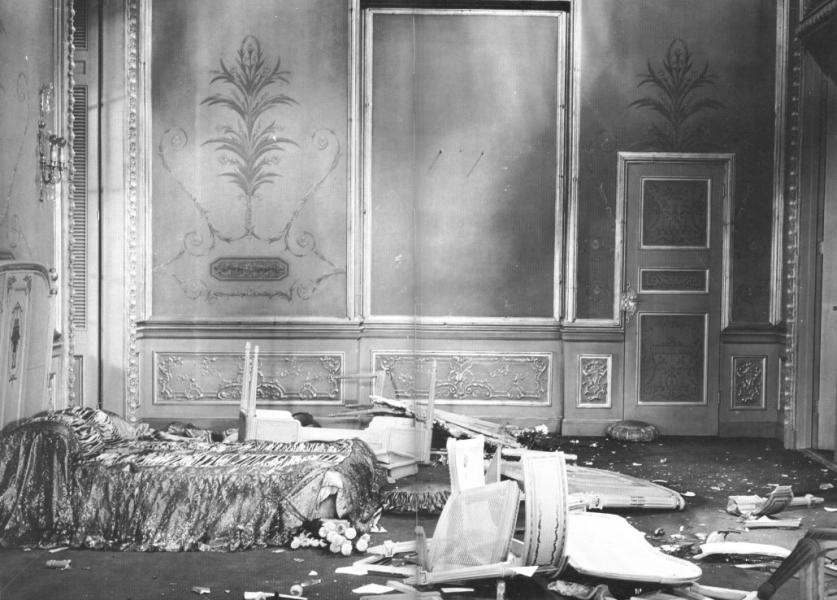
The room pretending to be room 1219 in Hollywood Babylon (1975). Notice the louvered doors, indicative of a subtropical manse rather than an American hotel room of the early 20th century.
The original image wasn’t used in Anger’s earlier editions of Hollywood Babylon. And one must realize that as an artist, too, Anger used stock images that conveyed the idea of the text. His room 1219 is just a “movie still” and may, indeed, be just that, a set, built on a sound stage for a long forgotten motion picture. It isn’t an archival image that has any connection to the Arbuckle case.
What the room really looked like, taken by the state’s criminologist Oscar H. Heinrich or his assistant, Salome Boyle, reveals quite a different interior than the high-ceilinged one with the painted plaster panels and moulding and the satin bedspread.

The real room 1219 in Professor Heinrich’s Arbuckle case notes (Edward Oscar Heinrich papers, BANC MSS 68/34 c, The Bancroft Library, University of California, Berkeley).
Instead of the one bed, there are two brass beds. Notice that they are mismatched. One had to be brought in after Arbuckle and his party arrived—he shared 1219 with the director Fred Fishback. Somewhere in this room, or the bathroom, on the floor between the beds, against a door, a pedestal sink, across the hard brass rail—somewhere here something happened to Virginia Rappe that was left to the imagination—for it couldn’t be reported and the trial transcripts are long lost (or long destroyed) such that we don’t know if such graphic details were presented in court—they certainly couldn’t be reported in newspapers. In any event, it is quite a different interior to work with a century later, with decades of getting it wrong, like hundreds of coats of the wrong color, the risqué painted over, waxy deposits from the candles of the curious, and so on, to remove with the fine, painstaking tools of an art restorer, as it were.
 Spite Work: The Trials of Virginia Rappe and Fatty Arbuckle
So I was recently able to take a look at these rooms today. Really quite fascinating. The general layout remains nearly identical. The biggest difference is that room 1221, which served as a bedroom in Arbuckle’s day is now the living room for 1220, which is now a bedroom. Also, in Arbuckle’s day, 1220 didn’t have a bathroom. Sometime after they added a bathroom to 1220, which meant moving the connecting door from the far end of the room by the window, to closer to the hallway door.
All in all, a fascinating look at history, even until this day.
LikeLike
I used to think it might be nice to spend a week there (which would cost thousands to have the suite, as much, perhaps, as a week of or more of Gavin McNab’s time adjusted for inflation). But, as I discovered with my book about the poet Weldon Kees, too much time has passed and there is a void, one that doesn’t materially add to the narrative save to underscore how transient reality is.
LikeLike
Out of curiosity, have you come upon any images of room 1220 as it existed during that time during your research?
LikeLike
Professor Heinrich only preserved photographs of 1219. There is, however, a photograph he took of 1219’s connecting doorway from 1220. You can see what passed for hotel art in 1921, a period reproduction of a game of whist. Whist, of course, was giving way to bridge–and that is what Arbuckle and his gang could have done instead. Virginia Rappe was excellent bridge partner.
LikeLike