Fred Fishback: carrying Arbuckle’s water

What has challenges anyone giving serious thought to the Arbuckle case—from lawyers and reporters in 1921 to this writer over a century later—is to reimagine the sequence of events that comprise Virginia Rappe’s crisis in room 1219 of the St. Francis Hotel as well as Roscoe Arbuckle’s culpability or innocence. The trial transcripts provide some answers if one is patient enough to read them. There you can see that District Attorney Matthew Brady and his assistants were confronted with how to arrange that sequence to advance their case against the comedian. His lawyers, to counter this, rearranged the sequence and provided an alternate to defend their client. That said, neither sequence is necessarily faithful to what happened seamlessly and without self-serving jump cuts of courtroom economies.

The most important of these discrete events concerned Virginia Rappe’s utterance: “I am dying, I am dying, he hurt me.” Prosecutors massaged these phrases from witness testimony so that a jury might conclude that Rappe had accused Arbuckle, an accusation fundamental to the charge of manslaughter. In response, the comedian’s lawyers found a convincing way to redirect Rappe’s accusation at Arbuckle’s roommate at the St. Francis Hotel, namely the comedy director Fred Fishback, whose role in organizing the 1921 Labor Day party, procuring women, and, despite not being a drinker, ensuring the supply of liquor, is very much discussed in my book. He is very much a person of interest.

Neither strategy on the part of the prosecution and the defense factored in that Rappe couldn’t have said those words so easily, so plainly, if at all. Nor was she very alert as her medical emergency progressed. Indeed, she went into shock and lost consciousness soon after Arbuckle left her fatally injured in his bedroom.

The ministrations of the first responders among the party guests were intended to learn what was wrong with Rappe. They found her writhing in the middle of a wet, disheveled bed. She was still fully clothed, still wearing her high heels. She clutched her lower abdomen. She was still verbal when she saw or sensed the presence of others in 1219. Then she kept complaining of her pain, saying over and over, “I am dying, I am dying.”

Being reassured that she was going to live gave Rappe little consolation. Her pain was excruciating enough to frighten her and anyone looking on. She became increasingly hysterical and started to tear at her clothes, which I attribute to going into shock while simultaneously exhibiting many of the symptoms associated with panic disorder.

Seeing this horrified Arbuckle and he immediately disassociated himself. He had two of his guests, both call girls, Zey Prevost and Alice Blake, try to dress Rappe and take her back to the Palace Hotel. But it was too late for that. So, Blake took it upon herself to pull Rappe up and off the wet bed after she had been undressed. Then, walking backward two or three steps, Blake let herself fall with her burden still on top of her. Unable to get out from under Rappe, whose body had gone slack, Fishback stepped up and lifted Rappe off of Blake. This was the first time Fishback handled Rappe.

At some point after Rappe’s “first” lift, Blake tried to get Rappe to drink bicarbonate of soda from a glass of hot tap water. But she could not swallow and the solution dribbled from her lips. Meanwhile, Prevost noticed that Rappe’s eyes were rolling backward.

From this point on, the prosecutors and defense lawyers were arbitrary in where to place events in a straight line. Blake, Prevost, Fishback, and other witnesses provided jigsaw pieces that almost fit but had to be forced together. Thus, a juror could see Arbuckle standing by an open window overlooking the light shaft outside room 1219. There he was within earshot when Rappe accused him, an important feature of being charged not only with manslaughter but with murder, too, if a woman is raped and dies as a result. And by that window, he responded to her. He told her to “shut up.” He threatened to throw her from the twelfth-floor to make her stop. Then he approached her with an ice cube, which he inserted into her vagina—ostensively to “come to” (pun and double entendre aside). A juror paying more attention, however, could see the problem. The victim was unconscious. So, how could Miss Rappe speak or pick someone out in the room to accuse him of hurting her?

The prosecutors never backed down from the paradox of the accusation—and never got over how it devolved from Prevost having heard “he killed me.” They could only go back to their signed statements, which had been extracted by compromise if not duress. As for Arbuckle’s lawyers, they could assert that Rappe meant someone else and Fishback served that purpose, given how much he had handled Rappe. They didn’t have to stretch the truth. Early on, Fishback admitted to the District Attorney’s men that he had tried to help Rappe. “They told me to pick her up by the feet,” he said in an unsigned statement made a few days after Rappe’s death. “One of the girls told me that, so the blood would rush down to her head. I got her up—held her up. She seemed to be a little relieved.”[1]

Not only did Fishback handle Rappe twice so far. He took responsibility for the following acrobatic feat, which is recreated in this scene from the working manuscript:

[. . . ] the only heavy lifting that Zey, Alice, and Maude agreed on followed the abortive attempt to make Virginia drink the bicarbonate of soda. Once more Alice tried to lift her up on her own and walk her toward 1219’s—this after someone, possibly Fishback himself, had suggested that a cold bath might better revive Virginia.

     After enough water had been drawn, he grabbed Virginia’s arm and leg and carried her bodily sideways through the narrow bathroom door. Alice followed, cradling the head in the awkward task of dropping Virginia into the water.

     Instead of regaining consciousness, Virginia began to scream in pain again and writhe about, sloshing cold water over the sides. So, Fishback pulled Virginia out. Alice toweled her off on the toilet seat. Then they carried her back to the dry bed.

     Seeing he could do no more, the comedy director left 1219 and took the elevator back downstairs to find his friend Ira Fortlouis playing cards in the Frontier Room—and no worse for wear, despite Lowell Sherman’s ruse to get him out of the Arbuckle suite.

(msp. 97)

None of above solves the crime of another century. Too much of the original chronology has been spliced together and lost. There will be no director’s cut. That said, the unintended slapstick of the Arbuckle–Rappe tragedy still remains: Fred Fishback, by holding her up by the waist, by the ankles, and like a side of meat, started an iatrogenic catastrophe. Rather than restore her, Fishback unwittingly decanted more urine into her abdominal cavity from a ruptured bladder, which Virginia Rappe still suffered under Arbuckle’s watch.

There was no scapegoat for that initial injury and the prosecutors relied on this rather atomic fact.

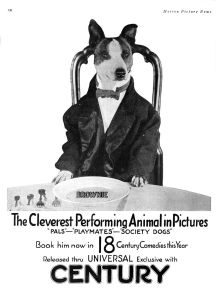
Fred Fishback, who served as Arbuckle’s dog on the stand, was a master at directing children and trained animals for Universal Pictures in the early 1920s.


[1] People vs. Arbuckle, Second Trial, “Testimony of Howard Vernon,” 2061. Vernon, a police department stenographer, transcribed the statement made by Fred Fishback on September 12, 1921.

A brief consideration of a tales(wo)man: Mrs. Helen Hubbard

The new manuscript is now well informed by the trial transcripts. The next part of the book still needs to be written, devoted to the Arbuckle–Rappe trials—and they are both on trial in this book. But any verdict will be handed over to the reader with some new ideas to consider. This, I guess, makes the reader a metajuror and, in keeping with that duty, we might look at how one of the original jurors was selected in November 1921. I cannot devote a lot of space to this, even though I am a trial junkie now. You can see how virtually everything is played out in advance of the first day of testimony. Indeed, writing about them will be like writing about a formality.

Let’s look at Mrs. Helen Hubbard. Her single vote of guilty caused a hung jury and forced the Arbuckle case to continue into 1922 and two more trials. The film historian Joan Myers took special interest in Mrs. Hubbard in her essay, “Virginia Rappe & The Search for the Missing Juror,” which, I believe, dates back to before 2013. But Ms. Myers could only go by newspaper accounts.

That Mrs. Hubbard served on the first Arbuckle trial jury stands out because she was the wife of a lawyer. She had once worked for a law office in Toledo, Ohio, before her marriage and worked for her husband’s growing practice, which dealt mostly in civil law. By 1921, however, she preferred to be a homemaker and bridge player. She was good enough to teach other women how to play as well and participate in bridge tournaments.

Mrs. Hubbard proved to be competent on the stand when first examined by Assistant District Attorney Milton U’Ren, her answers were quick and without hesitation, even when tested. She surely knew how to answer a question in such a way as to be disqualified and so avoid such an interruption to her life.

Q. Now, Mrs. Hubbard, if Mr. Hubbard were the District Attorney of the City and County of San Francisco, entrusted with the prosecution of this case, would you like to have him try the case before twelve jurors who were in your present frame of mine?
A. Yes, sir.
Q. You would think in that cast that he would have a fair and impartial jury?
A. I think he would.
Q. And if, on the other hand, some person near and dear to you were charged with a crime and placed upon trial, would you be willing to have them—be willing to have that person tried by twelve persons in your present state of mind.
A. I would.[1]

Although Mrs. Hubbard later professed a reluctance to serve as a juror, her crisp replies to U’Ren suggest otherwise. Indeed, until her vote, she was seen by the prosecution and defense as an ideal witness. Reporters who kept an eye on her in the jury box couldn’t get a read on her. (The poker face, presumably, owing much to her preferred game.)

Arbuckle’s lead counsel, Gavin McNab, asked different questions, prefaced, interpolated with parentheticals, and more often wrapping around their point. His required much more concentration not only from the juror, from by the other lawyers. McNab, however, had to tease out any female talesmen who might sympathize with women’s groups that wanted “Fatty” Arbuckle punished, namely San Francisco’s Women’s Vigilant Committee.

This organization, in the context of the Arbuckle trials did not police the “immoral” behavior of women but rather served as observers of how female witnesses were respected on the stand. The WVC also wanted justice served if Arbuckle case revealed a high-profile example of violence toward women. Some members of the WVC wanted to see another amendment, as important as the eighteenth, that guaranteed “the right of every woman to become intoxicated in personal safety. [. . .] If a man gets drunk, it is regarded as his liberty. If a woman does the same thing, society, like the Romans of the Coliseum, is willing to turn the wild animals upon her.”[2]

Despite U’Ren best efforts to get in front of the “clubwomen” issue, McNab didn’t waste time with his first question and making them the issue.

Q. Mrs. Hubbard, the District Attorney has asked you somewhat extensively about women’s clubs and their part in the case. It does not create any prejudice in your mind because the defendant and his counsel prefer to be tried by a sworn jury, and his Honor presiding, rather than the emotions of any club?
A. No, sir.

U’Ren did not let this go. “Well, we submit that is an improper question, if your Honor please, and argumentized,” he said to Judge Harold Louderback. “We do not know what is in the heart or mind of the defendant. It is understood he is to be tried by a jury.” The judge allowed for the question but said it was “rather farfetched” and admonished McNab for not framing his inquiries “so as they could be answered with less trouble.”

McNab abided by this warning and simply asked questions about “the mechanics of a trial.” Then he asked her a question that was posed to every talesmen, which foreshadowed the strategy Arbuckle’s lawyers took. (The so-called “blackmail plot” involving Bambina Maude Delmont had long since been cast aside. I have a theory for canard in the book—and it is a canard.)

What McNab did here was to try the case in a set-piece, presenting the defense’s theory about Virginia Rappe’s fatal injury as self-induced over many years of illness and immorality, despite promises made to the contrary.

Q. In the trial of the case, Mrs. Hubbard, it may be the duty of the defense to present evidence as to the physical condition of this young girl at various times in her life. She came to her death through a ruptured organ, an ordinary physiological occurrence, and it may—the defense may present testimony covering many years, to show that her condition, that that might haven at any time—

“Just a minute,” U’Ren interrupted from his end of shared counsel table (which weren’t divided into two in 1921). “We are going to object to that question, because, first, it is involved and complex and in the second place, if your Honor please—”

Then U’Ren was interrupted himself by Nat Schmulowitz, McNab’s chief assistant. “If you will just wait until the question is completed—

“Mr. McNab is conducting the examination,” replied U’Ren condescendingly, “and I am attempting to make an objection, and I thought the question had been completed, but the vice of the question is apparent already, when counsel says that the ruptured bladder is an ordinary physiological condition. I do not know whether he really meant that, or not, but that is assuming something that is not true.”

And so it went for Mrs. Hubbard. The examination of the jurors was, as many reporters pointed out, had all the hallmarks of the trial to come. There were also many curiosities for us to parse. McNab used the words “wine party” to describe the drinking of good scotch and questionable gin at Arbuckle’s Labor Day party. The word “wine” was a polite way to refer to the comedian’s violation of Prohibition. But the word, in an obsolete sense, also meant any fermented concoction. So, U’Ren would not have objected. He did question Mrs. Hubbard again in a brief redirect and one of his questions was no less longwinded than his counterpart’s—and McNab prompted it when he asked, “You understand that no one is supposed to own a witness, neither side, Mrs. Hubbard?”

This was in reference to the District Attorney Matthew Brady’s controversial policy of isolating his star witnesses, Alice Blake and Zey Prevost, for nearly two months prior to the trial, so as to prevent them from being influenced by Arbuckle’s lawyers through third parties. The prosecution had to ferret out problem jurors who might take to heart McNab’s statements “as evidence that these witnesses were put in cold storage or upon the grill”—yet another feature of all three trials, reaching a crescendo of sorts in the second trial, when much of the local press was aligned against the prosecution.[3]

Q. Now, if it should appear in this case, Mrs. Hubbard, that the District Attorney had certain information which led him to believe that certain of the witnesses who were to be called to testify for the State, were being approached by someone with propositions to change their testimony, and with their consent, he took the precaution of placing them in the care of an estimable lady in this city and count, would the fact that the District Attorney had taken such precautions prejudice you against their testimony?
A. No, sir.

Not all of Mrs. Hubbard’s answers were so yes and no. She did give a few personal details in some. She liked to go to the picture shows and was familiar with Arbuckle comedies, albeit not particularly a “fan.” That he played “funny parts” didn’t make her think that he was incapable of committing a criminal act on a woman.

I’m not so sure.

A still from Fatty’s Wine Party (1914)

[1] People vs. Arbuckle, First Trial, “Examination of Talesmen,” pp. 248ff.

[2] Alma Reed, “Right of Women to Personal Safety Urged by Club,” San Francisco Bulletin, September 15. 1921.

[3] There really should have been no controversy, for McNab himself was able to meet with Miss Blake after her mother took her home in early November. This forced Brady to let Prevost go home as well.

Roscoe Arbuckle’s suicidal ideation  or waxing philosophical?

A psychological portrait of Roscoe Arbuckle at this late date is all but impossible. One just has his “aw-shucks” remarks to go on and they are rather hard to take seriously or give a close-reading. But during a November 1920 interview, the comedian contemplated a weight loss regimen. “I’m going to train down for one thing,” Arbuckle said,

and then I’m going to tour the country, disguised in my thinness. I’ll visit all the big theaters and ask people what they think of that alleged funny man, Arbuckle. [. . .]  I’m going to see all of America first, and then, of course, I’m going to Europe. One place I look forward to is Monte Carlo. Sure, that’s the reason I’m rehearsing at Tia Juana![1]

He said this the same year that Virginia Rappe became obsessed with her own weight. She not only exercised, she used laxatives. She may have even purged.

But what might Arbuckle really be saying here, in keeping with in risu veritas (in laughter, truth)? Could he have been no less weight conscious? In his case, losing any weight would have been virtually a violation of his million-dollar contract with his employer, Paramount Pictures.

Then there is this: In the earliest statement made by Zey Prevost, the most reluctant witness against Arbuckle at his first two trials for manslaughter, she recounted a strange interlude at his Labor Day party on September 5, 1921. As the comedian and his guests enjoyed a drinking “brunch” in a reception room, 1220, on the top floor of the St. Francis Hotel, Arbuckle seemed to wax philosophical once more: but his method of escape had changed.

He undoubtedly intended his remarks to be heard by all his guests, including Virginia Rappe. She would have heard him. She may have even said something to prompt him.

After all, he and his friends were violating Prohibition. They were all married and had a roomful of young women to themselves. The comedian was certainly taking a career risk while playing hooky from Los Angeles and “Paramount Week,” when his company feted its latest motion pictures and actors.

Assistant District Attorney Milton U’Ren wanted to know from Prevost if Arbuckle had been intoxicated before he soon followed Rappe into his adjoining bedroom, 1219, and locked the door. But he got this answer instead.

Q. I mean was his speech coherent?

A. He was talking about jumping out of the twelfth-story window. He said, “Oh what is in life after all?” Really, it did sound funny. We were all sitting by the window. He said: I will jump out of the window with anybody who wants to jump out.

Q. Did anybody volunteer to go with him?

A. No, nobody. We all looked at him. He said something: If I would jump out of this twelfth-story window, they wouldn’t talk about me today and tomorrow. They would go to see the ball game instead. So, what is life after all?”[2]

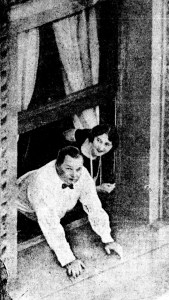
Roscoe Arbuckle and Mrs. Mae Taube at the window of room 1220,
St. Francis Hotel, September 4, 1921
(Newspapers.com)

[1] “Flashes: Roscoe Arbuckle Plans,” Los Angeles Times, July 7, 1920, III:4.

[2] “Zey Pyvron Prevost Tells of Wild Orgy: Arbuckle “Got Mad” at Rappe Girl,” San Francisco Examiner, September 15, 1921, 3.

Arbuckle’s testimony of November 28, 1921 – Revised and Expanded

No celluloid will ever show the like of it or scenario tell the equal of it. It is Fatty’s masterpiece.

—Freda Blum

On the morning Roscoe Arbuckle was to testify, November 28, 1921, it was rumored that an unidentified attorney threatened to quit the comedian’s “million-dollar defense” team. According to the Los Angeles Express, this was Milton Cohen, angered over the lead defense attorney, Gavin McNab, mulling the idea that it might be better not to have the defendant testify. Chandler Sprague in the San Francisco Examiner reported one possible reason for McNab’s hesitation: that “certain business interests were adverse” to the comedian testifying, a veiled reference to one man, surely, Adolph Zukor, who was hardly as sanguine about Arbuckle making a comeback as his manager and chief fund raiser for his defense, Joseph Schenck, and the man assigned to watch his clients in Hollywood, Lou Anger.

There was also dissension on the prosecution’s side. Milton U’Ren, a veteran assistant district attorney, had been passed over to lead the cross-examination of Arbuckle. He was angry enough to resign from the case as well, a case that he had largely developed with the approval of District Attorney Matthew Brady. During the noon recess, U’Ren could be heard arguing with Brady in the Hall of Justice because his fellow prosecutor, Leo Friedman, had hardly made a dent in Arbuckle.

Most reporters expected the comedian to do well and eclipse anything thus far said from the witness chair. Otis M. Wiles for the Los Angeles Times used a slapstick term for the comedian’s impending appearance as a “climax stunt.” Early into his cross-examination, Arbuckle impressed most of the reporters who saw and heard him. Who they were rooting for, too, was evident in their copy. According to Bart Haley of Philadelphia’s Evening Public Ledger, Arbuckle

revealed himself in his narrative as the most piteous of fat men, the most tragically used of all good Samaritans, an amiable individual whose rooms were invaded by uninvited guests, who ate his food and borrowed his motorcar, and ran up a big bill on him and got him into a pit of trouble with the hotel management before they finally started him on the way to jail under a charge of murder.[1]

Earl Ennis of the San Francisco Bulletin seemed to applaud Arbuckle as well. But he also touched on what the monitors of the Women’s Vigilant Committee—and Zukor as well—knew would be hard to square. “There was nothing nice about Arbuckle’s story—noting elevating,” Ennis wrote, “It was a ‘booze party,’ pure and simple with jumbled elements involved—salesmen, movie stars, women, all scrambled unconventionally into an afternoon’s entertainment.”[2]

What follows is a revised version of our “provisional” transcript of Arbuckle’s testimony, which is likely the most complete version available since no state transcript has been preserved or discovered. For the most part, it is based on four San Francisco dailies—the Bulletin, Call, Chronicle, and Examiner—which employed their own stenographers.

Most of the reporters covering the trial believed that Arbuckle had secured his acquittal. As it turned out, at least two jurors were unconvinced and saw Arbuckle as an actor playing a role. Indeed, the testimony reads as if it were tailored or, to use the language of the cinema, a recut of previous testimony by other witnesses to fit the image of a gentler Good Samaritan Arbuckle that would befit the public image of “Fatty.” This includes his original statement issued on the night of September 9, 1921, the day Virginia Rappe died, and published the next day in the morning Los Angeles Times. That statement, which was vetted by Arbuckle’s original lead attorney, Frank Dominguez, only states that “After Miss Rappe had a couple of drinks she became hysterical and I called the hotel physician and the manager.” In its place, however, Arbuckle posits a much expanded series of events.

Traces of the real Virginia Rappe emerge here and there in the testimony. There was even a moment of unintended silence just before the noon recess, when Deputy Coroner Jane Walsh entered the courtroom, carrying Rappe’s bladder, preserved in a glass jar and placed on the evidence table. But in Arbuckle’s account of September 5, 1921, Rappe remains a cipher, a poseable doll even before she is found on the bathroom floor. The comedian is very careful to avoid how well he knew Rappe. They had a certain rapport. But here the comedian quite literally turns his back on her the moment she made her way to his bedroom. This way, he can assert that he was unaware that she was there when he entered to get dressed in order to go “riding” with the other woman in his story, Mae Taube.

Though Arbuckle’s testimony is ductile, that fits and twists and conforms to what really happened in room 1219, it suggests to us that the injury that was inflicted on Rappe took place in the bathroom and even has the outlines of sexual imposition. Laws had been on the books for decades in regard to the temptations of hotel and furnished room accommodations as dens of lasciviousness, fornication, and adultery. But for casual sex during a party in a smallish three-room hotel suite, the privacy for such intimacies (and immediacies) could be found in the bathrooms. If there was a sexual encounter that preceded or led to the injury, the bathroom would have provided a space with greater privacy and sound dampening, not to mention conveniently located fixtures such as a sink, a toilet, and towel rods for grab irons, as well as the hard surfaces on which to brace oneself. The brass bedsteads in room 1219, shown in E. O. Heinrich’s photographs, could also serve this purpose. But Arbuckle, much as he was proud to cross his leg, likely could do it Venus observa.

What was termed an “official transcript” lacked much of Arbuckle’s real “voice” dismissing Friedman’s skepticism and often making him Fatty’s straight man. But the seeming frustration and incompetence seen in the youngest member of the prosecution is exaggerated. Friedman’s approach likely relied on the jury’s perception of subtleties in Arbuckle’s testimony that reveal it to be rehearsed, coached, and a piece of fiction. We also see places where Friedman should have probed more deeply, such as Arbuckle’s making his friend and roommate at the St. Francis Hotel, the comedy director Fred Fishback, a patsy for the liquor and inviting Rappe at the behest of his friend, Ira Fortlouis, a San Francisco gown salesman, the latter being mysteriously expelled from the party at the time of Rappe’s crisis.

It was Fortlouis’s sighting of—or rather attraction to—Rappe that resulted in her invitation to Arbuckle’s suite. Did Fortlouis pay so much attention to her that Arbuckle saw a rival to his own attentions to Rappe? And why did Friedman not ask about the vomit? It seems as though Rappe vomited copiously and it’s unlikely all of it would have gone down the toilet, yet that word is absent in all the other testimonies. In the testimony of party guests Zey Prevost and Alice Blake, the back of Arbuckle’s pajamas is visibly wet. The double bed in which Rappe was wet. But nothing was asked about the source of the wetness, as though it were a taboo subject. One must wonder if there was a code among newspaper editors that prevented them from reporting specific details. (Interestingly, the prosecution’s criminologist E. O. Heinrich reported on old semen stains he found on the mattress pads and bedclothes, but these had already gone through the laundry and could have come from other guests. For this reason, Milton U’Ren elected to pursue only the fingerprint evidence and the marks left by the French heels of Maude Delmont’s kicking the door—which Arbuckle said that he didn’t hear.)

The same might be asked about the defense attorneys who failed to subpoena May Taube. She was possibly Arbuckle’s only close friend at the hotel that day. She was seen by other party guests in the early afternoon, as Arbuckle’s testimony states. But in her one statement to the District Attorney, she left because she didn’t know anyone there, which refers to the women and with the implication that they were low by her standards. Friedman does establish that Arbuckle introduced Taube to one of these women, indeed, Virginia Rappe. But that is as far as he takes it, leaving it to the jury and us to see if there was a “woman scorned.”

Taube could have easily corroborated the story Arbuckle tells in the following transcript. She would also have been a perfect character witness. Although she didn’t go “riding” with Arbuckle on Labor Day afternoon, Mrs. Taube spent the night of September 5 dancing with him in the St. Francis ballroom according to her statement to the DA. But she is never called in any of the three Arbuckle trials. That she was that untouchable suggests she held a certain leverage. (See our Taube entry for more information about her.)
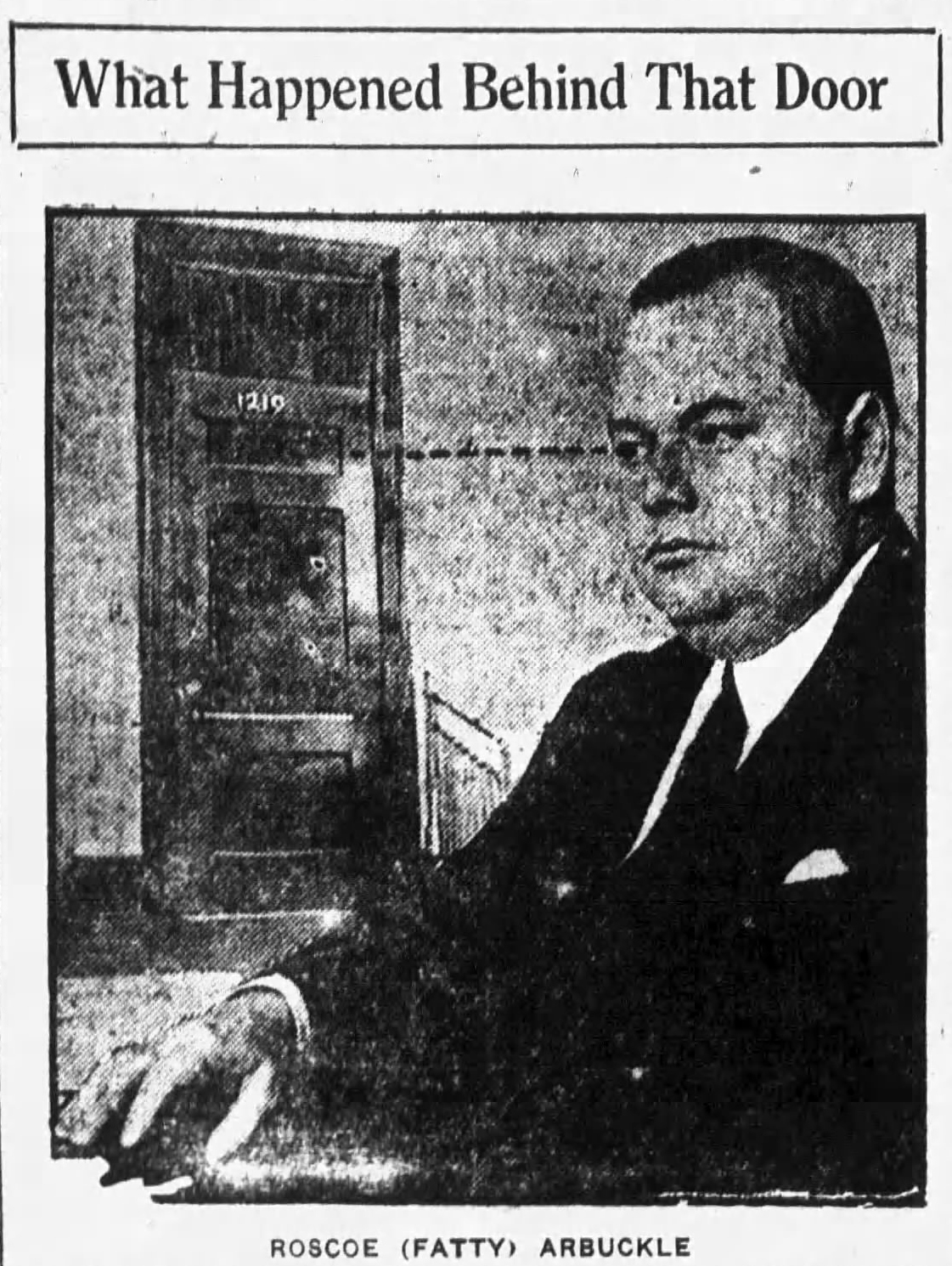
modesto_evening_news_mon__nov_28__1921_-1Satirical photograph published in the Modesto Evening News, November 28, 1921 (Newspapers.com)

[1] Bart Haley, “Fatty, Cool on the Stand, Recites New Version of Miss Rappe’s Hurt,” Evening Public Ledger, 29 November 1921, 1.

[2] Earl Ennis, “Crowded Court Listens Tensely as Actor Tells Details of Tragic Party,” San Francisco Bulletin, 28 November 1921, FS1.


Arbuckle: My name is Roscoe Arbuckle. I am a movie actor. [. . .]
McNab: Mr. Arbuckle, where were you on September 5 of this year?
A: At the St Francis Hotel.
Q: What rooms did you occupy at the St. Francis Hotel?
A. 1219, 1220 and 1221.
Q: Did you see Virginia Rappe on that day.
A: Yes, sir.
Q: At what time, and where?
A: She came into 1220 about 12 o’clock, I should judge.
Q: That is 1220, your room at the St, Francis Hotel?
A: Yes, sir.
Q. Who were there when she came?
A: Mr. Fortlouis, Mr. Sherman, Mr. Fischbach[1] and myself.
Q: Did Miss Rappe come to those rooms by your invitation?
A: No, sir.
Q: Who, if anybody, joined your party?[2]
A. A few minutes —
Q: Joined the company in your rooms?
A: A few minutes after Miss Rappe came in Mrs. Delmont came in.
Q: Dd you know Mrs. Delmont previous to that time?
A: No, sir.
Q: Was Mrs. Delmont there by your invitation?
A: No.
Q: Who else came in, if anybody?
A: Miss Blake came in.
Q: Did Miss Blake come there by your invitation?
A: No, sir.
Q: Anybody else come?
A: Yes, Miss Prevost came later.
Q: Did Miss Prevost come by your invitation?
A: No, sir.
Q: Anybody else come?
A: Mr. Semnacher came in.
Q: Did Mr. Semnacher come by your invitation?
A: No, sir.
Q: Did anybody else come?
A: Yes, sir, Mrs. Taube and another lady.[3]
Q: Did Mrs. Taube come by your invitation?
A: Yes, sir.
Q: How were you dressed on that occasion?
A: I was dressed in pajamas and bathrobe and slippers.
Q: I will ask you if this is the bathrobe that you wore on that occasion (showing bathrobe to witness).
A:  Yes, sir, my robe, yes, sir.
Q: I will ask the ladies and gentlemen of the jury to look at this; this has been much commented on in evidence.
Q: Did you at any time during that day see Miss Virginia Rappe in room 1219?
A: Yes, sir.
Q: About what time.
A: Around 3 o’clock.
Q: How do you know it was about 3 o’clock?
A: I looked at the clock; I was going out.
Q: And what fixes—what caused you to look at the clock at that time?
A: I had an engagement with Mrs. Taube, and she came up about 1:30, but I had loaned Mr. Fischbach my car and she said she would wait downstairs until he came back; and he said he was going to the beach and he would come back just as soon as he could, so I figured it was about time for him to come back, so I looked—
Mr. Friedman: Just a moment. We ask that everything after the words “I figured” be stricken out as a conclusion of the witness.
The Court: It goes out.[4]
Mr. McNab: Where, if any place, previous to seeing Miss Rappe in 1219, where last before had you seen her?
Arbuckle: In 1220; I saw her go into 1221.
Q: And when you entered—at what time did you enter 1219?
A: Just about 3 o’clock.
Q: At the time you entered 1219 was or not the door between 1219 and 1220 opened?
A: Yes, sir, it was open.
Q: Did you know at the time you entered 1219 that Miss Rappe was there?
Mr. Friedman: Now, that is objected to as calling for the conclusion of the witness, and as leading and suggestive. And upon the ground that the question has already been asked and answered.
Mr. McNab: I have not asked that, and the question is not leading.
The Court: Objection sustained.
Mr. McNab: Did your honor sustain the objection?
The Court: Sustained the objection.
Mr. McNab: At the time you entered 1219, I understand the door between 1219 and 1220 you state was open?
Arbuckle: Yes, sir.
Q: And where in 1219 did you see Miss Rappe?
A: I did not see her in 1219.
Q: Where did you see her?
A: I found her in the bathroom.
Q: Of what room?
A: Of 1219.
Q: And under what circumstances did you find her in the bathroom?
A: When I walked into 1219, I closed and locked the door, and went straight to the bathroom and found Miss Rappe on the floor holding her stomach and moving around on the floor. She had been vomiting [ill].[5]
Q: What did you do? Explain to the jury all the circumstances which occurred in the bathroom of 1219.
A: When I opened the door the door struck her, and I had to slide in this way (illustrating) to get in, to get by her and get hold of her. Then I closed the door and picked her up. When I picked her up, [I held her, and she was ill again]; I held her under the waist, like that (indicating), and by the forehead, to keep her hair back off her face.
Q: Then what else occurred? Give the jury all the circumstances occurring in the bathroom of 1219.
A: I took a towel and wiped her face, she was still sitting there holding her stomach, evidently in pain, and she asked for a drink of water.
Mr. Friedman: We ask that the words “evidently in pain” be stricken out.
Mr. McNab: It may go out.
Q: She asked for a drink of water, and I gave it to her, and she drank a glass of water, and she asked for another glass, and I gave it to her, and she drank another half a glass of water.
Q: What else happened?
A: I asked her if I could do anything for her. She said no, she would just like to lie down; so I lifted her into 1219 and sat her down on the small bed and she sat on the bed with her head toward the foot of the bed.
Q: What else did you do, if anything?
A: She just expressed a wish that she wanted to lie down; that she had these spells; that she wanted to lie down a while. I lifted her feet off the floor and put them on the bed; she was lying this way, with her feet off the bed, and I went into the bathroom and closed the door.
Q: What else happened when you left, the bathroom and returned to 1219, if anything?
A: I came back into 1219 in about—well, I was in there about two or three minutes, and I found Miss Rappe between the beds, rolling about on the floor, holding her stomach and crying and moaning, and I tried to pick her up, and I couldn’t get hold of her; I couldn’t get alongside of her to pick her up, so I pulled her up into a sitting position, then lifted her on to the large bed and stretched her out on the bed. She turned over on her left side (Arbuckle said Miss Rappe was taken ill again) and started to groan and I immediately went out of 1219 to find Mrs. Delmont.
Q: Whom did you find in 1220 when you went there?
A: Miss Prevost.
Q: Did you advise Miss Prevost of the condition of Miss Rappe?
A: Yes, I just said “Miss Rappe is sick.”
Q: Did Miss Prevost go into 1219 at that time?
A: Yes, sir.
Q: What else happened?
A: Just a few minutes after Mrs. Delmont came—not a few minutes, just may be a few seconds—Mrs. Delmont came out of 1221 and I told her and she went into 1219 and I followed behind her.
Q: What happened in 1219 then?
A: Miss Rappe was sitting up on the edge of the large bed, tearing her clothes in this fashion (illustrating), tearing and frothing at the mouth, like in a terrible temper, or something—
Mr. Friedman: We ask, of course, that the words “like in a terrible temper” be stricken out as a conclusion of the witness.
Mr. McNab: That may go out.
The Court: It goes out.
Mr. McNab: What else? Give the. jury a narrative of what occurred at that time in 1219.
Arbuckle: I say, she was sitting on the bed, tearing her clothes; she pulled her dress up, tore her stockings; she had a black lace garter, and she tore the lace off the garter. And Mr. Fischbach came in about that time and asked the girls to stop her tearing her clothes. And I went over to her, and she was tearing on the sleeve of her dress, and she one bad sleeve just hanging by a few shreds. I don’t know which one it was, and I says “All right, if you want that off I will take it off for you.” And I pulled it off for her; then I went out of the room.
Q: Did you return to the room later?
A: Yes, sir, some time later.
Q: What was occurring in the room at that time, when you returned?
A: Miss Rappe was then on the little bed nude.
Q: What occurred?
A: I went in there and Mrs. Delmont was rubbing her with some ice. She had a lot of ice in a towel or napkin, or something, and had it on the back of her neck, and she had another piece in her hand and was rubbing Miss Rappe with it. massaging her, and there was a piece of ice lying on Miss Rappe’s body. I picked it up and said, “What is this doing here?” She says, “Leave it here; I know how to take care of Virginia,” and I put it back on Miss Rappe when I picked it up and I started to cover Miss Rappe up, to pull the spread down from underneath her so I could cover her with it, and Mrs. Delmont told me to get out of the room and leave her alone, and I told Mrs. Delmont to shut up or I would throw her out of the window, and I went out of the room.
Q: What else occurred? Tell the jury what did you do? Anything further?
A: I went out of the room, and Mrs. Taube came in and I asked Mrs. Taube if she would phone Mr. Boyle, and we went into 1221, and Mrs. Taube picked up the phone and phoned Mr. Boyle and asked him to come up to the room and get a room for Miss Rappe.
Q: What occurred after that?
A. I went back into 1219 and told Mrs. Delmont to get dressed, that the manager was coming up, and she went out to get dressed, and she pulled the spread down underneath—from underneath Miss Rappe, down below, underneath her feet, and put it up over her, and went back into 1221.
Q: What further happened?
A: Mr. Boyle came in; he came to the door of 1221.
Q: What occurred thereafter?
A: I took him in to where Miss Rappe was lying in 1219.
Q: And what was done then?
A: Mrs. Delmont came in and we put a bathrobe on Miss Rappe, Mrs. Delmont and myself.[6]
Q: Where did you get the bathrobe?
A: Out of the closet; it was Mr. Fischbach’s robe.
Q: And what then was done?
A: We took her around through the hall into 1227.
Q: How did you get out of 1219?
A: Took her out of the door leading into the hall.
Q: Who opened the door?
A: Mr. Boyle.
Q: How did you get Miss Rappe around to 1227?
A: I carried her part of the way. She was limp and did not have any life in her body. She kept slipping, and I got about three-quarters of the way and I asked Mr. Boyle—I did not ask him to take her, I asked him to boost her up in the middle so I could get another hold of her, and he just took her right out of my arms and we went into 1227.
Q: Then what occurred in room 1227, if you know?
A: We put her to bed and covered her up, and I asked Mr. Boyle if he would get a doctor; and I walked back to the elevator with him and then I walked on into the room, into 1219.
Q: Was the door between 1219 and the hall unlocked throughout the day?
A: lt was, so far as I know. Mr. Fischbach went out that way.
Q: You saw him go out.
A: Yes, sir.
Q: And when you took Miss Rappe out, the door was open from the bedroom of 1219, was it?
Mr. Friedman: We object to the question as leading.
Mr. McNab:  Well I withdraw it. How was the door open from 1219 into the hall?
Arbuckle: Mr. Boyle just walked over and opened it.
Q: Was or was not the window of room 1219 open that day?
A:  lt was always open.
Friedman: Just a moment. We ask that the answer “always open” be stricken out.
Court: It goes out.
Arbuckle: lt was open.
McNab: How was the curtain of the window in room 1219?
Arbuckle: I raised the curtain myself in the morning when I arose.
Q: During the time that you were in room 1219, did you ever hear Miss Rappe say, “You hurt me” or “He hurt me”?
A: No, sir. I didn’t hear her say anything that could be understood.[7]
Q: Next day. September 6, or any other time, did you ever have any conversation at all with Mr. Semnacher about any incidents whatever regarding ice on Miss Rappe’s body?
A: Absolutely not.
Q: Did you ever—did you ever at any time, while in room 1219 of the St Francis Hotel, on September 5, 1921, have occasion to place the bottom of your hand over the hand of Miss Rappe, while her hand was resting against the door into the corridor, or did you do so?
A: No, sir.
Q: Did you at any time, while you were in room 1219 of the St. Francis Hotel, on September 5, 1921, come into contact in any way with the door leading into the corridor?
A: No, sir.
Q: Did you ever know a man by the name of Jesse Norgaard?
A: No, sir.
Q: Did you, during the month of August 1919, or at any other time, in Culver City, or at any other place, have the following conversation with Jesse Norgaard: You are supposed to have said to Mr. Norgaard, “Have you the key for Miss Rappe’s room?” and he is supposed to say. “Yes,” and then you are supposed to have said, “Let me have it; I want to play a joke on her.” And then Mr. Norgaard is supposed to have said, “No, sir, you cannot have it.” Then you are supposed to have said, “I will trade you this for the key,” and then you had a bunch of bills in your hand, supposed to have had a bunch of bills in your hand, consisting of two 20s and one 10 and other bills, too. Now, I will ask you if such a conversation, or any conversation like it, happened at the time and place between yourself and Mr. Norgaard?
A: No, sir.
Q: Did any such conversation occur between Mr. Norgaard and yourself, regardless of time and place?
A: No, sir.
Q: Did such a conversation, or anything like it, occur between yours self and any other person at any other time?
A: No, sir.
Q: Did any other circumstance occur in room 1219, of any kind, that you can tell this jury?
A: No, sir.
Q: You have narrated all the circumstances that occurred?
A: Absolutely all of the them.
Mr. McNab: That is all. Cross-examine the witness.
(Twenty-minute recess)
CROSS-EXAMINATION
Mr. Friedman: Now, you stated that you were residing at the St. Francis Hotel on the fifth of September, is that correct?
Arbuckle: Yes, sir.
Q: How many rooms did you have there?
A: Three rooms.
Q: Three, rooms?
A: Yes, sir.
Q: And which of those rooms did you occupy?
A: I slept in the small bed in room 1219.
Q: And did anyone else occupy the room
A: Mr. Fischbach—we were there three nights. He occupied the room with me the first two nights.
Q: And the third night he didn’t occupy the room with you, is that correct?
A: Yes, sir.
Q: Now, you stated that you never saw Mr. Norgaard at Culver City during August of 1919, or at any other time, is that correct?
A: I stated that I never had any conversation with Mr. Norgaard.
Q: Well, did you see him during the year 1919?
A: I cannot remember him.
Q: Now, where were you employed during August of 1919?
A: I had my own company.
Q: You had your own company, yes, but where?
A: At Culver City.
Q: At Culver City?
A: Yes, sir.
Q: And you had a studio there?
A:  No, sir.
Q: Were you using a studio?
A: I was renting a studio there.
Q: And from whom were yon renting the studio, if from anyone?
A: I had to work there, because I had to help finish paying for the studio, and that was the only way.
Q: You had to work where?
A: At Mr. Lehrman’s studio.
Q: Yes. then, during August of 1919, you did occupy the study in conjunction with Mr. Henry Lehrman?
A:  Yes, sir.
Q: And you do not recall whether you saw Mr. Norgaard there or not?
A: I do not remember.
Q: Do you recall of ever seeing Miss Rappe there?
A: Yes, sir.
Q: Now, what time did Miss Rappe enter your room on the 5th of September?
A: About 12 o’clock, as near as I could judge.
Q: Twelve noon?
A: Yes, sir.
Q: And there was no other lady in the room when she entered?
A: No, sir.
Q: And how long was she there before anyone else arrive?
A: I couldn’t tell you; Mrs. Delmont came up a few minutes afterwards, I think.
Q: You knew Miss Rappe before the 5th of September, did you not?
A:  Yes, sir.
Q: How long had you known her?
A: Um-huh, about five or six years.
Q: About five or six years?
A: Yes, sir.
Q: And when you say that—withdraw that. Did you know, before Miss Rappe came to your rooms on the 5th of September, did you know that she was coming there?
A: No, sir.
Q: Nobody told you that she was coming there?
A: No, sir.
Q: Mr. Fischbach didn’t say anything to you about her coming there, did he?
A: He said that he was going to phone her.
Q: Do you know whether or not he did phone her?
A: I presume he did.
Q: Do you know whether or not he did phone her?
A: I didn’t hear him phone.
Q: Did he tell you that he had phoned?
A: He said. “I am going to phone her.” He didn’t really say that to me. He said it to Mr. Fortlouis.
Q: He said that to Mr. Fortlouis in your presence?
A: Yes, sir.
Q: Did he say in your presence whether she was coming up or not?
A: I don’t remember.
Q: Do you recall whether or not he received any phone calls from the time he phoned Miss Rappe until Miss Rappe came up into your room?
A: I do not recall that.
Q: Then I take it that the first you knew that Miss Rappe was coming up to rooms 1219, 1220 ,and 1221 was when she knocked on the door and came into the room?
A: I just heard Mr. Fischbach say that he was going to phone, and then a short time afterwards she came in.
Q: But from the time that Mr. Fischbach said that he was going to phone nobody had told you that she was coming up to the room and you did not know it until she came into your room?
A: No, sir.
Q: Where were you when she entered the room?
A: I was in 1219.
Q: You were not in room 1220 when she entered?
A: No, sir. but I saw her come in.
Q: How long afterwards did you enter room 1220?
A: Almost immediately.
Q: Almost immediately?
A: Yes, sir.
Q: And how long did you remain in room after she arrived?
A: I remained there until I went into room 1219.
Q: And how long was that?
A: Well, from the time that she came in until around 3 o’clock.
Q: You remained there about three hours then?
A: Yes, sir.
Q: And you were donned how when Miss Rappe entered room 1220?
A: I was clothed in this bathrobe and pajamas and slippers.
Q: What kind of pajamas were they, silk?
A: Yes, sir.
Q:  And slippers?
A: Yes, sir, and I had my socks on.
Q: You had your socks on?
A: Yes, sir.
Q: And room 1219 was your room, wasn’t it?
A: Yes, sir.
Q: Now, how long after Miss Rappe had entered room 1219, how long after that was it that Mrs. Delmont appeared?
A: Mrs. Delmont came in just a few minutes after Miss Rappe came in.
Q: And did you know how Mrs. Delmont happened to come to room 1220?
A: No, I do not know.
Q: You do not know?
A: No, sir.
Q: Did you know Mrs. Delmont before the 5th of September?
A: No, sir.
Q: And the first that you knew that Mrs. Delmont was coming to your rooms was when she knocked on the door and entered?
A: Yes, sir.
Q: Nobody ever told you that Mrs. Delmont was corning up to your rooms?
A: No, sir.
Q: You didn’t hear anyone phone downstairs for her?
A: No, sir.
Q: Did you see or hear any one use a telephone in either of these three rooms at the time that Miss Rappe entered room 1220 until Mrs. Delmont entered?
A: Yes, sir, I saw Miss Rappe use the phone.
Q: Which phone did she use?
A:  She used the phone in room 1220.
Q: In the same room that you were in?
A: Yes, sir.
Q: You didn’t hear what she said?
A: No, I didn’t hear what she said; I knew to whom she was talking.
Q: In that conversation did she mention the name of Mrs. Delmont?
A: No, sir; not that I recall; she talked to a lady by the name of Mrs. Spreckels.[8]
Q: Did you hear Miss Rappe mention the name of Mrs. Delmont from the time that Miss Rappe entered your room until the time that Mrs. Delmont appeared?
A: No, sir, she. never mentioned the name. She said she had a friend downstairs.
Q: Did she say who that friend was that she had downstairs?
A: No, sir.
Q: She never said that Mrs. Delmont was coming up to the room; never said that Mrs. Delmont was waiting downstairs or never said anything about Mrs. Delmont until she arrived, actually arrived in room 1220?
A: She never mentioned the name.
Q: She didn’t say that she was coming?
A: Not by name.
Q: You don’t recall that?
A: No, sir.
Q:  You were in room 1220 when Mrs. Delmont arrived?
A: Yes, sir.
Q:  What room did she enter?
A: She came into room 1220.
Q: Came into room 1220?
A: Yes, sir.
Q: And you were still clothed as you have testified to?
A: Yes, sir.
Q: Did you ever change those clothes from the time Miss Rappe arrived until Miss Rappe went into the bath of room 1219 as you have testified to?
A: No, sir.
Q: Now, who was present when Mrs. Delmont arrived in the room?
A: Miss Rappe, Mr. Sherman, Mr. Fortlouis and myself, and Mr. Fischbach, I think. He was in and out; I do not know whether he was there or not at that time.
Q: And how long after Mrs. Delmont arrived was it before someone else joined the party, if anyone, did join the party?
A: Well, I do not know; they kept coming in all the time.
Q: Well, who was the next person to enter your rooms after Mrs. Delmont arrived?
A: Miss Blake.
Q: Now, had you known Miss Blake prior to her coming to room 1220 on the day in question?
A: Never saw her in my life.
Q: Never saw her in your life before?
A: No, sir.
Q: And how long after Miss Rappe had entered that room was it that Miss Blake arrived?
A: I do not know; they all came in there, and they were all there by 2 o’clock, when Miss Blake left again to go to Tait’s. They all kept stringin’ in.
Q: Now, prior to the time that Miss Blake came into your room, did you know that she was coming?
A: No, sir.
Q: Did you know that any other woman was coming to your room on that day?
A: No, sir.
Q: Then the first you knew that any other woman was going to join the party was when Miss Blake knocked on the door of room 1220 and entered the room?
A: Yes, sir.
Q: Nobody informed you that Miss Blake was coming up to your room on that date?
A: No, sir; never heard about it.
Q: You never heard about it?
A: No, sir.
Q: And you were in room 1220 when Miss Blake entered, were you not?
A: Yes, sir.
Q: Now, how long after Miss Blake entered these rooms was it before Miss Prevost entered?
A: I couldn’t tell you in minutes.
Q: Well, about how long, approximately?
A: I do not know; she came in after Miss Blake did. I will guess the time if you wish me to. Probably twenty or twenty-five minutes—I don’t know.
Q: You don’t know?
A: No, sir
Q: Had you known Miss Prevost before she entered your rooms on the 5th day of September?
A: No, sir; not that I can remember.
Q:  Nobody, prior to the time that Miss Prevost entered your rooms on the 5th day of September, had told you that she was coming up to your rooms?
A: No, sir.
Q: Prior to the time that Miss Prevost did come up on the 5th day of September, you did not know whether or not she was coming up to your rooms?
A: No, sir.
Q: Nobody told you that Miss Prevost or any other lady was coming?
A: No, sir.
Q: And after the entry of Miss Blake and the time that Miss Prevost arrived in your rooms on September 5, you had no idea that anybody else, or any other woman was coming to your rooms on that day?
A: Absolutely not.
Q: Then, sir, I take it from your testimony that you didn’t know at any time until these various parties knocked upon the door of your rooms, whether Miss Rappe, Mrs. Delmont, Miss Blake, or Miss Prevost was coming to your room. Is that correct?
A: No, sir, I did not.
Q: And all this time, while each of the ladies was arriving, you were still clothed, as you have testified, in your bathrobe and pajamas and slippers. Is that correct?
A: Yes, sir.
Q: Now, what were you doing when Miss Prevost entered room 1220?
A: I was sitting in a chair,
Q: Well, what were you doing?
A:  Talking to Miss Rappe and the rest of the people.
Q: What else were you doing?
A: Having some breakfast. I think, or lunch.
Q: Well, was it breakfast or lunch?
A: Well, it was lunch for some and breakfast for the others.
Q: Well, so far as you personally were concerned, what was it?
A: Breakfast.
Q: It was your breakfast?
A: Yes, sir.
Q: What time had you arisen that morning?
A: Between 10 and 11 o’clock, I guess.
Q: You had arisen between 10 and 11?
A: Yes, sir.
Q: And you were then having breakfast?
A: Yes, sir, I had a cup of coffee.
Q: What did you have to drink with your breakfast?
A: I had coffee.
Q: Was there anything else to drink there?
A: On another table, yes, sir.
Q: And what was there upon that other table?
A: Scotch whisky, gin and orange juice?
Q: What else?
A: White Rock.
Q: And what else?
A: That is all.
Q: And how much whisky was there?
A: A bottle or two.
Q: And how much gin?
A: A bottle.
Q: And how much orange juice?
A: Two quart bottles.
Q: And how long had that been there?
A: They had been brought up.
Q: Well, how long before?
A: Well, sometime between the time that Miss Rappe came in and the time that Miss Prevost came in.
Q: They were not in the room prior to that time?
A: The whisky and gin was in the closet in room 1221. The water and orange juice was brought up by a waiter.
Q: Oh, the whisky and gin was there in a closet?
A: Yes, sir. |
Q: And who brought the whisky and gin out of the closet into room 1220?
A: Mr. Fischbach; he had the key.
Q: Now, what was said at that time?
A: Nothing said; he just set it down
Q: Well, did anybody suggest that the drink be served?
A: They kind of helped themselves is all.
Q: Who said that?
A: He said probably “help yourselves.“
Q: Yes, who said that?
A: Mr. Fischbach, I suppose. He brought it in.
Q: Did you say anything else about a drink before this time when this whisky and gin was brought in?
A: Did I say anything about it?
Q: Yes.
A: I don’t remember.
Q: And who was the first person to mention a drink?
A: I do not know that anybody mentioned it; he just brought it in.
Q: And Mr. Fischbach brought it in?
A: Fischbach brought it in; I do not remember just what time be brought it in, but I know that he brought it in. I know it was there all morning.
Q: Was it there before Miss Rappe arrived?
A: No, sir. I do not think so. I think he brought it in about that time.
Q: All right: what I wanted to know is when he brought it in, was there anything said about a drink by anybody there, by Miss Rappe, Miss Pryvon [sic],[9] Miss Blake, Mr. Sherman or Mr. Fortlouis?
A: No, sir, he just brought it in, that is all.
Q: He brought it in without saying a word?
A: Yes, sir.
Q: What did you say, or what did he say?
A: He set it down—probably, “There it is; help yourselves.”
Q: Well, tell us the words?
A: His exact words I do not know.
Q: Did you hear him say anything?
A: I cannot recall.
Q: Did you hear anybody say anything?
A: About this liquor being brought in?
Q: Yes.
A: Not that I ran remember particularly.
Q: Now, when did Mr. Semnacher come up to your room?
A: He came up after Mrs. Delmont.
Q: Well, how long after Mrs. Delmont arrived?
A: I couldn’t say exactly.
Q: Had you known Mr. Semnacher before his coming up to your room on the 5th of September?
A: I had known Mr. Semnacher several years.[10]
Q: You had known Mr. Semnacher for several years?
A: Yes, sir.
Q: Did you know he was coming up to your rooms on this day?
A: No, sir.
Q: Did you know at any time, even for a minute before he entered your rooms on that day, that, he was coming up to your rooms on that day.
A: No, sir.
Q: Nobody mentioned the fact that he was coming up?
A: Not that I remember of.
Q: Now, from the time that Miss Pryvon entered room 1220, and you saw Miss Rappe go into room 1221, as you have testified to, what was being done in these rooms?
A: Well, people were eating, drinking, the Victrola was brought up and that is about all; just a general conversation.
Q: Well, who suggested that the Victrola—who, if any one, suggested that the Victrola be brought up?
A: Miss Rappe.
Q: Miss Rappe suggested that?
A: Yes, sir.
Q: And whom did she suggest that to?
A: To me.
Q: And what did you say?
A: She suggested that we get a piano and I said. “Who can play it?” Nobody. Then I said “Get a Victrola.”
A: And who, if anyone, sent for a Victrola?
A: I telephoned for it.
Q: You phoned for it?
A: Yes, sir.
A: And you say the parties had been drinking up to this time. Had you indulged in anything?
A: I was eating my breakfast.
Q: You didn’t drink anything?
A:  Yes, sir; after breakfast.
Q: And what were you drinking, gin or whisky?
A: I was drinking highballs.
Q: And after the phonograph was brought into the room, or the Victrola, what was done then by the people in room 1220?
A: Well, they danced.
Q: Did you dance?
A: Um, um.
Q: And how long did this dancing and drinking keep up?
A: All afternoon until I left, and some after that, I guess.
Q: All afternoon long?
A: Yes, sir.
Q: What time did you leave the room?
A: I went downstairs about 8 o’clock in the evening.
Q: Eight o’clock at night?
A: Yes, sir.
Q: Where did you go to?
A: Down in the ballroom.
Q: Down in the ballroom of the hotel?
A: Yes, sir.
Q: And were they still dancing when you came back to your room?
A: Yes, sir.
Q: And what time did you return to your room?
A: Around 12 o’clock, I guess.
Q: And from the time you left your room until you came back you were down in the ballroom of the St. Francis; is that correct?
A: Yes, sir.
Q: Now, you did know that one young lady was coming to your room that day, did you not?
A: Yes, sir.
Q: And that young lady was coming at your invitation?
A: Yes, sir.
Q: And what time was she to be there?
A: No special time; she just said that she would come there.
Q: No special time?
A: No, we were just going riding.
Q: Yes.
A: You had made this appointment the preceding day?
A: The preceding evening.
Q: The preceding evening, that would be the night of the 4th?
A: Yes, sir.
Q: And no particular time was set, she was just coming over, and you were going riding?
A: Yes, sir, she said that she would call up or come over.
Q: What time did Mr. Fischbach, leave your rooms, do you know?
A: He left sometime between 1:30 and a quarter to 2?
Q: He left between 1:30 and a quarter to 2?
A: Yes, sir.
Q: And had you had any conversation with him prior to his leaving?
A: Yes, sir.
Q: You knew he was leaving, did you not?
A: Yes, sir, he borrowed my car.
Q: Oh, he borrowed your car?
A:  Yes, sir.
Q: And did he tell you where he was going in your car?
A: Yes, sir.
Q: And what did you say?
A: I said, “All right, go ahead.”
Q: Yes. When did you next see Mr. Fischbach?
A: When he came into room 1219.
Q: Well, how long after he had left your room was that?
A: Probably an hour and a half, and maybe a little less, or maybe a little more, I couldn’t say.
Q: What time did ho leave your room, did you say?
A: Between half past one and a quarter to two.
Q: Did Mr. Fischbach tell you where he was going when he left your rooms and you loaned him your car?
A: Yes, sir.
Q: And did he tell you who he was going with?
A: No, sir.
Q: Did he tell you he was going to call on anyone?
A: No; he just told me he was going out to the beach with some friend of his; was going to take him out there to look at some seals; he thought—this fellow thought maybe he could use them in a picture.
Q: Now, after this Victrola was brought up, did Miss Rappe dance?
A: No, sir; I didn’t see her dance.
Q: You didn’t see her dance. And what did she say when she suggested that a piano be brought up? Just give the conversation at that time?
A: She says, “Can’t we get music or a piano, or something?’” I says, “Who can play it?”
Q: Did she say what she wanted the piano for?
A: Just said she wanted some music.
Q: When it was decided nobody could play it, who suggested the Victrola?
A: I did.
Q: And what did you say? Just give the conversation about the Victrola.
A: The conversation?
Q: Yes, the conversation.
A: I don’t know the conversation. I says, “I will get a Victrola—I will see if I can get a Victrola.”
Q: Did you say what you were going to get a Victrola for?
A: What I was going to get a Victrola for? We wanted music—she wanted music.
Q: Up to the time that the Victrola was brought into the room was anything said about dancing?
A: No, sir.
Q: Miss Rappe never mentioned dancing?
A: No, sir; not to me.
Q: Miss Rappe did not say to you, “Let us have some music so we can dance”?
A: Not to me.
Q: Did you hear her say it to anyone else?
A:  No, sir.
Q: Did you hear anyone say it?
A:  No, sir.
Q: You say that you danced after the music was brought?
A: Yes, sir.
Q: Did you dance with Miss Rappe?
A: No, sir.
Q: Who did you dance with?
A: Miss Blake.
Q: Did Mr. Sherman dance?
A: I can’t recall whether he did or not.
Q: Did Mr. Fischbach dance?
A: Mr. Fischbach was not there at that time.
Q:  Who else was there? What other men were there?
A: Mr. Sherman, Mr. Fortlouis, and Mr. Semnacher—I can’t keep track of him, he was in and out, all day.
Q: Did Mr. Semnacher dance at any time?
A: No.[11]
Q: Did you see Mr. Fortlouis dance?
A:  No, I didn’t see Mr. Fortlouis.
Q: Did Mr. Sherman dance?
A: Yes, he danced once in a while.
Q: Whom did he dance with?
A: I suppose with Miss Pryvon or Miss Blake.
Q: Do you know—did you see him dancing with anybody?
A: At that time I don’t recollect whether he did or not; I know later on he did.
Q: Whom did he dance with later on?
A: There was a couple of girls came up later on, about 4 o’clock.
Q: That was about 4. Then you never saw Miss Rappe dance at any time in your room?
A: Not that I can remember. I did not dance with her.
Q: You did not dance with her?
A:  No, sir.
Q: And yet she was the one that asked for the music?
A: She asked for the music, yes, sir.
Q: You have seen Miss Rappe on other occasions, have you not, when there has been music?
A: I have never been with her only once.
Q: You have seen her on other occasions?
A:  Yes, sir.
Q: Where there has been music?
A: Yes, sir.
Q: Have you ever seen her dance?
A: Certainly I have seen her dance.
Q: Now, did you, at any time up to 3 o’clock in the afternoon of the 5th of September, tell anyone in your rooms that they would have to leave your rooms?
A: Yes, sir.
Q: Yes. Whom did you tell they would have to leave?
A: I did not tell that party they would have to leave; I asked Mr. Sherman to ask them.
Q: You asked Mr. Sherman to ask whom?
A: Mr. Fortlouis.
Q: Is that the only person you asked to leave your rooms?
A: Yes, sir, in the afternoon.
Q: Well, at any time, I am speaking now of any time from 12 to 3 o’clock, did you tell anybody in your rooms outside of this Mr. Fortlouis that you have mentioned, that they would have to leave your rooms in the St. Francis Hotel?
A: I did not say they would have to leave; I was stalling to get him out. I said there was some press—some newspaper people coming up, to get him out.
Q: I am saying, with the exception of Mr. Fortlouis, did you suggest to any one that they would have to leave your rooms?
A: No, sir.
Q: Did you ask anyone to leave your rooms?
A: No, sir.
Q: What time did Mrs. Taube—is that the name, Mrs. Taube?
A: Mrs. Taube.
Q: Yes, what time did she enter your rooms?
A: The first time?
Q: On the 5th of September?
A: The first time she entered the room was, I guess, between, somewhere around 1:30. I guess, probably a little before.
Q: And she entered your rooms ai 1:30. How long did she remain there?
A: Five or ten minutes.
Q: Five or ten minutes. And she left?
A: Yes, sir.
Q: Was there any conversation between you and Mrs. Taube as to her returning?
A: She said she would call later. I told her that we would go riding I says, “I loaned Mr. Fischbach my car for a few moments; he is going to use my car and when he returns with it we will go out.”
Q: And what time did you tell her to return?
A: I didn’t tell her to return. She said she would call back.
Q: She said she would call back?
A: Later on in the afternoon.
Q: Was there anything else said about what you were going to do, between you and Mrs. Taube?
A: She asked me who all these people were, and I told her. “You can search me. I don’t know.” I tried to introduce her; I couldn’t remember their names. I introduced her to Miss Rappe, I think.
Q: She stayed there for how long?
A: Just a few moments.
Q: And then she left?
A: Yes.
Q: Do you know why?
A: Yes, I think I do.
Q: Why?
A: Well, she had another girl with her.
Q: Yes.
A: And she didn’t want to stay there.
Q: Did she say why she did not want to stay there?
McNab: I object to that as not proper cross-examination. It has nothing to do with the issues of this case.
Court: Objection overruled.
Arbuckle: This girl? Mrs. Taube says why—she didn’t say at that time. She said she was going down, that she would come back.
Friedman: What time did she return? Did she return?
A: Yes, she returned later on after this trouble in 1219; came up about ten minutes after Mr. Fischbach, somewhere along there.
Q: And how long did she remain at that time?
A: She remained in the rooms until after Miss Rappe had been taken to 1227 and I came back.
Q: Yes. And then she went out?
A: Then she went out again, yes, sir.
Q: You did not go with her?
A:  No; she did not go riding.
Q: You did not go riding?
A: No.
Q: And you saw her again that day?
A: Yes, sir; she called back about 6 o’clock in the evening, I think.
Q: Now, do you know why Mrs. Taube went away after you had moved Miss Rappe to room 1227?
A: I don’t know; she just seemed to me like she was a little peeved or something.
Q: Isn’t it a fact that she said something to you that indicated that she was a little peeved at the time?
A: Yes, she did.
Q: What was it she said?
A: She asked me who those people were, and what they were doing; I told her I didn’t know who they were.
Q: And she asked you on the first occasion, didn’t she?
A: Yes, sir.
Q: And that is why she left, wasn’t it, because these people were in your rooms?
A: I probably think so.
Q: And you did not go with her on either of the occasions in the afternoon?
A: No.
Q: Now, upon Mrs. Taube’s first visit to your room on the 5th of September, about half past one, as you have testified to, what was Miss Rappe doing at that time?
A: She was sitting on a settee in the corner, I think.
Q: Did she remain there all the time that Mrs. Taube was in the room on the first visit?
A: I can’t remember whether she did or not: I talked to Mrs. Taube.
Q: You can’t remember whether she did or not. Did you notice where Miss Rappe was after Mrs. Taube left on her first visit? I was talking to Mrs. Taube. I don’t know.
Q: You saw Miss Rappe go into room 1221. did you?
A: Yes, sir, later on.
Q: You introduced Mrs. Taube to Miss Rappe I believe you said?
A: I think I did; I don’t know; maybe somebody else; I just can’t recall whether I introduced her.
Q: Well, now, did you or didn’t you?
A: I don’t know whether I did or not.
Q: Did anyone else in that room know Mrs. Taube that you know of?
A: Yes, Mr. Fischbach knew her, but he was not there.
Q: He was not there, so you don’t know whether you introduced her to Miss Rappe, or not?
A: No, I don’t know.
Q: Do you know whether or not she was introduced to Miss Rappe?
A: Yes, sir, I think she was. I suppose so.
Q: Well, were you present when she was introduced to Miss Rappe?
A:  Well. I don’t know; I have a habit of introducing people. I don’t always do it.
Q: We are not talking about your habits; we are talking about what happened in this room at this time, about 1:30 on September 5.
A: Yes, I think she was introduced, as near as I can remember.
Q: All right; now where was Miss Rappe when you were introduced to Mrs. Taube? What was she doing? Was she standing up or sitting down?
A: I think she was sitting on the settee, as near as I can remember.
Q: All right; how was she dressed?
A: Miss Rappe or Mrs. Taube?
Q: Miss Rappe?
A: She had on a green dress, a green skirt and a green jacket.
Q: Did she have a hat on?
A: I can’t remember whether she had a hat on at that time or not.
Q: Well, you don’t know whether she had a hat on or not; is that the answer?
A: Yes.
Q: Was her hair up or down?
A: I can’t remember that, either.
Q: You can’t remember that. You don’t recall seeing her hair down at that time, do you?
A: No, I do not.
Q: Now, when Miss Rappe went into room 1221, as you have testified to, was she still dressed as she was introduced to Mrs. Taube?
A: Yes, sir.
Q: Did she have a hat on at that time, or not?
A: I don’t—no, she did not have a hat on then.
Q: Was her hair up or down at that time?
A: I can’t remember exactly.
Q: You can’t remember; you don’t remember of seeing her hair down at that time, do you?
A: No, sir.
Q: How long did she remain in 1221?
A: I don’t know.[12]
Q: You don’t know? You saw her go in?
A: I saw her go in, yes, sir.
Q: You saw her go in room 1219?
A: I did not.
Q: You did not—did not see her go into room 1219?
A: No, sir.
Q: How long a time elapsed from the time you saw Miss Rappe go into room 1221 until you went into room 1219?
A: I couldn’t tell you.
Q: Well, what were you doing when she went into room 1221?
A: I was sitting there talking to her when she went into 1221.
Q: You were sitting there talking to her?
A: Yes, sir.
Q: And she got up and went into room 1221?
A: Yes, sir.
Q: What did you do when she got up and went into room 1221?
A: I got up; I don’t know what I did; went to the Victrola or something, or danced; I don’t know; I don’t remember at that time.
Q: Well, how long a time would you say elapsed from the time you saw Miss Rappe go into room 1221 until you went into room 1219?
A: I couldn’t tell you.
Q: Well, was it a half hour?
A: No, I don’t think it was that long.
Q: Well, fifteen minutes?
A: I wouldn’t say what time it was. It was—
[Order inferred[13]]
Q: Now, you can’t fix the time—I withdraw that. What time did Miss Rappe to into room 1221?
A: I couldn’t tell you just what time.
Q: Well, you say that you had been sitting in 1220 talking to her when she went in there?
A: Yes.
Q: Where were you sitting?
A: She was sitting here, and I was sitting on this chair here (indicating on diagram).
Q: What time did Fischbach leave your room?
A: Between 1:30 and a quarter to 2, I guess.
Q: Between 1:30 and a quarter to 2. Did Miss Rappe go into room 1219 before or after Fischbach left your room?
A: It was after Miss Blake had come back from Tait’s, sometime between 2:30 and 3 o’clock.
Q: Sometime between 2:30 and 3 o’clock. And what time was it—withdraw that. You say that you told somebody to tell Mr. Fortlouis that the reporters were coming up to your room?
A: Uh huh (affirmative).
Q: Who did you tell?
A: I told Mr. Sherman, I believe.
Q: And when did you tell him that?
A: Oh, I can’t just remember when.
Q: You can’t remember when it was. Did Mr. Fortlouis leave your room?
A: Yes, but I don’t know when he left.
Q: You don’t know when he left. Well, how long after you told Mr. Sherman to tell him that the reporters were coming upstairs did he leave? Did he leave alone?
A: I can’t remember; I don’t know when he left.
Q: You don’t know when he left. Did he leave before or after Miss Rappe went into room 1221?
A: I don’t know.
Q: Did you see Mr. Semnacher again after he went out with Miss Blake?
A: He was in and out all afternoon. I can’t—I couldn’t tell you anything about him at all.
Q: Now you say that Miss Blake came in in about a half an hour or so; is that what you said?
A: Yes.
Q: How do you fix that?
A: That is just a judge of time; I don’t know; I couldn’t tell you; it seemed to me.
Q: When did you next see her after she went to rehearsal?
A: When she came back to the room.
Q: What was she doing? What was the occasion? What attracted your attention to her? Did you see her come in?
A: Not that I remember; she just appeared in the room.
Q: All of a sudden you discovered she was there?
A: She was back.
Q: Right in the middle of the crowd again?
A: Yes, she was there.
Q: Now, after you had discovered that Miss Blake had returned and Miss Rappe was in the room, what did you do? Play some more music?
A: Yes; the music was going.
Q: Did you dance after that?
A: I think I danced with Miss Blake, yes; I am not sure.
Q: Do you remember if, after you discovered Miss Blake had returned to this room, of changing any of the phonograph records yourself?
A: Yes, I think I did; I changed—
Q: How many?
A: Whoever was closest to it; I don’t know.
Q: You don’t remember what you did. As a matter of fact, you don’t remember how long it was after Miss Rappe went into room 1221 that you went into 1219?
A: Well, I couldn’t tell you exactly; no.
Q: But your recollection is it was five or ten minutes?
A: I believe, I don’t know; it might have been more or less.
Q: It might have been less?
A: I don’t know.
Q: It might have been as little as two or three minutes, isn’t that a fact?
A: No.
Q: Well, it might have been that short a period of time?
A: I couldn’t tell you, because that is the last time I saw her, when she went into 1221.
[Order inferred]
Q: As a matter of fact, was it only a minute or two?
A: I don’t know.
Q: Do you recall doing anything from the time that Miss Rappe went into room 1221 until you went into room 1219?
A: Yes, certainly.
Q: What did you do?
A: I put—changed a record on the phonograph; I think I danced with Miss Blake; I am not sure what I did.
Q: Then you don’t recall what you did; you don’t recall doing anything?
A: I was around the room; I don’t just exactly know what I was doing.
[Order inferred]
Q: You don’t know what you were doing or how long a time elapsed—is that it?
A: I couldn’t tell you.
Q: And what time was it that you entered the room 1219?
A: About 3 o’clock.
Q: About 3 o’clock? And how was it that knew it was 3 o’clock?
A: I looked at the clock.
Q: You looked at what clock?
A: On the mantel.
[Order inferred]
Q: Isn’t it a fact that the clock was not running when you looked at it?
A: (laughs) No, sir; that is not so.
Q: Are you certain the clock was correct?
A: Well, everything else in the hotel is pretty good, so I supposed the clock was all right.
[Order inferred]
Q: What time was Mrs. Taube coming back?
A: She said she would call back; she didn’t say any particular time.
Q:  Then you didn’t know whether she was coming back about 3 o’clock or not, did you?
A:  She said she was.
Q: Oh, what time did she say she was coming back?
A: I told her when she came up. I says, “Mr. Fischbach has got my car; is going to use my car; when he comes back we will go riding.” And she says, “Where is he going?” I says, “He is going to the beach and back.” She says, “I will come back after a while.”
[Order inferred]
Q: And, as a matter of fact, when you arose on the 5th of September and went into the bathroom to clean up, it was your intention then to get ready and go out riding with Mrs. Taube?
A: When she came in.
Q: When she came in?
A: There was no particular time set; it was just for the afternoon.
Q: But you did not get dressed at that time?
A: No, these people kept coming in, and I was trying to be sociable.
Q: With whom?
A: With them.
Q: They were not your guests?
A: No, I didn’t want to insult them.
Q: You didn’t invite them there, did you?
A: No, sir.
Q: With the exception of Miss Rappe, you didn’t know anybody that was coming there at that time, any of these young ladies?
A: No.
Q: You did not invite them?
A: No.
Q: And you didn’t tell anyone else to invite them?
A: No.
Q: And they were not your guests?
A: No.
Q: And you had an appointment to take Mrs. Taube out riding?
A: Yes.
Q: And still you figured you couldn’t go away without insulting those people, is that right?
A: No, I figured I couldn’t go away until Mr. Fischbach came back with my car.
[Order inferred]
Q: And you don’t know what you did after that; and you don’t know how long a time elapsed after that before you went into room 1219?
A: No, I suppose I did what I had been doing; there was music and dancing and kidding around the room.
Q: You’ve heard the other witnesses testify on the stand to that time, haven’t you?
A: I’m not telling their testimony.
Q: Well, refresh your memory and don’t argue about it. You say it was 3 o’clock when you went into room 1219 and that this was a little after you noticed Miss Rappe go into room 1221—when did you see Miss Rappe come out of room 1221 and go into 1219?
A: I didn’t see her leave room 1221.
Q: How long after you saw Miss Rappe go into 1221 did you go into 1219?
A: I don’t remember; it may have been five or ten minutes. I’ll guess for you if you wish, but I couldn’t say exactly.
[Order inferred]
Q: And you had an appointment to take Mrs. Taube out riding?
A: Yes.
Q: And still you figured you couldn’t go away without insulting those people, is that right?
A: No, I figured I couldn’t go away until Mr. Fischbach came back with my car.
Q: Now, isn’t it a fact, Mr. Arbuckle, that Mrs. Taube came into room 1220 in the St. Francis Hotel on the 5th day of September, between the hours of 1 and 2 o’clock in the afternoon thereof, before Mr. Fischbach had left your rooms and used your car?
A: No, sir, I don’t think so.
Q: You are positive of that, are you?
A: No, I would not be positive.
Q: You wouldn’t be positive. Then are you positive that you told Mrs. Taube that Mr. Fischbach was out using your care when she arrived at your rooms?
A: I don’t know whether I told her he was, or he was going to use it. I know I gave him my word he could have my car. I told her words to that effect.
Q: You don’t know whether you told her that he did have or he was going to have your car?
A: I gave her to understand that he was going to use the car for a while.
Q: Had you and Mrs. Taube decided on any particular place to go driving on this 5th of September?
A: No particular place.
Q: No particular place at all?
A: No.
Q: And all that Mr. Fischbach wanted your car for was to go out and look at seal rocks?
A: Not seal rocks; he was going out to look at some seals that he was going to use in a picture.
Q: Some seals. Those seals were where, did he tell you?
A: By the beach.
Q: And you don’t know how long a time elapsed from the time that Miss Rappe went into room 1221 until you went into 1219?
McNab: If the court please, we are supposed to end this trial sometime. I object to the same questions being asked more than ten times.
Court: Proceed with the examination.
Friedman: Very well, answer the question.
Arbuckle: What was it? (Question read by the reporter.)
Schmulowitz: I object to the question on the ground it has been asked and answered several times, if the court please.
Court: Objection overruled.
Arbuckle: No, I couldn’t tell you.
Friedman: Can you recall of speaking to anyone at all from the time that Miss Rappe went into room 1221 until you went into room 1219?
A: Me speaking to anyone? Can I recall me speaking? If there was people in there, I suppose I spoke to them.
Q: Can you recall of speaking to anyone, not what you suppose you did? Have you any recollection, any memory upon it all?
A: If there were people in the room, I would speak to them.
Friedman [to Louderback]: We ask that the answer be stricken out as not responsive, and ask that the witness be directed to answer the question.
Court: It goes out.
Arbuckle: I spoke to people.
Friedman: Who did you speak to?
A: Miss Blake.
Q: You spoke to Miss Blake?
A: Yes.
Q: Who else, if anyone?
A: I don’t know. I suppose Miss Pyvvon [sic], or whoever was in there at the time; I don’t know.
Q: Who do you remember speaking to, not what you suppose?
A: Well, I spoke to whoever was in the room.
Q: Whoever was in the room; and if there were five people in the room, you spoke to the whole five of them?
A: I don’t think there were five people.
Q: If there were three people in the room, you spoke to the three of them; is that correct?
A: I might have spoken to them, yes.
Q: Who was in the room when Miss Rappe went into room 1221?
A: Miss Blake, I think Miss Pyvvon was, possibly Mr. Sherman. I don’t recollect.
Q: And you recall speaking to Miss Blake during that period of time?
A:  Yes.[14]
[Order inferred]
Q: Do you recall speaking to Mr. Sherman during that period of time?[15]
A: I say I don’t recollect whether he was there; possible he was there; possibly he was not.
Q: Then you have no recollection of whether you spoke to him?
A: No.
Q: Do you recall what you said to Miss Rappe at that time?
A: No.
Q: Now, prior to your going into room 1219 and locking the door, as you have testified to—
A: Yes, sir.
Q: Did you tell anyone who was in either one of these three rooms what you were going into room 1219 for?
A: No.
Q: You didn’t tell anyone you were going to get dressed?
A: No.
Q: Just walked in and locked the door?
A: Walked in.
Q: And locked the door?
A: Yes, sir.
Q: When you spoke to Miss Blake just before going into room 1219, you didn’t tell her what you were going into 1219 for?
A: No, sir.
Q: Never said a word to her about it?
A: No, sir.
Q: Did you tell anyone that you were going to leave?
A: No, sir.
Q: And at 3 o’clock you decided, just without speaking to anyone about it, that you would go in and get dressed so that would be ready to go riding; is that it?
A: Yes, sir.
Q: What did you do after you entered room 1219? What was the first thing you did?
A:  Locked the door.
Q: You locked the door; and which door?
A: The door leading into 1219.
Q: There are two doors; was it the door from 1219 into 1220?
A: The door opening into 1219. As near as I can recollect, it had a mirror in it.
Q: You don’t recall closing more than one door do you?
A: No, I just closed the door and locked it.
[Before the noon recess, Jane Walsh briefly took the stand to officially identify the preserved bladder of Virginia Rappe as evidence.]
Friedman: Now, after Miss Rappe had gone into room 1221, did you remain in room 1220?[16]
Arbuckle: Yes, I was in 1220.
Q: And you remained in there until you went into room 1219 as you have testified to; is that correct?
A: Yes, sir.
Q: Did you at any time see Miss Rappe come out of room 1221?
A: No, I didn’t see her after she went into room 1221.
Q: You are positive you didn’t see her come out of room 1221?
A: Yes, sir.
Q: Now, from the time that Miss Rappe went into room 1221, until you went into room 1219, will you just show on this diagram which portion of room 1220 you remained in?
A: I do now know what part of the room I remained in; I was in the room.
Q: And you do not know what portion of the room you remained in?
A: No.
Q: And you are positive you didn’t see Miss Rappe come out of room 1221?
A: Absolutely.
Q: And you remained in room 1220 all that time?
A: Yes, sir.
Q: And you remained in room 1220 all that time?
A: Yes, sir.
Q: And you can’t recall what you did while you were in there?
A: I did the same thing as I had been doing all the afternoon.
Q: But more specifically than that you cannot say?
A: No.
Q: And what was the first thing that you did after you went into room 1219?
A: I closed the door and locked it.
Q: And that was the door that opened in as far as room 1219 was concerned?
A: I think so; I am not positive.
Q: And why did you lock the door?
A: I was going to get dressed.
Q: Is that why you locked the door?
A: Yes, sir.
Q: Is it your habit to lock that door when you to in to get dressed?
A: Yes, if there is anybody in the room—the ladies were there.
Q: Are you positive that is the only reason you had in locking the door?
A: Yes, sir.
Q: From 1219 to 1220?
A: Yes, sir, to change my clothes and get dressed.
Q: Did you bathe that morning?
A: Yes.
Q: Did you see Josephine Keza, the chambermaid, while you were bathing?
A: I did.
Q: Where were you at the time?
A: I was in the bathroom, shaving. She opened the door, and then excused herself and went out.
Q: Did you have your bathrobe on?
A: No.
Q: What did you have on?
A: Nothing.
Q: Nothing?
A: Nothing.
Q: And you locked the door so you would not be disturbed while you were dressing?
A: Yes, sir.
Q: So you did not lock the door at all from room 1219 into the corridor?
A: No, I did not; I never gave it a thought.
Q: Why didn’t you lock the door from room 1219 out into the corridor?
A: I told you I never gave it a thought.
Q: All you did think about was the door between 1219 and 1220 being open, being unlocked?
A: What do you mean? I locked it because there were so many coming back and forth through the rooms.
Q: Well, had anybody gone out into the hall?
A: I don’t know.
Q: Do you remember Miss Rappe going in there at any time?
A: No, sir, but the doors were open.
Q: Now, after you had locked the door to keep those ladies out of room 1219, while you were dressing, what did you do?
A: I went straight to the bathroom.
Q: You went straight to the bathroom?
A: Yes, sir.
Q: What did you do then?
A: Opened the door.
Q: You opened the door?
A: Yes, sir.
Q: And did the door open readily?
A: Yes, sir.
Q: And then what occurred?
A: The door struck Miss Rappe where she was lying on the floor.
Q: You say the door struck Miss Rappe where she was lying on the floor?
A: Yes, sir.
Q: And what was she doing at that time?
A: Just holding her stomach with her hands and moaning.
Q: Had she been ill up to that time?
A: No, sir.
Q: Then what did you do?
A: Then I asked her if there was anything I could do for her
Q: She wanted to lie down?
A: Yes.
Q: Then what did you do?
A: I helped her into the bedroom.
Q: From the time that you picked her up off the floor—I withdraw that. From the time that you [. . .] until you helped her into 1219 [. . .]
A: No.
Q: She held the water that you gave her on her stomach until you got her into room 1219?
A: I suppose so.
Q: How did you assist her from the bathroom to the bed?
A: She walked
Q: She walked. Did you help her in any manner?
A: I put my arm around her.
Q: You put your arm around her and assisted her, and you walked off to which bed?
A: To the little bed.
Q: Then what did you do?
A: She sat down on the edge of the bed.
Q: She sat down on the edge of the bed?
A: Yes; then laid over on it.
Q: Then laid over on the bed. Which way was she facing?
A: She was facing (going to diagram)—facing this way (indicating). She sat down here and just laid over on the bed with head toward the foot.
Q: With her head toward the foot?
A: Yes, sir. I picked her feet up and put them up on the bed.
Q: Then what did you do?
A: I went back into the bathroom.
Q: You went back into the bathroom. What did you do in the bathroom?
A: Well, I went back into the bathroom.
Q: All right. How long were you in the bathroom?
A: Three or four minutes, or a couple of minutes, I guess. I don’t know.
Q: Then what did you do?
A: I came out again.
Q: You came out again [. . .] I take it?
A: Naturally. [. . .]
Q: How, after you had—after Miss Rappe had been seated on this small bed, as you have testified to, and after she lay over with her head toward the foot, and you raised her feet up upon the bed, in which portion of the bed was she lying? Was she lying in the center of the bed, on one side or the other?
A: She just laid over in the bed; I didn’t notice whether she was to one side or the other.
Q: But it was on the side nearest to the window of the room that she sat down; is that correct?
A: Yes, sir?
Q: Now, then, what did you do after you came out of the bathroom?
A: I found her in between the beds.
Q: You found her in between the beds after you came out of the bathroom?
A: Yes, sir.
Q: And you were only in the bathroom how long?
A: Three or four minutes, I guess.
Q: Three or four minutes; and you found her in between the beds. Which way was her head when you found her?
A: Facing out toward the foot of the beds
Q: Just show upon the diagram?
A: She was lying right in here (indicating on diagram).
Q: Right in there?
A: Yes, sir.
Q: Which way was she facing?
A: Her head was this way.
Q: Her head was that way; which way was her face? Toward the window or toward the door, or was it facing toward the ceiling?
A: She was lying on her back.
Q: While you were in the bathroom, did you hear any noise in 1219?
A: No, I did not.
Q: You did not hear her fall out of the bed?
A: No, sir, I did not; I did not see her.
Q: Did she holler or was there any sound?
A: No, she was just moaning, holding her stomach and thrashing around on the floor.
Q: On the floor?
A: Yes, sir.
Q: What condition was she in when you went into the bathroom? You say you helped her up on the bed. Was she moaning then?
A: No, she just appeared to be sick and laid over on the bed.
Q: All right. After you went into the bathroom, and after you placed her on the bed, when was the first time you heard her moaning?
A: I heard her moaning when I came into the room, and she was lying between the beds.
Q: What did you do?
A: I put her on the big bed.
Q: Which way did you put her upon the big bed?
A: I picked her up and just put her on the big bed like this (illustrating), pulled up to a sitting position, and took hold of her, and put her on the bed, turned her around and laid her down on the bed.
Q: Did you turn around with her?
A: No, I just picked her up to a sitting posture. I couldn’t get to the side of her; there isn’t enough space, I just reached over like that, and picked her up and sat her over on the bed, and turned her around, and put her head upon the pillow.
Q: Then what did you do?
A: [. . .]
Q: Did you put her feet on the bed?
A: I put her whole body on the bed.
Q: [. . .]
A: I didn’t notice it particularly. I went right out of the room then to get Mrs. Delmont.
Q: Now, when you picked her up, when you started to lay her out upon the small bed, did she say anything at that time.
A: She might have said something.
Q: Now, did she—not what she might have said—did she say anything that you remember?
A: I can’t remember what she said exactly, or—
Q: Then she did say something to you, but you can’t remember it. Is that true?
A: She might have said something. I don’t know.
Q: Not what she might have said. Did she—do you remember her saying anything?
A: I can’t remember whether she did or not.
Q: You don’t know whether she did or at that time?
A: No.
Q: Did she, when you picked up, picked her feet up to straighten them out upon the bed, did she cry or moan at that time?
A: Not at that time, no.
Q: Never said a word. Did you place a pillow under her head?
A: No, I did not.
Q: You did not place a pillow under her head. There was a pillow on the bed, was there not?
A: Yes.
Q: And you did not place it under her head; you just laid her out and walked into the bathroom?
A: Yes, sir.
Q: When you came back, she was upon the floor between the beds?
A: Yes, sir.
Q: When you picked her up in this sitting position, what did she say then?
A: She didn’t say anything; she was just groaning and holding her stomach.
Q: She was just groaning and holding her stomach?
A: Yes, sir.
Q: Was she groaning very loud?
A: Not particularly.
Q: Not particularly loud?
A: No, she just seemed to be in pain, short pains, or something.
Q: Was she groaning as loud as you are talking now?
A: I couldn’t tell you just how loud she was groaning; she just seemed to be—
Q: You couldn’t hear her groan when you were in the bathroom, could you?
A: No.
Q: Did she say anything when you raised her to this sitting position?
A: No.
Q: And did you say anything when you picked her up in this position that you have described to the jury?
A: No.
Q: Did she say anything when you seated her upon the bed and helped her down upon the bed?
A: No, she did not.
Q: Did she say anything when you straightened her out upon the bed?
A: No; I just turned her around to straighten her out but she kind of rolled over.
Q: She never said anything from the time you came out of the bathroom until you put her one the bed, so far as you know?
A: Not that I can remember.
Q: Now, did she wrench [retch?[17]] [. . .] while you were picking her up off the floor just before you placed her upon the bed?
A: She was just holding her stomach and groaning. [. . .]
Q: After you laid her upon the bed [. . .] as you have testified; what did you do then?
A: Went out of the room.
Q: You went out of the room?
A: Yes, sir.
Q: Where did you go?
A: To 1220.
Q: To 1220. Did you unlock the door?
A: Yes.
Q: From the time you came into room 1219, from the time that you locked the door between room 1219 and room 1220, until you unlocked the door, as you have testified to, did you hear any sounds in room 1220?
A: No, I did not.
Q: Did you hear anybody at any time knock upon that door?
A: I did not hear them, no.
Q: Did you hear anybody at any time holler to you through the door?
A: No.
Q: Now, when you opened the door from room 1219 to 1220, who was the first person you saw?
A: Miss Prevost.
Q: Where was Miss Prevost standing?
A: She was standing in the room.
Q: Well, where?
A: I couldn’t just say where. She was in the center of the room. She was walking across the room.
Q: She was walking across the room?
A: Yes.
Q: Did you see Mrs. Delmont?
A: Not at that time, no; I saw her just a minute so afterwards.
Q: Where was she when you saw her just a minute or so afterwards?
A: She came out of 1221.
Q: And she was not in 1220 when you opened the door from room 1219, is that correct?
A: No, sir.
Q: Where was Miss Blake?
A: I don’t know.
Q: Did you see her in room 1220?
A: Not at the time.
Q: But you saw her in room 1220?
A: Not at the time.
Q: But you saw Miss Prevost in the middle of the floor?
A: Yes.
Q: Was anyone else in room 1220 after you opened the door?
A: I came out and I made some remark about Virginia being sick.
Q: What did you say?
A: I said, “Virginia is sick,” or words to that effect.
Q: Now, isn’t it a fact, Mr. Arbuckle, that when you came out of room 1219, when you unlocked the door and opened the door and stepped from room 1219 into 1220, Mrs. Delmont and Miss Prevost were right there at the door of 1220?
A: Miss Prevost was.
Q: Mrs. Delmont was not?
A: Not that I can remember.
Q: Did Miss Prevost say anything to you when you opened the door?
A: No, she just went in.
Q: What did you come out of room 1219 for?
A: To get Mrs. Delmont.
Q: To get Mrs. Delmont?
A: No; she came in right afterwards, and she went into 1219.
Q: So, you came out of room 1219 to get Mrs. Delmont, but you told Miss Prevost?
A: I just made a general remark as I came out, that is all.
Q: How long after you came out of room 1219 was it that Mrs. Delmont went into room 1219.
A: It could not have been very long, possibly a minute or two minutes she came in.
Q: From the time that you went into room 1219 until you came out of room 1219, how long a time elapsed?[18]
[. . .]
Q: You were dressing for the purpose of going out with Mrs. Taube when she arrived, were you not? That is what you went into 1219 for?
A: Yes, sir.
Q: And it didn’t concern you at all how long a time you had spent in attending to Miss Rappe while you were in there?
A: I had forgotten about my ride. When a person is sick, naturally you are thinking about it. You are not thinking about something else.
Q: Well, then, you were concerned about Miss Rappe’s condition?
A: Well, she appeared to be sick and I went out to get Mrs. Delmont.
Q: You went out to get Mrs. Delmont, but first you went into the bathroom?
A: Yes, because she wasn’t doing anything; she was just lying down on the little bed.
Q: Now, just state to the jury what you said when you opened the door from 1219 into 1220?
A: I couldn’t state the exact words; I made a remark that she was sick or something.
Q: All right. What did you say as near as you can remember?
A: I made some remark about Miss Rappe was sick, that is all.
Q: Miss Rappe was sick. Who did you say it to?
A: I suppose to Miss Prevost.
Q: Do you know who you said that to?
A: I just made that remark.
Q: You just made that remark?
A: Yes.
Q: For the benefit of anybody that wanted to listen to it?
A: Yes.
Q: To nobody in particular?
A: Yes, I just made the remark.
Q: How long did you remain in room 1220?
A: Just a minute or so. Mrs. Delmont came in and I went back with her.
Q: You went back to 1219; then what did you do?
A: Miss Rappe was sitting up on the bed; she sat up on the bed and started tearing at her clothes.
Q: She started tearing at her clothes?
A: Yes, sir.
Q: What did she start to tear first?
A: I don’t know; she was just tearing like this (illustrating [“jerking his hands apart and gritting his teeth”]).
Q: Just tell the jury how she tore the upper part of her dress?
A: She just tore her clothing; caught hold of them and tore them like that (showing).
Q: Did you help her take off any portion of them?
A: No, sir; I went over to see and tried to stop her, and kept on; she had one sleeve just hanging by a thread, or two, and I pulled that off.
Q: You pulled that off?
A: Yes.
Q: Then what did she say, if anything?
A: She kept tearing; she caught hold of the green jacket, but she could not tear that.
Q: Then what did she do?
A: I went out of the room there. Mr. Fischbach came back in and I went out of the room.
Q: Mr. Fischbach came in how soon after you took off the balance of this waist?
A: Well, I will tell you, I didn’t see him come in; he was in there when I turned around.
Q: He was in there when you turned around?
A: Yes, he was.
Q: When you turned around and discovered Mr. Fischbach what was Miss Rappe doing?
A: Tearing her clothes.
Q: Isn’t it a fact that Mr. Fischbach did not come in there while Miss Rappe had any clothes on at all?
A: Yes, he was in there while she was tearing her clothes.
Q: He was in there, while she was tearing her clothing?
A: I think he was.
Q: Now, after you turned around and saw Mr. Fischbach, what did you do?
A: I went back into 1220.
Q: You went back into 1220; how long did you remain there?
A: I was out sometime?
Q: You were out sometime?
A: Yes.
Q: And who was in 1220 while you were in there?
A: I don’t remember just who was in there; Mrs. Taube came up in a few minutes.
Q: Mrs. Taube came up in a few minutes? Did you see Mr. Boyle?
A: Not at that time; no.
Q: When did you see him?
A: He came up after I had phoned for him.
Q: After you phoned for him?
A: After Mrs. Taube phoned.
Q: After Mrs. Taube phoned. I believe you said, from room 1221?
A: Yes.
Q: Now, where were you when Boyle came into the room?
A: I was in room 1221 talking to Mrs. Taube.
Q: And what room did Mr. Boyle come in?
A: He came to the door of room 1221. He came to the door; he might have come in a little ways.
Q: What did you say?
A: I said, “She is in there,” and took him through room 1220 and into room 1219.
Q: What else did you say to Mr. Boyle?
A: I cannot remember what I said, I may have explained to him what happened, or something.
Q: What do you remember of saying anything?
A: I spoke about the situation, the exact words I cannot tell you.
Q: Well, in substance—at the time, in substance? Didn’t you say anything?
A: Yes, that the girl was sick and to get her another room.
Q: Did you tell Mr. Boyle what caused her sickness?
A: No, how would I know what caused her sickness?
Q: Now, when you came out of room 1219 to room 1220 and said that Miss Rappe was sick, did you tell Miss Prevost or Mrs. Delmont what was the matter with her?
A: No, I just said she was sick.
Q: You just said she was sick?
A: Yes, sir.
Q: You didn’t say anything else?
A: Not that I remember.
Q: Now, did anybody ask you what was the matter with Miss Rappe?
A: I cannot remember whether they did, or not.
Q: You cannot remember?
A: No, sir.
Q: And you cannot remember of telling anybody about her illness except that she was ill?
A: No, sir.
Q: You didn’t tell anybody that you found her in the bathroom?
A: No, sir, nobody asked me.
Q: Did you see anybody give Miss Rappe anything to drink after you had gone into room 1220 from room 1219?
A: No, I did not.
Q: Do you know whether or not anybody gave her some bicarbonate of soda?
A: I do not know.
Q: You didn’t tell anybody that you had found Miss Rappe upon the floor between the two beds, did you?
A: No, sir.
Q: You didn’t tell anybody that you had placed her on a bed, and that she had fallen off while holding her abdomen and moaning with pain, did you?
A: No, sir.
Q: Now, did you hear Miss Rappe make any statement of any kind, of any kind at all from the time that you found her upon the floor in the bathroom in room 1219 until you assisted in carrying her to room 1227?
A: No, sir, just heard her moan and groan.
Q: You just heard her moan and groan?
A: Yes, sir.
Q: She asked you for some water, didn’t she?
A: Yes, that was in the bathroom
Q: You understand that?
A: Yes, sir.
Q: Did she say anything else to you?
A: No, sir, excepting that she wanted to lie down for a little while.
Q: You had changed your clothes you say?
A: Yes, sir, after Miss Rappe was taken to room 1227, I changed my clothes.[19]
Q: You dressed?
A: No sir, I had on a pair of golf trousers, and a soft shirt.
Q: You dressed in a pair of golf trousers and soft shirt?
A: Yes, sir.
Q: And around 8:30 or 9 o’clock you changed again?
A: Yes, sir, and put on a dinner suit.
Q: And that is the way you went down to the ballroom and stayed there until after 12 that night, is it?
A: Yes, sir.
Q: What was Miss Rappe doing when you entered room 1219?
A: Which time?
Q: After you had been talking to Mrs. Taube in room 1220.
A: She was lying on the little bed.
Q: She was lying on the little bed?
A: Yes, sir.
Q: And was that before or after Mr. Boyle came—
A: (interrupting) That was before.
Q: Before Mr. Boyle arrived?
A: Yes, sir.
Q: Now, how long after Mrs. Taube had phoned for Mr. Boyle was it before Mr. Boyle appeared in your room?
A: Just a few minutes, I guess.
Q: And how long after you came out of room 1219 was it that you had Mrs. Taube phone for Mr. Boyle?
A: I came out of room 1219 and talked with Mrs. Taube; then went back into room 1219, and then went back and asked Mrs. Taube to telephone.
Q: All right. After you came out of room 1219 the first time, you saw Mrs. Taube then?
A: No, the second time.
Q: Then you went back into room 1219 after you came out the first time. Is that correct?
A: Yes, with Mrs. Delmont.
Q: All right. What did you do after you went back?
A: I came out the first time and saw Mrs. Prevost with Mrs. Delmont.
Q: And then you went back again?
A: Yes, sir.
Q: And that is where you saw her tearing her clothes?
A: Yes, sir.
Q: And that is when you saw Mr. Fischbach there?
A: Yes, sir.
Q: And then what did you do?
A: I went out.
Q: And that is when you saw Mrs. Taube?
A: Yes, sir.
Q: Now, how long after you came out was it that you had Mrs. Taube phone for Mr. Boyle?
A: I do not know. Probably ten or fifteen minutes. I do not know.
Q: Well, you talked with Mrs. Taube there for ten or fifteen minutes?
A: No, I had left Mrs. Taube once and went back to room 1219.
Q: And then you came out of room 1219 again. Is that correct?
A: Yes, sir.
Q: And then after you came out of room 1219 the last time, when you saw Mrs. Taube, how long a time elapsed before you had Mrs. Taube phone for Mr. Boyle?
A: I came right out and asked her to phone Mr. Boyle.
Q: You came right out and immediately asked her to phone for Mr. Boyle?
A: Yes, sir.
Q: And that is the first time that you saw Mrs. Taube?
A: I saw her before and talked to her before.
Q: How long before did you talk to her?
A: Well, probably ten or fifteen minutes.
Q: You didn’t ask Mrs. Taube to phone the first time?
A: Not until I went back in again.
Q: Now, what did you say to Mrs. Taube?
A: I said, “That girl is sick and we ought to get her a room,” and I said, “You know the management here, and phone down and get a room.”
Q: So you were concerned with getting her out of your room?
A: Well, I thought she was sick and needed another room.
Q: What is your answer; is your answer “yes”?
A: Yes, sir.
Q: You didn’t tell Mrs. Taube to phone for a doctor at that time, did you?
A: No, sir; I didn’t tell her at that time.
Q: Did you think she needed one at that time?
A: Well, I got her one later on.
Q: I am talking about the time that you told Mrs. Taube to phone for Mr. Boyle; you didn’t tell her to get a doctor at that time, and you didn’t think she needed one at that time?
A: No.
Q: Well, you say you got a doctor later?
A: After we took her into room 1227, I asked Mr. Boyle to get a doctor.
Q: And up to that time you never suggested getting a doctor?
A: No, sir.
Q: Did you ever tell anyone else, or did anyone else in your presence tell anyone that Miss Rappe was sick and needed a doctor, and to send for a doctor prior to that time that you sent for the doctor when she was in room 1227?
A: No, sir.
Q: Nobody suggested that at any time?
A: No, sir; not that I heard.
Q: I mean that you heard, of course.
A: No, sir. [. . .]
Q: Now, after you had seen Mr. Fischbach in room 1219, and after you had gone out into room 1220, you said you went back into room 1219 again.
A: Yes.
Q: All right. What was Miss Rappe doing when you came back on that occasion?
A: She was on the little bed.
Q: Well, she was not frothing at the mouth then?
A: She might have been.
Q: When you testified this morning that she was frothing at the mouth, did you mean that?
A: She might have been.
Q: Well, was she?
A: Yes, sir.
Q: When you first saw Miss Rappe tearing her clothes upon the bed, and she was frothing at the mouth, as you have testified to, did she say anything, did she make any sound?
A: Not outside of grunting and breathing (imitating slight grunt), just that.
Q: Just grunting and doing like that?
A: Yes, sir.
Q: She wasn’t hollering with any pain that you know of?
A: I couldn’t tell why she was acting like that.
Q: Well, did you hear her holler at any time?
A: No, sir.
Q: Did you hear her scream at any time?
A: No, sir.
Q: Did you at any time hear Miss Rappe say, “You hurt me”?
A: No.
Q: What was the condition of her hair?
A: Her hair was down.
Q: Her hair was down at this time?
A: Yes, sir, it was down when I went into the bathroom.
Q: Her hair was down when you went into the bathroom?
A: Yes, sir.
Q: On which occasion?
A: When I found her there.
Q: Then her hair was down when you found her there in the bathroom?
A: Yes, sir, I had to hold it back away from her when she was vomiting. [. . .]
Q: Now, when she was tearing her clothes off, [. . .]
A: She was just sitting on the bed there, tearing her clothes.
Q: Well, did she move the lower portion of her body at all?
A: I didn’t pay any particular attention to that.
Q: Just saw her tear her waist?
A: Yes, sir, and [. . .]
Q: When was it that you told Mrs. Delmont that she had better dress, or change her dress?
A: After I had Mrs. Taube phone Mr. Boyle.
Q: After you had Mrs. Taube phone Mr. Boyle.
A: Yes, sir.
Q: And where did you find Mrs. Delmont to tell her this?
A: She was in room 1219.
Q: She was in room 1219?
A: Yes.
Q: You are positive that you told that to Mrs. Delmont?
A: Yes.
Q: Now, when you moved Miss Rappe from room 1219 to room 1227, did anyone tell you to carry her?
A: No, I picked her up and carried her.
Q: Nobody told you to do that?
A: Not that I can remember of.
Q: How did you know that there had been another room procured for her?
A: Why, I asked Mrs. Taube to phone to Mr. Boyle to get another room.
Q: Yes, and Mr. Boyle came up?
A: Yes, sir.
Q: And that is when you made the statement to him that you testified to, that she was in the other room, or words to that effect?
A: Yes, “She is in here,” and took him in.
Q: And what occurred in there?
A: I went into the closet and got a bathrobe.
Q: Didn’t Mr. Boyle say something when he entered room 1219?
A: Not that I can remember.
Q: Did Miss Rappe speak to him, or to anyone else?
A: No, sir, she didn’t speak at all.
Q: Nobody spoke to Miss Rappe in your presence, while Mr. Boyle was in the room?
A: No, not that I can remember of.
Q: Do you recall if at any time from the time you found Miss Rappe in the bathroom until you helped to carry her into room 1227 if anybody asked her in your presence what was the matter with her?
A: No, sir, I do not.
Q: Well, can you tell from the various times that you saw Miss Rappe, from the time that you found her in the bathroom of room 1219 until you carried her into room 1227, whether or not Miss Rappe became unconscious at any time?
A: Yes, sir, she was unconscious when I asked Mrs. Taube to phone.
Q: She was unconscious at that time, when you asked Mrs. Taube to phone?
A: Yes, sir.
Q: And when did you first discover that fact?
A: When I went back into the room, when Mrs. Delmont had the ice on her.
Q: Then Miss Rappe was unconscious at the time you found the ice on her body?
A: Apparently, as near as I could tell, she was unconscious.
Q: And making no sound?
A: No, sir.
Q: What did you say then, when you discovered that she was apparently unconscious?
A: That is when I picked up the ice. I didn’t say anything to her.
Q: Did you say anything to anybody about her condition at that time?
A: No.
Q: You never say anything to anybody except that Miss Rappe was sick?
A: Nope.
Q: Not even to the doctor?
A: Nope.
Q: After Mrs. Delmont entered the room and you went back to 1219, how did you find Miss Rappe?
A: Nude. Mrs. Delmont had some ice in a towel. There was ice on the bed and piece of ice on Miss Rappe’s body. I picked the ice up from her body. I asked Mrs. Delmont what the big idea was. She told me to put it back, that she knew how to care for Virginia, and ordered me out of the room. I told her to shut up or I would throw her out of the window.
Q: And then, after you told Mrs. Delmont to shut up or you would throw her out of the window, then you left the room?
A: Yes, sir.
Q: And what is the time you went and told Mrs. Taube to phone for Mr. Boyle; is that correct?
A: Yes, sir.
Q: And that is when you told Mrs. Taube to get Mr. Boyle so he could get another room for Miss Rappe, is it not?
A: Yes, sir.
Q: And you believed that she was unconscious at that time?
A: Yes, sir.
Q: And you didn’t suggest that a doctor be called in at that time?
A: Not at that time, no.
Q: Now, did you see Mr. Fortlouis come back into the rooms at any time after you had opened the door from room 1219 to room 1220?
A: I cannot remember.
Q: You cannot remember whether you saw him again or not?
A: No. [. . .]
Q: And then, when they were placing this ice pack on her head, and you found this ice on her body, that was after clothes had been removed and she was on the smaller of the two beds?
A: I think so.
Q: Well, is it correct? You can answer that yes or no.
A: Yes, that is where I found her.
Q: Well, did anyone named Minnie Edwards come into your rooms on the day in question, the 5th of September?[20]
A: Not that I can remember of.
Q: Do you know anyone named Minnie Edwards?
A: No.
Q: Now, after Mr. Boyle had come in and you had gone to the closet in room 1219, and after you had got this bathrobe or cover, what did you do then?
A: Mrs. Delmont and I put it around Miss Rappe.
Q: Mrs. Delmont and you put this bathrobe around Miss Rappe?
A: Yes, sir.
Q: And then what occurred?
A: I picked her up in my arms.
Q: And then what happened?
A: Mr. Boyle opened the door and we went out into the hall.
Q: And did you notice how Mr. Boyle opened the door?
A: No, sir.
Q: Did you pay any particular attention to his opening of the door?
A: No, sir.
Q: Do you know whether or not the door was open?
A: I know it was open in the morning—when Mr. Fischbach went out.
Q: You never looked at the door any time after Mr. Fischbach left in the morning to see whether or not it had been locked?
A: No, sir.
Q: And after you opened the door from room 1219 to room 1220, you didn’t go over to the door to the corridor to see whether it was unlocked or locked, did you?
A: No, sir, I never paid any attention to it; never gave it a thought.
Q: Now, from the time that you found Miss Rappe in the bathroom of room 1219, until she was removed into 1227, you never told anyone in those rooms on that day that you had found her in the bathroom upon the floor, did you?
A: No.
Q: Did you tell anyone on the 5th day of September in these rooms at the St. Francis hotel, anyone at all, that you had found Miss Rappe lying between the large bed and the small bed in room 1219, apparently writhing in pain?
A: No.
Q: You never told that to anyone?
A: No, sir, I just said she was sick.
Q: Did you tell anyone that on the 5th day of September you had picked Miss Rappe up off the floor and placed her upon the large bed, and that [. . .] ?
A: No.
Q: When was the first time you told anybody that you had found Miss Rappe in the bathroom of room 1219?
A: I told Mr. Dominguez.
Q: You told who?
A: Mr. Dominguez.
Q: Mr. Dominguez?
A: Yes, sir.
Q: And who is Mr. Dominguez?
A: He is an attorney.
Q: And when did you tell him that?
A: I told him when I came up here.
Q: And when was that?
A: After we came up here.
Q: Well, when, what part of the month, what day of the month?
A: What day of the month?
Q: Yes.
A: I couldn’t tell you what day of the month it was; it was after I came up here.
Q: Well, how long after the 5th of September?
A: I told it to him when I was put in jail; I told him the whole story.
Q: You told him in jail?
A: Yes, sir.
Q: And from the time that you found Miss Rappe in the bathroom in room 1219, until you told your story to Mr. Dominguez in jail in this city and county, had you ever told anybody that you had found Miss Rappe in the bathroom of 1219, upon the floor, and that she had been vomiting.
A: No, sir.
Q: And from the time that you told it to Mr. Dominguez in the jail here, when was the next time that you ever told that to anyone?
A: I told it to Mr. McNab.
Q: And with the exception—Mr. McNab is your counsel, is he not?
A: Yes, sir.
Q: And with the exception of your counsel, have you ever told that to anyone?
A: No, sir.
Friedman: That is all.
McNab: That is all.
(Recess of twenty minutes)
Arbuckle is recalled and cross-examination resumed.
Friedman: Mr. Arbuckle, you have stated that you returned to San Francisco after the affair of September 5.
A: Yes, sir.
Q: Who did you come to San Francisco with?
A: Mr. Dominguez, myself and my chauffeur, and Mr. Anger.
Q: And that was before you were first placed in the city prison, as you have testified to?
A: Yes, sir.
Q: And you arrived in San Francisco what hour of the night?
A: I couldn’t say; I guess around 9 o’clock—between 8 and 9 o’clock.
Q: Between 8 and 9 o’clock that night. Now, isn’t it a fact, Mr. Arbuckle, that on the night you arrived in San Francisco, as you have been testifying to, about 10 o’clock that night, in the office of Captain Matheson, captain of detectives of this city and county, that you were asked what had occurred in room 1219 on the 5th day of September of the present year, and you replied that you refused to answer upon the advice of counsel?
A: Yes, sir.
Q: And had you told your counsel what had occurred in room 1219 prior to that time?
McNab: If the court please, that is invading the province of counsel, and it is a privileged communication, and has no right to go into the invasion of the confidence between attorney and client.
The Court: I think that had been answered heretofore, anyway. The objection will be sustained.
Friedman: That is all.
McNab: That is all.

[1] The original transcript uses the German spelling Fischbach—probably due to Arbuckle’s pronunciation—even though the name had been anglicized to Fishback as early as 1918 in reaction to the anti-German sentiments of the First World War.

[2] McNab misspeaks here, since he wanted Arbuckle to deny that he had organized the party, invited guests, supplied the liquor, and so on.

[3] The reference to “another lady” may refer to a “a wealthy and socially prominent Eastern woman” who, according to McNab, fled San Francisco as soon as the Arbuckle case made headlines.

[4] The “Court” is Judge Harold Louderback of the Superior Court of San Francisco County.

[5] The San Francisco Bulletin has “She had been ill.” That the prosecution didn’t have Arbuckle’s assertion—that Rappe had vomited—stricken from the record. Rappe’s vomitus makes for a serious oversight here and elsewhere in the Arbuckle case because no other witness besides Arbuckle suggests such copious amounts were disgorged that left no smell or trace in room 1219. (Nor does it help research that newspaper editors considered the v-word in bad taste, as if it might induce nausea on the part of readers.)

[6] Note that the previous animus between Delmont and Arbuckle doesn’t impede their cooperation here.

[7] But he had. When he found her in 1219’s bathroom, Rappe asked for water, to lie down, and said she had these “spells.” Friedman’s cross-examination didn’t question this inconsistency.

[8] Sidi Wirt Spreckels, the widow of John Spreckels Jr., a San Francisco socialite and Rappe’s friend.

[9] Friedman curiously falls back to using Zey Prevost’s professional name in early September.

[10] This is an instance where Arbuckle intentionally doesn’t answer the question.

[11] The San Francisco Bulletin transcript ends here.

[12] The San Francisco Call transcript ends here.

[13] Where indicated, the cross-examination’s questions and answers are inferred due to differences in newspaper transcripts.

[14] The San Francisco Examiner transcript ends here.

[15] The remainder of the composite transcript is largely based on the Chronicle version. The newspaper used two bold dots for ellipses or omissions, whether intended or unintended. In their place are conventional bracketed ellipses.

[16] This is approximately where the cross-examination resumed after the noon recess.

[17] Likely a transcription error here—recall that Arbuckle said she was “ill” while lying on the small bed, Friedman actually pinpoints an inconsistency but doesn’t give it anymore emphasis.

[18] The transcript is “silent” in regard to Arbuckle’s response. Given the context of where the transcript picks up below, a brief passage of the cross-examination seems to be missing.

[19] According to Betty Campbell, a party guest who arrived after 4:00 p.m. and after Rappe had been taken to room 1227, Arbuckle was still dressed in pajamas and bath robe.

[20] This name is introduced for the first time in the Arbuckle case—possibly a red herring to test the witness.

Sources: The transcript is a composite based on the following newspaper transcripts and reportage. The San Francisco newspapers relied on their own stenographers and the variation is minimal—but only the Chronicle transcript covers the entire examination and cross-examination with some editorial omissions.

San Francisco Bulletin, 28 November 1921, https://www.newspapers.com/image/996142220/

San Francisco Call, 28 November 1921, https://cdnc.ucr.edu/?a=d&d=SFC19211128&e

San Francisco Chronicle, 29 November 1921, https://www.newspapers.com/image/27535908

San Francisco Examiner, 29 November 1921, https://www.newspapers.com/image/458170526/

Los Angeles Evening Herald, 28 November 1921, https://cdnc.ucr.edu/?a=d&d=LAH19211128&e

Los Angeles Times, 29 November 1921, Otis M. Wiles quotes and paraphrases from Arbuckle’s testimony with an ear to his more casual speaking voice (e.g., “Nope” instead of “No”), https://www.newspapers.com/image/156456353/

Chicago Tribune, 29 November 1921, Edward Doherty reports much like Wiles, https://www.newspapers.com/image/354998408/

New York Daily News, 29 November 1921, https://www.newspapers.com/image/410387681/

A passage from the epilogue in which we introduce one last “character”

Our epilogue follows the lives and fates of the various “players” in the Arbuckle case. There are a few happy endings. Zey Prevost got married and lived an uneventful life. But most are rather tragic. Alice Blake died in a car wreck. Al Semnacher’s career was effectively over and he died of a heart attack a year after the trial. He was followed by Rappe’s “Uncle Joe” Hardebeck, who locked himself in his bathroom and shot himself. Maude Delmont lived as a recluse in Southern California under her maiden name. And so on.

There is almost an Arbuckle curse. But most of the epilogue is a survey of Arbuckle’s life after he was acquitted and it begins with this novel way of looking at the abortive attempt to reinstate the comedian and an “exposé” that was very much believable in regard to Arbuckle’s conduct.

Most books about the Arbuckle case—and those that devote chapters to it, like William J. Mann’s Tinseltown—seem to treat the resistance to Arbuckle’ return with disdain, as if they were nothing but “church ladies” to use Mann’s term for a very diverse group of women. Such writers assume that the majority of Americans wanted to see Arbuckle on screen again. What is more evident is that they didn’t care. They didn’t miss him. And one has to consider, in all fairness, that letting Arbuckle out of his box required real denial.


On December 20, 1922, Will H. Hays, while in Los Angeles, issued a statement in the Yuletide spirit. He intended to pardon the comedian, reinstate him as a film actor, and eventually lift the ban on his films. Arbuckle welcomed the news and expressed his gratitude. Naturally, he felt he deserved such Christian charity and, as yet, no one had noticed that for all those weeks and months since September 1921, no one observed him “darken the door” of any congregation. He had long ago maintained the separation of church and stage.

The blowback from clergymen was swift. They felt Hays should have consulted them. The Women’s Club of Hollywood, the National Committee for Better Films and the National Federation of Women’s Clubs demanded that Hays to take his Christmas gift back. The Rev. Dr. Wilbur Crafts surely knew of this outrage. But his voice was silenced by his untimely death “after a shockingly brief illness,” according to one Washington newspaper mourning his loss to the cause of the suppression of immorality.

The mayor of Los Angeles, who understood the lingering “disgust” for the debauchery revealed in People vs. Arbuckle, telegrammed Hays as he distanced himself from the controversy, en route to his home in Sullivan, Indiana. By the time he arrived, he had stacks of such wires from other mayors and every kind of prominent citizen. He now had to deal with the fact that Arbuckle’s innocence was never wholly accepted in Hollywood and his preexisting reputation never went away, even in the film colony, many of whom saw the comedian as liability.

Indeed, Hays proved to be remarkably tone-deaf to the real situation, made all the more real by the inopportune federal indictment in Los Angeles of one Ed Roberts a few days before Hays arrived on December 13, waxing with bonhomie and compassion for such artists as Wallace Reid and Roscoe Arbuckle.

Roberts, who managed such two film magazines, it and the Motion Picture Magazine of Joy, was also a spokesperson for the Affiliated Motion Picture Interests. This organization, which included the late William Desmond Taylor on its board, represented not only producers but rank-and-file actors, workers, and other employees of the motion picture industry and flourished until it ceded its mission—to disassociate its members from the industry’s black sheep—to Hays and the Motion Picture Producers and Distributors of America. Roberts was also a political activist in Los Angeles. He headed the Tenants Protective Association and sought the arrest of landlords whom he considered “rent-profiteers” and backed a citywide rent strike. He also organized the resistance to evict the so-called “squatter” families on Terminal Island and ran an unsuccessful campaign for city council on platform against blue laws and censorship. In other words, he wasn’t afraid of being controversial or contradictory.

Before the third Arbuckle trial began in March and before Hays took the reins of the MPPDA, Roberts put the finishing touches on The Sins of Hollywood, an eighty-page pamphlet published anonymously in May. In his introduction, piquantly dated April 1, 1922, Roberts stated, “Eight months before the crash that culminated in the Arbuckle cataclysm, they knew the kind of parties Roscoe was giving—and some of them were glad to participate in them—”

In October 1921, weeks before the first Arbuckle trial, Matthew Brady had come to Los Angeles on a fact-finding mission to learn first-hand about such gatherings. That he may have spoken to Roberts or those who could vouch for his veracity is unknown. But ultimately Brady agreed with Gavin McNab not to resort to such character defamation and thus tied a hand behind the prosecution’s back.

Copies of The Sins of Hollywood were scarce and it never saw anything like a national distribution. Even so, a deputy U.S. attorney in Los Angeles branded the book as “scurrilous” and the city’s chief post office inspector promised to ban the book from the mails as well as find and prosecute the author. In any event, someone with influence, someone in the motion picture industry, saw the book, saw that it sent the wrong message with Will Hays in place, and complained—perhaps all the way up to Hays himself.

Roberts was hardly graphic. But he was a good writer and knew how to be shamelessly suggestive in describing the party and sex subculture of Hollywood. His real offense was that he made it very easy to guess the names of the actors and actresses whose names he barely disguised along with their transgressions. “Jack” was Mack Sennett. “Molly” was Mabel Normand. The 1916 love triangle between her, Sennett, and Mae Busch and the “battle royale” between the two actresses wasn’t hard to miss. “Walter,” the dope fiend, was Wallace Reid. “Adolpho” was obviously Rudolph Valentino and “Rostrand” was Roscoe Arbuckle.

Recall that Virginia Rappe said, before she took the elevator up to twelfth floor of the St. Francis Hotel, that she hoped Arbuckle’s party wasn’t a “bloomer”—a disappointment. Did she expect something like the following entertainment, the arousal, the bad taste? “Not so long ago a certain popular young actress returned from a trip,” Roberts began.

She had been away for ten days. Her friends felt that their ought to be a special welcome awaiting her. Rostrand, a famous comedian; decided to stage another of his unusual affairs. He rented ten rooms on the top floor of a large exclusive hotel and only guests who had the proper invitations were admitted.

After all of the guests—male and female—were seated, a female dog was led out into the middle of the largest room. Then a male dog was brought in. A dignified man in clerical garb stepped forward and with all due solemnity performed a marriage ceremony for the dogs.

It was a decided hit. The guests laughed and applauded heartily and the comedian was called a genius. Which fact pleased him immensely. But the “best” was yet to come.

The dogs were unleashed. There before the assembled and unblushing young girls and their male escorts was enacted an unspeakable scene. Even truth cannot justify the publication of such details. (p. 74)

In late July, Hays traveled to Los Angeles and couldn’t avoid The Sins of Hollywood, with its lurid red Mephistopheles and his camera on a startled flapper and her beau. A respected Los Angeles minister handed him a copy at the behest of the author. Hays was appalled but he didn’t change his message before an enormous crowd that filled the new Hollywood Bowl. Hays had cover for the motion picture industry and declared, “The one bad influence in Hollywood is talk. And for the life of me I cannot see the horrors of Hollywood.”

In mid-December, Ed Roberts was finally identified as the author and indicted by a federal grand jury for having distributed over 10,000 copies of The Sins of Hollywood. For Hays, who only wanted to play Santa Clause for Arbuckle, an overzealous federal prosecutor had, perhaps, presented him with a very inopportune gift, ill-timed given the Arbuckle pardon. Indeed, the ministers and clubwomen who swore by Roberts would want Hays to act more like a moral policeman.

In the end, two of the latter put up the bail of $5,000—and Roberts said that he could name names and substantiate every one of his salacious claims, such that federal investigators wanted his cooperation in busting a dope ring. With the new year, Robert’ trial was postponed and eventually disappeared from the federal docket.

Notice that the girl is depicted in her undergarments (i.e., a teddy). (Internet Archive)

Although Ed Roberts had no real shot at a seat on the LA City Council, the Los Angeles Record endorsed his candidacy and published this photograph in May 1921. (Newspapers.com)

Epilogue

The following is a working draft of the epilogue to our work-in-progress, a medley of fates that came together and parted ways with the end of the Arbuckle trials in 1922.

Fatty suffered enough while he was alive. I guess that was what he had in mind.

Lew Cody to Hubbard Keavy, 1933

What has become of Fatty Arbuckle?

King Alphonse XIII of Spain to Douglas Fairbanks and Mary Pickford, 1924

Hundreds of people were directly affected by Virginia Rappe’s abbreviated time on earth over a century ago and by the Arbuckle trials.[*] Several of the fates are poignant enough to make one reconsider what happened before and after Labor Day 1921. Others are remain little more than postscripts due to the limited amount of investigation into the personal lives of Rappe, Arbuckle, and their friends, and the real Labor Day party itself, rather than the fictions that have been handed down.

Let’s start with Dr. Charles Barnes, whom Minta Durfee commended before she left Omaha en route to San Francisco to be by her estranged husband’s side. In August 1925, Dr. Barnes was arrested in the company of Andrew Durant, an actor and female impersonator. Police believed that he was “the head of an immense dope ring” that supplied morphine to scores of addicts. His bond was set at $10,000—the maximum—and ultimately faced thirty-one counts of violating the Narcotics Act, for which he could receive five years for each, 155 years in prison.

Incredibly, while under indictment for the narcotics violations in federal court, Barnes was arrested again in January 1927 and charged with first degree murder for the death of a Sunday school teacher with the unfortunate name of Wealthy Timpe Nelson. According to newspaper accounts, she was married on her deathbed as she bled out from a botched abortion for which her fiancé paid Dr. Barnes $125. But Dr. Barnes would serve no time for any of his crimes. A diabetic, he died, at the age of 46, on May 20, 1927, after a short illness attributed to his preexisting condition.

Two more defense witnesses who figured in the third trial also found themselves in trouble. Virginia Warren returned to Chicago and continued to work as a midwife and nurse, leading what appeared to be an unremarkable life until she was arrested and convicted in 1941 for assisting in an abortion. Mrs. Warren, 74 at the time, was given probation due to her age.

A year later, in 1942, Helen Whitehurst, served a five-month jail sentence for embezzling money intended for her two nephews as well as creditors from the estate of the late Paul Hershman, the Armour chemist and her boarder, for which she was the administratrix.

Mrs. Whitehurst also figured as a rebuttal defense witness in the 1931 murder trial of gangster Leo V. “Buster” Brothers for the assassination of Jake Lingle, a Chicago Tribune crime reporter believed to be on the payroll of the Chicago Outfit headed by Al Capone. Despite the apparent risk of crossing Capone, Whitehurst testified that she had seen another man, not the accused, escape from the crime scene. But under cross-examination, her credibility unraveled when it was revealed she had once approached Patrick Roche, the police detective who led the investigation into Lingle’s murder, and demanded that he investigate the death by fire of her “cousin,” whom she believed had been murdered for his estate of $300,000. Roche didn’t believe her story and refused her request.

Of the prosecution witnesses, only Grace Halston is known to have had later trouble with the law. She was accused of bigamy in August 1922. Authorities had accepted her word that her first husband was dead and she had a letter, sent from Norway by her former mother-in-law, stating as much. Although the charges were dropped, Lieutenant Halston was very much alive so Grace had to get a real divorce in order to remarry her second husband a second time.

Dr. Barnes’ antagonist at the Arbuckle trial, Catherine Fox, returned to Chicago. She didn’t win her late husband’s stake for a cemetery tract in Queens. But she apparently settled for a handsome sum and lived until 1964, when she died at the age of eighty-six.

There’s no record of Mrs. Fox ever speaking of the trial in public again. Nor did Rappe’s other “musketeers.”

In the years after the third trial, Winifred Burkholder lived in Pasadena, California. Although that city’s directory listed her as a housekeeper, she was once again referred to as a resident of New York and a designer of gowns in the social page of the San Anselmo Herald on the occasion of a “bridge tea” in 1926, when she was feted as a guest of Jeanette Rubel and Helen Wintermute, who managed a popular resort at Stinson Beach.

In the following year, Burkholder’s son George was killed while wiring a fuse box in the Southern California Edison plant in Long Beach, this just two weeks after his marriage. Winifred herself died in 1955.

After the trial, Kate Hardebeck moved with her husband Joseph to 5519½ Virginia Avenue in Hollywood. In May 1923, after an evening of entertaining guests, “Uncle Joe” locked himself in the bathroom and shot himself in the head and in the abdomen with a .32 caliber automatic pistol. Although he left no note, Hollywood police believed he had staged the party as his farewell and attributed his suicide to financial difficulties and failing health.

Following her husband’s death, Aunt Kate lived in Los Angeles for the next two decades, making her living as a seamstress. She died in 1944—and if she had kept anything that belonged to Virginia Rappe—fashion drawings, letters, clothes, photographs, etc.—they were lost.

On March 9, 1923, Al Semnacher suffered a fatal heart attack. Although he was said to have managed several movie stars, the only name that reporters could connect him with was Virginia Rappe. A small-town newspaper in Pennsylvania, however, headlined news of his death as “Movie Industry Loses a Great Man.”

His friend and the other traveling companion to Selma and San Francisco, Maude Delmont, remained in Chicago until Saturday, March 25, 1922, when she boarded a train to Cleveland, in order “to visit friends and to get a rest.”

Delmont had been in a Chicago hospital for a week, during the course of the third Arbuckle trial. There she met with Frank Peska, the Illinois Assistant State Attorney, who represented District Attorney of San Francisco Matthew Brady.

Before boarding her train, she spoke to a reporter for the Chicago Tribune:

Every one of the depositions trying to blacken Virginia Rappe’s character was false. A great opportunity was lost in making a wonderful example of Arbuckle’s case. It’s not the first time he had done a thing like this, either. It makes me boil to see these attempts to defame Virginia’s character and none whatever of Arbuckle’s past brought up.

With that, Delmont was never heard from again. She may have reverted to her maiden name and, according to the census of 1950, a Maude B. Scott—born in New Mexico, sixty-seven years old, and divorced—lived in Riverside, a suburb of Los Angeles.

The lawyer who intimated in court that Al Semnacher and Maude Delmont were extortionists, Frank Dominguez, continued to practice law in Los Angeles. After the death of his wife, however, in 1924, his health precipitously declined and he died a year later. If Roscoe Arbuckle really told him the truth about what happened at the party—the planned pleasure drive with Mrs. Taube, finding Virginia Rappe on the bathroom floor of room 1219, and so on—Dominguez never shared his opinion. Nor did he publicly admit that counseling Arbuckle to remain silent at that first meeting with Assistant District Attorney Milton U’Ren was a mistake.

As to the lawyer who succeeded him, Gavin McNab went on to represent another motion picture comedian, Charlie Chaplin, in his contentious divorce from actress Lita Grey, his leading lady in The Kid (1921). A few months after the divorce was final, McNab died in his office in December 1927.

Nat Schmulowitz, having been promoted to senior partner by the time of McNab’s death, took over the firm and had a long and distinguished career. His death in 1966 left Judge Leo Friedman as the last surviving principal in the Arbuckle case. Others, such as Isadore Golden, Milton U’Ren, Milton Cohen, and Charles Brennan had passed away in prior decades.

The trials made the news again in 1927, when the San Francisco Bar Association conducted an investigation into the money that Mrs. Emma Duffy was paid for the room and board of Zey Prevost and Alice Blake for seventy-five days. She insisted she only received $200 of the $250 that District Attorney Matthew Brady had promised. Brady had billed the city $844 and his adversaries saw possible embezzlement but political blood. Disbarment would have ended his career.  But Brady produced evidence that Mrs. Duffy had indeed been paid $250 and that the difference covered meals downtown and movie and theater tickets. Known affectionately by the people of San Francisco as “Uncle Matt,” Brady remained in office for two more decades until he was defeated in his 1943 reelection bid by Edmund Gerald “Pat” Brown in his second attempt to unseat the long-serving district attorney. Brady died in 1954 at the age of seventy-six.

These men took any secrets of the Arbuckle case to their grave—including Albert Sabath, who certainly had taken no pleasure in coaxing his friend Harry Barker to testify “against” Virginia Rappe. As to Barker, he relocated to Los Angeles and lived a quiet life and died sometime in the early 1970s.

Although Mae Taube (nee Saunders) was sometimes referred to as an actress from New York, there is no evidence of that. By 1923, she had left Gus Taube and relocated to Los Angeles where she rose to become a prominent socialite in the film colony and a “friend” to many actors. Taube was what Virginia Rappe strived to become and may have been a rival for Arbuckle’s attention.

In 1927, Taube undertook a reinvention, at the time going by her maiden name Saunders, she married Billy Sunday Jr. in Tijuana. In an era when bigamy seemed to be somewhat commonplace, the younger Sunday was no exception and he had to back up and divorce his first wife, actress Millicent Wood-Sunday, before going back to the altar a second time with Mae in April 1928 in Yuma, Arizona. Billy Jr. was wealthy, having made a fortune in Southern California real estate. He was also an alcoholic and a womanizer, and an embarrassment to his evangelist father. The legitimized couple, however, only lasted a year.

As Mae Sunday, she remained a close companion of Bebe Daniels and Gloria Swanson—and “famous” for her pink picture hat and being “Hollywood’s favorite guest” as well as hostess. Her name appeared in movie gossip magazines and columns during the 1930s and ’40. Following her divorce from Billy Sunday Jr., she was able to afford ta spacious Spanish Mission mansion at 509 N. Hillcrest Road in Beverley Hills for over a decade. There she lived with her boyfriends, including the Hollywood lawyer Wallace Davis and the restaurateur and oil millionaire David A. Harris.

As noted earlier in this book, Mae Sunday was considered a source of Hollywood gossip and a gatekeeper to its secrets. Her value as an advisor to Arbuckle as the crisis in room 1219 unfolded was incalculable. But Mrs. Sunday is rarely mentioned in Hollywood memoirs. No investigative reporter, author, or film historian is known to have interviewed her about the party or her friendship with Arbuckle despite her prominence in Hollywood society during both the Silent Era and the Golden Age of Hollywood.

Sometime after 1947 Mae Sunday downsized to an apartment in the Piazza del Sol at 8439 W. Sunset Boulevard, married Harris, and retreated into private life that lasted nearly four decades. She passed away in Palm Springs in 1984 at the age of eighty-eight.

Another Labor Day guest, Zey Prevost, also married and retreated into private life though in quite different circumstances. At first, she attempted to capitalize on being the irascible star witness for the state. Two weeks after Arbuckle’s acquittal, Variety reported that she had made an application with Harry Weber, a New York booking agent, for a vaudeville tour with the wife of Wally Schang, the catcher for the New York Yankees. The announcement of the pairing was more likely a trial balloon than a reality however. Marie Schang wasn’t a showgirl and Prevost’s waning celebrity status wasn’t much of a draw. Around 1930, she married an oil field “roughneck” and became Mrs. Dale Manning, a housewife in Long Beach.

Unlike Prevost, Alice Blake was able to resume her career as a café entertainer and continued at that until January 1940, when she was killed in a car accident. She was forty-four at the time and a passenger in a car driven by her companion, the stage and radio singer Henry Starr, who worked with her at the El Cerrito nightclub. Starr was speeding and lost control of the car on Eastshore Highway at Ashby Avenue in Berkeley and hit a light pole. Described as a “Negro entertainer,” Starr was initially charged with negligent homicide, though the charge was likely dropped.

Blake’s companion at the Labor Day party, Lowell Sherman, lived a charmed life compared the other revelers at the party. His motion picture career was only disrupted briefly and he continued to be cast as the rake throughout the Silent Era and into the early years of sound.

During the last two years of his life, Sherman directed six films, including Becky Sharp (1934), an early technicolor film. He died of pneumonia in December 1934.

As for Arbuckle’s other companion for the Labor Day holiday, Fred Fishback, the remainder of his career was bittersweet. Working under the name “Fred Hibbard,” Fishback directed a number of comedy shorts for Educational Films, including several featuring Lloyd Hamilton, Virginia Rappe’s one-time leading man. In late 1923, at the height of this “second life,” Fishback, who neither drank nor smoked, was diagnosed with oral cancer. Although he underwent immediate surgery, the cancer returned and his condition worsened during the spring of 1924. Seeking a miracle, He read a profile in the Los Angeles Record about a woman, Mae Sheridan, who had cured the fight promoter Al Lippe with a “poultice” for which she charged nothing. Without delay, Fishback took a train to New York City in May 1924 and met Lippe, who informed Fishback that the healer lived in Los Angeles.

Too weak and sick to return home, Fishback paid to have Mrs. Sheridan brought to New York. There she treated him with a drug that had allegedly been used by her family for over 200 years. While Al Lippe had recovered and continued to manage boxers into the 1930s, Fishback’s condition worsened. Unable to talk or direct by October, he died at home in early January 1925.

As for Fishback’s friend, Ira Fortlouis, the Zelig-like outsider who assumed some of the blame for getting Virginia Rappe invited to the Labor Day party, he continued to sell clothes up and down the Pacific coast, while living in hotel rooms and boarding houses. He married for a second time two months after the last Arbuckle trial but eventually that marriage also failed.

Fortlouis was jailed by the City of San Bernardino in 1939 for an old speeding violation, an occupational hazard for a travelling salesman. In late May 1941, he was again on the road and had to check into Sacred Heart Hospital in Medford, Oregon for a medical emergency. There he was diagnosed with advanced cardiorenal disease and died on June 8, 1941, at the age of fifty-four while still in the employ of the Phil Walters Coat Company. His brother-in-law signed his death certificate.

Henry Lehrman, who played no real part in the Arbuckle trials beyond his sound and fury, must have regretted losing Virginia Rappe in the two years that followed his marriage to Jocelyn Leigh. As the former Ziegfeld Follies dancer dreamed of becoming a movie star began to fade in 1922 and ‘23, she became a liability while Lehrman himself continued to have trouble with creditors, cash flow, and finding opportunities to direct. To obtain her generous alimony and a $2,000 Chrysler from him, she went to great lengths to embarrass Lehrman in public and private, threatening a scandal such that he would do anything to be rid of her. They were divorced in December 1924.

For the next two decades, Lehrman saw his career dwindle to nothing as he failed to impress such studios as Warner Brothers and Fox. He was one of the few directors who couldn’t make the transition to sound. Perhaps feeling sorry for the veteran comedy director Darryl F. Zanuck at 20th Century-Fox kept Lehrman on, albeit barely tolerated, letting him evaluate story treatments and write memos that were often ignored. By 1941, Lehrman declared bankruptcy for the last time and, in 1945, was a victim of a wave of studio layoffs following the end of the Second World War.

In comparison, Roscoe Arbuckle had it better. He was initially allowed to return to movie-making by Will H. Hays in December 1922. Hays saw it as a kind of an early Christmas present. But soon after the protests began again. Despite editorials extolling the virtues of the jury system—that Arbuckle had been acquitted by his peers—such voices were drowned out. American clubwomen, clergy, and organizations such as the Women’s Club of Hollywood, the National Committee for Better Films and the National Federation of Women’s Clubs—even lobbied to keep the ban on Arbuckle’s movies in place and that he never again appear as an actor. This extreme retribution wasn’t out of character for the heavy-handed moralism of the era. In 1921 the Black Sox scandal had resulted in lifetime bans for eight baseball players and in 1920 the national ban on alcohol sales and consumption became law.

With a sharper eye on the business end than Hays, Adolph Zukor and Jesse Lasky shelved the three unreleased Arbuckle feature-length films as well as his previous work. This came after Zukor refused a generous offer from the songwriter and impresario Arthur Hammerstein to buy all three for $1,000,000 and present them in his theaters, even in cities that were the most antagonistic to the comedian’s comeback.

Because Arbuckle had been blacklisted as a film comedian in the United States—other talented, rotund actors filled those roles, such as Kewpie Morgan and Oliver “Babe” Hardy. Famous Players-Lasky promoted Walter Hiers as its logical successor to Arbuckle. But Hiers demurred. As he pointed out, he had come up the ranks in polite comedy and children would be better off enjoying “legitimate farce” over “slapstick and hokum.”

Meanwhile, as the Arbuckle ban became an issue again in the winter–spring of 1923, The Isle of Love, the chaotic recut of Over the Rhine, starring Rudolph Valentino and now-uncredited Rappe was released in theaters. If one recognized her, if one was reminded of what happened to her on Labor Day 1921, it would remain a personal impression, private. But the way to deal with the Arbuckle problem, too, was for his name to disappear.

In April 1923, Hays took back Arbuckle’s permission to appear in movies and was praised by the activists who wanted him punished. The film ban would remain in place, but Arbuckle was permitted to work behind the scenes. Although it wasn’t a stipulation, to prevent further public outcry he would remain uncredited.

In January 1925 Minta Durfee agreed to divorce Arbuckle on the grounds of desertion—dating back to September 1917 when he had, in her filing, “given her the air.” At the time Durfee saved face by saying there was no “other woman” though Arbuckle would marry Doris Deane in May that same year. She also said that the Rappe “tragedy” had nothing to do with the divorce—only that Arbuckle had failed to provide her with support.

Durfee was nearly broke and interest in a possible return to the stage didn’t pan out. Pilgrim Pictures still had five “Mrs. Roscoe Arbuckle” shorts and few distributors—and no one was going to back her in any more motion pictures. Save for a summer variety show in Atlantic City, Durfee had no other takers.

Meanwhile, Arbuckle managed to cope with his money troubles with support from his longtime producer, Joseph Schenck, who had purchased the West Adams mansion, rented it to Lou Anger, who, in turn, made Arbuckle his permanent guest. Side work had been assigned to Arbuckle whenever he could do it—he was drinking again. And he had made a temporary foray into stage comedy, beginning in Chicago. But the “three-a-day” vaudeville circuit was a lot of work for less money. And people noticed that he wasn’t as funny as he used to be and the women’s clubs protested his appearances, wanting to ban him from the stage as well.

While Arbuckle enjoyed the company of a pretty young woman, Doris Deane, like many in Hollywood the relationship had a quid pro quo. For Deane—and perhaps for Rappe earlier—Arbuckle provided access to the center of power in Hollywood, access to men like Buster Keaton, who had stuck with Arbuckle through his troubles and had been best man at their wedding. Keaton gave Deane a small role in his movie Seven Chances. She also managed to get a few supporting roles in the shorts that Arbuckle directed for his nephew Al St. John though that was the extent of her movie career.

In 1924, Arbuckle directed St. John in a comedy and had a brief stint directing Keaton in Sherlock Jr. though a clash of egos ended that particular collaboration and the film is credited to Keaton alone. An ironic twist is that this film was rumored to have been inspired by Edward O. Heinrich, the forensic criminologist hired by Matthew Brady to examine Room 1219 for evidence of an assault. Heinrich himself investigated as many as 2,000 cases throughout his career and died in September 1953 not only with his career intact but deserving of the title many gave him: “America’s Sherlock Holmes.”

The oft-repeated anecdote that Keaton suggested Arbuckle direct films under the name Will B. Good was almost certainly a joke among friends. Instead Arbuckle began using the more prosaic “William Goodrich,” based on his father’s first and middle names.

Arbuckle made his directorial leap from two-reelers to a feature film in 1926 when he directed Marion Davies as a Dutch girl in The Red Mill. Unfortunately, this light, romantic comedy, in which Miss Davies could display one of her talents, figure skating, failed at the box office.

Though William Randolph Hearst, as the producer, and Miss Davies both blamed Arbuckle for the film’s flopping, he continued to direct, including a comedy for Paramount, Special Delivery (1927), starring newcomer Eddie Cantor, and fans might have spotted him in occasional uncredited cameos. He also made a triumphant return to Paris in the spring of 1928, and he moved back into the Hollywood Hotel, where he had first noticed Virginia Rappe.

Arbuckle, Lou Anger, and other investors opened the Plantation Café in Culver City in 1928 and it became a popular roadhouse and supper club that, according to its original prospectus, “embodied all of the features of the old Southern regime.” There Arbuckle was often the master of ceremonies, dressed to the nines or in overalls and derby—even in blackface—mingling with the crowd.

The Plantation promised plenty of “whoopie” The clientele naturally included Arbuckle’s milieu. They came all the way out to the end of Washington Boulevard to drink and be entertained by big bands, banjo players, toe dancers, the Plantation’s All-Star Revue, and the likes of Al Jolson, who performed songs from The Jazz Singer, which had been made the year. In 1929, however, Culver City, which was a growing suburb of bungalows and young families, had had enough of the film colony and the trouble it attracted, the gangsters, the fights, and the illicit serving of alcoholic beverages. Arbuckle and Anger sold their interest in September and purchased the old Eads Castle Inn on La Brea Avenue and renamed it “Roscoe’s,” with a decidedly more family-friendly atmosphere.

Despite his troubles, Arbuckle retained his stature among his friends in the movie colony and appeared to be happy and jovial in group photographs—and no one was fooled by the name William Goodrich. He spread bonhomie among almost everyone who mattered in his life. And there were no hard feelings about how he had triggered the creation of the Hays Office. That unpleasant business and inconvenience had blown over and the stifling Production Code was yet to come.

But there was another side to Arbuckle according to Doris Deane, who described “vicious, cruel, morose, and nagging” behavior in the divorce complaint she filed in August 1928. At a beach party, she claimed Arbuckle threw a woman to the dance floor and caressed her. As the woman called for help, Deane rushed to her defense. Thereupon, Arbuckle landed a punch on her nose.

“I wish I had knocked your brains out,” he was heard saying to Deane afterward. She said Arbuckle continued to argue and insult her and drove recklessly on the way home. Her complaint also cited numerous instances of his being intoxicated. The tone of news reports about the charges indicate that this behavior wouldn’t have been much of a surprise to readers.

Nearly four years passed before Arbuckle’s second divorce was decreed and he could marry a new girlfriend. Addie McPhail, another brunette, actress, and vocalist still married to her accompanist, songwriter Lindsay McPhail. Her divorce took time, complicated by the need to find a state that would overlook the residency requirement. Thus, Arbuckle’s third marriage began in June 1932 in Erie, Pennsylvania, while Arbuckle toured the east, performing shows in sold-out appearances that many believed foreshadowed his return to motion pictures. They were right. His ban wasn’t a legal decree but a business decision enforced by the Hollywood cartel and the times had changed.

With McPhail, Arbuckle proved he had the charisma, the success, and the energy to satisfy a considerably younger woman, said to be twenty-four. McPhail also seemed to be evidence that he wasn’t the cad projected by his past with Doris Deane, Minta Durfee, or even Virginia Rappe. He was well-liked and had steadily rebuilt his reputation despite his ban from acting. By 1932 “William Goodrich” had directed over forty films. In May of that year, Columbia began negotiating with Arbuckle’s new producer Leo Morrison and manager Joseph Rivkin for a possible return to the screen. In June it was Educational Pictures and finally Warner Brothers signed him to do six two-reelers at its Vitaphone Studios in Brooklyn. The first, Hey Pop! (1932), was ready for the Christmas holiday. Three more followed in the first half of 1933.

Traveling periodically to New York City by rail, with his wife, her maid, and a line of Pullman trunks, Arbuckle spent two or three weeks at Vitagraph’s plant in Astoria filming. He made public appearances, did radio spots, and enjoyed Manhattan’s night life. His schedule was punishing and he had to work hard. Warner Brothers was taking a risk in rehabilitating Arbuckle—and he needed the money.

Physicians who listened to Arbuckle’s broad chest warned him that heart disease was a certainty. At forty-six, he was noticeably less physical. However, at a relatively trim 240 pounds, he could still get up and down off the ground, throw a punch, run after mules, and reprise many of the antics of his country bumpkin character with the too-small derby and oversized pants.

Those who saw him on the set thought he was a little nervous and tentative. But after a few takes, the old slapstick gags and “hokum” seemed to translate well enough in sound and anyone seeing these old films now might think he could have joined the ranks of W. C. Fields, Laurel & Hardy, the Marx Brothers, and the Three Stooges. (Shemp Howard, the original “third stooge,” was one of Arbuckle’s costars). The only thing wrong was the comedian’s voice. There was nothing special about it. In some scenes, he sounded jaded and in others he came off as a bully. The innocence was gone.

In June 1933, Addie and Roscoe Arbuckle returned to New York to film the last of the six shorts, Tomalio (1933), which pitted his character against a stereotypical Mexican general. That he hadn’t felt good for the past two weeks wasn’t apparent on screen.

Arbuckle was also in New York to ink a contract for the first “Fatty” Arbuckle feature-length talkie, a remake of Brewster’s Millions. After a hot day at work, he returned to his room at the Park Central Hotel in midtown, bathed, and dressed in formal attire. Then he and his wife went out to dinner at the Tavern on W. 48th Street to celebrate a belated first anniversary. After eating, Arbuckle and Addie went to the apartment of the Tavern’s owner, William Lahiff, where a party was given in their honor. Among the guests were lightweight champion Johnny Dundee, actor Johnnie Walker—who was directing Mr. Broadway (1933) with Ed Sullivan in his first film, and his manager Joseph Rivkin.

That evening, Arbuckle smoked cigarette after cigarette and drank freely for Prohibition was in the process of being repealed and no one cared anymore. He waxed on his new contract and was obviously enjoying the moment. He played backgammon. He boasted of his tickets for the heavyweight rematch between Jack Sharkey Primo Carnera on Friday night at Madison Square Gardens. He leaned over at one point and told Rivkin, “This is the happiest day of my life” though he was known for exaggerated pronouncements.

But he also complained of feeling tired. Toward midnight, the Arbuckles returned to Park Central. Then they undressed and, well, who knows what they did at the end of this auspicious day. But they slept in adjoining rooms.

Just after 2:00 in the morning, McPhail woke and went to the bathroom for a glass of water. Then, hearing only silence, she called out, “How are you? Are you sleeping all right?”

When he didn’t answer, she called the desk for a physician.

Much like what happened in the St. Francis Hotel, McPhail’s memory for details changed over time. In another account, she said she woke on hearing him groan in pain. In another, he had just gone into the bedroom and when she called to him a few minutes later, got no answer.

When the hotel doctor failed to revive Arbuckle, other physicians were summoned. They determined that Arbuckle had died in his sleep of a fatal heart attack—angina pectoris according to the death certificate—soon after the couple retired for the night.

The next day, his body lay in state at the Campbell Funeral Church at Broadway and 66th Street on Saturday, July 1. Thousands were said to have marched past.

That Arbuckle didn’t suffer was interpreted by some as a karmic sign of his innocence. That he was struck down in the last stretch of his redemption was also seen as a cruel irony.

Despite Lou Anger’s advice to the contrary, Arbuckle had been no less careless with his money at the end than he had been in his heyday. His will, in a Los Angeles bank, stipulated that Joseph Schenck would inherit a $100,000 upon his death. That money didn’t exist, but it was the thought that counted.

* * *

As for Virginia Rappe? The grass grew on her grave in Hollywood Forever Cemetery, while her remains were joined by those of her contemporaries as they died young and old over time. Conspicuously missing was Roscoe “Fatty” Arbuckle. His ashes had been scattered over the Pacific Ocean. Aside from Henry Lehrman, who would be buried by her side, following his death in 1946, Rudolph Valentino, her early co-star and whom H. L. Mencken once described as “catnip to women,” would also be buried nearby after his untimely death in 1926.

Valentino died of peritonitis as well, following an operation for gastric ulcers. And like Rappe, he had died too young to plan ahead. He was buried in a crypt originally intended for another man, much as her grave was intended for someone else. Henry Lehrman, to his credit, had done the right thing. He provided one of a pair cemetery plots, that he had purchased to share with a future wife, to be used instead for the eternal rest of Virginia Rappe and there he joined her twenty years later.

The honorary pallbearers for Arbuckle’s casket included Bert Lahr, in the middle position. (Newspapers.com)


[*] pp. 000–000: Newspapers.com, California Digital Newspaper Collection, Lantern (Media History Digital Library of the Wisconsin Center for Film and Theater Research), and Ancestry.com.


Maude Delmont’s unrealized disambiguation

The following is an interpolation from our work-in-progress that allows for a segue between the second and first Arbuckle trials.


The day after second Arbuckle trial ended in a hung jury, the San Francisco’s newspaper announced the possible engagements of the two women who were present when Virginia Rappe passed away in September.[*]

Sidi Spreckels, the widow of the late John Spreckels Jr., had been linked to Art Hickman, the musician, composer, and leader of what is now considered the first real big band: the orchestra at the Ambassador Hotel in Los Angeles. But until recently, he had been the house bandleader at the St. Francis.

“Well,” said Hickman when approached by reporters, “we are great friends and have been for a long time. Many people have asked me about this rumored engagement. I cannot say a thing.”

Three days later, her attorney, Gavin McNab’s brother John, issued a terse denial that read in part that Mrs. Spreckels “isn’t contemplating matrimony at this time” and that “her rumored engagement is only gossip.” Maude Delmont’s rumored engagement was of a longer duration and contingent on her willingness to walk on stage.

On February 1, Bambina Maude Delmont became front-page news in Omaha and Lincoln, Nebraska. Newspapers in those cities profiled her and with whatever scant information she gave them, tried to make up for what little was known of her—that she grew up in Lincoln and spent two years running a beauty shop in Omaha. But when the local reporters and editors tried to search their files for anything about her, they came up empty handed. This allowed Delmont to fill a void of two decades after she arrived in Lincoln on January 31 and registered at a downtown hotel under the name “Mrs. J. C. Hopper.”

But the presence of the “Avenger” was no secret. Reporters were waiting for her when she got off her train as it arrived from Los Angeles at 1:20 on Tuesday afternoon. The young woman who had left twenty years ago on a career that was no less an adventure in fiction—the kind Willa Cather could not have experienced or written—had come home a celebrity. But just what kind eluded the press. They called her an actress, but she had only performed at Keystone Studio but had nothing to share about working with “Fatty” or the “Little Tramp.” She only mentioned that she had appeared with Minta Durfee, whom, despite everything, was “right charming” years ago—and she wasn’t “permanently reconciled” with her husband. But Delmont did want to talk about him and the role “money and influence” had played in his troubles.

“I’d might glad if Fatty could convince me personally that he is innocent,” she said. “But I was the first one to enter the room where Miss Rappe lay ill, and Fatty, I’m afraid, never could clear himself in my eyes.” As to what happened on Labor Day 1921, Arbuckle’s predicament had temporarily drawn her to his side.

When the asked if she believed Arbuckle would be acquitted, Delmont said she was certain that he would. What made her so certain? With an ironic smile, Delmont shrugged her shoulders and simply answered, “Money.”

Her impromptu press conference continued. Delmont described meeting met Rappe (“I fell in love with the girl at first sight.”) just two days before the party in Arbuckle’s suite at the St. Francis Hotel. She mentioned the 500-mile drive from Los Angeles with Semnacher and other incidents at the party.

Delmont enjoyed the attention she got—of being the person her high school teachers called “Maudie”—just as Rappe had been allowed to call her. On her first day in Lincoln, she was recognized by one admirer after another, including Robert Druesedow, a state representative, who saw her in the hotel dining room.

“I knew her when she was a girl,” he said of Delmont, whose hair was now described as totally gray. Other diners also recognized her as well as she spoke to a reporter from the Omaha Daily Bee. “Arbuckle could never convince me of his innocence,” she said. “I was the one who told the truth at the trial. Highly paid lawyers tried to sacrifice my reputation in an effort to protect their client, Arbuckle. I am trying to forget the tragic death of my friend, Virginia.”

Delmont also intimated that she would soon stop in Omaha and continue on to New York City. She also openly discussed being a convicted “bigamist.”

That, she said, was a technical charge that cost her a total of two weeks in jail. But how she left California without violating her probation was something that she didn’t have to explain. She was in Lincoln on legal business. She had come as a representative of her mother, sister, and herself “to dispose of some modest real estate holdings” that belonged to her grandmother, a Mrs. Catherine Stone. That Delmont had no such blood relative wasn’t explained either—but there was a deceased person with that name, the widow of a small-town clothier, who had passed away on January 28 in nearby Central City, Nebraska. Her obituary had appeared in the newspapers of that city, Grand Island, and elsewhere—making it easy to borrow the late Mrs. Stone to make a better story for Delmont’s real purpose in Lincoln: her deliberate rendezvous with an old boyfriend, Lawrence T. Johnston.

screen-shot-2020-02-17-at-9.53.28-am

Lawrence T. Johnston, late 1910s (Ancestry.com)

The son of a prominent Nebraska lawyer, Johnston had served as a bailiff in Lincoln n the 1890s and early 1900s and later as a judge in Idaho. His real ambition, however, was in vaudeville. He studied ventriloquism and by 1920 had performed all over the United States and as far away as Australia. When he and Delmont were reunited, he was still an itinerant judge in Idaho as well as the “King of Ventriloquists,” who boasted a dummy that cried “real” tears.

Delmont and Johnston had been engaged several times before in their youth. “The last time,” however, he said, “she married a Cincinnati millionaire.” But after hearing about the death of Delmont’s grandmother and her coming to Lincoln, Johnston claimed that he left an engagement in Sioux City, Iowa to be reunited with his old flame—and to make her a star. He told the press that he was now vice president of a motion picture corporation and that his company intended soon to star Delmont. “We feel that she will be a great asset to us,” Johnston said. In the interim, however, he convinced Delmont to cash in on her notoriety.

The couple left Lincoln on Friday, February 3—the day the second Arbuckle trial ended in a hung jury—for Kansas City, Missouri. There Johnston was to appear at the Globe Theater and Delmont intended to rest due to ill health.

Once more she was met by newspapermen—but this time they wanted her reaction to the majority vote for conviction. “Politics,” Delmont said, “is playing a part in the handling of the case. I am very much surprised that the second jury stood ten for conviction and two for acquittal—surprised that the prosecution did that well.”

“Why, nobody ever thought it would be that strong,” she continued. “Everyone on the coast expected an acquittal when I left there. Arbuckle is being tried on the murder complaint to which I swore—and yet my testimony is not good enough to be introduced into the trial. They wanted to get me out of the way and they succeeded.”

Delmont also spoke of the “intrigue” that was woven throughout the affair, apparently in reference to Zey Prevost and Alice Blake, who had eclipsed her as a witness.

“Yes,” she said, “I received an offer or was ‘approached’ in connection with my testimony of the death of Miss Rappe.”

Delmont refused to answer any more questions about who had tried to get her to change or withhold her statement to San Francisco’s district attorney. But she had a reason to withhold such details, for she had been approached in another way, perhaps en route by a theater promoter, to give a lecture during the couple’s layover in Kansas City. Regarding this new opportunity, Delmont could only say that she wanted to discuss “the woman’s side of the affair”—and that many young girls who went to Hollywood so as to “get into the movies” were exploited.

Delmont’s lecture was announced in the Saturday morning Kansas City Times of February 4. The venue was Kansas City’s Empress Theater on McGee Street. Although no times were given, the tickets for her “$5,000 act” would be “at pre-war prices,” that is, ten, twenty—and thirty cents for balcony and front-row seats. The advertisement promised that Maud “Bambina” Delmont would appear as “Herself / The Woman Who Signed the Murder Charge Against Arbuckle / The Most Sensational Act on the American Stage.”

Presumably in character as the “Complaining Witness in the Arbuckle Trial,” Delmont was to “tell of the famous Arbuckle-Rappe murder case” and “rip wide the screen which hides Hollywood and the movie colony. Hers is a story for Every Father and Mother, every Young Man and Young Woman in Kansas City.”

But if she ever took the stage was left in doubt. The San Francisco Call reprinted the lone Kansas City advertisement ten days later and could only speculate that Delmont’s run at the Empress had been abortive, based on a letter that she had written to a friend in San Francisco.

Mrs. Delmont’s gray negligee with henna trimming and black hair streaked with gray, minus the usual henna trimming, is making the same hit in Kansas City that it did here when first she received representatives of the press and gave her version of the fatal party. But evidently the stage is not making much of a hit with her—or else she is not making much of a hit on the stage—for she expects to sign a contract in Chicago to appear before the women’s clubs of that country.

What is known is that Delmont had a falling out with Lawrence Johnston and the couple parted ways. Delmont traveled on to Chicago and Johnston returned to the vaudeville circuit, realizing, perhaps, that it was easier to make money with his dummy doing the talking than Maude Delmont, who turned out to be a source of disappointment for him once more. Months later, Johnston emphatically told a stage gossip columnist in Portland, Oregon, that when he reached Lincoln, he had “something to say in the matter” and that he and Maude “never were, are not and never will be married.”

mauds-kansas-city-show

[*] pp. 000–000: “Mrs. Spreckels to Wed Again?” San Francisco Examiner, 4 February 1922, 5; “Engagement Denied by Mrs. Spreckels,” San Francisco Examiner, 7 February 1922, 11; “Bambina Delmont Returns to Lincoln in Estate Case,” Morning World-Herald, 1 February 1922, 1; “Mrs. Maude Delmont Arrives in Lincoln,” Lincoln Journal Star, 1 February 1922, 4; “Longtime Romance Buds: Mrs. Delmont and Lawrence Johnston Engaged,” Nebraska State Journal, 3 February 1922, 1; “Arbuckle Witness Coming to Omaha,” Omaha Daily Bee, 2 February 1922, 2; United Press, “10 to 2 Jury Surpise to Maude Delmont,” San Francisco Chronicle, February 5, 1922, 8; “Politics Playing Part in Arbuckle Case, Woman Says: Bambina Delmont Hints at Deep-laid Intrigue,” Springfield Leader and Press, 5 February 1922, 1; “Arbuckle’s Accuser is Here Mrs. Delmont,” Kansas City Star, 5 February 1922, 10; E.C.B., “Stage Gossip and Film News,” Oregon Daily Journal, 18 September 1922, 8; “Mrs. Delmont Plays in 10-20-30s; Also in Return Engagement with Ex-Fiancé,” San Francisco Call, 13 February 1922, 3.

The San Francisco Call goes all-in for Roscoe Arbuckle, January 20, 1922

The day before the second Arbuckle trial began with jury selection, two young women waited outside the offices of San Francisco District Attorney Matthew Brady. Alice Blake and Zey Prevost, two unemployed “showgirls”—a term that doesn’t do them justice—wanted to be paid “witness fees” for their testimony at the first Arbuckle trial. A trial that ended in a hung jury in early December 1921. Rather than meet with these women, who were expected to testify again at the second trial, Brady and his chief assistant on the Arbuckle case, Milton U’Ren, avoided them. The matter went unresolved.[1]

A week later, Blake and Prevost took the stand and both seemed to have forgotten much of their previous testimony, forcing Assistant District Attorney Leo Friedman to read portions. In their cross-examinations, Arbuckle’s lead counsel Gavin McNab questioned them in such a way that ensured the jury understood that their initial statements and testimony, following Virginia Rappe’s death on September 9, 1921, had been coerced by overzealous prosecutors and that both women had been sequestered by the District Attorney against their will.

In an editorial that followed the testimony of Blake and Prevost at the second trial, written by Edgar T. Gleeson, who covered the Arbuckle trials for the San Francisco Call, the reporter took the side of the defense and condemned Matthew Brady. Our commentary appears at the end. Brady’s response will appear in our next posting.


SHOW GIRLS EXPOSE ARBUCKLE EVIDENCE AS A FABRICATION[2]

The sensational developments in the Arbuckle case—the changed testimony of Zey Prevost—the girl’s insinuations that the district attorney’s office had dictated her testimony in the first trial of the film comedian, and District Attorney Brady’s last vainly despairing attempt to have her, one of his two principal witnesses, declared a hostile witness and subjected to cross examination—all these developments have thrown a new and astounding light on a trial that has held the public attention for more than three months. They indicated to The Call yesterday that the trial of Roscoe Arbuckle was merely another miscarriage of justice.

Today The Call is able to give to its readers detailed and convincing testimony on how the district attorney of San Francisco worked up his case against Roscoe Arbuckle. Edgar T. Gleeson has secured the facts from Miss Zey Prevost of how she and Miss Alice Blake were persuaded, threatened and almost compelled to take the stand and give perjured testimony against Roscoe Arbuckle.

FACTS ARE BARED

Here are the facts: It is in some respects another Mooney case—and the only reason Roscoe Arbuckle is not over in San Quentin at this moment, convicted of the death of Miss Rappe. is that another Oxman[3] did not happen to stroll on the scene at the proper moment. That, and that alone, saved Arbuckle.

The Call has no purpose in this exposure than to show how easy it is for men to make grave mistakes in the judgment of other men and how difficult it is for them to stand firm in the face of an inflamed and belligerent public opinion. It is not The Call’s intention to convince its readers that District Attorney Brady and his associates were prejudiced beforehand against Roscoe Arbuckle or that they are exceptionally weak or ruthless. It is the intention, however, to show that men who are very kindly and tolerant in their private lives can and do become both brutal and merciless under the pressure of public office.

BRADY SINCERE

Remember that Matthew Brady opened the case of Roscoe Arbuckle with a firmly sincere declaration that he would do his duty. The Howard street gangster cases were still in the public mind, and men remembered how punctual the district attorney had been in the prosecution of those men of little wealth and little influence.[4]

Matthew Brady announced that the power, the wealth and the popularity of Roscoe Arbuckle would not keep him from receiving as stern a trial as a “Spud” Murphy had received.[5]

So far, so good. But the district attorney did not stop there. Having pledged himself to try Arbuckle he came to believe that he had pledged himself to secure a conviction. Hence the invention of false testimony, the seclusion of witnesses and the stimulation of perjury on the part of a public official who is sworn to enforce and to protect the dignity of the law.

It is an astounding story and at the same time a very natural story—the story of how sincere and kindly men, living under pressure, can become involved in a situation that forces them to accomplish great injustices.

By EDGAR T. GLEESON

The story of how the prosecution in the Arbuckle case, driven to desperate lengths by the threatened collapse of Mrs. Bambina Maude Delmont, its capital witness, deliberately set about the business of manufacturing evidence to the end that the moving picture actor might be convicted on a charge of murder, has now been bared for the first time. Miss Zey Prevost. former moving picture girl and a guest at the Arbuckle party, finally admitted, although reluctantly, that the part of her testimony in which Miss Virginia Rappe was represented as having accused Arbuckle of hurting her, was fabricated.

Miss Prevost is one of the two witnesses whom the district attorney seized upon when his case began to teeter and after investigation had failed to yield any corroboration of Mrs. Delmont’s story.

CREATES SENSATION

The facts as revealed on the stand yesterday (January 19, 1922), and as hinted at on the preceding day by Miss Alice Blake, show that the two girls consented to testify that Miss Rappe had said “I’m dying. I’m dying; he hurt me,” only after efforts had been made by the district attorney to force them into testifying that the girl had accused Arbuckle in the stronger words, “I’m dying, I’m dying; he KILLED me.”

The extraordinary declaration of Zey Prevost that she had testified falsely in the first Arbuckle trial under fear of the district attorney’s office has, of course, created a sensation. Everywhere men ask, how can such things be? Surely a district attorney does not deliberately set out to violate justice!

A review of the immediate events following the death of Miss Rappe will help one to understand something of how such an amazing situation can come about. And this review will show the district attorney’s office, first misled by the now thoroughly discredited story of Mrs. Delmont, and then persisting in a theory of the case built up on the exploded story of Mrs. Delmont who, herself, was so impossible that she was never called as a witness in the case.[6]

When the authorities first learned of the circumstances surrounding the death of Miss Rappe on September 9, of last year, four days after the party in Arbuckle’s rooms at the Hotel St. Francis, an effort was made to secure statements from all of the participants.

One of the first persons visited was Mrs. Delmont, who was then in a state bordering on collapse at the Hotel St. Francis. The Rappe girl, her friend of a week, and companion on the trip from Los Angeles, had died suddenly and under conditions that were as terrifying as they were mysterious. Mrs. Delmont had come to one conclusion about the whole affair. She was not in Miss Rappe’s company when the girl left room 1219, nor did she see Arbuckle accompany her into that ill-fated chamber.

IN OTHER ROOM

The facts are that Mrs. Delmont had partaken of some of the liquor and was in room 1221 with another member of the party.[7] The door was locked between 1221 and 1220. Mrs. Delmont couldn’t possibly nave seen what transpired in or near the door of 1219.

Yet, in her grief and hysteria, following the tragedy she insisted on describing a struggle at the entrance to room 1219. She told of Arbuckle clutching Virginia Rappe by the arm and saying “I’ve waited five years to get you.”

Thereupon, she said, Arbuckle pulled the girl back into 1219 and locked the door behind them. Mrs. Delmont depicted a struggle between the girl and the actor. She said that in this struggle Miss Rappe cried out, again and again for help, and that she, Mrs. Delmont, rushed to the locked door, to beat upon it and cry out that Arbuckle open the door and release Virginia.

When the door, after remaining locked an hour, was finally opened, Arbuckle was alleged to have rushed out, a terrified object. He was said to be perspiring as though from a long struggle while Miss Rappe lay dying upon the bed, naked and in a state of unconsciousness. Mrs. Delmont said that Miss Rappe had fought off Arbuckle’s advances as long as her strength and senses remained and that then she was criminally assaulted.

TOLD OF SCREAMS

She said further that Arbuckle had stripped the clothes from Miss Rappe during the fight and that they were scattered about the floor in ribbons; that when she and other members of the party came upon the girl, Miss Rappe was crying out. “I’m dying, I’m dying, Roscoe killed me.”

Mrs. Delmont took charge of Miss Rappe when the girl was removed to another room that afternoon. She was lying alongside the bed, intoxicated, when Dr. Olaf Kaarboe called to attend Miss Rappe.[8] The doctor detected the odor of liquor upon Miss Rappe’s breath and concluded that there was nothing serious the matter with her.[9]

When Dr. Arthur Beardslee, house physician of the St. Francis, visited Miss Rappe later in the evening, he found her conscious and complaining of a pain in her abdomen. He made an examination and endeavored to get at a history of the case.

DENIED STATEMENT

Mrs. Delmont started to tell the doctor of the Arbuckle party and mentioned that Arbuckle hurt her. Miss Rappe, who overheard the statement, denied this to Dr. Beardslee. This evidence is known to the prosecution, but it will not be admitted as part of the present case because it comes under the heading of hearsay.[10]

To Detective George Glennon, the St. Francis Hotel detective, Miss Rappe likewise denied the accusation against Arbuckle. She said she did not know what happened to her.[11]

Both District Attorney Matthew Brady and his assistant, I. M. Golden, were in Mendocino County investigating some features of the Woodcock case when Arbuckle drove up from Los Angeles to give his story of what happened at the party.[12] Arbuckle was accompanied by his attorney, Frank Dominguez, and some of the other men who were present in his rooms on Labor Day. He went to the office of Captain of Detectives Duncan Matheson, where Milton U’Ren, representing the district attorney, joined the actor and the detective chief.

QUIZZED BY MATHESON

After some brief discussion Captain Matheson began to interrogate Arbuckle along the lines of Mrs. Delmont’s statement. Arbuckle denied some of the accusations. Third degree methods were then attempted, according to Dominguez, and he gave Arbuckle instructions not to answer some of the interrogations unless by the consent of his counsel.

This, according to both Dominguez and Arbuckle, angered the captain of detectives and Milton U’Ren. The attorney said afterward that the threat was then made to lock Arbuckle up on a charge of murder unless he gave kind of a statement the officials wanted. Dominguez told Arbuckle not to answer, and that Matheson and U’Ren carried out the threat.

CHARGED WITH MURDER

The charge on which Arbuckle was booked was murder, sworn to by the police. Later a formal charge was placed against him in Police Judge Daniel O’Brien’s court, when Mrs. Delmont appeared as the complaining witness.

Although discrepancies were found in Mrs. Delmont’s story, the district attorney’s office set about trying to verify her statements through others who were present at the party.

Brady and Golden returned to San Francisco to find the prosecution of Arbuckle for murder well under way. When Golden saw and talked with Mrs. Delmont and had a chance to study her testimony, he began to have misgivings. The same with Al Semnacher’s testimony.

PRESSURE USED

The feeling began to grow that if the prosecution was to uphold its charge it had better go about getting other props for the structure. That is when the pressure began to be exerted upon Miss Alice Blake, former entertainer at Tait’s, and Miss Prevost.

At the time the coroner’s inquest was held, an effort was made to subpoena Miss Blake and Miss Prevost, but the district attorney’s office refused to surrender the witnesses. It didn’t know at that time just how it was going to have them testify, and for that reason wasn’t  prepared to have them give contradictory testimony.

Alice Blake was seen at Tait’s immediately after the death of Miss Rappe. She told what she knew of the facts to Detective Griffith Kennedy and in the presence of George Hyde and Les Gillen, two reporters on a morning newspaper.[13] Miss Blake knew nothing of a struggle or criminal assault in Arbuckle’s room. She said she thought Miss Rappe was intoxicated at the time and that there was nothing of a fatal nature in her illness. She said she didn’t hear Miss Rappe say Arbuckle killed or hurt her. She said all the girl cried was, “I’m dying. I’m dying; I know I’m going to die.”

Mrs. Delmont said Arbuckle and Miss Rappe were in room 1219 an hour. Alice Blake said, and has since been supported by other testimony, that she went from the Arbuckle rooms to Tait’s for a rehearsal at 2 o’clock on the day of the party; that she returned at 2:30 or 2:45, and that the party was still in progress, with all persons present.

IN ROOM TEN MINUTES

It was about 3 o’clock, ten or fifteen minutes later, that the Rappe girl was stricken. She did not leave room 1220 until after Miss Blake’s return. The best recollection of Fred Fishback who helped Miss Blake carry Miss Rappe to the cold bath, is that he returned to the hotel at 3 o’clock. The testimony of the prosecution’s witnesses allows Arbuckle only ten minutes alone in the room with the girl.

When the grand jury investigation was launched the district attorney sought to get new statements from Miss Blake and Miss Prevost. The latter had been dragged down to police headquarters by George Duffy of the district attorney’s office and an attempt was made to get a statement supporting Mrs. Delmont from her. It failed and the next day Miss Prevost was asked by Milton U’Ren to sign a new statement, prepared by U’Ren, in which Miss Rappe was alleged to have cried out In Miss Prevost’s hearing, “I’m dying; I’m dying; he killed me.”

Although Miss Rappe was conscious for three days of her illness she made no accusation, no dying statement against Arbuckle.

Having first charged Arbuckle with murder, without determining whether it had a case, the district attorney’s office now sought to make a dying statement out of what Mrs. Delmont reported, namely that Miss Rappe had charged Arbuckle with killing her. The rules of evidence demand that this statement must be made in the hearing of the defendant; so Mrs. Delmont conveniently placed Arbuckle in the room when Miss Rappe was alleged to have made the accusation and had him reply: “You’re crazy; shut up, or I’ll throw you out the window.”[14]

GIRL REFUSES

Miss Prevost was asked to swear to the same set of circumstances.

“I will not,” she replied to U’Ren. “I never heard Miss Rappe say that anybody hurt her.”

When the district attorney’s office failed to get the information it sought to elicit from Miss Prevost, it had her hauled before the grand jury. It was thought that she could be broken under the continuous fire of suggestion and cross-examination. But she would not swear to the statement that Virginia Rappe had said Arbuckle killed her.

When the girl was brought back, as she now relates to the district attorney’s office, she was ready to collapse. The prosecution had harried her by asking over and over again the same question as to the Rappe girl’s accusations.

“Did you tell me, downstairs in the district attorney’s office,” U’Ren had asked “that Miss Rappe had said Arbuckle killed her? “No, I did not,“ said Miss Prevost. “I never said that Miss Rappe had made any such statement.”

Source: San Francisco Call, January 20, p. 13 (California Digital Newspaper Collection)

MOTHER THREATENED

Outside Brady’s office at 4 o’clock in the morning Miss Prevost found her mother and brother waiting for her. They had been threatened with prosecution for subornation of perjury because they warned Miss Prevost against signing any statements that she did not agree with.

“Wait until they subpoena you into court, if you don’t want to swear to those things,” the brother had advised.

Brady’s patience was exhausted by the efforts to secure the testimony of Miss Prevost and he ordered Detective Leo Bunner to take her upstairs and lock her in the city prison. Later he relented and said that if she would be at his office at 10 o’clock the next morning he would let her go home with her mother and brother.

That night Miss Prevost’s home was watched.[15] In the morning a representative of Brady’s office called and brought her to the Hall of Justice. Then ensued another long third degree with U’Ren doing the questioning. He was determined to wring from her a statement that Miss Rappe had charged Arbuckle with killing her. He had a new one prepared.

While reporters cooled their heels in the hall outside U’Ren quizzed Miss Prevost for hours without result. She would go no further than the statement that Miss Rappe had said she was dying, a fact that she, Miss Prevost, qualified with the remark, “We attached no importance to it, because we thought she was suffering from gas pains. That is why Alice Blake gave the bicarbonate of soda.”

U’REN EXASPERATED

U’Ren after a morning’s work, in an attempt to support the murder charge placed against Arbuckle, at his insistence. came out of the room exasperated. He said that he would give Miss Prevost one more chance and that if she didn’t testify to what the people wanted he would have her placed in custody.

Then Alice Blake was brought from Oakland, to which city she had fled after the first days of the tragedy She was taken to Brady’s office and the same means were employed to get the dying statement into her testimony. Miss Blake would not stand for it.

The district attorney played one girl against the other. Word was carried to Miss Prevost that Miss Blake had testified that Miss Rappe had said Arbuckle killed her. “I never heard her say it,” said Miss Prevost. “If Alice says that, then her ears hear differently than mine.”

The district attorney’s office threatened Miss Blake, it told her that it had an abundance of proof, that it knew positively that Arbuckle was guilty. Finally, Golden appealed to the heart of the woman in Miss Blake. The show girl had a tragic face and a deep emotion.

Golden pictured to her that girls like Miss Rappe were nothing but dirt under the feet of men like Arbuckle. He asked if she could question the sincerity of the district attorney’s office.

GIRL BREAKS DOWN

“Don’t you know,’’ pleaded Golden, “that we would be down here making this same kind of a fight if you were the victim?’’

Nervous and distracted, Alice Blake easily crumbled. She broke into tears. The strong appeal of Golden persuaded her. She agreed to stand for the statement that Miss Rappe had said. “I’m dying; I’m dying (she couldn’t go the full route, but she compromised); he hurt me.”

The fact was carried to Miss Prevost that Alice had “come through’’ to that extent. “I never heard Miss Rappe say it.” said Miss Provost, frightened and overcome with weariness after the third degree ordeal, “but if you want me to say it I will.”

The statement was handed her. the words “he killed me” crossed out. and Miss Prevost wrote in the words “he hurt me.”

That night the grand jury indicted Arbuckle for manslaughter. Later the police court held Arbuckle for manslaughter.

Mrs. Delmont was not called because, as Judge Brady and Isadore Golden both told me, “we cannot believe a word she says.”

The prosecution dropped Mrs. Delmont. but it saved her story for the purpose of convicting Arbuckle. Miss Prevost and Miss Blake were to take up the evidence where Mrs. Delmont left off. The two girls were then placed in Mrs. Duffy’s custody. Mrs. Duffy is the mother of George Duffy, an attaché of the district attorney s office.

Miss Blake escaped from the district attorney’s care when her mother visited Calistoga and took her away from her jailer. Miss Prevost was not delivered up until the last trial. Yesterday afternoon Miss Prevost said she would tell the whole story when she returned to the stand. And she did.


The Call was a newspaper in the Hearst chain. We have mentioned in earlier blog entries that William Randolph Hearst’s animus for Arbuckle is a myth. As a publisher, he tended not to interfere with his editors and reporters or issue memoranda on how they should cover a story. This is true of the Arbuckle case and one needs only look at the reportage in September 1921. The sensational aspect of the case—which sold Hearst newspapers—quickly evaporated. The Arbuckle case became more of a sporting event, in which the prosecution was one team and defense the other. The press sided with the perceived winner.

Gleeson, representing his newspaper, bought into the story that Blake and Prevost had been coerced due to the failure of Maude Delmont to perform as a reliable prosecution witness. This, however, was an oversimplification of what happened. All three women were being groomed as state witnesses at the same time with differing results. All three, too, had exhibited trepidation at having to relive what happened on September 5. They would bear the responsibility of violating a kind of show business omertà that extended from movie stars paid millions (Arbuckle) to a Sennett Bathing Beauty (Prevost) or a San Francisco nightclub dancer (Blake) to a film colony society girl (Rappe) to a former extra practically living in the streets of Los Angeles (Delmont). They risked losing access to the club so to speak, the demimonde-democracy in which they had status. They also risked losing access to the employment and benefits that membership entailed, even if that meant being little more than being an escort and dance partner at a Hollywood party held in San Francisco for one day without pay. They took a great risk, perhaps even to their persons, if they were complicit in sending Arbuckle, a fellow entertainer, to the gallows or a ten-year prison sentence in San Quentin. Regarding his work with the Labor Day party guests, Assistant District Attorney Isadore M. Golden said it best when he was faced with their reluctance and reservations about talking to him. “We have made out a case [. . .] through witnesses who had to have the truth dynamited out of them, witnesses who would give anything to say, ‘I was not there.’”[16] This certainly applied to Alice Blake and Zey Prevost—and Maude Delmont as well.

In the case of Prevost, she might have been too outspoken about the party, at least in the first days after Rappe’s death. She likely learned this when she was approached by one of Arbuckle’s lawyers before any charges were filed. From that point on, she began to resist the District Attorney and his assistants. But they likely did doctor her statement. District attorneys have been and still are often more tactical than criminal defense lawyers, especially when the ends justified the means. One method used by Brady’s assistants was to exploit the power of sisterhood by shaming the female witnesses into believing they would be protecting Rappe’s honor.

Blake, the rebellious daughter of a wealthy Oakland family, returned home and was likely coached in some way not to be so voluble for the DA. A former boyfriend, who played a part in keeping her on the other side of the Bay, employed Prevost’s brother—who aspired to be a motion picture cameraman and director—as an electrician in Oakland. Ultimately, it was Brady’s fear of witness tampering and the flight risk that forced him to isolate Blake and Prevost for as long as he could. But they were both free by the time of the first trial in November 1921 and their tilt toward favoring Arbuckle’s defense can be seen in their testimony given then.

Nothing they said on the stand explains their own presence at Arbuckle’s Labor Day party. They certainly weren’t total strangers. The news that “Fatty was in town” seemed to be a familiar call to action, in keeping with previous visits by Arbuckle and/or his traveling companions, director Fred Fishback and actor Lowell Sherman. They were likely of a sort in keeping with escorts, groupies, or “girls in port.” Whether they were compensated for their attentions and attendance at the Labor Day party of 1921 is unknown. But whatever they did at the party before Rappe’s crisis in room 1219 went unreported. If it came up in trial testimony, that was censored and entirely kept out of the newspapers. Reporters do mention that aspects of their testimony couldn’t be repeated. This was certainly true of Maude Delmont’s story of Arbuckle wearing Rappe’s Panama hat like a trophy, his wanting to “get” Rappe in bed for five years, and so on.

No other guest would corroborate Delmont’s story—but no one corroborated Arbuckle’s either. It was simply seen as the most probable by jurors in the first and third trials. But two words stand out as it concerns Delmont. She stated the Labor Day party was “rough” and the word “censored” was used early on in describing her initial statements. For that reason, we believe that she wasn’t allowed to testify. For one, there was probably a concern she wouldn’t self-censor herself about any sexual activities at the party, an aspect the prosecution would have been eager to suppress. Also, we think she was reluctant to testify.

Maude Delmont may not have been the one who gave a statement first. Alice Blake’s initial statement is the that got the attention of Arbuckle and his lawyers while still in Los Angeles on the night after Rappe’s death. Allegedly, Zey Prevost made her statement next followed by Delmont. This still seems counterintuitive to us. But it is possible that someone else tipped them off about the possible criminal nature of Rappe’s death. An anonymous telephone call was how the Coroner’s office learned of the first and unsanctioned autopsy performed on her body. In any event, Delmont surely stirred up things for Arbuckle.

That said, Delmont nevertheless exhibited a palpable fear of having to sign a murder complaint or face Arbuckle and his lawyers in court. In our work-in-progress we ask if this was her defense mechanism against having to testify any further? Where Blake, Prevost, and other party guests couldn’t remember or didn’t see what happened to Virginia Rappe vis-à-vis Roscoe Arbuckle, Delmont didn’t have that option. She had blurted out a story that detectives and an overworked assistant district attorney wanted to believe and she had been convinced or forced to sign the murder complaint, which Blake and Prevost would have refused to do.

Delmont, too, said things out of resentment. She said things that might also be correct but perhaps only enough to lend credence to other statements. But we must not lose sight of the fact that Delmont, despite her humble status, was chummy enough with Arbuckle to call him “Roscoe,” just like most of the women who attended the Labor Day party. If there was a kind of freemasonry to the gathering of entertainers ranging from two movie stars, a director, an actress, as well as local showgirls, Delmont belonged at the end of the line.

Before Arbuckle lawyers demonized her, Delmont felt she was doing the comedian’s bidding by taking care of the fatally injured Rappe and interacting with hotel physicians. Delmont was the intermediary between Arbuckle and the party’s inner circle until he left San Francisco. Then she, like Rappe, was cast aside. Such rejection and the consequent resentment, penury, and that Rappe was such a “good fellow” was likely used to extract her version of events—at the other end of the spectrum from Arbuckle’s (see Arbuckle’s Testimony of November 28, 1921). We think the truth lies in between.

We think—at this writing anyway—that Delmont’s loyalty to the “party” ended with Rappe’s life. Whether consciously or unconsciously, however, she became impossible to work with as a credible witness. Thus, Matthew Brady and his assistants could go with Alice Blake and Zey Prevost who, over the weekend of September 10 and 11, no longer wanted to stick to their original stories of what happened to Virginia Rappe.


[1] “Witnesses in Arbuckle Case Denied Fees,” San Francisco Chronicle, 11 September 1922, 9.

[2] San Francisco Call, 20 January 1921, 1, 12.

[3] Frank C. Oxman, the state’s star witness at the 1917 Preparedness Day Bombing trial who said he saw labor activist Tom Mooney and an accomplice near the site where the bomb was placed on July 22, 1916.

[4] The Howard Street Gang trial took place in early 1921.

[5] Edmund “Spud” Murphy, leader of the Howard Street Gang.

[6] Maude Delmont did, indeed, testify at the Coroner’s Court in September 1921, which was an early venue in the Arbuckle case.

[7] Gleeson fails to tell his readers that this was undoubtedly Ira Fortlouis and that both were likely in the bathroom of 1221.

[8] An internist and surgeon covering for St. Francis Hotel’s regular physician, Dr. Arthur Beardslee, during the afternoon of September 5, 1921.

[9] In Arbuckle’s testimony, she had been vomiting profusely and was given water by him. Alice Blake also tried to get Rappe to drink a glass or warm water and bicarbonate of soda. That she had no more than three gin and orange juice cocktails (“Brooklyns”) if at all suggests Dr. Kaarboe either had the olfactory senses of a canine or made his testimony up.

[10] Technically it is, hearsay, but Dr. Beardslee wasn’t allowed to discuss it at the preliminary hearing because Arbuckle’s lead counsel, Frank Dominguez, objected.

[11] Glennon’s testimony was deemed hearsay as well.

[12] In September 1921, Alice Woodcock, a school teacher, was on trial for perjury relating to the 1919 murder trial of her husband Edward Woodock.

[13] San Francisco Chronicle.

[14] This wasn’t in any statement made by Delmont; but it was made by Prevost.

[15] Gleeson fails to tell his readers that Arbuckle’s lawyer, Charles Brennan, had approached Zey Prevost on Market Street and asked her if she needed an attorney. Was that all the said? The district attorneys were utterly paranoid about witness tampering.

[16] Edward J. Doherty, “State Springs Coup on Fatty; Defense Wild,” Chicago Tribune, 28 September 1921, 3.

Zey’s great escape; or the fall of a star witness

Zey Prevost—born Sadie Reiss—and known by various permutations of her professional name, gave statements as well as testified at one preliminary investigation as well as the first two Roscoe Arbuckle trials. During the second trial, her testimony had changed enough to help Arbuckle, so much so that the prosecution wanted her declared a hostile witness. But she had always been hostile save for her earliest statement, which she later claimed was coerced.

We use that statement in our narrative primarily to reconstruct the “life” of Arbuckle’s Labor Day party as well as the condition in which she found Virginia Rappe in room 1219, with important details that hardly seem coerced, just matter of fact (e.g., Rappe’s eyes rolling upward, the wet bed on which she lay, and so on).

During the first days of the Arbuckle case in mid-September 1921, Prevost denied that she had tried to leave for San Francisco for New Orleans. But detectives had heard her say that she had been told to “keep her mouth shut.” And she did admit to meeting one of Arbuckle’s lawyers on the street before her Grand Jury testimony.

From the beginning the San Francisco District Attorney Matthew Brady regarded Prevost as potential hostile witness and successfully detained her for several weeks—a precaution that Arbuckle’s chief lawyer, Gavin McNab, used to assert that anything Prevost said to aid the prosecution’s case was coerced.

Prevost was called an actress and a model. She was undoubtedly a former Mack Sennett bathing beauty who boldly appropriated the name of another and more famous one, Marie Prevost. While her trip to New Orleans may have been arranged by Arbuckle’s lawyers—given her loyalty to the comedian. She may have made the move on her own. In any event, she had undone much of the damage she had done to him by her initial statements and testimony—and she also genuinely pitied him.

The following article comes in the wake of nationwide search for Prevost after she bought that train ticket to New Orleans on February 6, 1922, after the second Arbuckle trial had ended in a hung jury, this time the vote was 10 to 2 for conviction. Several jurors attributed their vote to Prevost’s reluctance to testify on the stand. This didn’t go unnoticed by Arbuckle’s lawyers.

Brady responded late on February 11, issuing a “foreign subpoena” for good reason. According to “Miss Tease Dowling,” a burlesque performer and one of Prevost’s girlfriends in New Orleans, said that “if Zey ever got to New Orleans, she’d hike right out to Cuba [. . .] she’s in Cuba by now. Sure ‘nuff.”[1]

Two San Francisco detectives was sent to New Orleans to locate Prevost and bring her back to California. Although they found her living at the Chalmette Hotel registered under the name Zaybelle Elruy, Prevost managed to escape. While two local toughs prevented the detectives from getting inside her room, she lowered herself and her suitcase on a rope into a courtyard and fled.

Eventually Brady received a telegram informing him that Prevost frequented the race track—meaning the Fairgrounds—in New Orleans and that she had no intention of returning to San Francisco for the foreseeable future. And he could do nothing.

He could only complain impotently to the press what he believed or what was true, that Prevost “was living in luxury” in New Orleans, subsidized by Arbuckle’s lawyers, and devoting much time to playing the races. “When the state had her in charge,” he said, “she was begging us for money to buy silk stockings.”[2]

Despite his “foreign subpoena,” California law was clear. Prevost couldn’t be compelled to return to California unless she were facing a criminal charge. With Mardi Gras only days away and the race track still open, Prevost remained ensconced in New Orleans for the duration of the third trial.

Race Track at Fairgrounds, New Orleans (private collection)

P.S. “Lawyers connected with the defense learned this week learned this week that Miss Prevost had made application through the office of Harry Weber, variety booking agent in New York, for a tour in vaudeville. She proposes, it is understood here, to appear in a sketch, together with Mrs. Wally Schang, wife of the catcher for the New York Yankees. Presumably Miss Prevost will trade upon the notoriety given her through the Arbuckle case, and that Mrs. Schang will try to ‘get over’ partly through the prominence of her husband in baseball.” The Knave, “Miss Prevost Heard from,” Oakland Tribune, 28 May 1922, S-8.


Arbuckle to Be Pitied, Says Zey Prevost
Missing Witness in New Orleans Gives Chronicle Views on Case
Not to Return Here
Actress Kept in Southern Metropolis by Lure of Racing Ponies

Special Dispatch to The Chronicle

New Orleans, Feb. 24. – Zey Prevost, missing witness for the state of California in the prosecution of Roscoe Arbuckle on a charge of manslaughter in connection with the death of Virginia Rappe, motion picture artist, is still in New Orleans. Lure of the ponies is the only reason for her continued sojourn in the Crescent city, frankly admits the young woman, who District Attorney Brady of San Francisco would like to see back on the coast.

But for all Zey cares, Brady and the other prosecutors can paddle their own canoes in trying to convict the comedian. Although her testimony at former trials of Arbuckle as to certain details of the party was considered one of the main points on which the state based its hope for conviction, Zey now sings a different tune.

Friday, when greeted on Canal Street by a Chronicle representative, Miss Prevost talked freely of the Arbuckle case.

“If you followed the trial closely, big boy,” she said in a bantering tone, “you know they ain’t no case. The would-be reformers just want to ‘pop it’ to Roscoe, and so they painted him as black as they could.

“The truth about the whole thing is that ‘Fatty’ was just giving a little party like many other persons in the moving picture and theatrical world have been accustomed to give. Fact that Miss Rappe was taken seriously ill at this party and died shortly after naturally was considered to be a result of the party.

“Personally, I think Arbuckle was absolutely innocent of any direct causes of her death. It is true a gay time was had by all, but I do not think the fun-making should have been construed as a wild orgy, for this certainly was not the case.

“Roscoe is more to be pitied than condemned. He was really a victim of circumstances. The fact that he was one of the most famous and most widely known comedians in the world naturally resulted in his being the center of publicity. Had the party been given by some lesser light in all probability little would have been said or written about it.”


[1] “New Orleans Search Proves Fruitless,” Minneapolis Tribune, 12 February 1922, 11.

[2] United Press, “Arbuckle Will Face Third Trial Monday [. . .] Witness Doing Well,” Ft. Wayne Sentinel, 12 March 1922, 1.

100 Years Ago Today: Maude Delmont Is marginalized, September 27, 1921

On Tuesday morning, September 27—the fiftieth anniversary of the Chicago Fire—the Women’s Court reconvened. The anticipation to hear Maude Delmont on the stand was palpable in Judge Lazarus’ courtroom. Bold, breathless headlines and above-the-fold stories still appeared in the dailies. But already other stories were commanding attention, bread-and-butter issues such as the railroad unions threatening a nationwide strike and a postwar economy still in a recession. The Ku Klux Klan’s growing popularity continued to divide Americans by race, nationality, and religion.

The first two witnesses that day, Zey Prevost and Alice Blake, gave testimony that Arbuckle was present when Virginia Rappe said, “He hurt me.” The third was the chambermaid, a Polish immigrant named Josephine Keza, who had been working the twelfth floor on the day of Arbuckle’s Labor Day party.

From the corridor, she claimed to have heard a woman pleading for someone stop and a man’s voice gruffly ordering her to shut up. Keza, a surprise witness, took Arbuckle’s lawyer, Frank Dominguez, by surprise. He had hoped to cross-examine Maude Delmont and use the “proof” he had, in the form of letters, that she was a blackmailer and intended to blackmail his client.

The next day, when Dominguez was offered the opportunity to call Maude Delmont as a witness. He famously declined and observers at the time believed he had squandered an opportunity to have the case dismissed. [Editor’s note: the alleged letters have never surfaced nor have any arrest records that indicate Delmont was involved in these kinds of schemes.]

It was a victory of sorts for Dominguez. Arbuckle’s murder charge was dropped in favor of duplicate manslaughter charges. But Dominguez soon resigned from the defense team.

His successor, Gavin McNab, didn’t use the extortion angle or any of the evidence Dominguez’s investigators had found on Delmont. Blackmail wasn’t even mentioned when Maude Delmont reappeared in November, subpoenaed as a witness for the first Arbuckle trial but never called.

Although marginalized, she didn’t go quietly. Delmont allegedly confronted McNab in his office in San Francisco’s Merchants Exchange Building, She also attended the first Arbuckle trial—once in the company of a reporter from the San Francisco Call—and participated on the sidelines until her arrest on a charge of bigamy in December.

The Merchants Exchange Building in San Francisco, the nerve center of Arbuckle’s defense team from October 1921 until April 1922 (Private collection)