If one reads superannuated texts about the Arbuckle case, such as David Yallop’s The Day the Laughter Stopped (1976), Andy Edmonds’ Frame Up!: The Untold Story of Roscoe “Fatty” Arbuckle (1991), or Wolves at the Door: The Trials of Fatty Arbuckle (2010) by David Allen Kizer, and the like, the prosecutor Matthew Brady emerges as a vindictive man trying to “get” Arbuckle.
According to the jacket blurb for the Kizer book, “Roscoe was a gentle soul caught in the middle of a political and media hurricane led by Matthew Brady, the district attorney who would stop at nothing to convict him with or without real evidence.”
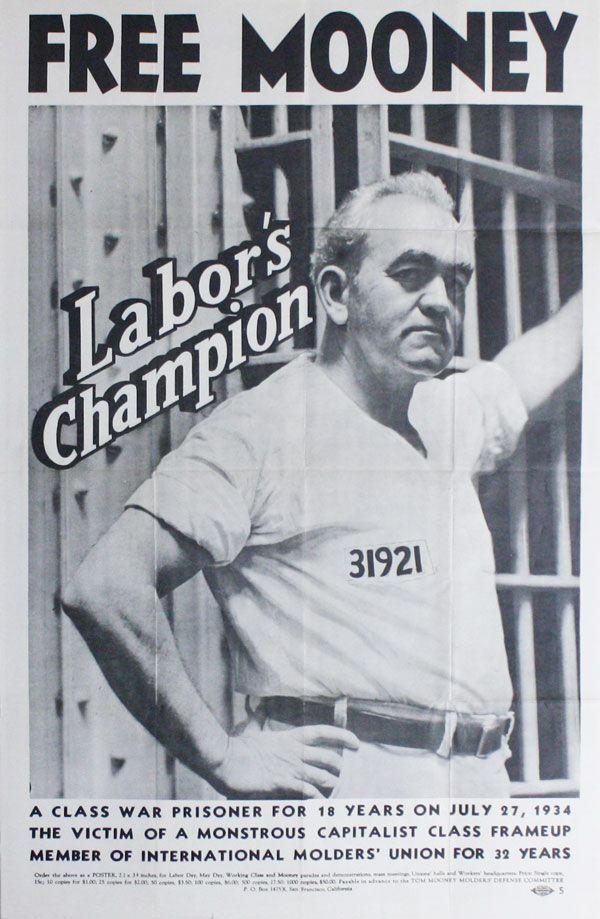
Some authors imagine Brady to have been motivated by political ambitions, such as becoming the next Democratic governor of California. But he never ran for an office beyond district attorney, the position to which he had been elected in 1919. The ambition for which Brady probably became best known speaks more about his zeal for fairness than an interest in a political career. Thomas Mooney, a labor leader and socialist, had been convicted in a show trial, prosecuted by the district attorney who proceeded Brady, Charles Fickert, for the bombing of a parade in San Francisco that resulted in ten deaths. Mooney was serving a life sentence in San Quentin and Brady was among those who publicly (and unsuccessfully) lobbied for a new trial for him for nearly a decade. Mooney was eventually pardoned in 1937.
Dorothea Lange photo for Tom Mooney Defense Fund, 1934.
What is underappreciated is that Brady rarely examined or cross-examined witnesses. One could probably count as many times on one hand. He didn’t step into the spotlight the way his adversary, Arbuckle’s lawyer Gavin McNab, did. McNab had a dominant personality in the courtroom and in California politics, sometimes called the “dictator” of Democratic party politics. Brady, in contrast, seemed disassociated from the trial and to most observers his case seemed lost by the middle of the second week. However, as in The Art of War, Brady’s relative quiet now seems to have been calculated to allow the defense to destroy itself.
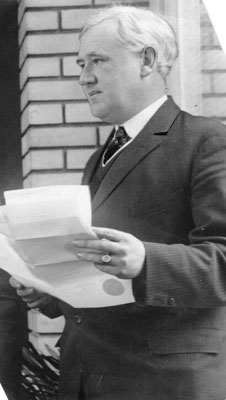
Matthew Brady (Calisphere)
The following letter was published on the editorial page of the Fort Wayne Sentinel on November 26, 1921. It sheds light on Brady’s motivations. We see a number of possibilities here, from good (a “slave revolt,” an “I am Spartacus” moment before Hollywood got there) to bad (a veiled anti-Semitism that would appeal to Indiana readers in one of the hotspots of Ku Klux Klan membership).
Unbought and Unbribed
E. V. Emrick, of this city, is a long-time friend of Matthew Brady, district attorney of San Francisco, and recently wrote him endorsing his stand in the Arbuckle case and making inquiry as to certain matters in connection therewith. The following answer has been received:
Mr. Brady is a public officer and naturally speaks with the utmost conservatism concerning a case about which public interest centers so particularly. It means much, therefore, when he alludes to the powerful influences that have been brought to bear to swerve him from his duty, and reading between the lines one can imagine just what influences there were and picture the golden lure they held out. The conscienceless and rapacious producers of California have millions of dollars wrapped up in the Arbuckle films and if it were possible for them not only to clear Arbuckle but to whitewash him at the same time, it would be to their immense financial advantage to do so.
City and County of San Francisco District Attorney, Hall of Justice San Francisco, Oct. 21, 1921
E. V. Emrick, Citizens Trust Bldg. Fort Wayne, Ind.
Dear Mr. Emrick:
This is to acknowledge receipt of your courteous communication of recent date respecting the Arbuckle case. It is most gratifying to me to receive expressions of this kind form individuals of your standing in the community; a public official in the honest discharge of his duty needs moral support of this kind and I am extremely gratified at the sentiments expressed. Under the California law, if a death results from the commission of a felony the charge is murder. In the Arbuckle case it is alleged that either an attempt was made to commit rape or a rape was committed upon Virginia Rappe, as a result she died. Therefore, under the law, it is our contention that the crime committed was murder and not manslaughter. The duty of a police magistrate is to inquire into the facts of the case. If reasonable and probable cause appear, it is the duty of the police magistrate to hold the defendant to answer. It has been held that even where there exists the remotest possibility of a crime having been committed, it is the duty of the magistrate to hold. Evidence was introduced at the preliminary hearing of Roscoe Arbuckle showing reasonable and probable cause to believe him guilty of the crime of murder, as charged. At the conclusion of the hearing, the police magistrate[1] reduced the charge from murder to manslaughter, upon which charge Arbuckle was held to answer to await trial before a jury in the superior court. As district attorney, I am convinced that more than ample evidence was introduced to warrant a holding upon the murder charge. I regret deeply that the police magistrate in his judgement reduced the charge to manslaughter. Has Arbuckle been held upon the murder charge, it would then have been within the province of the jury to have rendered a verdict of manslaughter, if in their judgement mitigating circumstances were present. Powerful influences have been brought to bear upon this office with the hope that I might be swayed from doing my full duty as district attorney, but you may rest assured that such efforts have proved of no avail, and every facility of my office will be employed in a most vigorous and earnest prosecution of this case. Again assuring you of my sincere appreciation of the moral support you have given me through the sentiments expressed in your letter, I am
Very truly yours, Matthew Brady District Attorney
It is hardly to be doubted but that Mr. Brady could have gathered in at least half a million dollars had he been willing to prostitute his high office and see to it that the evidence went as these sinister and malign corrupters of the public morals desired. It is fortunate, indeed, when the people have as firm and honest a champion in public office as Matthew Brady.
Note: We’re rather disappointed to see that the New Yorker published a piece observing the centenary of the Arbuckle case and the death of Virginia Rappe and only rehashed what the author could lift from the Greg Merritt book, Room 1219, which is also superannuated.
This blog was published in time for journalists to see what is new and what other possibilities there are for revision and doing justice—especially in regard to Virginia Rappe.
This isn’t new for the magazine, since one of us (James Reidel) assisted in the writing of a similar anniversary piece observing the 1955 disappearance of Weldon Kees. It is entirely lifted from his book Vanished Act (2003), a biography of the poet and artist who disappeared from the Golden Gate Bridge in 1955.
Reidel did enjoy seeing himself called “the assiduous biographer” by Tony Lane.
[1] Brady refers to Police Judge Sylvain Lazarus, who presided over the preliminary hearing referred to here as well in late September 1921.
While working on the corpus of our narrative, we have neglected to add some timely sidebars to this blog. So, we shall observe the end of the first week of the first Arbuckle trial with this mock theater review by George Warren, a theater critic for the San Francisco Chronicle.
Unlike the Examiner and the Call, the Chronicle didn’t give the Arbuckle trial first-page coverage. The editors saw it as local news and restricted the front page to more serious stories, like the naval disarmament conference in Washington. Even this “review” didn’t appear in its pages. It was distributed by a press syndicate to newspapers such as the Salt Lake Telegram,Chattanooga News, and other out-of-town papers where it ran the week of November 20-26, 1921.
Datelined November 19, the Sunday feature is based on the initial days of jury selection. But it captures the theatrics that many observers thought characterized the defense. Here, Arbuckle played an important part that may not have been passive but well planned, like shooting a comedy. So did his estranged wife, Minta Durfee.
What Dramatic Critic Thinks of Arbuckle: Frisco Writer Sees Fatty’s Biggest Drama Being Enacted in Court
By George Warren
Life, the greatest dramatist of them all, has written a rather involved piece in that much discussed tragedy, “The Death of Virginia Rappe.”
I have seen but the prologue and find that, as usual, this master of the drama makes one wait through tedious routine in order to catch the fine climaxes and thrills. There has been more of action than of drama. For the most part, the lines run too long to sustain dramatic interest.
This may explain why, in spite of the worldwide publicity, the tragedy has received, the first-night audiences were slim. There was no rush for admission and those who attended were mostly students of life’s dramas or professionals who came in on complimentaries.
While the product was being prepared, I had heard so much of the lead character, Roscoe Arbuckle, that I was a bit disappointed at the manner in which he was shoved into the background in the earlier scenes. A newcomer had been secured,[1] almost on the eve of the first presentation, and had been given all the “fat speeches.”
He is Gavin McNab, a veteran actor who plays the role of attorney for Arbuckle. He gives a fine and finished performance. In his past roles of a political dictator, clubman, and public figure, he has handled himself almost equally well, but he is best known for the performances in which he plays the part of defense counsel.
His stage presence is perfect and he becomes at once a dominant figure. His long and sometimes tiresome lines are forgotten in his excellent facial expressions and suave command of situations.
Arbuckle is doing tremendously fine work in his unhappy role. He is presumed, in the play, to have brought about the death of a beautiful actress, Virginia Rappe, during a revel staged in a fashionable hotel suite.
Here is an actor who, a few months back, was presumed to be fit only for slapstick comedy. Never have I seen a player who so completely reversed his type. His expression is frequently that of a hurt and troubled victim of circumstances, perplexed by what is going on about him, appealing to all eyes for sympathy. Again, he is the tense observer of the figures that pass before him, as though disinterested in all else but that upon which his eye centers. It is an impressive performance, having a tendency to make one forget the lack of drama and center upon this characterization of the man who plays the “heavy.”
Quite an interesting a performance is given by Minta Durfee Arbuckle, the wife. It has been customary in drama of this sort for the accused and his wife to appear side by side, but here we have the wife in a more or less inconspicuous part of the stage. Accustomed to the ingénue, the soubrette of light opera roles, she now appears in a semi-emotional part—that of a wife helping her husband in his fight for freedom. My chief criticism would be that she overdresses a bit for the part.
The district attorney and his assistants are handled with fine restraint by Matthew Brady and Milton U’Ren. Assurance and confidence, rather than spectacular stagecraft, marks their work.
Comedy relief was furnished for the most part by several dozen men and women who had bits as prospective jurors. They acted as “feeders” for the lines of the attorney characters.
Altogether it gets away to a fair start and, as the plot later proceeds, may prove as interesting a drama of life as had been done in some years.
San Francisco Hall of Justice, the site of all three Arbuckle trials (Calisphere)
[1] A reference to Gavin McNab having taken over as lead defense counsel from Frank Dominguez.
One hundred years ago Roscoe Arbuckle’s trial for manslaughter in the death of Virginia Rappe began. Most of that first week was taken up by jury selection. Although Arbuckle’s chief defense lawyer, Gavin McNab was reportedly against including women on the jury, he and prosecutor Matthew Brady settled on five women and eight men, including one alternate.
Although the procedure of accepting and rejecting jurors is tedious, we devote some attention to this deliberate process because it reveals much of the trial strategies of both the prosecution and defense.
For those of you who have followed this blog, we discussed the possible testimony of George Glennon, the St. Francis Hotel detective (see George Glennon, the muted witness). His midnight interview with Virginia Rappe on September 5, 1921—conducted hours after she had been found in Arbuckle’s bedroom variously in a state of shock and hysteria, tearing at her clothes—was intended to be used by the defense to quickly end the trial in an acquittal. If a jury had heard that Rappe had absolved Arbuckle of injuring her, the case in all likelihood would be over. No matter how much circumstantial evidence there was in room 1219, her words would underscore Arbuckle’s professions of innocence. He only need take the stand and provide an anodyne account that that would make him out to be nothing less than a decent, caring gentleman.
However District Attorney Matthew Brady and his deputies challenged Glennon’s simple question-and-answer statement as hearsay and managed to keep it out of the record. Accusations of witness tampering were being made against both sides so the objection may have been borne of that suspicion.
Similarly, McNab and his colleagues intended to get the doctors who attended Rappe to “speak” for Arbuckle. Here Maude Delmont factored. She had, as Rappe’s companion at the Labor Day party, looked after Rappe and taken charge as her ersatz medical power-of-attorney. She spoke with some authority, despite being inebriated, and was the person the attending physicians consulted about what was wrong with Ms. Rappe. But the Prosecution saw to it that Delmont’s comments to the physicians were also barred from the record.
At the end of the second week of the trial, one of these doctors, Melville Rumwell, was called to the stand as a defense witness. He, too, like Glennon, had spoken with Rappe in the hotel about her condition. Again, the answers Rappe gave Rumwell were believed to have exonerated Arbuckle. These too were stricken as hearsay.
This defense strategy is intriguing on several levels, given the prosecution’s determined effort to prevent a jury from hearing a narrative that included the words of Rappe and Delmont. While it seems counterintuitive to silence the victim and the accuser, we think we understand Prosecutor Brady’s motivation. At the time Rappe’s injury occurred, Delmont’s initial statements might have intentionally downplayed Arbuckle’s involvement without really knowing what the truth was. She didn’t want to be at the center of a sex scandal. Rappe, too, may have been likeminded. They didn’t, like other guests, see any gain in getting Arbuckle in trouble, whether he did something injurious behind the door of room 1219, something desperate to save his reputation, or something that, as he made it out to be, the Good Samaritan redux.
In other words, Brady and his deputies were building their case on the belief that Arbuckle had injured Rappe in a clumsy attempt at rape or possibly rough consensual sex and they couldn’t afford to let anything Rappe or Delmont had said that evening stop them.
Roscoe Arbuckle and costar Alice Lake in The Rough House (1919) (Private collection)
Roscoe Arbuckle’s first trial for manslaughter was to begin on Monday, November 7, 1921. But the following day was Election Day and Armistice Day would be celebrated later in the week. So, Judge Harold Louderback of the Superior Court of San Francisco County announced that he would delay the opening of the trial one week.
This gave the prosecution and defense breathing space to consolidate their strategies. Assistant District Attorney Isadore Golden had been dispatched to Chicago to get the testimony of Mrs. Katherine Fox. She had been Rappe’s mentor and virtual foster mother since 1905. Mrs. Fox had been responsible for coaxing Rappe to become a teenage art model, dancer, and stage performer. Undoubtedly, Mrs. Fox also directed Golden to other associates who might contradict the testimony of the three Chicago witnesses deposed by Arbuckle’s lawyers, Alfred Sabath and Charles Brennan.
The Chicago witnesses for the defense, especially the nurse/midwife/provider of adoption services, Josephine Rafferty Roth, would help convince a jury that Rappe’s bladder and sex organs had been ravaged by unwanted pregnancies, bouts of cystitis, and the invasive procedures the treatment of those conditions involved in the early twentieth century.
Arbuckle’s lead attorneyGavin McNab, however, had an even stronger card to play in house detective George Glennon. Glennon had initially been interviewed and dismissed by the District Attorney’s office only to be later chosen as a witness for the defense.
His testimony might have been enough to sway a jury to acquit Arbuckle of the manslaughter charge. But what he had to say was largely squelched by prosecution objections on the basis of hearsay.
Despite not being able to deliver on Arbuckle’s behalf, Glennon may have been rewarded for his willingness, having made the curious career move from hotel dick to movie theater manager, a job he held until Prohibition ended and he went back to his preferred profession of bartending.
The following draft passage is where we introduce him into our account of Labor Day, September 5, with the working title of “The Life of the Party.”
Around midnight, Virginia Rappe received a visit from George Francis Glennon, the stout, middle-aged house detective at the, St. Francis Hotel. As a defense witness during the first Arbuckle trial, Glennon said that Maude Delmont and Dr. Beardslee were in room 1227 when he arrived. Despite the late hour, he wanted to speak to Rappe.
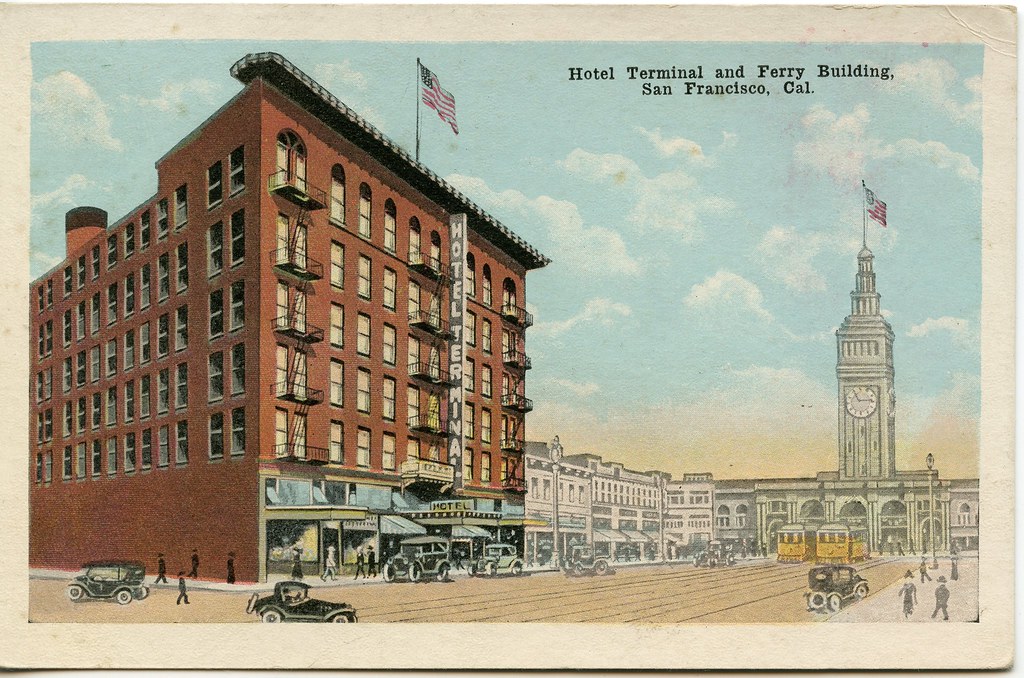
Glennon held various jobs over the years. As a boy, he operated a freight elevator and, in later years, worked as clerk, a chauffeur, and as a bartender, a job at which he excelled. Prior to Prohibition, Glennon was described as “the best mixologist in the business” while employed at the Hotel Terminal’s bar on Market Street. We can assume he had a brutish attitude, having made the news for striking an effeminate young man who had “lisped” a request for a “beauty special,” a lavender-colored cocktail with a dash of ice cream.[1] The blow cost him a ten-dollar fine. The coming of Prohibition however forced him out of bartending altogether. – at which point he found work as a special policeman.
The special police were essentially security guards and privately paid by the businesses that hired them. Special police were employed by banks, penny arcades, movie theaters, skating rinks, and the like. They worked as night watchmen in warehouses, factories, and on San Francisco waterfront. They also worked as hotel detectives. Since they carried firearms and could arrest people, they were licensed by the San Francisco Police and were considered peace officers as well. Thus, Glennon possessed a modicum of authority if there should be trouble in the hotel in the form of an unruly guest, room thief, call girl, and any other criminal acts on the hotel’s premises.
So the Arbuckle party, despite being hosted by a frequent and famous guest, couldn’t be ignored. There was liquor in plain view in Room 1220, seen by maids, bellboys, waiters, and now an assistant manager, Harry Boyle. It had also become known that an unclothed woman at the party had been found in severe distress and had to be carried to an empty room. By the time Glennon arrived late in the evening, she had already been seen four times by the two hotel doctors.
However when Glennon was a defense witness at the first Arbuckle trial, he was prevented from discussing his brief conversation with Rappe, as the prosecution objected on the basis it was hearsay.
Glennon’s account was reported in the newspapers though and, unlike the accounts provided by Drs. Kaarboe and Beardslee who said she barely spoke, he said he found Rappe to be alert and responsive to his questions. She was no longer agitated. If Glennon indulged in any small talk with her, it went unreported. Instead, Glennon got to the point, asking a battery of questions that had nothing to do with her welfare but rather serendipitously worded as though by a lawyer to exonerate Arbuckle when the time came.
Glennon said he asked Rappe if Arbuckle had hurt her and she answered “no”. Then Glennon asked if anyone had hurt her. “I do not know,” Rappe allegedly said. “I may have been hurt by falling off the bed.”[2]
[1] Universal News Service, “Beauty Special Was Too Much for This Bartender,” The [Pomona]Bulletin, 10 September 1919, 6.
[2] “Girl Said to Have Cleared Arbuckle: Clown’s Lawyer Has Statement from the Hotel Sleuth,” Daily Arkansas Gazette, 11 November 1921, 1.
After spending a week in Chicago, lawyer Charles H. Brennan of San Francisco had secured depositions from three witnesses, among them Josephine Rafferty Roth, a midwife and nurse. All three claimed that Rappe had given birth to a premature baby in 1908 and again in 1910 and treated more than once for the “same trouble,” meaning the chronic cystitis that was evidenced in her autopsy.
Nevertheless, Brennan reassured reporters in Chicago, “The defense has no intention of defaming the character of Miss Rappe after she is dead. We are merely trying to establish the fact that Miss Rappe had been suffering from organic trouble for a long time. Arbuckle, we contend, was not responsible for the rupture which caused her death.” The introduction of a “fallen woman” trope, however, was undoubtedly intended. If Rappe was to blame, then Arbuckle was the unfortunate victim of a coincidence.
Fallen woman? Virginia Rappe in Redbook, August 1912
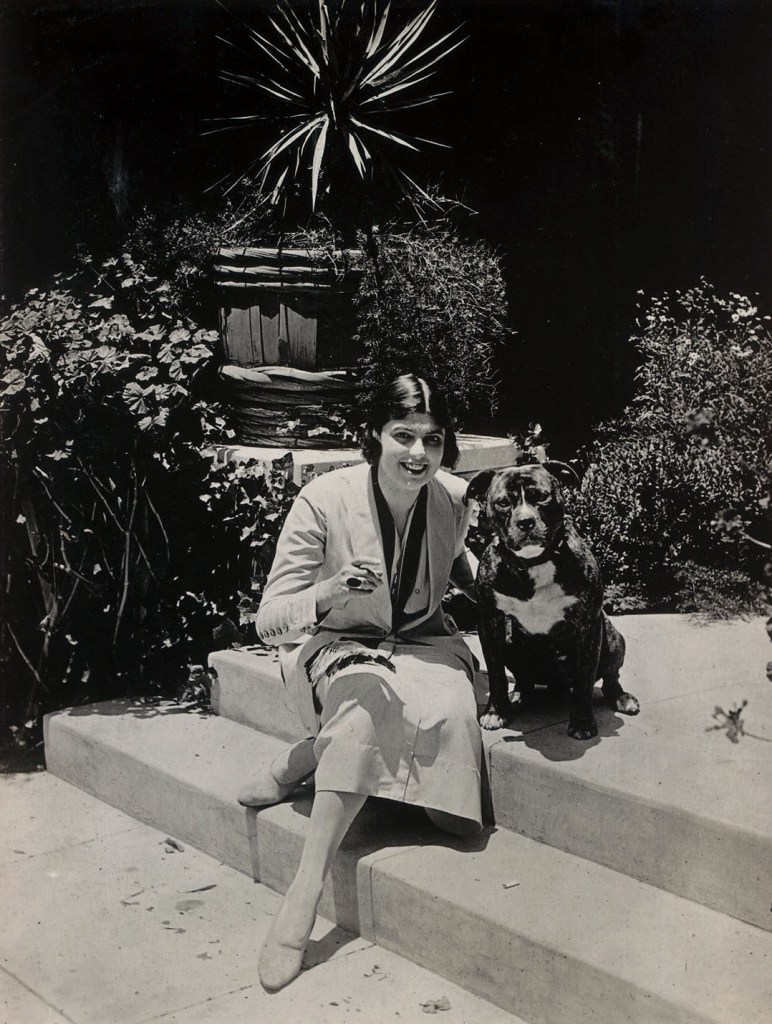
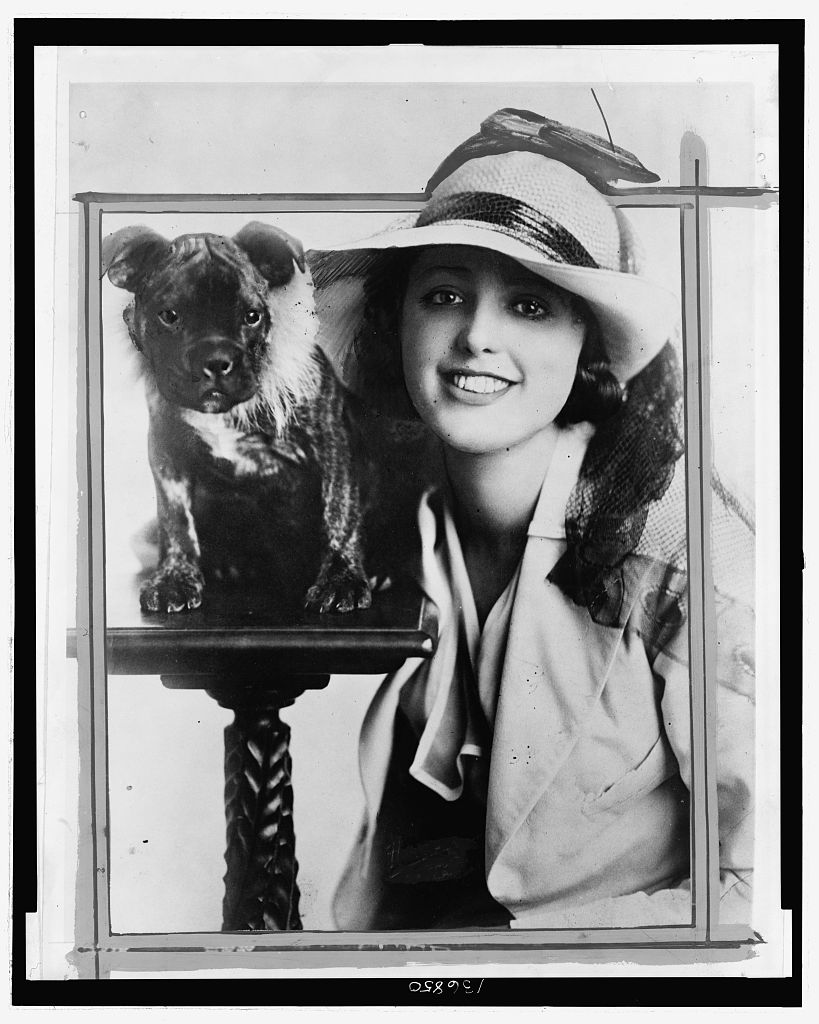
One of the last photographs taken of Virginia Rappe before she left for San Francisco in September 1921 was with her dog “Jeff.” Like Roscoe Arbuckle’s dog “Luke,” Jeff was a Staffordshire bull terrier. The difference between the two was that Jeff had a brindle coat and, like Rappe, hadn’t made it big in pictures.
Rappe and Jeff, 1921 (Calisphere)
Jeff was from a large menagerie of animals acquired by Rappe’s boyfriend, the comedy director Henry Lehrman, when he was in charge of Fox Studio’s Sunshine Comedy Co.
The menagerie also included: “Joe,” a monkey; “Theodore,” a cat; “Billy,” a goat; “Bum,” a bulldog; “Rats,” a terrier; “Ludwig,” a dachshund; as well as three unnamed white mice and four canaries.[1] Lehrman also had ostriches, ducks, chickens, a small herd of elephants, and a pair of lions.
Jeff’s first performance may have been this studio photograph with Virginia Rappe (below). He sits on a telephone stand while Rappe poses in a summer suit and Panama hat.[2]
Jeff and Virginia Rappe, about 1917 (Library of Congress)
The puppy bonded with her over time, due in part to her stepping in to comfort him when she thought his trainer was abusive.
Jeff was evidently indifferent about movie stardom, having once wandered away from a shoot in Los Angeles’ Exposition Park in August 1918, and found only after Lehrman was forced to offer a reward.
Eventually, Jeff became Rappe’s charge after he began routinely waiting at her car in the parking lot of Lehrman’s Culver City before she left for home. After refusing to recognize any other master, Rappe was allowed to keep Jeff as her own. But given Lehrman’s penchant for dangerous stunts, Jeff may have been easy to part with, having already lost an eye, which spoiled his appearance and ended his brief career.
[1] “Who Said Monkey Dinner?” Los Angeles Times, 29 July 1917, III:2.
[2] See “Lost Dog Star, Not Sirius, But Lehrman’s Jess [sic],” Los Angeles Herald, 10 August 1918, II:3; and “Aunt, Pet Mourn Death of Miss Rappe,” San Francisco Call, 16 September 1921, 2.
[This early report, in the early afternoon of September 10, 1921, raised our eyebrows more than once. You will read here, just as the San Francisco Call readers did a century ago, how many of the essential details of what became the Arbuckle case were known. There is much here about the illegal autopsy performed on Rappe’s body, which suggests that had someone—a whistleblower—not called the S.F. Coroner’s office, Arbuckle’s downfall might never have happened. Other revelations here, of course, include the term “spontaneous” to describe Rappe’s bladder rupture. The source, Dr. Ophuls, the professor of pathology at Stanford’s medical school, didn’t use that term again. He also described the walls of Rappe’s bladder as thin. Later he used the term “small for a woman her size.” Notice too, that all those foxtrots and like dances imagined at the Labor Day party in various Arbuckle narratives are certainly moot.]
GRILL FOR ARBUCKLE; ACTRESS DEATH QUIZ; POLICE AWAIT COMEDIAN IN FATAL BOOZE PARTY
FRESNO, Sept 10. —Roscoe Arbuckle, film star, tore through Fresno today in a high-powered car, on his way to San Francisco for the inquiry into the death of Virginia Rappe, movie actress. He would not pause to give new details of his answer to charges involving him, but said he would reach San Francisco at 3 p. m.
A manifold official investigation was begun today into the death of Virginia Rappe, film beauty, following a drinking party in the suite of Roscoe (Fatty) Arbuckle, film star, at the Hotel St. Francis.
The police, while spreading a watch for Arbuckle as he sped north from Los Angeles, detailed a squad of veteran detectives to the case, and the coroner’s office and District Attorney Matthew Brady both took steps for a complete investigation, while members of the grand jury also went into the case with a view to action by that body.
Clubwomen also entered the situation, many of them telephoning officials of the grand jury demanding an inquiry. The jury may take up the case at its regular meeting Monday night.
The investigation included not only the circumstances of the actress’ injury, illness and death, but those of an autopsy performed at the request of the physician in charge of her case, Dr. M. E. Rumwell.
Dr. Rumwell, instructed to appear at the coroner’s office to explain, telephoned that he would come this afternoon and said the autopsy was regular, the case having been one of natural causes.
Dr. William Ophuls went to the morgue and declared that the autopsy was regular, and he had taken it for granted the legal requirements had been met by his confrere.
A coroner’s jury met this afternoon to view the body, which was photographed.
These developments today came on the heels of the breaking of a dam which had held up all word of the scandal for several days. Acting Captain of Detectives Michael Griffin detailed Detectives Henry McGrath, Griffith Kennedy ard Thomas Regan to the case with orders to look into the autopsy matter as well as all other features.
District Attorney Matthew Brady said this afternoon: “It is reported death occurred under mysterious circumstances. If necessary my entire force will be detailed to aid the police in a full investigation and if it is found death was due to an attack or abuse by any person, we will prosecute. We will go after anyone who seems guilty just as strongly as we went after the Howard street gangsters.”
When he spoke, Brady had not been officially advised of the case.
Curtis Clifford, foreman of the grand jury, said today that the case had not been called to his notice, officially, but that he would investigate with a view to bringing the matter before the grand jury if the circumstances warrant it.
GRAND JURY ACTION
The grand jury is due back tomorrow from a trip to Hetch Hetchy.
Harry Kelly, secretary of the grand jury, also declared the grand jury was ready to hear all pertinent evidence in .the case. He said he himself had received telephone messages from many clubwomen demanding grand jury inquiry.
Arbuckle left Los Angeles at 1 a.m. today by auto, accompanied by Frank Dominguez, Los Angeles attorney. He said he was coming to help in the inquiry.
The police established a watch for his machine, with orders to take him to the detective bureau immediately on his arrival.
Arbuckie came north issuing denials of responsibility for the girl’s death. The stomach of the actress was sent to Dr. Frank T. Green, city chemist, for analysis, following the report of the physicians who attended her that death was caused by peritonitis, due to a rupture of the bladder, which might have been caused by a fall or by a blow.
This action was taken by the coroner’s office after the autopsy had been performed by a private physician, Dr. Ophuls, called in especially for that purpose by the doctors who had been attending the woman.
The body was taken from the hospital to the undertaking: establishment of Halstead & Co., 1122 Sutter street, and later removed to the morgue. Dr. Ophuls and Dr. M. E. Rumwell, whose patient the woman had been and therefore in charge of the case, were directed to go to the morgue to give their explanation.
It was declared that Dr. Ophuls assumed the other doctors had fulfilled the legal requirements for an autopsy and that he considered his action a part of routine in a surgical case.
The death of the woman was learned by accident by the coroner’s office.
WOMAN PHONES TIP
Yesterday afternoon a woman phoned, saying she was speaking from the Wakefield Sanitarium, 1065 Sutter street, where the actress had died. She asked when the autopsy was to be performed.
Coroner T. B. W. Deland was at Santa Crux with the naval reserve, but Deputy Michael Brown, who had answered the phone, went to the hospital immediately after the woman, presumably an employee, had hung up without giving further details.
At the hospital Brown was refused the name of the dead woman and told to see Dr. Rumwell, whose patient the woman had been. He waited.
Presently Dr. Rumwell and Dr. Ophuls came down stairs. They had portions of the body—specimens.
Brown told them they had exceeded the law and had them telephone to the chief deputy coroner, Mrs. Jane C. Walsh. Dr. Rumwell said he had beep trying to get Dr. Leland by telephone.
Dr. Shelby Strange, acting autopsy surgeon, was sent to make a post mortem examination, and today the body was ordered taken from the undertaker’s, Halsted & Co., where it was removed from the hospital, and subjected to a new examination at the morgue.
Dr. Strange found bruises on the right and left legs of the body, one apparently from a pinch on the arm. and dark spots on the abdomen.
Dr. Ophuls said today, death was caused by peritonitis, due to a rupture of an abnormally thin bladder.
Dr. Rumwell was called to the St. Francis Tuesday. The actress remained at the hotel till Thursday, when she was taken to the hospital.
Dr. Rumwell was the physician in charge of the case and called in others in consultation—Doctors W. P. Read and Emmet Rixford.
His contention was, when asked for an explanation by the coroner’s office, that the case was one of natural causes and therefore his conduct was within the law’s requirement.
When the deputy coroner went to the hospital and met Dr. Rumwell immediately after the autopsy performed by Dr. Ophuls, Dr. Rumwell was told that he should have got in touch with the coroner’s representatives and that the law demanded that relatives or the coroner’s office issue a permit for an autopsy.
He said: “I did not attend the woman but was called in only for the autopsy. I found a spontaneous’ rupture of the urinary bladder. It was abnormally thin and may have been too full. There were no signs of violence. The case was simply a surgical one in which the diagnosis was doubtful.”
He denied a report that one of the woman’s ribs was broken.
Dr. Beardslee was the St. Francis house surgeon. He attended the woman while she was there before Dr. Rumwell was called in.
NINE AT PARTY
According to members of the party of nine that participated in the party at the hotel, which took place Monday, there was plenty of liquor in Arbuckle’s room. Virginia Rappe’s case was at first believed by her companions to be one of hysterics. She had taken two drinks, they said. The physicians who treated her found her suffering apparently from alcoholism.
As pieced together by the police, the story of the events leading up to the fatal illness is this:
Miss Rappe, Mrs. Maude Del Mont and Al Semnacher, manager for Miss Rappe, met at a Los Angeles candy shop and motored to San Francisco, going to the Palace Hotel. They spent Sunday night at the hotel.
Arbuckle telephoned the Palace and invited them to his rooms at the St. Francis on Monday. There was general drinking. Arbuckle and Virginia Rappe went into a room of his suite adjoining that in which the party was being held. The door was locked. According to one report, eventually there were sounds of a scuffle and an outcry.
ARBUCKLE IN PAJAMAS
Pounding on the door eventually brought out Arbuckle. He was clad then, as before, in pajamas and bathrobe. The girl lay on the bed in the room where she had gone with him. She was naked. According to women members of the party her clothing, even her stockings, was torn to shreds so that she could not be clothed at once. The girl was put to bed in another room. She was unconscious. A cold bath did not revive her. The hotel management was notified.
Arbuckle had come to San Francisco with Frederick Fishback and Lowell Sherman.
The management of the hotel knew nothing of the party in the actor’s suite except that he asked that a phonograph be sent up and this was complied with when it was determined the machine was not wanted for dancing.
ARBUCKLE’S STORY
Here is the story as told today by Arbuckle, with the corroboration of Fishback and Sherman:
“We arrived In San Francisco. Fishback, Sherman and I, last Saturday afternoon and went to the St. Francis Hotel, where we engaged an apartment. Tired from the long trip, we went to sleep immediately. Shortly before noon Monday a friend of Mr. Fishback. with us in the apartment, remarked that he had seen Miss Rappe at the Palace, and desired to meet her, as he wished her to model some gowns for him.”
HAD A FEW DRINKS
“I told him that I knew her and would make the introduction. She readily consented to come to the St. Francis. After meeting the man, we had a few drinks. Miss Rappe had one or two drinks. She went into the other room of the apartment and began tearing her clothes from her body and screaming.
“The other woman, Maude Del Mont, and a companion, rushed into the room. They put Miss Rappe into a tub of cold water. She cried out that gas had formed around her heart—that she couldn’t breathe.
“We engaged another room in the hotel for her and moved her there. Then a physician was called and, after he reported that she had quieted down, Mr. Sherman and I went down into the dining room and danced the rest of the evening.
“We already had engaged passage on the Harvard to return to Los Angeles Tuesday, and did so.
“We had not received any intimation that Miss Rappe’s illness was as serious as it turned out to be and were very much surprised to learn of her death.”
NEW DETAILS GIVEN
One of the women guests at the party gave new details today, saying:
In all there were eight or ten people there. Some came in and went out after a little while.
Virginia Rappe went to the bath room, which connected the room where all were with another.
Arbuckle followed and took her to the other room. He said something about having waited five years for her.
Then there were screams.
She said, “He’s killing me.” Someone kicked on the door and told him to let her out. He said “no.”
When the door was finally opened, she was hysterical and he was swearing at her.
Among those who were In Arbuckle’s suite during the party, according to other guests, were Lowell Sherman, an actor; Dollie Clark and a man named Glass. Arbuckle was ordered from the hotel, according to Assistant Manager H. J. Boyle. This the actor denies.
ORDERED FROM HOTEL
Boyle said:
“Mr. Arbuckle came to the hotel Monday and took a suite of two rooms. Monday afternoon he sent word that he wanted a phonograph, and after Assistant Manager Thomas Keating had learned that no dance records were desired—only popular songs—he sent the machine and some records.
“There was nothing to cause comment until late in the afternoon, when a woman’s voice from the room occupied by Mrs. Del Mont asked for assistance, saying:
“A woman is hysterical tip here and is tearing her clothes off. You had better do something about it.”
“I went to the room, but before I entered the room another door opened, and Arbuckle, clad in a bath robe, pajamas and bath slippers, came to the door of the adjoining room and said: “She is in here; come in.”
OTHERS IN ROOM
“I entered and lying on the bed was Miss Rappe, nearly nude and unconscious. Mrs. Del Mont, three or four women whose names I did not learn, a man who gave his name as L. Sherman and another who gave his name as Fred Fishback. both of Los Angeles, were in the room.
“Their story was that the young woman had had three drinks and had become hysterical. There were several bottles in evidence, and I took it for granted that there was nothing more serious than a drinking party. Mrs. Del Mont wanted another room for Miss Rappe and she was placed in bed.
PHYSICIAN CALLED
Later her condition became so serious that a physician was asked for and one of the hotel’s assistant physicians was sent in the absence of Dr. Arthur Beardslee, the house physician. Later he arrived and took charge of the case, which was deemed sufficiently serious to make it advisable to send the young woman to the hospital.
DETAILED FOR POLICE
A detailed version of the event was given to the police In the form of a sworn statement by Alice Blake, art actress, living at the Woodrow Hotel, 364 O’Farrell street.
She has been appearing in a revue at Tait’s.
Her statement, given to Detective Griffith Kennedy, says:
“On Monday, about 2 o’clock, Lowell Sherman, an actor friend, called me and invited me to a party in Roscoe Arbuckle’s apartments, rooms 1219, 1220 and 1221. at the Hotel St Francis. There were several people in the room when I entered. There were Sherman, a short, stout Jewish gentleman whose name I do not know; Mrs. Maude Del Mont Miss Zey Prevon. Miss Virginia Rappe and Arbuckle.
“When I entered Arbuckle and Miss Rappe were occupying a settee together. All were laughing and talking. All had been drinking. Miss Rappe was drinking gin and orange Juice. We all ordered something to eat and afterward just sat around and talked.”
Alice Blake, September 1921 (Associated Press)
MANY CALLERS
“Various people whom I did not know, men and women, came in from time to time. One of them was Al Semtoacher, who, I was told, was Miss Rappe’s manager. At this time we were in room 1220, which was used as a reception room. After we had finished eating. Miss Rappe got up and went into the bath room, which was connected with Arbuckle’s room, No. 1219.”
GIRL’S DEATH CRY
“About the same time I went into room 1221 with Miss Prevon. When I returned a few moments later neither Arbuckle nor Miss Rappe was present. I asked Sherman where Arbuckle and Miss Rappe were. He replied; “In there.” pointing to the door of room 1219. About a half hour later Mrs. Del Mont tried to get into the room, but the door was locked. She banged and banged on the door and Arbuckle came out. As he opened the door we heard Miss Rappe moaning and crying. ‘I am dying! I am dying!’ Arbuckle came out and sat down with us and said. ‘Go in and. get her dressed and take her back to the Palace. She makes too much noise.’
“In the meantime Mrs. Del Mont had entered the room where Miss Rappe was. Miss Prevon and I entered and found Miss Rappe lying on the bed. She was entirely unclothed. She was moaning and crying. She seemed to be in great pain and I tried at once to help her. I first thought she was suffering from gas pains so I gave her a cup of hot water with bicarbonate of soda, but she vomited at once.
“Someone suggested a cold bath, so we filled the tub, and one of the men and I carried her and put her into it for a moment. It had no effect so We took her out.”
CLOTHES TORN TO SHREDS
“We tried to dress her but found her clothes torn to shreds. Her shirtwaist, underclothes and even her stockings were ripped and torn so that one could hardly recognize what garments they were. We could not dress her because her clothes were torn so.
“After that a clerk was summoned. Then we carried her to room 1227, which we had engaged, and the house physician, I believe, was called. There was plenty of liquor there, but I was told that Miss Rappe had only had two drinks. I had only one drink myself. “From the time I entered the suite arid all during the party Arbuckle was clothed in pajamas, a bathrobe and bedroom slippers.”
Virginia Rappe had been in the movies for several years, was well known in film circles and had played important parts in some productions, but is said not to have been working lately.
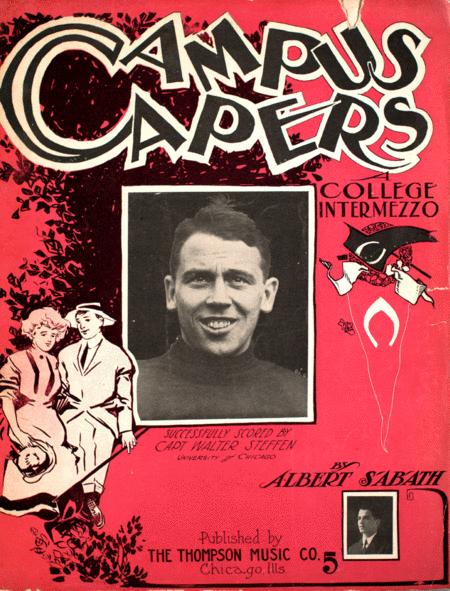
Before meeting with Minta Durfee as she was en route to join her husband in San Francisco, Chicago attorney Albert Sabath had been digging into Virginia Rappe’s earlier life in his city. In doing so, and without ever appearing in a San Francisco courtroom, the former amateur playwright may have done as much as Arbuckle’s lawyers in situ in crafting a counter-narrative that would take the focus off of the movie star. With such musicals as Campus Capers and Hoo-sier Girl to his credit, Sabath had a knack for telling a story and dramatizing the life of Virginia Rappe probably came easily. But the line between real life and poetic license was tailored to the needs of his client.
In effect, Sabath was tasked with reworking Rappe’s adolescence with cooperative defense witnesses who were willing to neatly frame “their” stories as predictive evidence for Rappe’s later behavior, bladder problems, and early death. Sabath merely had to ask the right questions to limit the testimonies to information that would suggest Rappe’s death had been a predestined event and Roscoe Arbuckle was nothing more than a witness with really bad timing. Sabath had the added advantage of knowing firsthand about Rappe, from the time when her Hoosier “fella” was Harry Barker, a friend of his.
Sabath’s investigations on Arbuckle’s behalf went on long enough to dig deep, to find useful and reliable people with stories to tell, elicit, and massage as necessary. Perhaps John Bates was one of Sabath’s candidates. Bates being the man who presented himself as a concerned party inquiring about Rappe’s estate on behalf of her purported orphaned “little girl”. But Bates, could have been an outlier, a freelancer.
After the rumor of the abandoned “daughter” ran its course during the second week of October, the next story that “leaked” was about chronic cystitis that Rappe allegedly suffered in girlhood. On Saturday, October 22, a syndicated article from the International News Service appeared, quoting a nurse named Virginia Warren. “Sensational information,” the piece began, “bearing on the early life of Virginia Rappe,
beautiful movie actress, who died following a party staged by Roscoe “Fatty” Arbuckle, has been made in a disposition by Miss Virginia Warren, Chicago nurse, it was revealed today. Miss Warren and Mrs. Josephine Ross [sic], both made depositions to counsel for Arbuckle which are to play an important part in his coming trial. Miss Warren declared she was a nurse in attendance upon Miss Rappe in 1908. At that time, Miss Rappe, only 14, was in a delicate condition and was in the care of Mrs. Ross, in the latter’s apartment near 24th street and Wabash avenue, Chicago, according to Miss Warren.
“I first saw Virginia Rappe in 1908,” Miss Warren said. “I was called as a private nurse to attend her. She was in the apartment of Mrs. Josephine Fogarty [sic], now Mrs. Josephine Ross.
“Miss Rappe was then only 14. She was in a delicate condition. She had been taken to Mrs. Ross’ apartment by her sweet, old grandmother.
“She was also suffering at that time from a bad attack of bladder trouble. On one occasion while she lay on her bed, she suddenly screamed., half rose and clutched at my waist. Her fingers tore into my skin and made deep scratches.
“Then Virginia suddenly grabbed her night gown at the shoulder and almost tore it off her body.
Miss Warren said Miss Rappe told her at that time that her bladder trouble made her violent at times. She said she remained in Mrs. Ross’ home for five days.
Miss Warren said she decided to help Arbuckle because, as she explained, “As a nurse, I know that a girl who has had bladder trouble at 14, and in after years drank to some extent, and possibly neglected herself at times, could easily puncture her bladder. The least strain or twist would do it.”
Mrs. Ross also made a deposition in which she corroborated that of Miss Warren.[1]
Miss Warren, the only African American to testify at one of the Arbuckle trials, covered every facet of the defense’s strategy to divert attention away from Arbuckle’s role in Rappe’s death.[2] However Warren was talkative and her testimony defied credulity by too closely matching the details of Rappe’s preexisting illnesses to the condition in which she was found in room 1219. It was obvious she had been coached.
Nevertheless, her testimony likely had little effect, few major market newspapers carried the story, and her account varied little from the stories that followed which all sounded suspiciously familiar.
Sheet music for the musical Campus Capers (1910) by Albert Sabath (Johns Hopkins University Sheridan Libraries)
[1] Compiled from International Wire Service, “Say Miss Rappe Was Always Delicate,” Buffalo Enquirer, 22 October 1921, 1; “Virginia Rappe Was Mother At the Age of Fourteen Declares Chicago Nurse,” Topeka State Journal, 22 October 1921, 1; “Miss Rappe’s Early Life Is Now Revealed,” Evening News (Wilkles-Barre), 22 October 1921, 1; and “To Reveal Past of Miss Rappe, Victim of Arbuckle Party,” Coshocton Tribune, 22 October 1921, 1.
[2] Virginia Warren indicated herself as “Mu,” for mulatto on the 1910 census and, in 1920, as white while living with a boarder named “John Williams” who indicated his race as “Mexican,” which, like “Cuban,” was a way for light-skinned African Americans to pass as white.
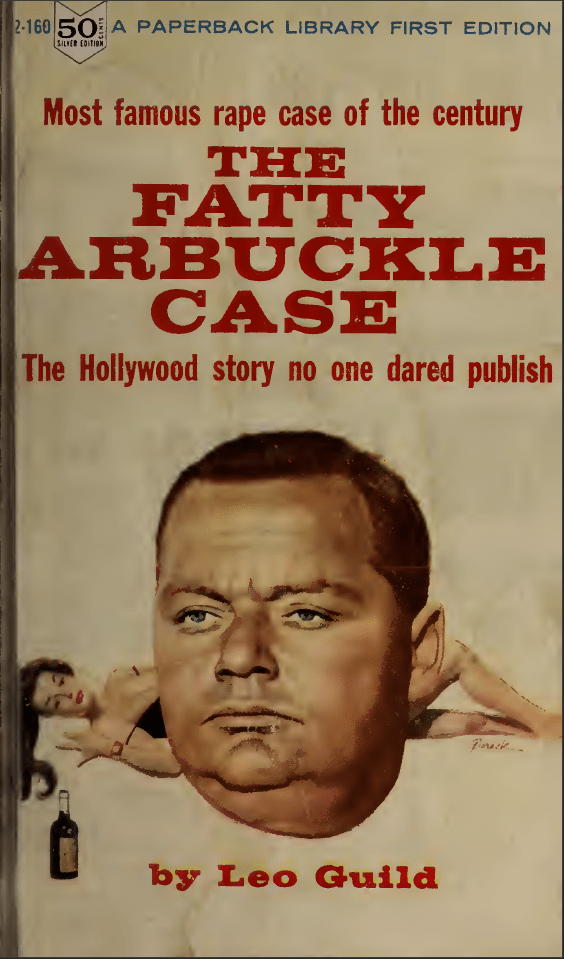
Four years before he coauthored Ecstasy and Me (1966), the autobiography of Hedy Lamarr, Leo Guild published The Fatty Arbuckle Case(1962), the first book in English to tell the “true” story of the death of Virginia Rappe and the three Arbuckle trials.[1] Guild’s previous credits included Bachelor’s Joke Book (1953), The Loves of Liberace (1956), Where There’s Life There’s Bob Hope: The Hilarious Life Story of America’s Favorite Funny Man (1957). He would go on to write a series of nonfiction books that can only be called “blaxploitation,” such as Some Like It Dark: The Intimate Autobiography of a Negro Call Girl (1966), Street of Hos (1976), Josephine Baker (1976), and Black Streets of Oakland (1984), and the Black Bait (1993).
Guild’s Arbuckle book is worth reading because he (cf. Clifford Irving’s attempt to write a biography of Howard Hughes) faced an enormous problem in that he had limited time, sources (no Internet, real library research with stacks, microfilm machines, etc.), and witnesses long dead or very old, even in the early 1960s.
Guild wasn’t unaware of the steep learning curve he faced in writing about events four decades ago. From his foreword:
The writing of a book such as this is a monumental research job. It entails conversation with people who were on the scene; a search for their friends, relatives, acquaintances; study of the court records, the newspaper stories of the trial, magazines which contain much pertinent material about the case. People only remotely involved with the subject or the circumstances must be questioned. One interview always leads to another and another until the list of prospects becomes so long it seems impossible to write or to see all of them. But all must be reached.
But likely very few were “reached.” In the list of names of people he thanks is not one recognizable name from the reportage of 1921–’22.
Thus, much of the book is a mix of facts, factoids, and even material that appeared to be made-up. Much, too, was accepted as gospel and repeated in other books and articles over the years. Nevertheless, as a denizen of Hollywood, Guild may have gotten some things right.
But the problems with Guild’s book are legion and while The Fatty Arbuckle Story is a work of entertaining pulp nonfiction that has a certain cultural value for being so wrong, there is very little that is reliable.
The first pages are larded with untruths. Arbuckle didn’t live alone in his West Adams Avenue mansion. He had a live-in secretary, Katherine Fitzgerald, who had to leave when Minta Durfee returned to perform her role as Arbuckle’s estranged but devoted wife. Virginia Rappe’s love interests from her youth, the sculptor “John Sanple” (sic) and “Robert Moscovitz,” “the heir to a considerable dress manufacturing dynasty,” never existed. Further on in the book, three chapters are devoted to the Arbuckle trials. There District Attorney Matthew Brady conducts his own spirited examination of witnesses in the three Arbuckle trials. In reality, his deputies did all the courtroom performances because Brady likely had a lowkey courtroom demeanor when compared to Arbuckle’s lawyers, Frank Dominguez and Gavin McNab, who were both orators and politicos.
We will likely reference Guild’s book in our introduction, which features a “review of literature” that our book (and this blog) will put in perspective as being useful, misleading, entertaining but all in some way the inspiration for our revisionary treatment.
Leo Guild’s career might have been very different had his fifty-cent paperback been turned into a motion picture to mark the thirtieth anniversary of Arbuckle’s death.
In the May 1963 issue of Variety, reported that the producer Richard Bernstein had bought the rights to The Fatty Arbuckle Case and had budgeted $500,000 to begin production in September 1962. Bernstein was also negotiating with the actors Victor Buono and, incredibly, George C. Scott to play the male leads.
Undoubtedly, Buono—who played the piano teacher in What Ever Happened to Baby Jane? (1962) and perhaps more familiarly as King Tut in the Batman TV series (1966)—was intended to play the title role with Scott as Gavin McNab. [1]
In the same Variety column, another Arbuckle biopic was allegedly in the works based on a forthcoming Broadway play by the screenwriter Harry Essex. The latter work, unlike Guild’s, had the cooperation of Minta Durfee. Ultimately, however, Essex’s play, titled Fatty (an “execrable production,” according to the Los Angeles Times) wouldn’t be performed until 1985 and only for a very limited run at LA’s Tiffany Theatre.
Front cover of the The Fatty Arbuckle Case (1962)
[1] Guild’s book appeared after the publication of the French edition of Kenneth Anger’s Hollywood Babylone (1959).
[The following is a draft passage about the first wave of “defamation” and “propaganda”—the actual terms used by San Francisco District Attorney Matthew Brady—that began on the same day that his counterpart on Roscoe Arbuckle’s defense team, Gavin McNab, assumed his lead role. A series of news stories began to appear during the second half of October 1921 that made for a “recut” of Virginia Rappe’s past. Rather than being a fashion model before coming to Hollywood, she was recast as a girl of the streets who got pregnant at a very young age. Such propaganda would sway prospective jurors and further pull Rappe from the pedestal on which she had been placed as a victim. If she were depicted as “damaged goods” before Arbuckle met her, like the heroine in Tess of the d’Urbervilles and countless others in “ruined women” fiction, her fate would make for a more familiar “fallen woman” trope — one that might take the spotlight off of the comedian in the eyes of any morally righteous observers. McNab and his new client could ill afford “A Pure Woman Faithfully Presented.”]
The first salvo in the effort to damage Rappe’s reputation had taken place three days earlier on October 16 in the Sunday editions of many U.S. newspapers. Each published the same Universal Service syndicated story, that Virginia Rappe had given up an infant daughter born in 1912 and was the long-hidden shame of her life. The source of this story was a “traveling salesman” named John Bates. He had recently sent letters to district attorneys and other officials in Los Angeles and San Francisco requesting information about Rappe’s estate with the intention of “entering claim on behalf” of a child “supported since infancy by the earnings of her mother,” the late actress. He claimed to have knowledge of the child’s existence and that he was “a close friend of Virginia Rappe and her mother Mabel Rappe.”[1] His acquaintance with both may have been the only thing true, however.
Bates, according to the reportage datelined October 15, had once been the proprietor of a South Side Chicago advertising distributing agency, which made it seem as though he would have known Rappe and her mother since the 1890s and that he might have worked with Rappe as a model. His entries in the 1910 census bear this out to some degree, in which he listed himself as a “circulator”—but this was hardly the kind of trade in which Rappe’s image might have been used. A circulator printed or distributed handbills, fliers, leaflets, and like ephemeral advertisements. The census, too, indicated that he was an older man, born in Iowa in 1856 (which made him sixty-five in 1921).[2] A newspaper item also revealed that he was who he said he was. Bates had once been the former financial secretary of the South Side Business Men’s Society, elected to the position in January 1914.[3]
One of the Society’s officers vouched for Bates’s word. “If Bates said Virginia Rappe’s daughter is in Chicago, it is true, and he knows where she can be found.”
According to Bates himself:
Most of Virginia Rappe’s friends on the South Side knew about her daughter. She would be about 8 or 9 years old now. She was born just a short time before Virginia went West to go into the movies. The last I heard of the girl she was living with her foster parents on the northwest side. I don’t know just where Virginia Rappe’s daughter is at present, but I am confident that I can locate her in a short time if necessary and prove her identify beyond all doubt. I know that Virginia paid for the child’s care up to a few years ago and I assume that she continued to pay until the time of her death. If the estate is of any value, I intend to see that her daughter receives the benefit of it.
Bates, at least in Chicago, seemed to be a moral person and, perhaps, willing to undertake such altruism given the causes he undertook in the past. In 1916, for example, while residing at 22nd Street and Wabash Avenue, he complained to the police about the houses of prostitution “where blacks and whites get hilarious with each other” and operated openly.[4] However John Bates had a colorful past of his own that, to his benefit, went unreported at the time.
He was the same John Bates, the petty thief from Iowa, who had been charged as a co-conspirator in a 1895 murder-for-hire killing of a Chicago stockbroker.[5] Although the charges were dismissed, Bates served consecutive sentences in the state penitentiaries of Illinois and Iowa due to other outstanding warrants. In 1900, he returned to Chicago and turned his life around under his older brother Miles’ supervision. Miles Bates is listed as an “Advertising Agent” in the 1900 census and John eventually followed him into the same trade.
In 1902, due to the perseverance of the victim’s widow, John Bates was rearrested in connection to the 1895 murder. But he was released once more, for much of the evidence and testimony had mysteriously been destroyed—presumably at the behest of the person or persons who had hired Bates and his fellow conspirators. Despite such an onus, Bates managed to escape his criminal past.
Though Bates claimed to personally know Rappe’s child he did little to act on her behalf other than to attempt to discover if an estate of any means existed. Before Bates was finished he introduced another wrinkle to his story. He claimed the child wasn’t illegitimate. His story features a husband “about whom even her most intimate Chicago friends know little,” a father who “disappeared before the child’s birth [. . .]
Who he was and when they were married remains a mystery. Virginia was then following in the footsteps of her beautiful mother and making her living by posing. She was unable to work and care for the baby at the same time and it was placed in the hands of friends. There was gossip, rumors, but Virginia resumed her rounds of the studios, her face still wreathed in the smile that never faded. Soon afterward she left for California.
The “author” of the story—the scare quotes meaning that this person may not have been Bates or the reporter and editor, simply one of the many hands now writing in Rappe’s life—ensured that the reader didn’t miss the irony of the “tragic culmination of the two-day ‘party’ in Arbuckle’s San Francisco apartment” and the costume in which to see her now. This
was not the first tragedy in the life of the “the girl who smiled.” For nearly ten years she hid beneath her twisted smile and beneath the cap and bells of her movie comedienne the bitter secret of the tragedy of her Chicago days, the blasted romance of her youth, that drove her from Chicago to seek fame—and to forget.
Such purple prose was intended to change the public perception of readers, many of whom had spent the morning in a church pew. The article, when it appeared in its entirety, put Virginia Rappe in a darker and less virtuous light.
As it turned out, this story had no bearing on the case and if Bates sent his letters, they were ignored as were the letters from Rappe’s adherents and defenders. Despite the attestation of Bates’s veracity, no reporters followed up on his story and his name disappeared from the case. No one else came forward to corroborate his story. No one betrayed the identity of the nine-year-old girl.
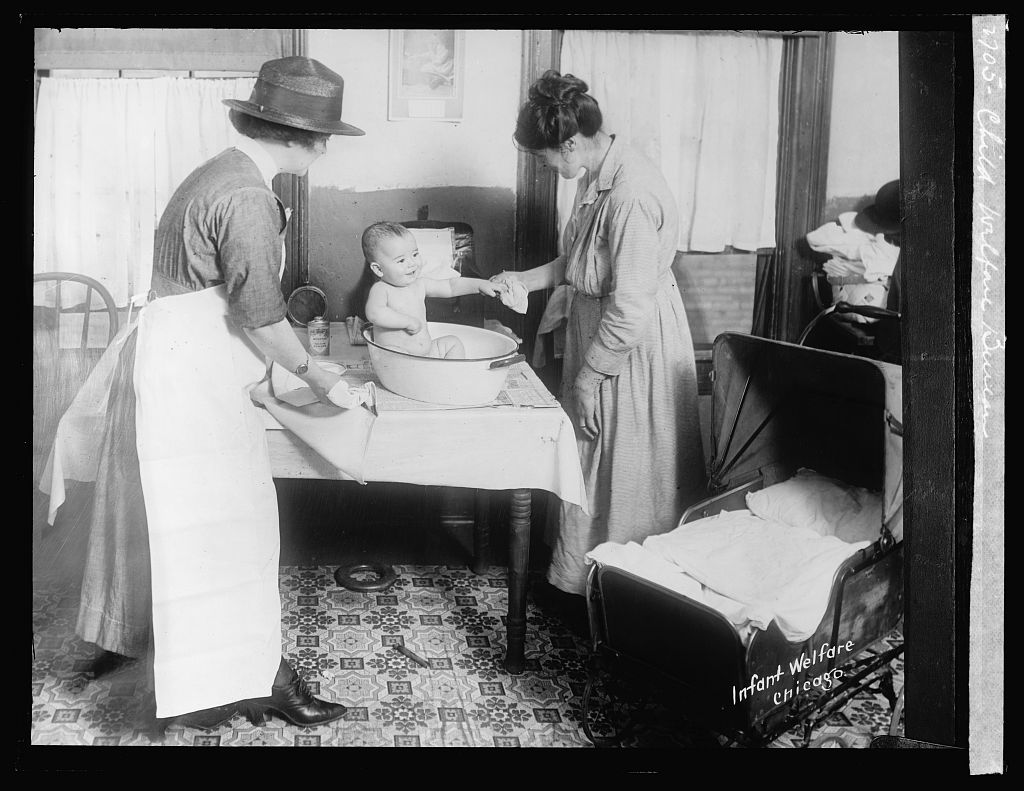
Infant Welfare, Chicago, before 1920 (Library of Congress)
[1] The following passage is based on the many different versions of the Universal News Service dispatch datelined October 15, Chicago, e.g., “Says Miss Rappe Left a Daughter,” Boston Globe, 16 October 1921, 6; “Virginia Rappe Has Child in Chicago?” Okmulgee Daily Times, 18 October 1921, 6; and “Daughter Is Left by Virginia Rappe,” Los Angeles Times, 16 October 1921, 7. A syndicated Chicago Daily News version datelined September 17 appeared subsequently but added no new information.
[2] Census data for John Bates are from 1900 U.S. Federal Census, Illinois, Cook, Chicago Ward 31, District 0969, line 58; and 1910 U.S. Federal Census, Illinois, Cook, Chicago Ward 2, District 0183, line 3.
[3] “South Side Business Men Elect,” Chicago Tribune, 9 January 1914, 9.
[4] “Queens of Society, Gayest of Gay, In Levee Cafe,” The Day Book (Chicago), 2 December 1916, 2.
[5] “Bates Confessed to Hunter Crime,” Inter Ocean, 6 April 1902, 1, 3.




 Spite Work: The Trials of Virginia Rappe and Fatty Arbuckle