“I heard a man’s voice say, ‘Shut up.’”

The following passage is from 1 Judges, that part of our book dealing with the preliminary investigation of Judge Sylvain Lazarus in late September 1921. Lazarus, A police court judge, had been tasked with determining if Roscoe Arbuckle should be tried in the Superior Court of San Francisco on a charge of murder in the first degree or manslaughter.

The testimony of Josephine Keza, the last witness, convinced him to decide on the lesser charge. Otherwise, the judge could have decided against charging Arbuckle for any crime given his grim view of the other witnesses and the failure of putting Maude Delmont on the stand (see 100 Years Ago Today: Arbuckle to be tried for manslaughter instead of murder, September 28, 1921).

Mrs. Keza would testify in all three Arbuckle trials.

Josephine Keza in her St. Francis Hotel maid uniform, Oct. 1921 (Newspaper Enterprise Association, private collection)

After the clinical charts pertaining to Virginia Rappe had been handed over to the defense and entered into the court record, the next witness appeared. She wasn’t Maude Delmont. Although Josephine Keza had been deposed by Milton U’Ren among other St. Francis Hotel employees ten days earlier, her appearance caught Arbuckle’s defense team off-guard.

Freda Blum, who covered the Arbuckle trials for Hearst’s San Francisco Call and International News Service, noted the contrast between the twenty-two-year-old Polish immigrant and the fashionable young women who testified before her. “Unlike the one who ‘models’ for her bread and the other whose ability to entertain earns for her a living,” Blum observed,

the third witness revealed herself in a far different status—one engaged in menial labor. Josephine Keza is a chambermaid at the St. Francis and assigned to the section of the hostelry where the party took place. She wore the unmistakable “beat silk” of the servant class, with long gloves and a last winter’s hat.

Josephine Keza is a foreigner and the English language is difficult for her. She was alternately confused and enthralled by the orations of the defense and prosecution, and when the court released her from the stand, she quietly left the room and went back to her housecleaning.

Milton U’Ren hurriedly questioned his new witness. “Do you remember that Mr. Arbuckle—Roscoe Arbuckle—the gentleman sitting here and some other gentlemen occupied some rooms is the St. Francis Hotel on Labor Day?”

Keza did and U’Ren continued. She described for him that, while cleaning vacant rooms on the twelfth floor, she had heard a woman scream from the direction of Arbuckle’s party. Keza was uncertain about the time. She estimated it to be between 2:00 and 2:30 p.m., which, unlike prior testimony, provided an actual window for Rappe and Arbuckle to be inside room 1219. This pushed the time of Rappe’s injury taking place earlier than previous timeframes, which thus far could only be inferred between 3:00 and 4:00 p.m.

Keza recalled that she hurried down the hall and stood outside room 1219, having heard a woman pleading, crying, “Oh, no, no! Oh, my God! Oh, no!”

“And did you hear a man’s voice in the room?” U’ren asked.

Keza responded, “I heard a man’s voice say, ‘Shut up.’”

With that U’Ren turned his witness over for cross-examination, knowing that Dominguez wasn’t prepared. Although furious and incredulous for the introduction of such a witness, he comported himself and calmly, firmly asked who had deposed her. He was, in effect, ferreting out whether she had been coached by the prosecution. “Who told you to come here and tell this outrageous story?” Dominguez asked with an incredulous tone.

The witness explained that she had given a statement more than a week before to Assistant District Attorney U’Ren.

“Are you in the habit of listening at the doors of the rooms?” asked Dominguez.

Keza understood enough English to know that the lawyer was insulting her. She denied that she eavesdropped for diversion. “When we hear shrieks like those, of course,” she said, “We run to see what is the matter.”

Given the noise, shouting, laughter, and music emanating from the Arbuckle suite on Labor Day afternoon, it was hard not to pay attention. Then, Keza, according to Oscar Fernbach of the Examiner, “positively, unswervingly, and with even added force” repeated to Dominguez what she had heard through the door of the room 1219.

Arbuckle, whose reactions to Zey Prevost and Alice Blake were more of boredom than interest, had come to life when he saw the hotel maid. According to Edward J. Doherty of the Chicago Tribune, the comedian began

rubbing his red chin. Streaks of white showed on them from the pressure of his fingers. Frank Dominguez, his chief counsel appeared utterly bewildered. The spectators were leaning forward, drinking in every word.

Miss Keza, a large woman in a blue dress splashed with white, her string of pearl beads, her gray elbow gloves, gay stockings, and sandals, and her wide black sailor hat, was a little conscious of the crowd, a bit amused and perhaps a bit delighted, at the bomb shell she had exploded.

Dominguez took the witness; he questioned her at length, but only made her testimony stand out the plainer. Every question brought more dynamite for the defense. He dropped her suddenly and finally after she had stated she did not always listen at doors and explained—

“But when there’s music and dancing and loud talking you sometimes want to listen.”

Now, leaning forward in his chair as well, Arbuckle whispered to his lawyers. He surely recognized Keza, who had been in an out of his suite throughout the day before and after Rappe’s crisis. This came up as Dominguez pressed Keza to tell him who had been the first person to hear her story, even before she shared it with the other maids.

“I don’t know who it was first—everybody,” Keza answered and then remembered an exception. “I said to a lady in the hotel by the table I heard the girl scream.”

This overlooked statement stands out. It means that Keza had been in room 1220 and after Rappe had been moved to room 1227 as the party went on without her, as the frolicking continued with the arrival of Betty Campbell and Dolly Clark.

As damning as Keza’s testimony sounded, she couldn’t see through the walls of 1219 and Dominguez knew this.

“I heard all afternoon screaming,” she answered as he continued to query her about the level and kinds of noise coming out Arbuckle’s suite—and so revealed that the “screaming” could have been just the ambience from any of the rooms or all three.

“And in 1221,” Keza continued. “And 1220 was all music and dancing and all kinds of noise—and doors slamming and everything—and by the time there was a girl[’s] scream I saw one gentleman came out and after him one lady, but I could never say which one it could be—because I didn’t see her very good, and she was undressed.”

Without being asked, Keza divulged that the hallway door to room 1220 was open. She made it plain to the court that she was alert to the sounds from Arbuckle’s suite for much of the afternoon.

Dominguez’s next line of questions addressed Keza’s opportune hovering right outside room 1220.

Q: The fact of the matter is, you never heard this language at all; isn’t that true—isn’t that the fact—you never heard this language at all, did you?”

A: What I don’t hear?

Q: I mean these voices—you didn’t hear them at all in 1219?

A: I didn’t hear them say “Oh my God?”

Q: Yes.

A: I did hear it, plain, too—and I heard a lot of slamming the doors just the same at that time.

Q: What is that?

A: I heard the door slamming at that time.

Q: Did anybody tell you to tell this story here in court?

A: When?

Q: That you heard these voices in that room—did anybody tell you to tell it here?

A: Well, I had nobody to tell me.

When Dominguez asked Keza if she had reported the “conversation,” his euphemism for the voices she heard, meaning to the hotel management, Keza said no. “You are sure it ever occurred?” he asked.

Before Keza could be browbeaten any further and give the defense an advantage, Isadore Golden objected. Dominguez had already asked that several times. Judge Lazarus agreed. Flustered, Dominguez responded that he hadn’t repeated this question and that the record would show it.

Golden: Three times.

Dominguez: I beg your pardon; not in this form. It is a peculiar witness, Mr. Golden.

Golden: There is nothing peculiar about the witness, she is a very hard-working woman.

Dominguez: That is all.
 

A new legend about Virginia Rappe: Anna Mariania

At this writing, we are revising the part of the manuscript dealing with Arbuckle’s first trial venue, the Police Court preliminary investigation that would determine whether to charge him with murder or manslaughter before referring the case to the Superior Court of San Francisco.

There is an extant court transcript for us to reference. And this phase of the Arbuckle case was well documented by the press, especially the reporting filed by Evelyn Wells of the San Francisco Call and John H. Richardson of the Los Angeles Evening Herald. Both newspapers were part of the Hearst chain and their coverage hardly evinces the yellow journalism asserted by most other Arbuckle case narratives. Nevertheless, one can find some strange items like the piece about Virginia Rappe’s mysterious past. An edited version first appeared in the Los Angeles Evening Herald on September 26, 1921. But a much longer version, reprinted here, was published in the Pomona Bulletin the following day.

In all likelihood the feature was “propaganda” provided by Arbuckle’s defense lawyers, or a “friendly” third party, to associate Rappe with the Chicago underworld and the demimonde of the notorious Levee district. The target audience was the press, especially the wire services, and ultimately the jury pool in San Francisco, the prosecutors, and the judge.

The following reportage, without byline or dateline, covering Rappe’s early years and introduction to show business, is a marvel of creativity, more like the work of screenwriter than a lawyer if one can imagine the prose as intertitles in a silent film. (During the third Arbuckle trial, a witness was found to posit Rappe as a nightclub entertainer early in her career. See Inexpert witness shopping (Chicago style).) And if this piece wasn’t propaganda, the story of Anna Mariania–Virginia Rappe shows the frustration that many journalists had in trying to piece together Rappe’s background, so much so that they resorted to making things up. Resorting to fiction, too, is hardly restricted to 1921. One can find creative license throughout “authoritative” biographies of Arbuckle and other actors of the silent era, histories, scholarly monographs, and the like.


Virginia Rappe Was Child of Steel Puddler

From obscure poverty as the daughter of an immigrant steel worker to a place in the sun of screen popularity with attendant luxury, this was the career of beautiful Virginia Rappe, according to investigators into the past of the girl for whose death Roscoe Arbuckle, film comedian, is now imprisoned.

Though known by thousands, she was a girl alone. Seemingly she did everything possible to remain alone, to cut herself off from a past with its share of storm and cloud in the hope of future happiness. But a tragic death intervened.

Contrary to recent reports of the girl’s parentage, Virginia Rappe was born Anna Mariania, say those who claim to know. The secret of her dark, flashing beauty lay in an Italian–Jewish parentage. Her father, according to information obtained by investigation, was a steel puddler at Braddock, Pa..[1]

But the life of a steel worker’s daughter amid the grime and soot of the mills was not to the taste of Anna. Eager to see the world, to taste of a life more alluring than that to which she was accustomed, the girl joined a repertoire troupe, which passed through her home town, and went on the road.

The leader of the show was named Rappe, and it was from him that the future film favorite took the name by which she was afterward known, Virginia Rappe.

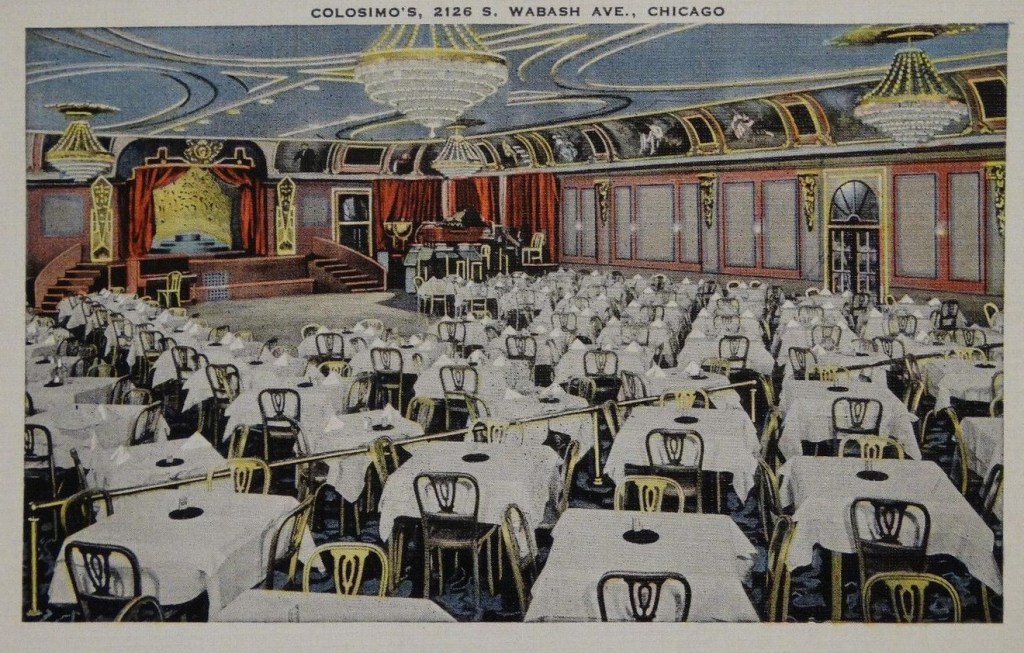
After some months with traveling show, it is said Virginia went to Chicago. Here she became a cabaret dancer, and was a popular entertainer at the famous establishment of “Big Jim” Colosimo, king of the Chicago tenderloin, who was mysteriously murdered a year ago.[2]

Her strange, dark beauty, exploited in a “hooch” dance, became one of the attractions of the resort, and drew the attention of many admirers.[3]

But the lure of the movies took possession of the girl who had already gone far on the road from the humble home at Braddock. The bright lights of Chicago’s night life held her, but not so closely. She longed for something else. Ambition whispered, “You can star in pictures. Others do. Why not you?”

And she listened.

Among those who came to Colosimo’s was a certain motion picture director. He was attracted to the girl, who told him of her desire to come to California, to enter motion pictures. He encouraged her. With her beauty and talent, he said, she could make a success. He would help her.

Virginia came. Six years ago it was she left Chicago. In time the film director starred her in comedies and she became well known as a screen beauty.

There were tales of many admirers. There was Tony, who was only a waiter at one of the city’s most exclusive restaurants, but whose hot Italian blood flamed with love for the voluptuous beauty of Miss Rappe.

His room was a photograph gallery of the picture girl. He had three portraits of her on the ceiling that he “might see her the first thing in the morning and the last thing at night,” so he said.

And she returned his love. After dinner with other admirers when her waiter sweetheart would serve her every wish, she would leave the first man of the evening to go home with her more humble love.

There were rumors that one who had done much for her had deserted her. But who could tell? She was the same vivacious beauty, in love with a “good time.” And it was while out “for a good time” that Death stalked in where only Joy had come before.

Source: The Bulletin (Pomona, California), 27 September 1921, 8.


[1] Braddock, a suburb of Pittsburgh, was the site of Andrew Carnegie’s first steel mill.

[2] Vincenzo “Big Jim” Colosimo, called the “underworld czar” of Chicago, who made his fortune on prostitution, was shot to death on May 11, 1920, possibly by Al Capone or an out-of-town hitman as he advanced in his “career.”

[3] Hooch, i.e., any sexually provocative dance better known as the “hoochie-coochie.”

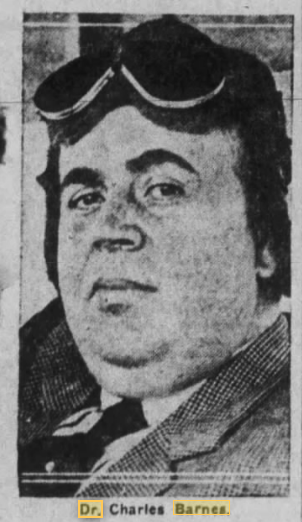
Dr. Charles E. Barnes, the quack whose heroic measures saved Arbuckle?

Our unconventional narrative leads in with the life or legend of Virginia Rappe. It leads out with an epilogue that follows some of the figures from the Arbuckle trial and the so-called “Rappe curse.”


Practically all members of the jury declared that the most important piece of evidence in their minds was the testimony of Dr. Charles Barnes of Omaha, defense surprise witness, who impeached the testimony of one of the state’s principal witnesses, Mrs. Fox, and declared that he had treated Miss Rappe for the same sort of trouble which the defense claimed was the cause of her death.

Edward W. Brown, jury foreman[1]

A century ago this week, Minta Durfee made the decision to part ways with Roscoe Arbuckle. Like the vaudeville actress that she was at heart, she could see that her role in “standing by” her estranged husband for eight months was over. Despite Adolph Zukor’s promise to release two new Arbuckle films as well as Gasoline Gus (1921), he and other stakeholders in Arbuckle agreed with Will H. Hays, the Chairman of the Motion Picture Producers and Distributors of America, that the ban on Arbuckle’s films should continue for the present.

Arbuckle was also prevented from going back to work on new films. If Durfee hoped to ride on his coattails again in making her own comeback, those hopes had been dashed. She decided to return to her apartment on Riverside Drive and Arbuckle remained behind in Los Angeles to settle his debts. He put his West Adams Street mansion on the market and looked for someone to buy his beloved Pierce-Arrow “palace car” that he drove to San Francisco and his ill-fated Labor Day party at the St. Francis Hotel.


On her return to New York City, Durfee got off the train in Omaha to spend a couple of days with a special friend, made during the course of the third Arbuckle trial, Dr. Charles Edwin Barnes. His rebuttal testimony on April 10, challenged the assertion of Katherine Fox, Virginia Rappe’s guardian and mentor, that Rappe had been healthy and suffered from no illnesses (see also Katherine Nelson Fox . . .). Dr. Barnes took the stand and said that he had treated Rappe for cystitis in Chicago during the summer of 1909 and that Mrs. Fox herself had brought Rappe to him.

Barnes, too, also embarrassed Fox, letting on that he had known her for years, ever since 1898 when they lived across the hall from each other in his mother’s boarding house. Since the press had long taken sides with the defense, this revelation somehow made Fox’s assertions of Rappe’s robust health false.  Barnes even addressed Fox in the courtroom by her maiden name of “Dot” Nelson in such a way that even put her status as a widow in doubt.

Mrs. Fox, who sat through Barnes’ testimony, shook her head at his claims of having treated Rappe and even performing surgery on her. The prosecution challenged Dr. Barnes’ notes and records. But ultimately, in surrebuttal Fox was compelled to admit that she knew Dr. Barnes in 1898, something she denied during her cross-examination. This, too, the press saw as another reason to question her entire testimony, even though she wasn’t aware that he went on to attend medical school.

Soon after her final appearance on the stand, the final arguments were made for and against Arbuckle’s guilt. Then the case went to the jury in the late afternoon of April 12. They made their decision to acquit in minutes and returned to the courtroom with a ready statement that could have been written by Arbuckle’s manager Lou Anger or his studio bosses, Joseph Schenck or Adolph Zukor, insisting that a great injustice done to the comedian and that his career be restored.


Newspaper reporters were quick to see that Dr. Barnes had scored a “direct hit” on the prosecution’s case. For us, however, it is another indication that the victim—the woman—was on trial no less than the famous motion picture comedian.

The defense scored in the third trial of Roscoe “Fatty” Arbuckle today when it placed Dr. Charles E. Barnes of Omaha, formerly of Chicago, on the witness stand to rebut the testimony previously given by Mrs. Catherine [sic] Fox of Chicago. At the conclusion of Dr. Barnes testimony and several other witnesses from Southern California the defense announced it had completed its case. The state asked time to check up by telegraph certain portions of Dr. Barnes’ testimony, and the court [i.e., Judge Louderbeck] granted until 10 o’clock tomorrow morning for the prosecution get this information. The court announced, however, that if the state was not ready to proceed at that time he would order the case closed and arguments started.

Dr. Barnes testified that for three months—from June through August—in 1909 he had treated Miss Rappe for an abscess and a chronic ailment and that it was Mrs. Catherine Fox, whom he pointed out in the court room as Miss Dot Nelson, who had introduced him to Miss Rappe and who had brought the girl to his office for treatment.

Mrs. Fox has testified that during the year 1909 she had seen Virginia every day and that at no time was the girl under the care of a physician.

“When did you first meet Dot Nelsen [sic]?” the doctor was asked.

“The latter part of 1908, at the boarding house run by my mother,” Dr. Barnes replied. “Dot Nelson lived in a room across the hall from my room at the time and I saw her every day. The last time I saw her was in August 1909,” the witness continued.[2]

“Do you see any change in the person you recognize as Dot Nelson,” Assistant District Attorney Leo Friedman asked the witness.

“None whatever, I could never mistake her. She has changed but very little,” the witness replied.

Shortly after he met Miss Rappe in a social way, at the States restaurant, said the physician, he treated her for acute gastritis. Then in June, 1909, he declared, she visited him with Miss Nelson, because of her health. An examination revealed an abscess and a condition which necessitated an operation. The operation, Dr. Barnes said, was performed by himself and a Dr. Wicks.[3] He found the organ, which was mentioned so prominently in this case [i.e., the bladder], in a diseased condition, and continued his treatments for over a period of three months.

Five prescriptions, which the physician said he had written for Miss Rappe, were introduced in the evidence. The prosecution tried in vain to confuse the doctor regarding the dates, but the witness always corrected his cross-questioner and at times caused the spectators to laugh at his answers.

The court, however, took the pleasure of the laughing away from the spectators by announcing he would clear the room if it was repeated.[4]

Although some newspapers reported the “chronic ailment” as cystitis, what little testimony that survives in reportage doesn’t have Dr. Barnes using this exact term.[5] In any case, he had exposed Mrs. Fox as an “imposter” and liar. Marjorie Driscoll of the San Francisco Chronicle, who had covered the three trials for months, wrote effusively—and, perhaps, relieved that Barnes had finally put an end to the Arbuckle case so that she and her colleagues could move on.

Dr. Charles M. [sic] Barnes was literally and figuratively the biggest gun fired by the defense. He was a double-barreled weapon, for his testimony not only tended to show that Virginia Rappe had at one time suffered precisely from the ailment claimed for her by the defense, but the load from the other barrel landed squarely on Mrs, Catherine Fox, state witness to Miss Rappe’s excellent health.

Dr. Barnes identifies Mrs. Fox in open court as the “Dot Nelson” who had visited his office in company with Virginia Rappe in the summer of 1909, when she was treating Miss Rappe for serious illness. Mrs. Fox had previously admitted having born the nickname of “Dot” in the days before her marriage, when she was Miss Nelson.

Mrs. Fox sat in the front row and radiated silent but vigorous denials as Dr. Barnes testified. If looks could slay, Dr. Barnes would have crumpled on the spot.

Dr. Barnes produced his prescription book containing duplicates of prescriptions he said he furnished Miss Rappe. The state drew some consolation from his admission that there no dates in the book, but he insisted that it covered the period in question, declaring that he remembered many cases therein referred to.

Whereas Mrs. Fox previously testified that she never knew Dr. Barnes, Dr. Barnes yesterday said that for two years between 1899 and 1900 he and Mrs. Fox, then Miss Nelson, not only lived in the same boarding house, kept by his mother, but occupied rooms across the hall from one another. He also said that he had seen her on other occasions since that time, and described a meeting in a Chicago café, denied by Mrs. Fox.

A ray of light for the state appeared during the cross-examination when Dr. Barnes said that he considered Miss Rappe cured of her illness at the time his treatments ceased. The prosecution failed, however, to shake his testimony involving Mrs. Fox.[6]

Dr. Barnes held such a privileged place in the outcome of the third Arbuckle trial that he and his wife were invited by Minta Durfee to accompany her and husband back to Los Angeles in the Pierce-Arrow. 


So, who was Barnes? He was an incompetent surgeon and a quack. But so were many doctors during the early twentieth century who provided what they believed to be what we now call “alternative medicine.”

According to the Directory of Deceased American Physicians, Barnes was born in Madison, Wisconsin, in 1881. While on the stand during the third Arbuckle trial, Barnes disclosed that he had lived in the same boarding house as Katherine Fox, but there is no census data for either of them until 1910.

A graduate of the Chicago College of Physicians and Surgeons (1903), Barnes was trained as an allopath. His career had few highlights until much later, but he did have a curious connection to the art model community of Chicago to which Rappe belonged.

In September 1905, the Physical Culture Society of Chicago appointed him as one of three physician judges for a beauty contest in which he decided on which woman would be “the model,” displaying the most beautiful “symmetry of form.”

In 1907, Dr. Barnes married the daughter of a physician, Laura Reese. The couple had no children and lived on West Garfield Boulevard, on Chicago’s South Side, before moving to the Saratoga Hotel in 1908.

Dr. Barnes practiced medicine in Chicago at least until the summer of 1909—when he had crossed paths again with Katherine Fox and with Virginia Rappe for the first time. But Mrs. Fox had been married to Albert Fox a wealthy window glass salesman and heir to a glass-making firm in upstate New York, for six years, and had likely long since moved from the boarding house of Dr. Barnes’ mother.[7]

That same year saw Dr. Barnes declare bankruptcy. In the autumn, he relocated to Crete, Nebraska. There he took over another physician’s practice and opened the “Barnes Hospital.” Dr. Barnes also practiced in Mountain Grove, Missouri (1909) and Rock Island, Illinois (1911). While there, he found himself in court for the first time in a replevin suit over a lost bulldog that he refused to return to its original owner.

In late 1916, Dr. Barnes opened a new practice in Omaha, Nebraska. Not only did this give him access to more patients and billings, but he could now avoid accusations of malpractice, especially when he performed surgeries. In Omaha, Dr. Barnes ran advertisements for treatments of chronic diseases that required less heroic measures, such as hay fever, asthma, constipation, lumbago, pimples, “cancer cured without a knife,” and the like. He claimed he could cure what other doctors could not and advertised long lists of diseases that one might find on bottles of patent medicines. Ironically, none of his advertisements mentioned cystitis.

in the late 1910s, Barnes’ career suffered a few setbacks though none as severe as what some of his patients suffered while under his care. In 1919, he attacked his office girl and threatened to dissect her because she refused to comb her hair. She sued him for $15,000. He also had to deal with unsatisfied patients who also took him to court. Then, in 1921, his advertisements no longer ran in Omaha newspapers.

In early April 1922, he took the stand as a surprise witness at the third Arbuckle trial. His photograph, in which he is wearing what look like medical lamp goggles, appeared in the Omaha newspapers and he became a local celebrity.

Screen Shot 2022-04-26 at 9.53.52 PM
The doctor who saved Arbuckle’s career? Source: Newspapers.com

Unlike other witnesses who claimed to have treated Rappe during her youth, Dr. Barnes wasn’t still living in Chicago, where such witnesses came forward or were recruited by the lawyer Albert Sabath (see Inexpert witness shopping Chicago style . . .). Although Sabath likely sought such a star rebuttal witness, that Barnes didn’t appear until the third trial suggests that he had come forward himself. The late date is telling because Dr. Barnes might have neutralized Mrs. Fox during the second trial, which nearly convicted Arbuckle except for one juror voting in his favor. One could almost imagine Barnes writing Minta Durfee. It might explain why they became friends.

Dr. Barnes moved on after his brief taste of fame. In 1923, he advertised his latest offering, “Electronic Diagnosis and Treatment,” for which he trained under Dr. Albert Abrams, the inventor of such devices as the “Oscilloclast” and the “Radioclast.” That Dr. Barnes proudly mentioned this association shows his nerve or recklessness since Dr. Abrams was already known as quack and had been under investigation for years.

In 1925, Dr. Barnes and his wife separated. Then his career suffered as he turned to more desperate ways to earn income. Three years after his testimony clinched Arbuckle’s acquittal, he himself was arrested under circumstances no less bizarre than the comedian for whom he bore a resemblance.

Dr. Charles E. Barnes, wealthy Omaha physician, charged with being the head of an immense dope ring, was released under $10,000 bond, the maximum provided by law, after he waived preliminary hearing before U.S. Commissioner Mary Mullen here today.

Andrew Durant, an actor and female impersonator, and D. H. Armstrong, also arrested with Barnes, are being held for investigation.

Dr. Barnes is charged with having sold Fred Mapes, under indictment for embezzling from the Becker Asphaltum company of which he was general manager, a quantity of morphine yesterday. Mapes gave the doctor a marked $10 bill in payment for the drugs and police charged the money was found in Barnes’ possession.

Miss Josephine Nepodal, eighteen-year-old office assistant of Dr. Barnes, is held under technical arrest also. She has given the police valuable information in the case.[1]

In February 1926, Dr. Barnes was charged on 31 counts of violating the Narcotics Act, for which he could receive five years for each, or a total of 155 years in prison.

Incredibly, and while still under indictment for the narcotics violations, Barnes was arrested in January 1927, on first degree murder for the death of a Sunday school teacher and farmer’s daughter, with the unfortunate name of Wealthy Timpe Nelson, who was married on her deathbed as she bled out from a botched abortion for which her fiancé paid Dr. Barnes $125.[2]

Barnes’ lawyer tried to get the charge reduced to manslaughter—and as he awaited trial, his wife sued for divorce. Dr. Barnes served no time for his crimes. A diabetic, he died, at the age of 46, on May 20, 1927, after a short illness attributed to his own preexisting condition. Mrs. Barnes arranged for his funeral in Chicago, where he is buried in Mt. Hope Cemetery.


[1] “Release Barnes on Bond,” Lincoln Star-Journal, 4 August 1925, 13.

[2] “Dr. Barnes Bound Over in His Case,” Lincoln State Journal, 24 January 1927, 1.

[1] Qtd. in “Arbuckle Freed of Manslaughter,” Omaha Daily, 13 April 1922, 2.

[2] Realize that this woman was married to Albert Fox at the time. There is no mention of him here.

[3] Most likely Seth Wicks, who, like Barnes, graduated from the College of Physicians and Surgeons in 1903. He could hardly vouch for Barnes’ allegations since he died in 1920.

[4] Associated Press, “Arbuckle Defense Closes Case with Doctor’s Evidence,” El Paso Times, 11 April 1922, 2.

[5] A typical example is found in “Doctor Tells of Treating Miss V. Rappe,” Oxnard [California] Daily Courier, 10 April 1922, 1.

[6] Marjorie C. Driscoll, “Defense Ends Testimony in Arbuckle Case,” San Francisco Chronicle, 10 April 1922, 7.

[7] We haven’t been able to identify her as yet to corroborate his testimony.

Arbuckle’s lawyers as witnesses . . . for the prosecution?

On Saturday, April 8, which was a short session for the third and final Arbuckle trial now entering its third week, Assistant District Attorney Leo Friedman called Gavin McNab, Arbuckle’s lead attorney, to take the stand. According to the Associated Press reporter, McNab “absentmindedly” did so without being sworn in.[1] More accustomed to examining witnesses rather than being questioned as one himself, McNab was asked how he obtained the deposition of Mrs. Helen Madeline Whitehurst taken by Albert Sabath, the Chicago attorney.

Earlier in the week, she had taken the stand and claimed to have seen Virginia Rappe drinking in her Chicago cafés and her own home in 1914 and 1915, becoming ill and tearing off her clothes—the behaviors that she exhibited in Arbuckle’s hotel bedroom on Labor Day 1921.

During her examination, McNab confronted her about a discrepancy found in her deposition regarding how many times she saw Rappe fall ill in her home: a “number” of times versus only two.

Whitehurst claimed her deposition had been altered and McNab then offered the deposition as an altered document. This seemingly minor detail, however, prompted the prosecution to expose the true nature of Sabath’s relationship to the defense—as a purveyor of tainted evidence and witnesses all designed to damage the reputation of Virginia Rappe.

McNab said that Sabath wasn’t a defense attorney and that his office didn’t correspond with him. If Sabath had acted as a defense attorney, McNab said, those arrangements had been made “in the east,” adding that he didn’t know who sent him the deposition, stating that it merely came to him “from the east.”

The prosecution’s strategy here was simple: to reveal that Sabath had really been in the employ of the defense during the time that he had been commissioned by the court to take depositions in Chicago. In that capacity, Sabath should have been answerable to the court and expected to be impartial. Logically, such a strategy put jury members in the strange position that if any of them voted to acquit Arbuckle, it would be with the knowledge that there might have been false testimony presented. By placing the burden of guilt on the jury, Brady and his assistants hoped to bolster their case against Arbuckle made entirely on circumstantial evidence and also parry the defense’s attacks on Rappe’s character—to restore the victim to her victim status.

McNab expressed a certain plausible deniability by stating that his colleague on Arbuckle’s so-called “million dollar” defense team, Charles H. Brennan handled the “eastern agents” of the defense. But that was as far as Friedman got before McNab’s chief assistant, Nat Schmulowitz objected—and Judge Louderback sustained. McNab left the chair and Friedman called Brennan to the stand. He testified—this time under oath—that he knew Sabath, having met him in October 1921. He also admitted that Sabath handed him the deposition in Chicago in late February but denied that Sabath worked for the defense. In contrast to the AP Night Wire, Oscar Fernbach of the San Francisco Examiner reported that Brennan said that Sabath, “in the time of procuring a statement for the defense from Mrs. Helen M. Whitehurst, was not a commissioner of the court.”[2]

A cursory look at the reportage from October 1921 and February 1922 reveals that Sabath, indeed, had been working closely with the defense. This, of course, put Judge Louderback in a more uncomfortable position than the jury. The judge could now be seen as having favored the defense. He had commissioned a lawyer who obviously worked for Arbuckle’s defense since October if not earlier—and Sabath himself wasn’t the least bit covert about it. He had offered to defend Arbuckle at the third trial in the wake of the second trial. He had personally dispatched one of his Chicago witnesses for the defense, Nurse Virginia Warren, to San Francisco so that she was well prepared to take the stand and say that Rappe gave birth to a premature infant in 1908.

This small but bold move by the prosecution ended the rebuttal phase of the third Arbuckle trial. It was followed by a brief surrebuttal, in which Harry Barker, although sick from a cold or flu, repeated his testimony from November 1921, in which he, as Rappe’s former Chicago sweetheart, suffered her hysterics vis-à-vis a drink or two. Ironically, Brady and his associates were aware that Sabath was Barker’s friend, business partner, and fellow litigant in a long-standing lawsuit that already made its way to the California Supreme Court. But they had thus far made nothing of this curious connection. Time was running out. The public was impatient. Hundreds of thousands of dollars, if one adjusts for inflation, had been spent by the state to prosecute Arbuckle.

Gavin McNab (l to r) making a point at the defense counsel table to Milton Cohen, Roscoe Arbuckle, Charles Brennan, and Joseph McInerney (Newspapers.com)

[1] Associated Press Night Wire, in various newspapers, 9 April 1922.

[2] Oscar H. Fernbach, “M’Nab Poor Witness for Prosecution,” San Francisco Examiner, 9 April 1922, 2.

April Fool’s Day 1922: Fred Fishback testifies for the defense

The comedy director Fred Fishback[1] was one of Roscoe Arbuckle’s two traveling companions who arrived at the St. Francis Hotel on the evening of September 3, 1921. The other was one of the first Hollywood actors who specialized in “heavy” male roles, Lowell Sherman. But unlike Sherman, Fishback had testified at the previous two trials and had made himself available for Arbuckle’s defense. The resulting notoriety temporarily interrupted his work as a director and forced him to work under the name of Fred Hibbard.

A tall and athletic man—Fishback was a swimmer—who neither smoked nor drank made an unusual participant in Arbuckle’s revels as well as Arbuckle’s roommate in room 1219. He made for an even stranger roommate for Virginia Rappe’s manager, Al Semnacher, when he moved from the Palace Hotel to the St. Francis during the late afternoon–evening of September 5. Fishback and Semnacher slept on another floor.

Fishback, naturally, didn’t want to return to 1219 given what had happened there in the mid-afternoon, when Rappe was found going in and out of shock given the true nature of her injury. He was, like the women at the party, a first responder. He had handled Rappe’s body twice. The first time was corroborated by prosecution witnesses: Fishback had lifted Rappe up on one side, while Maude Delmont and Zey Prevost had taken the other arm and leg, and carried Rappe into the bathroom and placed her in a bathtub filled with cold water. The object of this treatment was to bring Rappe back to her senses so that she could explain what was wrong with her.

The second time as Fishback testified was when he took Rappe by the ankles and held her upside down vertically. To do this, he claimed to have stood on the bed so as to allow blood to flow back into her brain and thus bring her back to consciousness.

That he could hold a woman up like this wasn’t questioned. Fishback appeared to be physically capable of doing so. The more curious feat was the act of standing and balancing on a mattress that was supported only by bedsprings rather than a modern box spring mattress. Thus, we can imagine Fishback’s act of first aid akin to a trampoline gag worthy of a comedy director. Fishback, too, stated that his big hands had likely caused the bruises on Rappe’s arms, which the prosecution had to Arbuckle.

What seemed like an act of mercy, however, worked well for the defense. The jury would have to consider that Fishback might have accidentally caused her ultimately fatal bladder rupture. That and Fishback’s dogged loyalty to his friend, Arbuckle, made him an effective prosecution witness. He was unshakable on the stand. His loyalty to Arbuckle began early, when he refused to sign a statement that, ironically, quoted him accusing Lowell Sherman of trying to “upstage” when Sherman and Arbuckle conspired to to rid themselves of his company after Rappe’s crisis.

Still, the whole exercise with Rappe’s limp body seemed too opportune. And no one else witnessed such a robust display despite the other accounts of what was done to help Rappe.

Fishback also served to deflect the direction of the accusations that Rappe was said to have uttered—“I am dying” and “He hurt me”—which the prosecution contended were aimed at Arbuckle. Gavin McNab, Arbuckle’s chief counsel, said if Rappe had said anything like this, it was directed at Fishback.

Fishback previously stated and restated that he never heard Rappe say anything. But on April 1, 1922, he recalled that he only heard her say one word, “Don’t”—but who was the recipient of this simple, human request goes unmentioned in the reportage.[2]

There was also a light moment as the Saturday session came to an end, which suggests that the two prosecutors didn’t believe that Fishback had stood on the bed and held Rappe up. McNab, undoubtedly reflecting the upbeat mood at the defense table, asked Assistant District Attorney Milton U’Ren if he would like to subject himself to a demonstration. But U’Ren declined being held upside down by his ankles, saying that he did not care to be “manhandled.“

A rare photograph of the man behind the camera: Fred Fishback (l) serving Edith Roberts (c) sparkling grape juice on the set of A Baby Doll Bandit (Exhibitor’s Herald, August 2, 1919)

[1] Fishback is the conventional Americanized spelling but newspapers in 1921 and ’22 also spelled his name in keeping with his Romanian Jewish ethnicity (e.g., Fischbach or Fischback).

[2] Associated Press, “Fischbach on Stand in Arbuckle Trial,” Los Angeles Times, 2 April 1922, I:4.

Two reporters testify and test-bed inferences based on scant reportage

Which faded first, public interest in the Arbuckle trials or the press coverage? Since metrics for the former didn’t exist in 1922, it would seem the latter. As the days stretched into weeks, the number of reporters in Judge Harold Louderback’s courtroom dwindled. The headlines gave way to the death of Pope Benedict XV, the murder of William Desmond Taylor, Lenin’s declining health, the Arthur Burch trial in Los Angeles, and the other intractable problems of the world. By the end of the first Arbuckle trial much of the coverage had already been relegated to below the fold and inside newspapers. This became the norm for the second trial. Fewer stories were bylined. But Marjorie Driscoll for the San Francisco Chronicle and Oscar Fernbach for the Examiner soldiered on. Nevertheless, their copy read as though they were bored by the Arbuckle case or believed their readers were. There was little that was new to report. That Arbuckle wore the same blue Norfolk suit to court each day was like a mantra.

For the authors of books and articles about the Arbuckle case, however, the lack of reportage is either a boon if one wants to get in and get out so as to meet a deadline and page count. For us, however, it means inferring from newspaper sources that are, to paraphrase researcher Joan Myers, dicey. But this relative lack of competition allowed the few remaining reporters to focus on details and hope that they could hold the reader’s attention—an expectation that was also placed on three different juries with three different outcomes.

The prosecution and defense virtually repeated themselves in the second and third trials that lasted into spring 1922. Nevertheless, there were subtle changes in strategy. After the second trial ended in a hung jury—10 to 2 for conviction—the defense understood that it could no longer hold back on Rappe’s past. The newspapers reported this as if it were new, but Arbuckle’s lawyers in San Francisco, Los Angeles, and Chicago had started to deconstruct Rappe’s “good girl” image before she was even buried in Hollywood Forever Cemetery.

Ironically, while the press took less interest in the Arbuckle trial, San Francisco District Attorney Matthew Brady and his assistants took more interest in the press—indeed, in the earliest pieces written about the Arbuckle case. Therein, they brought into the light the first statements that Arbuckle made to reporters about his Labor Day party and the death of Virginia Rappe.

Curiously missing was the foundation of Arbuckle’s “Good Samaritan” testimony from the first trial, that he gave aid and comfort to Virginia Rappe after finding her writhing on his bathroom floor in room 1219 of the St. Francis Hotel, leaving it up to the jury and public to see that he should be seen as a decent man rather than an uncaring rapist. The clipped, matter-of-fact testimony that Arbuckle gave was also intended to emphasize that he was alone with Rappe in the bedroom for just eight minutes—a claim that could be corroborated with nothing but circumstantial evidence.

But Arbuckle’s version of events wasn’t heard by anyone but his lawyers until late November, nearly two months after his arrest. Why hadn’t he mentioned his heroics in room 1219 to the two reporters who had contacted him just hours after Rappe’s death and before his arrest? He likely would have saved himself and the motion picture industry a world of grief as it might have prevented the clamor for government regulation of the motion picture industry and de facto the private lives of performers, producers, writers, etc.

Arbuckle’s fantastically opportune testimony came late. It was like the missing piece in a jigsaw puzzle, a story that would dovetail with the established timeline as described by prosecution witnesses and account for the physical evidence that had been presented in court, notably fingerprints.. It rendered Arbuckle an innocent victim of circumstances who had, against the odds, stumbled into a medical emergency and found himself accused of rape and murder. But if this puzzle piece was contrived, carved out of new cardboard, so to speak, as Brady and his assistants believed, it was imperative to attack its cardinal weakness, its timing.

Arbuckle said that his original chief counsel, Frank Dominguez, had ordered him not to say anything in his own defense in September 1921. The public animus against was just too much to overcome in the weeks after Rappe’s death. Arbuckle claimed that he was intentionally silenced. But eventually he had been given the opportunity to speak out and took it.

While he hadn’t been particularly forthcoming when interviewed on the day of Rappe’s death, at the first trial and for the first time Arbuckle inserted an alibi of sorts, that he was intending to get dressed in room 1219 to take a female friend out for a drive in his Pierce-Arrow during the afternoon of September 5 and by coincidence he discovered Rappe on the bathroom floor.

The prosecution believed that what Arbuckle told the two reporters on September 9 was important to have before a jury not for what was said but also for what wasn’t. A close reading, or rather a close hearing of the reporters’ testimony allowed one to infer that Arbuckle was more than a passive participant at the party and his traveling companions were solely to blame for the women, the alcohol, etc. But it was a stretch by the prosecution to believe they could convince a jury that Arbuckle’s omission of discussing his concern for Rappe’s suffering — in light of what he would describe in his sworn testimony two months later — was evidence that he was a man covering up a crime. (see “Arbuckle’s testimony of November 28, 1921).


Warden Woolard of the Los Angeles Times was one of the two who interviewed Arbuckle after the news broke about Rappe’s death and he testified at both the second and third trials. Due to the abbreviated coverage of these trials, we can only infer that he repeated his original reportage of Saturday, September 10, 1921, to one of the two assistant district attorneys who conducted the examination. To him Arbuckle seemed to be a man unconcerned about the problem that Rappe’s death presented and confident he could straighten the matter out with the chief of police in San Francisco. But the prosecution would question why many of the details Arbuckle later testified to were not mentioned on September 9. Woolard’s interview with Arbuckle happened at Grauman’s Million Dollar Theater which may sound innocuous but was at the time a seat of power in Hollywood so it’s likely Arbuckle was being counseled by Frank Dominguez or Milton Cohen to arrange for it as damage control. We can infer that the prosecution framed the arrangement of this interview as an indication that Arbuckle’s comments were something less than extemporaneous.

Unfortunately, Woolard’s testimony revealed little beyond what he had originally reported. At the second trial, however, he added that although Arbuckle denied hurting Rappe, he had pushed her down on the bed to keep her quiet. Arbuckle also said that there were no locked or closed doors at the party all afternoon. In regard to Maude Delmont’s description of the party being “rough,” Arbuckle responded that the only thing rough about the party was Delmont herself.

After Woolard left the stand, the jury heard Arbuckle’s first trial testimony read into the record of the second by Assistant District Attorney Leo Friedman, who was known for the insinuating tone he added to such readings.

Woolard said that he was prompted to seek out Arbuckle on September 9, 1921, hours after Rappe’s death, because he had read a San Francisco Chronicle wire that, apparently, had been written by someone who had heard Delmont’s side of the story as well as earlier comments by Arbuckle. The San Francisco reporter of these accounts was George R. Hyde. He took the stand at the third trial on March 25, 1922—just after Woolard presumably repeated much of his testimony from the second trial.

We have little to work with regarding Hyde’s testimony, only one detail emerges, that he made a long-distance telephone call to Arbuckle’s house and that someone he presumed to be Arbuckle answered his questions. Unlike Woolard, however, Hyde was asked to provide a carbon copy of his interview notes to the defense though it appears that they provided any useful revelations. That said, we must infer that either Leo Friedman or his colleague, Milton U’Ren, treated Hyde’s published interview as a de facto deposition that could be used to challenge statements Arbuckle later made under oath, such as his declaration that he was never alone with Rappe and that doors were never locked in the suite. Like so many paper cuts, the inconsistencies would not be fatal in themselves but could add up if the jury had the patience to process them.

Neither Woolard nor Hyde were cross-examined. The defense elected not to do so as not to give their stories any more time on the stand . To do otherwise risked calling attention to them, imprinting them on the jurors’ minds. Arbuckle’s lawyers did, however, argue that the two reporters’ testimony should be inadmissible. But the court allowed the testimony. It was then followed by another reading of Arbuckle’s first trial testimony on Monday, March 27 by Leo Friedman.

Inexpert witness shopping (Chicago style) and other random thoughts regarding the third Arbuckle trial

In the wake of the second Arbuckle trial, Chicago lawyer Albert Sabath told the Chicago Tribune that he intended to leave for San Francisco to take part in the upcoming third trial. Undoubtedly, he was waxing in his importance to Arbuckle’s defense. In October 1921, a month before the first trial began, Sabath had deposed a doctor and two nurses on behalf of the Arbuckle defense team, and allowed for highlights of their statements to reach the press. Given other stories out of Chicago at the time, Sabath, too, may have been looking for witnesses who could support the contention that Rappe had a child out of wedlock. San Francisco District Attorney Matthew Brady called this pre-trial reportage propaganda.

The first trial had been a hung jury: 10 to 2 for acquittal. The more that Rappe’s purported past was heard in court, the greater the doubt was among jury members that Arbuckle had committed a crime. If Rappe had cystitis and other gynecological complications caused by being sexually active since adolescence she would seem more of a victim of her own lifestyle. For any rumors or uncorroborated hearsay to have an effect they needed to be published before the jury was chosen. Once selected the jurors would be sequestered in a hotel and any mention of the Arbuckle case would be scissored from their copies of the San Francisco papers.

Sabath had been retained since September 1921, probably by Arbuckle’s personal lawyer, Milton Cohen, soon after Arbuckle’s arrest. Sabath was in a position to help Arbuckle. His law partner was his uncle, U.S. congressman Adolph Sabath, his father, Joseph Sabath, was a Chicago judge, and Albert was well connected in Chicago society and its underbelly given the people his law office represented. Albert Sabath likely also knew Rappe in life. Her one-time fiancé, Harry Barker, had been one of Sabath’s groomsmen at his January 1914 wedding.

Rappe had no living family and few willing to step forward to contradict anything Sabath’s witnesses said. As the Tribune put it, the defense could “tear to fragments the character of Virginia Rappe, who is dead and cannot speak in her own behalf.” Barker, a friend and business partner in the Sabath family’s real estate holdings in California before and during the Arbuckle case, would have known about some of the blank spots in Rappe’s history, which could then be creatively filled to raise doubts among the jury.

“The vote of 10 to 2 for conviction by the last jury,” Sabath said on February 7, “ended the defense polity of shielding the name of Virginia Rappe. It appears impossible to free Arbuckle and at the same time steer the testimony clear of the facts about Miss Rappe’s condition. We must show the kind of life she led. We must lay bare every shred of information on her past.”[1]

Arbuckle’s lead attorney Gavin McNab, concerned about keeping the defense under his control, declared “Sabath’s sole service for the defense is the gathering of depositions in Chicago. We know nothing of his intended visit to San Francisco or the witness he is supposed to have found. The defense counsel list will remain the same as in the two previous trials.”[2] But Sabath did arrive in San Francisco and brought with him Virginia Warren, one of the nurses he had deposed in October.

Warren’s story—or rather stories—were already being floated in the press during the third week of October 1922. But now, for the third trial, she would be groomed to take the stand.

We will discuss her again in a post marking the hundredth anniversary of her testimony. For the present, we want to editorialize briefly on the quality of Sabath’s witnesses and why McNab consented to having them deposed.

One reason was to replace Harry Barker, who had testified on behalf of Arbuckle at the first trial (see Bit Player #5: The Sweetheart). District Attorney Matthew Brady had already brought charges of perjury against two defense witnesses and was threatening to do the same to Barker, who had faced a withering cross-examination during the first trial which left him looking like a cad if not an outright liar.

To fill this void, Sabath located three more doctors to add to Dr. Maurice Rosenberg. Rosenberg’s deposition was allowed to be read at the first trial. He said he had treated Rappe for cystitis in 1913. One thing the prosecution skipped over during the cross-examination of Dr. Rosenberg’ was his role as a house physician for an infamous Chicago brothel.

An angle that Brady could exploit was that Chicago was known for corruption and organized crime and any defense witnesses from there would be easy to denounce. Arbuckle’s defense understood this as well so they had to be wary of the quality of witnesses Sabath deposed. One such case was John “Butch” Carroll, whose criminal background went back at least to an 1896 murder during a burglary attempt gone wrong.

“Butch” Carroll’ was best known for the saloons he operated on the “levee” of the Chicago River or “West Side.” These were known haunts of Chicago’s underworld, where one risked life and limb, as in the 1908 case of a salesman from Cincinnati who was killed by a stray bullet meant for another man’s wife in a domestic argument.

Carroll’s bars also offered entertainment, typically young, pretty singers wearing short skirts. His Palm Garden, at 948 W. Madison St., also featured a “house of ill repute” on the floors above. One Chicago police chief lost his job because of the payoffs that Carroll and other bar owners arranged so that no one shut them down. Chicago newspapers are rife with criminal cases in which Carroll’s name surfaces, sometimes as a defendant. What they don’t report is the names of their attorneys. Even so, one can assume they had the backing to afford the best lawyers, such as Albert Sabath’s firm.

When Sabath showed “Butch” Carroll photographs of Virginia Rappe, he recognized her. He said she sang in his bar in 1911—which would have been the Palm Garden. It was not the kind of establishment that Harry Barker described taking Rappe to during their courtship, but we can’t discount Carroll’s claim out of hand. Although Rappe wasn’t known for her voice, she could dance. Our research shows that she had an early theatrical career that would have required her to sing as well. Conversely it’s known that her mother, Mabel Rapp, a familiar face among Chicago’s demimonde, had steered her daughter away from this kind of life.

Although he identified Rappe in photographs, whatever else “Butch” Carroll added to Rappe’s history or legend is unknown. His deposition wasn’t used. But what he succeeded in doing for Sabath and for Arbuckle was further assert in newspapers that Rappe was an immoral young woman years before she arrived in the comedian’s suite in the St. Francis Hotel. Achieving the effect of tarnishing her reputation would require more than just one witness and one angle. It also required the temporal space in which to work. Sabath found 1914 to be particularly useful for it is the one year in which Rappe disappears from newspapers after her arrival from Europe in early January 1914. (The last reportage being about her dress, which exposed her underwear from the ankles to just above her knees as she danced the tango with her female companion in an ocean liner’s ballroom.) In that year Dr. Fred A. Van Arsdale claimed he delivered Rappe’s baby. Sabath also deposed two more doctors who claimed to have advised Rappe to stop drinking alcoholic beverages because of abdominal pain. Sabath also found two witnesses who attended a drinking party at which Rappe went into hysterics—rather than anything to do with obstetrics.

Another Sabath witness—or phantom witness—was Estelle Wyatt, described as a “negress” and the “widow of a preacher”. She was quoted, before boarding a train in Cincinnati for Chicago, as having “nursed” Rappe in a South Side Chicago hospital twelve years earlier. She said that Rappe was so grateful for her service that, “up until five years ago, she frequently sent her presents to show her appreciation.”[3]

We took interest in Wyatt since we, the authors, are both from Cincinnati and this is one of two connections that the Arbuckle case has to our hometown. (The other is the resting place of Albert Royal Delmont, Maude Delmont’s first husband.) People of color are mostly absent from the Arbuckle case., except for Wyatt and a contingent of African American clubwomen who had attended the preliminary investigation and may have attended Arbuckle’s subsequent trials. Also, as we noted in a previous blog entry, Virginia Warren was possibly an African American who passed for white given her census data.

Mrs. Wyatt, however, doesn’t have a verifiable Chicago connection and that would make “her” claim about Virginia Rappe suspect. But Wyatt’s existence isn’t. An Estelle Wyatt lived in Cincinnati in 1922 given her real estate transactions in College Hill, which is still a largely middle-class African American suburb a century later. She was a widow according to U.S. Census records from 1930 onward. Her occupations were listed as nursemaid (1930) and seamstress (1940). Her two sons were born in Ohio in 1911 and ’13, respectively and their World War II draft cards indicate Cincinnati as their birthplace.

Our reason for the “scare quotes” is the possibility that the identical stories published in hundreds of newspapers about her leaving Cincinnati to be deposed in Chicago was likely planted—perhaps without her knowledge, consent, or the payoffs that Matthew Brady believed were used to create the battery of Chicago witnesses and depositions he faced.[4]

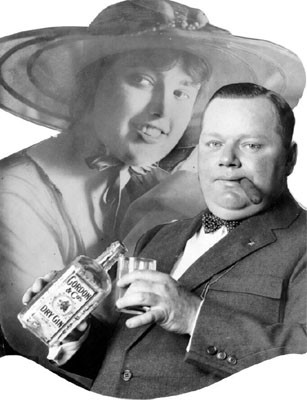
Photomontage of Roscoe Arbuckle pouring himself (or a revenant Virginia Rappe) a glass of gin, ca. 1921 (Calisphere)

[1] The original wire story appeared variously credited to the Associated Press, Hearst International News Service and the Chicago Tribune-New York Times, idated February 7, 1922.

[2] “New Artuckle Case Witness,” Salt Lake Tribune, 9 February 1922, 14.

[3] “Negro Woman Going to Testify Behalf ‘Fatty’ Arbuckle: Negress Says She Nursed Virginia Rappe and That Actress Grateful,” York Daily News-Times, 11 March 1921, 1. This is just one example of many.

[4] An Illinois state attorney and commissioner were present for Sabath’s depositions. We are currently investigating the possibility that these still exist in the state’s archives.

Alice Blake breaks down on the stand, March 23, 1922

The reportage for the third trial was not as detailed as the first trial. The legion of reporters had been cut back as public interest in the Arbuckle case waned. Oscar Fernbach of the San Francisco Examiner soldiered on though and noted some important turning points as the trial unfolded—mostly lost opportunities for the prosecution.

As we pointed out in yesterday’s blog post, District Attorney Matthew Brady’s star witness, Zey Prevost, had fled to New Orleans beyond the reach of his subpoena power. She and showgirl Alice Blake were in roughly the same place at the same time while at the Labor Day Party. Both women had entered room 1219 after Roscoe Arbuckle had exited while Virginia Rappe was lying semiconscious in one of the room’s beds. Blake had heard Rappe “accuse” a male of hurting her and that she felt like she was dying. Her earliest statements are hardly ambiguous. But whether her statements had been fine-tuned by her interrogators has to be scrutinized. Nevertheless, like her friend Zey Prevost, Blake was less than enthusiastic about testifying against the comedian and was almost declared a hostile witness during the second trial. Like others who attended the party, Blake was in the “in crowd” and probably felt some kindred loyalty to the group. As an entertainer she would have also been aware of the possible impact her cooperation with the prosecution could have on her career.

Until March 23, 1922, Alice Blake had maintained her composure but her reluctance to testify was often apparent in the way she spoke almost in a whisper and, by degrees, ceased remembering details of what happened on Labor Day 1921—with the exception of being one of Rappe’s first responders.


Girl Checks State Attack upon “Fatty”
Alice Blake Denies She Heard Virginia Rappe Say “He Killed Me”; Breaks Under Fire

Oscar H. Fernbach, San Francisco Examiner, 24 March 1922

With every inch of the battle ground hotly contested, the fight being waged in Judge Louderback’s court to establish Roscoe Arbuckle’s guilt or innocence of the manslaughter of Virginia Rappe proceeded yesterday.

Tears and temper, accusations and recriminations, insults and apologies all contributed to the sensational features of the trial.

Alice Blake, star witness for the prosecution, broke down under the grilling cross-examination of Gavin McNab, became hysterical, and was led weeping from the witness stand, while an enforced recess was taken to give her time to compose herself. She could not stand the strain of McNab’s attempt to expose what he termed “fabricated testimony, produced under duress,” his accusations being directed more against the district attorney’s office than against the girl on the stand.

It was all about Alice Blake’s direct testimony to the effect that she had heard Virginia Rappe exclaim as she lay in agony upon the bed in Arbuckle’s room: “I am dying; he hurt me.” By producing the original statement, which the witness had given to the police on the day following the death of Virginia Rappe [September 10, 1921], McNab established the fact that Alice Blake at the time had not included the words, “He hurt me,” and the attorney proceeded to insinuate that District Attorney Brady and his assistants had subsequently tried to compel the witness to testify as she did. The girl explained yesterday [March 22, 1922] that when she was questioned in Brady’s office she was told that Zey Prevost had declared that Virginia Rappe had used the words, “He killed me,” and had informed Brady and [Assistant District Attorney] U’Ren that Alice Blake had heard her so exclaim.

“I told them I did not hear her say so,” was the emphatic testimony of the witness yesterday. And she went on to say that at the time she had expressed the belief that Virginia Rappe, if anything, might have said, “He hurt me.”

[Assistant District Attorney] Leo Friedman, who conducted the direct examination, had a hard time with his witness. The value of her statements to the prosecution seemed to have become inversely proportional to the number of trials to which Arbuckle is being subjected. She reached a strage yesterday where she “could not remember.” In vain did Friedman show her the record of her testimony in the police court and at two preceding trials. It merely refreshed her memory to the extent that she could recollect nothing.

On cross-examination, however, Alice Blake made a startling announcement. She confessed that she had left the sitting room of Arbuckle’s suite before either Virginia Rappe or Arbuckle had gone into the bedroom, and did not actually see either of them enter that apartment. This was news—and McNab made the most of it.[1]

True, the witness admitted that before she left to enter the third room [1221] of the suite, she had seen both the comedian and the actress walking toward the door of the bedroom [1219]. But she [Blake] further declared that she had been absent less than fifteen minutes when, upon her return to the sitting room [1220], she found Mrs. Delmont knocking on the bedroom door and calling to Arbuckle to open it. This testimony placed the comedian and Virginia Rappe alone in the bedroom for fall less period of time than hitherto had been inferred from all the testimony.

The story of how Virginia Rappe was found in agony in Arbuckle’s rooms, and the ministrations that were given her, was repeated in detail by Alice Blake. McNab, in turn, sought to convince the jury that the actress had been injured while being given a cold bath, or while being held upside down by Fred Fishback and that her cry, “He hurt me,” referred to the latter and not to Arbuckle. [. . .]

Alice Blake, September 19, 1921 (Underwood & Underwood)

[1] In reality, her initial statement indicates that she left room 1220 for room 1221—Lowell Sherman’s bedroom—as Rappe and Arbuckle entered room 1219. Blake didn’t disclose whether Sherman accompanied her. But this can be inferred from Prevost’s early statements and testimony, where she, Prevost, is alone in room 1220 with Maude Delmont. Here Blake mentions that fifteen minutes passed before she saw and heard Delmont kicking the door and demanding that she be allowed to speak to Rappe. While this seems to fit the defense’s assertion that Arbuckle and Rappe were alone for less than ten minutes, as Fernbach suggests here, it doesn’t. Blake omits here that she returned to room 1221. She was there when Arbuckle finally opened the door of room 1219 and didn’t see him exit. Keeping up with these details and nuances is not only difficult for authors and readers. Imagine what it was like for the prosecutors in 1921 and ’22!

“Fighting” Bob Shuler and the marketability of Virginia Rappe

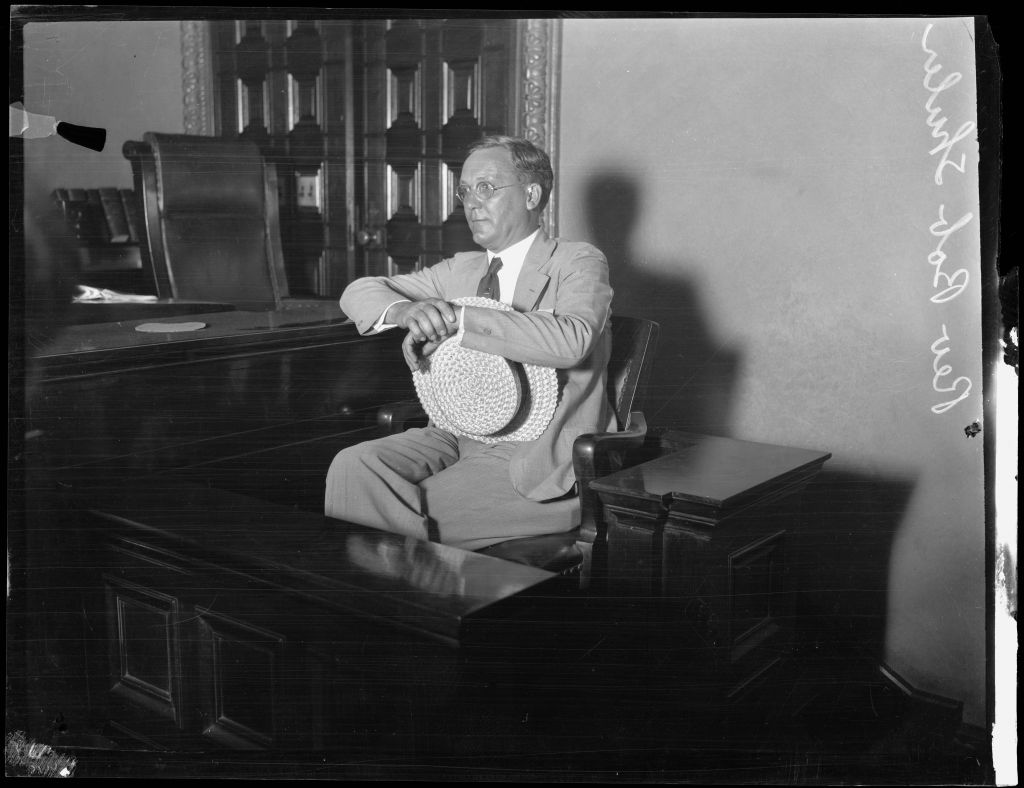
During the 1920s and ‘30s, the radio evangelist Robert P. Shuler was known for his controversial broadcasts from his Southern Methodist church in Los Angeles, California. Known as “Fighting Bob,” Shuler attracted a large following for his vitriolic attacks on corrupt politicians during the Prohibition Era. Before the advent of radio, however, Shuler’s medium was the pulpit and pamphlets like the one that follows.

Shuler was one of the clergymen who exerted a major influence on the motion picture industry given his proximity to Hollywood. The appointment of Will H. Hays as Chairman of the Motion Picture Producers and Distributors of America in January 1922, just days before the second Arbuckle trial, was intended to placate those who, like Shuler, demanded that the movie industry be subjected to regulation and censorship.

Shuler took a special interest in the Arbuckle case. Most of his fellow clerics had moved on from the case even before the first trial began in mid-November 1921. Some, such as Billy Sunday, had virtually exonerated Arbuckle. Others distanced themselves from Virginia Rappe, after Arbuckle’s lawyers began to leak information revealing her “past” in October. For Shuler, however, Rappe’s past wasn’t the point. To him it didn’t matter if she was a “fallen woman” or that she consented to enter room 1219. Rappe was, ironically, still a featured actress in one of Shuler’s pamphlet, one that was rushed out in the wake of the Arbuckle party.

Following the hung jury of the first trial in December 1921, Shuler wrote A Deadly Comparison, which is one of the longest and most eloquent tracts that specifically targets Arbuckle and the motion picture executives who funded his defense. Shuler wasn’t known to be anti-Semitic nor did he decry the “Jewish business interests” that largely ran the movie-making industry, which was common in the propaganda of the revived Ku Klux Klan during the 1920s. But one will give pause though when reading his repeated rhetorical references to “shekels”.


Roscoe Arbuckle

From A Deadly Comparison (1922)

Rev. Robert Shuler, Trinity Methodist Church, Los Angeles[1]

I do not believe Roscoe Arbuckle deliberately murdered Virginia Rappe. That he was directly and absolutely responsible for her death, I am certain, and I think there are very few, indeed, who doubt that fact for a moment. I think Arbuckle was half drunk when the pitiful tragedy was enacted. I am sure Miss Rappe was also intoxicated. Thanks to our frank newspapers, everybody knows why Roscoe Arbuckle and Virginia Rappe were in a room together for almost an hour. Whether by force or by her consent, the world may never know, but we all know what crime against virtue and morality was therein enacted. Then came the end—the death of Virginia Rappe.

I confess that I myself have been as innocent as a new born babe in the face of conditions that ought to shock the very world and stir humanity to revolt. I have been a preacher and have not ferreted into the situation that has of late months forced itself upon the public. The facts have dawned upon me as a horrible revelation.

We now come face to face with the information that such parties as Fatty Arbuckle had in San Francisco have been the common and ordinary affairs of every day social life among the movie people. The movie folk have been so bold and brazen as to defend themselves on the ground that they are not ordinary mortals and should not be restricted by the usages and customs of ordinary life. We hear of the “eccentricities of genius.” We are told that the movie people are “temperamental,” and must have their wine and cigarettes, their pajama parties and loose relations because of their distinctive artistic peculiarities. One defender goes so far as to declare that the law should not require marriage among the movie folk and that the Bohemian community is their ideal abode. Daily we note divorce scandals that would seem to support his contention.

On top of this revelation, we find Arbuckle’s drunken carousal his crime against decency and morality, whether over the protest of by the consent of his victim, and the part he took in the death of the girl in question defended almost universally by the movie people, while not as prominent star or producer had come out, that we have noticed, to brand his acts as infamous. A large fund has been raised among the movie profession for his defense and one of the most successful criminal lawyers in California, when it comes to freeing murderers and rapists, has been retained by the movie people for the purpose of “white-washing” Fatty Arbuckle.

The attitude of the movie luminaries toward the marriage relation; their continuous “souse” divorce and scandal; their quarter of a century of screened sex appeal, itself a diagnosis of the condition back of the film; their attitude toward those of their number who, like Fatty Arbuckle, have insulted and outraged every decent sentiment of virtuous idealism; their insistent demand that they be left unrestricted by the American public to practice their “personal liberty” doctrine in deportment as well as in the products of their art, the evident looseness that has sprung up among them; their booze parties; their cigarette smoking beauties; their behavior as reported by scores who live neighbor to their studios; their refusal to brand such men as Arbuckle and kick them out; their disposition to pass over without criticism such a crime as the San Francisco crime; especially their willingness to defend the criminal with their money; all has forced me against my will and over my protest to believe that a majority of the movie crowd are of the same stripe as this comedian and that they see the necessity of saving his hide in order to save their own.

Not for a moment would I accuse all movie people of being immoral. I have until recently stubbornly declared that I believed the immoral element, although entirely too large, to be far in the minority. But I have been forced to revise my opinion and I have come to the deliberate conclusion that the extraordinary movie actor and actress, whose life is chaste and clean, whose deportment socially and otherwise is a blessing and help to American standards of life, whose moral standards are such as that they give support to chastity ad purity in the relations of men and women are not in the majority. That there are scores and hundreds of movie actors and actresses who are clean I am absolutely confident, but that they are today in the minority in their profession I have been forced to concede much as I hate to make such a concession.

Perhaps there is no single proof of this fact more pronounced than that they persist in the battle, against the Christian forces of America, to maintain their industry outside the pale of sane and safe regulation for the protection of public morals. There can be but one reason why they make such a fight: certainly, if they did not desire to produce that which would tarnish and stain the morals of the young, they would have no cause to make a concerted attack upon the efforts sponsored by Christian citizens to protect the child life of the land from the immoral in their films. If they did not desire to sell the salacious and suggestive, they could not for a moment object to a sane effort on the part of Christian men and women to rid the film of the salacious and suggestive. They have put their “personal liberty” over against public safety, much as the old saloon man and brewer did. And in doing so, they have not only committed themselves, but they convicted themselves as well. If you will seek for the fountain of this public attitude, you will find it in the private life of those assuming it. Certainly, Fatty Arbuckle does not believe in commissions for censorship, in regulation, in laws for the protection of the public. We know the reason why, for his story is in the newspapers. I think you will have no trouble in recognizing that he is a most splendid example of a type, a most certain sample of a variety of folk who have decided to be the independent authors of their own standards of morality or immorality, without regard to or respect for the public.

The manner of fostering upon the public the menacing doctrine of “personal liberty” is also a grave commentary upon the people who have adopted it. Just as slavery sought to maintain itself by bribes, in that the annihilation of the industry would bankrupt the nation; just as the brewers and distillers flung their threat of withdrawing their money bags; just as white slavery screwed its vice of money pressure when the houses of justice were after it; so the movies have threatened Los Angeles, in a recent censorship fight, with financial ruin if they are not permitted to have their own way. Great and startling headlines announced that they would move away and carry their millions with them if the public were given protection from the vicious in their wares. They approached businessmen with their money cudgel and cowed them into submission. They brought their gold to bear upon business and social organizations and whipped them into line. They used their abnormal advertising budgets to line the newspapers of this city solidly for their private interests and against the public welfare. In this policy, they followed with precision the well-defined paths over which every menacing agency has pushed its wa in an effort to profit personally from the wounding of idealism and the lowering of moral standards. Unfortunately, we have not had enough backbone in manhood and fearlessness in womanhood in this city to mee their attack and defend our sons and daughters against their greed. Their shekels sounded so loudly as that they drowned our love for little children and our interest in their purity in thought and life. And matching this attitude of the movie people in Los Angeles in the censorship fight comes a like stand with their dollars in their efforts to free Fatty Arbuckle and turn him loose upon the public an acceptable star, though the criminal that the whole world knows him to be. Again they type true. Again they measure up to their sample.

If a man should sin against industry in California as Fatty Arbuckle has sinned against society, no man would dare lift his voice in his defense. Fortunately for Fatty, he has only killed a woman, after defiling her body and spitting in the face of all decency. With the movies’ money to the rescue, he is virtually assured of his liberty and he will again come into Los Angeles to be kissed b his kind, a conqueror, a star. But had his crime been against a factory, had he blowed[2] up a ten-story building, had he interfered with business, his would have been a far different story. And again Fatty becomes a sample; for should the movie industry threaten the hogs or cattle or even chickens of California as they threaten the moral character of our sons and daughters, they would find the chamber of commerce, the business and industrial organizations after their scalp in true earnests. But Fatty and his movie cohorts have a great secret. Virginia Rappe dead and defenseless has no money value. Even her character may be torn to shreds, and allis well for she is dead. Just so the moral character of the young of Los Angeles is not worth $10.79 per school girl. It has no cash value. Factories and skyscrapers are valuable and Fatty dare not attack them. Hogs, cattle, and chickens are valuable and the movie people must not interfere with them. Herein is the sickening secret known to the movie world and practiced most perfectly.

Again I have drawn a deadly parallel, but who dares deny it. The loaf of bread is censored. The bottle of milk is censored. The factory must face a commission for the protection of life and limb. The railroad must deal with a commission for the protection of public interests. The bank must account to a like commission. We elect a board of education, a commission on our schools. The movie business stands alone today with the unbridled privilege of exploiting for grate receipts. The reason is that all they threaten is character, idealism, manhood, womanhood, and here there is no cash value. Money has talked in the censorship fight. Money is talking in the Arbuckle trial. Ah, gold is eloquent, indeed!

They have taken Fatty off the screen, you say. Yes, but not because of any antagonism to Fatty’s crime, as their attitude clearly denotes, but for the protection of their gate receipts which were suddenly imperiled by the indignation that swept the nation following the San Francisco tragedy. And now the newspapers have announced (their newspapers, you understand) that their money is flowing into an immense fund to clear the comedian, and whether or not his pictures will go back upon the screen depends upon the verdict of the jury. That jury will only pass upon the guilt or innocence of the defendant, charged with manslaughter, and the public must never forget that, unfortunately, the history of such cases in America, where unlimited money is set in motion, is not very hopeful for justice. That jury will have nothing to say as to that drunken party, as to the crime against womanhood, against virtue, against decency, committed in that room, either by the consent or over the protest of the victim. The pictures of Fatty Arbuckle will go back and become the sensation of the movie world for the next twelve, if that jury says “not guilty,” despite the fact that all men know the filth and viciousness of the circumstances attending that party.

It is the common understanding that the ordinary movie man or woman considers Fatty as unfortunate. The newspapers controlled by their abnormal advertisers, are so picturing him. He is likened to a “big, naughty boy,”[3] who, unfortunately, got caught. There is no blame attached to the party by his fellow movie stars. There is no condemnation for what happened in that room is unspeakable. We are told that he played in “hard luck.” Such an attitude can be a commentary on but one thing: An all but total loss of ideals; an all but absolute annihilation of moral standards.

In conclusion, I desire to reiterate what I have so often said: The movie is here to stay. We need it, if it can be controlled for decency and morality, for right and humanity’s welfare. It is a great educational agency. It has to do with the very motives or fountains of life and thereby becomes extremely beneficial or of limitless danger. Guarded and guided, controlled and directed, the movie has no confines to its appeal for the better things. Left to the doctrine of license, its menacing power will overwhelm American idealism within another decade. It is best understood by a study of the people who are behind and in it and for this reason I have drawn the deadly parallel and stated the frank, blunt, cold conclusions which you have heard. It is up to the people. Unfortunately, the movie industry is run a strictly commercial basis. It has no character. It has only a purse. In the censorship fight its leaders had the nerve to ask the Los Angeles chamber of commerce to make the box office receipts the bill of health for the industry. Such a pernicious doctrine will do nothing less than wreck, unless the people act.

Here are the ridiculous high places in Fatty’s trial: “Fatty” finds Virginia Rappe on the floor in mortal agony. He tenderly places her on his bed and locks the bedroom door. He ministers to her in gallant fashion during almost an hour of excruciating agony without calling for help from the adjoining room where her friends and his are gathered, phoning for a doctor or asking for other assistance. At last her friends begin to knock on the door and he lets them in, announces that Virginia is sick and proceeds to place chunks of ice on her nude body. And when he is accused of an awful crime, he locks the story of his good Samaritan activities in his own heart and, though charged with the act of a fiend, does not so much as tell his closest friend until the trial comes on. His lawyer declares that he kept this secret of his chivalry lest the public mob him. The fabrication is not even artistic. It is too crude for an amateur. It is as full of holes as a sieve.

Beautiful story! And the movie people are back of it with their cash. No wonder the prosecuting attorney remarked before the trial concluded that a failure to convict would prove that “jails were builded [sic] for the poor.”[4] He further went on record as declaring that his efforts to secure evidence were blocked at every turn by this financially builded [sic] machine of moviedom, set in motion for the purification of the reputation of one of its most brilliant stars. Thus movie gold in California had defied justice; mocked womanhood, standing the presence of her defiled and dead sister; sneered its contempt in the face of decent social demands; laughed to scorn idealism and morality and battered down the very citadels of childhood’s worshipful faith. The brutal force of clinking shekels has been felt in California, until our social order has trembled to its foundations.

But the mockery of justice that has attended this carnival of shame has not wiped out the record. What a tutor in idealism and morality is “Fatty” Arbuckle, clothed in his pajamas, reigning king in the Belshazzar feast of a San Francisco hotel, where looseness, debauch, drunkenness and filth run riot!

The newspapers have hinted at the “dog parties” of filmdom.[5] No, I can’t tell you about them. There is no language that I could use, howeverncarefully selected the wording, that would fitly describe those parties and this pamphlet go through the United States mails. Picture the most degrading and nauseating scene that could possible by enacted before a mixed audience, and you have not outdone the facts. These are the people who are playing upon the emotional fountains and motives of growing boys and girls in this Christian nation. God forgive us when we train our children for life under the tutorage of those who go the way of the Arbuckle “dog party.”

They all but washed “Fatty” and in the second trial will no doubt complete the renovation, but American fathers and mothers stand horrified before the evidence of that trial. The guests are pictured chasing each other through hallways and bedrooms, through bathrooms and parlors, clad in sleeping attire and undergarments, dancing with each other in such garbs, drinking, smoking, swearing, telling vile stories, without regard to sex or convention, or morality, or decency. Yes, it is all in the wide open now, this disgusting, putrid, filthy mess, amazing in its slime, even though “Fatty” has virtually secured his gold-bought liberty.

And no one denies that such filth, that such disgusting behavior, that such defiance of morality and chastity constitute the “thrills” and “high touches” of the ordinary booze party of filmdom. “Fatty’s” San Francisco party was one of the many, a splendid sample, a glorious success, had not an “accident occurred” in which we are given to understand “Fatty” played in “hard luck.: In other such parties leading luminaries have been more fortunate and the “accidents” that occurred were not so disastrous. There are on the record an instance or two where the ambulance was needed and the hospital called into play, but this seems to haven the first straight killing accomplished.

The battle is just a step away if not already upon us. It is Idealism vs. Pelf.[6] It is the same fight that stained America red with blood back in the sixties. It is the same fight waged by womanhood and real men against the booze industry. It is the same fight that the sons and daughters of Christianity put up against white slavery. It is the fight for the preservation of society, the maintenance of right and justice, the saving of American ideals from the ravenous lust for revenues. The gate receipts have decreed that purity, that virtue, that cleanliness must give way before the clink of coin, and when the society resents this brutal rape of idealism, the yellow monarch marches forth to bribe, to buy, to intimidate; to win with the rattle of shekels, whether it be in a court, or a city council, an effort to bring a star to justice or an attempt to sucre freedom from filth for the eyes of little children, by appointment of a commission of censors.

In this battle that must be joined if civilization is to survive, the film folk have not only resurrected the sword of gold, so tremendously used by the liquor forces in their last stand, but the bozze-wet arguments of that battlefield have found for themselves a new champion. The doctrine of license; the “personal liberty” plea of those whose stomachs in the old liquor days were far more important than society’s welfare; the battle against restriction, against regulation, against interference for public good. This is the new battle cry of filmdom, revamped and revarnished. Again the ghost of that old man straw in the wet days of yore spoke eloquently of blue laws championed by long-haired fanatics who would deprive mankind of all liberty. There is nothing new in this fight. It is as old as slavery, as old as booze, as old as license, as old as lust, as old as greed, as old as the seeds of hell.

Robert Shuler in the witness chair during a 1929 libel suit (Calisphere)

[1] Adapted from a reprint in the Enid [OK] Daily Eagle, March 5, 1922, the day before Will Hays assumed his new job as Chairman of the Motion Picture Producers and Distributors of America.

[2] Shuler’s spellings, which are consistent with Southern idioms, have been retained.

[3] An allusion to the pronouncements of Mabel Normand, Alice Lake, and others who had worked with Arbuckle.

[4] Shuler is quoting San Francisco District Attorney Matthew Brady.

[5] dog party, i.e., film colony slang for booze party; also called a “monkey dinner.”

[6] pelf, money earned in a disreputable or dishonest way.

Jesse Norgaard, the old soldier at Lehrman Studios

On March 18, 1922, the selection of two alternate jurors was interrupted when a member of the Women’s’ Vigilant Committee was seen whispering something to Assistant District Attorney Milton U’Ren while he sat at the counsel table. Defense lawyers immediately objected since they saw the Vigilant Committee as an “enemy” of their client, Roscoe Arbuckle. They began to call her a “stool pigeon” and, despite U’Ren’s protests, she was removed by the bailiff and ejected from the courtroom.

What did they mean by “stool pigeon”? It’s likely they feared that their private conversations were being listened in on, that the women milling around them on the street, in restaurants, hotel lobbies, and in the corridors of San Francisco’s Hall of Justice were, in effect, spying for the prosecution.

This sideshow and the arrest and release of an important prosecution witness, Jesse Norgaard, provided some human interest to newspaper readers before testimony began in what would be the last Arbuckle trial. The following is adapted from our notes about him.

Showgirls entertaining the residents at the Old Soldiers Home, Sawtelle, c. 1920 (Calisphere)

Jesse K. Norgaard had appeared as a witness for the prosecution in the first Arbuckle trial as it came to a close in late November. Two years before, he had worked as a watchman at the Henry Lehrman Studio in Culver City in 1919.[1] When asked to take the stand, he was a 62-year-old resident of the Old Soldiers Home at Sawtelle, California.

Norgaard testified that in 1919 Arbuckle had attempted to get from him the key to Virginia Rappe’s room “while he was working in the studios of Harry [sic] Lehrman.”[2] He said Arbuckle offered him a “roll” of money, which he believed was at least $50, to get the key. Norgaard said he refused. “The defense fought hard to keep out this testimony,” reported the San Francisco Examiner, “but after a long wrangle, Arbuckle himself whispered to his attorneys to withdraw the objection. The witness will be [recalled and] redirectly examined by U’Ren when the court convenes this morning [November 23].”

Arbuckle allegedly smiled and laughed when the elderly Norgaard made this claim in court. He had stopped taking the prosecution witnesses seriously. Zey Prevost and Alice Blake on that same day had recanted their original testimony that they heard Rappe accuse Arbuckle of having hurt her. Maude Delmont had been charged with bigamy in the meantime and would not be testifying. Arbuckle’s attorneys were taking no chances, Rappe’s victim image was to be overshadowed by their narrative about a woman with physical–mental illness triggered by small amounts of alcohol.

When Arbuckle famously—or infamously—took the stand in his own defense in the first trial on November 28, he denied that he offered Norgaard money and, for the next two months nothing more was heard of it. That said, however, District Attorney Matthew Brady and his assistants established that there was a personal relationship between Arbuckle, Henry Lehrman, and Virginia Rappe—that at one time they all shared the same working space. Norgaard’s version would corroborate the timeframe mentioned in Maude Delmont’s claim that Arbuckle had been fixated on Rappe since 1916. Although Brady had dropped Delmont as a witnesses, he apparently believed there was something to the claim. Thus, he continued to bring Norgaard to San Francisco to repeat his story and be subjected to both cross examination and character assassination by Arbuckle’s lawyers.

Either Norgaard believed in his own story or Brady had something on the old soldier to keep him in line.  Norgaard’s credibility seems no greater than some of the defense’s Chicago witnesses, but given how much vitriol was brought to bear on him by defense counsel Gavin McNab, the content of his testimony must have posed an existential threat as it depicted Arbuckle as someone more adult (and sexual) than the man-child with whom the public was familiar.

Who was Jesse Jenson Norgaard? The first news reports claimed he was a Civil War veteran. He wasn’t that old but he had been a career soldier since the 1880s and his early life is fairly well documented given his extant military records. According to the 1880 census, he was born in 1859 in Toftland, that part of Denmark lost to Germany during the Second Schleswig Wars. Like other young men, Norgaard likely saw emigration as better alternative to being drafted into the Prussian Army so came to the United States as a teenager in 1878. He worked as a servant on a Nebraska farm. In 1884, he enlisted in the U.S. Army at Fort Meade in the Dakota Territory toward the end of the Indian Wars. Five years later, in 1889, while working as a farmer in Montana, he became a U.S. citizen. When he was recorded by the 1900 census, he was a private stationed in Kalispell, Montana, having volunteered in the U.S. Army’s 37th Infantry [Regiment] during the Philippine-American War, the civil war that followed the Spanish-American War of 1898.

When Norgaard mustered out in 1901, he was in his early forties. For a time, he performed menial jobs while in and out of various soldiers homes as a patient, including two years, from 1906 to 1908 in Leavenworth, Kansas. He married a woman named Amelia, but there are four conflicting dates for when this marriage took place between 1905 and 1913

Norgaard primarily supported himself on his Army pension of $12 a month. This was likely due to his age and injuries. In 1914, he was admitted as a resident to the Soldiers Home in Orting, Washington, suffering from lameness in his right leg. He was discharged a year later, but, as before, he could only perform light work, such as operating an elevator.

Despite having spent much of his life in Montana, South Dakota, Minnesota, Kansas, and Washington state, he relocated to California, where he lived in San Diego during the war years. It was during this time, in 1918, that he was arrested for selling liquor to the recruits at Camp Kearney. He was sentenced to six months on a “work farm” but walked away and took a train to Los Angeles. This was the only arrest record he had and it would play a role in the third Arbuckle trial,

In Los Angeles, Norgaard found the kind of work he could handle as a watchman for the Henry Lehrman Studios. His appearance in all three of the Arbuckle trials, outside of his years as a soldier, was almost certainly the most eventful period in his life. Since the state would have only paid for his travel expenses and room and board, there was little to induce Norgaard to come forward but he did so willingly and worked with the District Attorney, Matthew Brady, to secure Arbuckle’s conviction.

Like other prosecution witnesses, Norgaard saw his reputation sullied by Arbuckle’s defense lawyers. At the second trial in January 1922, when he testified his earlier military career was foregrounded by the prosecution and he was allegedly wearing a “congressional medal of honor,” which may have been a reporter’s hyperbole. (There is no record of such a medal awarded to Norgaard and if he had “stolen valor,” Arbuckle’s defense would have likely uncovered this and destroyed his credibility.)

On January 20, the former watchman–janitor testified again that Arbuckle offered him “handful of greenbacks” for the key to Rappe’s dressing room. “I saw two $20 greenbacks and a $10,” he said. “I don’t know how much there was.”[3] The following week, on January 26, A. L. Barnes, an auditor and secretary for the former Henry Lehrman Studios, was called by the defense to refute Norgaard’s accusation. Barnes took the stand and said that he had the only duplicate key to the Yale lock to Rappe’s door and that it was always kept in his office. However, the keys were openly displayed on a rack, “accessible to anyone.”[4] This testimony allegedly refuted Norgaard’s assertion that he had the only key. But it hardly refuted his contention that he had been offered money to produce it. Nevertheless, the technicality, added to the many others, prevented the jury from unanimously declaring Arbuckle guilty or not.

Norgaard testified again at the third trial. By mid-March, the defense had more time to find ways to detract from his testimony. They succeeded this time with what some newspapers called a “mystery arrest.”

J. Norgaard, witness in the Roscoe Arbuckle case, who claims he was railroaded to jail here to prevent his testifying, was today paroled and will leave tonight for San Francisco to appear for prosecution there.

The parole board here took immediate action when they learned that District Attorney Matthew Brady of San Francisco had urged the parole of Norgaard.

Norgaard is the former janitor at the Culver City studios who testified at a former Arbuckle trial that “Fatty” tried to bribe him to give him the keys to Virginia Rappe’s dressing room.

In 1918, Norgaard was convicted here of selling liquor to solders, in violation of a city ordinance. He was sentenced to six months on the city farm, as was customary in such cases. After serving five days of that time he walked over to Linda Vista and took a train for Los Angeles.

Two weeks ago a man appeared at the local police station and asked to see the 1918 police court records, stating that he wished to look up the case of Norgaard. A few days later Norgaard was arrested at the soldiers’ home at Sawtelle. He was brought here and on Saturday re-sentenced to six months in jail.

Police Chief Patrick knew nothing of the case until he found the man in jail late Saturday, he declares. This is the first case the police say, where one of the many city farm prisoners who walked away during the war times was ever returned to serve out their “time” in jail.[5]

Norgaard testified at the third trial on March 28, 1922. He repeated his charge that Arbuckle tried to bribe him for the key and added that Arbuckle had said he intended to play a joke on Rappe if he got inside her room. As to being sentenced to jail, Norgaard claimed also that it had been Arbuckle’s attorneys who induced him to return to San Diego to serve out a sentence at the county farm that had been imposed on him in 1918 for selling liquor to the soldiers at Camp Kearney. But Arbuckle’s defense team was hardly finished with defaming Norgaard. Gavin McNab “sought further to prove that the witness [Norgaard] had been driven from Catalina Island for conduct involving an eight-year-old girl.”[6] This prompted Milton U’Ren to accuse McNab of using “shyster” tactics, which, in turn, led to a reprimand from Judge Louderbeck.

On March 30, a witness was called to speak to Norgaard’s character in an attempt to offset the charge of pederasty and to shore up his credibility. But it was inconclusive and most of the day’s session was consumed by a discussion of the meaning of the word “integrity.”

Justice of the Peace Joseph H. Stanford of Avalon, Catalina Island, was testifying when the discussion arose. He had previously testified in regard to the character of Jesse Norgaard, another witness. He was recalled and said he could testify as to Norgaard’s morals, but not as to his integrity. The defense contended morals included integrity, while the prosecution maintained they did not. A dozen legitimate authorities and a dictionary were involved in an effort to decide the point, but without success.[7]

The dissection of Norgaard’s character and challenge to his integrity had the effect of diluting the prosecution’s contention that Arbuckle had an obsession with Rappe. Once more, a key witness’s troubled past gave Arbuckle a “pass” in that the accuser appeared to be of weaker character than Arbuckle, who, at most, might have come across as a naughty practical joker, a trickster.

After the third Arbuckle trial, Norgaard moved back to Washington and resided at the soldiers homes in Kitsap and Orting, where he died in 1938.

[1] In some reports, Norgaard is referred to as a janitor and as “Oscar” Norgaard.

[2] Oscar H. Fernbach, “Zey Prevost, Alice Blake in Witness Chair,” San Francisco Examiner, 22 November 1921, 4.

[3] “Surprise Witness Explodes Bomb in Arbuckle Defense,” New York Daily News, 21 January 1922, 3.

[4] Marjorie C. Driscoll, “Arbuckle Case Defense May Close Today,” San Francisco Chronicle, 27 January 1922, 4.

[5] “State Finds Aarbuckle Witness Serving Unexpired Term in Jail,” Long Beach Press, 20 March 1922, 1.

[6] Oscar H. Fernbach, “U’Ren Flayed by Court for M’Nab Attack,” San Francisco Examiner, 28 March 1922, 9.

[7] A.P. Night Wire, “Fresh Problem in Fatty Case,” Los Angeles Times, 31 March 1922, 7.