First thoughts on my second visit to the San Francisco Public Library

Last week, I worked on the Arbuckle trial transcripts at the San Francisco Public Library, filling in the gaps from my December 2024 visit. My familiarity with the course of all three trials, including every participant and their background, has served me well. It’s a kind of meta-understanding that makes everything in the transcripts intelligible, which you cannot get reading them cold. But that doesn’t mean I’m not surprised at the latest revelations.

In my book, two people are on trial for rape, although it is called “manslaughter”: Roscoe Arbuckle and Virginia Rappe. And they must be presented in a way that is dualistic. Arbuckle is still the famous, smiling comedian, suitable for the children in the audience. He is also a man with an appetite, not only for food and liquor, but female company. His reason for being in San Francisco on Labor Day 1921 was for casual sex with an escort, a “call girl.” He does play a part in his own misadventure. So, too, Virginia Rappe. She got her telephone call in the Garden Court of the Palace Hotel.

I don’t think she misunderstood what was expected of her—and she did not live up to expectations. I see her trying to frustrate them, buying for time as she engages in conversation with Arbuckle—keeping him talking and joking. So, too, Rappe’s wanting a piano when it came time to dance. Arbuckle said no one knew how to play. Rappe did. She played a good “party piano.” But he overruled her and ordered up a victrola from the front desk of the St. Francis Hotel. She would have no excuse not to be a dance partner as the midafternoon approached and well before she could be—what?—extracted by her manager for the 130-mile road trip to Del Monte before nightfall. Then she had to use the bathroom in room 1219 and was cornered.

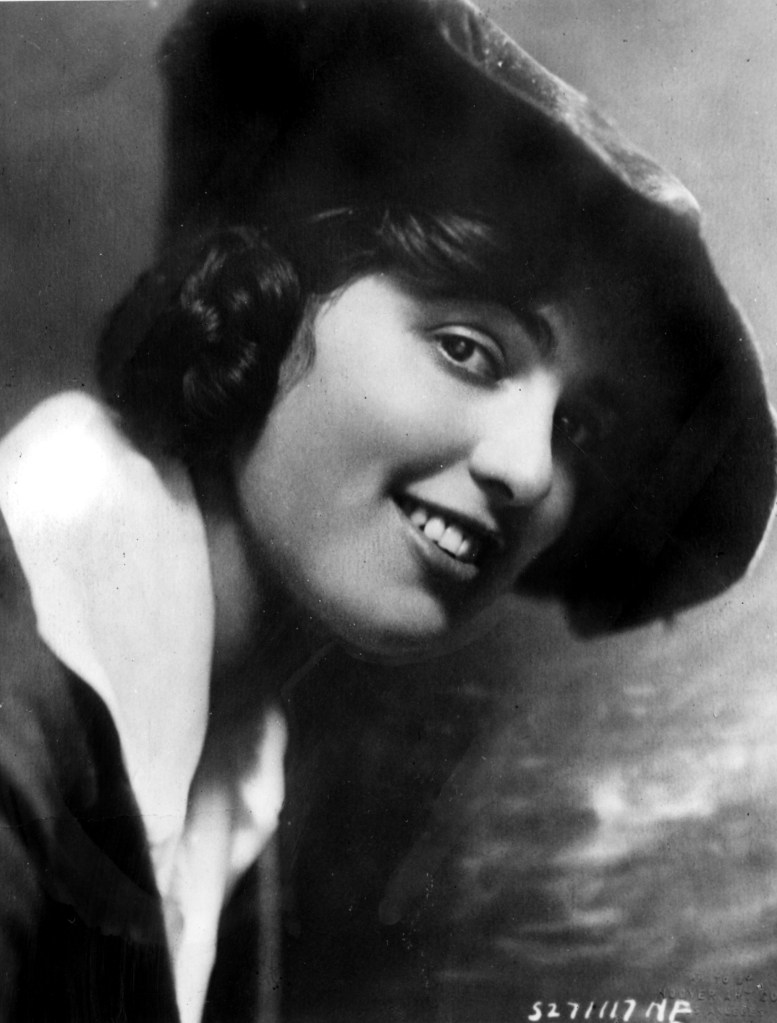
Virginia Rappe in a painter’s beret (Hoover Art Co.)

Then she had to be either a “good fellow,” as Maude Delmont, the companion provided for her by her manager (who may very well have pimped his women to get them work and his percentage). Or Rappe could choose not to be so “good.” My working hypothesis is that Rappe had learned to keep a certain distance from men so as not to be sexually exploited or abused. The defense mechanism had been imprinted in her youth. Nevertheless, she still wanted the benefits, so to speak, of the comedian’s good will. The risk was worth taking. After all, there were other women at the party when sex raised its ugly head.

Such a hypothesis requires as much background as possible about Rappe and that begins with her childhood and who served as her earliest influences. She had a grandmother who served as “Mama” to both her and the adult sister who was, in fact, her birth mother. The grandmother wasn’t related to either of them. She had interceded in some way. So, what kind of family breakdown or tragedy led to this arrangement? And how did that affect the course of Virginia Rappe’s life? We get so close here in the following extract from the third trial. But it has nothing to do with the res gestae.

Milton Cohen, one of Arbuckle’s lawyers, is very methodically and respectfully cross-examining Kate Hardebeck, Rappe’s adoptive “Aunt Kittie.” Here he is trying to get at the mystery of Rappe’s origins in order to present to the jury anything dubious about her character, something that will exonerate Arbuckle and redirect the blame. There is nothing new in that. It is perfectly lawyerly. But there is more context. This trial takes place in the heyday of social Darwinism, when considerable emphasis was placed on genetic factors as well as environment in determining one’s morality or lack thereof.

Alert to the possibility of seeing the victim pushed from her pedestal, the prosecutor, Milton U’Ren, waits for the right moment to object.

Q. Do you remember how you happened to meet Virginia’s grandmother, or I mean Mrs. Virginia Rap[p]?

A. I knew the grandmother some years before and her mother, Mabel Rap[p], and I had lost track of them, and I had friend who had met them in the meantime, A Mrs. Tomlee, who had known me for years, and she took me their home again.

Q. How did her grandmother pronounce her name, Rap[p]?

A. Rap[p]?

MR. U’REN. Of course, if your Honor please, this family history is very interesting but I think it is entirely immaterial, irrelevant and not proper cross-examination.

MR. COHEN. They have gone back, if your Honor please, to the history—

MR. U’REN. No, we have just gone back to the acquaintance of this witness with Virginia Rappe, in regard to her health, and while it may be very interesting to find out the family branches of all the witnesses that appear upon the stand, I do not think that it can add anything to the knowledge of the jury as to how Virginia Rappe came to her death.

A brief consideration of a tales(wo)man: Mrs. Helen Hubbard

The new manuscript is now well informed by the trial transcripts. The next part of the book still needs to be written, devoted to the Arbuckle–Rappe trials—and they are both on trial in this book. But any verdict will be handed over to the reader with some new ideas to consider. This, I guess, makes the reader a metajuror and, in keeping with that duty, we might look at how one of the original jurors was selected in November 1921. I cannot devote a lot of space to this, even though I am a trial junkie now. You can see how virtually everything is played out in advance of the first day of testimony. Indeed, writing about them will be like writing about a formality.

Let’s look at Mrs. Helen Hubbard. Her single vote of guilty caused a hung jury and forced the Arbuckle case to continue into 1922 and two more trials. The film historian Joan Myers took special interest in Mrs. Hubbard in her essay, “Virginia Rappe & The Search for the Missing Juror,” which, I believe, dates back to before 2013. But Ms. Myers could only go by newspaper accounts.

That Mrs. Hubbard served on the first Arbuckle trial jury stands out because she was the wife of a lawyer. She had once worked for a law office in Toledo, Ohio, before her marriage and worked for her husband’s growing practice, which dealt mostly in civil law. By 1921, however, she preferred to be a homemaker and bridge player. She was good enough to teach other women how to play as well and participate in bridge tournaments.

Mrs. Hubbard proved to be competent on the stand when first examined by Assistant District Attorney Milton U’Ren, her answers were quick and without hesitation, even when tested. She surely knew how to answer a question in such a way as to be disqualified and so avoid such an interruption to her life.

Q. Now, Mrs. Hubbard, if Mr. Hubbard were the District Attorney of the City and County of San Francisco, entrusted with the prosecution of this case, would you like to have him try the case before twelve jurors who were in your present frame of mine?
A. Yes, sir.
Q. You would think in that cast that he would have a fair and impartial jury?
A. I think he would.
Q. And if, on the other hand, some person near and dear to you were charged with a crime and placed upon trial, would you be willing to have them—be willing to have that person tried by twelve persons in your present state of mind.
A. I would.[1]

Although Mrs. Hubbard later professed a reluctance to serve as a juror, her crisp replies to U’Ren suggest otherwise. Indeed, until her vote, she was seen by the prosecution and defense as an ideal witness. Reporters who kept an eye on her in the jury box couldn’t get a read on her. (The poker face, presumably, owing much to her preferred game.)

Arbuckle’s lead counsel, Gavin McNab, asked different questions, prefaced, interpolated with parentheticals, and more often wrapping around their point. His required much more concentration not only from the juror, from by the other lawyers. McNab, however, had to tease out any female talesmen who might sympathize with women’s groups that wanted “Fatty” Arbuckle punished, namely San Francisco’s Women’s Vigilant Committee.

This organization, in the context of the Arbuckle trials did not police the “immoral” behavior of women but rather served as observers of how female witnesses were respected on the stand. The WVC also wanted justice served if Arbuckle case revealed a high-profile example of violence toward women. Some members of the WVC wanted to see another amendment, as important as the eighteenth, that guaranteed “the right of every woman to become intoxicated in personal safety. [. . .] If a man gets drunk, it is regarded as his liberty. If a woman does the same thing, society, like the Romans of the Coliseum, is willing to turn the wild animals upon her.”[2]

Despite U’Ren best efforts to get in front of the “clubwomen” issue, McNab didn’t waste time with his first question and making them the issue.

Q. Mrs. Hubbard, the District Attorney has asked you somewhat extensively about women’s clubs and their part in the case. It does not create any prejudice in your mind because the defendant and his counsel prefer to be tried by a sworn jury, and his Honor presiding, rather than the emotions of any club?
A. No, sir.

U’Ren did not let this go. “Well, we submit that is an improper question, if your Honor please, and argumentized,” he said to Judge Harold Louderback. “We do not know what is in the heart or mind of the defendant. It is understood he is to be tried by a jury.” The judge allowed for the question but said it was “rather farfetched” and admonished McNab for not framing his inquiries “so as they could be answered with less trouble.”

McNab abided by this warning and simply asked questions about “the mechanics of a trial.” Then he asked her a question that was posed to every talesmen, which foreshadowed the strategy Arbuckle’s lawyers took. (The so-called “blackmail plot” involving Bambina Maude Delmont had long since been cast aside. I have a theory for canard in the book—and it is a canard.)

What McNab did here was to try the case in a set-piece, presenting the defense’s theory about Virginia Rappe’s fatal injury as self-induced over many years of illness and immorality, despite promises made to the contrary.

Q. In the trial of the case, Mrs. Hubbard, it may be the duty of the defense to present evidence as to the physical condition of this young girl at various times in her life. She came to her death through a ruptured organ, an ordinary physiological occurrence, and it may—the defense may present testimony covering many years, to show that her condition, that that might haven at any time—

“Just a minute,” U’Ren interrupted from his end of shared counsel table (which weren’t divided into two in 1921). “We are going to object to that question, because, first, it is involved and complex and in the second place, if your Honor please—”

Then U’Ren was interrupted himself by Nat Schmulowitz, McNab’s chief assistant. “If you will just wait until the question is completed—

“Mr. McNab is conducting the examination,” replied U’Ren condescendingly, “and I am attempting to make an objection, and I thought the question had been completed, but the vice of the question is apparent already, when counsel says that the ruptured bladder is an ordinary physiological condition. I do not know whether he really meant that, or not, but that is assuming something that is not true.”

And so it went for Mrs. Hubbard. The examination of the jurors was, as many reporters pointed out, had all the hallmarks of the trial to come. There were also many curiosities for us to parse. McNab used the words “wine party” to describe the drinking of good scotch and questionable gin at Arbuckle’s Labor Day party. The word “wine” was a polite way to refer to the comedian’s violation of Prohibition. But the word, in an obsolete sense, also meant any fermented concoction. So, U’Ren would not have objected. He did question Mrs. Hubbard again in a brief redirect and one of his questions was no less longwinded than his counterpart’s—and McNab prompted it when he asked, “You understand that no one is supposed to own a witness, neither side, Mrs. Hubbard?”

This was in reference to the District Attorney Matthew Brady’s controversial policy of isolating his star witnesses, Alice Blake and Zey Prevost, for nearly two months prior to the trial, so as to prevent them from being influenced by Arbuckle’s lawyers through third parties. The prosecution had to ferret out problem jurors who might take to heart McNab’s statements “as evidence that these witnesses were put in cold storage or upon the grill”—yet another feature of all three trials, reaching a crescendo of sorts in the second trial, when much of the local press was aligned against the prosecution.[3]

Q. Now, if it should appear in this case, Mrs. Hubbard, that the District Attorney had certain information which led him to believe that certain of the witnesses who were to be called to testify for the State, were being approached by someone with propositions to change their testimony, and with their consent, he took the precaution of placing them in the care of an estimable lady in this city and count, would the fact that the District Attorney had taken such precautions prejudice you against their testimony?
A. No, sir.

Not all of Mrs. Hubbard’s answers were so yes and no. She did give a few personal details in some. She liked to go to the picture shows and was familiar with Arbuckle comedies, albeit not particularly a “fan.” That he played “funny parts” didn’t make her think that he was incapable of committing a criminal act on a woman.

I’m not so sure.

A still from Fatty’s Wine Party (1914)

[1] People vs. Arbuckle, First Trial, “Examination of Talesmen,” pp. 248ff.

[2] Alma Reed, “Right of Women to Personal Safety Urged by Club,” San Francisco Bulletin, September 15. 1921.

[3] There really should have been no controversy, for McNab himself was able to meet with Miss Blake after her mother took her home in early November. This forced Brady to let Prevost go home as well.

Roscoe Arbuckle’s suicidal ideation  or waxing philosophical?

A psychological portrait of Roscoe Arbuckle at this late date is all but impossible. One just has his “aw-shucks” remarks to go on and they are rather hard to take seriously or give a close-reading. But during a November 1920 interview, the comedian contemplated a weight loss regimen. “I’m going to train down for one thing,” Arbuckle said,

and then I’m going to tour the country, disguised in my thinness. I’ll visit all the big theaters and ask people what they think of that alleged funny man, Arbuckle. [. . .]  I’m going to see all of America first, and then, of course, I’m going to Europe. One place I look forward to is Monte Carlo. Sure, that’s the reason I’m rehearsing at Tia Juana![1]

He said this the same year that Virginia Rappe became obsessed with her own weight. She not only exercised, she used laxatives. She may have even purged.

But what might Arbuckle really be saying here, in keeping with in risu veritas (in laughter, truth)? Could he have been no less weight conscious? In his case, losing any weight would have been virtually a violation of his million-dollar contract with his employer, Paramount Pictures.

Then there is this: In the earliest statement made by Zey Prevost, the most reluctant witness against Arbuckle at his first two trials for manslaughter, she recounted a strange interlude at his Labor Day party on September 5, 1921. As the comedian and his guests enjoyed a drinking “brunch” in a reception room, 1220, on the top floor of the St. Francis Hotel, Arbuckle seemed to wax philosophical once more: but his method of escape had changed.

He undoubtedly intended his remarks to be heard by all his guests, including Virginia Rappe. She would have heard him. She may have even said something to prompt him.

After all, he and his friends were violating Prohibition. They were all married and had a roomful of young women to themselves. The comedian was certainly taking a career risk while playing hooky from Los Angeles and “Paramount Week,” when his company feted its latest motion pictures and actors.

Assistant District Attorney Milton U’Ren wanted to know from Prevost if Arbuckle had been intoxicated before he soon followed Rappe into his adjoining bedroom, 1219, and locked the door. But he got this answer instead.

Q. I mean was his speech coherent?

A. He was talking about jumping out of the twelfth-story window. He said, “Oh what is in life after all?” Really, it did sound funny. We were all sitting by the window. He said: I will jump out of the window with anybody who wants to jump out.

Q. Did anybody volunteer to go with him?

A. No, nobody. We all looked at him. He said something: If I would jump out of this twelfth-story window, they wouldn’t talk about me today and tomorrow. They would go to see the ball game instead. So, what is life after all?”[2]

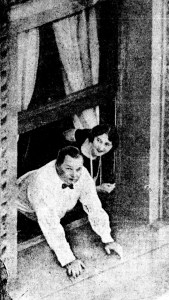
Roscoe Arbuckle and Mrs. Mae Taube at the window of room 1220,
St. Francis Hotel, September 4, 1921
(Newspapers.com)

[1] “Flashes: Roscoe Arbuckle Plans,” Los Angeles Times, July 7, 1920, III:4.

[2] “Zey Pyvron Prevost Tells of Wild Orgy: Arbuckle “Got Mad” at Rappe Girl,” San Francisco Examiner, September 15, 1921, 3.

“S.B., what’s a matter with her?”: Josephine Keza, the fly on the walls of Arbuckle’s Labor Day Party[1]

Josephine Keza, 1921 (Collection of the author)

Assistant District Attorney Milton U’Ren interviewed Josephine Keza, a Polish immigrant and hotel maid, in room 1220 of the St. Francis Hotel on September 16, 1921, one week after Virginia Rappe’s death. Her statement, read into the record of the first Arbuckle trial, provides a different take on Virginia Rappe’s arrival at the Labor Day party. 

Mrs. Keza had been going in and out of all three rooms of the Arbuckle suite—1219, 1220, and 1221—throughout the late morning of Monday, September 5. Arbuckle, Fred Fishback, and Lowell Sherman let her work around them. Missing in her account is Ira Fortlouis, the gown salesman, whose sighting of Rappe in the Palace Hotel resulted in her invitation to Arbuckle’s suite and what happened to her during the course of the afternoon.

Keza noticed Arbuckle shaving in room 1219’s bathroom. She paid special attention to a man named “Freddie,” the comedy director Fred Fishback, Arbuckle’s roommate in 1219. She heard him trying to telephone Rappe from the room’s telephone and getting no answer. If so, it adds another link in the chain of events. It means that (1) Fishback didn’t need Fortlouis to tell him what he already knew, that Rappe was staying at the Palace; and (2) Fishback tried her room first before having her paged in the hotel dining room.

Keza also saw that Fishback was in charge of the liquor supply, keeping it under lock and key in room 1221’s closet. In her rambling account, she may have seen him drinking, too. (During the three Arbuckle trials, Fishback was adamant about shunning both alcohol and cigarettes.)

U’Ren, of course, wanted to know what Arbuckle did, which wasn’t easy, given Keza’s Polish accent and command of English. She was, nevertheless, observant. The party proved to be a rich source of gossip for her workmates below.

To Keza, the comedian and the actress were on familiar terms when she entered the reception room, 1220, shortly after Rappe’s arrival. She knew Fishback and Arbuckle’s friend, the actor Lowell Sherman, who had also come from Los Angeles for the long weekend in San Francisco. At first, they were the only ones in the room.

Q. And then Mr. Arbuckle came in?
A. Yes, sir, then he came out from the bathroom and he come right straight to Miss Virginia and he talked to her very closely. I can’t say if he kissed her, or he spoke to her. They were talking very quiet. I didn’t listen.
[. . .]
Q. Did you hear the sound of a kiss?
A. No.

Whether Arbuckle planted a kiss is moot. But other guests saw that he and Rappe paired off and that she enjoyed his company.

Understanding Keza was one thing. Getting the sequence of events from her must have been maddening. U’Ren wanted to hear what the other witnesses had told him. Arbuckle had been disturbed in whatever he was doing to Rappe on his bed in 1219. As soon as he left the room, his guests tried to help Rappe. As she eavesdropped from an adjacent room, Keza only heard a certain disregard, even resentment.

Q. Did you hear a crowd in 1219 while you were in 1218?
A. Yes. I was in 1218. There was a whole bunch talking and hollering and they go back to the parlor and holler and were dancing and that girl was crying.
Q. Did you hear anybody knocking on the door [of 1219] before the crowd went into the room.
A. No, sir.
Q. Did you hear anybody say, “Open the door”?
A. No, I didn’t hear that.

This had to frustrate U’Ren, who was, perhaps, more than just enthusiastic about taking on the Arbuckle case. Keza wasn’t corroborating what the other guests were saying, especially the women he intended as state witnesses.

Keza heard people laughing as Rappe screamed “Oh my God! No, no, no!” Continuing to listen to the hubbub of the guests inside Arbuckle’s suite, Keza caught a glimpse of a partially clad couple running between one room and another.

A. [. . .] I couldn’t catch it quick, because I was taking my towels, or something, from the closet, but I saw a man come through the room [i.e., the hallway], but I couldn’t say whether from 1219 or 1220, but he came out from one of those two rooms, and then I saw a woman, undressed, go out and run quick to number 1220. She was undressed, she had nothing on, just a combination suit, what you call it.[2]
Q. She could have come from 1220 and run in[to] 1221?
A. She didn’t go to 1221, she go to 1220, the parlor. I didn’t see where she came from, but I saw her right in the hall. She sneaked as quick as she could. First the fellow get up, then she was the next one, then they slammed the door.
Q. First a fellow, then a girl?
A. The fellow first.
Q. How was the fellow dressed?
A. I didn’t see. I just saw the bare feet of a man. I saw the shoes—
Q. (Interrupting) Was the girl in her bare feet?
A. She had her shoes and stockings on.

U’Ren intended to leave the mysterious couple out of his direct examination of Josephine Keza. He had also left out other details so that he could make Rappe’s utterances into a single one, more like a woman suddenly afraid of being hurt, of being raped, after Arbuckle had her cornered in his bedroom, on the other side of 1219’s hallway door. This was how a messy case was cleaned up by district attorneys, to make the crime easy to understand for a jury.

Arbuckle’s lawyers knew what U’Ren did. They considered him a dirty prosecutor for his neat work. And U’Ren hardly protested when Gavin McNab, the comedian’s lead counsel, had him hand over Keza’s statement to be read aloud to jurors. They had more evidence to consider, not only did Rappe’s cries of pain extend over a period of time. They had a few snapshots of what the real Labor Day party was like along with the straightened versions on the part of both the prosecution and the defense.

(See also “I heard a man’s voice say ‘Shut up.’”)


[1] This is from Keza’s statement, where she quotes an exchange she heard between two women in room 1221. “S.B.” was likely the stenographer’s abbreviation for “stupid bitch,” in reference to Rappe.

[2] A “combination suit,” a single undergarment, consisting of a camisole and panties.

Developing a few latent impressions: another note on E. O. Heinrich’s testimony

The American Sherlock takes the stand,” published here last August, is still quite informative about the pioneer criminologist Edward O. Heinrich. This new note simply shares some first impressions after reading his testimony in the transcripts of People vs. Arbuckle. These show how the science of dactyloscopy—of taking and identifying fingerprints—contributed to the prosecution of Roscoe Arbuckle for causing the death of Virginia Rappe. They also invite a long-overdue reinvestigation.

Heinrich obviously relished the opportunity to explain what fingerprints were, that the pattern of ridges in the form of loops and whorls on fingers and palms were unique to every person from cradle to grave. He explained how fingerprints were lifted from a surface and compared to those taken from a living or dead subject. Heinrich even lectured the jurors on the history of fingerprints. He also described how fingerprints were developed using aluminum powder and the tedious process of using different kinds of microscopes, enlarging photographs, and performing mathematical computations to rule out any doubt. Ultimately, the process came down to probability and points of similarity. Ten or more points were considered a match, based on Scotland Yard’s standard adopted by the identification bureaus of virtually every American police department.

Heinrich also described his work in various police departments, his summer session lectures at the University of California-Berkeley, his memberships in applicable professional organizations, and so on. He provided a list of books by fingerprint “authorities.” But, like many criminologists in the early twentieth century, fingerprint analysis was not his specialization. More often than not, these early practitioners were called upon to analyze handwriting samples. Nevertheless, for Heinrich, a proper criminologist had to make the jump from examining the downstroke of a lowercase f, say, and the hypnotic whorl in a fingertip.

Such evidence wasn’t new to American courts in 1921. Police departments, federal and state governments, even businesses were collecting and keeping fingerprint files. But to the layperson, the science behind them was almost as controversial as natural selection. To criminal defense lawyers and defendants, circumstantial fingerprint evidence was hard to overcome if jurors found it convincing.

Heinrich—and the assistant district attorney who was his handler, Milton U’Ren—had to convince juries that he had been long at work on his own methodology and that fingerprints were hardly a sideline for him. He was presented as a professor, even though he his real title was lecturer at the University of California-Berkeley. He reeled off everything he had done professionally, including taking the fingerprints of enemy aliens during the First World War. He also conducted many experiments, including the application and detection of fake fingerprints. But Heinrich’s work on identifying the faded latent fingerprints of Roscoe Arbuckle and Virginia Rappe on a hotel door was his first real test as an expert witness. The defense quickly apprehended this and that he was mostly self-taught. They pulled out all the stops to discredit not only his findings but his person as well.

During the first trial, Arbuckle’s chief counsel, Gavin McNab, tried to convince the jury that the fingerprints were “spooks,” inferring that criminologists who dealt in fingerprints were as phony as Victorian spiritualists. McNab and his colleagues also never missed a chance to note that Heinrich wasn’t a tenured professor, forcing him to admit that he was only a lecturer at Berkeley.

The defense lawyers scored points with the press for their entertaining cross-examinations, which turned Heinrich into an “egghead”—his pattern baldness made him look the part. But after the first trial ended in a hung jury, in part due to Heinrich’s thoroughness in revealing that room 1219 had not been thoroughly cleaned and wiped down, new tactics were adopted in the second trial.

Arbuckle’s longtime personal lawyer, Milton Cohen, took over grilling Heinrich. He was better prepared. He had pored over the literature and cleverly cherrypicked paragraphs to assert that Heinrich had violated protocols and standards in taking fingerprints, photographing them, and developing them using aluminum powder. The most heinous thing that Heinrich and the prosecution did was not handing over the hotel room door to the police and storing it in the property (i.e., evidence) room. This line of attack, however, only revealed that the district attorneys didn’t trust the police, that some members of the department, even the chief, were cooperating with Arbuckle’s lawyers. (Heinrich also disclosed that he had been followed in the St. Francis Hotel.)

Other avenues of attack included the way that Heinrich glibly introduced his assistant and secretary, Salome Boyle, a senior at Berkeley, to the St. Francis deskman. Heinrich called her “my Watson,” implying that he was some sort of Sherlock Holmes. But Heinrich wasn’t being vain but rather self-deprecatory, indeed, self-conscious of his own appearance and what he looked like in the company of a young woman. Cohen also tried to bait Heinrich with an insinuations that wasn’t reported in the newspapers: the seeming impropriety of a professor locking himself away with a coed in a hotel bedroom well into the night, leaving the jurors to think she couldn’t just be there to hold his flashlight.

Heinrich attempting to deflect misspeaking about Miss Boyle at the third Arbuckle trial. (Courtesy of the San Francisco Public Library)

The alleged “struggle” between Arbuckle and Rappe, entirely based on circumstantial evidence, was an important theme in the unsuccessful prosecution of the comedian. Most books about the Arbuckle case place little credence in Heinrich’s work. But, given today’s sophisticated scanning technology and computer analysis, perhaps a latter-day criminologist might stress test Heinrich’s results. It would provide a puzzle piece that certainly would force one to take every version of events apart and start over again.

Arbuckle renews his pep: a ms. cutting

The first iteration of the work-in-progress is seeing drastic cuts. I hate to lose some of this material, especially where it foreshadows what happened on Labor Day, September 5, 1921. The following passage was intended to document Roscoe Arbuckle’s career in parallel with that of Virginia Rappe’s.


While Virginia Rappe’s career lay dormant in the first months of 1918, Roscoe Arbuckle directed such comedies as Out West, The Bell Boy, and Moonshine despite the wartime fuel shortage that forced the closing of two Los Angeles studios. With his manager Lou Anger overseeing the budget, Arbuckle’s company, Comique Film Corporation, took advantage of the financial straits of the Balboa Studio and leased its lot in Long Beach, much to the delight of the city’s politicians and Chamber of Commerce, which wanted no interruption in the benefits of such a large business venture. And here Arbuckle, Al St. John, Alice Lake, Buster Keaton, and others did some of their best work. Such visitors as Charlie Chaplin came to see their work, for he wanted his own plant as well and hoped to exert the kind of artistic control Arbuckle had.

Its members were suitably impressed and took as gospel that Comique would probably develop into one of the largest units of the industry in the country. Nevertheless, to Arbuckle’s surprise, he inherited the remnants of Balboa’s bad reputation, for its employees left many unpaid bills among Long Beach merchants such that Arbuckle’s people were refused credit. Things got so bad that Arbuckle published disclaimers in the local newspapers to inform readers Comique pumped $300,000 into the local economy. But he didn’t wait for Long Beach to show its appreciation. Anger always looked for better, cheaper facilities and after Arbuckle completed Good Night, Nurse! and The Cook, Comique moved to the Diando Studio in Glendale.

Roscoe Arbuckle with baseball hat

Roscoe Arbuckle as a Vernon Tiger (Calisphere)

No matter where Arbuckle lived and worked, he loomed across Los Angeles and its environs. Their hotels, restaurants, nightclubs, stadiums, racetracks, the infamous Vernon Country Club—and the traffic courts—were venues graced by his largeness and largesse. Together with his growing entourage, he had become known as “the Fat One” and something of a force of nature in Hollywood. So much did Arbuckle’s reputation as well as value soar in 1918 that it was necessary to issue a warning to anyone trying to capitalize on having worked with him, that he was the sole author and director of his comedies and responsible for all stories, intertitles, gags, stunts, and so on.

Unlike other directors, Arbuckle didn’t make a propaganda film in 1918. He did, however, do much charity work for morale, such as donating heavily to the United War Work Fund and the Tobacco Fund, which supplied doughboys with cartons of cigarettes. Arbuckle, too, made personal appearances at Liberty and Salvation Army events, and so on. He even “adopted” Company “C” of the 159th Infantry Regiment at Camp Kearny—and the regiment, in kind, made him its “godfather.”

Not long afterward, Arbuckle visited the Marines training on Mare Island, just north of San Francisco on San Pablo Bay. There he proved to dubious leathernecks that despite his belly, he was no less athletic than recruits. He held his own in a round of “pushball.” Arbuckle also played baseball and exerted himself in other ways, including leading a marching band around the parade grounds. He attributed his ability for such physical exertions to the locale and promised reporters “that this visit to San Francisco is to be one in a regular series,” which included a wink at Los Angeles banning liquor sales one year before Prohibition became the law of the land:

The climate of the southland is declared to be too trying on him and following the completion of each picture he makes he plans to come here to renew his “pep.” Other film artists are making the same declaration, which may not be surprising when it is realized that within another month the city of the angels is to become as dry as the proverbial bone.[1] 


[1] “Arbuckle Renews Pep among Marines,” Moving Picture World, 30 March 1918, 1805.

A Projectile Revelation in Arbuckle’s First Trial Testimony

I shouldn’t be so glib with the double entendre, but that is often the best way to think about disturbing things. The critical difference between the transcript of Roscoe Arbuckle’s first trial testimony published in newspapers in late November 1921 and the real thing is vomit. According to Arbuckle, he found Virginia Rappe in bathroom of room 1219 lying on the floor in front of the toilet bowl. She had already vomited and had not missed the bowl. Then the comedian assisted her in another bout. So that she didn’t miss the bowl, he lifted her up by the waist. Then, from behind her, with one hand still around the waist and the other pulling back Rappe’s hair back and head to keep it centered over the toilet bowl, he let her finish.*

The defense’s contention, based on their medical experts, was that Rappe had suffered a spontaneous rupture of her bladder due to any number of causes separate from any sexual assault on the part of Arbuckle. Yet, in one of the penultimate moments in his first trial, they allowed him to posit himself in such a way that one could see that he had caused the fatal injury while being such a Good Samaritan. But the prosecutor didn’t go there. Assistant District Attorney Leo Friedman took as much interest in Rappe’s copious vomit and its odor as I have in writing my book.

He questioned Arbuckle at length, who repeated what he said during his direct examination. Arbuckle had given Rappe two glasses of water and helped her to the smaller of two beds in the hotel room. Then he returned to the bathroom to do his business. He flushed his—and Rappe’s—away.

When he exited the bathroom, he found Rappe on the floor between the two beds in room 1219. He lifted her up and put her on the larger bed, whereupon she vomited again on the pillow and down the side of the mattress.

The vomit testimony wasn’t published in newspapers as a matter of taste. Indeed, not one reporter mentioned how “wet” the cross-examination was, not even euphemistically. No one knew that Friedman never let go of the subject.†

Nevertheless, dispensing with any squeamishness on the part of the jury, Friedman kept asking about whether the vomit had spattered the tile floors, had it gotten on Rappe’s clothes, Arbuckle’s, the odor, the stains, and so on. They had to have disappeared by the time the Labor Day party guests entered the comedian’s bedroom to help the fatally injured Rappe. And not one of them mentioned the presence of vomit or its distinctive smell, which can induce one to vomit sympathetically.

There was, in a manner of speaking, nothing for the school janitor to mop despite the puke buckets Arbuckle’s lawyers coached their client through.

Friedman, while diligent on the above, danced around the major theme of Arbuckle’s testimony to disassociate himself from Virginia Rappe: taking Mrs. Mae Taube for a drive. As you can see, my Juror Number 0, whose inquisitiveness informs some of my PDF notes, finally asks the really big question that was never asked at the Arbuckle trials.

Juror Number 0’s rather run-on question betrays some personal knowledge about this blog entry, “The woman in the window.”

*What Arbuckle says here fits the hypothesis that his testimony had a scaffold based in reality on which to project his testimony. This is discussed in the book. But for rarified minds, it’s not hard to imagine.

†Rappe also frothed at the mouth and Friedman made Arbuckle demonstrate for the jurors. He did.

“Cover up”? The first day into night for reporters assigned to the Arbuckle case

During the second Arbuckle trial of January 1922, the District Attorney of San Francisco, Matthew Brady, subpoenaed a witness who shed light on the comedian’s conduct in the immediate aftermath of Virginia Rappe’s during the early afternoon of September 9, 1921. This was Warden Woolard, a reporter for the Los Angeles Times. His purpose was to contradict Arbuckle’s testimony from the first trial in November on two points: (1) whether he had been alone in his hotel bedroom with Rappe; and (2) whether he had locked the doors. Although Woolard no longer had his notes, he had a good memory and was on the stand with much to tell.

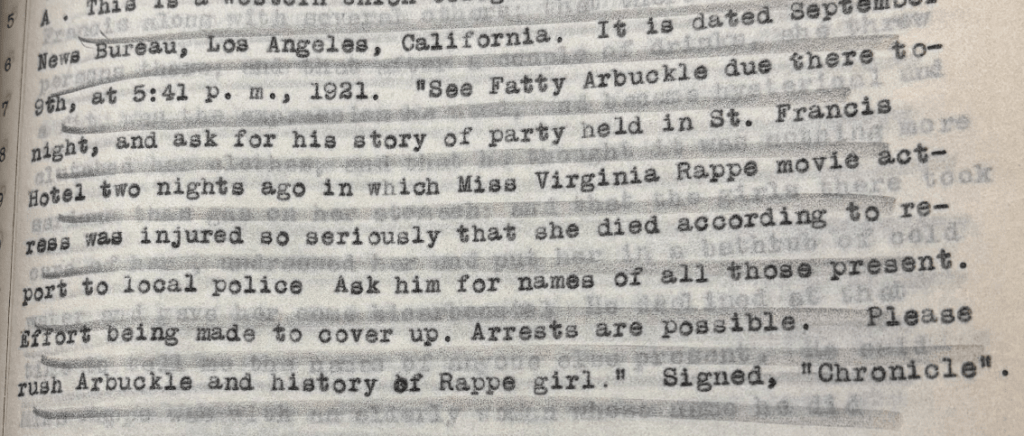
He was prompted to meet Arbuckle by a telegram from the San Francisco Chronicle. It was hard not to ignore its urgency—and both newspapers would sell plenty of copies by sharing information. The Chronicle wanted answers from Roscoe Arbuckle about his Labor Day party of September 5.

The Times sent Woolard to Arbuckle’s Tudoresque mansion on W. Adams Street. The reporter arrived arrived just after 7:00 in the evening. He rang the bell and was met at the front door by an attractive woman who identified herself as Arbuckle’s secretary. This was Catherine Fitzgerald (see “Arbuckle’s housekeeper, secretary and escort: Catherine Fitzgerald”). He gave her his card and she told him to wait outside.

If you are familiar with The Day the Laughter Stopped (1976) by David Yallop, who claimed to have used the trial transcripts to write his book, he describes a rather different scene on p. 132 that was surely intended for a screenplay that any assiduous research would have spoiled.

At 10:30 p.m. that Friday evening, Roscoe Arbuckle sat quietly studying the script for his next picture. The doorbell rang and his butler opened the door. Two dozen reporters charged past the butler, knocking him over. They poured all over the house, taking photographs and looking for Roscoe. Surrounding him, they began to fire questions based on the statements that had already been made in San Francisco by Maude and Alice. [. . .] “Is it true that you screwed five women during the afternoon?”

That is not how it went. According to Woolard, Arbuckle soon appeared. The comedian asked Woolard to follow him away from the house, so that they could talk in private. Arbuckle did not need to be told about what happened in San Francisco earlier in the day. Friends had informed him of Rappe’s death.* And, as their conversation began in earnest, the actor Lowell Sherman joined the two men on the sidewalk. He had apparently come from a back door. Arbuckle denied hurting Rappe. He had only pushed her down on a bed to keep her quiet. And so on. This is in Wallop, all taken from Woolard’s reportage the next day, September 10, as well as that of George Hyde of the Chronicle.

Arbuckle wasn’t “studying” the script for a silent film. Instead, Lowell and other partygoers were getting on the same page and had been getting on that page during the afternoon of September 9. And this continued into the night, when Woolard attended a meeting held in the office of Grauman’s Million Dollar Theater. What Woolard curiously omitted from his testimony was the presence of Arbuckle’s first lawyer, Frank Dominguez. The first thing he did was school Arbuckle with the understanding that anything he said needed to be made only with the advice and consent of counsel. So, I will attempt to square this in the work-in-progress. It may have simply been a courtesy extended by the journalist to one of the most important criminal defense lawyers in Los Angeles during the 1910s and ’20s, the kind of man you heard when he said, “I’m not here,” and you wanted to keep your job.

Warden Woolard did. He went on to enjoy a long and storied career, including assigning reporters to the Black Dahlia case. George Hyde, who likely wired the Times for the initial scoop and wrote the first columns about the Arbuckle case for the Chronicle, either resigned or was released soon after. He went on to testify at the third trial. But offered very little in substance. He came and went from the stand in minutes. His career took another direction. For a time, he worked for various newspapers in Los Angeles, including the Times. But he was never assigned to anything like the death of Virginia Rappe again. For a time he the publicity agent for the evangelist Aimee Semple McPherson. Eventually, he returned to San Francisco, where he poisoned himself in July 1932, “in a fit of despondency,” after a long period of unemployment.

Woolard read the text of the Chronicle’s telegram in open court. The underlining, suggesting its importance, was made by Arbuckle’s lawyer Nat Schmulowitz. (Courtesy of the San Francisco Public Library)

*This was really one “friend,” Rappe’s manager Al Semnacher. He may have monitored her decline, which provided more lead time for damage control. The problem for Arbuckle was his own hubris and the absence of his personal lawyer, Milton Cohen, Dominguez’s law partner, who was en route from New York during this critical time.

Did she keep a little black book?

Toward the end of the third trial in late March 1922, Milton Cohen, one of Arbuckle’s five defense lawyers, cross-examined Kate Hardebeck at length. She was a rebuttal witness for the prosecution and had been Virginia Rappe’s longtime foster mother and housekeeper known as “Aunt Kitty.”

Cohen had a special place in Arbuckle’s defense. Not only was he the comedian’s personal lawyer, he had once been Rappe’s. He knew her, had been a friend. However, now that she was deceased and Arbuckle accused of having causing her death, Cohen was no longer bound by lawyer-client privilege. Thus far, he had used his personal knowledge of Rappe’s time in Los Angeles to procure witnesses who vouched for her alleged episodes of hysteria triggered by the smallest amounts of alcohol.

Cohen also knew that Rappe had left a paper trail over the years. She traveled a great deal and sent letters, postcards, and telegrams to not only the one foster mother, but the other who testified to Rappe’s good health and morals, namely Katherine Fox. Both women proved to be effective rebuttal witnesses, who painted a sympathetic portrait of their former charge. The prosecutors, especially Assistant District Attorney Milton U’Ren, wanted this idealized image of the victim preserved and to counter the “unfortunate” but fallen woman advanced by Arbuckle’s “million-dollar team” of lawyers.* So, the two foster mothers were undoubtedly encouraged not to mention any correspondence and stonewall where necessary, especially if that might intrude on the happy, girlish creature they described on the stand. And they may have done better than what was asked for. They told the defense lawyers that they had destroyed their foster daughter’s letters—this despite how precious she had been to them.

But one such document still existed. It lay on prosecution side of the shared consuls’ table. Cohen fixed on it. Was that the “diary” Al Semnacher, Rappe’s putative manager, had mentioned during his testimony a few days ago?

“Mr. U’Ren,” Cohen asked, “will you be good enough to let me have Miss Rappe’s diary?” Then Cohen turned to the witness. “By the way, did you deliver Miss Rappe’s diary to Mr. U’Ren.”

U’Ren started to object but Cohen cut him off. “I beg your pardon, just let her answer.” And Hardebeck answered in the negative.

When U’Ren handed the tiny book to Cohen, the latter saw that it wasn’t the diary. It had tabbed pages from A to Z. Nevertheless, he continued his fishing expedition.

COHEN: Q. Mrs. Hardebach (sic) have you ever see a book about six inches long by three inches wide, the sheets being gold edged?

A. No.

Q. And a black leather cover?

A. This is the book Miss Rappe had besides her address book, and we discarded that when we left Ivor Avenue, because it was full and had come apart.

Q. You say you discarded that book?

A. Miss Rappe discarded it before we left Ivor Avenue; and after that we had no telephone, and it was not necessary to keep the book.

Q. This is the only book, then, that you have?

A. Yes.

Aunt Kitty responded in a way that suggests there are two books: one for addresses, one for telephone numbers. While such items could be discrete objects in 1921, this didn’t sound convincing. So, Cohen continued to grill the witness. He needed a diary—or just a simple daybook, a proto-planner—with dates and jottings that might put Rappe where she had an episode, one that anticipated the fatal one ascribed to Arbuckle just two weeks before the Labor Day party of September 5, 1921.

In the end, Cohen let the matter go. U’Ren, however, did not. During the redirect examination, he took the precaution of burying the issue of a diary once and for all.

U’REN: Q. Mrs. Hardebach (sic) did Virginia Rappe keep a diary?

A. Not to my knowledge, no, I am sure she did not.

CT_BLACK_BOOK_01_0f13022f-818a-4d29-9cbc-81f6dd55497b_1000x1000


*In the revised narrative, a more accurate version will fall between these two contrived ones created for Arbuckle’s trials.

Update: The trial transcripts

The transcripts were the personal copies of Arbuckle’s lawyers. (Courtesy of San Francisco Public Library)

The transcripts of the three Arbuckle trials proved to be revelatory. I have spent the past six days working with them. And I will have weeks of reading ahead of me as well as an entirely new narrative to consider. Its like having all the bones of a museums brontosaurus in the entrance hall. The transcripts release me from depending too much on the newspaper reportage of the period, on reporters who came of age during the heyday of yellow journalism.

What I also learned was that every book and article previously written about the Arbuckle case and his alleged victim, Virginia Rappe, put their “bones” together wrong. To be continued . . .

The opening argument of the second trial asserts that Virginia Rappe’s presence at Arbuckle’s :abor Day party was hardly a coincidence but rather prearranged by her manager. (Courtesy of San Francisco Public Library)