Document Dump #2: Caveat aqua frigida cum succus aurantii!

“Rupture of the Female Urinary Bladder” by K. Sellers Kennard, M.D.

N.b. This article appeared in the May–June 1923 issue of the Medico-Legal Journal, vol. 11, no. 3, pp. 71ff. The author, Dr. K. Sellers Kennard, was Assistant Medical Examiner for New York City as well as an instructor in anatomy at Fordham University Medical School in the 1910s and 1920s. This document is cited in our forthcoming book and, we think, for the first time in relation to the Arbuckle Rappe Case. Notice the editor’s note at the end of the article that posits a “consensual” theory. Notice, too, that he doesn’t disagree with the “lithotomy position.” In addition to meaning on one’s back with knees up—and clasped together in self-defense, as Dr. Kennard means below—the lithotomy position can mean knees parted, dorsal recumbent (the so-called “missionary” position) as well as knee-to-chest on a flat surface such as a mattress, or standing, supported by a table, bathroom sink, and so on.

Traumatic rupture of the urinary bladder is a condition which in the great majority of cases is of surgical interest only. The injury though of considerable frequency has its most obvious legal relations to civil actions in suits for negligence or of claims under accident insurance policies or Compensation Acts and Employers’ Liability statutes. Apparently where the rupture of the bladder is the sole competent producing cause of death, it is of extreme rarity as the result of criminal acts. When the bladder is ruptured, most often fractures of the pelvis as the result of great crushing force is the cause; or punctured or incised wounds of the abdominal wall may extend into the bladder and injure it.

But this is not rupture per se, for that form of bladder rupture which we desire to note here is produced by force applied directly to the abdominal wall and the injury is unaccompanied by any other evidence of disease or of force to related parts. The mechanics by which a healthy bladder is ruptured by force applied to the anterior or lateral lower abdominal wall is no doubt well understood by the physician. The writer’s views on this subject were expressed in an article published in the Medico-Legal Journal, vol. 38, No. 1, p. 5. The method there discussed applies equally to the bladder with the exception that it is necessary for the bladder to be distended with fluid, otherwise in the empty or slightly distended condition the rules of transmitted force applicable to other organs would not strictly apply.

This was done not for the purpose of any surgical instruction, but primarily for medico-legal interest, for counsel may be very persistent, and rightly so, as well as exacting, in his desire to be informed how and why some given injury of an internal organ occurred. The medical testimony as to how an injury occurred anatomically may have important bearing on a case, for it can be used to prove or disprove an alleged cause of an injury.

Putting aside all those instances of rupture of the bladder occurring by obvious means and in the presence of witnesses, or by apparent accidents of trade, occupation or travel, it is hardly to be questioned that rupture of the female urinary bladder is of prime investigative importance. Hardly is it secondary in importance to rupture of the uterus and it seems to the writer that it may be accepted as a medico-legal axiom that a case of rupture of the urinary bladder of a woman, occurring under circumstances which do not admit of ready explanation either by verbal testimony or apparent circumstantial evidence, is homicidal per se. The degree of homicide is not in question in this presumption, but homicide as distinguished from accident or suicide under the circumstances is the intended use of the term. These cases are most likely to fall under constructive murder, at least in New York (Penal Law, 1044- sub. 2), which provides that an act by a person engaged in the commission of, or in the attempt to commit, a felony either upon or affecting the person killed though without design to effect death is guilty of murder in the first degree. (P[eople]. vs. Schermerhorn 203 N. Y. 57, P. vs. Wolter 26 N. Y. Cr. 519), and while it is possible that excusable homicide by misadventure may explain such an affair, such causation should be of ready explanation and that most likely by the party at fault.

More than rupture of the uterus is rupture of the female bladder presumptive of homicide, for in the former the probability exists that manipulations of the woman herself, though denied, may have caused the injury and this presumption cannot be exluded in spite of denial unless the character and extent of the wound excludes self-infliction and the circumstances of injury admit of possible solution by investigation. Never could this be applied to the urinary bladder alone. This view certainly narrows the field of urinary bladder ruptures, but within these limits the rule of presumptive homicide will be the safer course for the medical examiner to follow.

If the presumption is overthrown by subsequent evidence so much the better for some possible defendant. But if the rupture be tagged as accident even after investigation it will be necessary to determine how an unexplained accident caused, without witnesses or bodily evidence, a rupture of the bladder of sufficient extent to result in death.

Anatomically, these injuries are of two kinds, extra- and intra-peritoneal, the latter having particular interest for us here. Extra-peritoneal ruptures could not likely be caused in the manner we assume the injury to have been produced in the cases noted here. One of the reasons for and one of the points in question for this being the fact that the portion of the bladder which lies behind the symphysis pubes is below the line of reflection of the peritoneum over the fundus and sides of the viscus. Consequently this portion of the bladder could not be subjected to the application of force un less the symphysis were first broken down. As the empty bladder lies wholly behind the symphysis, pressure upon the woman’s abdomen would not rupture the organ in this position, and as the neck of the bladder does not rise with distention, its relation to the line of peritoneal reflection is not materially altered.

The distended bladder lies against the posterior surface of the anterior abdominal wall, usually confining itself without serious discomfort to the hypogastric region. The female bladder does not rise above the pubes until more distended than that of the male, a fact that formerly led to the opinion of its greater capacity. But it is probably due to a more capacious pelvis and thus a second fact is met with in considering the cause of these injuries. The lower half of the female sacrum being more curved than in the male, provides a larger space for a distended bladder to occupy, but renders it more likely to be brought in contact with the projecting sacro-vertebral angle. The sacral curvature also provides a more prominent over hanging sacral promontory against which the bladder can be pushed, a possibility rendered much easier if the female be recumbent and with the thighs flexed or partially so upon the abdomen. This position brings a distended, receding bladder and an advancing body of great resistance in close relationship, and should force or weight be applied to the abdomen intra-peritoneal rupture could result.

Unless surgical intervention is early the injury is almost uniformly fatal from peritonitis. Bartels collected ninety-eight cases, all of which died but four. It has been said that the bladder may rupture spontaneously from over-distention and is a defense. The medico-legal axiom that “healthy tissue does not rupture spontaneously” may well govern this assertion. If the bladder so ruptures there is disease somewhere in its walls. Prolonged over distention from causes outside the bladder may so affect healthy walls that abnormal changes result and permit rupture. This is probably what is meant by spontaneous rupture by hyper-distention but the qualifications should never be omitted, and particularly since it is stated in the most recent authority on Legal Medicine, that “the bladder may rupture spontaneously from over distention without being diseased”—a statement as such which is most misleading.

The autopsy will disclose the state of the bladder walls, and if in a ruptured bladder we exclude unhealthy tissue, we need not be perturbed by a defense of spontaneous rupture.

Coats (Br. Med. Journ. July 21, 1894) reports two cases of uncomplicated rupture of the male urinary bladder. No history of injury could be obtained. One patient was a maniac and the other was intoxicated. The absence of history seems obvious. At autopsy no peritonitis or inflammatory reaction about the bladder wound was disclosed. It was not recorded if microscopic sections were made. If these organs were healthy and with the facts of the personal condition of the patients before us, it does no violence to the imagination to believe that both these injuries were caused by force applied to the bladder through the abdominal wall in some manner.

Two cases of rupture of the female bladder have recently occurred in which the injury was assumed to have been caused by the weight of a human body applied to the abdomen of the female during forcible attempts at sexual intercourse. The most famous, and indeed the only case of which apparently there is any record, is the Arbuckle case in San Francisco in September, 1921. The circumstances of this affair as we gather them from the trial notes and reports of the incident are that on September 5, 1921, and at about three o’clock in the afternoon, a sociable gathering was in progress in the apartments of the defendant on the twelfth floor of the Saint Francis Hotel in San Francisco, Cal. A member of the party was one Virginia Rappe, a motion picture actress, two other women, a man and the defendant. The gathering was quite hilarious, considerable intoxicants having been consumed, or so reported, and about the hour stated the defendant forced, induced or followed the Rappe woman into an adjoining room and there committed or attempted to commit a sexual assault upon her.

The statements upon this point of how the two entered room 1219 are conflicting as is much of that which marks the opening of the case. It is reported that after one-half an hour to an hour’s absence screams from room 1219 attracted the attention of one of the other women and upon demanding and finally obtaining entrance, the deceased was found lying upon a bed, clothes much disarranged, writhing in pain and said, “I am dying. He hurt me.”

Such attention as was possible was given; ice was applied to some portion of the body; she was carried to a bath and immersed therein.

A physician, Doctor Karhoe [i.e., Olav Kaarboe], was then called and states that the woman appeared intoxicated; did not seem to be in need of medical attention and on examination at that time saw no bruises.

The next physician called was Doctor [Arthur] Beardslee, who saw the patient at 7 P.M., about four hours after the occurrence; had severe pain in the lower abdomen; could not palpate until after hypodermic of morphia had been given; pain was so great that is over shadowed any evidence there may have been of intoxication; no definite diagnosis at this time. Was called again at 11 P.M.; condition about the same as at first; writhing about and complaining of pain in lower abdomen; did not give rational answers; said very little to her; by this time I felt she was suffering from some internal injury; gave hypodermic of morphia. Called between 4 A.M. and 5 A.M. again September 6; more severe pain; catheterized the patient under ordinary surgical technique. (Small metal catheter exhibited.) The result of this confirmed my suspicions of an internal injury and also assisted in localizing the lesion; immediately knew the bladder was complicated in whatever injury there was; external violence applied to lower abdomen most usual cause of rupture of the bladder; rupture of bladder has occurred with very slight fall; that vomiting itself I don’t believe would rupture the bladder, but the contortions gone through during the vomiting might be a cause or effect; saw black and blue marks on left arm.

The patient was subsequently transferred to Wakerfield’s [i.e., Wakefield] Sanatorium, where she died Friday, September 9, 1921, at 1.30 P.M. An unofficial autopsy was performed at the request of friends of the deceased the same day at 1.30 P. M. by Doctors [William] Ophuls and [Melville] Rumwell. Doctor Ophuls states two spots on inside of upper right arm; bruise on front of left leg; similar superficial bruise on one of thighs, don’t remember which; these were the only abnormal signs I found on the body; bruises on right arm were discolored; none on left arm; continued inspection of bladder; the tear in the bladder did not seem quite fresh nor very old either; the tear was possibly a day or two old at least and not over ten or twelve days; investigated other internal organs and found them entirely intact and perfectly normal.

Q. Going back to the bladder did you find any deposit in it?

A. Yes; there was a small clot of blood evidently there for a day or two; tear in bladder was a clean break; evidence of peritonitis; organs other than bladder perfectly healthy; cause of death was rupture of the bladder.

Q. What in your opinion was the cause of rupture of the bladder?

A. Presumably from a medical view the bladder had been over dis tended and probably exposed to some force from the outside.

The official autopsy was performed by Doctor [Shelby] Strange on September 9, at 8.15 P.M. He states height 5 ft. 5 in., weight 140 pounds. On right arm between elbow and shoulder were three bruises ; two bruises on the lower abdomen and others on thigh and shin; there was a large area 2 in. above the right elbow  1/2 in. in width and 4 in. long, extending around the arm; an inch above this was an area on the external surface of the arm 1-1/2 in. x 1/2 in.; another 1/2 in. from the insertion of the right deltoid, circular and 1/4 in. in diameter; on the left arm noticed a vaccination mark which I used as a landmark; two circular areas, 1/4 in. in diameter, 1/2 in. forward (in front of) and 1/4 in. below this mark; believe hypodermic needle caused these marks.

Q. Any other marks?

A. On the right and left leg and left thigh; on right leg there was a large bruise on the outside of the middle third over the shin bone; this was 7 in. long and 2-1/2 in. wide at its widest point, oval in shape; over the shin bone and extending on either side it began 3/4 in. above the instep; was surrounded by several other smaller marks practically contiguous 1/2 in. above the ankle.

Q. Is that all on the right leg?

A. Yes. On the left leg there was a smaller mark 6 in. long and 3 in. wide at its widest point and oval.

Q. Any other marks on the left leg?

A. Several others. Small areas around the large bruise and almost connected; on the left thigh there was an area 3/4 in. x 3 in. beginning in front at the lower third of the left thigh and extending downward and outward; there were no marks on the back at all or others on the trunk or limbs.

Q. In your judgment, doctor, were these bruises ante-mortem or post-mortem, made before or after death?

Objection: not qualified as expert.

Overruled.

A. The two on the left arm near the vaccination mark were apparently made by a hypodermic needle, each had a little central point where a sharp instrument had been inserted. I assumed the others were made by a blow or a — Objection. Discussion by counsel.

Allowed.

A. Just ordinary bruises which would seem—

Objection; discussion.

Question repeated.

Allowed.

A. My opinion at the time was that the smaller bruises on the right arm were due to finger marks. But as to the other bruises on the body I am unable to say just what had caused them. (Bruises identified by photographs introduced as diagrams.) There was an area in the groin, circular, 1/4 in. in diameter to the left of the central junction of the pubic bones, and another nearer the middle of the body, in. above the first. Both were irregular, circular. Brain negative, as were other organs. Lungs, hypostatic congestion. Stomach given to city chemist. Peritoneum was roughened from inflammation. Bladder and female organs had been removed.

Q. Did you subsequently get possession of them?

A. Yes. Doctor Ophuls brought them to me in a sealed jar.

Q. Describe the condition.

A. Normal.

Q. Absolutely normal?

A. Yes, except for an incision that had been made.

Q. Was it of a normal, healthy person?

Objection.

Overruled.

Q. Did you examine the bladder?

A. Yes.

Q. What was the condition?

A. There had been an operation by incision. (This evidently refers to the previous autopsy as there seems to be no evidence of surgical procedure, but there is no certainty there was not) upon its anterior surface. On the upper and posterior surface I observed a rent in the bladder, a rent or lesion of the wall; it measured fully 3/4 in. in length.

It was testified that microscopic examination of the bladder wall showed a chronic inflammation, but not necessarily of a nature to produce a fatal condition.

The statement of Miss Briggs [i.e., Mrs. Virginia Breig], secretary to Wakerfield Sanatarium, was admitted in evidence over objection and motion to strike out as hearsay that the patient had stated to her “Arbuckle took me by the arm, threw me on the bed and put his weight on me.”

Upon evidence submitted to the Coroner’s Jury, its verdict read as follows: We, the Coroner’s Jury, find the said Virginia Rappe, aged 25 years, residence Los Angeles, came to her death September 9 at Wakerfield Sanatarium from a ruptured bladder, contributory cause peritonitis. And we further find that said Virginia Rappe came to her death from peritonitis caused by a rupture of the urinary bladder, caused by the application of some force, which from the evidence submitted was applied by one Roscoe Arbuckle. We therefore charge Roscoe Arbuckle with manslaughter.

The indictment was for murder in the first degree. The legal aspect of the case is not under discussion, but it may be stated that the defense seems to have been (1) The bruises were produced by carrying the patient to immerse her in a cold bath. (2) That the rupture of the bladder was caused by vomiting. (3) By muscular contraction consequent upon vomiting and immersion in cold water. (4) The application of force by falling from a bed to the floor.

The usual conflicting medical testimony was given. The three trials, jury disagreements and final disposal of this case is no doubt familiar to all. But I would be cheating the forensic physicians of generations yet to come if I failed to remark the following medico-legal gem. It is recorded that an expert for the defense, “Flatly and repeatedly” testified that three drinks of gin in orange juice, followed by immersion in a cold bath, has repeatedly caused rupture of the urinary bladder. Caveat aqua frigida cum succus aurantii![1]

The other case referred to occurred in New York City in March, 1923. On March 17, at 9.30 P.M., Mrs. Frances Cone Beckwith, an actress in company of three men and two girls, attended a party and dance, she having been previously called for by one of the men at 7 P.M. the same day and promised to meet them at the time stated. Some drinking was indulged in and about 12.30 A.M. one of the men and the two girls left the gathering and went home. The Beckwith woman refused to go, or was un able to do so on account of intoxication and rather than create a scene the two men took her to a room on the second floor of the place where the dance was held and laid her, fully dressed, upon the bed. The men then went to a room on the third floor and there spent the night. At 9.30 A.M. March 18 she was found by one of the men, in bed, and still apparently intoxicated. They got her into a taxicab and took her to her residence, 144 E. 61st street. When they reached this address they met a friend of Mrs. Beckwith and he seeing that she was intoxicated and was complaining of colicky pains in the abdomen took her to his own apartment at 308 W. 82d street, as her own apartment was not in a suitable condition for her to remain in owing to neglect of it, and there was no one to care for her. A private physician was called and who treated her until the afternoon of March 19, on which date she was transferred by private ambulance to Roosevelt Hospital, being admitted at 5.30 P.M.

While at the hospital her parents, who had been notified, visited her. They found her conscious, suffering with pain in the lower abdomen; admitted to them that she had been drinking heavily; that she had fallen against objects while intoxicated, but when questioned if any assault or forcible attempt at rape had been made upon her, she refused to make any comment. She admitted that two illegal abortions had been performed upon her in August and in November, 1922. She died March 20, at 3.25 P.M. No definite diagnosis seems to have been arrived at as to the cause of her physical condition.

What transpired on the night of March 17 and the morning of the 18th is according to the statement of the two men in question and pertains to occurrences after the third man and other woman had left the party. There were no bruises on the woman’s chin when she went to the dance. They were when she was seen the following morning.

Autopsy March 21. Frances Beckwith, 22 years, 5 ft. 4-1/2 in. in heighth, weight 126 pounds. Body adult female, white. rigor mortis complete, no colostrum in breasts, vagina large, abdomen markedly distended.

Contusion over left side of chin, 1/2 in. in extent and a superficial scratch mark over the left side of the lower jaw, about 1 in. in length, extending from the contusion. There is a small area of ecchymosis [i.e. bruising], about 3/4 in. in extent, over the crest of the left ilium, which on section shows a small amount of hemorrhage. There are a few superficial scratch marks on the anterior surface of the left thigh, running transverse for about 1-1/2 in. in extent There is a small blue spot on the upper and inner aspect of the right thigh with a needle puncture in its centre. (Saline transfusion.)

Peritoneal cavity is filled with red-stained fluid which has the odor of urine. The small intestines are distended markedly and are covered with fibrin and somewhat adherent in places, but can be easily separated. There is no hemorrhage in the skin or muscles of the lower abdominal wall. There is a mass of clotted blood in the right lumbar region in front of the kidney, in the peritoneal cavity, occupying an area about the size of the kidney.

Heart negative. Lungs, terminal broncho pneumonia. Other abdominal organs negative. Urinary bladder— there is a hole in the bladder over the middle of the posterior surface, extending into the fundus and measures 1 in. in diameter. The bladder is markedly thickened about this area and there is hemorrhage about the margins of the opening.

Uterus measures 2-3/5 x 1-3/4 x 7/8 in. The external os is closed; endometrium normal; surface covered by fibrin; ovaries, tubes and vagina normal. Gastro-intestinal tract negative. Cause of death: Peritonitis, following traumatic rupture of the urinary bladder.

These cases present some very interesting medico-legal points. Both are bare of direct evidence and while we have a statement of the deceased in the former case it does not carry any legal weight, as it is not of the character of a dying declaration. In both these affairs ecchymosis and their kindred, scratches, form from the medico-legal standpoint the entire case, as these show intention to overcome resistance to some objective act. Medically we may dismiss all the defense claims in the Arbuckle case, for microscopic examination shows the bladder normal, and we know that vomiting, bathing or sneezing or muscular exertions would never alone rupture a healthy bladder. The muscular exertion attending these acts, by exerting pressure by the abdominal walls upon a distended, healthy bladder would be most apt, and in fact I think experience proves it to be true, to cause relaxation of the sphincters with an involuntary discharge of urine.

A fall would certainly cause the ruptures in both cases, even a fall from a bed to the floor, if the organ were full, but a fall does not explain either the distribution of the bruises or scratches in either case. For value and interpretation of such marks in cases occurring under circumstances similar to those noted here, the reader is referred to “People vs. Fritz,” Medico-Legal Journal, vol. 37, Nos. 5 and 6, 1920.

Unless plainly demonstrable that they are due to infection or constitutional disease, ecchymosis mean force. Force means resistance by the person who bears the marks, and under the circumstances attending cases presumptive of sexual attacks, the defendant must offer some better explanation of the production of the bruises, if he is to be believed, than one, which upon its face bears the impossibility of competent cause. When a witness testifies he produced bruises upon the left leg and arm of a person by carrying them to a bath tub, holding the said leg and arm, he cannot include bruises on the right leg and arm as contingent to the same act, when there is no further testimony on the point. It has been my invariable experience that when an accused tells the truth, bruises will substantiate him to the most minute particular.

It is possible that the large bruises noted on the right and left legs in the Rappe case may have been produced by striking the limbs against the bed fixtures in pain contortions, but this assumption does not explain the small, isolated bruises contiguous to the larger bruise. Falls do not make bruises circular in extent, though they may be circular in shape, and that on the right arm was of such type. Small, numerous, regularly circular bruises, scattered, yet in relation to each other, are finger marks and when occurring about the ankles or thighs or upon the arms of a female, under circumstances pointing to sexual as saults, have a very significant and restricted meaning. In the Beckwith case the location of the bruises and scratches are equally significant as in the Rappe case. On the chin they indicate an attempt to hold the head down or to stifle cries. In both cases the marks on the body and limbs all bear circumstantial relation to the genital organs of the female.

In neither of these cases is there any doubt from the reports that both women were drunk. Assuming a sexual attack made upon them, each were recumbent. In the Rappe case the thighs were most likely flexed upon the abdomen in lithotomy position, which may readily account for the bruises just above both ankles. There is no such evidence in the other case. Crile (Keen’s Surgery, 1910-1-90) denies that the drunken person is under a special protection of Providence. “In deep alcoholism muscular tone is greatly reduced, and in this state the viscera are sometimes subjected to serious trauma. The muscular tone of the abdomen and lower thorax is such as to protect the heart fairly well against mechanical violence.”

Daily experience in medico-legal practice amply verifies this statement. Force has no special respect for the organs of a drunken person. So it does not seem difficult to assume the reconstruction of these two cases from what medical signs we possess. Both these women were under similar circumstances prior to the critical moment. Both lived about the same length of time after the injury. Both died from peritonitis. In both the wound of the bladder was in the same location and approximately the same character and extent. Organ was normal in either case. The lesser extent of markings upon the body of the Beckwith case was probably due to less degree of resistance on account of greater intoxication.

We readily admit that in both cases the internal injury could have been produced by force applied to the abdominal wall by a fall or otherwise, and that without any external mark to indicate the point of impact. But the very fact that there were marks on the body, and marks not correlative to force as the result of falls alone; marks of such character as to predicate voluntary resistance to something on the part of the recipient, makes the cause of these injuries something entirely different from accidental means or of causative factors residing within the deceased.

These are the things which circumstances must explain away and the circumstances of both these cases admit of no other reasonable explanation than that the ruptured bladder was the result of a more or less forcible attempt at sexual assault.

If either of these women consented to intercourse, what was the reason for the marks found upon their bodies, distributed as they were and indicating a force, quite unnecessary for the accomplishment of any act from consent.

Women under the influence of alcohol, with muscular tone much lowered to the extent that the reflex spasm of resistance of the abdominal wall to mechanical attack is wanting; a recumbent position, with thighs more or less flexed upon the abdomen; a distended bladder from consumption of that which produced the intoxicated condition; force, in the form of weight from a human body suddenly applied to a non-resisting abdomen, and if such weight be productive of sufficient force, the internal wounds found in both these cases seems to be a necessary resultant.

Note by the Editor

In view of the fact that the Jury brought in a verdict of “Not Guilty,” let us assume the following as likely: That the victim of the accident was under the influence of alcohol and had a distended bladder; that she went with the accused willingly for the purpose of sexual intercourse. That during the consummation of the act, and after the penis had entered the vagina with her consent, she complained of severe pain, due to an overdistended bladder and the weight of the accused. That some of the bruises were caused during the consummation of the act. for, as accused could not be assumed to have had the necessary medical knowledge to know that the bladder was being ruptured, and if, as must be assumed, the deceased consented to the sexual act at the beginning, the accused could not have been expected to desist during the act and the result could at most be construed as involuntary manslaughter and the accused must be considered as innocent, both as to criminal intent and act.

ALFRED W. HERZOG  


[1] Beware of cold water with orange juice!
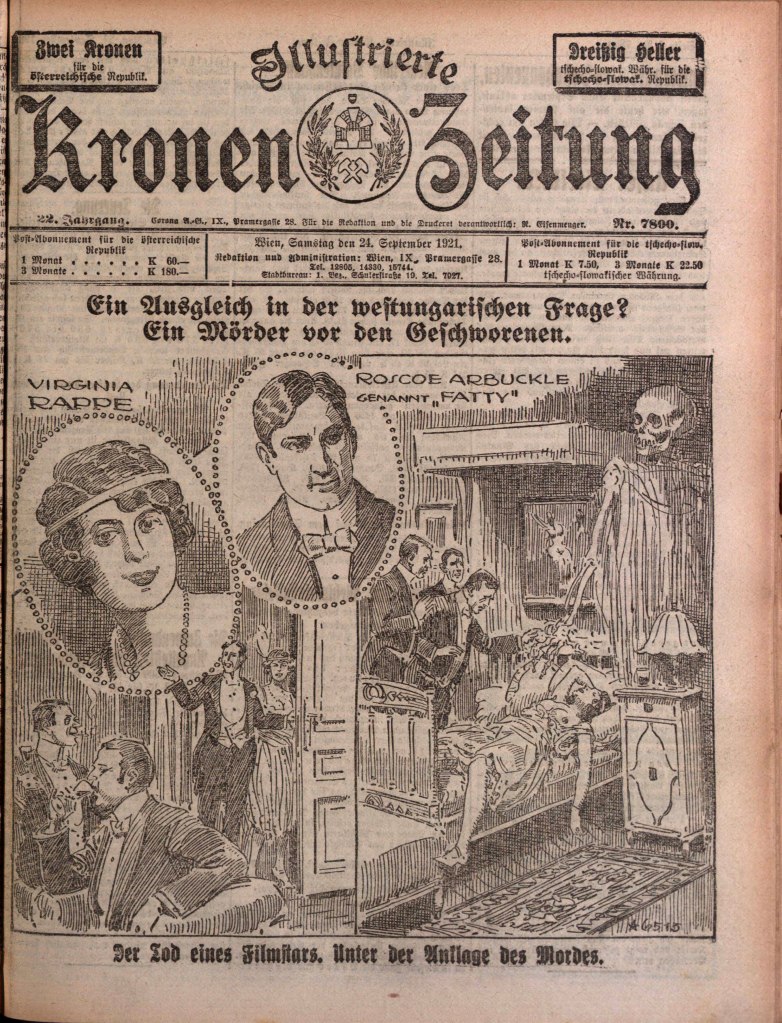
The scene of the crime . . . from Vienna

Although Roscoe Arbuckle was well known in England and France, his appearance was evidently a mystery to the editor of the Illustrierte Kronen Zeitung, a tabloid in the Austrian capital of Vienna. Despite lacking visual references for Arbuckle and Virginia Rappe, the cover artist used his imagination and wire service reports to recreate the scene in room 1219 of the St. Francis Hotel on September 5, 1921.

The German reads “The Death of a Film Star. On Suspicion of Murder.” (ANNÖ)

Buster Keaton on Virginia Rappe and Roscoe Arbuckle

The following text is an excerpt from Buster Keaton’s 1960 autobiography My Wonderful World of Slapstick (written with Charles Samuels) from the chapter “The Day the Laughter Stopped.” Keaton was probably Arbuckle’s closest friend in show business and in life. Arbuckle mentored Keaton when he started in Hollywood and in turn Keaton was there for Arbuckle after the latter was banned from the screen. There are a few factual errors in Keaton’s account, for instance Arbuckle was born in Smith Center not Smith Corners and the car he drove to San Francisco was a Pierce Arrow rather than a Rolls Royce, though these are relatively insignificant details as they relate to the case of Arbuckle and Rappe.

“But one day in September 1921, all of the laughter in Hollywood stopped. Overnight what had been innocent fun was suddenly being denounced as “another Hollywood drunken orgy” or “one more shocking example of sex depravity.” The day our laughter stopped was the day Roscoe Arbuckle was accused of having caused the death of Virginia Rappe, a Hollywood bit player and girl about town, in his suite at the St. Francis Hotel, in San Francisco. They’d had several weekend dates together, but there had been no arrangements made for this one [our italics]. She just happened to be up in San Francisco at the time.

“The full poignancy of what followed can be grasped only when one considers how touched with magic Arbuckle’s life had been during the years he had been a movie actor. Roscoe was born in Smith Center, Kansas, on March 24, 1887, which meant he was only thirty-four when catastrophe overwhelmed him. He was a small child when his family moved to California and at eight made his stage debut in San Jose with the stock company of Frank Bacon. If he ever went back to school after that it was not for long. He did anything he could to stay in show business: was a ticket taker at one theatre, sang sentimental ballads in a nickelodeon, worked as a smalltime vaudeville blackface monologuist up and down the West Coast.

“Roscoe got his first movie job by dancing up the steps to a porch where Sennett was standing with Mabel Normand and casually doing some back flips. Sennett, thinking a policeman that fat might be very funny, put him on as a Keystone Cop at three dollars a day. His fame started shortly afterward when he appeared with Mabel Normand in a series of shorts called Fatty and Mabel. Roscoe had been with Sennett for four years when producer Joseph Schenck gave him his own unit. Yet it was only when he started doing features for Famous Players-Lasky that Roscoe Arbuckle got into the big money. Then it became very big money indeed, $7,000 a week. Jesse Lasky was in charge of that studio which later became Paramount. In his autobiography, Blow My Own Horn, he calls Arbuckle “conscientious, hard-working, intelligent, always agreeable and anxious to please,” and adds, “He would invent priceless routines and also had a well-developed directorial sense.”

“Once Lasky handed Roscoe the tough assignment of doing three feature pictures in a row without a day’s rest in between. “I don’t know of another star,” said Lasky, “who would have submitted to such exorbitant demands on his energy. But Fatty Arbuckle wasn’t one to grumble. There were no temperamental displays in his repertoire. He went through the triple assignment like a whirling dervish, in his top form. They were the funniest pictures he ever made. We were sure they would reap a fortune. . . .”

“It was on finishing that backbreaking triple assignment that Roscoe drove up to San Francisco in his $25,000 Rolls Royce for the Labor Day weekend. With him were the actor Lowell Sherman and Fred Fischbach, a comedy director. San Francisco always has been a high-rolling good-time town but never more so than in the early twenties when flouting Prohibition became the new competitive sport. Roscoe checked into a large suite at the St. Francis. Friends and free-loaders, including several of San Francisco’s most important officials flocked there the moment news got around that Arbuckle, that prince of a fat man, was in town. Roscoe liked nothing better than playing host to all comers. He ordered three cases of the best whiskey and gin obtainable and all sorts of food sent up to his suite.

“in a police court. Then the district attorney demanded that the charge be changed to murder. On the plea of Dominguez this was refused. The official charge became “involuntary manslaughter,” and Roscoe was released in $5,000 bail. Realizing the seriousness of Roscoe’s situation, Joe Schenck tried to get the fabulous courtroom spellbinder Rogers to take over the case himself. But Rogers, old and sick and near death, begged off. He told Schenck, “Arbuckle’s weight will damn him. He will become a monster. They’ll never convict him. But this will ruin him, and maybe motion pictures also for some time. I cannot take the case but prepare Hollywood for tornadoes.”

“The tornadoes were already exploding all around us by then. Along with other friends of Roscoe’s, I offered to go to San Francisco to testify. Among the nasty rumors circulated was one that Arbuckle had pushed the piece of ice into the girl’s private parts, thus contributing to her death. As Roscoe’s intimate friend I knew that any such obscene act would have been beyond him. I was eager to tell the jury this and also to explain. The day was hot, and he had put on pajamas with a dressing gown over them. Among his guests that weekend was Virginia Rappe, the twenty-five-year-old Hollywood bit player. She had a reputation for getting hysterical and tearing off her clothes after taking a few drinks.

“On hearing Roscoe was in town, Virginia joined Arbuckle’s party with an older woman and her own manager, Al Semnacher. After her death, everyone in Hollywood who knew Virginia was surprised to read newspaper descriptions of her as a frail little flower, a starlet whom death had robbed of the chance to achieve the heights on the silver screen. The truth is that Virginia was a big-boned, husky young woman, five feet seven inches tall, who weighed 135 pounds. She was about as virtuous as most of the other untalented young women who had been knocking around Hollywood for years, picking up small parts any way they could [our italics].

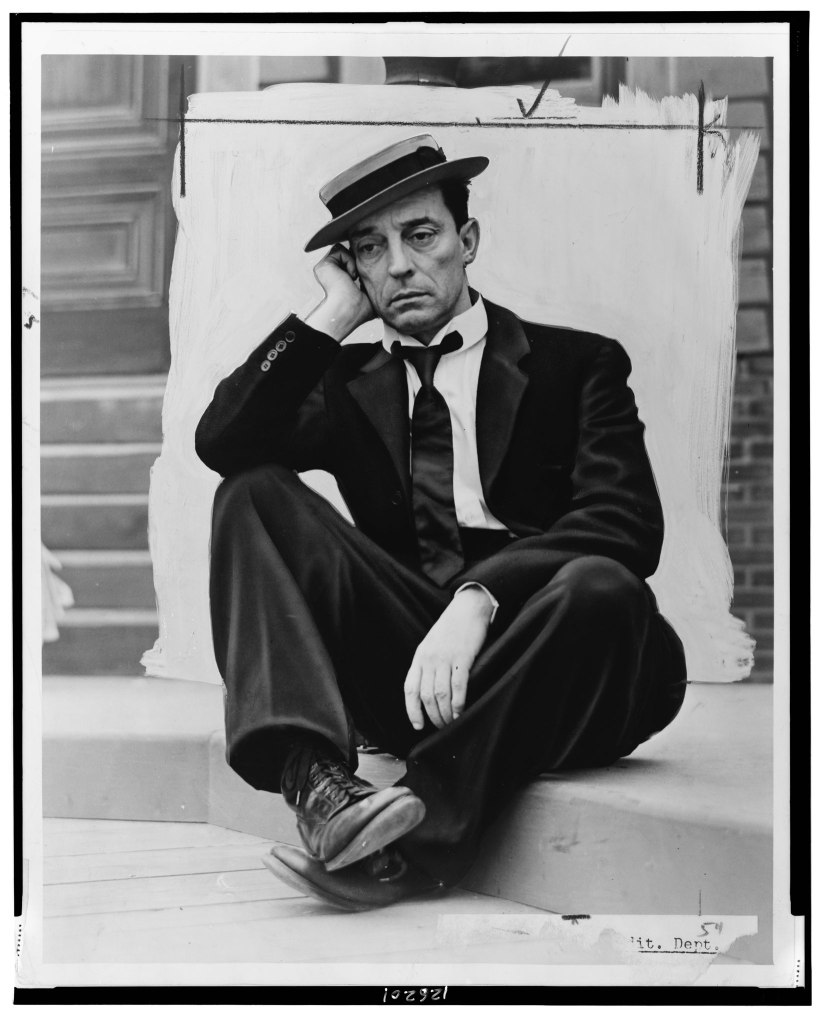
Buster Keaton (Library of Congress)

“After taking a couple of orange blossoms, a cocktail made of orange juice and gin, Virginia got sick. Most of the persons present testified later that she had started to tear off her clothes. She also complained of feeling ill. Roscoe had a couple of girls—one was the woman Virginia had arrived with—take her into the bedroom. He joined the three of them a little later and found Virginia in bed. Suspecting she might be faking he placed a bit of ice against her thigh. She failed to react, and he asked the women in the room to undress her and put her in the tub. When Virginia continued ill, Roscoe sent for the St. Francis’s house physician.

“Virginia was removed to a hospital where she died a few days later. According to her woman friend, she had kept moaning just before she died, “He hurt me. Roscoe hurt me.” It was largely on the basis of this statement that Roscoe was requested to come back to San Francisco for questioning by District Attorney Matthew Brady. He returned immediately, accompanied by Lou Anger and Frank Dominguez, an associate of Earl Rogers, California’s most famous criminal attorney.

“On September 12, a Coroner’s Jury returned a true bill against Arbuckle charging manslaughter. He was jailed, held without bail until he was arraigned that it was I who had first told Roscoe that ice held against a person’s thigh was the quickest way to discover whether they were faking illness.

“Mr. Dominguez talked us out of going to the trial. He said that there was bitter feeling in San Francisco even against him for taking a case that local people felt should have gone to one of their own lawyers. “They would resent you fellows even more,” he said, “and discount your evidence, feeling you were merely Arbuckle’s front men.”

“Meanwhile an unprecedented storm of hatred and bitterness was sweeping the country against Arbuckle. Before he even was tried his films were barred in many communities including New York City. Reform groups everywhere threatened to boycott any theatre which exhibited Roscoe’s movies. Churches of many denominations rocked with their preachers denunciations of the famous funny man. At a meeting of the League of Nations in Geneva, Switzerland, a Danish delegate, Mrs. Forchhammer, dragged Arbuckle’s name into a discussion of international white slavery.

“Adolph Zukor and other producers of Arbuckle films received such a flood of abusive and condemnatory mail from Roscoe’s former fans that they were frightened into promising that none of his pictures would ever be shown again. With all of this came persistent threats of national censorship. The studio heads, hoping to avoid that, decided to ask Will Hays, United States Postmaster General, to become czar of their industry and to censor themselves. They chose Hays, who had also been President Harding’s campaign manager, because he was the most influential politician in the United States.

“In all, there were three trials of Roscoe Arbuckle in San Francisco for manslaughter. The first two resulted in hung juries. In the third he was acquitted by a jury that said he deserved an apology from those who had wrecked his career with the baseless charge of contributing to the death of Virginia Rappe. Before his first trial started, he had returned to Los Angeles to await the start of court proceedings. With some other of his close friends, I went to meet him at the old Santa Fe Railroad Station in Los Angeles.

“So did a hate-frenzied mob of 1500 men and women who seemed to want only to get close enough to tear him to pieces. And they yelled at the fat man they had loved so much a few weeks before, “Murderer!” “Big, fat slob!” “Beast!” and “Degenerate bastard some in the crowd had come to cheer him, but they were drowned out in the din.

“Roscoe never got over that experience. He never could forget how those people had looked at him and cursed him, how it had been necessary for the police to rush to protect him from them. People everywhere in the world seemed to feel the same way about him as that mob. By then the letters of abuse and vilification were flooding in from every country in the world.

“However, there was one spot on earth where nobody hated Roscoe Arbuckle or thought he was guilty. That was Hollywood. the town so often pictured as turning on its own people whenever they get into trouble. What Hollywood did later on to encourage this bewildered, baby-faced fat man to stand on his feet and face the terrifying outside world might well be remembered, I think, by all of us.”

Buster Keaton with Charles Samuels, from the chapter “The Day the Laughter Stopped,” in My Wonderful World of Slapstick (Garden City, NY: Doubleday, 1960), pp. 156ff.

Rappe Brief #2

Naming Rights and the Surname “Rappe”

Greg Merritt, in Room 1219, was the first to publish Virginia Rappe’s correct birth date, July 7, 1891, based on a live birth recorded for one Mabel Rapp in Chicago. During the Arbuckle case and ever since, Virginia Rappe is given credit for changing her own name. In reality, it was her mother who changed the family name to Rappe.

A color facsimile of Mabel’s 1905 New York City death certificate clearly indicates the deceased’s surname as Rappé. The accent was probably inserted by the attending physician to indicate the preferred pronunciation—or how he heard it from Mabel’s survivors, Virginia Rappe and her putative grandmother, who also went by Virginia Rappe.

The death certificate has handwritten entries and when it was transcribed by the New York City Health Department, the typist interpreted the é as a lowercase, dotted letter i.

For this reason, such genealogical sites as Ancestry.com and FamilyResearch.com repeat the mistake, identifying the deceased as “Mabel Rappi.” This surname is very rare and required some more due diligence. We requested the source document, which also has more information about what killed Virginia Rappe’s mother when she and her family lived in Hell’s Kitchen between 1900 and 1905.

Rappe likely served as Mabel’s professional name as an entertainer and to obscure the notoriety “Mabel Rapp” had in Chicago and New York in 1899, when she was identified in many newspapers as the moll of a Chicago-based check forgery ring.

Bit Players #1: Helen Hansen

Helen Hansen

(This entry is the first in a series of briefs about peripheral though significant figures in the Rappe–Arbuckle case.)

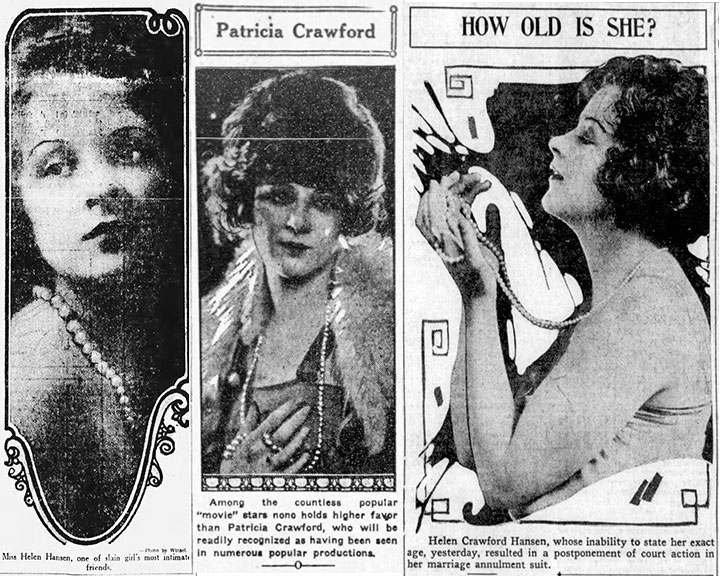
During the first week after Virginia Rappe’s death on September 9, 1921, members of the “film colony” in Hollywood—actors, actresses, directors, and the like—spoke out in support of Arbuckle. Mabel Normand said that her former Keystone costar was a gentleman and incapable of intentionally hurting a woman let alone kill her. For a short time, many film colonists also came out in support of Virginia Rappe, even though more than a few didn’t know her. Helen Hansen was an exception. She was called an “intimate friend” of Rappe. She lived only a few blocks away, on N. Oxford St., from Rappe’s house on N. Wilton St. in the Melrose neighborhood of Los Angeles. Hansen was said to be an actress. Some of the newspaper accounts of Hansen were accompanied by a publicity photograph of her wearing a long strand of artificial pearls. What she said about Rappe fed into the public’s image of Rappe as “Virginia, the Girl Victim,” as one headline read in the Los Angeles Record.

Hansen describe Rappe as a quiet, reserved young woman—presumably like herself—who didn’t go in for Hollywood parties, that is, the kind given by Roscoe Arbuckle and his companions. Her meaning was clear to the newspaper readers of the early 1920s—Rappe wouldn’t attend a gathering where she was expected to drink and engage in sex. Hansen said that Rappe showed little interest in other men. She remained loyal to comedy director Henry Lehrman and she was waiting for him to return from New York City. Hansen’s meaning was clear here as well: Rappe was keeping herself for the man she loved. Much of what Hansen said was anodyne and, perhaps, for that reason she goes unmentioned in previous texts about the Arbuckle case.

There is a takeaway from Helen Hansen that we think shouldn’t be overlooked though. But first, who is she? A filmgoer in the 1920s would have been hard pressed to think of a motion picture featuring Helen Hansen. None of the news stories in which she was quoted mentioned her being associated with any studio. One reason was that she withheld her screen name, Patricia Crawford, from reporters. While even that name likely meant little to the contemporary reader/filmgoer, it was apparent that Helen Hansen wanted to protect her brand, a name and image she had been gradually cultivating since her arrival in Hollywood just before 1920.

Her real name was Helen Grace Crawford. She was allegedly born in Scotland and lived with her parents in Vancouver, British Columbia, until 1918, when she, at the age of sixteen, married a telephone company clerk named Harold B. Hansen in Tacoma. Soon after, the couple moved to San Francisco, where she modeled clothes. Then Helen left Harold for Hollywood (as if inspired by headlines in fan magazines).

Camera!, a motion picture industry magazine, provided a clue to Hansen’s identity. A “Helen Hansen” was cast in a Dorothea Wolbert vehicle for Universal Pictures, Nearly a Lady (1920). Not long after this film was released in the autumn of 1920, a press release, undoubtedly written by Hansen’s press agent, identified her as the beautiful—and likely uncredited—Patricia Crawford who appeared in the finished two-reel comedy. Three other uncredited roles were also mentioned, as though she had been a supporting actress to Viola Dana in Cinderella’s Twin (1920), Anita Stewart in Sowing the Wind (1921), and Dorothy Phillips in Man–Woman–Marriage (1921). Such exaggeration shouldn’t cast doubt on the veracity of what Hansen said about Rappe. But we have to consider that she had abandoned her husband for Hollywood, didn’t correct reporters who called her “Miss Hansen” in their copy, and avoided mentioning her screen career.

Such problems are common when parsing the lives of actors from a hundred years ago and reconciling them with their real selves. That said, how was Helen Hansen irrefutably linked with the uncredited Patricia Crawford? In 1923, in a San Francisco courtroom, a Grace Crawford Hansen sought to have her marriage annulled from a Harold B. Hansen. That same year, a Patricia Crawford of Vancouver, B.C., married the actor Eddie Phillips. She was still married to him in the 1930 census, where her given name was Helen Phillips and her true age, thirty, which was certainly not rounded to the nearest 10.

And the “takeaway”? Helen Hansen told reporters that the publicity man, press agent, talent scout, and Rappe’s alleged “manager,” Al Semnacher, had asked Hansen to accompany him and Rappe on that long Labor Day weekend. Despite Rappe’s insistence that a friend and fellow actress come, Hansen ultimately refused to go. She told reporters that she had suffered a recent “break down.” Hansen said, too, that Rappe wouldn’t have gone alone with Semnacher, a married man in the midst of divorce proceedings. By Hansen’s estimation, Rappe only went along because Semnacher found a willing party in Maude Delmont.

At this writing, we can only ask questions. But the inclusion of Helen Hansen in the traveling party certainly could change the accepted notion that the trip was intended as nothing more than a day trip to Selma, California, which got extended by chance to include a visit to San Francisco. The fact that Al Semnacher paid for the lodging and meals of his traveling companions at a not inexpensive hotel suggests the purpose of the trip was business rather than pleasure or a mix of the two.

When the first Arbuckle trial opened in the third week of November 1921, another press release about Patricia Crawford appeared in small-town newspapers from Ohio to Mississippi to Kansas. It featured a photograph and no dots connect the person in the image to the Helen Hansen who spoke for Virginia Rappe, even though Crawford and Hansen are the same, as are the string of pearls they clutch.

The three faces of Helen: from left to right, Helen Hansen, Patricia Crawford, and Helen Crawford Hansen (Newspapers.com)

Although Hansen never appeared in any subsequent film as Patricia Crawford, she did take the stand for the prosecution at the second Arbuckle trial on January 23, 1922. If she said anything about Rappe wanting her to come to San Francisco, it wasn’t reported. She only stated that she had never seen Rappe ill, which, by the second trial, was the focal point. Indeed, Rappe’s health was on trial as much as Arbuckle was for fatally injuring her.

Rappe Brief #1

A Misfit Pair

The Wikipedia entry for Virginia Rappe suffers from inaccuracies but doesn’t take sides per se. What we have found out is that her traveling companion at Roscoe Arbuckle’s Labor Day party of September 5, 1921, Maude Delmont, is not the infamous figure, who “had a police record for extortion, prostitution and blackmail.” This assertion has been made over and over again without any evidence to support it. None was offered during the three Arbuckle trials and nothing was made of the fact that she was on a first-name basis with “Roscoe” and quite familiar with him as well as one of the doctors who treated Rappe and requested her autopsy. We are developing a more sympathetic picture of this woman.

This note, however, deals with another revision that should be less contentious: adding a final film to Virginia Rappe’s thin filmography.

Before it was considered indecent and unseemly to show the dead actress in American movie theaters, A Misfit Pair(1921) began its run during the week following her death on September 9. The one-reel comedy, made by a small production unit for Universal Pictures’ Century Comedies, was intended for a package called “Romance Week”—to compete with Paramount Week—and first mentioned in the June 3, 1921, issue of Universal Weekly.[1]

A Czech film scholar found a very brief synopsis that lacked a cast list. But the main gag was a grocery store clerk who, after a number of hijinks, finds himself trying to save a man dangling from a building and a man drowning in a pond at the same time. They are the “misfit pair” of the title as well as the clerk’s rival for the attentions of a young lady. But nothing is known about that episode in the comedy.

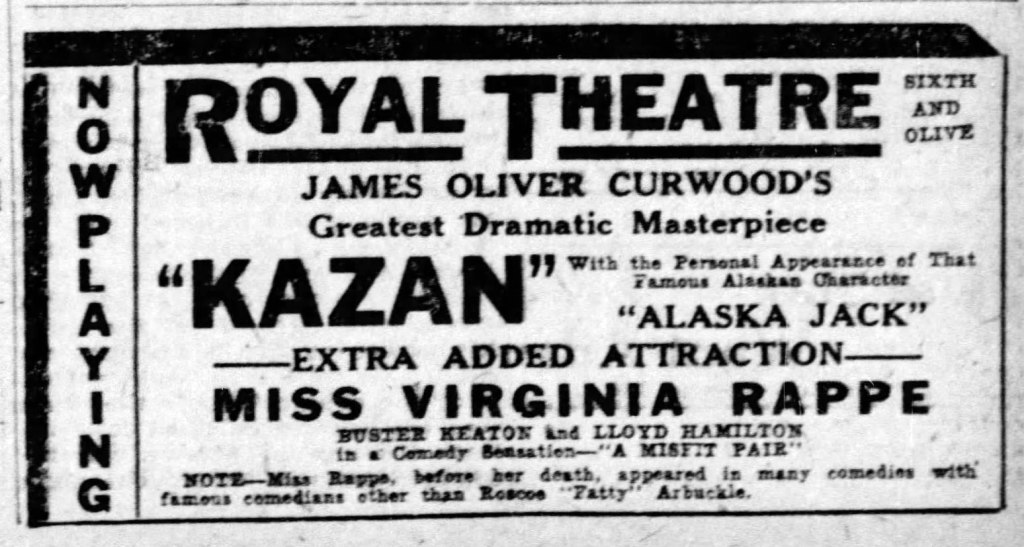
As it turned out, Rappe’s death and the charge of murder being brought against Arbuckle by Maude Delmont and San Francisco District Attorney Matthew Brady, offered theater managers the opportunity to fill seats with those curious to see Virginia Rappe on screen. Across a broad swath of the country’s midsection, from St. Louis to Salt Lake City, Rappe’s name appeared prominently in newspaper advertisements. In St. Louis, the Royal Theatre not only listed A Misfit Pair as an “Extra Added Attraction” starring Virginia Rappe, but added that Lloyd Hamilton, Rappe’s co-star in Henry Lehrman’s A Twilight Baby (1919), starred as well as —impossibly? in cameo?—Buster Keaton.[2]

Hamilton, undoubtedly, really was in this comedy. It was his vehicle and apparently funny enough to enjoy a revival in 1927. But why A Misfit Pair was never advertised as such in 1921 makes it curious. Hamilton was a prominent screen comedian— usually playing an oblivious type not far from what Arbuckle and Keaton covered but didn’t cost a $1 million a year. We can only guess that Hamilton wasn’t under contract with Universal and that it was side work.


A Virginia Rappe “exploitation” ad in the St. Louis Star and Times of September 18, 1921 (Newspapers.com)

Rappe’s part in A Misfit Pair was likely restricted to a few scenes that became, in 1921, a voyeuristic “glance” in a motion picture lasting no longer than a cartoon. Nevertheless, our curiosity goes in a different direction. We see, or better, triangulate another significance of this short—and lost—comedy’s existence. It is threefold. A Misfit Pair suggests (1) that Rappe wanted to be a “photoplayer” after several years of testing the waters, mostly under the aegis of her putative boyfriend, the comedy director, Henry Lehrman. It also (2) lends credence to the director Fred Fishback’s possible intercession in her career after Lehrman. He was head of Century Comedies and rumored to be working with Rappe in the earliest reportage in the Los Angeles Times on the day after her death. Lastly, it was Fishback who took advantage of the “accident” of Rappe’s presence in San Francisco on Labor Day morning. He telephoned her at the Palace Hotel, as she sat having breakfast in the Garden Court, a setting that still exists, to invite her to Arbuckle’s suite in the St. Francis Hotel. Fishback relied on “intelligence” (these scare quotes are necessary) from a friend, the gown salesman Ira Fortlouis. Both knew Rappe’s manager, Al Semnacher, who drove her and Delmont from Los Angeles to San Francisco.

The Garden Court of the Palace Hotel, San Francisco, ca. 1920 (Library of Congress)

We have read reportage in which District Attorney Brady suspected that Rappe had been lured to Arbuckle’s party with the promise of future film roles. But Brady and his assistants never built a case on those suspicions. In our book, we want to shine a light on the people and reasons that fed his suspicions and that one of these men, Fred Fishback, was in a position to help her career, as a fellow protégé of Henry Lehrman, and had already done so directly or indirectly.

Was the chance adventure to the St. Francis really part of an intended venture?


[1] “Your Universal Ready to Help You,” Universal Weekly, June 3, 1921, 8.

[2] “Movie Directory,” St. Louis Star and Times, 18 September 1921, B7.

Arbuckle Brief #1

Dorothy Wallace, the Spite Bride?

(Periodically, we will report about where we are in the manuscript or discuss research that deserves mention, especially when it forces a revision or judicious speculation in response to those made by previous writers on this subject.)

Our book is divided into four parts named for the major cities in Rappe’s life—Chicago, Los Angeles, and San Francisco—and an epilogue. Over the past week, while adding to the Los Angeles section, where the text moves from 1920 to Rappe’s final year, we briefly introduced a new name that is peripheral to her life but contributory to what lies in store or wait: Dorothy Wallace. Shortly before Arbuckle sailed for Europe in late November 1920, ostensively for a long-deserved vacation, an “eastern publication” allegedly published a rumor that Arbuckle intended to marry the young actress in New York. Supposedly, however, the marriage was called off due to a “quarrel.”

The rumor of an impending Arbuckle marriage came back to life upon his and Wallace’s return to Los Angeles just before the Christmas holiday. The woman in question was in her late twenties and her early life and career has some parallels to Virginia Rappe’s save that Wallace was from a wealthy San Francisco family. Wallace was said to be a globe trotter, having traveled with her parents all over the world. Once she met an Indian prince who fell violently in love with her. Her parents had to leave Istanbul to escape the “ardent attentions of Turkish royalty.” Like Rappe, Wallace was entrepreneurial, having owned a millinery shop in San Francisco. This she gave up to pursue a modeling career in New York City, including posing for a poster series by James Montgomery Flagg. The celebrated illustrator also picked her for a one-reel silent biopic, The Art Bug (1918), in which she played herself, a Greenwich Village art student.

In 1918, Wallace arrived in Los Angeles and began to appear in supporting roles alongside Gloria Swanson in The Secret Code (1918) and Olive Thomas in The Spite Bride (1919). Because of her performance alongside Dustin Farnum in A Man’s Fight (1919), she was publicized as the love interest in his next vehicle, The Harvest of Shame, playing a New York society girl. But the project was shelved and her debut as a leading lady went unrealized.


Dorothy Wallace as one of the “Girls You Should Know” of 1918 (Lantern)

Wallace, in 1919, allegedly owned a wardrobe variously valued at $10,000 and $500,000—which would rival that of established actresses—and was seemingly on the upswing of a promising career in motion pictures. Nevertheless, her name and the marriage rumor appear in no Arbuckle biography. The omission seems strange in that a biography is where falsehoods and factoids are dealt with along with establishing the the true person.

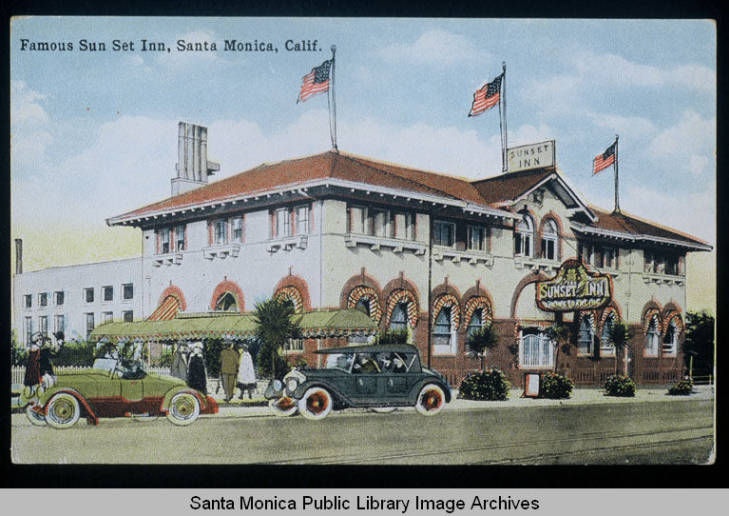
While there was no corresponding rumor to suggest Wallace set sail as well to Europe with Arbuckle in a shipboard reconciliation, which, like Pullman sleepers, was a common way of indulging in an assignation, the two surely met and socialized at the Sunset Inn overlooking the Santa Monica beach. Both were habitués as was Virginia Rappe, who won dance contests there.

The Sunset’s proximity to the studios on the west side of Hollywood as well as its distance made it a convenient gathering place for the film colony during the teens and twenties. Arbuckle, Buster Keaton, and their entourages often came to dine, drink, dance, and flirt.

The Sunset Inn, early 1920s (Calisphere)

The Wallace–Arbuckle rumor persisted in two newspapers, the Los Angeles Times and the Los Angeles Herald throughout December 1920. There was news of an engagement, of a broken engagement, of a quarrel, and even a New Year’s Eve engagement party. When Arbuckle’s manager Lou Anger denied the engagement party, he didn’t deny the engagement.

Minta Durfee, a native of Long Beach, California, undoubtedly found the rumor troubling, especially since her family read those newspapers. It took another month for a minor syndicated movie column to remind the public that such a marriage between Wallace and Arbuckle was “impossible” since he was still married to Durfee. Despite such reminders, Arbuckle, for his part, behaved like a bachelor all the more, an eligible bachelor.

The marriage rumor persisted until April 1921, where it appeared again in Motion Picture Magazine. While it would be easy to pass on such biographical chaff, we see it as possible evidence, to which we can add more, that Arbuckle was casting about for a new, younger, and prettier Mrs. Arbuckle for much 1920 and into 1921. (This is true even if Arbuckle was the victim of a joke.) Until the death of Virginia Rappe in September 1921, Minta Durfee had to know that sooner rather than later her husband would want a divorce that wouldn’t be as remunerative as their separation. Instead, the advantage went to her. Rather than serve her with papers, so to speak, Arbuckle’s lawyers ensured that Minta Durfee would appear prominently at his side when his courtroom ordeal began.

The winner of what may have been a long and ongoing beauty contest wasn’t Virginia Rappe, of course, but rather a young ingenue whom Arbuckle met aboard the SS Harvard when he sailed from San Francisco the day after Labor Day, 1920.

It was another chance meeting in San Francisco, too, like that between him and Rappe the day before.


J. Barney Sherry, Lois Wilson, Dustin Farnum, and Dorothy Wallace in A Man’s Fight (1919) (IMDb.com)

“Citizen” Hearst vs. Roscoe Arbuckle?

16 June 2021

This entry is for journalists researching feature articles to mark the centenary of the Arbuckle case. But it is also for , historians, cinéastes, and simply the curious who wish to survey any new discoveries on the subject. There is much that has emerged over the intervening years and much of that has gone unquestioned and unrevised with only a few exceptions in print and online. That in itself should pique the readers’ curiosity about what really happened or what could have in a way that departs from previous theories and speculation.

One myth we saw in researching this book is the role of the press in 1921. Did newspaper publishers and editors try to shape public opinion against Arbuckle? Transform him from lovable man-child screen comedian into a drunk and rapist? Body-shame away any doubt that his belly burst Virginia Rappe’s bladder and so cause her death? The basic scenario seemed to speak against him. The Labor Day party, the liquor, the married men inviting unmarried women to their rooms—and Arbuckle himself following Rappe into his bedroom and locking the door. When he opened it, a young actress was laying on his wet bed going in and out of shock and aware that she had been gravely injured.

Publishers and editors reflexively knew that, since Arbuckle was a screen comedian and a living caricature of himself, he should be presented as a figure of fun even in a murder case. They also knew that public sympathy flowed in Rappe’s direction as the victim of this other Arbuckle, this real Arbuckle. For a while, the press stuck to the narrative that Arbuckle was an out-of-control malfeasant, a sociopath (a word still uncommon in American criminology of the 1920s) and Rappe, the silenced innocent, would never experience a full life: getting married to her fiancé, being a mother, serving a slice of apple pie, never see her family, and never get her seat on the lifeboat. She was, almost as long as Arbuckle was figure of fun and immorality, this sentimental image that should bring tears to reader’ eyes. To more serious-minded women, feminists and those who fought for suffrage and prohibition, Rappe was a victim of that deadly combination of male violence against women and alcohol. Her death made for a test case.

Page A-4 of the Los Angeles Herald on September 12, 1921, as the Arbuckle case began to unfold in one Hearst newspaper. (California Digital Newspaper Collection)

Much has been made of the newspaper publisher William Randolph Hearst’s responsibility for “framing” Arbuckle as a murderer. The British crime historian, David Yallop, the author of The Day the Laughter Stopped: The True Story of Fatty Arbuckle(1976), is one if not the source for blaming Hearst for intentionally ruining Arbuckle’s flourishing film career in order to sell newspapers across his vast press empire.

The Hearst press adopted an attitude towards the Arbuckle case that was criminally irresponsible. Feature articles, news stories and editorials in Hearst’s newspapers had but one aim: to boost circulation. In the event, the policy was successful beyond Hearst’s wildest dreams. [. . .] His ruthlessness in boosting circulation was to have a significant effect on Arbuckle’s fate, so it is worth pausing here to describe the man behind the press.

Yallop’s obsessive allusions to the film Citizen Kane (1941) suggest he was more intent on shoring up Orson Wells’ fictional version of Hearst and grinding his ax in a book that was long accepted as a definitive account when under close scrutiny appears to be more and more a work of fiction, an often titillating tale, a book expected to be a bestseller among movie-mad readers. If Yallop’s estate should ever release his alleged though never-revealed primary documents, such as the original trial transcripts and taped and transcribed interviews with people who knew every record spun on the phonograph that blared during Arbuckle’s Labor Day party, we might never question this sensational account again. That said, the Hearst theory in Yallop is only one example that just seems to be, well, Fleet Street, tabloid fare. A deliberate spin to create a sinister portrait of those who stood to gain from Arbuckle’s downfall.

In our research, a cursory look at the headlines and reportage in the Hearst chain’s flagship San Francisco Examiner, the Los Angeles Herald, and the Washington Times reveals that the Hearst newsrooms had their own comedians, so to speak, who didn’t follow any directive or template issued by their publisher. What stands out is how mercilessly they made fun of Arbuckle’s woes during the first week after Rappe’s death, as though he had made the ultimate stage fall, as though their readers might not apprehend this were it not a tragedy that a woman died and a beloved screen comedian had seemingly brought himself so low. The Times, for example, had a field day with the assumption that the obese actor’s weight was the likely cause of Rappe’s death, and reprinted a heretofore innocent publicity photograph of Arbuckle. The image was of the comedian, dressed in a white shirt, trousers, and shoes, sprawled with bottle in hand under the caption “How ‘Fatty’ Looks on Morning After the Wild Night Before.”

The journalistic slapstick had its day and if the Hearst papers can be faulted for anything, their newsrooms excelled. What made it problematic for Arbuckle and those who set out to rehabilitate him was the amount of ink and flattering photographs that elicited sympathy for Virginia Rappe. We see this coverage as more compelling, for it acknowledged women both as substantial segment of the readership and as a political force to be reckoned with, having recently won two significant legislative victories: prohibition of alcohol sales, for reasons including male violence against women, and the women’s right to vote, both ratified in 1920. Rappe was almost a martyr in this respect. (Her presence in San Francisco a year earlier, during the climactic final days of the Democratic Convention of 1920, placed her at the epicenter for the last great demonstration for the ratification of the 19th Amendment. We have many thoughts about this in the work-in-progress.)

Gradually, in the first week after Rappe’s death, the tone of the press coverage sobered as Arbuckle’s journey through the justice system began. First, Arbuckle’s legal team began giving press conferences and taking reporters aside, reminding the public that their client, regardless of his stature or what his conduct looked like, was “innocent until proven guilty.” Such damage control had the effect of blunting the sympathy for the “poor girl.” Then, Rappe’s liminal presence was eclipsed as Arbuckle’s estranged wife, Minta Durfee, quickly inserted herself. (Despite having lived years apart, Durfee had been capitalizing on his name, branding herself as Roscoe Arbuckle’s wife” in her solo career and screen comeback., so justice for Rappe was an existential threat.)

The Hearst papers took notice of her early on and did so with as much respect for her station as that given to the victim. The first big headlines devoted to the Arbuckle case in the Washington Times devoted its largest typeface to read “ARBUCKLE’S WIFE RUSHES TO AID.”[1] And, as she made her way West, the tenor of the coverage began to change, as did the quality of the reporting. The Examiner assigned Oscar H. Fernbach, its criminal case correspondent at San Francisco’s Hall of Justice. The Chronicle put its most prominent female reporter on the case, Marjorie C. Driscoll. The national press featured such bylined reporters as M. D. Tracy of the United Press and Frieda Blum of the Universal Service. They among others began to turn out stories that were balanced, inquiring, objective, and factual whenever possible.

If Arbuckle was “framed,” it would have been only in the initial days when competing newspapers rushed to create narratives. As conflicting details surfaced many readers quickly switched sides, even among the women who crowded the pretrial court proceedings where San Francisco District Attorney Matthew Brady was forced to reduce a first-degree murder charge to manslaughter. That these men doggedly prosecuted Arbuckle for months with no real chance of a conviction is one of the most curious aspects of the Arbuckle case given that victim, with no aggrieved family pressing the case, was now a ghost fading from view, virtually forgotten. Was Brady’s pursuit of the case politically motivated or was it a more personal crusade, an orphic quest?

The Hearst chain as well as other newspapers took a few last jabs at Arbuckle when, at last, his conduct wasn’t the source of any amusement. During a pretrial investigatory proceeding in the Women’s Court* in late September 1921, Rappe’s manager was compelled by a judge to repeat a story that Arbuckle told his male friends the day after her crisis in his bedroom. The comedian made a joke of inserting a piece of ice into her vagina. (After this revelation, Arbuckle’s chief consul, the Los Angeles-based criminal defense lawyer, Frank Dominguez, said that inserting ice in this manner was a tried-and-true method of bringing an unresponsive female back to consciousness.) Ironically, however, the moral outrage of such an act didn’t have the impact the prosecution hoped for. A judge decided that Arbuckle could only be tried for manslaughter, not murder. And the women who crowded the courtroom to hear the witnesses’ accusations and hopefully see Arbuckle himself take the stand? After Arbuckle paid his bail, he and Minta Durfee were mobbed by well-wishers and most were women. Crowds of women even met the comedian at the train station when he, his lawyers, and Durfee left for Los Angeles.

Because Hearst had his own upstart studio, Cosmopolitan Productions, in partnership with Adolph Zukor and Paramount, he had no apparent reason to personally demonize Arbuckle and the motion picture industry. There is also little evidence to support the notion that Hearst had a vendetta against Hollywood for the treatment of his mistress, Marion Davies who not only wasn’t an opera singer as portrayed in Citizen Kane, but proved to be a capable comic actor. Hearst was grooming her for a career that would require goodwill from the studio moguls. That Arbuckle later directed her in a film shouldn’t be seen as an anomaly.

Indeed, all the newspapers at the time piled on the Arbuckle case and Hearst hardly led the charge. At least there is no extant evidence of that, no memos, no memoirs in which Hearst discusses any intentions toward Arbuckle or his employers. That kind of direction from the top was more in keeping with Hearst’s focus on bigger issues such as the danger a revived Ku Klux Klan posed for the nation. Arbuckle was only a diversion, a clown, albeit a sad and rich one who was not too big to fall.

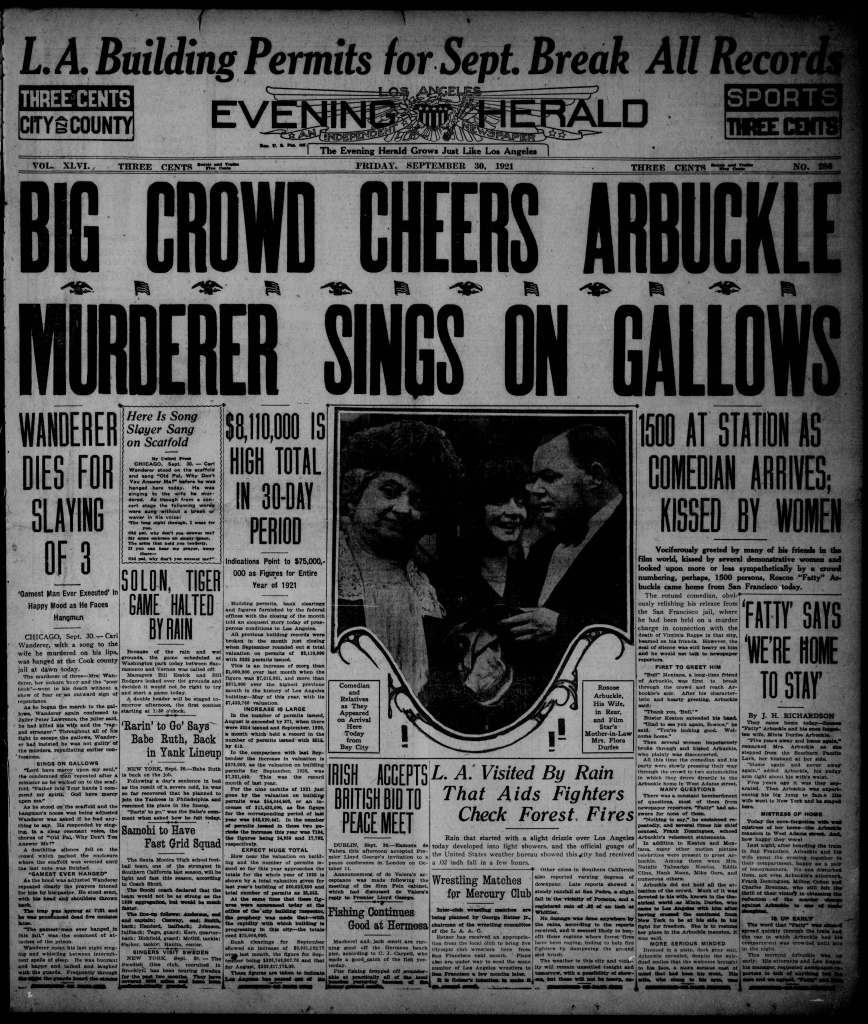
The front page of the Los Angeles Evening Herald after Arbuckle escaped the initial charge of first-degree murder. By the end of September 1921, Arbuckle began to enjoy some good press, even across the Hearst chain. He is shown with his estranged wife Minta Durfee and her mother. Notice, however, the juxtaposition of lower headline, which refers to another story. One last jab? (California Digital Newspaper Collection)

*A special women’s venue of the Police Court that restricted the number of men, especially when female witnesses were being called and when the crime had involved a woman as perpetrator or victim.


[1] See Washington Times, 12 September 1921, 1.


Introduction

2 June 2021

This blog is a work-in-progress about a work-in-progress: a reconsideration of the Roscoe “Fatty” Arbuckle case and its principals, Virginia Rappe and Arbuckle himself, and what took place at a Labor Day party in San Francisco on September 5, 1921 in the St. Francis Hotel. The book we propose is provisionally titled Spite Work: The Trials of Fatty Arbuckle and Virginia Rappe. “Spite” for what may have been the motivation of one or more individuals and “trials” because more than just one person was judged. Indeed, both the dead actress and the living comedian were on trial for their lives—and still on trial after the San Francisco courtroom drama took place a century ago. In acquitting Arbuckle of manslaughter with the spectre of a murder charge in the background, Virginia Rappe had to be misrepresented in court such that the victim was a victim of herself, of her own body, of her imperfections. One need only go, like a middle school student, to the Wikipedia entry for Virginia Rappe for a briefing on the litany of mistakes that have come to represent her, beginning with the year of her birth.


A photograph of Virginia Rappe taken on the set of The Punch of the Irish (1920).
The “Dead” stamp doesn’t refer to the deceased but to the news story no longer being current.
Note the curious typographical error or Freudian slip of “whose” in the body copy.  

Rappe’s life story will receive an overdue remediation if not rehabilitation. We wanted to know the person who died on September 9, why she had no family, why thousands who never knew her came to see her buried, as well as Mildred Harris, the estranged wife of Charlie Chaplin, who provided the gown Rappe was buried in. Conversely, we don’t believe Arbuckle was a criminal or sociopath. Nor do we believe he was framed and entirely innocent, at the least his acquiescence to the defamation of Rappe’s character during his trials while pragmatic was morally craven. After all, he knew her. He knew her well.

Though Arbuckle was considered one of the two leading comedian–directors of the silent era in 1921, Chaplin being the other,  he was still an employee and a valued brand of Paramount Pictures and its uncompromising chief, Adolph Zukor. Millions of dollars were at stake, and in an era when the film industry was feeling an encroaching threat of censorship. Indeed, the Arbuckle case proved to be the catalyst for the so-called “Hays office” and Motion Picture Production Code. He was too big to fall and yet he still fell. There was no justice for Rappe in that, just further infamy.

That feature of the Arbuckle case first attracted one of us in the late 1970s after discovering Kenneth Anger’s Hollywood Babylon in the library of a college friend. In that notorious book, there is one of the first, and most salacious, attempts to tell the story of what happened in room 1219 of the St. Francis Hotel. It gives ink to such myths as Rappe being penetrated with a Coca-Cola bottle and the trashed hotel room photograph, erroneously said to be the scene of the crime, that continues to be re-used as a shorthand emblem of the scandal. Nevertheless, Anger imparts the pathos of the story, that something unfair happened to Rappe. If nothing else, the man who made Scorpio Rising, by his sloppy research, presented us with the orphic challenge of bringing the dead actress to the surface to give her due The book will also serve to illuminate how history is often written, when facts are missing and unreliable witnesses (and authors) have been used as principal sources.

Coming from the vantage point of Rappe, from her victimology, allowed us to wade through the reams of Arbuckliana that is factual, factoidal, and fabricated in the tradition of Clifford Irving’s fictional “autobiography” of Howard Hughes. We saw problems in reporting, much of it due to a lack of proper legwork, even when there is some intellectual honesty. When confronted by the learning and research curve in writing about the Arbuckle case, with such challenges as the make-believe of Hollywood that permeates its real lives, the passage of time, hostile witnesses, missing court transcripts, the journalism that was lost until the invention of OCR technology, and the many voids in documentation, we found that the most often cited authors seem to have made up facts rather than be stymied by a gap in their narratives. Their self-interest rivals that of the many reluctant witnesses who testified against Arbuckle, knowing that their careers, too, were on the line. And then there are those writers who simply accepted the fixed narratives and agendas set by their predecessors, that Rappe was a diseased tramp, Delmont was a swindler, and Arbuckle was robbed of his career.

Arbuckle was a gifted physical comedian and the talented director of many wonderful comedies but it’s important that the artist and the real person are recognized as discrete entities. Nevertheless, the well-intentioned efforts of others to restore his name and reputation have been invariably made at the expense of a woman, who in the kindest versions is dismissed as a “bit player” in a handful of mediocre silent movies. Nor was Rappe a vector of sexually transmitted disease and promiscuous as declared by Arbuckle’s first wife, Minta Durfee, who seems to have set that persona in cement in interviews with authors conducted decades later. Nor should Rappe be seen as an accessory to an extortion ring. Nor should she be reduced to a female bladder in a specimen jar.

We shall undo many of these received notions, including the one that would seem the least likely to be challenged, that she was just another ambitious young woman struggling to make it in Hollywood. Virginia Rappe emerges here as a person of interest in her own right, no longer lost in an echo chamber of libelous claims passed down as facts..

Another irony to consider is that in unearthing what is known about Virginia Rappe, she would have been not unlike the reluctant witnesses who testified in the trials. By nature, she wouldn’t have faulted Arbuckle in court but rather addressed him in person, as a personal matter between two friends. If Rappe had been deposed, she likely would have abided by the kind of omertà observed by the other witnesses who attended the Labor Day party. Despite the constant pain, Rappe wasn’t seeking vengeance against Arbuckle, instead her expectations were little more than a show of sympathy from him and that he pay her modest hospital bill of $60—an incredible bargain given what Arbuckle later incurred  in legal fees and the enormous setback to his career in a peculiar form of American excommunication or shunning that we see now in the so-called “cancel culture.”

Books that see “Fatty framed” and the like often interweave the text with an early specious biography of Arbuckle where Rappe is presented as a femme fatale, a “juvenile vamp” as she was once called, who picks Arbuckle’s bedroom as a place to die. We don’t believe Rappe’s presence at the St. Francis Hotel was a coincidence but rather closer to matchmaking, even an assignation. Arbuckle was shopping for the next Mrs. Arbuckle even before he had asked his estranged wife for a divorce.

The Labor Day incident should be seen as a personal tragedy and that is the real reason for not making this revisionary view of the Arbuckle case simply about him. We understand that what happened behind closed doors can only be conjectured. But something did happen to Rappe in that room that had the traumatic force of a motorcycle accident. Because of Arbuckle’s silence on possible causes one cannot disregard the possibility that he was involved somehow. We also recognize that Rappe was not quite the “healthy, normal girl” portrayed by Arbuckle’s prosecutors. She was an analysand, not the Freudian or Jungian kind, but rather by a “metaphysician,” a term still used by holistic life coaches and the like.

Rappe and Arbuckle were tête-à-tête during the first hour of the Labor Day party, inseparable. If we reconsider where that rapport came from, we can begin to see something other and larger than what a jury turned into a nonevent with Arbuckle’s acquittal coming in three minutes. We also see why the prosecutors spent so much time and effort on a hopeless case, an exercise in vanity or . . . spite. The facts don’t support the long-held belief that District Attorney Matthew Brady was angling to become the next Democratic governor of the state of California—given that Arbuckle’s lawyer Gavin McNab was known as a kingmaker in the state and was opposing Brady in the most high profile case of their careers. Brady’s idea of ambition was along the lines of undoing the miscarriage of justice in the case of labor activist Tom Mooney. Brady perhaps saw the outrage of Arbuckle’s Labor Day party and the expensive legal counsel to defend him to be in the same league as the fraudulent conviction of Mooney who was  serving a life sentence in San Quentin State Prison.

Brady also surely apprehended that Arbuckle’s Labor Day party was important to women after they had earned the right to vote. The militancy of the Suffragist Movement was being channeled into the criminal justice system—and the women who attended Arbuckle’s party and testified gave it a certain democracy. They sat at the same table and spoke familiarly and informally to Arbuckle. They included a former Mack Sennett bathing beauty; a San Francisco nightclub entertainer and single mother; a bigamous mule trader’s wife who was intimate with A-list Hollywood actresses; Virginia Rappe, of course, with as many films to her credit as could be counted on one hand; and her companion, Maude Delmont, an erstwhile couturier now selling ads for  a farm labor journal. Delmont signed the murder complaint against Arbuckle and was considered Rappe’s “Avenger.” As with Rappe, much of what has been previously written about Delmont—that she was an extortionist, a divorce correspondent, a groomer of white slaves—is also a myth that has lingered for a century.

This “democracy” in our book makes Arbuckle less a central figure and, at times, peripheral. Nevertheless, he is a presence and we mark his progress the way one might revisit the iceberg approaching the Titanic. (The Arbuckle case, incidentally, does have an encounter with ice.)