After three days of testimony, including the only time that Maude Delmont took the stand, San Francisco Coroner T. B. W. Leland instructed eight jurors to render a verdict. Doctors who treated Rappe or conducted the autopsy performed on her body testified as did eyewitnesses who attended Roscoe Arbuckle’s Labor Day party.
On the afternoon of September 14, 1921, the jury deliberated for hours and issued the following verdict.
We find that the said Virginia Rappe, female, white, aged about 25 years, single, residence Los Angeles, Cal., nativity unknown, occupation unknown, came to her death on September 9, 1921, at the Wakefield Sanatorium, from rupture of the bladder, contributory cause, acute peritonitis.
And we further find that said Virginia Rappe came to her death from peritonitis caused by a rupture of the urinary bladder. Said rupture was caused by the application of some force which, from the evidence submitted, we believe was applied by one Roscoe Arbuckle. We, the undersigned jurors, therefore charge said Roscoe Arbuckle with the crime of manslaughter.
We, the jury, recommend that the district attorney of San Francisco in conjunction with the grand jury, the chief of police, and the federal probation officials, take steps to prevent the recurrence of affairs similar to the one in which this young woman lost her life, so that San Francisco shall not be made the rendezvous of the debauchee and gangster.
Colbert Coldwell
A. T. Hunter
Eugene Simmons
R. J. Goff
W. Garner Smith
James Ging
W. E. MacPherson
Roscoe Arbuckle sharing some make-up with Lila Lee, 1921 (Library of Congress)
An eighth juror, Ben Boas, a bond broker, provided a minority verdict that agreed with his fellow jurors on all points save that “from the evidence submitted I am unable to determine who was responsible for the application of said force.” Eventually, his minority opinion would become the majority in subsequent venues of the Arbuckle case.
Source: “Manslaughter Charged against Arbuckle by Coroner’s Jury,” San Francisco Examiner, 15 September 1921, 1.
[The following is taken from our work-in-progress, in which we describe the testimony at the second session of the Coroner’s Court, conducted by San Francisco County Coroner T. B. W. Leland before an all-male jury. Following her appearance, her importance to the prosecution of Arbuckle quickly faded. Nevertheless, District Attorney Matthew Brady kept open the possibility that she might appear in court again as late as March 1922, during the third Arbuckle trial.
We have various theories about why Delmont wasn’t put on the stand again at any subsequent venue related to the Arbuckle case. One of these is that much of what she stated behind closed doors and even in the Coroner’s Court was “unprintable.” It is usually assumed that her account of events differed so greatly from others’ statements that it was deemed unreliable and too much of a risk to the prosecution.
When the defense had an opportunity to call her to the stand, they refused. Of course, the risk of her describing the real nature of Arbuckle’s party may have been the cause. By having his Labor Day party in a hotel suite, Arbuckle may have thought he’d found a loophole in a Hollywood maxim cited in Evelyn Waugh’s The Loved One, to wit, “never do before the camera what you would not do at home and never do at home what you would not do before the camera.”]
Still dressed in black, Maude Delmont was again aided by a policewoman who, beside her, made Delmont appear taller. Delmont looked tense, fragile, ten years older than her real age (late thirties), and hardly what one would imagine of a flinty, hard-drinking daughter of a frontier dentist. The corners of her mouth drooped, her dark hair showed strands of gray. Kinder reporters saw her crow’s feet as “lines of sorrow” that suggested an “intimacy of years” spent with Rappe. The intimacy was quickly revealed to be less than a week. “But friendship,” Delmont said, “cannot be reckoned by the clock. The moment I met Virginia I felt there was a real bond between us. We were together every minute almost after we met, and it seems to us now as though I’d always known and loved her.”[1]
Delmont faced a packed courtroom, including Arbuckle sitting between two policemen and wearing a new blue Norfolk jacket with a pair of knickerbocker trousers. His bloodshot eyes were fixed on Delmont while he squeezed and twisted his green golf cap in his fists and leaned forward in his chair just behind the railing that separated him from the defense counsel’s table. At times he yawned, either tired or bored, and said nothing to his lawyers
After identifying herself and where she lived, Delmont drank deeply from a glass of cold water. She put the glass down, asked for warm water, and the inquest was held up while a coffee cupful was brought to her. As though by rote, with lines almost certainly rehearsed beforehand, Delmont repeated much of the same story she had told in her original statement, as it appeared in the press albeit with changes that were hardly negligible, which got the attention of everyone at the defense table.
With trembling hands, Delmont took sip after sip of warm water so as not to lose her voice or composure. She described everything in “minutest detail” from the trip to Selma to the Palace Hotel breakfast, where a bellhop handed Rappe a note inviting her to Arbuckle’s suite at the St. Francis Hotel. Delmont said the note read, “Come on up and say hello.” It bore Arbuckle’s signature.
Delmont made no mention of Fred Fishback or Ira Fortlouis playing any role in the invitation. Instead, she went on to the Labor Day party and once more reporters were forced to censor themselves rather and give only the gist. Instead of being forced into room 1219, Delmont no longer would say that Arbuckle had dragged Rappe by the wrist. Nor did she repeat that he had always wanted Rappe since 1916. Delmont made it seem as though Rappe entered that room of her own free will to use its bathroom. Then Arbuckle immediately followed Rappe. When she came out of the bathroom, Delmont saw them talk for a moment in the middle of the bedroom. “I can’t say if he went into the bathroom with her,” she said at one point. I guess he dragged her in.” But this last statement was not allowed to stand. Delmont, however, said she saw Arbuckle walk past Miss Rappe and close the connecting doors between 1220, the parlour room, and his bedroom. When a juror asked Delmont if she had verbally objected to when Arbuckle locked the door on himself and Rappe, Delmont said no.
Fifteen minutes passed before Delmont began to worry about Rappe. “I didn’t see why Virginia would not come out,” Delmont said. “I didn’t think it was nice for her to be in there with Mr. Arbuckle.”
Other accounts of the same testimony suggested that Delmont was alerted to something wrong not by Rappe’s silence but by her scream at one point.
“What was the nature of the scream,” Leland asked.
“As a woman in agony,” replied Delmont.
There was no response from inside room 1219 as Delmont tried to get Rappe’s attention. “Then I became angry,” Delmont said, “and I kicked ten or twelve times on the door of the room, but there wasn’t a sound.” After more time passed, Delmont called the desk. Harry Boyle took the call and came up at once and his presence in room 1220 prompted Arbuckle to open the door of 1219.
Touched-up and discarded photograph of Maude Delmont, September 13, 1921 (Calisphere)
Delmont continued, describing what happened after she, Zey Prevost, and Alice Blake entered Arbuckle’s bedroom up until Rappe was carried out. Throughout her testimony, however, Dr. Leland could hear that Delmont had changed her original story. Perhaps getting looks from Arbuckle’s lawyers, Dr. Leland interrupted Delmont and lectured her on the significance of her testimony as a complaining witness.
“I am here to tell just the truth,” she protested. Nevertheless, Leland warned the witness to “consider her statements well.”
“Maybe I am leading you,” he continued, attempting to tease additional details from Delmont, whom he presumed to be fatigued from a night of Grand Jury testimony.
“Sometimes people go to sleep and just say yes,” Leland said.
“I’m not asleep,” Delmont replied and candidly added, “for I had a little hypodermic before I came here, and I am all right.”
Observers took her to mean an injection of morphine, of which dry mouth is a tell-tale side effect. Her drinking, too, raised eyebrows and made for the logical impression that she was an alcoholic—morphine being a temporary palliative for the side effects of alcohol abuse, including delirium tremens. Delmont admitted to drinking on the way up from Los Angeles to San Francisco—six whiskies while in Selma alone.
Dr. Leland asked about her prodigious capacity on Labor Day afternoon. Delmont admitted to drinking “eight or ten drinks of Scotch whisky.”
“Were you beginning to feel the effect of the drinks?” Leland asked.
“Undoubtedly,” Delmont answered. She had been dancing, as well, and getting very hot in her black dress. “So I asked Mr. Sherman if he would mind if I slipped on some pajamas and he said, ‘No, certainly not’ and he took me into his room, got a suit of his pajamas from a dresser drawer and went out while I put them on.”
Dr. Leland asked Delmont about what Rappe and Arbuckle had to drink. Rappe may have had two or three drinks, both gin and orange juice. Rappe, said Delmont, was more interested in dancing and having a good time. Leland pressed on, asking if it were possible that Rappe had been drinking before Delmont had been allowed to join the Labor Day party.
“She was there only five minutes,” Delmont said in disbelief, “and common sense will tell you that she couldn’t have had many.”
[1] The following passage is adapted from “Woman Witness Tells Why She Is Actor’s Nemesis,” Oakland Tribune, 13 September 1921, 2; United Press, “Arbuckle Sees Ray of Hope,” [Long Beach] Daily Telegram, 13 September 1921, 1; “Sensational Details of Party Told at Virginia Rappe Inquest,” San Francisco Chronicle, 14 September 1921, 7; and Robert H. Willson, “Stories Told Coroner Jury Conflicting,” San Francisco Examiner, 14 September 1921, 4; and A.P. Night Wire, “Proceedings of the Day,” Los Angeles Times, 14 September 1921, 1, 2.
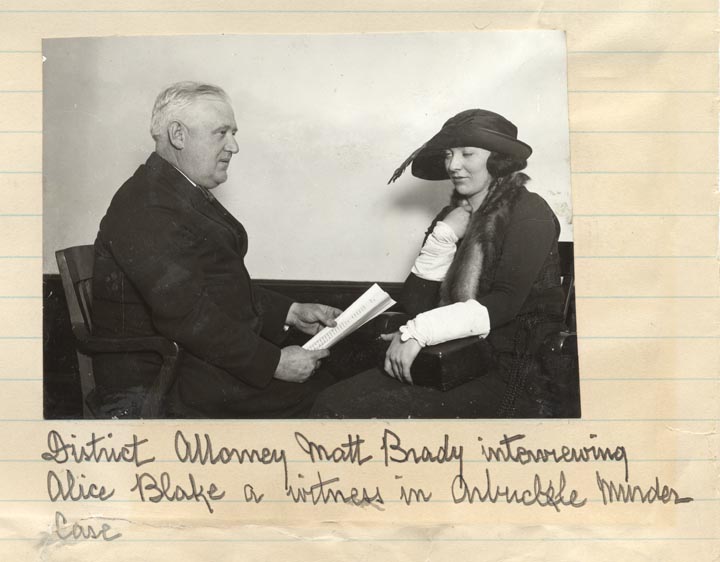
Given that Arbuckle was the highest paid actor in 1921 and made millions more for hundreds of theater owners and others, District Attorney Matthew Brady grasped the magnitude of the case and his greatest fear was witness tampering. He knew that, as Roscoe Arbuckle waited for the Oakland Ferry for the last stretch of their trip, his lawyer Frank Dominguez had made a telephone call to the police, assuring that Arbuckle would turn himself in. But he suspected another call was made, to Arbuckle’s new lawyer in San Francisco, Charles Brennan, to learn of any developments that they would need to get ahead of.
What has gone under-appreciated in the early days of the Arbuckle case, indeed, in the hours after Rappe died on September 9, is how quickly Arbuckle responded to the possibility of his arrest and the accusation of murder against him. By midnight, a strategy meeting convened in the office of Sid Grauman’s Million Dollar Theater, attended by two lawyers, a friendly journalist from the Los Angeles Times as well as three men who attended the ill-fated party.
In the annals of crisis communications, what was accomplished for Arbuckle could be the first modern example.
One aspect of this was to neutralize the witnesses who might inflict the most damage to the defense by making them aware of the risk–reward of doing so.
For an aspiring entertainer, Zey Prevost was just such a person. She had made a statement to police on Saturday, September 10, the day Arbuckle and his team spent driving from Los Angeles to San Francisco. Two days later, on the day the Grand Jury was to meet, she asked to change her story and remove any testimony that could be used to make Arbuckle responsible for the injury that led to Virginia Rappe’s death. Later, she testified in another venue that she had been approached by another of Arbuckle’s lawyers, Charles Brennan, on Market Street in San Francisco.
Q: What did Mr. Brennan say to you?
A: Just asked me if I had a lawyer—if I needed a lawyer, to tell him. I said “Sure.”
Q: Did he ask you anything further about remaining in town, or going out?
A: He asked me about staying in town. I said “I may stay in town a few days until this thing is over.”[1]
This was all she said of her conversation with Brennan. But she went away from it committed to undermining Brady’s case against Arbuckle before it even got off the ground. Only a threat of perjury and jail time convinced her to keep to her original statement. In any event, the defense, over time, was able to convince jury members to vote for acquittal in part because Brady allegedly coerced his witnesses to say what he wanted to hear.
If Prevost was somehow rewarded for her loyalty, it didn’t amount to much. She was signed as a vaudeville act a few weeks after the third trial. But that was short-lived and her career as a comedienne was soon over.
Alice Blake, a friend of Zey Prevost, was also seen as a “coerced” witness (Calisphere)
Sunday, September 11, 1921, was a day of preparing for the next evening’s Grand Jury session. The preparation and ongoing investigations were overseen by Duncan Matheson, San Francisco’s long-serving Captain of Detectives. Unlike his subordinates, he was cast from a different mold and hardly the Irish American stereotype of Dashiell Hammett’s novels.
Born in 1865 in Nova Scotia, Matheson was of Scottish ancestry. As a young man, he emigrated to the United States and began working as laborer for the Southern Pacific Railroad. By 1900, he had married and was roadmaster for the Mojave District and in charge of track maintenance through the California desert. Then, in 1901, Matheson joined the San Francisco Police Department at the relatively advanced age of thirty-six and began working as a patrolman along the Mission Street wharves, where he was feared for the way he would swing a nightstick in breaking up fights and the like. His exploits were often newsworthy, including a time he crashed through a skylight while jumping from one building to another in pursuit of a gang of juveniles.
Over the first decade of the new century, Matheson became a real-life Untouchable—his resemblance to Sean Connery’s Frank Malone, is striking—rising in rank from sergeant to lieutenant by 1911. That year Matheson was put in charge of policing Chinatown, where he had been given the task of curbing its illegal gambling, lotteries, narcotics, and notorious tongs (gangs). Perhaps because the “Chinese were more afraid of him” than they were of the police chief, Matheson was promoted to Chief of Detectives by 1916.
Matheson gained notoriety for his role in the investigation that led to the arrest and conviction of the radical labor activist Tom Mooney for the Preparedness Day Bombing of July 22, 1916, along San Francisco’s Market Street. American socialists organized numerous protest rallies across the country in support of Mooney and Matheson is still recognized in historical accounts for the part he played in allegedly framing him.
One can imagine Matheson seeing himself as cut from the same cloth as the cowboys and others who settled the west. He was a skilled horseman, sometimes saddling up to lead a posse into the hill country around San Francisco in search of a suspect. And as the father of a teenage daughter, was protective and sympathetic to issues that would impact her as the 1910s came to a close and women’s suffrage and Prohibition loomed.
Duncan Matheson, S.F. Captain of Detectives (Calisphere)
A nondrinker and public speaker, Matheson once spoke before the Women’s Christian Temperance Union (WCTU) about how he intended to enforce the new Volstead Act. He spoke to the Housewives League on the need to protect girls and young women—from themselves, for, as he noted, seventy percent of all the juvenile cases he handled involved girls who had gone “bad.” In early 1921, when the state tried to reduce funding for the State Home for Delinquent Women, Matheson spoke against the defunding given the rise in girls and young women involved in criminal activities.
As much as Matheson took a grim view of radicals setting off bombs in his city, he also shut down at least two high-profile abortionists, Dr. Ephram Northcott in 1919 for the botched abortion and death of an army nurse, and the infamous Dr. Galen Hickok in 1920, whose victims remains were buried on the grounds of his so-called “castle of mystery” overlooking Salada Beach. In October 1920, Matheson and his detectives investigated the murder of a so-called “nightlife habitué” and prostitute Ruby Allen. She had checked into the Knickerbocker Hotel and was later found dead, bound and gagged, the victim of an apparent robbery by one of her johns. Although Matheson claimed he knew who the killer was, no one was brought to trial.
Matheson, too, took a prominent role in the investigation of the brutal gang rape of two girls in a shack on Howard Street by a gang of juveniles in November 1920 that became a cause célèbre for San Francisco’s women’s groups and clubs that packed the courtroom to see Arbuckle brought to justice for what many of them believed was a rape. Lastly, in April 1921, Matheson busted a white slavery ring and included two men charged with conducting orgies with three young girls and grooming them to appear in pornography films and photography.
Having learned firsthand what some men were capable of doing to women, Matheson was primed to act when he was told what happened to Virginia Rappe at Arbuckle’s Labor Day party and saw what was left of this beautiful woman in the city morgue.
For most of Saturday, September 10, Roscoe Arbuckle and his pals Fred Fishback and Lowell Sherman once again drove north on Highway 4, which is now California 99 and Interstate 5, to San Francisco. Only this time in a much less joyful mood and with company. Arbuckle rode in his Pierce-Arrow which was driven by his chauffeur, and also carried his manager Lou Anger, and Frank Dominguez, his newly appointed attorney. Fishback followed in his car, accompanied by Sherman and Al Semnacher, the late Virginia Rappe’s manager/booking agent.
They had left Los Angeles at 3: 00 a.m., stopped for breakfast in Bakersfield, and reached Fresno at about 11:00 a.m., making good time.
As the two cars were being serviced and refueled at the A.B.C. Garage, an employee heard one of Arbuckle’s companions speaking to Arbuckle. “Say, a motor cop had been following you for a long while.”[1]
“Well,” the comedian retorted, “he’s been following you too.” Then he strolled over to the Hotel Fresno to purchase cigars and the latest papers to see what was being reported about him and Rappe, who was very much on his mind now if she hadn’t been over the past five days.
A desk clerk, Joe Davis, recognized Arbuckle standing by the cigar stand in the hotel lobby. Davis approached the film star and asked, “Well, who was the girl?”
Although outwardly jolly and carefree—like “Fatty” in the movies—Arbuckle took the opportunity to vent about his troubles, as one does with a stranger who one imagines is offering a sympathetic ear. He revealed a little of the man behind the celebrity who, on screen, seemed no more than a fat but lovable simpleton.
After giving the question some thought, Arbuckle lied about Rappe and disparaged her in the same breath. “I don’t know who she was,” he said, “some bum, I guess. They brought her in and we ‘bought a drink,’ and the first thing I knew she was drunk, and we got a room for her and called the manager in order to get a doctor.”
“We’re going up to find out about this now,” Arbuckle continued, adding that he and his party were due at the Palace Hotel in San Francisco at 3 o’clock in the afternoon. But they wouldn’t arrive at the Oakland Ferry for another five hours.
Source: San Francisco Examiner, September 11, 1921 (Newspapers.com)
[1] The following is adapted and quoted from “I Don’t Know Who She Was—Some Bum, I Guess,” Arbuckle Says; Sacramento Bee, 10 September 1921, 1; and “Arbuckle to Be Held Pending Probe of Death,” Fresno Morning Republican, 11 September 1921, 1, 6.
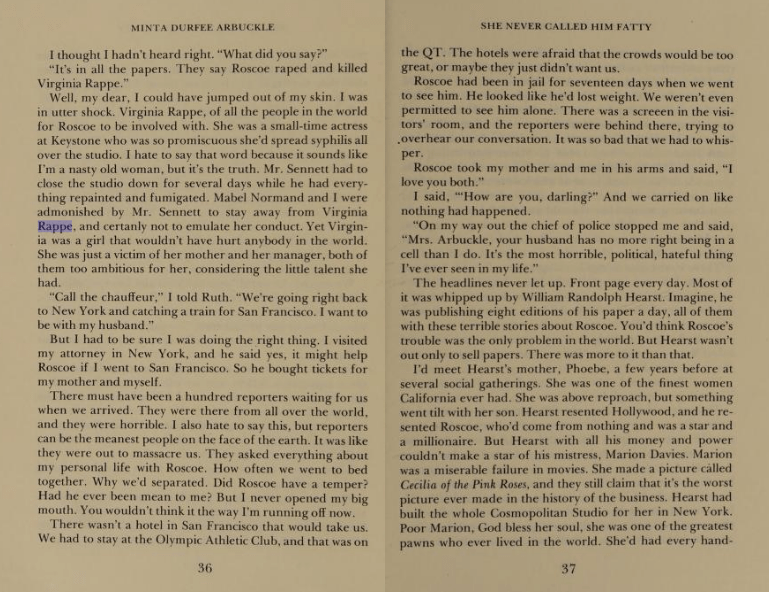
An Italian journalist, who has written an article to mark the centenary of the Arbuckle case and the death of Virginia Rappe, reminded us of a Latin expression that certainly applies to both Rappe and Roscoe Arbuckle. Both figures have suffered a kind of damnatio memoriae, but rather than their faces and names erased from monuments and other official records of their existences, they have been damned by misrepresentation. In Arbuckle’s case, Durfee’s honey-glazed rehabilitation of him doesn’t acknowledge that he was bridling under what had become a sham marriage—a sham that facilitated the kind of dissolute lifestyle and assignations that fell the great Silent Era comedian. There is much more to this story though for another time.
Minta Durfee, Arbuckle’s first wife, was and still is behind the character assassination of Virginia Rappe. She was the source of the infamous story about Rappe being the naive promiscuous actress on the Keystone lot who spread some kind of sexually transmitted disease or Pediculosis pubis.
Supposedly, Mack Sennett, the head of Keystone, had his studios, stages, prop and dressing rooms, and so on, repainted and “fumigated.” Entire buildings were allegedly encapsulated by tarps to ensure that nothing verminous survived that had come from Rappe’s mons veneris.
An example of damnatio memoriae as it applies to Virginia Rappe in You Must Remember This(1975)
This story was spread with every interview that Durfee gave in her dotage—and in any memoir she had written for her. It was accepted in the 1960s onward because Durfee likely knew it would sell in the heyday of the Sexual Revolution. But one didn’t need the Internet then to discover that Rappe never worked for Keystone and although she eschewed marriage, she was remarkably monogamous in her relationships—perhaps to a fault.
Durfee’s story about the Keystone studio does have some basis though. It originates in the spring of 1913—three years prior to Rappe’s arrival in Los Angeles—when there was a crackdown on so-called “white slavery” rings in the city. Among those arrested was a then-fifteen-year-old Keystone actress named Evelyn Quick, better and later known as Jewel Carmen. To support her mother, and, perhaps, because Mack Sennett only paid his talent a few dollars a week, the enterprising minor earned extra income as a sex worker.
When her name began to appear in newspapers among the “ruined” girls, and since some of her clients were other Keystone employees, Sennett took most of his company to film on location in Tijuana, Mexico as the first indictments were handed down. Rappe’s future boyfriend, director Henry Lehrman, and Keystone’s star comedian “Fatty” Arbuckle were among the actors and crew members who crossed the border to wait out the fallout and bad press.
Evelyn Quick in the Los Angeles Times, 1913 (Newspapers.com)
Virginia Rappe, of course, never imagined that she would be branded as “that kind of girl.” She slipped in and out of a coma on September 9, 1921, in a private room in a private hospital. She told a nurse to “get Arbuckle” not because she wanted revenge but just to get her $65 hospital bill paid.
She had no family around her as she died. One friend, who later said she barely knew Rappe, Sidi Spreckels did come to see her but was met by that doomed, faraway stare that the dying have. Spreckels tried to find a minister in time to pray over Rappe. But he arrived too late in the afternoon.
Later that day, Arbuckle answered the doorbell at his W. Adams Street mansion. He had been getting ready for a date to the theater with a young actress whom he had met earlier in the week while aboard the SS Harvard, during the voyage back from his Labor Day holiday in San Francisco. Those plans, however, had to be changed as a reporter told Arbuckle about Rappe’s death earlier in the day and that he was being blamed for it.
Virginia Rappe was finally taken by ambulance to the Wakefield Sanitarium at 1065 Sutter Street in San Francisco on Wednesday, September 7, 1921. Her presence in the small private hospital was quickly noticed by the nursing staff.
The Wakefield Sanitarium, also known as the Wakefield Hospital, wasn’t an institution that specialized in high-risk pregnancies—and abortions for its wealthy clientele, as it has been described by others looking to dish some dirt. It admitted men, women, and children, especially accident victims who required surgery. The hospital was private though and intended for patients who wanted to avoid the populations—and diseases—of general and charity hospitals. It was staffed by top-tier doctors, and patients were often referred there by doctors who taught at Stanford University’s medical school, including Virginia Rappe’s doctor, Melville Rumwell.
Rumwell specialized in taking female surgical patients. Early in his career, he made a real name for himself in saving the life of a mother and child in a difficult birth. The mother honored him by naming her newborn son “Melville.” But Dr. Rumwell had also earned the opprobrium of tent-city dwellers in the aftermath of the 1906 earthquake, especially that of the women, when he served as a city medical officer in charge of homeless people. He was seen as uncaring and unmindful of their plight. In Rappe’s case, he dialed back the nature of her illness to alcoholism, at the time the term would have been closer to a diagnosis of alcohol abuse disorder today. That is, Rappe was still being seen as suffering from having had too much to drink—even two days later!
Rumwell had taken Rappe’s case as a favor to Maude Delmont, a former patient and Rappe’s voluntary guardian for the past three days. Apparently, when it came to his fee—as well as the cost of two private nurses and a private room at Wakefield—he had been told that someone else would cover the cost, that someone being Roscoe Arbuckle. Delmont probably didn’t reach out to the comedian about Rappe’s medical costs. She was also expecting Al Semnacher to return to San Francisco to drive her and Rappe back home and deal with the medical costs later.
Even though the St. Francis Hotel’s doctor, Arthur Beardslee, suspected a grave internal injury, indeed, a ruptured bladder, he testified that he didn’t share his suspicions or the results of his catheterization, which revealed bleeding, with Dr. Rumwell. If he had, Rumwell would have done two things in 1921: he would have attempted “heroic measures,” that is, a high-risk surgery to clean out the massive infection and close the tear in Rappe’s bladder; or palliative care since a bladder rupture, if not operated on immediately, meant certain death from peritonitis and septic shock.
The second option turned out to be deliberate or a fait accompli if Dr. Rumwell took a passive course and simply neglected his patient, knowing she was going to die anyway. In that case, any optimism he expressed was pro-forma for the sake of Delmont and Rappe’s nurses, especially the two who had grown close to her over the past two days.
Delmont may have come around to the idea that surgery was needed since Rappe’s condition only deteriorated. She called one of Rumwell’s colleagues at Stanford to get a second opinion. But she never lost faith in the doctor whom she referred to affectionately as “Rummie.” As Rappe slipped into a coma, Delmont likely interpreted this as a relief since she was no longer in distress.
Meanwhile, on the evening of September 8, Rappe’s night nurse, Vera Victoria Cumberland, had gone back on duty. Before doing so, however, Cumberland learned from Rappe’s day nurse, Jean Jameson, that the latter believed Rappe was suffering from an infection and that “microscopic tests” were in order.”[1]
But “Dr. Rumwell failed to do this,” Cumberland said during a coroner’s inquest, “and I thought his attitude of enough importance that I left the case. I told Mrs. Delmont I thought this ought to be done and she said, ‘Oh, Rummy can’t be bothered, he had a party on tonight.’”
That Rappe’s case had “been handled negligently” wasn’t the only reason that Cumberland resigned.[2] Her other rationale was more personal and might explain why she stood up to the physician. She believed herself to be a granddaughter of Queen Victoria, her namesake, and a countess, and, if true, had a reputation at stake.
“When I realized the circumstances of the case,” she said to the press after Rappe’s death, “I had visions of juries, judges, investigators, and policemen. It was disgusting. Finally, I determined that the fair name of Cumberland should not be dragged into the filth of actors’ misdoings, so I requested my release.”[3]
Naturally incredulous, a reporter consulted Debrett’s Peerage and discovered that Vera Cumberland wasn’t among the issue of either Queen Victoria or her German cousin, the Duke of Brunswick, who currently held title of Duke of Cumberland.
Vera Cumberland (Calisphere)
[1] Associated Press, “Arbuckle Indicted: Manslaughter Grand Jury Says,” Des Moines Register, 14 September 1921, 1, 2; and “The Grand Jury: Evidence Submitted by Witnesses to Arbuckle’s Wild Party and Those Who Attended Stricken Girl,” Des Moines Tribune, 14 September 1921, 1.
[2] “Words of Girl on Death Bed Stir Audience . . .,” San Francisco Chronicle, 14 September 1921, 7.
[3] Nurse Reveals Dying Confidences,” Los Angeles Evening Post-Record, 12 September 1921, 6.
Soon after he was arraigned in San Francisco’s Hall of Justice, Roscoe “Fatty” Arbuckle didn’t return to the room that he had taken at the Palace Hotel, where the rest of his entourage were staying. Instead, he spent that first night in cell number 12 of the San Francisco County Jail.
During the night before and into the early morning, the comedian suffered the indignity of being under arrest. Nevertheless, Arbuckle had no trouble falling asleep after his long day, which included a long drive from Los Angeles that began around three that morning.
When the comedian woke, he surely noticed what the Morris DeHaven Tracy (M. D. in his bylines), West Coast correspondent for the United Press, described as “cabalistic marks” on the cell walls made by previous occupants. One composition in yellow chalk featured a figure labeled “Gloom” shaking hands with “Joy.” Under another drawing, which was left to readers’ imaginations, the artist had written “Little Mary and her lamb.”[1]
Arbuckle summoned the warden and complained about the darkness of his new accommodations—and the loneliness. He asked for a cellmate and was given the privilege of selecting one from among eighty inmates. Arbuckle chose Albert Martin, a handsome young man with dark hair and brown eyes and the photogenic looks of an actor. Martin also looked clean, tailored, normal, like someone else who shouldn’t be in jail.[2]
The Los Angeles Record published one of the few photographs taken of Albert Martin in cell 12 (Newspapers.com)
Martin was a traveling salesman. He had recently been arrested for “contributing to the delinquency of a minor” under Section 268 of the Penal Code. Whether Arbuckle knew or found out later, he probably deduced that Martin was a pedophile. But that likely made little difference to the comedian. Arbuckle knew gay actors, extras, and crew in the movie business and he was tolerant and even protective toward them. He may have been protecting Martin, who was surely grateful for being moved from the general population who knew the real nature of his crime—he had allegedly raped a boy.
Soon Martin found himself the recipient of Arbuckle’s good will, eating catered meals, getting shaved by a visiting barber, and listening to the comedian’s jokes, high talk, and troubles. Martin, in kind, attended to Arbuckle as his jailhouse valet. In October, Albert’s case went to trial and he was convicted of sodomy. In November, he was sentenced to serve an “indeterminant term” in San Quentin Prison.[3] He was still there, in the prison’s asylum, as late as 1926.
Imagine the book Martin could have written about his two weeks with “Fatty” Arbuckle.
Albert Martin, San Quentin mugshot, November 1921 (Ancestry.com)
[1] United Press, “Prosecutor to Ask Murder Indictment in Arbuckle Case,” St. Louis Star, 12 September 1921, 1.
[2] Erroneously identified as “Fred Martin” in some newspapers.
[3] “Fatty’s Cellmate Is Sent to Prison,” San Francisco Examiner, 8 November 1921, 10.
[In this sidebar adapted from our work-in-progress, Betty Campbell provides one of the few eyewitness accounts of what Arbuckle’s party was like for most of Labor Day 1921. The word “rough,” of course, was the 1920s euphemism for “sexual harassment” or abuse. Presumably, Virginia Rappe fell for some other variation of Sherman’s entrapment, that is, if she didn’t enter room 1219 with her consent. Incidentally, in Arbuckle first time taking the stand at his first trial, he claimed to have found Rappe in 1219’s bathroom.]
Neither the Grand Jury nor the Coroner’s Court heard Betty Campbell. San Francisco County District Attorney Matthew Brady knew that she had attended Roscoe Arbuckle’s Labor Day party late in the afternoon with her friend, the store model Dolly Clark. But he had shown more interest in Clark. Campbell though had a story too and while so many other witnesses were giving testimony, hers was published in the San Francisco Examiner.[1]
The youngest guest at the Labor Day party, Campbell was a chorus girl in the Ziegfeld Follies and Al Jolson’s traveling show. She wanted to be a motion picture actress and her photographs, taken by the Hartsook Studio, attested to that aspiration as did her being a guest at Arbuckle’s Labor Day party. Her description of the latter half of the party reveals that Rappe’s crisis in room 1219 was merely an interruption, which barely cast a pall over the rest of the afternoon. Her description also revealed the kind of activity that the press was calling an “orgy,” a “debauch,” or, simply “the weird affair” and what was meant by “rough” in the parlance of the 1920s, a word used by other Labor Day party witnesses.
Source: Newspapers.com
Despite her youth, Campbell was no ingenue and no stranger to courtrooms and being questioned by lawyers. That summer she was named as the correspondent in the divorce case between a Southern California millionaire, Guy Lewis, the so-called “Bean King of Ventura County,” and his wife. While she was caught “spooning” with a millionaire, Campbell was not so willing to do the same with just any man.
“Lowell Sherman, the actor, came over and sat by me,” she recalled, “and began to get rough in his speech and actions, so I got up and walked away. A little later he went into his bedroom, leaving the door open, and called: ‘Come in here—I want to talk to you.’”
“Like a fool, I went in,” Campbell said. “Sherman immediately closed the door
and locked it. I heard them laughing outside. I kept my head, and when Sherman stepped toward me, I said: “Wait a moment—I want to fix my hair,” and ran into the bathroom. Just as he had done, I slammed the door and locked it. He tried to get in for a time, but gave it up and went back into the parlor. I watched my chance and ran out through the bedroom. As I came through the door, Freddy Fischbach [sic] tried to push me back into the room again. I shut the door on him and a little later got out safely.
“If I hadn’t been quick and in full possession of my senses,” Campbell added, “the same thing would have happened to me that happened to Miss Rappe. Only it was not Arbuckle who tried it.” In regard to the comedian, he was a “gentleman.” Although he drank a “considerable” amount of liquor in Campbell’s presence as the afternoon wore on, he wasn’t intoxicated.
“He did little except dance,” she said, “make clownish remarks, and sit shrugging his shoulders in that funny way of his.” Campbell felt safe enough in his company to be his dance partner. She stayed at the party for supper, too, during which she overheard Arbuckle lament, “I’m not going to take any blame for anything that happened to that girl.”
“This was the only remark that indicated nervousness,” Campbell, said. Otherwise, Arbuckle was merry and showed no remorse or concern for Virginia Rappe, who, Campbell, learned from others at the party, had been in room 1219 alone with him.
The other revelation that Campbell made to reporters was that Arbuckle left the party when supper was served. He had to make an appearance at a local theater. She is the only source for this anomaly in his Labor Day schedule.
Assistant District Attorney Milton U’Ren, caught flatfooted on learning of Campbell’s newspaper story, told the press that he and his colleagues were “very anxious to locate Miss Campbell,” but she had “mysteriously disappeared.”
[1] The following is based on “Girl Tells of Revel at Arbuckle Party,” San Francisco Examiner, 13 September 1921, 1, 2; “Lewis Co-Respondent Also Arbuckle Flame,” Oxnard Daily Courier, 14 September 1921, 1; Universal Service, “Show Girl Who Told of Assault Attempt at Orgy Disappears,” [Pittsburgh] Gazette,14 September 1921, 2; and other corroborative sources.
Perhaps the worst decision made by Roscoe Arbuckle and whoever had his ear was to let Maude Delmont stay with Virginia Rappe in room 1227 of the St. Francis Hotel.
Although she didn’t pretend to be a real nurse, she assumed the authority of one. (Delmont’s younger sister, with whom she lived from time to time, was indeed a registered nurse.)
When the second hotel physician, Dr. Arthur Beardslee, came to see Rappe, he realized that this wasn’t the usual patient with a stomach ache from overindulging on rich food from the hotel kitchen or alcoholic beverages—as Delmont said. What he saw was a young woman he believed needed to be taken to a hospital for immediate surgery. But Dr. Beardslee erred on the side of hospitality, being a hotel doctor, and gave Rappe morphine injections to keep her quiet.
Meanwhile, Delmont had been going back and forth between room 1227 and the reception room of Arbuckle’s suite, room 1220.
The people in that room decided against sending Rappe to the nearby St. Francis Hospital, where Dr. Beardslee was a resident. That risked “notoriety.”
Dr. Arthur Beardslee (FamilySearch.com)
Delmont never disputed this decision. She returned to room 1227 and was satisfied with the effects of the morphine. She also convinced Dr. Beardslee that the only thing wrong with Rappe was gas. She suggested having an enema bag and Dr. Beardslee ordered one.
When he was gone, Delmont gave Rappe the enema, apparently with expertise and little mess. But undoubtedly the experience for Rappe was no less excruciating than her ruptured bladder.
Only Dr. Beardslee suspected the true nature of the injury. On his last visit, in the wee hours of Tuesday, September 6, he catheterized Rappe and extracted a little urine and clotted blood. The results alarmed him but he suppressed any expression of urgency given, perhaps, the inconvenient hour.
Still deferential to Delmont, Dr. Beardslee could only advise that his patient—whose name he incredibly failed to learn—be taken by ambulance to the hospital. Delmont, exercising a kind of medical power-of-attorney before there was ever such a thing, elected not to do so. Rappe would be treated in her hotel room.
Later that Tuesday morning, Dr. Beardslee was informed by Maude Delmont that her personal friend, a famous San Francisco surgeon who had performed an operation on her in the past, Dr. Melville Rumwell, would take over the case.





 Spite Work: The Trials of Virginia Rappe and Fatty Arbuckle