Document Dump #6: Did Gouverneur Morris side with Arbuckle?

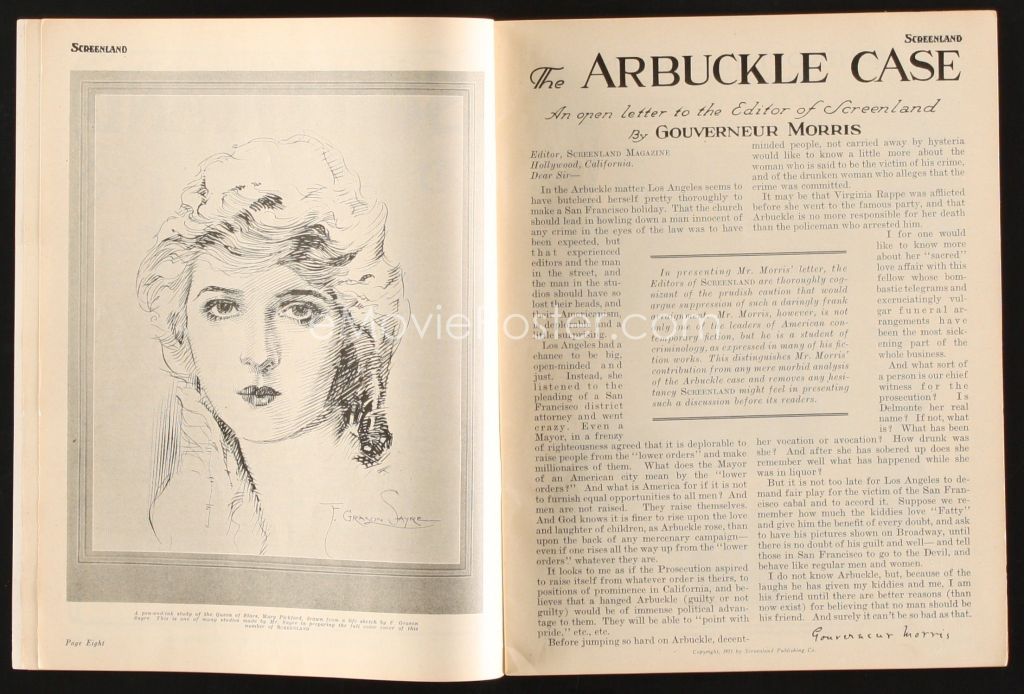
We first became aware of Gouverneur Morris’s interest in the Arbuckle case in Greg Merritt’s Room 1219 (p. 208). He refers to the following “open letter.” Our take is this: the letter was likely written before Gouverneur Morris began to turn in his editorials about the Arbuckle case and trial to the San Francisco Call (see Document Dump #5). These pieces were intended to be daily and were syndicated by the editor of Screenland, Myron Zobel.[1] He appears to be the “recipient” of this letter. For such copy to be published in time for the November 1921 issue of Screenland, where it appears on page nine next to a drawing of Mary Pickford, Morris would have been commissioned in late September or October—weeks before the actual trial, which isn’t referenced in this letter. The murder charge, which Brady sought in September 1921, is the giveaway here as to when this letter was actually composed. And one can see this as well by reviewing Morris’s copy for the Call. In the piece published on November 14, 1921, the first day of jury selection, Morris once more endorsed Matthew Brady, calling the district attorney “honest and big hearted, who has a greater faith in probation than prison.” The other pieces that Morris turned in are soberly written and don’t really take sides. Indeed, the writing for the Call differs so much from the Screenland letter that what you will read here was likely ghost-written by someone else with a different agenda.


An open letter to the Editor of Screenland

By Gouverneur Morris

In presenting Mr. Morris’ letter, the Editors of Screenland are thoroughly cognizant of the prudish caution that would argue suppression of such a daringly frank arraignment. Mr. Morris, however, is not only one of the leaders of American contemporary fiction, but he is a student of criminology, as expressed in many of his fiction works. This distinguishes Mr. Morris’ contribution from any mere morbid analysis of the Arbuckle case and removes any hesitancy Screenland might feel in presenting such a discussion before its readers.

Editor, Screenland Magazine
Hollywood, California

Dear Sir—[2]

In the Arbuckle matter Los Angeles seems to have butchered herself pretty thoroughly to make a San Francisco holiday. That the church should lead in howling down a man innocent of any crime in the eyes of the law has to have been expected, but that experienced editors and the man in the street, and the man in the studios should have so lost their heads, and their Americanism, is deplorable and a little surprising.

Los Angeles has a big chance to be big, open-minded and just. Instead, she listened to the pleading of a San Francisco district attorney and went crazy. Even a Mayor, in a frenzy of righteousness agreed that it is deplorable to raise people from the “lower orders” and make millionaires of them.[3] What does the Mayor of an American city mean by the “lower orders”? And what is American for if it is not to furnish equal opportunities to all men? And men are not raised. They raise themselves. And God knows it is finer to rise upon the love and laughter of children, as Arbuckle rose, than upon the back of any mercenary campaign—even if one rises all the way up from the “lower orders,” whatever they are.

It looks to me as if the Prosecution aspired to raise itself from whatever order is theirs, to positions of prominence in California, and believes that a hanged Arbuckle (guilty or not guilty) would be of immense political advantage to them. They will be able to “point with pride,” etc., etc.

Before jumping so hard on Arbuckle, decent-minded people not carried away by hysteria would like to know a little more about the woman who is said to be the victim of his crime, and of the drunken woman who alleges that the crime was committed.

It may be that Virginia Rappe was afflicted before she went to the famous part, and that Arbuckle is no more responsible for her death than the policeman who arrested him.

I for one would like to know more about her “sacred” love affair with this fellow whose bombastic telegrams and excruciatingly vulgar funeral arrangements have been the most sickening part of the whole business.[4]

And what sort of person is our chief witness for the prosecution? Is Delmonte her real name? If not, what is? What has been her vocation or avocation? How drunk was she? And after she has sobered up does she remember well what has happened while she was in liquor?

But it is not too late for the Los Angeles [people] to demand fair play for the victim of the San Francisco cabala and to accord it. Suppose we remember how much the kiddies love “Fatty” and give him the benefit of every doubt, and ask to have his pictures shown on Broadway, until there is no doubt of his guilt and well—and tell those in San Francisco to go to the Devil, and behave like regular men and women.

I do know Arbuckle, but, because of the laughs he has given my kiddies and me, I am his friend until there are better reasons (than now exist) for believing that no man should be his friend.[5] And surely it can’t be so bad as that.

Gouverneur Morris
We wish to thank eMoviePoster.com for providing this image for our research.

[1] Not to be confused the other Myron “Global” Zobel, the travelogue filmmaker.

[2] I.e., Myron Zobel

[3] I.e., George E. Cryer,

[4] I.e., Henry Lehrman.

[5] Morris had two teenage daughters.

100 Years Ago Today: Al Semnacher, Virginia Rappe’s manager, takes the stand during the third session of the preliminary investigation, September 23, 1921

Isadore Golden, one of Matthew Brady’s assistant district attorneys, put it this way: “We have made out a case [. . .] through witnesses who had to have the truth dynamited out of them, witnesses who would give anything to say, ‘I was not there.’”[1] One witness he had in mind was Al Semnacher, part motion picture publicity man, part talent agent, and part talent scout, who represented at various times ZaSu Pitts, Jacqueline Logan, Kenneth Harlan, and Virginia Rappe for less than two months. If going to Arbuckle’s party had been a business venture to get her into Arbuckle’s party, either all along or an opportunity of coincidence, he failed her miserably.

Al Semnacher (San Francisco Call)

Semnacher was a kind of subaltern Hollywood functionary, even factotum. His estranged wife was the late Olive Thomas’ personal secretary. His stock-in-trade was primarily developing—or exploiting—young aspiring people, especially young women, who wanted to break into the movies and needed their face and contact information in a casting directory with a flattering portrait taken at the Hartsook Studio. Semnacher, too, served the Hollywood nobility. For example, when one of Arbuckle’s lawyers produced a purse in the courtroom, inferring that it might belong to Virginia Rappe, the accessory, as it turned out, belonged to Mildred Harris (Mrs. Charlie Chaplin). Semnacher had taken it to a jeweler for her to be fixed.

The actress Miriam Cooper expressed one school of opinion about Semnacher’s role in the Arbuckle affair. She saw Semnacher as a liar covering up what he really knew.[2] Her husband, the actor and director Raoul Walsh, believed that Henry Lehrman had arranged with Semnacher to bring Rappe to San Francisco to see Arbuckle.

When Al Semnacher took the stand during the afternoon of September 23, 1921, his testimony came so reluctantly that the defense demanded that Assistant DA Golden treat Semnacher as a hostile witness. Some newspaper accounts described his performance as unimpressive. Others took issue with the appearance of the dapper, sporting man who was photographed wearing an ankh symbol tie pin on his four-in-hand, a pince-nez, and a Gatsby cap (picture above).

Edward J. Doherty—“America’s Highest Paid Reporter”—of the Chicago Tribune’s Hollywood bureau knew Semnacher to be Arbuckle’s friend and described him as “a short, squat, middle-aged man, with iron gray hair, gray eyes, and a weary gray countenance.”[3]

Ellis H. Martin of the International News Service described Semnacher it terms as “a wiry little man whose dark, sparkling eyes peeped cautiously from behind shell-rimmed glasses.”[4]

The Rev. William Kirk Guthrie, the pastor of San Francisco’s First Presbyterian Church, writing in the San Francisco Examiner, not only appeared in the Women’s Court as a reporter, wearing a clerical collar, but also as an editorialist. He, too, had something to say about Semnacher’s untrustworthy features.[5]

What a rotten way to spend a perfectly good afternoon. Sitting in a stuffy courtroom, listening to a lot of seemingly stupid questions, that seemed to lead nowhere, and were repeated over and over again in an effort to get a witness who apparently had made up his mind not to say anything that was worth anything to anybody to say what he had already said. [. . .] And the witness, Mr. Semnacher, who, I believe, was the manager for Miss Rappe, was a very clever and interesting little person, with dark, sparkling eyes, and many of the manners and actions of a monkey. At times, he was quite cute, with a funny little twinkle behind the glasses in his black eyes—and then he knew so much, and so intimately, about some things, and was ready to run on telling it, and against he knew so little, in fact, almost nothing of what the District Attorney wanted to know.

I wonder whether it is a good thing to shout at a witness. [. . .] In talking of torn garments, I couldn’t help thinking, as I saw the detectives coming into court, with two pitiful packages in their hands, of how a short while before what they contained had clothed beautiful womanhood, and were now but a wretched exhibit in a police court. And that ultimately there is but one garment that can cover our shame and failure, and that is the robe of His righteousness.[6]

The Rev. Guthrie, like other spectators, wanted to be interested, entertained perhaps, but for many of them, this was the first time they had sat through a direct examination and cross-examination. They had no idea that this was how district attorneys laid their groundwork, especially for a reluctant witness who realized that he was being led along a precipice in which he could perjure himself, bring financial ruin, and make him an untouchable in film colony—this on top of a humiliating divorce.


[1] Qtd. in Edward J. Doherty, “State Springs Coup on Fatty; Defense Wild,” Chicago Tribune, 28 September 1921, 3.

[2] Miriam Cooper and Bonnie Herndon, Dark Lady of the Silents (New York: Bobbs-Merrill, 1973), 180.

[3] Edward J. Doherty, “Fatty Pales at Moving Picture of Fatal Party,” Chicago Tribune, 24 September 1921, 1.

[4] Ellis H. Martin, “Death of Actress Laid to Injuries,” Washington Times, 24 September 1921, 1.

[5] Anti-Semitism did loom over the Arbuckle trial, perhaps more than we know. In the case of Rev. Guthrie, Semnacher may have been seen as the stereotypical “Hollywood Jew,” a label already well-established especially in the revived Ku Klux Klan and among their WASP betters who entertained the “suburban prejudice.”

[6] Rev. William Kirk Guthrie, “Judge Lazarus Untangles Knows of Legal Verbiage, Impresses Cleric,” San Francisco Examiner, 24 September 1921, 1–2.

100 Years Ago Today: The first full day of the preliminary investigation

The Women’s Court of Judge Sylvain Lazarus reconvened on the morning of Thursday, September 22. The first witnesses called were those who had conducted autopsies on Virginia Rappe’s body. Dr. William Ophuls conducted the first autopsy, which was unofficial and done at the request of Dr. Melville Rumwell, Rappe’s physician. He had been compelled to perform the autopsy by Maude Delmont and Rappe’s friend, Sidi Spreckels, the second wife of the late John Spreckels Jr., heir to one of California’s wealthiest and most influential families.

Dr. Shelby Strange, took the stand first, for he had conducted the second autopsy sanctioned by the San Francisco Coroner. It was his painstaking measurements of the numerous bruises on Rappe’s body that posed a challenge for the defense, for these suggested a forcible assault—or a rough handling of Rappe while being moved from bed to bathtub to toilet seat to bed and ultimately to a room of her own in the St. Francis Hotel.

In addition to the controversial bruises was Dr. Strange’s description of Rappe’s viscera. After removing all the bloodstained cotton that packed the lower half of Rappe’s abdomen, Dr. Strange found that her bladder, uterus, and rectum had been removed. This wasn’t a surprise, for Dr. Ophuls had preserved them in a specimen jar.

Assistant District Attorney Miltion U’Ren asked about the uterus first.

Q: What was its general shape and condition?
A: The shape was normal.
Q: Normal size?
A: Normal size. It had been—there had been an incision from top to bottom on the anterior surface of the uterus, and opening the cavity.
Q: And so far as you could observe from your examination, it was a perfectly normal, healthy uterus?
A: Yes sir, and likewise the tubes and the ovaries.[1]

Here Frank Dominguez, Arbuckle’s chief defense attorney, objected to U’Ren “leading” Dr. Strange on the word “healthy” in regard to Rappe’s sexual organs—for that suggested a “healthy” morality, as well, a young woman who wasn’t promiscuous. “Healthy,” too, meant there was no sign of any forced penetration as well as other anomalies, including a fetus, presumably.

Dr. Ophuls, too, had a similar opinion about Rappe’s viscera. “All that I saw and felt seemed perfectly normal,” he said. “I did not make an examination of the chest.”[2] Dr. Ophuls, however, had another opinion in regard to Rappe’s Fallopian tubes. These “were badly inflamed—that is, I mean, they were congested in blood, which I attributed to the existence of the inflammation [i.e., peritonitis] in the body cavity in which these tubes are situated. And the uterus and vagina and the vulva were apparently perfectly normal.”[3]

Dr. William Ophuls, ca. 1909 (Calisphere)

[1] People vs. Arbuckle, 26–27.

[2] Ibid., 38.

[3] Ibid., 37.

Document Dump #5: Gouverneur Morris’ on S.F. District Attorney Matthew Brady

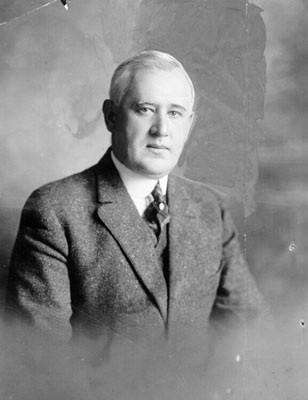
Gouverneur Morris IV (1876–1953), the author of novels, short stories, and screenplays as well as a freelance journalist. To call him a “pulp” novelist is probably an injustice, for his work hardly anticipates or resembles Dashiell Hammett and Raymond Chandler. Morris, at least during the first half of his career, dealt with bad characters of another kind, like men who took advantage of women in his 1914 short story “When My Ship Comes In,” about Broadway, with illustrations by Charles Dana Gibson. His screenplay for the Wallace Beery vehicle A Tale of Two Worlds (1921) follows the life of a white child raised by Chinese foster parents who is sold as a sex slave by Beery’s tong gang leader.

Morris covered the first Arbuckle trial in November–December 1921 for the San Francisco Call and his articles leading up to the trial didn’t take sides per se. Here he writes perhaps the only published profile of District Attorney Matthew Brady.

Gouverneur Morris, ca. 1920 (Library of Congress)

AUTHOR MORRIS ANALYZES ARBUCKLE PROSECUTOR
BRADY GIVES IMPRESSION OF BEING FAIR, IMPARTIAL FOR JUSTICE IN TRIAL
By GOUVERNEUR MORRIS

Gouverneur Morris, celebrated author, who will write a daily description of the Arbuckle trial exclusively for The Call, gives his impression of District Attorney Matthew Brady in the following thumb nail sketch:

The newspapers do not give me the same impression of San Francisco’s district attorney that the man himself does. That’s because one newspaper quotes him and another misquotes him and none attempts to describe him or to say what he is like, though all probably did plenty of that better than I can when he was being elected to his present high office. But that was a long time ago and readers may have forgotten.

ERRONEOUS IMPRESSION

From the quotations and misquotations I derived the erroneous impression that Brady is no longer an Irish name, and that it usually belongs to a man who is lean and savage, and, who if he is in the public service is a persecutor rather than a prosecutor. I got the idea that Mr. Brady was one of those district attorneys who believes that the end and the aim of public service is convictions. Now if Mr. Brady is that kind of a district attorney, then in the conversation which I had with him today, he deceived me grossly. For most certainly he gave me the impression in his dealings with the sins of mankind his inclination is to be tolerant and humane, to get at the truth rather than to garble it for glamour’s sake, and on the whole to be very much relieved whenever the truth warrants a jury bringing in a verdict of “not guilty.”

IDEAL DEFENDANT

He himself, for any other district attorney with humane, and tolerant impulses. would make an ideal defendant. It would be difficult to convict him, and I not a pleasure. He has the broad and strong body which so often is kept going by a kind heart; white hair, rosy checks, a voice at once manly and beguiling; large but not loud.

Upon one point his friends and his enemies are united. And I have talked with no man in San Francisco who does not say with all his heart that Mr. Brady is an honest man. And I would have taken it upon myself to say that I thought that of him, even if a lot of others had said the opposite. Certainly, he rings true and honest.

FAIRNESS IN DICTATED

Mr. Brady has no intention of letting the prosecution of Roscoe Arbuckle turn into a persecution. He believes that he has a case, or else, of course, he could not prosecute, and he believes that case is stronger than any defense that can be made. Nevertheless, if the defense has I something up its sleeve which has not been foreseen by the prosecution or known to exist, and which would cause the case of the prosecution to fall to the ground like a house of cards, I am inclined to believe that Mr. Brady would be more glad than sorry, for to him a prisoner at the bar of justice or behind the bars of a prison, whatever his alleged or proven wickedness may be, is also a human being in trouble.

But this can only be a thumbnail. Impressionistic sketch. I believe that San Francisco is going to be proud of the figure which Matthew P. Brady will cut at the Arbuckle trial.

Source: San Francisco Call, 12 November 1921, 1.

Matthew Brady (Calisphere)

100 Years Ago Today: Virginia Rappe buried, September 19, 1921

In San Francisco, Roscoe Arbuckle had another woman to consider beside Virginia Rappe.

Minta Durfee woke to spend her first full day in the city as the comedian’s wife. For some people, who may have forgotten Arbuckle had a wife, Durfee must have seemed like a revenant.

Meanwhile, to the south, in Los Angeles, a brief service was conducted in the Strother & Dayton mortuary chapel. Some of Rappe’s film colony friends were observed among the celebrity mourners. Kathleen Clifford, termed “a dear friend of the dead girl,” came with Canadian actress Grace Darmond and her mother. Although Lloyd Hamilton couldn’t make it, his wife Ethel was present as was the future Mrs. Oliver Hardy, Myrtle Reeves, and her sister May, also a Vitagraph actress.

Many of Rappe’s friends had sent flowers, which required an open hearse to bring to the cemetery. Maude Delmont, sent a bouquet of Cecile Brunner roses with a note that read “To Virginia: You know I love you as though you were my sister.” Norman Taurog and Larry Semon provided a loving cup filled with roses and inscribed in Rappe’s memory. Aunt Kate and Uncle Joe Hardebeck contributed a pillow of rosebuds decorated with a ribbon that read, “Tootie,” her childhood nickname.

The most curious thing about the arrangement was the card, which read “from a friend,” an indication that the Hardebecks didn’t pay for it. Of all the flowers, however, nothing compared to Lehrman’s tiger lilies.

Rev. Frank Roudenbush, Rector of St. Thomas Episcopal Church—known in Hollywood as “the little church around the corner” on Sunset Blvd.—performed the burial rites from the Book of Common Prayer. Virgie Lee Mattoon, the celebrated contralto soloist and wife of a Los Angeles district attorney, sang “Abide with Me” and “There Is No Night There,” accompanied by Jessie Pease on the funeral chapel’s organ.

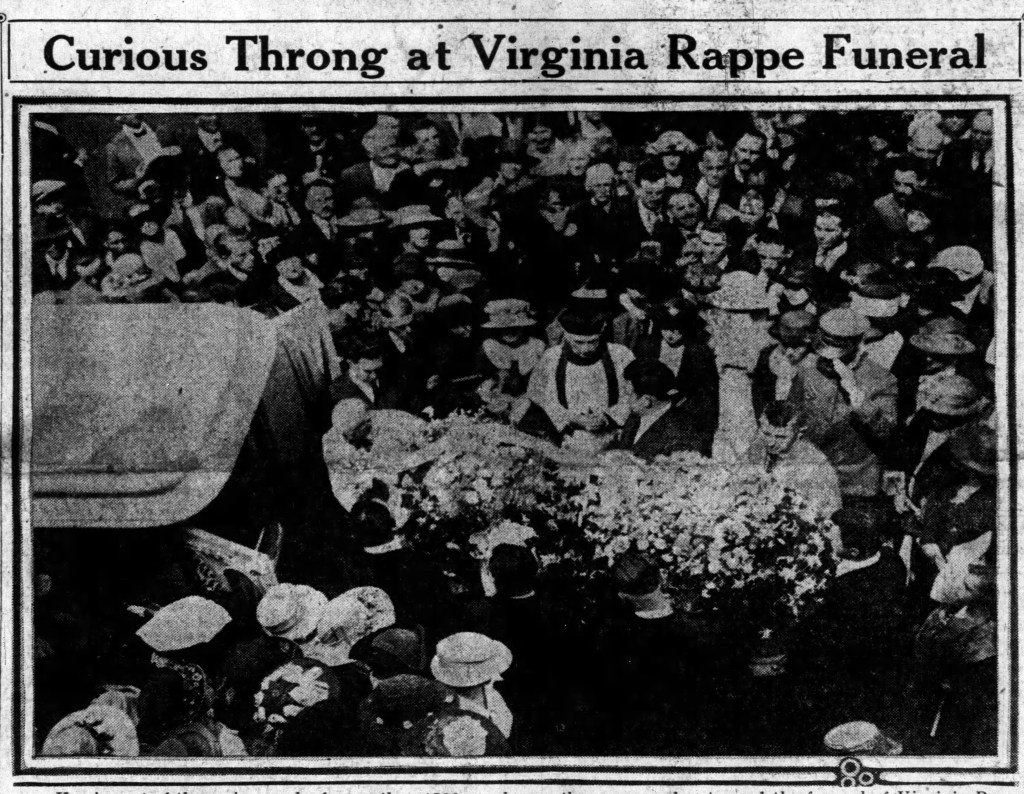
Outside, a mostly female crowd estimated to be as large as 1,500 attempted to force their way inside in what was called a “riot.” The police came in squad cars and on horseback. They made a path so that the pallbearers could shoulder their burden to the hearse. On each side of the flower-decked coffin slowly walked Rappe’s retinue of pallbearers, dwarfed by how high they carried it on their shoulders. Among them were not only Taurog and Semon, but Oliver Hardy, Al Herman, Dave Kirkland, and Frank Coleman.

As they slid the silver casket inside a white hearse, a mob closed in, some shouting questions for directions, the name of the cemetery, and if Rappe’s casket would be opened there one last time. “Can we see her there?”

After the cortege traveled the few blocks east to Hollywood Cemetery, followed by a parade of cars and people on foot, the mourners and the curious and those who could say “I was there” made their way toward Lehrman’s plot near the edge of a pond. They trampled the grass, stepped on gravesites, and sat on monuments. Many pushed their way to the front. Rev. Roudenbush offered one last prayer “with orthodox comfort of Christianity”—regardless of Rappe’s true faith if, indeed, she had one.

“Whosoever believeth in Me shall have everlasting life,” from John 3, was heard and one more body was added that made its later name, Hollywood Forever, a little more insistent, believable.

Source: Los Angeles Record (Newspapers.com)

Composing a Nota Bene (N.b.) and filling the pornographic void of the Arbuckle case

We welcome other acknowledgements of the centenary of the Arbuckle scandal, especially the piece at Silentology and its sequel and the credit extended to the pioneering work of Joan Myers. Silentology’s new entries remind us of another centenary being observed, the hundredth anniversary of the philosopher Ludwig Wittgenstein’s Tractatus Logico-Philosophicuss (1921) and its limitation, that “what can be said at all can be said clearly” and “what cannot be said must be passed over in silence.” This problem very much exists for the Arbuckle case, for it is hard to be silent about it and hard to know when to shut up.

What is he doing in this blog? Ludwig Wittgenstein and his chalkboard, early 1930s

This thought may appear as a nota bene (regard well in Latin) or headnote for a chapter provisionally titled “The Life of the Party.” Here we reimagine Arbuckle’s Labor Day party as it evolves and devolves following Virginia Rappe’s crisis in room 1219. We believe that witness descriptions of events were self-censored so often the number of voids and circumlocutions left the prosecution few stable details with which to piece together a consistent narrative for the jury.

There are clues, indeed, one specific word that gives a hint at what was being covered up in the testimony. That word was “rough” and it was the term chosen by the state’s chief witness, the so-called “Avenger,” Maude Delmont to describe the party. It was used again by a minor witness, Betty Campbell, who was dismissed early but was rather loquacious about the latter half of the party. In the parlance of the early twentieth century, this wasn’t just sexual harassment, that women tolerated. It was aggressive touching, disrobing, grabbing breasts and crotches, giving in to dancing topless or even nude, and relenting to being pulled into side bedrooms for foreplay and sex.

Women were expected to go along with this and not be “party poopers,” so to speak. If a woman didn’t want to be dragged into a room, she shouldn’t be at the party. The testimonies about the Arbuckle party make it sound less licentious than this but at least two woman, Mae Taube and Joyce Clarke, were uncomfortable enough to get out of there.

One need only look at the blue movies and photographs from this era to know what Delmont and Campbell meant: coitus with men still wearing their garters, stockings, and shoes. (This is almost de rigueur in Roaring Twenties pornography). The testimony of every eyewitness tiptoes around this. It is the story that Maude Delmont might have been willing to tell but couldn’t. Graphic details were censored from her published statement.

District Attorney Matthew Brady’s surprise witness at the preliminary investigation in September (the Police or Women’s Court session), was the hotel maid Josephine Keza. She could see into room 1220 and watch men and women in a state of undress. This is what a “rough” party looks like, a sex party.

So, what do we say before one delves into “The Life of the Party”? Given what we have to work with, Occam’s Razor must be tossed out or used in a different way. Three of the principal attendees had excuses for not being there at the crucial moments. Were these excuses scripted and practiced? Was Semnacher indeed elsewhere at the opportune times such that he saw, heard, and said nothing. (He was compared to an evil little monkey by a S.F. clergyman writing for the Examiner.) Did Fishback really go off looking for seals to include in a future movie? He was on hand for most of the party up till then. Lowell Sherman’s testimony that he was too busy on the phone discussing a theater engagement to pay attention to what was happening around him, was proven false when it surfaced that he was with Delmont in a bathroom during the period Arbuckle and Rappe were alone together. Even Ira Fortlouis who was allegedly kicked out of the party earlier made a statement that he was with Delmont at the time that Rappe was allegedly screaming for help.

What we have seen in some of Arbuckle’s offhanded and callous remarks, made before his lawyers silenced him, was this disappointment in Rappe, that she had spoiled his party, that she wasn’t fun anymore, like some broken toy. Therein lies part of the mystery of what happened between these two.

Here, of course, there are several ways to speculate what happened including some that haven’t been raised yet. For example, during his first trial, Arbuckle took the stand and explained that he found Rappe on the floor of room 1219’s bathroom and proceeded to help her to his bed. Is it possible her bladder ruptured when she fell from the toilet or rolled off of his bed, etc.?

Reading the medical journals of the early twentieth century on cystitis and bladder rupture, there are rare instances when, if one cannot urinate readily and tries to force him- or herself to do so, bears down, his or her bladder can burst from the effort, go into shock, be unable to walk.

Imagine Arbuckle waiting on his bed, his potency on the wane, his sweaty back leaching into the sheets, and calling out, “Virginia, please hurry!”

Don’t laugh. This may seem in keeping with the feverish mind of Kenneth Anger, who tried to stick a Coke bottle where it didn’t belong, but it can’t be ruled out that this began as a consensual encounter and was interrupted by a medical emergency unrelated to Arbuckle altogether. Had Rappe’s crisis come purely from excessive fluid retention, it might explain why Arbuckle didn’t express remorse or accept blame for what happened to her.

So, we must have a headnote that tells the reader that the party that Zey Prevost, Alice Blake, Al Semnacher et al. describe reads as too innocent, as if sex wasn’t on the minds of any of these unchaperoned, lubricated attendees. Was the party little more than an afternoon open house or was it something more uninhibited? The possibility of the latter is the first of many “thought experiments,” a term we liberally borrow as well from Dr. Wittgenstein.

100 Years Ago Today: Mildred Harris (Mrs. Charlie Chaplin) prays for Virginia Rappe, September 18, 1921

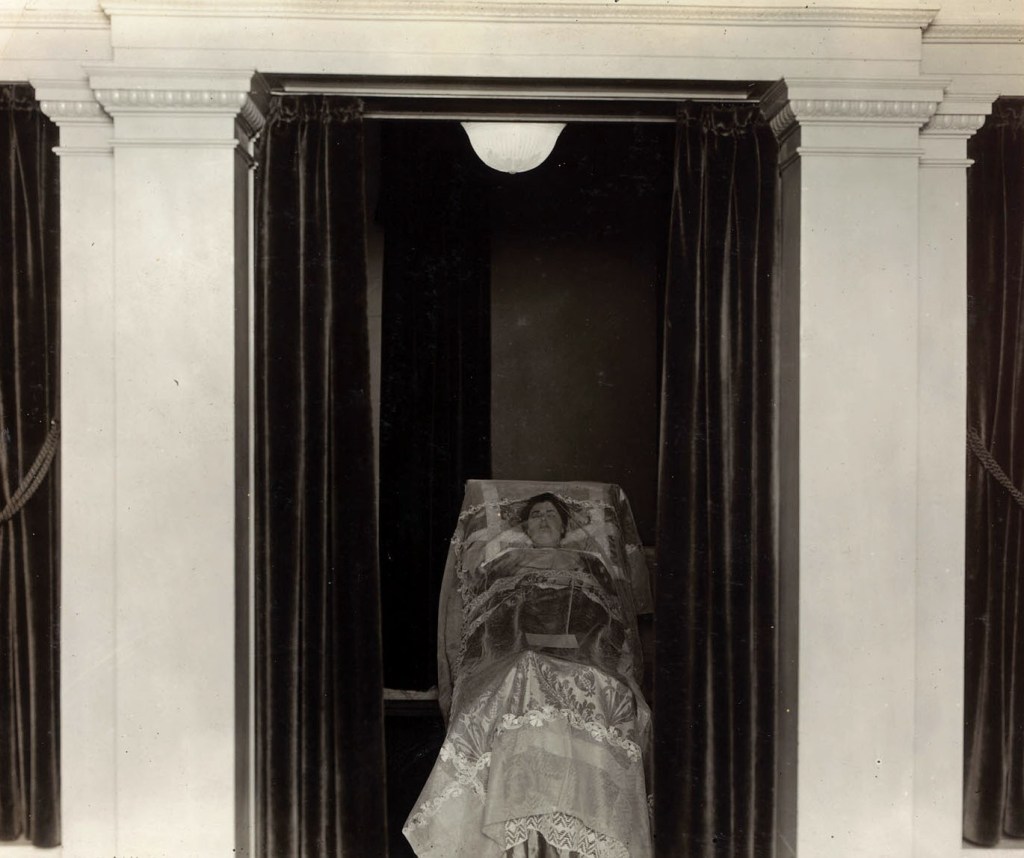
On Sunday morning, September 18, a line began to stretch from the entrance of Strother & Dayton, Argyle Avenue and Hollywood Boulevard. The Los Angeles Times estimated that 3,000 people filed past Rappe’s open casket. The San Francisco Examiner rounded the number to 8,000 people!

The most accurate estimate was kept by mortuary employees. Writing home to his parents in Iowa, Leonard Collenbaugh, a young undertaker who prepared Rappe’s body, described how he and his coworkers, on seeing all the people outside, posted a man at the entrance of the chapel to keep a head count. Another was posted at the exit to keep the nearly 4,000 mourners moving in an orderly fashion.[1]

At some point, however, Rappe’s manager, Al Semnacher, the man who had chauffeured her to San Francisco for her fatal Labor Day holiday, thought that not enough Hollywood people were there, especially people who knew Rappe. One exception was the the actress Mildred Harris, the estranged first wife of Charlie Chaplin.

At Arbuckle’s Labor Day party, the guests noticed that he and Rappe were virtually tete-a-tete most of time, talking and laughing. Perhaps during their conversation, the Chaplins’ divorce made for some of their bright conversation. Harris demanded $100,000 in alimony from Chaplin, who had just left for Europe after escaping being served papers by jumping onto a moving train with the nimbleness he showed on screen.

Arbuckle’s friend and onetime protege Charlie Chaplin had married Harris when she was still sixteen and their public parting of ways made for amusing stories in the newspapers in early September, that is, until the news about Rappe’s death dwarfed any interest in the Little Tramp’s personal life.

Mildred Harris (Calisphere)

When Mildred Harris arrived at the funeral home, the crowd was held back so that she could approach Rappe’s body. Harris observed the corsage bouquet of roses, lilies, and orchids placed in Rappe’s hands. Harris had sent the arrangement, Still addressed as “Mrs. Chaplin,” the young actress was allowed to kneel and pray by the coffin in private. After five minutes, she rose and said that she wanted Rappe’s body dressed in something other than a shroud for the burial the next day. She went home and brought back an evening gown, designed by Rappe for Harris to wear, of white georgette, over crepe de chine, with white lace and green silk ribbon. “It is the last gift I can make to one I loved,” Harris said to reporters.

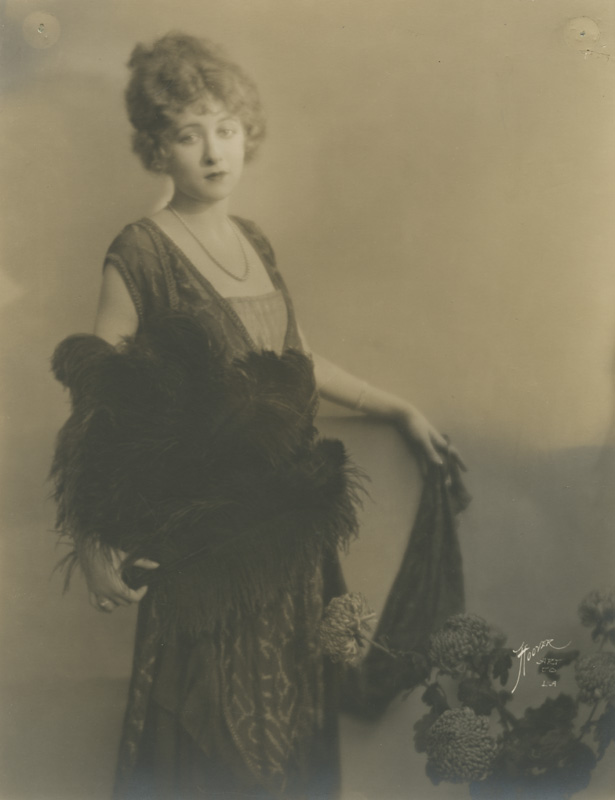
Virginia Rappe, September 18, 1921 (Calisphere)

[1] “Iowan at Rappe Funeral,” Webster City (Iowa) Freeman, 24 October 1921, 3.

100 Years Ago Today: Henry Lehrman’s 1,000 tiger lilies for Virginia Rappe (and a fur for his Follies girl), September 17, 1921

On Saturday morning, September 17, 1921, Arbuckle woke once more inside cell no. 12 of San Francisco’s Hall of Justice, having been denied bail the day before. A murder charge still hung over his head as he sat on the edge of his cot. It would be determined over the coming days at a preliminary investigation in a special Police Court session the known as the “Women’s Court,” which limited the intimidating number and often rude behavior of male spectators.

Meanwhile, on that same morning, in Los Angeles’ Central Station, a reporter witnessed the lid removed from the crate in which Rappe’s silver coffin had been shipped. But what he saw first was the striking orange blanket of a thousand tiger lilies.

The casket of Virginia Rappe and the tiger lily blanket (American Florist)

The flowers had been ordered by Rappe’s putative fiancé, Henry Lehrman, from San Francisco’s master florist, Albert O. Stein at the cost of $150 (over $2,200 adjusted for inflation).[1] The choice of such flowers had been deliberate—and, perhaps, at the suggestion of Mr. Stein whose work in floral arrangements for funerals, public events, table decorations, altar pieces, chuppahs for Jewish weddings, and the like made him the go-to for making the best impression.

As Lehrman said to the press more than once already, Virginia Rappe had fought off Arbuckle “like a tiger.”

Two weeks later, in early October, Lehrman still neglected to pay the $150 invoice. But his checkbook was open for a mink coat, which he gave to his new girlfriend, a Ziegfeld Follies girl and aspiring actress, Jocelyn Leigh, who, like Rappe, was another Chicago native.

The check for $75 bounced, as Miss Leigh learned when she returned to the furrier to buy some accessories on credit.

Albert O. Stein was still trying to collect his fee on the day Arbuckle was acquitted in April 1922.

Jocelyn Leigh (Tattler, May 1922)

[1] See “Arbuckle Fate Up to Jury, Belief,” San Francisco Chronicle, 12 April 1922, 3.

100 Years Ago Today: Virginia Rappe returns to L.A., September 16, 1921

Before Virginia Rappe’s coffin was sealed, Lehrman sent his final instructions. “Tell her,” he wired, “Henry said that he still loves you; she will hear.”[1] One of Halsted’s morticians took care of whispering the sentiment into the dead woman’s ear.

This privilege might have gone to Maude Delmont, but her role as Rappe’s caregiver no longer extended to Rappe’s corpse, whereas Lillian Gatlin offered to accompany Rappe’s coffin on the trip back for the honor of doing so. Nevertheless, Delmont was miffed that she had been denied the chance to chaperone Rappe’s body given the devoted attention she had provided when she was alive. She quoted a tactful telegram from Lehrman thanking her for the courageous manner in which she had “defended unfortunate Virginia” and that it was his most sincere wish that she go with Rappe’s body.[2] But, as the state’s star witness, Delmont was stuck in San Francisco and the District Attorney’s office could hardly risk her disappearing.

Outraged at Lehrman’s last minute decision to ask Lillian Gatlinto accompany the body on the trip, one made behind her back, Delmont shouted at reporters, “She shall not go”. “There will be serious trouble if she tries to. She did not know Virginia Rappe.”[3] But Delmont’s willingness to sign a murder complaint against Arbuckle now meant it was impossible for her to leave San Francisco for the immediate future. A policewoman had been assigned to watch her, not only to prevent witness tampering but to prevent the witness from disappearing.

On Friday afternoon, September 16, Rappe’s coffin was taken by hearse to the Southern Pacific’s Third and Townsend Depot.[4] There Gatlin purchased a first-class ticket for herself and one for the body to be stamped corpse. For the deceased to travel by first class was not an extravagance but rather a railroad regulation. But the corpse’s accommodations were hardly that of a Pullman car. The silver coffin was placed inside a large pinewood crate, which was nailed shut, and loaded into one of the dark green baggage cars of Owl, the Southern Pacific’s night express to Los Angeles.

For most of the journey south, the train lacked the scenery that the coastal route took and mostly traveled in darkness before it pulled into Los Angeles’ Central Station by mid-morning. The Los Angeles Examiner found a headline (“Tears, Flowers, Friends, All Are Missing”) in what little ceremony there was to sliding Rappe’s coffin, enclosed in a plywood box, from a baggage wagon into the back of a waiting white hearse. The mortuary workers did take the trouble to display Lehrman’s blanket of 1,000 tiger lilies. The choice was deliberate—for he said to the press more than once that Rappe had fought off Roscoe Arbuckle “like a tiger.”

In gold letters, a white ribbon draped across the lilies read: “To My Brave Sweetheart, From Henry.” The poignancy of Rappe’s neglect—and penury—was also taken up by a brief editorial in the Los Angeles Times, which noted that a “flood of light is shed on the lives of the pretty, highly dressed movie-picture stars by the fact that when Virginia Rappe died as the result of her injuries in San Francisco, there was not a penny in sight to prepare for her burial. She was absolutely broke.”

Thirty minutes after Rappe’s coffin arrived, Arbuckle’s manager, Lou Anger, and his lead defense lawyer, Frank Dominguez stepped off the Lark, the train that took the Southern Pacific’s coastal route. If they saw Rappe’s body being picked up at the train station, no one would know anyway, for they refused to answer any questions directed at them.

Virginia Rappe’s coffin being loaded into a hearse (Calisphere)

[1] Burton L. Smith, “Arbuckle to be Tried on Charge of Murder [. . .] Body of Virginia Rappe Is Being Brought to Los Angeles,” Los Angeles Times, 17 September 1921, 1.

[2] Ibid.

[3] Ernest Hopkins, “Tragic Return of Body Marks End of Trip Virginia Rappe Planned for Pleasure,” Akron Beacon Journal, 16 September 1921, 25.

[4] The following is corroborated in Arthur Turney, “Unescorted Body of Virginia Rappe Is Received in L.A.,” Los Angeles Evening Express, 17 September 1921, 1; “Rappe Girl’s Body to be Shipped to Los Angeles Today: Will Be Accompanied by Lillian Gatlin, Scenario Writer and Friend,” San Francisco Chronicle, 16 September 1921, 6; “Pen Points by the Staff,” Los Angeles Times, 18 September 1921, 20; “8,000 at L.A. View Body of Virginia Rappe,” San Francisco Examiner, 19 September 1921, 3; “Thousands Pass Before Bier of Virginia Rappe,” Wichita Daily Eagle, 19 September 1921, 1; “Mob Blocks Traffic at Hollywood,” Los Angeles Record, 19 September 1921, 1, 2; “Virginia Rappe in Final Rest,” Los Angeles Times, 20 September 1921, 2.

100 Years Ago Yesterday and Today: S.F.’s “Bird Girl” rescues Rappe’s body from neglect

[An intractable WordPress coding error had required us to repost this entry from 9/15.]

When Henry Lehrman put Virginia Rappe on a pedestal, remembering her as “clean, decent, high-spirited,” he could ill afford to step off his moral high ground in Manhattan and return to the West Coast. It would take him three days to reach San Francisco, longer than it would take to bury Rappe, and then another three days to return. Even at a whirlwind pace, Lehrman would need nearly two weeks for the trip as well as the funds on hand. He could afford neither. His contractual obligation to finish an Owen Moore comedy in New York gave him cover to avoid making the expected public appearance to mourn his erstwhile lover.

Still, Lehrman could “direct” Rappe’s final appearance via long-distance telephone calls and Western Union telegrams. He could take advantage of the sympathy extended to him by Sidi Spreckels, Maude Delmont, and people in Hollywood who had worked with Rappe and admired her, including his protégé, Norman Taurog, who offered to interrupt the directing a motion picture to handle the funeral arrangements in Los Angeles.

While Rappe’s body laid in a morgue and in the cold storage of a mortuary, Arbuckle made headlines, some ink was spared for Rappe’s memory and her status as a victim, a woman who died young, in the prime of her life. The newspapers reported that her body was still unclaimed as the new week unfolded despite her having “friends numbered by the scores” and being “one of the prettiest members of the Los Angeles film colony”—whose beauty the embalmers and cosmeticians of Halsted & Co. had restored as best they could because such matters couldn’t wait for instructions or payment.[1]

Fortunately for Lehrman, the spectacle of Rappe’s seemingly unwanted and orphaned corpse was avoided when someone unexpected stepped forward to represent him and give his “loved one” her due, the writer and aviatrix Lillian Gatlin, the first woman to fly across the United States and the “bird girl” of San Francisco.

Gatlin may have associated with Rappe in Los Angeles, where Gatlin once worked as a scenario writer. They met earlier, however, at the Panama-Pacific Exposition in 1915. That same year, Gatlin lost her lover and flight instructor, Lincoln Beachey, when he crashed into San Francisco Bay before thousands of horrified onlookers. On the first anniversary of his death, Gatlin flew over the spot where Beachey died and dropped a bouquet of roses. She made her rose drops an annual event and these became the centerpiece of San Francisco’s Aerial Days, which Gatlin expanded to honor American airmen killed during the First World War. 

Lillian Gatlin (Calisphere)

Gatlin may have regarded Rappe as an honorary bird girl herself for being the first Vin-Fiz girl. But Gatlin’s motivations for caring about Rappe’s body were really in keeping with her favorite charity, the Silent Big Sisters, which assisted young unmarried mothers and their babies. Although Rappe wasn’t a mother, there was something no less pathetic about her situation in death.

When Gatlin learned that no flowers had been displayed around Rappe’s body, she had two long-stemmed roses placed like guards at either side of Rappe’s bier. With that and a large bouquet from a person who wished to remain anonymous, a public viewing of Rappe’s body could take place and soon women and girls filed past the open casket. The visitation, however, quickly came to an end as the long lines and crowds outside Halsted’s forced the mortuary to close its doors.


[1] “Tragedy Victim Is Sent Home,” Los Angeles Times, 17 September 1921, 2.