. . . is no excuse to run so silent and deep. Furthermore, there hasn’t been a post in two months and a progress report must be dashed off.
Of course, the holidays and family obligations took place. But, during that time, the manuscript was hardly neglected. The third part, devoted to the first trial of November–December, was revised and then edited down by 25 percent. That way, busy readers will not be impeded in block quotes that once seemed fascinating and worth sharing in toto. This process was also necessary for publishers. They don’t employ the kind of editors of a century ago, when Scribners made Hemingway and Wolfe and the like sound “lean and mean.” And publishers are very much allergic to manuscripts that have obvious negative commercial qualities, that is, thickness, which triggers a semiconscious resistance to being pulled away from the tactile pleasure of one’s smartphone for too long. Thus, much “scaffolding,” that jungle gym for one’s inner voice, was also removed, all that compositional writing necessary for a complex topic.
There is plenty of drafted manuscript to go—meaning the other two trials and the aftermath. Even so, there is progress in continuing to move backward and making judicious cuts to the second part, “Roscoe,” which deals with the arrival of Arbuckle in San Francisco, where he stood on Labor Day 1921 as an entertainer, and the arrival of his guests. This segues into the infamous party, during which Virginia Rappe received her fatal injury.
The rest of this month will be spent on the first part, revisiting “Virginia,” which was, admittedly, a kind of love letter to write in that a very different and real person emerges, rather than the “fallen woman” who ruined Arbuckle’s career. That will squarely rest on his shoulders—or more to the point, his girth—and Miss Rappe’s midriff. Their misadventure can be attributed to haste in consummation or lack thereof, this before his self-appointed minder, Mrs. Mae Taube, came back upstairs from where she had parked herself on the first floor of the St. Francis Hotel (most likely the Fable Room, a tea room set aside for ladies).
Incidentally, Mrs. Taube, the mysterious lady who figures so much and so little in other Arbuckle narratives, had a female companion with her who remained studiously unidentified. We’ve been toying with the possibility that she was Bebe Daniels. Both were always close from 1921 onward if not earlier, until Miss Daniels moved to England after the war. (There are posts here that address Mrs. Taube in some detail. She is just as much the femme fatale as Virginia.)
If anyone has some information to help or set aside dots that should not be connected, let us know.
There was also a men’s-only safe space in the St. Francis Hotel, the Far Western Club, on the third floor. Sophie Tucker once entertained members there to raise funds for sending doughboys cigarettes. The comedy director Fred Fishback was a member—or friend of one—and slept in room 373 rather than in room 1219, which he shared with Arbuckle, and where Virginia Rappe was found in her distress, to put it mildly, in the bed where Fishback slept the night before.
If someone knows about the Far Western Travelers’ Club and what went on there—it had to be closed in 1922, from what the newspapers suggest—could you share your thoughts privately.
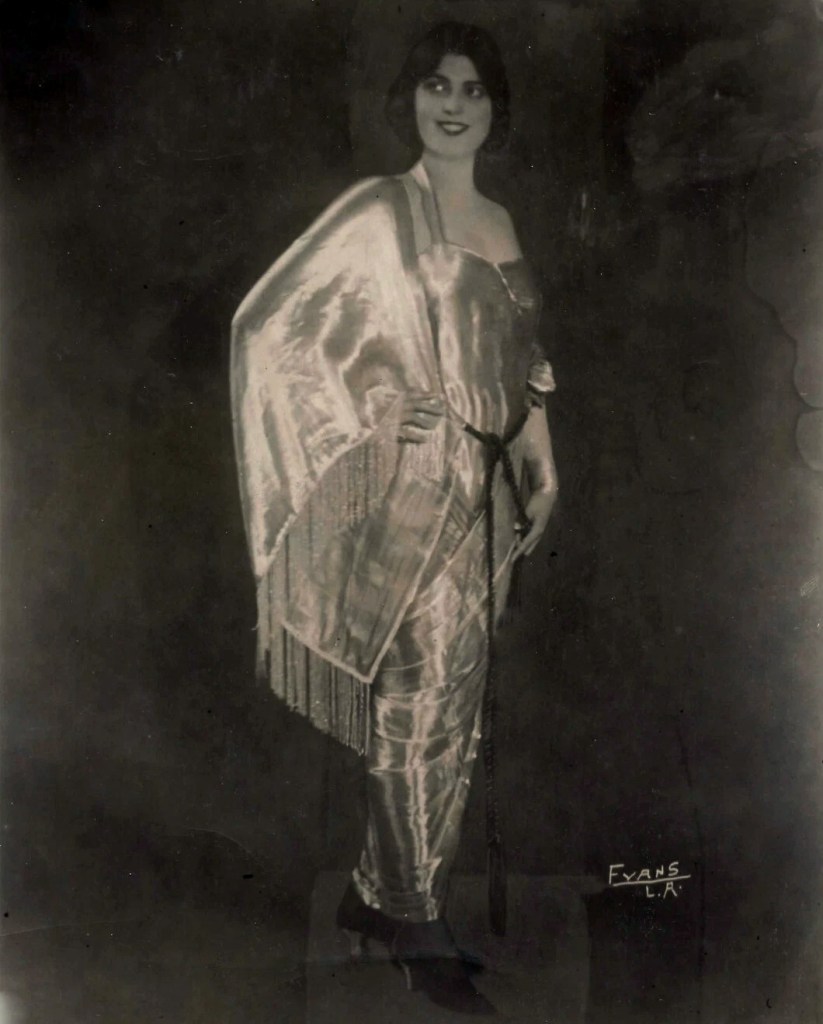
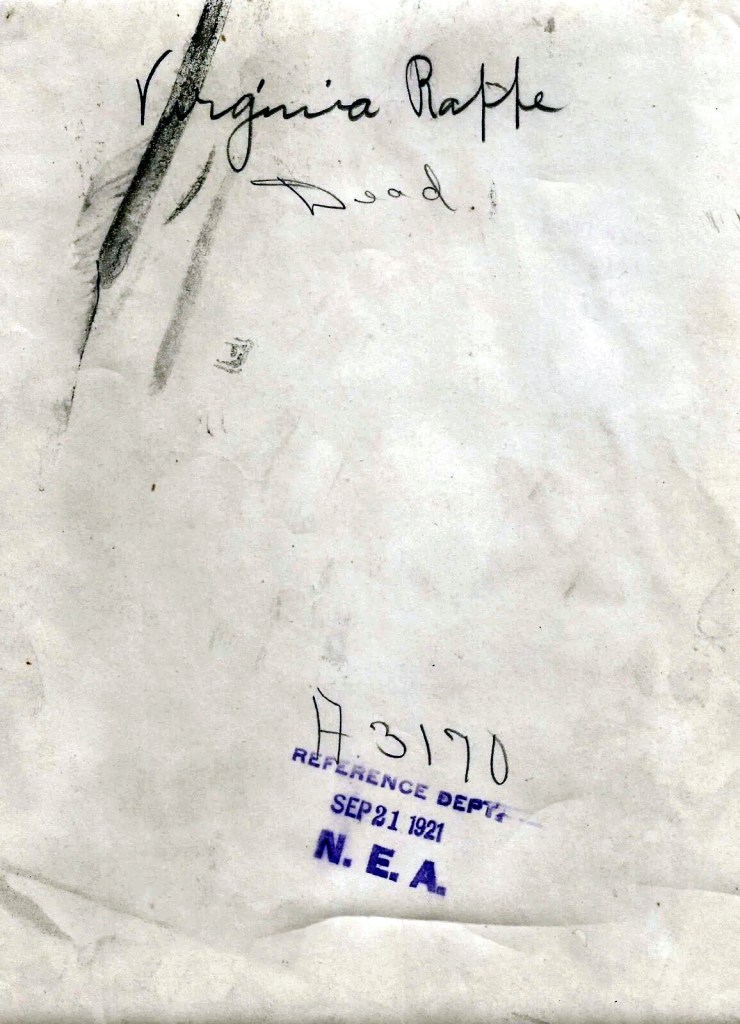
The obverse of the N.E.A. photograph, Virginia Rappe in a shimmering cocktail dress and French heels. (There are better reproductions of this Nelson Evans photograph. As for a date, given the gown and Rappe’s hair, this image is his late work, likely dating from mid-1921, a year before his death.)
 Spite Work: The Trials of Virginia Rappe and Fatty Arbuckle