The Arbuckle trial transcripts provide a few clues about this bangle as to what it looked like and how it was worn. The prosecutors made little issue of the so-called armlet or arm bracelet. Arbuckle’s lawyers, however, wanted juries to see the bruises on Virginia Rappe’s right bicep attributed to the bracelet and not caused by a hand gripping it tightly, namely Roscoe Arbuckle’s, as he struggled with her in room 1219 of the St. Francis Hotel in San Francisco.
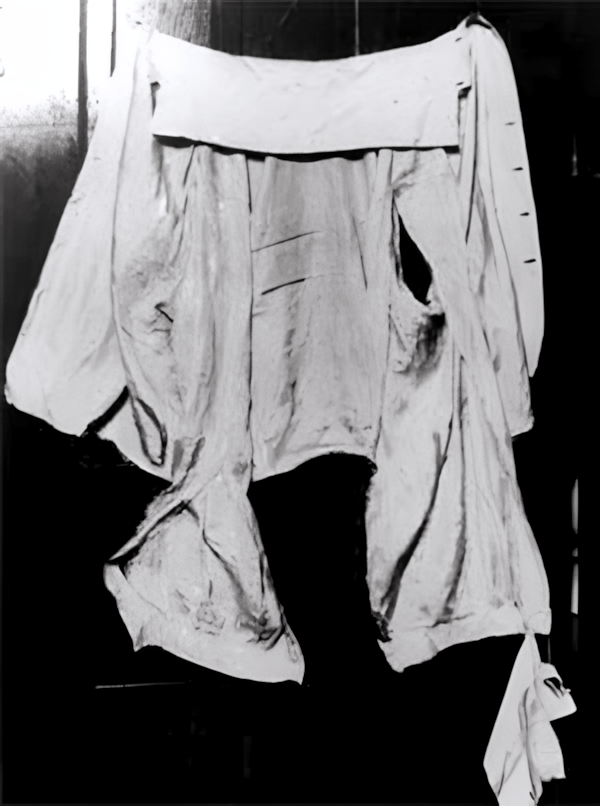
The bracelet in the manuscript of Spite Work is a kind of MacGuffin. But how could such an object inflict a bruise? That is one thing. The other is how did Rappe wear her bracelet in the first place. On Labor Day, September 5, 1921, she wore a long-sleeve silk shirtwaist. A photograph exists of this garment, which shows the sleeves and cuffs, which required cufflinks. So, any bracelet worn on the right arm would have to worn outside the sleeve, which would seem unconventional. If worn underneath, then the object takes on a rather decadent aspect, suggesting Rappe wanted the arm bracelet to teasingly appear after she disrobed, if that was expected of her. She was, after all, a “junior vamp.” (Incidentally, no brassiere was found.)
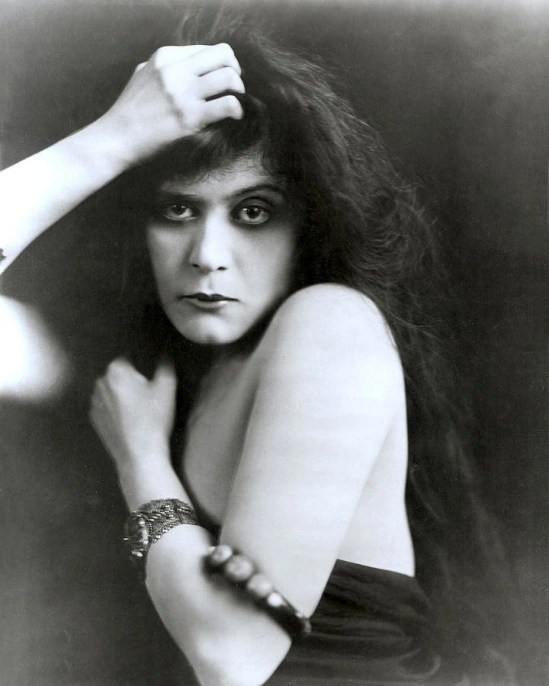
Theda Bara wearing an arm bracelet like a true vamp of the Silent Era.
There are two descriptions of where the bracelet was worn. Maude Delmont, Virginia’s companion at Arbuckle’s ill-fated party, described seeing the bruising on the upper right arm where the bracelet had been—“worn across the arm.” Maude, as she is affectionally called in Spite Work, had a rather idiosyncratic line of sight. One of Arbuckle’s lawyers, Frank Dominguez, satirized her ability to see around corners and into Arbuckle’s bedroom. Putting that aside, “across the arm” suggests just above the elbow.
During the second trial, Alice Blake, one of the showgirls who served as a star witness for the People, saw the bracelet worn above the elbow during the course of the early afternoon and when Virginia had presumably still been dressed, which is not a given. So, the mystery still remains as to where she wore her bracelet, inside or outside the sleeve.
The second trial is also the venue in which we have a description of the bracelet. Assistant District Attorney Leo Friedman showed it to Alice Blake. “I call your attention to this round jade or green glass bracelemt, or armlet,” he began, “and ask you if that resembles in shape, size, and appearance the braclet that you saw upon the arm of Miss Rappe?”
So why is this important to the narrative? (1) To dress Rappe as close as possible to how she appeared on Labor Day 1921; (2) to write objectively about the prosecution’s adherence to a struggle between Arbuckle and Rappe; and (3) to stress test the defense hypothesis that Virginia had been bruised by her own bracelet. Arm bracelets, of course, don’t bruise on their own. Pressure would still have to be applied, say, from a fall or some other misadventure, moving a body from one place to another . . . It anticipates the late Johnnie Cochran in regard to “the glove” defense, albeit applied a bracelet, and inspiring this paraphrase:
“If it’s a tight fit, you must acquit.”
The remains of Virginia Rappe’s shirtwaist from a photograph published in many newsapers during the second week of September 1921. As a matter of discretion, of course, newspapers did not run photographs of her panties.
Slipped between the pages of the Arbuckle trial transcripts are some folded sheets of papers. One letter caught my eye. The letter writer seemed like a very serios fellow given his strong opinions on the Arbuckle case. Miley B. Wesson (1881–1981) was a pioneering urologist, especially new field of urologic roentgenology in the treatment of cancer during the 1920s and ’30s. He also received a Carnegie Hero award in 1932 for saving a woman’s life during an operation. She had grabbed hold of a copper wire attached to an X-ray machine with current of 30,000 volts. Dr. Wesson managed to knock it out of her hands. He not only electrocuted himself. He stood up and finished the operation. By then he was already an author of many articles on urology, including rupture of the human bladder. Indeed, Dr. Wesson would have made a perfect medical expert for the Arbuckle trials, namely for Nat Schmulowitz, the defense lawyer who specialized in examining and cross-examining the physicians who took the stand—and the recipient of Dr. Wesson’s letter of December 3, 1953.
Nat Schmulowitz and friend, Phyllis Diller[1] (Courtesy of the San Francisco Library)
Dr. Wesson was hardly ambiguous about which side he took. “Your understanding of the medical side of the case is most interesting,” he wrote. This is true. Even the prosecutor, Assistant District Attorney Milton T. U’Ren, whose sarcasm in the transcripts is hard not to miss, admitted that Schmulowitz had virtually become a medical expert himself in defending Arbuckle. And Wesson’s next sentence could almost have been directed at U’Ren himself, who, in kind, became something of an expert in dactylology, given how much faith he had in H. O. Heinrich in identifying the Arbuckle’s fingerprints superimposed over those of Virginia Rappe, suggesting that she had struggled with him as she tried to leave his bedroom in the St. Francis Hotel through hall door.
“The criminologist, Heinrich, I believe,” Wesson continued, “was a big faker. I have been interested in two cases in which he testified at great length and was 100% wrong in all ways.”
So much for the “American Sherlock.” I have written Heinrich’s biographer. Perhaps she can shed some light on this controversial man. My book, of course, sees him as a very serious man—and one would think that Dr. Wesson, too, is a very serious fellow.
What caused me to take pause—and, perhaps, Nat Schmulowitz over seventy years ago—was the paragraph that follows his remarks about Heinrich. I have read a lot of nineteenth-century medical literature on ruptures of the human bladder, especially in the rare instances when a woman suffered this injury that in the past always resulted in peritonitis and death. The cases that stood out were those caused by falling over a footboard or the edge of a washtub. Arbuckle’s bedroom in the St. Francis, room 1219, had such rocks and hard places, made of brass rails and cast iron, respectively.
What follows suggests that Wesson was intimate with the physicians who not only treated Rappe (Arthur Beardslee and Rumwell), but conducted her autopsy (Dr. William Ophuls). I can almost see them getting together, no longer beholden to a criminal trial and the rules of evidence. But Wesson gets two names wrong. Rappe was never diagnosed with the clap.
Mel Rummell [sic] gave me his notes of the case, and I discussed it with Drs. Ophuls and Beardsley [sic]. I have reported this case on two occasions without mentioning any names. The girl had a urethral discharge, and the doctors jumped at the conclusion that she had gonorrhea. She was catheterize when first seen, and her bladder contained 6 ounces of urine. For that reason the doctors and pathologists were amazed when they found that there was a hole in the bladder. It was a pinpoint opening in the dome of the bladder which had been sealed by a tag of omentum. Dr. Ophuls said that he caught the partially filled bladder in his hands and squeezed it as you would a rubber bulb, and the tag separated form the bladder, and there was a pinpoint stream of urine ejected.
The omentum refers to a fold of peritoneum, that tissue that protects the internal organs, which is attached to the bladder. Presumably, the pathologist, Dr. Ophuls, had already removed the bladder and a piece or “tag” of this tissue. Dr. Wesson makes it sound rather playful as to what happened next, as if Dr. Ophuls was squirting the dead woman’s pee from a defective water balloon.
Dr. Ophuls never described such conduct on the stand. The pinhole, in testimony, was a tear that allowed Rappe’s urine gush inside the peritoneum, where it caused the massive infection that killed her.
The urine, according to the physician who catheterized her, Dr. Beardslee, was described as “scant.”
Of course, Milton U’Ren—the irony of that name!—could have “encouraged” Drs. Ophuls and Beardslee to be cooperative state’s witnesses in ways we will never know. (Rumwell testified for the defense.) I do consider U’Ren’s highhandedness in my book. But both physicians agreed that a very real insult to Miss Rappe’s bladder had taken place. Dr. Wesson doesn’t get into that. He goes on to blame the tumblers the St. Francis Hotel provided in keeping with Prohibition and in lieu of glassware for cocktails—and Rappe herself.
The girl had drunk 3 pint glasses of equal parts of gin and orange juice without going to the bathroom. She was thought to have fallen on the side of the tub. A sudden jar will rupture a bladder. A slow steady pressure will not. This woman had lived an active sexual life for many years. For that reason it was stupid to talk about Fatty Arbuckle hurting her with intercourse. She came to San Francisco with her gigolo. He left a bill of about $150.00 for flowers, and she bought him a pair of cuff links which were not paid for. They were bad people.
Dr. Wesson, a urologist, should not be unfamiliar with the undulating motion of coitus and the effort of a man, Arbuckle, who suffered from episodes of ED. Had he been a veterinarian, he would know that many a cow and ewe suffer ruptured bladders due to the animal exertions of their partners. Something like this, purely a misadventure, between humans—albeit very rare—is what animated Mr. U’Ren and the other prosecutors.
The “bad people” he means here, in addition to Rappe, include Al Semnacher, a booking and talent agent, who could be seen as a pimp if he had steered one of his actresses into a situation where she needed to “close her eyes” and think of anything-but-Central-Casting. The flowers and cufflinks refer to another man, Rappe’s boyfriend, the comedy director Henry Lehrman. It is true that Lehrman didn’t pay for the many tiger lilies that served as a drape over her coffin and grave. As for the cufflinks that were gifted to Lehrman, Rappe paid for those with her own money.
I have to wonder if Dr. Wesson wanted to write about the Arbuckle case. He had traveled to Los Angeles to ask people about Arbuckle. There someone told him that Arbuckle had been “ruined by this trial and ended as barker in a midway in one of the nearby towns,” which is in keeping with other legends (such as the one Randall Jarrell invented for his famous poem “The Player Piano,” in which Jarrell imagines Arbuckle having once “drove the El Molino bus” up and down Pasadena.) Schmulowitz’s annotations are “Not true” in regard to the comedian’s sideshow career and “True” in regard to his being ruined. Yet how does this explain the 1923 Mercer belonging to Jay Leno that once belonged to Arbuckle?
I wonder if Schmulowitz considered Dr. Wesson just another crank, the kind who will never make that uphill climb of the learning curve that is the Arbuckle case. Inideed, a postscript suggests something personal about his animus toward Rappe. Wesson had lost a bitter alimony suit between him and the first Mrs. Wesson. Despite documenting his wife’s drinking, he still had to pay her.
P.S. Fatty Arbuckle and Bill Hart were probably two of the cleanest movie actors ever in Hollywood, and both ruined by mercenary lying women.
[1] Ms. Diller was a gracious contributor to my biography of the poet Weldon Kees, Vanished Act (University of Nebraska Press, 2003).
The new manuscript is now well informed by the trial transcripts. The next part of the book still needs to be written, devoted to the Arbuckle–Rappe trials—and they are both on trial in this book. But any verdict will be handed over to the reader with some new ideas to consider. This, I guess, makes the reader a metajuror and, in keeping with that duty, we might look at how one of the original jurors was selected in November 1921. I cannot devote a lot of space to this, even though I am a trial junkie now. You can see how virtually everything is played out in advance of the first day of testimony. Indeed, writing about them will be like writing about a formality.
Let’s look at Mrs. Helen Hubbard. Her single vote of guilty caused a hung jury and forced the Arbuckle case to continue into 1922 and two more trials. The film historian Joan Myers took special interest in Mrs. Hubbard in her essay, “Virginia Rappe & The Search for the Missing Juror,” which, I believe, dates back to before 2013. But Ms. Myers could only go by newspaper accounts.
That Mrs. Hubbard served on the first Arbuckle trial jury stands out because she was the wife of a lawyer. She had once worked for a law office in Toledo, Ohio, before her marriage and worked for her husband’s growing practice, which dealt mostly in civil law. By 1921, however, she preferred to be a homemaker and bridge player. She was good enough to teach other women how to play as well and participate in bridge tournaments.
Mrs. Hubbard proved to be competent on the stand when first examined by Assistant District Attorney Milton U’Ren, her answers were quick and without hesitation, even when tested. She surely knew how to answer a question in such a way as to be disqualified and so avoid such an interruption to her life.
Q. Now, Mrs. Hubbard, if Mr. Hubbard were the District Attorney of the City and County of San Francisco, entrusted with the prosecution of this case, would you like to have him try the case before twelve jurors who were in your present frame of mine? A. Yes, sir. Q. You would think in that cast that he would have a fair and impartial jury? A. I think he would. Q. And if, on the other hand, some person near and dear to you were charged with a crime and placed upon trial, would you be willing to have them—be willing to have that person tried by twelve persons in your present state of mind. A. I would.[1]
Although Mrs. Hubbard later professed a reluctance to serve as a juror, her crisp replies to U’Ren suggest otherwise. Indeed, until her vote, she was seen by the prosecution and defense as an ideal witness. Reporters who kept an eye on her in the jury box couldn’t get a read on her. (The poker face, presumably, owing much to her preferred game.)
Arbuckle’s lead counsel, Gavin McNab, asked different questions, prefaced, interpolated with parentheticals, and more often wrapping around their point. His required much more concentration not only from the juror, from by the other lawyers. McNab, however, had to tease out any female talesmen who might sympathize with women’s groups that wanted “Fatty” Arbuckle punished, namely San Francisco’s Women’s Vigilant Committee.
This organization, in the context of the Arbuckle trials did not police the “immoral” behavior of women but rather served as observers of how female witnesses were respected on the stand. The WVC also wanted justice served if Arbuckle case revealed a high-profile example of violence toward women. Some members of the WVC wanted to see another amendment, as important as the eighteenth, that guaranteed “the right of every woman to become intoxicated in personal safety. [. . .] If a man gets drunk, it is regarded as his liberty. If a woman does the same thing, society, like the Romans of the Coliseum, is willing to turn the wild animals upon her.”[2]
Despite U’Ren best efforts to get in front of the “clubwomen” issue, McNab didn’t waste time with his first question and making them the issue.
Q. Mrs. Hubbard, the District Attorney has asked you somewhat extensively about women’s clubs and their part in the case. It does not create any prejudice in your mind because the defendant and his counsel prefer to be tried by a sworn jury, and his Honor presiding, rather than the emotions of any club? A. No, sir.
U’Ren did not let this go. “Well, we submit that is an improper question, if your Honor please, and argumentized,” he said to Judge Harold Louderback. “We do not know what is in the heart or mind of the defendant. It is understood he is to be tried by a jury.” The judge allowed for the question but said it was “rather farfetched” and admonished McNab for not framing his inquiries “so as they could be answered with less trouble.”
McNab abided by this warning and simply asked questions about “the mechanics of a trial.” Then he asked her a question that was posed to every talesmen, which foreshadowed the strategy Arbuckle’s lawyers took. (The so-called “blackmail plot” involving Bambina Maude Delmont had long since been cast aside. I have a theory for canard in the book—and it is a canard.)
What McNab did here was to try the case in a set-piece, presenting the defense’s theory about Virginia Rappe’s fatal injury as self-induced over many years of illness and immorality, despite promises made to the contrary.
Q. In the trial of the case, Mrs. Hubbard, it may be the duty of the defense to present evidence as to the physical condition of this young girl at various times in her life. She came to her death through a ruptured organ, an ordinary physiological occurrence, and it may—the defense may present testimony covering many years, to show that her condition, that that might haven at any time—
“Just a minute,” U’Ren interrupted from his end of shared counsel table (which weren’t divided into two in 1921). “We are going to object to that question, because, first, it is involved and complex and in the second place, if your Honor please—”
Then U’Ren was interrupted himself by Nat Schmulowitz, McNab’s chief assistant. “If you will just wait until the question is completed—
“Mr. McNab is conducting the examination,” replied U’Ren condescendingly, “and I am attempting to make an objection, and I thought the question had been completed, but the vice of the question is apparent already, when counsel says that the ruptured bladder is an ordinary physiological condition. I do not know whether he really meant that, or not, but that is assuming something that is not true.”
And so it went for Mrs. Hubbard. The examination of the jurors was, as many reporters pointed out, had all the hallmarks of the trial to come. There were also many curiosities for us to parse. McNab used the words “wine party” to describe the drinking of good scotch and questionable gin at Arbuckle’s Labor Day party. The word “wine” was a polite way to refer to the comedian’s violation of Prohibition. But the word, in an obsolete sense, also meant any fermented concoction. So, U’Ren would not have objected. He did question Mrs. Hubbard again in a brief redirect and one of his questions was no less longwinded than his counterpart’s—and McNab prompted it when he asked, “You understand that no one is supposed to own a witness, neither side, Mrs. Hubbard?”
This was in reference to the District Attorney Matthew Brady’s controversial policy of isolating his star witnesses, Alice Blake and Zey Prevost, for nearly two months prior to the trial, so as to prevent them from being influenced by Arbuckle’s lawyers through third parties. The prosecution had to ferret out problem jurors who might take to heart McNab’s statements “as evidence that these witnesses were put in cold storage or upon the grill”—yet another feature of all three trials, reaching a crescendo of sorts in the second trial, when much of the local press was aligned against the prosecution.[3]
Q. Now, if it should appear in this case, Mrs. Hubbard, that the District Attorney had certain information which led him to believe that certain of the witnesses who were to be called to testify for the State, were being approached by someone with propositions to change their testimony, and with their consent, he took the precaution of placing them in the care of an estimable lady in this city and count, would the fact that the District Attorney had taken such precautions prejudice you against their testimony? A. No, sir.
Not all of Mrs. Hubbard’s answers were so yes and no. She did give a few personal details in some. She liked to go to the picture shows and was familiar with Arbuckle comedies, albeit not particularly a “fan.” That he played “funny parts” didn’t make her think that he was incapable of committing a criminal act on a woman.
I’m not so sure.
A still from Fatty’s Wine Party (1914)
[1]People vs. Arbuckle, First Trial, “Examination of Talesmen,” pp. 248ff.
[2] Alma Reed, “Right of Women to Personal Safety Urged by Club,” San Francisco Bulletin, September 15. 1921.
[3] There really should have been no controversy, for McNab himself was able to meet with Miss Blake after her mother took her home in early November. This forced Brady to let Prevost go home as well.
During the second Arbuckle trial of January 1922, the District Attorney of San Francisco, Matthew Brady, subpoenaed a witness who shed light on the comedian’s conduct in the immediate aftermath of Virginia Rappe’s during the early afternoon of September 9, 1921. This was Warden Woolard, a reporter for the Los Angeles Times. His purpose was to contradict Arbuckle’s testimony from the first trial in November on two points: (1) whether he had been alone in his hotel bedroom with Rappe; and (2) whether he had locked the doors. Although Woolard no longer had his notes, he had a good memory and was on the stand with much to tell.
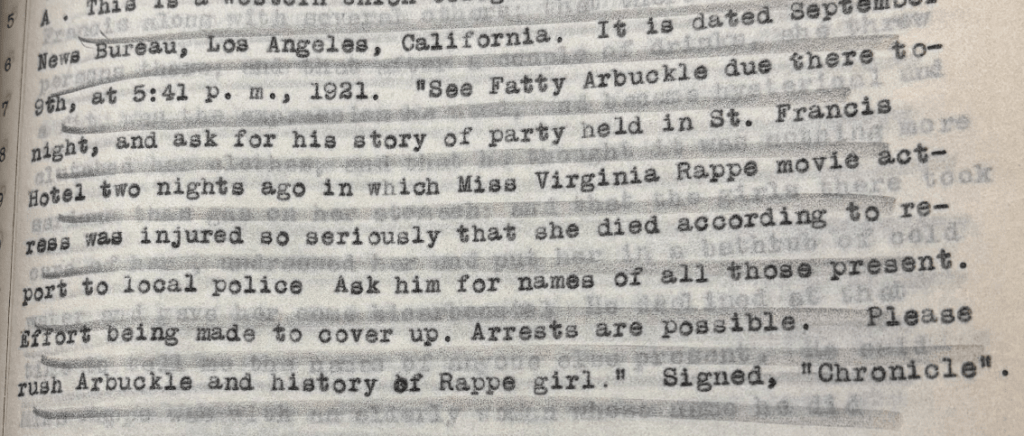
He was prompted to meet Arbuckle by a telegram from the San Francisco Chronicle. It was hard not to ignore its urgency—and both newspapers would sell plenty of copies by sharing information. The Chronicle wanted answers from Roscoe Arbuckle about his Labor Day party of September 5.
The Times sent Woolard to Arbuckle’s Tudoresque mansion on W. Adams Street. The reporter arrived arrived just after 7:00 in the evening. He rang the bell and was met at the front door by an attractive woman who identified herself as Arbuckle’s secretary. This was Catherine Fitzgerald (see “Arbuckle’s housekeeper, secretary and escort: Catherine Fitzgerald”). He gave her his card and she told him to wait outside.
If you are familiar with The Day the Laughter Stopped (1976) by David Yallop, who claimed to have used the trial transcripts to write his book, he describes a rather different scene on p. 132 that was surely intended for a screenplay that any assiduous research would have spoiled.
At 10:30 p.m. that Friday evening, Roscoe Arbuckle sat quietly studying the script for his next picture. The doorbell rang and his butler opened the door. Two dozen reporters charged past the butler, knocking him over. They poured all over the house, taking photographs and looking for Roscoe. Surrounding him, they began to fire questions based on the statements that had already been made in San Francisco by Maude and Alice. [. . .] “Is it true that you screwed five women during the afternoon?”
That is not how it went. According to Woolard, Arbuckle soon appeared. The comedian asked Woolard to follow him away from the house, so that they could talk in private. Arbuckle did not need to be told about what happened in San Francisco earlier in the day. Friends had informed him of Rappe’s death.* And, as their conversation began in earnest, the actor Lowell Sherman joined the two men on the sidewalk. He had apparently come from a back door. Arbuckle denied hurting Rappe. He had only pushed her down on a bed to keep her quiet. And so on. This is in Wallop, all taken from Woolard’s reportage the next day, September 10, as well as that of George Hyde of the Chronicle.
Arbuckle wasn’t “studying” the script for a silent film. Instead, Lowell and other partygoers were getting on the same page and had been getting on that page during the afternoon of September 9. And this continued into the night, when Woolard attended a meeting held in the office of Grauman’s Million Dollar Theater. What Woolard curiously omitted from his testimony was the presence of Arbuckle’s first lawyer, Frank Dominguez. The first thing he did was school Arbuckle with the understanding that anything he said needed to be made only with the advice and consent of counsel. So, I will attempt to square this in the work-in-progress. It may have simply been a courtesy extended by the journalist to one of the most important criminal defense lawyers in Los Angeles during the 1910s and ’20s, the kind of man you heard when he said, “I’m not here,” and you wanted to keep your job.
Warden Woolard did. He went on to enjoy a long and storied career, including assigning reporters to the Black Dahlia case. George Hyde, who likely wired the Times for the initial scoop and wrote the first columns about the Arbuckle case for the Chronicle, either resigned or was released soon after. He went on to testify at the third trial. But offered very little in substance. He came and went from the stand in minutes. His career took another direction. For a time, he worked for various newspapers in Los Angeles, including the Times. But he was never assigned to anything like the death of Virginia Rappe again. For a time he the publicity agent for the evangelist Aimee Semple McPherson. Eventually, he returned to San Francisco, where he poisoned himself in July 1932, “in a fit of despondency,” after a long period of unemployment.
Woolard read the text of the Chronicle’s telegram in open court. The underlining, suggesting its importance, was made by Arbuckle’s lawyer Nat Schmulowitz. (Courtesy of the San Francisco Public Library)
*This was really one “friend,” Rappe’s manager Al Semnacher. He may have monitored her decline, which provided more lead time for damage control. The problem for Arbuckle was his own hubris and the absence of his personal lawyer, Milton Cohen, Dominguez’s law partner, who was en route from New York during this critical time.
Milton U’Ren grinned, his teeth crooked and sharp in the long, lean face.
—Ace Adkins, Devil’s Garden
The hiatus in our blog entries is, of course, due to the holidays. But we are drafting one of the key chapters in the book, with the working title “Spontaneous Rupture of the Bladder.” What follows is the final argument of the first trial given by one of Roscoe Arbuckle’s most dogged prosecutors, Assistant District Attorney Milton U’Ren. Arbuckle case narratives—with the exception of Greg Merritt’s—don’t give U’Ren his due as an important figure in the three Arbuckle trials. Typically, if there is a mention of him, he is demonized, albeit as a minor demon. While many writers attribute some personal animus for Arbuckle on the part of District Attorney Matthew Brady, it is evident in the transcripts that it was U’Ren who was most determined to see Arbuckle brought to heel.
This hostility was noted during the first week of the Arbuckle trial, when U’Ren routinely referred to Arbuckle as a has-been.
Having no real political aspirations or agenda, U’Ren likely saw Arbuckle as an avatar of the sins of the motion picture industry. U’Ren was a Progressive Republican who shared Theodore Roosevelt’s belief that an unhealthy body betrayed unhealthy behavior. (Roosevelt, as a boy, took to heart being diagnosed as “suffering from a handicap of riches.) Then there is also the possibility that U’Ren wanted to avenge Virginia Rappe—a task that could hardly be left to Maude Delmont, a woman he saw as just another debauchee. But, lastly, and more likely, U’Ren was the father of two young daughters, aged five and seven. That motivation also applied to two others who regarded Arbuckle as an uninhibited predator. Matthew Brady’s only child was a daughter and Captain of Detectives Duncan Matheson also had two daughters.
On December 1, 1921, Milton U’Ren’s fellow prosecutor, Assistant District Attorney Leo Friedman, presented the first half of the prosecution’s closing argument. He was followed by Arbuckle’s lead defense attorney Gavin McNab, whose closing argument continued into the next day.
Otis M. Wiles of the Los Angeles Times thought “the dynamic and youthful prosecution attorney” had an effect on the jury. “For one hour and forty-six minutes,” Wiles wrote, “Friedman literally dragged Roscoe up and down before the jury of five women and seven men, nailed him to the cross of justice and pelted him with the defilements of his mental makeup.” Indeed, without using a rather new word for 1921, Friedman presented Arbuckle as a sociopath. But any “wounds” he delivered on the comedian, according to Wiles, “soon were alleviated by the healing power of McNab’s soothing syrup voice”, his “mellow Scotch accent,” and his “genial smile.”
A natural orator like fellow Democrat William Jennings Bryant, McNab could sway a jury with the force of his voice, figures of speech, and frequent allusions to American decency and the Bible. Most journalists at the trial sided with him and devoted more column space to his exposition.
Milton U’Ren’s was treated as footnote in most newspapers. We wanted to present as much of it as possible because the prosecution of Roscoe Arbuckle was very much U’Ren’s project and his contribution deserves to be restored. The following is taken from our work-in-progress. Without a transcript of the first Arbuckle trial—which exceeded 2,200 pages or 525,000 estimated words—we extracted quotations from the extant reportage, compared them, and harmonized them to render a narrative that comes close to the original language and order of each speaker’s address to the jury. This method is provisional and comes with caveats that all the quotations used are based on contemporary reporters’ notes. Their objective was to get the feel and intent of the original. So have we. But our objective is to pull as much together of the Arbuckle trial experience as possible.
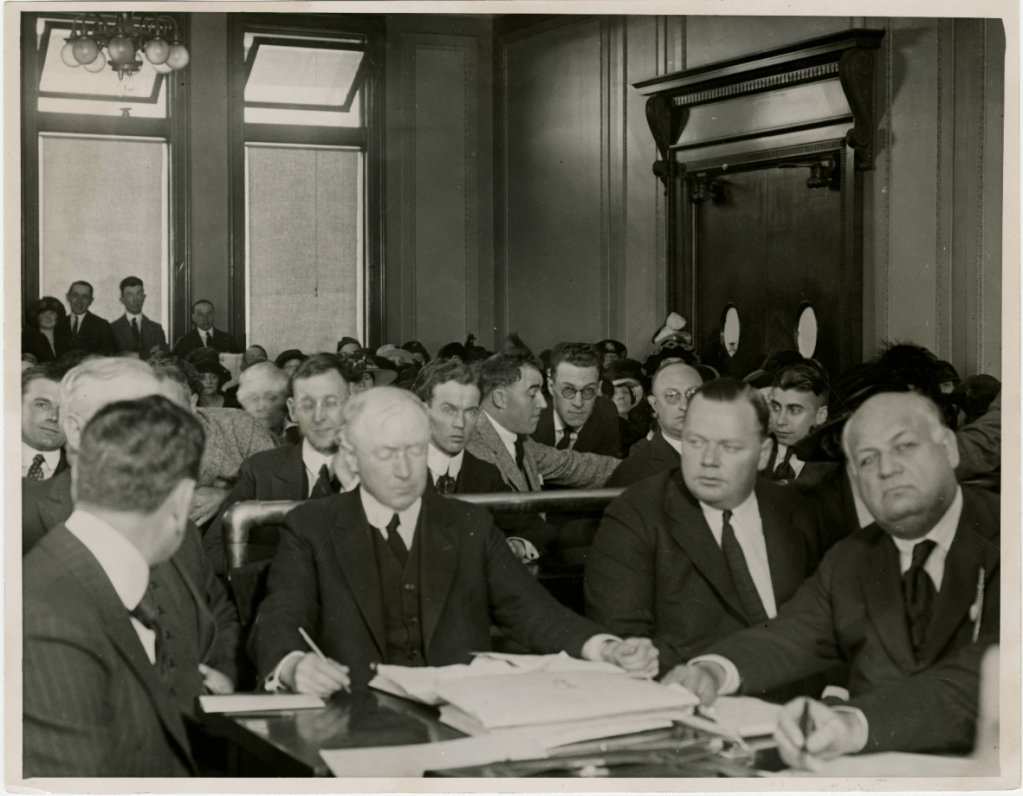
From left to right, Milton T. U’Ren sitting next to Roscoe Arbuckle and his criminal defense lawyer, Frank Dominguez, September 1921 (San Francisco Public Library)
Gouverneur Morris was a regular attendee at the Arbuckle trial and published his occasional vignettes.[1] Like other journalists behind the rail of Judge Louderback’s courtroom, he had taken sides. Morris believed that Arbuckle had “spoken the truth” on the stand. Morris questioned nothing and took to task the person responsible for the comedian’s long ordeal. “[Frank] Dominguez,” he wrote, “lost his head, forgot that it was his client who was the million-dollar actor, assumed the role himself, ranted, mistook friends for enemies, antagonized everybody in sight and imposed absolute silence upon Arbuckle.”
Morris had good reason to take sides. He had just enjoyed a year of success as a scriptwriter and hoped to enjoy another, as well as the perquisites and status of the film colony in Los Angeles. No doubt, too, Morris represented the feelings of not only the press but many in the motion picture industry, that what happened to Virginia Rappe should be put behind them. Nothing would bring her back and there was barely enough of her on screen to remember, to fill a couple of matinees.
As to the closing arguments, in the last piece Morris posted from the Arbuckle trial, he hardly looked forward to them. “[W]e shall listen to Friedman and U’Ren saying absolutely nothing for four mortal hours.”
* * *
Gavin McNab would be a hard act to follow. Even fair-minded observers had to admit that Arbuckle’s lead attorney had the ladies and gentlemen of the jury, as well as the press, in the palm of his hand. That Matthew Brady had chosen not to speak was noticed. To his harsher critics, Brady’s not taking “the splendid opportunity to deliver an address to the jury,” wasn’t a result of exhaustion or burnout but that he was distancing himself from an impending acquittal.
All that remained was for the prosecution to go through the motions of a challenger falling behind on points and trying to avoid a knockout. Nevertheless, the “challenger” had the irrefutable fact that two people entered room 1219 and one came out.
Around 2:15 p.m., Assistant District Attorney Milton T. U’Ren rose to speak, picking up where the defense had left off—the image of Arbuckle’s adoring young fans—and with a voice that rivaled McNab’s at least in volume. Taking umbrage at McNab’s comparing Arbuckle to Christ and praise for simply not dropping Virginia Rappe on the way to room 1227, U’Ren responded:
What would the millions of little children say if they could have seen “Fatty,” the modern Belshazzar, dressed in pajamas, surrounded by his lords and ladies, drinking, dancing, and “kidding around?” What would these children say if they could have seen him putting the ice on the nude body of Miss Rappe as she writhed in pain? And what would their mothers say? The great Belshazzar saw the handwriting on the wall and quaked as it was interpreted. “You have been weighed in the balance and found wanting. Your kingdom shall be divided among the Medes and Persians. That night Belshazzar was killed and the city overrun with enemies.
“The modern King Belshazzar has also seen handwriting on the wall,” U’Ren continued, alluding to the fingerprints on the hotel door in the same breath as he alluded to the ill-fated King of Babylon in the Book of Daniel. “The king is dead, and his kingdom is divided. He will never make the world laugh again. The king is dead. Thank God!”
Described like a cartoon character, Edward Doherty of the Chicago Tribune simply wrote a “little man, U’Ren, red faced, spectacles, bald—but he can shout.” But those familiar with Milton U’Ren from other trials knew that he, while not the orator, could sway juries “by talking quietly and reasoning logically.” And in a calmer voice, U’Ren explained that the defense had based its case upon “perjury and hypocrisy rather than upon facts. [. . .] Arbuckle’s story cannot withstand your scrutiny,” he said, “nor can it weaken the chain of circumstances against him.”
Arbuckle’s testimony was what the prosecution had been waiting for, having been limited to nothing but circumstantial evidence. In Arbuckle they surely believed they had the ultimate perjurer—one who had foolishly testified on his own behalf when he wasn’t required to do so. McNab wanted to credit Arbuckle for that. But he knew the day before he agreed to letting Arbuckle take the stand that it could work against him. U’Ren only needed to present it as a fabrication. Then, at best, only one juror was needed to keep the case alive and so move past this jury, which U’Ren, like Brady, like his other deputies, saw as tampered, an impression reinforced by the jurors nodding, smirking, winking, and their rapt attention to McNab this morning.
U’Ren declared that the defense had been opportunists, having no basis for their case and having proposed no theory for Rappe’s death until they heard the prosecution’s evidence. Here, of course, U’Ren exaggerated, given that Frank Dominguez had already introduced the argument that Rappe had a preexisting condition that made her bladder prone to spontaneous rupture.
“It was then” he said, “that they manufactured the story that Arbuckle told—manufactured it to meet the evidence presented by the prosecution.” McNab’s argument yesterday and today “was not a summary of the case but merely an attack upon the District Attorney.” Then U’Ren cannily reminded that Matthew Brady had been a reform candidate who had beaten Charles Fickert, a man the defense presumably would have preferred. “The present District Attorney is not Mr. McNab’s District Attorney,” U’Ren continued. “Attacking this public officer is merely throwing dust in the jury’s eyes.”
After excoriating Arbuckle for his silence and testimony, U’Ren refuted the defense’s clever dismissals of the fingerprints as the ghostly hands of “spooks” and turned the incessant ridicule of Professor Heinrich against them. U’Ren, too, should have been credited with the cleverest allusion of the day, besting his comparison of Arbuckle to Belshazzar.
Another writer fascinated by the science of criminology and fingerprinting in the late nineteenth century was Mark Twain. U’Ren returned to the prosecution table and picked up a copy of Twain’s 1894 satire of penny-dreadfuls, Puddin’head Wilson, to illustrate that such an admired American author, familiar to everyone, understood the reliability of fingerprints in criminal cases.
Sitting at the defense table, Nat Schmulowitz, a bibliophile of satirical works who prized the issues of Century Magazine in which Twain’s novel had been serialized, knew where U’Ren was headed. Twain’s hero, an eccentric small town Missouri lawyer, David Wilson, could be seen in the person of Professor Heinrich during the presentation of the fingerprints on the hotel door. Deemed soft in the head by fellow townsfolk for his then-obscure use of fingerprints in crime detection, Wilson solves a murder with by distinguishing between the fingerprints of twins. Comparing him to Heinrich, who had been made out to be an egghead, a fool, and an innocent fraud by the defense’s fingerprint experts and many in the press, was a master stroke by U’Ren and not too obscure for the jury. Twain’s novel was still popular twenty years later and had been adapted into a stage play and motion picture. The maxims of Puddin’head Wilson’s Calendar were and still are pearls of Twainian wisdom (e.g., “It was wonderful to find America, but it would have been more wonderful to miss it.”).
Schmulowitz objected to U’Ren’s attempt to read from the book but was overruled by Judge Louderback (a personal decision, perhaps, since the novel centers around the murder of a judge). The “offending” passage is unknown, but it was likely from the penultimate Chapter XXI, Doom, in which Wilson, much like Heinrich, describes the criminal act in a courtroom with white sheets of cardboard with pantographic enlargements of “bewildering maze of whorls or curves or loops,” a person’s “natal autograph.”
Just after three o’clock, U’Ren closed in a long speech, excoriating Arbuckle before the jury much as he had in the beginning of his argument.
He sat there surrounded by his lords and his ladies, this man who Mr. McNab says has made the children of America laugh. He appeared in his pajamas before this mixed audience, this world’s comedian, this Good Samaritan who Mr. McNab says was merely helping a sick girl. A Good Samaritan! I proclaim him a moral leper!
This man who made the world laugh—my God!—who made the world laugh. I wonder what the children and their mothers would have though could they have seen him as he placed the ice on this poor girl’s body. He may have made them laugh before, but thank God! He never will make the world laugh again!
Do your duty so that when you go home and you can look your fellow citizens in the face. Do your duty so that you may take your children to your breast with the full knowledge that they will be protected from this man and others like him. Do your duty so that this man and all the other Arbuckles in the world will know that the womanhood of American is not their plaything.
U’Ren ended his argument at 3:20 in the afternoon. Not long afterward, the trial entered its third phase as Judge Louderback instructed the jury on coming to a verdict.
[1] This passage is based on Gouverneur Morris, “‘Fatty’s’ Story Late but True, Thinks Morris,” Des Moines Tribune, 29 November 1921, 3; Gouverneur Morris, “Rebuttal Adds Little to Case against Fatty,” Des Moines Tribune, 1 December 1921, 17; ; James Gordon, “Minister Tells Highlights in ‘Fatty’ Case,” Los Angeles Evening Herald, 1 December 1921, 1; Oscar H. Fernbach, “Woman Votes Actor Guilty, Says Report,” San Francisco Examiner, 3 December 1921; Marjorie C. Driscoll, “Arbuckle Jury Retires at 4:10 to Deliberate,” San Francisco Chronicle, 3 December 1921, 7; ; Otis M. Wiles, “No Verdict Returned,” Los Angeles Times, 3 December 1921, I:1, I:2; and other corroborative sources.


 Spite Work: The Trials of Virginia Rappe and Fatty Arbuckle