The Celtic prose poem: Gavin McNab’s argument for the defendant

A new version of the arguments is being drafted (as I write) delivered before the jury near the end of the first Arbuckle trial of November–December 1921. The first draft had been based on very detailed reportage. The trial transcripts, however, differ markedly from the paraphrased versions in published in newspapers.

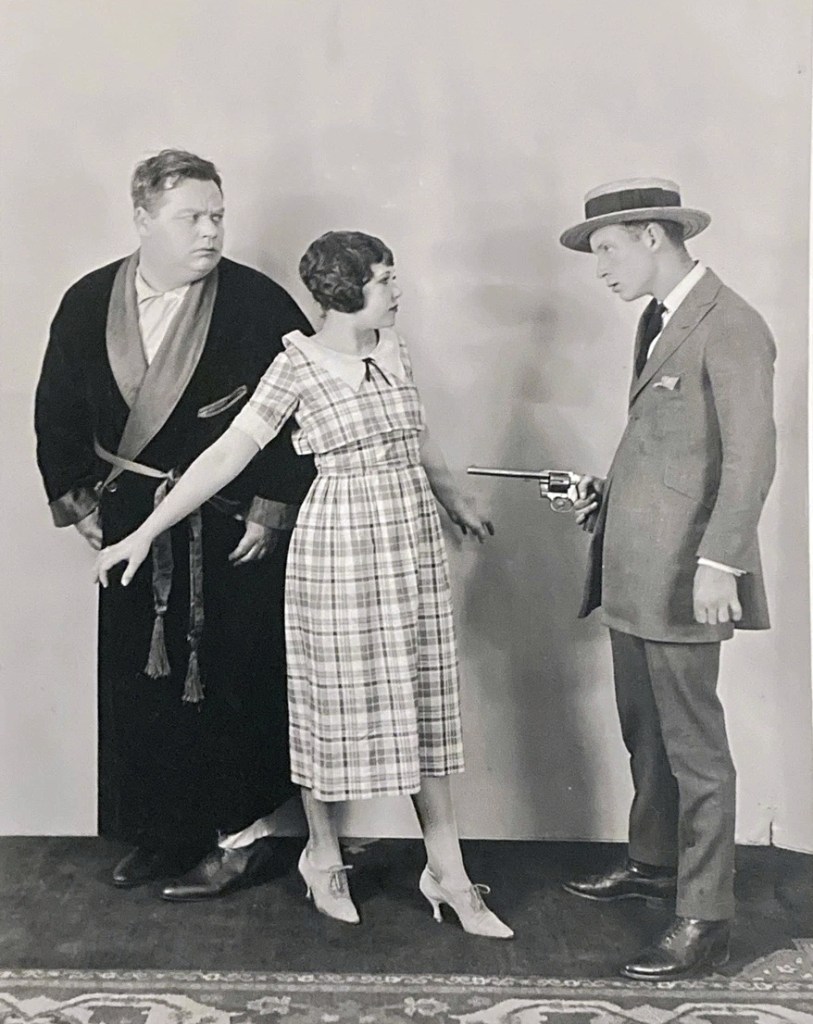
Roscoe Arbuckle with his female interest throwing herself in front of him. (He wears one of his capacious bathrobes, perhaps even the one worn at his Labor Day Party. As a further aside, the more militant feminists who panned Gavin McNab’s bible readings were far outnumbered in court by young women who, not unlike this one, stood up for the comedian.)

What follows is the end of the section devoted to Gavin McNab’s defense of “Fatty” Arbuckle.[1] Its title is derived from the Rev. James Gordon, the same Rev. Gordon whom Sidi Spreckels called to Virginia Rappe’s bedside. The clergyman, writing in his new column, described McNab’s speech as a “Celtic prose poem” after McNab’s rich Highland accent, which made him sound as much like a Presbyterian divine as a lawyer.[2] The man who followed McNab, with closing argument for the People, Milton U’Ren, was not as sanguine. To him the Good Samaritan described below was a “moral leper” and inspired another kind of outburst of faith: “Thank God, he will never make the world laugh again.”[3]


Had it not been for Maude Delmont being an unreliable witness, there would be no reliance on Zey Prevost or Alice Blake. All three women, for men who remembered the Preparedness Day bombing, always posed the risk of blowing up the People’s case. Every one of the district attorneys had a hand in planting those bombs in their own case, most of all Isadore Golden, who had come up with the compromise “hurt.” Still, that is what those showgirls undersigned. And, lest anyone forget, the “unfortunate circumstances,” the “wine party” as McNab put it, that event still resulted in murder to the prosecutors. They just needed to bide their time for a little longer and weather the dated lawyerly magniloquence of the 1800s autodidact showing off for the jury.

McNab’s had a working lunch. He met with his colleagues to discuss his performance and to go over the record and what had not been covered. There had been no mention of Jesse Norgaard, whose testimony suggested that Arbuckle had been obsessed with Virginia and that he disrespected her as well, and women in general, given whatever joke he intended to play.

Nat Schmulowitz surely and tactfully expressed a concern for the way medical evidence had not been exploited thoroughly. McNab had only burnished the reputations of Dr. Shiels and Collins brighter. And he had yet to draw on the Chicago affidavits, Albert Sabath’s contributions. One had been read into the record—and three doctors the day before certified that Miss Rappe was diseased. She had cystitis, which, to these conferees who had been holding back on leaving her reputation alone, was virtually a junior venereal disease in keeping with the late junior vamp.

And so, when the trial resumed at 1:45 p.m., McNab linked the medical commission’s report to “the testimony of Dr. Rosenberg of Chicago.” This evidence revealed that the defense had been right in contending that the young woman’s bladder had “defects,” that it was not the “perfect organ” the prosecution contended. Even that realization elicited another opportunity to preach to the jury as if it were the choir. “It would be an assurance trespassing on the domain of Divine Providence for any lawyer to intrude into the mysteries of nature and say what caused that rupture,” McNab intoned.

But the disease for which we have contended had been established. Whether that contributed materially to the disorder, we do now know, nor have any of the medical men on either side who have appeared before you pretended to tell you what did. All they could say to you was that many things might have done so. This leaves it with you of any direct testimony, outside of the medical and of the surgical demonstrations, to determine what probably brought about this young woman’s demise.

McNab, of course, did not want jurors to glance knowingly at Arbuckle’s girth—the District Attorney’s murder weapon that had been turned against the comedian. And so jurors who had already made up their minds, the reporters, as well as Arbuckle and Minta who knew better, now heard McNab deliver a paean, a panegyric devoted to the exercise of impartial judgement. “We do not ask you to give him any consideration because he is a great artist,” McNab said, without being ironic again, “or because he had brought joy into the world, or because he has made a success of his life. [. . .] This man without any disfigurement in this case, because there was not the slightest testimony reflecting on his character.”

The prosecution’s case, McNab reasoned, was based entirely on “conjecture.” As for the Arbuckle’s version of events, in response to all that had been made up about him, McNab made it a special point that his side made no objections during “two hours and twenty minutes of crucial cross-examination.” That was unheard of. That only proved Arbuckle’s candidness before the people of San Francisco and the nation. Then McNab waxed into a Cross of Gold speech made of diamonds.

That is the story. And you heard the story in its simplicity of how he tried to help this woman in the distress that had come upon her, and which was a common experience in her life, as is established without a contradiction, and how actuated by the spirit of mercy, you see this picture of this man crucified before you as a wicked character, in speech but not in evidence, carrying the limp body of this injured girl down the corridor of the hotel, staggering with her weight. Was this an unkind man? Doesn’t that tell the story, open for the world there to look at what went on behind the closed but not locked doors? [. . .] And he has told you in simple words what happened, and it exactly corresponds with this great, big, warm-hearted man, this rough diamond, perhaps, but still a diamond, carrying that injured girl down thru the hall; a more pathetic and a more beautiful picture than he ever put on the screen.

“There is to my mind a beautiful thought in connection with this thought,” McNab said in afterthought, that counsel had “not asked about the pictures that this man produced, but has anybody ever suggested that anybody ever saw an unclean picture of Roscoe Arbuckle? I think sometimes that the instincts of childhood is the most accurate of all instincts of the human race.” And yes, McNab really did impress upon the jurors the notion that Arbuckle himself was a juvenile. That gave his lawyer a fitting way to end of his Celtic sermon. “I always am impressed,” McNab said sagaciously,

with that beautiful spiritual suggestion of the Savior, “Suffer little children to come unto me.” And the childhood of the world, the instinct of childhood, had been accurate from that day to this, and this man who has sweetened human existence by the laughter of millions and millions of innocent children comes before you with a story of a frank, open-heated, big American, and submits the facts of this case in your hands.

To this a bored Leo Friedman, speaking for the People, asked McNab if he were done.


[1] People vs. Arbuckle, First Trial, “Argument of Mr. McNab, on Behalf of the Defendant,” 2188ff.

[2] James Gordon, “Minister Tells Highlights in ‘Fatty’ Case,” Los Angeles Evening Herald, December 1, 1921.

[3] People vs. Arbuckle, “First Trial, Closing Argument for the People, by Mr. U’Ren,” 2269ff.

A brief consideration of a tales(wo)man: Mrs. Helen Hubbard

The new manuscript is now well informed by the trial transcripts. The next part of the book still needs to be written, devoted to the Arbuckle–Rappe trials—and they are both on trial in this book. But any verdict will be handed over to the reader with some new ideas to consider. This, I guess, makes the reader a metajuror and, in keeping with that duty, we might look at how one of the original jurors was selected in November 1921. I cannot devote a lot of space to this, even though I am a trial junkie now. You can see how virtually everything is played out in advance of the first day of testimony. Indeed, writing about them will be like writing about a formality.

Let’s look at Mrs. Helen Hubbard. Her single vote of guilty caused a hung jury and forced the Arbuckle case to continue into 1922 and two more trials. The film historian Joan Myers took special interest in Mrs. Hubbard in her essay, “Virginia Rappe & The Search for the Missing Juror,” which, I believe, dates back to before 2013. But Ms. Myers could only go by newspaper accounts.

That Mrs. Hubbard served on the first Arbuckle trial jury stands out because she was the wife of a lawyer. She had once worked for a law office in Toledo, Ohio, before her marriage and worked for her husband’s growing practice, which dealt mostly in civil law. By 1921, however, she preferred to be a homemaker and bridge player. She was good enough to teach other women how to play as well and participate in bridge tournaments.

Mrs. Hubbard proved to be competent on the stand when first examined by Assistant District Attorney Milton U’Ren, her answers were quick and without hesitation, even when tested. She surely knew how to answer a question in such a way as to be disqualified and so avoid such an interruption to her life.

Q. Now, Mrs. Hubbard, if Mr. Hubbard were the District Attorney of the City and County of San Francisco, entrusted with the prosecution of this case, would you like to have him try the case before twelve jurors who were in your present frame of mine?
A. Yes, sir.
Q. You would think in that cast that he would have a fair and impartial jury?
A. I think he would.
Q. And if, on the other hand, some person near and dear to you were charged with a crime and placed upon trial, would you be willing to have them—be willing to have that person tried by twelve persons in your present state of mind.
A. I would.[1]

Although Mrs. Hubbard later professed a reluctance to serve as a juror, her crisp replies to U’Ren suggest otherwise. Indeed, until her vote, she was seen by the prosecution and defense as an ideal witness. Reporters who kept an eye on her in the jury box couldn’t get a read on her. (The poker face, presumably, owing much to her preferred game.)

Arbuckle’s lead counsel, Gavin McNab, asked different questions, prefaced, interpolated with parentheticals, and more often wrapping around their point. His required much more concentration not only from the juror, from by the other lawyers. McNab, however, had to tease out any female talesmen who might sympathize with women’s groups that wanted “Fatty” Arbuckle punished, namely San Francisco’s Women’s Vigilant Committee.

This organization, in the context of the Arbuckle trials did not police the “immoral” behavior of women but rather served as observers of how female witnesses were respected on the stand. The WVC also wanted justice served if Arbuckle case revealed a high-profile example of violence toward women. Some members of the WVC wanted to see another amendment, as important as the eighteenth, that guaranteed “the right of every woman to become intoxicated in personal safety. [. . .] If a man gets drunk, it is regarded as his liberty. If a woman does the same thing, society, like the Romans of the Coliseum, is willing to turn the wild animals upon her.”[2]

Despite U’Ren best efforts to get in front of the “clubwomen” issue, McNab didn’t waste time with his first question and making them the issue.

Q. Mrs. Hubbard, the District Attorney has asked you somewhat extensively about women’s clubs and their part in the case. It does not create any prejudice in your mind because the defendant and his counsel prefer to be tried by a sworn jury, and his Honor presiding, rather than the emotions of any club?
A. No, sir.

U’Ren did not let this go. “Well, we submit that is an improper question, if your Honor please, and argumentized,” he said to Judge Harold Louderback. “We do not know what is in the heart or mind of the defendant. It is understood he is to be tried by a jury.” The judge allowed for the question but said it was “rather farfetched” and admonished McNab for not framing his inquiries “so as they could be answered with less trouble.”

McNab abided by this warning and simply asked questions about “the mechanics of a trial.” Then he asked her a question that was posed to every talesmen, which foreshadowed the strategy Arbuckle’s lawyers took. (The so-called “blackmail plot” involving Bambina Maude Delmont had long since been cast aside. I have a theory for canard in the book—and it is a canard.)

What McNab did here was to try the case in a set-piece, presenting the defense’s theory about Virginia Rappe’s fatal injury as self-induced over many years of illness and immorality, despite promises made to the contrary.

Q. In the trial of the case, Mrs. Hubbard, it may be the duty of the defense to present evidence as to the physical condition of this young girl at various times in her life. She came to her death through a ruptured organ, an ordinary physiological occurrence, and it may—the defense may present testimony covering many years, to show that her condition, that that might haven at any time—

“Just a minute,” U’Ren interrupted from his end of shared counsel table (which weren’t divided into two in 1921). “We are going to object to that question, because, first, it is involved and complex and in the second place, if your Honor please—”

Then U’Ren was interrupted himself by Nat Schmulowitz, McNab’s chief assistant. “If you will just wait until the question is completed—

“Mr. McNab is conducting the examination,” replied U’Ren condescendingly, “and I am attempting to make an objection, and I thought the question had been completed, but the vice of the question is apparent already, when counsel says that the ruptured bladder is an ordinary physiological condition. I do not know whether he really meant that, or not, but that is assuming something that is not true.”

And so it went for Mrs. Hubbard. The examination of the jurors was, as many reporters pointed out, had all the hallmarks of the trial to come. There were also many curiosities for us to parse. McNab used the words “wine party” to describe the drinking of good scotch and questionable gin at Arbuckle’s Labor Day party. The word “wine” was a polite way to refer to the comedian’s violation of Prohibition. But the word, in an obsolete sense, also meant any fermented concoction. So, U’Ren would not have objected. He did question Mrs. Hubbard again in a brief redirect and one of his questions was no less longwinded than his counterpart’s—and McNab prompted it when he asked, “You understand that no one is supposed to own a witness, neither side, Mrs. Hubbard?”

This was in reference to the District Attorney Matthew Brady’s controversial policy of isolating his star witnesses, Alice Blake and Zey Prevost, for nearly two months prior to the trial, so as to prevent them from being influenced by Arbuckle’s lawyers through third parties. The prosecution had to ferret out problem jurors who might take to heart McNab’s statements “as evidence that these witnesses were put in cold storage or upon the grill”—yet another feature of all three trials, reaching a crescendo of sorts in the second trial, when much of the local press was aligned against the prosecution.[3]

Q. Now, if it should appear in this case, Mrs. Hubbard, that the District Attorney had certain information which led him to believe that certain of the witnesses who were to be called to testify for the State, were being approached by someone with propositions to change their testimony, and with their consent, he took the precaution of placing them in the care of an estimable lady in this city and count, would the fact that the District Attorney had taken such precautions prejudice you against their testimony?
A. No, sir.

Not all of Mrs. Hubbard’s answers were so yes and no. She did give a few personal details in some. She liked to go to the picture shows and was familiar with Arbuckle comedies, albeit not particularly a “fan.” That he played “funny parts” didn’t make her think that he was incapable of committing a criminal act on a woman.

I’m not so sure.

A still from Fatty’s Wine Party (1914)

[1] People vs. Arbuckle, First Trial, “Examination of Talesmen,” pp. 248ff.

[2] Alma Reed, “Right of Women to Personal Safety Urged by Club,” San Francisco Bulletin, September 15. 1921.

[3] There really should have been no controversy, for McNab himself was able to meet with Miss Blake after her mother took her home in early November. This forced Brady to let Prevost go home as well.

“S.B., what’s a matter with her?”: Josephine Keza, the fly on the walls of Arbuckle’s Labor Day Party[1]

Josephine Keza, 1921 (Collection of the author)

Assistant District Attorney Milton U’Ren interviewed Josephine Keza, a Polish immigrant and hotel maid, in room 1220 of the St. Francis Hotel on September 16, 1921, one week after Virginia Rappe’s death. Her statement, read into the record of the first Arbuckle trial, provides a different take on Virginia Rappe’s arrival at the Labor Day party. 

Mrs. Keza had been going in and out of all three rooms of the Arbuckle suite—1219, 1220, and 1221—throughout the late morning of Monday, September 5. Arbuckle, Fred Fishback, and Lowell Sherman let her work around them. Missing in her account is Ira Fortlouis, the gown salesman, whose sighting of Rappe in the Palace Hotel resulted in her invitation to Arbuckle’s suite and what happened to her during the course of the afternoon.

Keza noticed Arbuckle shaving in room 1219’s bathroom. She paid special attention to a man named “Freddie,” the comedy director Fred Fishback, Arbuckle’s roommate in 1219. She heard him trying to telephone Rappe from the room’s telephone and getting no answer. If so, it adds another link in the chain of events. It means that (1) Fishback didn’t need Fortlouis to tell him what he already knew, that Rappe was staying at the Palace; and (2) Fishback tried her room first before having her paged in the hotel dining room.

Keza also saw that Fishback was in charge of the liquor supply, keeping it under lock and key in room 1221’s closet. In her rambling account, she may have seen him drinking, too. (During the three Arbuckle trials, Fishback was adamant about shunning both alcohol and cigarettes.)

U’Ren, of course, wanted to know what Arbuckle did, which wasn’t easy, given Keza’s Polish accent and command of English. She was, nevertheless, observant. The party proved to be a rich source of gossip for her workmates below.

To Keza, the comedian and the actress were on familiar terms when she entered the reception room, 1220, shortly after Rappe’s arrival. She knew Fishback and Arbuckle’s friend, the actor Lowell Sherman, who had also come from Los Angeles for the long weekend in San Francisco. At first, they were the only ones in the room.

Q. And then Mr. Arbuckle came in?
A. Yes, sir, then he came out from the bathroom and he come right straight to Miss Virginia and he talked to her very closely. I can’t say if he kissed her, or he spoke to her. They were talking very quiet. I didn’t listen.
[. . .]
Q. Did you hear the sound of a kiss?
A. No.

Whether Arbuckle planted a kiss is moot. But other guests saw that he and Rappe paired off and that she enjoyed his company.

Understanding Keza was one thing. Getting the sequence of events from her must have been maddening. U’Ren wanted to hear what the other witnesses had told him. Arbuckle had been disturbed in whatever he was doing to Rappe on his bed in 1219. As soon as he left the room, his guests tried to help Rappe. As she eavesdropped from an adjacent room, Keza only heard a certain disregard, even resentment.

Q. Did you hear a crowd in 1219 while you were in 1218?
A. Yes. I was in 1218. There was a whole bunch talking and hollering and they go back to the parlor and holler and were dancing and that girl was crying.
Q. Did you hear anybody knocking on the door [of 1219] before the crowd went into the room.
A. No, sir.
Q. Did you hear anybody say, “Open the door”?
A. No, I didn’t hear that.

This had to frustrate U’Ren, who was, perhaps, more than just enthusiastic about taking on the Arbuckle case. Keza wasn’t corroborating what the other guests were saying, especially the women he intended as state witnesses.

Keza heard people laughing as Rappe screamed “Oh my God! No, no, no!” Continuing to listen to the hubbub of the guests inside Arbuckle’s suite, Keza caught a glimpse of a partially clad couple running between one room and another.

A. [. . .] I couldn’t catch it quick, because I was taking my towels, or something, from the closet, but I saw a man come through the room [i.e., the hallway], but I couldn’t say whether from 1219 or 1220, but he came out from one of those two rooms, and then I saw a woman, undressed, go out and run quick to number 1220. She was undressed, she had nothing on, just a combination suit, what you call it.[2]
Q. She could have come from 1220 and run in[to] 1221?
A. She didn’t go to 1221, she go to 1220, the parlor. I didn’t see where she came from, but I saw her right in the hall. She sneaked as quick as she could. First the fellow get up, then she was the next one, then they slammed the door.
Q. First a fellow, then a girl?
A. The fellow first.
Q. How was the fellow dressed?
A. I didn’t see. I just saw the bare feet of a man. I saw the shoes—
Q. (Interrupting) Was the girl in her bare feet?
A. She had her shoes and stockings on.

U’Ren intended to leave the mysterious couple out of his direct examination of Josephine Keza. He had also left out other details so that he could make Rappe’s utterances into a single one, more like a woman suddenly afraid of being hurt, of being raped, after Arbuckle had her cornered in his bedroom, on the other side of 1219’s hallway door. This was how a messy case was cleaned up by district attorneys, to make the crime easy to understand for a jury.

Arbuckle’s lawyers knew what U’Ren did. They considered him a dirty prosecutor for his neat work. And U’Ren hardly protested when Gavin McNab, the comedian’s lead counsel, had him hand over Keza’s statement to be read aloud to jurors. They had more evidence to consider, not only did Rappe’s cries of pain extend over a period of time. They had a few snapshots of what the real Labor Day party was like along with the straightened versions on the part of both the prosecution and the defense.

(See also “I heard a man’s voice say ‘Shut up.’”)


[1] This is from Keza’s statement, where she quotes an exchange she heard between two women in room 1221. “S.B.” was likely the stenographer’s abbreviation for “stupid bitch,” in reference to Rappe.

[2] A “combination suit,” a single undergarment, consisting of a camisole and panties.

Did she keep a little black book?

Toward the end of the third trial in late March 1922, Milton Cohen, one of Arbuckle’s five defense lawyers, cross-examined Kate Hardebeck at length. She was a rebuttal witness for the prosecution and had been Virginia Rappe’s longtime foster mother and housekeeper known as “Aunt Kitty.”

Cohen had a special place in Arbuckle’s defense. Not only was he the comedian’s personal lawyer, he had once been Rappe’s. He knew her, had been a friend. However, now that she was deceased and Arbuckle accused of having causing her death, Cohen was no longer bound by lawyer-client privilege. Thus far, he had used his personal knowledge of Rappe’s time in Los Angeles to procure witnesses who vouched for her alleged episodes of hysteria triggered by the smallest amounts of alcohol.

Cohen also knew that Rappe had left a paper trail over the years. She traveled a great deal and sent letters, postcards, and telegrams to not only the one foster mother, but the other who testified to Rappe’s good health and morals, namely Katherine Fox. Both women proved to be effective rebuttal witnesses, who painted a sympathetic portrait of their former charge. The prosecutors, especially Assistant District Attorney Milton U’Ren, wanted this idealized image of the victim preserved and to counter the “unfortunate” but fallen woman advanced by Arbuckle’s “million-dollar team” of lawyers.* So, the two foster mothers were undoubtedly encouraged not to mention any correspondence and stonewall where necessary, especially if that might intrude on the happy, girlish creature they described on the stand. And they may have done better than what was asked for. They told the defense lawyers that they had destroyed their foster daughter’s letters—this despite how precious she had been to them.

But one such document still existed. It lay on prosecution side of the shared consuls’ table. Cohen fixed on it. Was that the “diary” Al Semnacher, Rappe’s putative manager, had mentioned during his testimony a few days ago?

“Mr. U’Ren,” Cohen asked, “will you be good enough to let me have Miss Rappe’s diary?” Then Cohen turned to the witness. “By the way, did you deliver Miss Rappe’s diary to Mr. U’Ren.”

U’Ren started to object but Cohen cut him off. “I beg your pardon, just let her answer.” And Hardebeck answered in the negative.

When U’Ren handed the tiny book to Cohen, the latter saw that it wasn’t the diary. It had tabbed pages from A to Z. Nevertheless, he continued his fishing expedition.

COHEN: Q. Mrs. Hardebach (sic) have you ever see a book about six inches long by three inches wide, the sheets being gold edged?

A. No.

Q. And a black leather cover?

A. This is the book Miss Rappe had besides her address book, and we discarded that when we left Ivor Avenue, because it was full and had come apart.

Q. You say you discarded that book?

A. Miss Rappe discarded it before we left Ivor Avenue; and after that we had no telephone, and it was not necessary to keep the book.

Q. This is the only book, then, that you have?

A. Yes.

Aunt Kitty responded in a way that suggests there are two books: one for addresses, one for telephone numbers. While such items could be discrete objects in 1921, this didn’t sound convincing. So, Cohen continued to grill the witness. He needed a diary—or just a simple daybook, a proto-planner—with dates and jottings that might put Rappe where she had an episode, one that anticipated the fatal one ascribed to Arbuckle just two weeks before the Labor Day party of September 5, 1921.

In the end, Cohen let the matter go. U’Ren, however, did not. During the redirect examination, he took the precaution of burying the issue of a diary once and for all.

U’REN: Q. Mrs. Hardebach (sic) did Virginia Rappe keep a diary?

A. Not to my knowledge, no, I am sure she did not.

CT_BLACK_BOOK_01_0f13022f-818a-4d29-9cbc-81f6dd55497b_1000x1000


*In the revised narrative, a more accurate version will fall between these two contrived ones created for Arbuckle’s trials.

Virginia and a “victor”: Adela Rogers St. John

“History is written by the victors” and so is writing about Hollywood in the Silent Era. But we should probably paraphrase here, just a little, and say that “History is written by the defenders.” And if one scores by the number of defenders, then Virginia Rappe lost the contest with Roscoe Arbuckle, regardless whether she put up a fight in room 1219.

One of the earliest defenders was the Hollywood writer and memoirist Adela Rogers St. John. as mentioned in an earlier post, she interviewed Arbuckle for “Love Confessions of a Fat Man,” which was published in Photoplay during the early weeks of the Arbuckle scandal in the September 1921 issue.

Arbuckle, by hosting a party that flaunted its defiance of Prohibition laws and moral standards—it was essentially a party of married men cavorting with single showgirls—had ruined the innocence of St. John’s tongue-in-cheek portrayal of Arbuckle as a lady’s man, a virtual eligible bachelor. Her resentment eventually fell not on him but on Virginia Rappe. And St. John lived long enough to write it up in her autobiography Love, Laughter and Tears: My Hollywood Story (1978).

St. John, whose career got its start working for William Randolph Hearst—the bête noire of so many Arbuckle narratives—devotes several pages (60ff) to the Arbuckle scandal.

Perhaps St. John is less a defender and more the apologist, especially in regard to Arbuckle’s being in San Francisco in the first place.

St. John recalls a conversation with her father, Earl Rogers. Although she described him as “still the Coast’s leading criminal lawyer,” he had been in poor health since the death of his second wife in January 1919 and was more often hors de combat and no longer the feared trial lawyer who served Earle Stanley Gardner as the model for Perry Mason.

According to St. John, her father discussed why he had to refuse a request made by Arbuckle’s producer, Joseph Schenck, to represent the comedian. Although Rogers assumed Arbuckle wouldn’t be convicted, he would nevertheless be seen as a monster given his weight. His career would be ruined. “Tell Joe,” Rogers said to his daughter, “I can’t take the case; the doctors won’t let me, but to prepare Hollywood for tornadoes.”

The news would have been a disappointment, for Rogers was considered preeminent as a criminal attorney in cases that involved medical expert evidence. In his prime, he would have been perfect for the Arbuckle case given that his alleged victim had died from ruptured urinary bladder. But by early 1920, his health, mental, and legal problems had come to a head. He had assaulted a deputy sheriff sent to arrest him for making threats against members of his own family, which was attributed to “excessive use of stimulants and drugs.”

The “statement” St. John quoted in her memoir may have been paraphrased to make Arbuckle look innocent from the beginning. But her version isn’t what Arbuckle said in the Los Angeles Times the day after Rappe’s death. But let’s get back to why Earl Rogers wasn’t to be Arbuckle’s Perry Mason.

Frank Dominguez, Arbuckle’s original defense attorney, had resigned from the defense team in early October 1921, leaving Milton Cohen and the San Francisco attorney Charles Brennan shorthanded for November’s manslaughter trial. Several names appeared in the press, but not Earl Rogers. While it is true that his doctors allowed him to return to work in November and form a new practice, he restricted himself to Los Angeles and his health only deteriorated. He died in February 1922. However, one of Arbuckle’s prosecutors, Milton U’Ren, made it a point to ask prospective jurors if they knew Milton Cohen’s law partners—Frank Dominguez and Earl Rogers. If the answer was yes, presumably that talesman could be excused. Did U’Ren suspect that Rogers was giving his fellow lawyers advice? That might be a more reasonable explanation for what his daughter reimagined.

She also opined that Arbuckle, Fred Fishback, and Lowell Sherman went to San Francisco because it had “the best restaurants on the North American Continent” and

for a few days of fun probably partly on the Barbary Coast, a well-known section where night clubs and honky-tonks and cafes clustered together and produced the first-floor shows, the first new dances such as the Bunny Hug and the Turkey Trot, and much of the best music of our times. During this vacation an extra girl named Virginia Rappe got some alcohol in her system, stripped off her clothes, and plunged Fatty and Hollywood into a major scandal.

The resentment here is hard to miss. To St. John, a Hollywood insider, Virginia Rappe was a nonentity who had spoiled the much greater party that was the motion picture industry before the arrival of Will H. Hays.

“At that time,” she continues, “Miss Rappe had been living only a few blocks from me in Hollywood.” By “a few blocks” St. John means one of two places where Rappe lived—in 1920, not 1921. It is the distance to Henry Lehrman’s house, where Rappe lived for the greater part of 1920, at 6717 Franklin Ave., or 1946 Ivar Ave., which was fewer blocks away, where Rappe roomed briefly for the first two or three months of 1921. This can be documented. If we go by the 1920 federal census, St. John and her family lived miles away on Toberman St. and far from Hollywood. However, the 1921 city directory, which was compiled in the latter half of 1920, has Rappe living at the Ivar Ave. address and Adela and her husband, W. Ivan St. John, just as close as she states—to 5873 Franklin Ave.[1]

Memory can be tricky writing decades later, and if it’s a gossipy story that has been told repeatedly there’s a good chance the version that prominently places the narrator in the story will come to be accepted as true. So, we should be accepting that the St. John’s account isn’t airtight though it’s likely too odd of a coincidence to have been completely invented.

The day after Fatty had been indicted on the testimony of several girls [i.e., Zey Prevost and Alice Blake] and Virginia Rappe’s own deathbed statements, the man who did my cleaning came and told me: “I did Virginia Rappe’s cleaning. I see where one side says she was a sweet young girl and Mr. Arbuckle dragged her into the bedroom, the other witnesses say she began screaming and tearing off her clothes. Once I went in her house to hang up some cleaning, and the first thing I knew she’d torn off her dress and was running outdoors, yelling, “Save me, a man attacked me.” There I was standing in the kitchen with my hands still full of hangers with her clothes on them and she was running out hollering I’d tried to attack her. The neighbors told me whenever she got a few drinks she did that. I hated to lose a good customer, but I thought it was too dangerous so I never went back.”

I asked those neighbors and they confirmed the story. But you couldn’t put that kind of evidence into court! The girl was dead. To blacken her character would only increase public indignation against Fatty, for trying to save himself at her expense. (63–64)

St. John, ever the lawyer’s daughter, seems to suggest such evidence would have been dismissed as hearsay. But Gavin McNab, Arbuckle lead counsel through three trials, put as many witnesses on the stand as he could find to testify to Rappe’s frequent hysterics and disrobing. An example was Irene Morgan, who had served as a nurse, masseuse, and maid in the Lehrman household for several months in 1921. She was both deposed and examined on the stand by Milton Cohen at the first Arbuckle trial.

Cohen had the advantage of knowing Lehrman and Rappe—he was their personal lawyer as well as Arbuckle’s. He knew Rappe was suffering from what was described as a “nervous condition,” which, in part, had less to do with alcoholic beverages than with her self-image: she was overweight in early 1919 and losing weight was necessary to be considered for future movie roles.

Paradise Garden - Rappe and 1917 swimwear

She was no extra: Virginia Rappe looking like herself in 1917 swimwear. The still is from her first film, Paradise Garden (1917) (IMDb)

According to the trial reportage, Morgan described her service as it concerned Rappe, which included massages and treatments described as hydrotherapy. Morgan also knew that Rappe had been advised by a doctor to adhere to a bland diet and not drink alcoholic beverages. Morgan, however, testified that Rappe disregarded the advice. When she drank, “Miss Rappe often “tore her clothing in frenzy.” During one of these incidents, she said she ran nude from Lehrman’s house into Highland Ave. (See also our blog post about Morgan about her problematic testimony.)

Cohen did the spade work of finding and interviewing witnesses to similar episodes in Los Angeles. But there is no evidence that he met with the man who cleaned the clothes of Virginia Rappe and, coincidentally, Adela Rogers St. John. So, we have to ask, was he a real person or a strawman made up—or to be generous again, a composite—created to give St. John a role in the story. If he was real, one has to wonder how Cohen overlooked him. Perhaps the laundry man had sympathy for Rappe despite the aborted cleaning contract and chose to give no aid to the Arbuckle camp.

The story St. John tells here, of course, is one of many that turned Rappe from being “the best dressed girl in Hollywood” to the most self-undressed during the three Arbuckle trials and in much of what has been written about her ever since. Despite the bias, however, such an account reinforces just how much Rappe was resented in death and that, again, is the takeaway.

St. John mentions in passing Rappe’s former landlord, studio boss, dance partner, and boyfriend. She disparagingly refers to him as “a man named ‘Pathé’ Lehrman, claiming to be the dead girl’s sweetheart”—while knowing he wasn’t called that in the newspapers during the Arbuckle case. He was always Henry Lehrman and St. John well knew he was a key figure of early Hollywood history. Lehrman directed and mentored both Arbuckle and Charlie Chaplin in their first comedies for Keystone Studios. But we mustn’t lose sight that St. John is a victor in the sense that she outlived everyone who could challenge her stories. She got to write that history and cast Lehrman as she pleased. But it is from Lehrman that we find something that suggests that St. John’s memory of “the man who did her cleaning” touched on a recurring theme, that Rappe feared being sexually assaulted.

In an interview with Louis Fehr of the New York American, Lehrman said, “I remember once when there was a terrible assault case in the newspapers. She said to me quietly: ‘Henry, if anyone tried to do a thing like that to me, he’d have to kill me.’ Well, she’s dead.”

So, perhaps St. John’s story has a grain of truth to it, that Rappe’s hysteria may have been histrionics—theater of a kind—intended as self-defense, to startle or frighten a potential rapist. We still have a possible hypothesis in our work-in-progress.

Women are still advised to disrupt the idea or fantasy of their attacker, that they should “fight like a furious cat” and “yell loudly and strongly.” Perhaps Rappe removed one facet of the male fantasy: the forcible disrobing, the tearing off the victim’s clothes, and so on. Perhaps, too, a good lawyer like Milton Cohen knew how to frame such episodes into what was needed to get Arbuckle acquitted. Maybe we can only leave that to the reader.

3c26480u

Adela Rogers St. John, 1966 (Library of Congress)


[1] In 1921, W. Ivan St. John served as personal secretary to the new mayor, George E. Cryer. He had been elected to on a platform to close the city’s vice dens and supported efforts to establish a censorship board. He also wholly supported the ban on Arbuckle’s films—which surely put Mr. St. John in an awkward position vis-à-vis Mrs. St. John.

Alice Blake breaks down on the stand, March 23, 1922

The reportage for the third trial was not as detailed as the first trial. The legion of reporters had been cut back as public interest in the Arbuckle case waned. Oscar Fernbach of the San Francisco Examiner soldiered on though and noted some important turning points as the trial unfolded—mostly lost opportunities for the prosecution.

As we pointed out in yesterday’s blog post, District Attorney Matthew Brady’s star witness, Zey Prevost, had fled to New Orleans beyond the reach of his subpoena power. She and showgirl Alice Blake were in roughly the same place at the same time while at the Labor Day Party. Both women had entered room 1219 after Roscoe Arbuckle had exited while Virginia Rappe was lying semiconscious in one of the room’s beds. Blake had heard Rappe “accuse” a male of hurting her and that she felt like she was dying. Her earliest statements are hardly ambiguous. But whether her statements had been fine-tuned by her interrogators has to be scrutinized. Nevertheless, like her friend Zey Prevost, Blake was less than enthusiastic about testifying against the comedian and was almost declared a hostile witness during the second trial. Like others who attended the party, Blake was in the “in crowd” and probably felt some kindred loyalty to the group. As an entertainer she would have also been aware of the possible impact her cooperation with the prosecution could have on her career.

Until March 23, 1922, Alice Blake had maintained her composure but her reluctance to testify was often apparent in the way she spoke almost in a whisper and, by degrees, ceased remembering details of what happened on Labor Day 1921—with the exception of being one of Rappe’s first responders.


Girl Checks State Attack upon “Fatty”
Alice Blake Denies She Heard Virginia Rappe Say “He Killed Me”; Breaks Under Fire

Oscar H. Fernbach, San Francisco Examiner, 24 March 1922

With every inch of the battle ground hotly contested, the fight being waged in Judge Louderback’s court to establish Roscoe Arbuckle’s guilt or innocence of the manslaughter of Virginia Rappe proceeded yesterday.

Tears and temper, accusations and recriminations, insults and apologies all contributed to the sensational features of the trial.

Alice Blake, star witness for the prosecution, broke down under the grilling cross-examination of Gavin McNab, became hysterical, and was led weeping from the witness stand, while an enforced recess was taken to give her time to compose herself. She could not stand the strain of McNab’s attempt to expose what he termed “fabricated testimony, produced under duress,” his accusations being directed more against the district attorney’s office than against the girl on the stand.

It was all about Alice Blake’s direct testimony to the effect that she had heard Virginia Rappe exclaim as she lay in agony upon the bed in Arbuckle’s room: “I am dying; he hurt me.” By producing the original statement, which the witness had given to the police on the day following the death of Virginia Rappe [September 10, 1921], McNab established the fact that Alice Blake at the time had not included the words, “He hurt me,” and the attorney proceeded to insinuate that District Attorney Brady and his assistants had subsequently tried to compel the witness to testify as she did. The girl explained yesterday [March 22, 1922] that when she was questioned in Brady’s office she was told that Zey Prevost had declared that Virginia Rappe had used the words, “He killed me,” and had informed Brady and [Assistant District Attorney] U’Ren that Alice Blake had heard her so exclaim.

“I told them I did not hear her say so,” was the emphatic testimony of the witness yesterday. And she went on to say that at the time she had expressed the belief that Virginia Rappe, if anything, might have said, “He hurt me.”

[Assistant District Attorney] Leo Friedman, who conducted the direct examination, had a hard time with his witness. The value of her statements to the prosecution seemed to have become inversely proportional to the number of trials to which Arbuckle is being subjected. She reached a strage yesterday where she “could not remember.” In vain did Friedman show her the record of her testimony in the police court and at two preceding trials. It merely refreshed her memory to the extent that she could recollect nothing.

On cross-examination, however, Alice Blake made a startling announcement. She confessed that she had left the sitting room of Arbuckle’s suite before either Virginia Rappe or Arbuckle had gone into the bedroom, and did not actually see either of them enter that apartment. This was news—and McNab made the most of it.[1]

True, the witness admitted that before she left to enter the third room [1221] of the suite, she had seen both the comedian and the actress walking toward the door of the bedroom [1219]. But she [Blake] further declared that she had been absent less than fifteen minutes when, upon her return to the sitting room [1220], she found Mrs. Delmont knocking on the bedroom door and calling to Arbuckle to open it. This testimony placed the comedian and Virginia Rappe alone in the bedroom for fall less period of time than hitherto had been inferred from all the testimony.

The story of how Virginia Rappe was found in agony in Arbuckle’s rooms, and the ministrations that were given her, was repeated in detail by Alice Blake. McNab, in turn, sought to convince the jury that the actress had been injured while being given a cold bath, or while being held upside down by Fred Fishback and that her cry, “He hurt me,” referred to the latter and not to Arbuckle. [. . .]

Alice Blake, September 19, 1921 (Underwood & Underwood)

[1] In reality, her initial statement indicates that she left room 1220 for room 1221—Lowell Sherman’s bedroom—as Rappe and Arbuckle entered room 1219. Blake didn’t disclose whether Sherman accompanied her. But this can be inferred from Prevost’s early statements and testimony, where she, Prevost, is alone in room 1220 with Maude Delmont. Here Blake mentions that fifteen minutes passed before she saw and heard Delmont kicking the door and demanding that she be allowed to speak to Rappe. While this seems to fit the defense’s assertion that Arbuckle and Rappe were alone for less than ten minutes, as Fernbach suggests here, it doesn’t. Blake omits here that she returned to room 1221. She was there when Arbuckle finally opened the door of room 1219 and didn’t see him exit. Keeping up with these details and nuances is not only difficult for authors and readers. Imagine what it was like for the prosecutors in 1921 and ’22!

Bit Player #5: Harry Barker: The “Sweetheart”

. . . a man and a gentleman who tried to clean himself and keep all around him clean.

Gavin McNab, Chief Defense Counsel[1]

Harry Beaconsfield Barker was one of the most effective witnesses called by Roscoe Arbuckle’s defense lawyers during the first Arbuckle trial. His testimony, too, resulted in their first defeat. Two jury members, including its only woman, wouldn’t vote to acquit.

Barker knew Rappe “intimately” for almost five years, from 1910 to 1914, and had not lost touch with her, even after he had moved to San Francisco in 1918 and married in July 1920. For a time, he even lived in the St. Francis Hotel and may have seen her there, a year later, when his wife was about six or seven months pregnant—that is, about June or July 1921. In other words, they were on good terms.

Barker was considered a surprise witness. Arbuckle’s lawyers, led by California’s Democratic kingmaker, Gavin McNab, surely learned of the connection between Rappe and Barker from their colleagues in Chicago. Best of all, Barker was conveniently in San Francisco.

Barker, like Rappe, had gone West. He was called a “Stockton rancher.” Barker, however, had already made a considerable fortune in northern Indiana real estate and, together with other investors from Chicago, hoped to make more speculating on farmland in the San Joaquin Valley.

Barker was no stranger to courtrooms. He was mired in another legal battle at the time he was called to the stand to describe his relationship with Virginia Rappe. He and his close friend Albert Sabath, the Chicago lawyer who worked for Arbuckle’s defense, were named in a lawsuit and accused of fraud and conspiracy by a group of Chinese American investors over a large tract of farmland on Mildred Island in the San Joaquin River delta. Their lawsuit amounted to $400,000 in damages (over $6 million adjusted for inflation). The case had progressed from the lower courts and would soon make its way to the California Supreme Court. Making this problem go away may have induced Barker to take the stand and discuss his personal life with Rappe.

Barker’s testimony substantiated the assertion that Rappe had a long history of becoming hysterically ill after only a few drinks, that she suffered excruciating abdominal pains, and, of course, tore her clothes off. He described a handful of incidents. These as well as similar episodes of Rappe’s past behavior that other defense witnesses described seemed to follow the same script, a predictable formula not unlike that of slapstick comedies, such that Rappe’s drinking and stripping and going wild uncannily foreshadowed what happened in room 1219 of the St. Francis Hotel on Labor Day 1921.

Harry Barker dated Virginia Rappe on and off those years in Chicago. He was about twenty-six years old when he met Rappe in the spring or early summer of 1910, after her brief foray as a chorus girl and vaudeville performer. At the time, he still lived with his widowed mother Rebecca on Michigan Avenue in Groveland Park. She and Barker’s late father were both Russian Jewish emigrants who still spoke Yiddish in the home. The son, however, was born in Chicago in 1885 and had already established himself at the age of twenty-one in 1906 as a real estate broker whose business was largely based in and around the Indiana Harbor region. There he was responsible for many of the new homes “for workers,” as the newspapers described them, built for The Gary Works, the massive steel mill on Lake Michigan. His attention to detail and price almost resulted in his being lost at sea. In 1916, he had traveled into the interior of Panama to inspect the timber holdings of a Chicago syndicate. On his return, however, his motor launch sailed too far out into the Pacific Ocean, ran out of fuel, and went adrift for eighteen hours.[2]

Barker would have appealed to Rappe’s grandmother–guardian. He was the kind of prosperous, middle-class man Rappe might have been attracted to if she were to “settle down” in Chicago rather than pursue a career of her own. But Barker’s appeal to Virginia may have been that he wasn’t so settled and was willing to move to where the opportunities were including having lived out of a suitcase “for a time at the Gary Young Men’s Christian Association.”[3]

It could be said that he lived dangerously and took risks, which also appealed to Rappe. He drove fast cars. He attended the early Indianapolis 500s and drove a fast car himself, described as a “40 horsepower flyer.” In all likelihood, it was in his car that Rappe learned to drive and compete in auto races herself. He also had nothing against the drinking of alcoholic beverages.

Barker’s business partner was Adolph Joachim Sabath, the powerful Chicago Democrat who represented the 5th District in Chicago and chaired the Alcoholic Liquor Traffic Committee. Legal and illegal alcohol sales were no mystery to Congressman Sabath, who, with his brother, Judge Joseph Sabath, once operated a saloon in Chicago. Adolph was, unsurprisingly, a “wet” congressman and was a leading opponent of making Chicago and the country “dry”. He rightly predicted that Prohibition would only lead to bootlegging on a national scale—and some of his knowledge came from Harry Barker who, in 1916, served as one of Sabath chief agents in monitoring illicit alcohol sales in the border region between Indiana and Illinois. Adolph’s nephew, the son of his brother, Judge Joseph Sabath, Albert, was his law partner and Arbuckle’s chief lawyer in Chicago. He had likely been retained in the last week of September 1921, if not earlier, to begin the discovery process into Virginia Rappe.

Although none of Barker’s original testimony of November 25, 1921, is preserved in any length, the content and tenor can be pieced together from the reportage.

The surprise witness of the entire case was Barker [“one-time ‘sweetheart’ of the dead girl”]. It revealed a romance of the early days of Virginia Rappe in Chicago. Barker, who now has a ranch in California, and a real estate business in Gary, Ind., was then “on the road.” He met Virginia Rappe, he said, in 1910—when the state contends she was but 13 years old—and “a warm friendship sprang up which lasted four and a half years.”

Barker “made Chicago often” and when he did he “went with Virginia.” Her grandmother usually accompanied them to dinner and the theater, he said. He described dinners ranging from an Italian restaurant where Virginia partook of too much red wine, to the LaSalle hotel, where he met her the last time he saw her in Chicago. He declared [that] he had seen her the last two months before [her] death.

At that time, he admitted on cross-examination, “she was looking her old self—always bright, high spirited and full of fun.”

Barker underwent a grilling cross-examination. The state scored when they brought out that all the times to which he testified that Virginia tore her clothes were while she lived with her grandmother, now dead, and none of them after she went to live with her “aunt,” Mrs. Hardebeck, now living. Barker will likely be questioned further today.[4]

Despite Rappe’s seeming intolerance for alcoholic beverages, despite the “high maintenance” of dating her, Barker still took her out drinking hundreds of times.” In addition to the wine incident, he also described seeing Rappe become hysterical and tear her clothing when she had partaken of liquors in small quantities.

“She had one attack after dinner at Rector’s café in Chicago,” he said.

“Virginia and I were dining together. It was about 7:30 p.m. She drank gin and orange juice.

“Another attack occurred at South Haven, Mich. Her grandmother was with us at the summer resort there. I had not seen her drink anything.

In Chicago I frequently took her to dinner. She often drank liquor at these dinners.

“I took her several times to the Bismarck gardens in Chicago.”

He was asked if he took her with a Mrs. Katherine Fox of Chicago and a “gentleman from Australia” in the Bismarck gardens in 1913.

“I don’t remember,” he said.

“I tried to keep Virginia from drinking,” he said when asked if he had refused to permit Virginia to drink at that party.

In answer to a question as to his visits to cafes with Miss Rappe[,] he declared he had taken her “hundreds of times.”

He denied he had been engaged to Miss Rappe and [that] she had terminated the engagement.

Reverting to the question of liquor[,] he said he could not remember any Chicago café refusing to serve Miss Rappe liquor.[5]

Katherine Fox, for whom Rappe served as a “protégé,” as Gavin McNab sarcastically put it, was Barker’s chief foil for the prosecution. In the following reportage, she responds to Assistant District Attorney Milton U’Ren here, while tracing Rappe’s life at the time of her association with Barker.

Mrs. Fox repeatedly denied she had ever seen her in pain or in the care of a physician, and had never seen her tear her clothing nor take an intoxicating drink. Mrs. Fox testified she was intimately associated with Miss Rappe during all that time.

“Do you know Harry B. Barker?” U’Ren asked her. She did.

“Was he engaged to Virginia Rappe?”

“Yes, he was.”

“Was that engagement broken?”

“Yes.”

“She broke it?”

“Miss Rappe did.”

“How do you know she broke the engagement?”

“I was present.”[6]
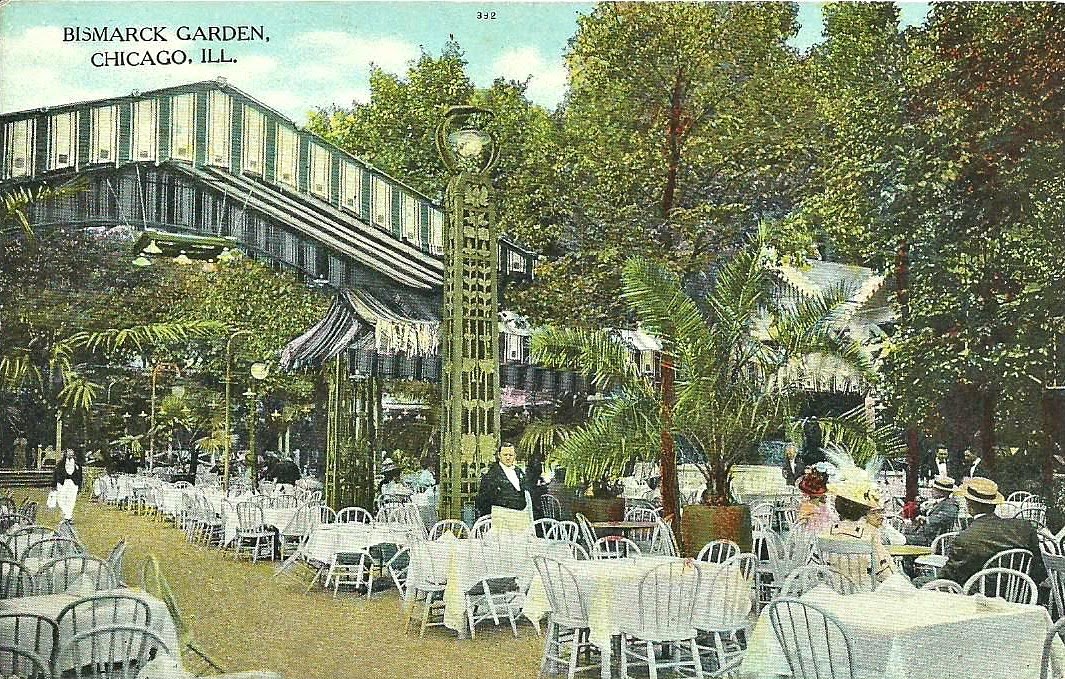
bismarck-gardens-postcard-frontIn addition to denying Fox’s assertion of an engagement, Barker also denied that he had said what Fox overheard in a restaurant ten years before, that “Miss Rappe has not taken a drink yet.”[7] The reportage doesn’t include the context for this remark—also via Mrs. Fox—but it implies that Rappe didn’t drink at the time and may have only started while in Barker’s company, that he introduced her to alcoholic beverages and continued to ply her despite her alleged bizarre behavior that so clearly resembled what happened to her at Arbuckle’s party.

Barker “enumerated at least six occasions where, in his presence, the dinner was disturbed by Virginia becoming hysterical, shrieking in pain and tearing her clothing.”[8] That she had even had two gin and orange juices—the same concoction, coincidentally, that she allegedly imbibed at Arbuckle’s party—surely must have seemed to the prosecution too good to be true for Arbuckle.[9] Such detail surely incited the heated “wrangle between Deputy District Attorney Milton U’Rren and Attorney Milton Cohen, whom the prosecutor charged with ‘coaching’ defense witnesses.”[10]

Coaching aside, the picture that Barker paints shows a man who had invested much time and money into enjoying Rappe’s company hundreds of times. The restaurants he did mention—Bismarck Garden at Broadway and Lake, and Rector’s, an oyster house at Clark and Monroe—were popular, fashionable, and expensive. Barker obviously “courted” the grandmother by attending Thanksgiving Day dinner at her Fullerton Avenue apartment and having her in tow for dinner “usually” means a certain commitment if not patience and suffering on the man’s part.

The South Haven incident would have been an expensive vacation, which included two long day cruises across Lake Michigan and the expense of putting Rappe and her grandmother up in a hotel as well as entertaining them at the town’s many attractions, including theaters, a casino, an opera house, and an amusement park. Even if it wasn’t an engagement ring in testimony, Barker had given Rappe a diamond ring. He did everything that a man might do if he were in love.

Barker’s testimony as to the length of their relationship suggests that it began to fade in 1913, when Rappe’s modeling career was at its height and she had sailed to Europe to attend the autumn fashion shows in Paris. When Rappe returned to Chicago in January 1914 and the LaSalle Hotel, she and Barker distanced themselves further. The Chicago Tribune reported on the marriage of Albert Sabath later that same month. Harry Barker was in the wedding party. If he attended the reception with Virginia Rappe, her name wasn’t mentioned.

Barker’s testimony had a profound effect on the only woman juror, Mrs. Helen Hubbard, who apparently took offense at what probably seemed his caddish betrayal. The resulting hung jury forced a new trial for late January 1922.

Barker was not called to testify at that trial or the third one. The defense found other witnesses who had seen Rappe’s drinking and striptease. Instead, Barker went back to running his businesses. Nevertheless, his name was often invoked during those trials and, especially, the last one, when Arbuckle was acquitted in April 1922.

What Barker had said on the stand at the first trial was not lost or forgotten by Milton U’Ren. In a fiery address to the jury, in which he blasted that they would be just as guilty as Arbuckle if they voted to acquit, he referred to Barker “as a ‘buzzard, snake, skunk and blackguard.’”[11] To this, Gavin McNab responded that Barker was

a man and a gentleman, who tried to be clean himself and keep all around him clean. This man whom the prosecution calls a blackguard was the only mourner at the funeral of Miss Rappe’s mother [sic] and he sacrificed himself financially to pay the expenses of that funeral. Where were Mrs. Fox and others who professed in this court to be such good friends of Miss Rappe? They were not there.[12]

In late December 1921, Barker and the Sabath family enjoyed a small legal victory in the California Supreme Court. But the Mildred Island case, due to the tenaciousness of the plaintiffs, dragged on in the courts until 1932.

[1] “Arbuckle Case Near Jury,” Sioux City Journal, 12 April 1922, 2.

[2] “Harry Barker Home from Panama,” Munster Times, 14 February 1916, 2.

[3] “Says Arbuckle Not Accused by Movie Star,” Fresno Morning Republican, 26 November 1921, 1.

[4] “Arbuckle Case Closes Monday, M’Nab Declares: Rancher and Former Friend of Miss Rappe on Stand,” Oklahoma City Times, 26 November 1921, 16.

[5] “The Past of Virginia Rappe Inquired Into,” Stockton Daily Evening Record, 26 November 1921, 1.

[6] “Impeachment of 2 Arbuckle Witnesses Looms,” Philadelphia Inquirer, 30 November 1921, 1.

[7] “Defense Will Close Monday for Arbuckle: Stockton Rancher Resumes Testimony,” Sacramento Bee, 26 November 1921, 1.

[8] “Booze Parties Hold Stage in Arbuckle Case: Former Sweetheart of Virginia Rappe Testifies Woman Would Tear Clothing after Drinking Liquor,” Salt Lake Telegram, 27 November 1921, 1.

[9] Some narratives use the term “orange blossom” to describe “Rappe’s drink.” She herself called it a “Bronx Cocktail,” which she preferred made with very little gin as she did not like its taste. See A.P. Night Wire, “Defense Is Contradicted,” Los Angeles Times, 7 April 1922, 1.

[10] “Miss Rappe Often Crazed with Pain, Witness Asserts,” Philadelphia Inquirer, 27 November 1921, 1.

[11] Oscar H. Fernbach, “Arbuckle’s Fate Is with Jury Today: Closing Argument in Third Trial of Comedian Now Under Way; McNab Yet on Argument,” San Francisco Examiner, 12 April 1922, 15.

[12] “Arbuckle Lawyers Flay Alleged Bully Methods Used by Prosecution,” Billings Gazette, 12 April 1922, 8.