A note on Aunt Kate Hardebeck

Those who followed the Arbuckle case from the beginning were surprised that Virginia Rappe had no family members—or even an extended family. No one came forward to claim her body in a San Francisco mortuary. By the time she was buried in Hollywood Forever Cemetery on September 19, 1921, ten days after her death, Virginia had an adoptive aunt, Kate Hardebeck. Those who attended the funeral noticed that she and her husband, Joseph Hardebeck, had supplied a pillow of roses for their late “niece.”

Although her presence on the stand saw some of better reportage, using the trial transcripts have brought to light the nature of the curious relationship between Virginia—called “Tootiie” in Hardebeck household—and her “Aunt Kate” or “Aunt Kitty.”

At this writing, I have no photograph of Aunt Kate for my book. Although very likely more of a facilitator than a guardian, Aunt Kate was fiercely loyal to Virginia and proved that on the stand. When she appeared as a rebuttal witness to vouch for Virginia’s good health and sensible lifestyle. Then there was Aunt Kate herself, whom Cohen could not intimidate. According to Bart Haley of the Philadelphia Evening Ledger, Mrs. Hardebeck seemed to be “a self-possessed and clever-looking woman, who in a quiet way had been doing considerable damage to his client’s position”—meaning Milton Cohen. He was not only “Fatty” Arbuckle’s personal lawyer, but Virginia’s as well. Cohen and his partner Frank Dominguez—who was Arbuckle’s first lead counsel—made the legal and financial arrangements for Virginia’s alleged paramour, Henry Lehrman and his Culver City studio in 1919. This allowed for Arbuckle to advance Lehrman the money to actually build two studios in one, thus allowing Arbuckle’s Comique Company to use one half as payback on the loan. This is, of course, a revealing rabbit hole down which to plunge—and something to save for the book.

Cohen, of course, knew a lot about Rappe’s household. He used that to exaggerate what may have been some isolated theatrics, the kind of thing expected of a “wild girl,” a “junior vamp,” to amuse the other film colonists when their parties needed some life, that someone, that is to be the life of the party. Such innocent escapades were transformed into bouts of hysteria that replicated and anticipated the fear if dying, loss of control and distress Virginia exhibited before losing consciousness in room 1219 of the St. Francis Hotel, after being alone with Arbuckle on the Labor Day afternoon of September 5, 1921.[1]

Cohen was very careful with Aunt Kate. Only during the third trial did he come close to revealing that “Uncle Joe” Hardebeck was an ex-convict and, like his wife, dependent on Virginia. But Cohen never did. Instead, he tried to exploit the curious dependence that Aunt Kate had on Virginia, that she was no blood relative, no aunt, but nothing more than Virginia’s housekeeper in Los Angeles, first at her apartment on Ivor Avenue and later at N. Wilton Place. It did not serve Cohen’s narrative to reveal too much about Aunt Kate’s other function, that of companion and chaperone when Virginia, that is, someone to intimidate the “boys,” the category under which Arbuckle fell. But Aunt Kate knew when to step aside, too, and not ask too many questions, like why was Virginia packing a lot more for an overnighter in Selma, just outside Fresno. Aunt Kate surely knew that her “niece” had to make some money, to get work, so that she could keep the Hardebecks and herself under the same roof. Virginia was no less loyal to the couple. This, perhaps, went back to a dire time in Virginia’s early life, after the death of her mother, Mabel Rappe, in 1905, which forced Virginia and her grandmother to move from New York back to Chicago and intermittent homelessness.

“I saw her two or three times a week,” Aunt Kate recalled on the stand, “and she and her grandmother would come out and stay overnight.”

The most current view of Virginia Rappe’s N. Wilton Pl. residence beset in Google “fog.”

Although very little is known about Aunt Kate’s early life, according to census data, she was born near Philadelphia in 1862 and was known as Kate Williams in 1900 and a widow. Her 1910 entry also reveals that she bore at least one child, whose absence might explain her connection to Virgina, which began on the South Side of Chicago, where Aunt Kate once worked as a housekeeper for a boarding house.

In 1903, in Covington, Kentucky, Kate married Joseph Hardebeck (b. 1863), a lawbook salesman. And this vocation certainly explained his title “the Judge,” as the leader of a gang of swindlers whose bad checks cost banks in the United States and Canada over $100,000 in 1909. When he was apprehended in the following year, Hardebeck was sentenced to four years in Missouri’s state penitentiary. Naturally, Aunt Kate told reporters she had no idea and believed her husband would be found innocent. And she stuck by him much as she did Virginia—until he barricaded himself in a bathroom in May 1923, a little over a year after the last Arbuckle trial, and shot himself to death. After that, Aunt Kate got by as a seamstress, something she also did for Virginia, whose outfits made her “the best dressed girl in Hollywood.”


[1] The “wild girl” can be compared to the Hollywood “bad girl” as personified by Bebe Daniels, whose best friend hovered inside the Arbuckle suite and downstairs in the Fable Room of the St. Francis. Arbuckle, incidentally, was a close friend of Bebe and I have a theory that she may have been hovering along with her friend.

First thoughts on my second visit to the San Francisco Public Library

Last week, I worked on the Arbuckle trial transcripts at the San Francisco Public Library, filling in the gaps from my December 2024 visit. My familiarity with the course of all three trials, including every participant and their background, has served me well. It’s a kind of meta-understanding that makes everything in the transcripts intelligible, which you cannot get reading them cold. But that doesn’t mean I’m not surprised at the latest revelations.

In my book, two people are on trial for rape, although it is called “manslaughter”: Roscoe Arbuckle and Virginia Rappe. And they must be presented in a way that is dualistic. Arbuckle is still the famous, smiling comedian, suitable for the children in the audience. He is also a man with an appetite, not only for food and liquor, but female company. His reason for being in San Francisco on Labor Day 1921 was for casual sex with an escort, a “call girl.” He does play a part in his own misadventure. So, too, Virginia Rappe. She got her telephone call in the Garden Court of the Palace Hotel.

I don’t think she misunderstood what was expected of her—and she did not live up to expectations. I see her trying to frustrate them, buying for time as she engages in conversation with Arbuckle—keeping him talking and joking. So, too, Rappe’s wanting a piano when it came time to dance. Arbuckle said no one knew how to play. Rappe did. She played a good “party piano.” But he overruled her and ordered up a victrola from the front desk of the St. Francis Hotel. She would have no excuse not to be a dance partner as the midafternoon approached and well before she could be—what?—extracted by her manager for the 130-mile road trip to Del Monte before nightfall. Then she had to use the bathroom in room 1219 and was cornered.

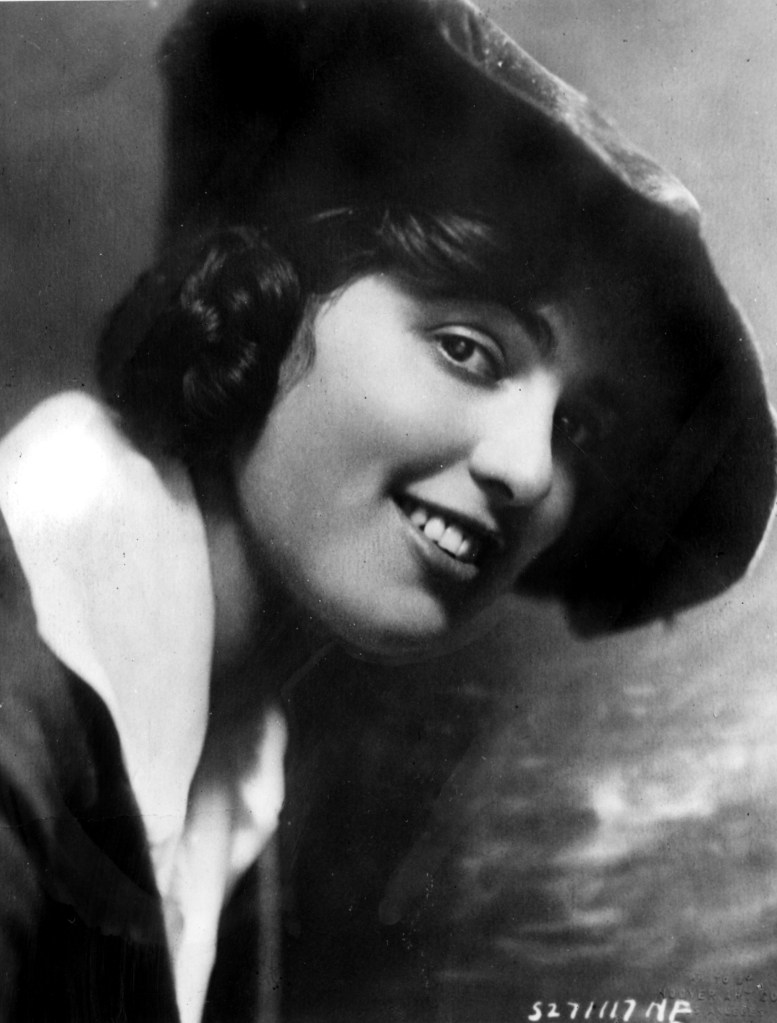
Virginia Rappe in a painter’s beret (Hoover Art Co.)

Then she had to be either a “good fellow,” as Maude Delmont, the companion provided for her by her manager (who may very well have pimped his women to get them work and his percentage). Or Rappe could choose not to be so “good.” My working hypothesis is that Rappe had learned to keep a certain distance from men so as not to be sexually exploited or abused. The defense mechanism had been imprinted in her youth. Nevertheless, she still wanted the benefits, so to speak, of the comedian’s good will. The risk was worth taking. After all, there were other women at the party when sex raised its ugly head.

Such a hypothesis requires as much background as possible about Rappe and that begins with her childhood and who served as her earliest influences. She had a grandmother who served as “Mama” to both her and the adult sister who was, in fact, her birth mother. The grandmother wasn’t related to either of them. She had interceded in some way. So, what kind of family breakdown or tragedy led to this arrangement? And how did that affect the course of Virginia Rappe’s life? We get so close here in the following extract from the third trial. But it has nothing to do with the res gestae.

Milton Cohen, one of Arbuckle’s lawyers, is very methodically and respectfully cross-examining Kate Hardebeck, Rappe’s adoptive “Aunt Kittie.” Here he is trying to get at the mystery of Rappe’s origins in order to present to the jury anything dubious about her character, something that will exonerate Arbuckle and redirect the blame. There is nothing new in that. It is perfectly lawyerly. But there is more context. This trial takes place in the heyday of social Darwinism, when considerable emphasis was placed on genetic factors as well as environment in determining one’s morality or lack thereof.

Alert to the possibility of seeing the victim pushed from her pedestal, the prosecutor, Milton U’Ren, waits for the right moment to object.

Q. Do you remember how you happened to meet Virginia’s grandmother, or I mean Mrs. Virginia Rap[p]?

A. I knew the grandmother some years before and her mother, Mabel Rap[p], and I had lost track of them, and I had friend who had met them in the meantime, A Mrs. Tomlee, who had known me for years, and she took me their home again.

Q. How did her grandmother pronounce her name, Rap[p]?

A. Rap[p]?

MR. U’REN. Of course, if your Honor please, this family history is very interesting but I think it is entirely immaterial, irrelevant and not proper cross-examination.

MR. COHEN. They have gone back, if your Honor please, to the history—

MR. U’REN. No, we have just gone back to the acquaintance of this witness with Virginia Rappe, in regard to her health, and while it may be very interesting to find out the family branches of all the witnesses that appear upon the stand, I do not think that it can add anything to the knowledge of the jury as to how Virginia Rappe came to her death.

Developing a few latent impressions: another note on E. O. Heinrich’s testimony

The American Sherlock takes the stand,” published here last August, is still quite informative about the pioneer criminologist Edward O. Heinrich. This new note simply shares some first impressions after reading his testimony in the transcripts of People vs. Arbuckle. These show how the science of dactyloscopy—of taking and identifying fingerprints—contributed to the prosecution of Roscoe Arbuckle for causing the death of Virginia Rappe. They also invite a long-overdue reinvestigation.

Heinrich obviously relished the opportunity to explain what fingerprints were, that the pattern of ridges in the form of loops and whorls on fingers and palms were unique to every person from cradle to grave. He explained how fingerprints were lifted from a surface and compared to those taken from a living or dead subject. Heinrich even lectured the jurors on the history of fingerprints. He also described how fingerprints were developed using aluminum powder and the tedious process of using different kinds of microscopes, enlarging photographs, and performing mathematical computations to rule out any doubt. Ultimately, the process came down to probability and points of similarity. Ten or more points were considered a match, based on Scotland Yard’s standard adopted by the identification bureaus of virtually every American police department.

Heinrich also described his work in various police departments, his summer session lectures at the University of California-Berkeley, his memberships in applicable professional organizations, and so on. He provided a list of books by fingerprint “authorities.” But, like many criminologists in the early twentieth century, fingerprint analysis was not his specialization. More often than not, these early practitioners were called upon to analyze handwriting samples. Nevertheless, for Heinrich, a proper criminologist had to make the jump from examining the downstroke of a lowercase f, say, and the hypnotic whorl in a fingertip.

Such evidence wasn’t new to American courts in 1921. Police departments, federal and state governments, even businesses were collecting and keeping fingerprint files. But to the layperson, the science behind them was almost as controversial as natural selection. To criminal defense lawyers and defendants, circumstantial fingerprint evidence was hard to overcome if jurors found it convincing.

Heinrich—and the assistant district attorney who was his handler, Milton U’Ren—had to convince juries that he had been long at work on his own methodology and that fingerprints were hardly a sideline for him. He was presented as a professor, even though he his real title was lecturer at the University of California-Berkeley. He reeled off everything he had done professionally, including taking the fingerprints of enemy aliens during the First World War. He also conducted many experiments, including the application and detection of fake fingerprints. But Heinrich’s work on identifying the faded latent fingerprints of Roscoe Arbuckle and Virginia Rappe on a hotel door was his first real test as an expert witness. The defense quickly apprehended this and that he was mostly self-taught. They pulled out all the stops to discredit not only his findings but his person as well.

During the first trial, Arbuckle’s chief counsel, Gavin McNab, tried to convince the jury that the fingerprints were “spooks,” inferring that criminologists who dealt in fingerprints were as phony as Victorian spiritualists. McNab and his colleagues also never missed a chance to note that Heinrich wasn’t a tenured professor, forcing him to admit that he was only a lecturer at Berkeley.

The defense lawyers scored points with the press for their entertaining cross-examinations, which turned Heinrich into an “egghead”—his pattern baldness made him look the part. But after the first trial ended in a hung jury, in part due to Heinrich’s thoroughness in revealing that room 1219 had not been thoroughly cleaned and wiped down, new tactics were adopted in the second trial.

Arbuckle’s longtime personal lawyer, Milton Cohen, took over grilling Heinrich. He was better prepared. He had pored over the literature and cleverly cherrypicked paragraphs to assert that Heinrich had violated protocols and standards in taking fingerprints, photographing them, and developing them using aluminum powder. The most heinous thing that Heinrich and the prosecution did was not handing over the hotel room door to the police and storing it in the property (i.e., evidence) room. This line of attack, however, only revealed that the district attorneys didn’t trust the police, that some members of the department, even the chief, were cooperating with Arbuckle’s lawyers. (Heinrich also disclosed that he had been followed in the St. Francis Hotel.)

Other avenues of attack included the way that Heinrich glibly introduced his assistant and secretary, Salome Boyle, a senior at Berkeley, to the St. Francis deskman. Heinrich called her “my Watson,” implying that he was some sort of Sherlock Holmes. But Heinrich wasn’t being vain but rather self-deprecatory, indeed, self-conscious of his own appearance and what he looked like in the company of a young woman. Cohen also tried to bait Heinrich with an insinuations that wasn’t reported in the newspapers: the seeming impropriety of a professor locking himself away with a coed in a hotel bedroom well into the night, leaving the jurors to think she couldn’t just be there to hold his flashlight.

Heinrich attempting to deflect misspeaking about Miss Boyle at the third Arbuckle trial. (Courtesy of the San Francisco Public Library)

The alleged “struggle” between Arbuckle and Rappe, entirely based on circumstantial evidence, was an important theme in the unsuccessful prosecution of the comedian. Most books about the Arbuckle case place little credence in Heinrich’s work. But, given today’s sophisticated scanning technology and computer analysis, perhaps a latter-day criminologist might stress test Heinrich’s results. It would provide a puzzle piece that certainly would force one to take every version of events apart and start over again.

“Cover up”? The first day into night for reporters assigned to the Arbuckle case

During the second Arbuckle trial of January 1922, the District Attorney of San Francisco, Matthew Brady, subpoenaed a witness who shed light on the comedian’s conduct in the immediate aftermath of Virginia Rappe’s during the early afternoon of September 9, 1921. This was Warden Woolard, a reporter for the Los Angeles Times. His purpose was to contradict Arbuckle’s testimony from the first trial in November on two points: (1) whether he had been alone in his hotel bedroom with Rappe; and (2) whether he had locked the doors. Although Woolard no longer had his notes, he had a good memory and was on the stand with much to tell.

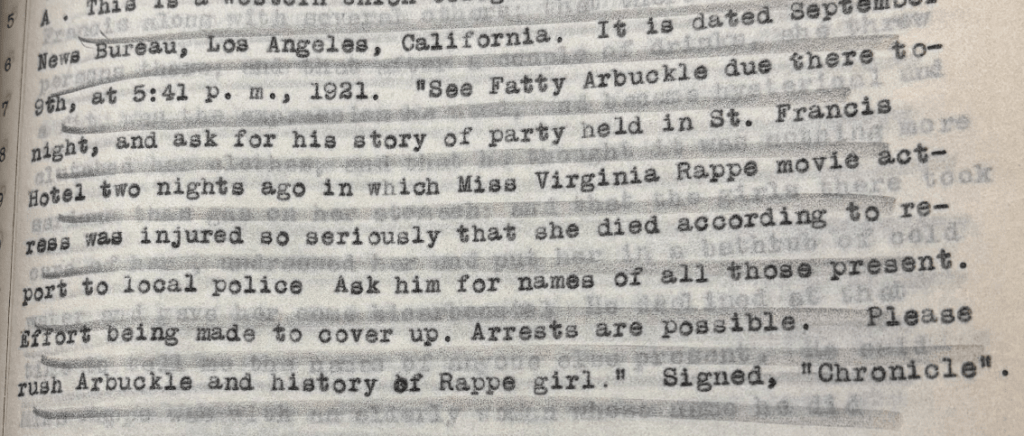
He was prompted to meet Arbuckle by a telegram from the San Francisco Chronicle. It was hard not to ignore its urgency—and both newspapers would sell plenty of copies by sharing information. The Chronicle wanted answers from Roscoe Arbuckle about his Labor Day party of September 5.

The Times sent Woolard to Arbuckle’s Tudoresque mansion on W. Adams Street. The reporter arrived arrived just after 7:00 in the evening. He rang the bell and was met at the front door by an attractive woman who identified herself as Arbuckle’s secretary. This was Catherine Fitzgerald (see “Arbuckle’s housekeeper, secretary and escort: Catherine Fitzgerald”). He gave her his card and she told him to wait outside.

If you are familiar with The Day the Laughter Stopped (1976) by David Yallop, who claimed to have used the trial transcripts to write his book, he describes a rather different scene on p. 132 that was surely intended for a screenplay that any assiduous research would have spoiled.

At 10:30 p.m. that Friday evening, Roscoe Arbuckle sat quietly studying the script for his next picture. The doorbell rang and his butler opened the door. Two dozen reporters charged past the butler, knocking him over. They poured all over the house, taking photographs and looking for Roscoe. Surrounding him, they began to fire questions based on the statements that had already been made in San Francisco by Maude and Alice. [. . .] “Is it true that you screwed five women during the afternoon?”

That is not how it went. According to Woolard, Arbuckle soon appeared. The comedian asked Woolard to follow him away from the house, so that they could talk in private. Arbuckle did not need to be told about what happened in San Francisco earlier in the day. Friends had informed him of Rappe’s death.* And, as their conversation began in earnest, the actor Lowell Sherman joined the two men on the sidewalk. He had apparently come from a back door. Arbuckle denied hurting Rappe. He had only pushed her down on a bed to keep her quiet. And so on. This is in Wallop, all taken from Woolard’s reportage the next day, September 10, as well as that of George Hyde of the Chronicle.

Arbuckle wasn’t “studying” the script for a silent film. Instead, Lowell and other partygoers were getting on the same page and had been getting on that page during the afternoon of September 9. And this continued into the night, when Woolard attended a meeting held in the office of Grauman’s Million Dollar Theater. What Woolard curiously omitted from his testimony was the presence of Arbuckle’s first lawyer, Frank Dominguez. The first thing he did was school Arbuckle with the understanding that anything he said needed to be made only with the advice and consent of counsel. So, I will attempt to square this in the work-in-progress. It may have simply been a courtesy extended by the journalist to one of the most important criminal defense lawyers in Los Angeles during the 1910s and ’20s, the kind of man you heard when he said, “I’m not here,” and you wanted to keep your job.

Warden Woolard did. He went on to enjoy a long and storied career, including assigning reporters to the Black Dahlia case. George Hyde, who likely wired the Times for the initial scoop and wrote the first columns about the Arbuckle case for the Chronicle, either resigned or was released soon after. He went on to testify at the third trial. But offered very little in substance. He came and went from the stand in minutes. His career took another direction. For a time, he worked for various newspapers in Los Angeles, including the Times. But he was never assigned to anything like the death of Virginia Rappe again. For a time he the publicity agent for the evangelist Aimee Semple McPherson. Eventually, he returned to San Francisco, where he poisoned himself in July 1932, “in a fit of despondency,” after a long period of unemployment.

Woolard read the text of the Chronicle’s telegram in open court. The underlining, suggesting its importance, was made by Arbuckle’s lawyer Nat Schmulowitz. (Courtesy of the San Francisco Public Library)

*This was really one “friend,” Rappe’s manager Al Semnacher. He may have monitored her decline, which provided more lead time for damage control. The problem for Arbuckle was his own hubris and the absence of his personal lawyer, Milton Cohen, Dominguez’s law partner, who was en route from New York during this critical time.

Did she keep a little black book?

Toward the end of the third trial in late March 1922, Milton Cohen, one of Arbuckle’s five defense lawyers, cross-examined Kate Hardebeck at length. She was a rebuttal witness for the prosecution and had been Virginia Rappe’s longtime foster mother and housekeeper known as “Aunt Kitty.”

Cohen had a special place in Arbuckle’s defense. Not only was he the comedian’s personal lawyer, he had once been Rappe’s. He knew her, had been a friend. However, now that she was deceased and Arbuckle accused of having causing her death, Cohen was no longer bound by lawyer-client privilege. Thus far, he had used his personal knowledge of Rappe’s time in Los Angeles to procure witnesses who vouched for her alleged episodes of hysteria triggered by the smallest amounts of alcohol.

Cohen also knew that Rappe had left a paper trail over the years. She traveled a great deal and sent letters, postcards, and telegrams to not only the one foster mother, but the other who testified to Rappe’s good health and morals, namely Katherine Fox. Both women proved to be effective rebuttal witnesses, who painted a sympathetic portrait of their former charge. The prosecutors, especially Assistant District Attorney Milton U’Ren, wanted this idealized image of the victim preserved and to counter the “unfortunate” but fallen woman advanced by Arbuckle’s “million-dollar team” of lawyers.* So, the two foster mothers were undoubtedly encouraged not to mention any correspondence and stonewall where necessary, especially if that might intrude on the happy, girlish creature they described on the stand. And they may have done better than what was asked for. They told the defense lawyers that they had destroyed their foster daughter’s letters—this despite how precious she had been to them.

But one such document still existed. It lay on prosecution side of the shared consuls’ table. Cohen fixed on it. Was that the “diary” Al Semnacher, Rappe’s putative manager, had mentioned during his testimony a few days ago?

“Mr. U’Ren,” Cohen asked, “will you be good enough to let me have Miss Rappe’s diary?” Then Cohen turned to the witness. “By the way, did you deliver Miss Rappe’s diary to Mr. U’Ren.”

U’Ren started to object but Cohen cut him off. “I beg your pardon, just let her answer.” And Hardebeck answered in the negative.

When U’Ren handed the tiny book to Cohen, the latter saw that it wasn’t the diary. It had tabbed pages from A to Z. Nevertheless, he continued his fishing expedition.

COHEN: Q. Mrs. Hardebach (sic) have you ever see a book about six inches long by three inches wide, the sheets being gold edged?

A. No.

Q. And a black leather cover?

A. This is the book Miss Rappe had besides her address book, and we discarded that when we left Ivor Avenue, because it was full and had come apart.

Q. You say you discarded that book?

A. Miss Rappe discarded it before we left Ivor Avenue; and after that we had no telephone, and it was not necessary to keep the book.

Q. This is the only book, then, that you have?

A. Yes.

Aunt Kitty responded in a way that suggests there are two books: one for addresses, one for telephone numbers. While such items could be discrete objects in 1921, this didn’t sound convincing. So, Cohen continued to grill the witness. He needed a diary—or just a simple daybook, a proto-planner—with dates and jottings that might put Rappe where she had an episode, one that anticipated the fatal one ascribed to Arbuckle just two weeks before the Labor Day party of September 5, 1921.

In the end, Cohen let the matter go. U’Ren, however, did not. During the redirect examination, he took the precaution of burying the issue of a diary once and for all.

U’REN: Q. Mrs. Hardebach (sic) did Virginia Rappe keep a diary?

A. Not to my knowledge, no, I am sure she did not.

CT_BLACK_BOOK_01_0f13022f-818a-4d29-9cbc-81f6dd55497b_1000x1000


*In the revised narrative, a more accurate version will fall between these two contrived ones created for Arbuckle’s trials.

Arbuckle’s abortive ‘round-the-world tour of 1922

The epilogue, like the introduction, is always in flux and won’t be finalized until we finish the next two trials. For the most part, the text feels sound—and much is devoted to the denouements of various principal and some minor witnesses. We have traced, for example, some of Maude Delmont’s life to the end. And we have much devoted to Arbuckle’s post-trial career with a certain emphasis on the incidents of misconduct that continue after Virginia Rappe.

The following passage may need to be shortened or cut. But what happened may have been more than what we have been previously told. The Merritt book, Room 1219, for example, devotes a vanilla paragraph to the incident and attributes Arbuckle’s injury to slipping and falling down a stairwell. Our treatment more relies on the eyewitnesses among the Japanese crew who spoke to reporters in Yokohama.

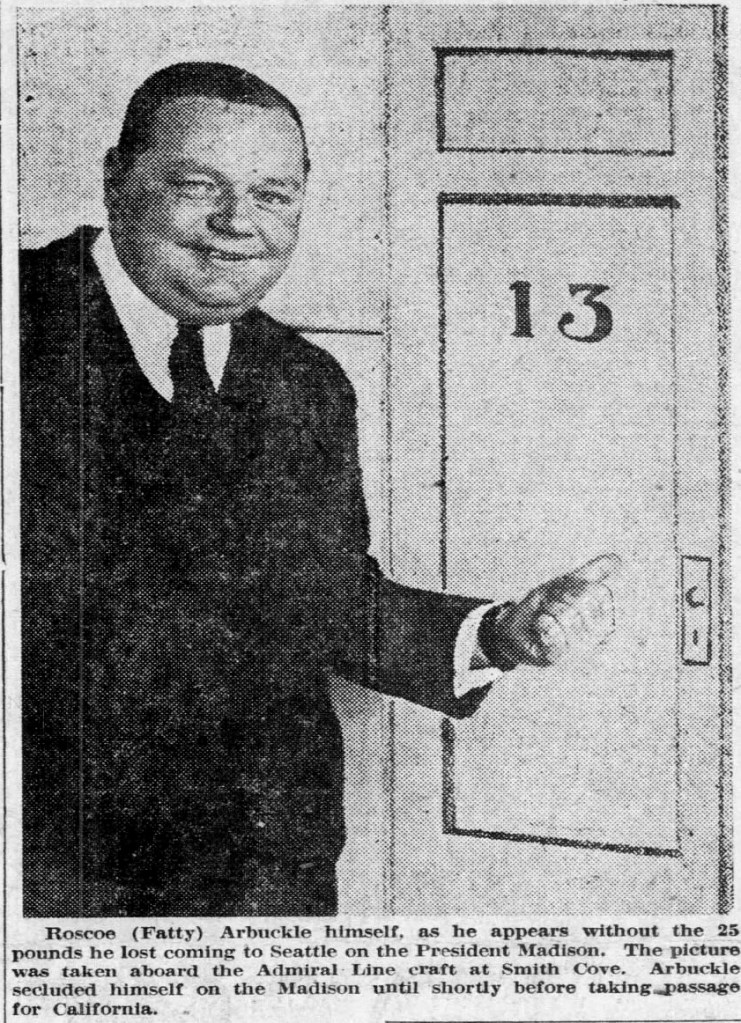
<rbuckle smile and pointing at his “hoodoo” number (Newspapers.com)

In late July, Hays traveled to Los Angeles and couldn’t avoid The Sins of Hollywood, with its lurid red Mephistopheles and his camera on a startled flapper and her beau. A respected Los Angeles minister handed him a copy at the behest of the author. Hays was appalled but didn’t change his glad tidings in the speech he gave at the new Hollywood Bowl. He declared, “The one bad influence in Hollywood is talk. And for the life of me I cannot see the horrors of Hollywood.”

Arbuckle’s reaction to the pamphlet and the grim presence of the motion picture czar is unknown. Still, his subsequent misadventure to remove himself from Los Angeles and the public eye may have been connected given the timing.

Not long after Hays returned to New York, the disgraced comedian applied for a passport for himself and his new secretary and minder, Harry R. Brand, a young publicist in the employ of Joseph Schenck. Their itinerary was to sail around the world with stops in Honolulu, Japan, China, the Philippines, India, and Egypt, where Arbuckle was to meet up with Schenck and his wife, Constance Talmadge, before continuing on to France, England, and New York. The voyage was to take months and invited much speculation. Did Arbuckle intend to resume his career abroad? Will he accept offers from Japanese and French producers?

Arbuckle was guarded about his plans. He only said he wanted to “rest.” Schenck was more explicit. He told reporters that Arbuckle was “jumpy and nervous” and in “poor personal health.” This was code to cover for Arbuckle and the real reason, which may have been a reward for the comedian’s good behavior. Arbuckle had certainly suffered not only being unable to work but to play—and the late summer had always been set aside his vacations and carousing.

Seen off by his lawyer Milton Cohen—and without Brand—Arbuckle boarded the SS Siberia Maru in San Francisco on July 16. On the first or second night at sea, Arbuckle was seen drinking sake in the company of friends. According the Japanese press, he got into a braw and threw a punch at a British passenger, cutting his hand on the other man’s teeth.

Arbuckle quickly denied the incident in a radiogram to Schenck. Then things got worse. The comedian contracted blood poisoning and a hospital room in Tokyo was quickly arranged. There Japanese doctors considered amputating Arbuckle’s arm at one point. But the comedian eventually recovered and returned via Seattle four weeks later. His arrival was intended to be “incognito.” But he was discovered and photographed outside his stateroom, number 13.

Virginia and a “victor”: Adela Rogers St. John

“History is written by the victors” and so is writing about Hollywood in the Silent Era. But we should probably paraphrase here, just a little, and say that “History is written by the defenders.” And if one scores by the number of defenders, then Virginia Rappe lost the contest with Roscoe Arbuckle, regardless whether she put up a fight in room 1219.

One of the earliest defenders was the Hollywood writer and memoirist Adela Rogers St. John. as mentioned in an earlier post, she interviewed Arbuckle for “Love Confessions of a Fat Man,” which was published in Photoplay during the early weeks of the Arbuckle scandal in the September 1921 issue.

Arbuckle, by hosting a party that flaunted its defiance of Prohibition laws and moral standards—it was essentially a party of married men cavorting with single showgirls—had ruined the innocence of St. John’s tongue-in-cheek portrayal of Arbuckle as a lady’s man, a virtual eligible bachelor. Her resentment eventually fell not on him but on Virginia Rappe. And St. John lived long enough to write it up in her autobiography Love, Laughter and Tears: My Hollywood Story (1978).

St. John, whose career got its start working for William Randolph Hearst—the bête noire of so many Arbuckle narratives—devotes several pages (60ff) to the Arbuckle scandal.

Perhaps St. John is less a defender and more the apologist, especially in regard to Arbuckle’s being in San Francisco in the first place.

St. John recalls a conversation with her father, Earl Rogers. Although she described him as “still the Coast’s leading criminal lawyer,” he had been in poor health since the death of his second wife in January 1919 and was more often hors de combat and no longer the feared trial lawyer who served Earle Stanley Gardner as the model for Perry Mason.

According to St. John, her father discussed why he had to refuse a request made by Arbuckle’s producer, Joseph Schenck, to represent the comedian. Although Rogers assumed Arbuckle wouldn’t be convicted, he would nevertheless be seen as a monster given his weight. His career would be ruined. “Tell Joe,” Rogers said to his daughter, “I can’t take the case; the doctors won’t let me, but to prepare Hollywood for tornadoes.”

The news would have been a disappointment, for Rogers was considered preeminent as a criminal attorney in cases that involved medical expert evidence. In his prime, he would have been perfect for the Arbuckle case given that his alleged victim had died from ruptured urinary bladder. But by early 1920, his health, mental, and legal problems had come to a head. He had assaulted a deputy sheriff sent to arrest him for making threats against members of his own family, which was attributed to “excessive use of stimulants and drugs.”

The “statement” St. John quoted in her memoir may have been paraphrased to make Arbuckle look innocent from the beginning. But her version isn’t what Arbuckle said in the Los Angeles Times the day after Rappe’s death. But let’s get back to why Earl Rogers wasn’t to be Arbuckle’s Perry Mason.

Frank Dominguez, Arbuckle’s original defense attorney, had resigned from the defense team in early October 1921, leaving Milton Cohen and the San Francisco attorney Charles Brennan shorthanded for November’s manslaughter trial. Several names appeared in the press, but not Earl Rogers. While it is true that his doctors allowed him to return to work in November and form a new practice, he restricted himself to Los Angeles and his health only deteriorated. He died in February 1922. However, one of Arbuckle’s prosecutors, Milton U’Ren, made it a point to ask prospective jurors if they knew Milton Cohen’s law partners—Frank Dominguez and Earl Rogers. If the answer was yes, presumably that talesman could be excused. Did U’Ren suspect that Rogers was giving his fellow lawyers advice? That might be a more reasonable explanation for what his daughter reimagined.

She also opined that Arbuckle, Fred Fishback, and Lowell Sherman went to San Francisco because it had “the best restaurants on the North American Continent” and

for a few days of fun probably partly on the Barbary Coast, a well-known section where night clubs and honky-tonks and cafes clustered together and produced the first-floor shows, the first new dances such as the Bunny Hug and the Turkey Trot, and much of the best music of our times. During this vacation an extra girl named Virginia Rappe got some alcohol in her system, stripped off her clothes, and plunged Fatty and Hollywood into a major scandal.

The resentment here is hard to miss. To St. John, a Hollywood insider, Virginia Rappe was a nonentity who had spoiled the much greater party that was the motion picture industry before the arrival of Will H. Hays.

“At that time,” she continues, “Miss Rappe had been living only a few blocks from me in Hollywood.” By “a few blocks” St. John means one of two places where Rappe lived—in 1920, not 1921. It is the distance to Henry Lehrman’s house, where Rappe lived for the greater part of 1920, at 6717 Franklin Ave., or 1946 Ivar Ave., which was fewer blocks away, where Rappe roomed briefly for the first two or three months of 1921. This can be documented. If we go by the 1920 federal census, St. John and her family lived miles away on Toberman St. and far from Hollywood. However, the 1921 city directory, which was compiled in the latter half of 1920, has Rappe living at the Ivar Ave. address and Adela and her husband, W. Ivan St. John, just as close as she states—to 5873 Franklin Ave.[1]

Memory can be tricky writing decades later, and if it’s a gossipy story that has been told repeatedly there’s a good chance the version that prominently places the narrator in the story will come to be accepted as true. So, we should be accepting that the St. John’s account isn’t airtight though it’s likely too odd of a coincidence to have been completely invented.

The day after Fatty had been indicted on the testimony of several girls [i.e., Zey Prevost and Alice Blake] and Virginia Rappe’s own deathbed statements, the man who did my cleaning came and told me: “I did Virginia Rappe’s cleaning. I see where one side says she was a sweet young girl and Mr. Arbuckle dragged her into the bedroom, the other witnesses say she began screaming and tearing off her clothes. Once I went in her house to hang up some cleaning, and the first thing I knew she’d torn off her dress and was running outdoors, yelling, “Save me, a man attacked me.” There I was standing in the kitchen with my hands still full of hangers with her clothes on them and she was running out hollering I’d tried to attack her. The neighbors told me whenever she got a few drinks she did that. I hated to lose a good customer, but I thought it was too dangerous so I never went back.”

I asked those neighbors and they confirmed the story. But you couldn’t put that kind of evidence into court! The girl was dead. To blacken her character would only increase public indignation against Fatty, for trying to save himself at her expense. (63–64)

St. John, ever the lawyer’s daughter, seems to suggest such evidence would have been dismissed as hearsay. But Gavin McNab, Arbuckle lead counsel through three trials, put as many witnesses on the stand as he could find to testify to Rappe’s frequent hysterics and disrobing. An example was Irene Morgan, who had served as a nurse, masseuse, and maid in the Lehrman household for several months in 1921. She was both deposed and examined on the stand by Milton Cohen at the first Arbuckle trial.

Cohen had the advantage of knowing Lehrman and Rappe—he was their personal lawyer as well as Arbuckle’s. He knew Rappe was suffering from what was described as a “nervous condition,” which, in part, had less to do with alcoholic beverages than with her self-image: she was overweight in early 1919 and losing weight was necessary to be considered for future movie roles.

Paradise Garden - Rappe and 1917 swimwear

She was no extra: Virginia Rappe looking like herself in 1917 swimwear. The still is from her first film, Paradise Garden (1917) (IMDb)

According to the trial reportage, Morgan described her service as it concerned Rappe, which included massages and treatments described as hydrotherapy. Morgan also knew that Rappe had been advised by a doctor to adhere to a bland diet and not drink alcoholic beverages. Morgan, however, testified that Rappe disregarded the advice. When she drank, “Miss Rappe often “tore her clothing in frenzy.” During one of these incidents, she said she ran nude from Lehrman’s house into Highland Ave. (See also our blog post about Morgan about her problematic testimony.)

Cohen did the spade work of finding and interviewing witnesses to similar episodes in Los Angeles. But there is no evidence that he met with the man who cleaned the clothes of Virginia Rappe and, coincidentally, Adela Rogers St. John. So, we have to ask, was he a real person or a strawman made up—or to be generous again, a composite—created to give St. John a role in the story. If he was real, one has to wonder how Cohen overlooked him. Perhaps the laundry man had sympathy for Rappe despite the aborted cleaning contract and chose to give no aid to the Arbuckle camp.

The story St. John tells here, of course, is one of many that turned Rappe from being “the best dressed girl in Hollywood” to the most self-undressed during the three Arbuckle trials and in much of what has been written about her ever since. Despite the bias, however, such an account reinforces just how much Rappe was resented in death and that, again, is the takeaway.

St. John mentions in passing Rappe’s former landlord, studio boss, dance partner, and boyfriend. She disparagingly refers to him as “a man named ‘Pathé’ Lehrman, claiming to be the dead girl’s sweetheart”—while knowing he wasn’t called that in the newspapers during the Arbuckle case. He was always Henry Lehrman and St. John well knew he was a key figure of early Hollywood history. Lehrman directed and mentored both Arbuckle and Charlie Chaplin in their first comedies for Keystone Studios. But we mustn’t lose sight that St. John is a victor in the sense that she outlived everyone who could challenge her stories. She got to write that history and cast Lehrman as she pleased. But it is from Lehrman that we find something that suggests that St. John’s memory of “the man who did her cleaning” touched on a recurring theme, that Rappe feared being sexually assaulted.

In an interview with Louis Fehr of the New York American, Lehrman said, “I remember once when there was a terrible assault case in the newspapers. She said to me quietly: ‘Henry, if anyone tried to do a thing like that to me, he’d have to kill me.’ Well, she’s dead.”

So, perhaps St. John’s story has a grain of truth to it, that Rappe’s hysteria may have been histrionics—theater of a kind—intended as self-defense, to startle or frighten a potential rapist. We still have a possible hypothesis in our work-in-progress.

Women are still advised to disrupt the idea or fantasy of their attacker, that they should “fight like a furious cat” and “yell loudly and strongly.” Perhaps Rappe removed one facet of the male fantasy: the forcible disrobing, the tearing off the victim’s clothes, and so on. Perhaps, too, a good lawyer like Milton Cohen knew how to frame such episodes into what was needed to get Arbuckle acquitted. Maybe we can only leave that to the reader.

3c26480u

Adela Rogers St. John, 1966 (Library of Congress)


[1] In 1921, W. Ivan St. John served as personal secretary to the new mayor, George E. Cryer. He had been elected to on a platform to close the city’s vice dens and supported efforts to establish a censorship board. He also wholly supported the ban on Arbuckle’s films—which surely put Mr. St. John in an awkward position vis-à-vis Mrs. St. John.

Gestational cystitis and Rappe’s Baby Girl: Nurse Roth speaks out, October 28, 1921

The work-in-progress features a chapter on October 1921. During this time, Roscoe Arbuckle’s defense team and strategy changed. Frank Dominguez, the comedian’s lead counsel in September, allegedly resigned to pursue the interests he had in Los Angeles. But his departure had more to do with his strategy of insinuating that Maude Delmont and Al Semnacher had tried to blackmail Arbuckle with Rappe’s torn undergarments, which they had secreted away to Los Angeles.

Dominguez probably didn’t believe in such a scheme. It only served to further undermine the credibility of Maude Delmont. Once she testified at the preliminary hearing or trial, a masterful cross-examination could destroy the prosecution’s case. No jury would convict Arbuckle after this alleged extortionist, alcoholic, and drug addict was deconstructed in the witness chair.

But this strategy presupposed a crime, that Arbuckle had done something wrong, like raping Virginia Rappe or failing to report a tragic accident that might have happened in an act of consensual intercourse. Such a defense only made the problem worse for Joseph Schenk, Adolph Zukor, Jesse Lasky, and other stakeholders in Arbuckle’s career. They knew that their star comedian had to be completely innocent of any wrongdoing, “squeaky clean,” as his career and reputation were based on a wholesome (though often raffish) screen image. Thus, there had to be a kind of legal, ethical, and situational “estrangement” from the parttime actress and society girl who, until she suffered her fatal injury, was Arbuckle’s friend, “one of the gang.”

Dominguez’s partner and Arbuckle’s personal lawyer, Milton Cohen, was also part of the comedian’s defense team. Cohen authored the strategy of “deconstructing” Virginia Rappe. He had also once been her personal attorney and knew more about her than any of his colleagues. He knew that of the many performers who remade their personas, with their different names and confected backstories, Rappe’s was a nearly blank slate. If she didn’t have any skeletons in her closet, he could put them there.

Dominguez’s successor, Gavin McNab, was on board to develop this strategy with Cohen’s counterpart in Chicago, the lawyer Albert Sabath, a close friend of Rappe’s first boyfriend, Harry Barker. The strategy was simple enough: to blame the victim before Arbuckle’s manslaughter trial in November and get it into the press before jury selection.

Arbuckle’s defense team spent much of October locating witnesses who could tell tales of Rappe’s private life. They had an immense war chest and weren’t shy about intimidating the District Attorney of San Francisco with how much money they had as the postscript below the following news item makes clear.

The news item reprinted below is the capstone to a wave of such articles that DA Matthew Brady dismissed as “propaganda.” These appeared in various forms published by the Hearst syndicate’s International News Service (in contrast to the oft-mentioned animus William Randolph Hearst and his papers allegedly had toward Arbuckle and Hollywood, a meme that has been recycled in many narratives and biographies).

We devote an earlier blog entry to this topic because of the centrality of the cystitis–pregnancy strategy in finally getting Arbuckle acquitted in April 1922. Although we can’t fault the law of diminishing returns after three trials, the money spent on his defense wasn’t enough to convince the public that Arbuckle was the upright person they once had imagined.

Here, we return to the “propaganda” campaign because of the unusual features of this version from the Los Angeles Evening Herald of October 28, 1921. It gives a description of Rappe’s “daughter,” as though she were a tiny clone of the mother. This article, too, was the first to give a name to Rappe’s bladder disease.

Readers should note that premature infants were sometimes used as sideshow oddities in the early twentieth century. Nurse Roth, a self-proclaimed friend and confidante of Rappe, showed no hesitation in mentioning that her dear friend’s alleged child was used in such an exhibit.


NURSE REVEALS RAPPE GIRL’S PAST
TELLS LIFE OF WOMAN IN ARBUCKLE TRAGEDY
Attorneys in Chicago Hear Story of Acquaintance of Actress

By International News Service

CHICAGO, Oct. 28.—Shadowed secrets from the hidden past of Virginia Rappe, dead movie actress, were drawn to light today in an effort to clear Roscoe “Fatty” Arbuckle from responsibility for her death. The dead actress’ early life was revealed with many sordid details by Mrs. Josephine Roth, her lifelong friend.

The revelations included the fact that Virginia had been a mother, her child dying when 5 years old. The most startling statement made by Mrs. Roth was that the actress was in constant danger of a sudden shock.

DRAMATIC STATEMENT

“If I could tell my story to a jury of physicians, ‘Fatty’’ Arbuckle would be freed in 10 minutes,” was her dramatic statement. “Virginia could have died at any time from a sharp fall or even a sudden misstep.”

Her story was told to Assistant State’s Attorney Frank Peska, who represented District Attorney Brady of San Francisco. It was to be repeated later to Attorney Brennan of Arbuckle’s defense counsel, who arrived this afternoon.

Mrs. Roth told her story with tears, in her eyes.

“Virginia’s memory is still so tender,” she said.

CHRONIC AILMENT

She declared that Miss Rappe was a constant sufferer from systitus [sic], a chronic disease of a vital organ. Mrs. Roth, who had acted frequently as nurse to the former model, then described in detail the medical attention given the ailing woman. This treatment had been continued until 1913, when Virginia left Chicago, said Mrs. Roth.

“A baby was born here to Virginia. It was so small and frail, it was placed in an incubator and exhibited at a local amusement place,” said the former nurse.

BEAUTIFUL CHILD

“The child was very beautiful. She had Virginia’s black hair and big black eyes. She died when 5 years of age.”

Other depositions were taken during the day from Miss Virginia Warren, also a nurse; Jay Abrams and a prominent theatrical producer, whose name was withheld.

REPORT UNLMITED FUND AT DISPOSAL OF FATTY ARBUCKLE

SAN FRANCISCO, Oct. 28—The fight to save Roscoe “Fatty” Arbuckle from prison today assumed a wider scope with the circulation of the rumor that unlimited money for defense purposes has been placed at the comedian’s command. Lawyers, picked not for price but for the success they have achieved in San Francisco courts, have been engaged to conduct the defense. A nation-wide search for evidence, admittedly costing heavily, was underway today.

Gavin McNab, recently named chief counsel for Arbuckle, has frankly stated a group o{ men with investments in motion pictures have employed him. It was generally believed here that McNab’s fee went high into five figures and perhaps six.

Charles Brennan, another of Arbuckle’s lawyers, expected to reach Chicago tomorrow, in his search for evidence. Later, Brennan is expected to go to New York and Washington, where other witnesses are believed located.

Among those he will see in the east will be Lowell Sherman, Broadway favorite and picture star, who was a guest at Arbuckle’s party preceding Virginia Rappe’s death. The entire story of Virginia Rappe’s life Is being pieced together by the defense as a foundation for a theory that she died from unavoidable causes for which Arbuckle had no responsibility.

Source: Los Angeles Evening Herald, 28 October 1921, A3.

Nurse Josephine Rafferty Roth, infant, and onlooker, ca. 1910s (Private collection)

Rappe and friends in The Picture Show, 1919

To theorists Jacques Derrida and Roland Barthes, photos of individuals have a spectral quality where it’s the photograph that is looking at us from a fixed moment in the past. A photo of Virginia Rappe with two of her friends provides a good example of that quality.

Source: Lantern (https://lantern.mediahist.org/)

The more prominent of the two is the actress Louise Glaum, who, when The Picture Show published the photo in November 1919, had just made or was making such motion pictures as The Lone Wolf’s Daughter (1919), Sex (1919) and Love (1920). These and other films made Glaum Theda Bara’s rival for the title of Hollywood’s leading vamp.

During this time, too, Glaum, was also seen around Los Angeles in Rappe’s company. That they were friends is known from the reporting of the first Arbuckle trial, when prosecutors tried to get “Miss Glaum“ to testify to Rappe’s health and wellbeing. This required Glaum that come from New York, where she had retired to enjoy her private life and file lawsuits against her former studio.

What she might have said as a rebuttal witness will never be known. But it is not hard to guess. She likely would have told the jury that in all the time she spent with Rappe, she hadn’t seen her drink alcoholic beverages, fall into hysterical fits, tear her clothes off, and the like. Glaum, too, who enjoyed hiking in the Hollywood Hills like Rappe, would have said that Rappe’s physical health was robust.

Being a rebuttal witness, however, would have required subjecting Glaum to cross examination by Gavin McNab or, more likely, Milton Cohen among Arbuckle’s battery of lawyers. This would have exposed her personal life to some degree. Glaum was single, having divorced at an early age. Her nickname was “Weirdy” among the other women in the studio. The lawyers would also probe the depth of her friendship with Rappe. It may have been so casual as to make Glaum out to be a weak witness who really wouldn’t know about Rappe’s wellbeing. Or Rappe may have been closer, like a “lady-in-waiting” in Glaum’s entourage. (Glaum could have known her in Chicago, where Glaum was a stage actress around 1909–11 and Rappe was both a model and aspiring actress herself.) Or Glaum and Rappe may have been—and this is more likely—equal partners in whatever acquaintance they had.

One thing they did have in common were dogs. Glaum had rescued a Boston terrier that she named “Runtie” and Rappe had “Jeff,” her brindle Staffordshire, rescued from director Henry Lehrman’s studio menagerie. In the photo, Rappe’s dog is the center of attention with Rappe flanked by Glaum and the former actress Jean Darnell.

Darnell, too, could have made a good rebuttal witness. She was an actor-turned-gossip-columnist and privy to many Hollywood lives and secrets. Unfortunately for the work of biographers and historians, her own life was kept private. At the time of Rappe’s death, she had already returned to her native Texas as an “exploitation” agent for Goldwyn.

Source: Lantern (https://lantern.mediahist.org/)

Bit Player #5: Harry Barker: The “Sweetheart”

. . . a man and a gentleman who tried to clean himself and keep all around him clean.

Gavin McNab, Chief Defense Counsel[1]

Harry Beaconsfield Barker was one of the most effective witnesses called by Roscoe Arbuckle’s defense lawyers during the first Arbuckle trial. His testimony, too, resulted in their first defeat. Two jury members, including its only woman, wouldn’t vote to acquit.

Barker knew Rappe “intimately” for almost five years, from 1910 to 1914, and had not lost touch with her, even after he had moved to San Francisco in 1918 and married in July 1920. For a time, he even lived in the St. Francis Hotel and may have seen her there, a year later, when his wife was about six or seven months pregnant—that is, about June or July 1921. In other words, they were on good terms.

Barker was considered a surprise witness. Arbuckle’s lawyers, led by California’s Democratic kingmaker, Gavin McNab, surely learned of the connection between Rappe and Barker from their colleagues in Chicago. Best of all, Barker was conveniently in San Francisco.

Barker, like Rappe, had gone West. He was called a “Stockton rancher.” Barker, however, had already made a considerable fortune in northern Indiana real estate and, together with other investors from Chicago, hoped to make more speculating on farmland in the San Joaquin Valley.

Barker was no stranger to courtrooms. He was mired in another legal battle at the time he was called to the stand to describe his relationship with Virginia Rappe. He and his close friend Albert Sabath, the Chicago lawyer who worked for Arbuckle’s defense, were named in a lawsuit and accused of fraud and conspiracy by a group of Chinese American investors over a large tract of farmland on Mildred Island in the San Joaquin River delta. Their lawsuit amounted to $400,000 in damages (over $6 million adjusted for inflation). The case had progressed from the lower courts and would soon make its way to the California Supreme Court. Making this problem go away may have induced Barker to take the stand and discuss his personal life with Rappe.

Barker’s testimony substantiated the assertion that Rappe had a long history of becoming hysterically ill after only a few drinks, that she suffered excruciating abdominal pains, and, of course, tore her clothes off. He described a handful of incidents. These as well as similar episodes of Rappe’s past behavior that other defense witnesses described seemed to follow the same script, a predictable formula not unlike that of slapstick comedies, such that Rappe’s drinking and stripping and going wild uncannily foreshadowed what happened in room 1219 of the St. Francis Hotel on Labor Day 1921.

Harry Barker dated Virginia Rappe on and off those years in Chicago. He was about twenty-six years old when he met Rappe in the spring or early summer of 1910, after her brief foray as a chorus girl and vaudeville performer. At the time, he still lived with his widowed mother Rebecca on Michigan Avenue in Groveland Park. She and Barker’s late father were both Russian Jewish emigrants who still spoke Yiddish in the home. The son, however, was born in Chicago in 1885 and had already established himself at the age of twenty-one in 1906 as a real estate broker whose business was largely based in and around the Indiana Harbor region. There he was responsible for many of the new homes “for workers,” as the newspapers described them, built for The Gary Works, the massive steel mill on Lake Michigan. His attention to detail and price almost resulted in his being lost at sea. In 1916, he had traveled into the interior of Panama to inspect the timber holdings of a Chicago syndicate. On his return, however, his motor launch sailed too far out into the Pacific Ocean, ran out of fuel, and went adrift for eighteen hours.[2]

Barker would have appealed to Rappe’s grandmother–guardian. He was the kind of prosperous, middle-class man Rappe might have been attracted to if she were to “settle down” in Chicago rather than pursue a career of her own. But Barker’s appeal to Virginia may have been that he wasn’t so settled and was willing to move to where the opportunities were including having lived out of a suitcase “for a time at the Gary Young Men’s Christian Association.”[3]

It could be said that he lived dangerously and took risks, which also appealed to Rappe. He drove fast cars. He attended the early Indianapolis 500s and drove a fast car himself, described as a “40 horsepower flyer.” In all likelihood, it was in his car that Rappe learned to drive and compete in auto races herself. He also had nothing against the drinking of alcoholic beverages.

Barker’s business partner was Adolph Joachim Sabath, the powerful Chicago Democrat who represented the 5th District in Chicago and chaired the Alcoholic Liquor Traffic Committee. Legal and illegal alcohol sales were no mystery to Congressman Sabath, who, with his brother, Judge Joseph Sabath, once operated a saloon in Chicago. Adolph was, unsurprisingly, a “wet” congressman and was a leading opponent of making Chicago and the country “dry”. He rightly predicted that Prohibition would only lead to bootlegging on a national scale—and some of his knowledge came from Harry Barker who, in 1916, served as one of Sabath chief agents in monitoring illicit alcohol sales in the border region between Indiana and Illinois. Adolph’s nephew, the son of his brother, Judge Joseph Sabath, Albert, was his law partner and Arbuckle’s chief lawyer in Chicago. He had likely been retained in the last week of September 1921, if not earlier, to begin the discovery process into Virginia Rappe.

Although none of Barker’s original testimony of November 25, 1921, is preserved in any length, the content and tenor can be pieced together from the reportage.

The surprise witness of the entire case was Barker [“one-time ‘sweetheart’ of the dead girl”]. It revealed a romance of the early days of Virginia Rappe in Chicago. Barker, who now has a ranch in California, and a real estate business in Gary, Ind., was then “on the road.” He met Virginia Rappe, he said, in 1910—when the state contends she was but 13 years old—and “a warm friendship sprang up which lasted four and a half years.”

Barker “made Chicago often” and when he did he “went with Virginia.” Her grandmother usually accompanied them to dinner and the theater, he said. He described dinners ranging from an Italian restaurant where Virginia partook of too much red wine, to the LaSalle hotel, where he met her the last time he saw her in Chicago. He declared [that] he had seen her the last two months before [her] death.

At that time, he admitted on cross-examination, “she was looking her old self—always bright, high spirited and full of fun.”

Barker underwent a grilling cross-examination. The state scored when they brought out that all the times to which he testified that Virginia tore her clothes were while she lived with her grandmother, now dead, and none of them after she went to live with her “aunt,” Mrs. Hardebeck, now living. Barker will likely be questioned further today.[4]

Despite Rappe’s seeming intolerance for alcoholic beverages, despite the “high maintenance” of dating her, Barker still took her out drinking hundreds of times.” In addition to the wine incident, he also described seeing Rappe become hysterical and tear her clothing when she had partaken of liquors in small quantities.

“She had one attack after dinner at Rector’s café in Chicago,” he said.

“Virginia and I were dining together. It was about 7:30 p.m. She drank gin and orange juice.

“Another attack occurred at South Haven, Mich. Her grandmother was with us at the summer resort there. I had not seen her drink anything.

In Chicago I frequently took her to dinner. She often drank liquor at these dinners.

“I took her several times to the Bismarck gardens in Chicago.”

He was asked if he took her with a Mrs. Katherine Fox of Chicago and a “gentleman from Australia” in the Bismarck gardens in 1913.

“I don’t remember,” he said.

“I tried to keep Virginia from drinking,” he said when asked if he had refused to permit Virginia to drink at that party.

In answer to a question as to his visits to cafes with Miss Rappe[,] he declared he had taken her “hundreds of times.”

He denied he had been engaged to Miss Rappe and [that] she had terminated the engagement.

Reverting to the question of liquor[,] he said he could not remember any Chicago café refusing to serve Miss Rappe liquor.[5]

Katherine Fox, for whom Rappe served as a “protégé,” as Gavin McNab sarcastically put it, was Barker’s chief foil for the prosecution. In the following reportage, she responds to Assistant District Attorney Milton U’Ren here, while tracing Rappe’s life at the time of her association with Barker.

Mrs. Fox repeatedly denied she had ever seen her in pain or in the care of a physician, and had never seen her tear her clothing nor take an intoxicating drink. Mrs. Fox testified she was intimately associated with Miss Rappe during all that time.

“Do you know Harry B. Barker?” U’Ren asked her. She did.

“Was he engaged to Virginia Rappe?”

“Yes, he was.”

“Was that engagement broken?”

“Yes.”

“She broke it?”

“Miss Rappe did.”

“How do you know she broke the engagement?”

“I was present.”[6]
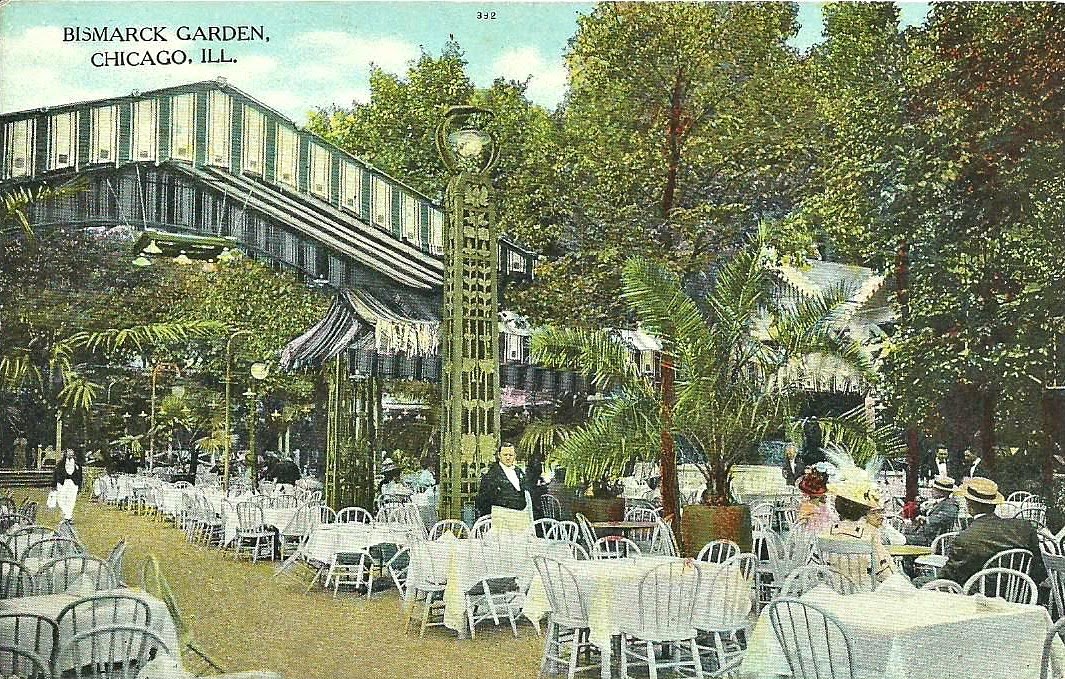
bismarck-gardens-postcard-frontIn addition to denying Fox’s assertion of an engagement, Barker also denied that he had said what Fox overheard in a restaurant ten years before, that “Miss Rappe has not taken a drink yet.”[7] The reportage doesn’t include the context for this remark—also via Mrs. Fox—but it implies that Rappe didn’t drink at the time and may have only started while in Barker’s company, that he introduced her to alcoholic beverages and continued to ply her despite her alleged bizarre behavior that so clearly resembled what happened to her at Arbuckle’s party.

Barker “enumerated at least six occasions where, in his presence, the dinner was disturbed by Virginia becoming hysterical, shrieking in pain and tearing her clothing.”[8] That she had even had two gin and orange juices—the same concoction, coincidentally, that she allegedly imbibed at Arbuckle’s party—surely must have seemed to the prosecution too good to be true for Arbuckle.[9] Such detail surely incited the heated “wrangle between Deputy District Attorney Milton U’Rren and Attorney Milton Cohen, whom the prosecutor charged with ‘coaching’ defense witnesses.”[10]

Coaching aside, the picture that Barker paints shows a man who had invested much time and money into enjoying Rappe’s company hundreds of times. The restaurants he did mention—Bismarck Garden at Broadway and Lake, and Rector’s, an oyster house at Clark and Monroe—were popular, fashionable, and expensive. Barker obviously “courted” the grandmother by attending Thanksgiving Day dinner at her Fullerton Avenue apartment and having her in tow for dinner “usually” means a certain commitment if not patience and suffering on the man’s part.

The South Haven incident would have been an expensive vacation, which included two long day cruises across Lake Michigan and the expense of putting Rappe and her grandmother up in a hotel as well as entertaining them at the town’s many attractions, including theaters, a casino, an opera house, and an amusement park. Even if it wasn’t an engagement ring in testimony, Barker had given Rappe a diamond ring. He did everything that a man might do if he were in love.

Barker’s testimony as to the length of their relationship suggests that it began to fade in 1913, when Rappe’s modeling career was at its height and she had sailed to Europe to attend the autumn fashion shows in Paris. When Rappe returned to Chicago in January 1914 and the LaSalle Hotel, she and Barker distanced themselves further. The Chicago Tribune reported on the marriage of Albert Sabath later that same month. Harry Barker was in the wedding party. If he attended the reception with Virginia Rappe, her name wasn’t mentioned.

Barker’s testimony had a profound effect on the only woman juror, Mrs. Helen Hubbard, who apparently took offense at what probably seemed his caddish betrayal. The resulting hung jury forced a new trial for late January 1922.

Barker was not called to testify at that trial or the third one. The defense found other witnesses who had seen Rappe’s drinking and striptease. Instead, Barker went back to running his businesses. Nevertheless, his name was often invoked during those trials and, especially, the last one, when Arbuckle was acquitted in April 1922.

What Barker had said on the stand at the first trial was not lost or forgotten by Milton U’Ren. In a fiery address to the jury, in which he blasted that they would be just as guilty as Arbuckle if they voted to acquit, he referred to Barker “as a ‘buzzard, snake, skunk and blackguard.’”[11] To this, Gavin McNab responded that Barker was

a man and a gentleman, who tried to be clean himself and keep all around him clean. This man whom the prosecution calls a blackguard was the only mourner at the funeral of Miss Rappe’s mother [sic] and he sacrificed himself financially to pay the expenses of that funeral. Where were Mrs. Fox and others who professed in this court to be such good friends of Miss Rappe? They were not there.[12]

In late December 1921, Barker and the Sabath family enjoyed a small legal victory in the California Supreme Court. But the Mildred Island case, due to the tenaciousness of the plaintiffs, dragged on in the courts until 1932.

[1] “Arbuckle Case Near Jury,” Sioux City Journal, 12 April 1922, 2.

[2] “Harry Barker Home from Panama,” Munster Times, 14 February 1916, 2.

[3] “Says Arbuckle Not Accused by Movie Star,” Fresno Morning Republican, 26 November 1921, 1.

[4] “Arbuckle Case Closes Monday, M’Nab Declares: Rancher and Former Friend of Miss Rappe on Stand,” Oklahoma City Times, 26 November 1921, 16.

[5] “The Past of Virginia Rappe Inquired Into,” Stockton Daily Evening Record, 26 November 1921, 1.

[6] “Impeachment of 2 Arbuckle Witnesses Looms,” Philadelphia Inquirer, 30 November 1921, 1.

[7] “Defense Will Close Monday for Arbuckle: Stockton Rancher Resumes Testimony,” Sacramento Bee, 26 November 1921, 1.

[8] “Booze Parties Hold Stage in Arbuckle Case: Former Sweetheart of Virginia Rappe Testifies Woman Would Tear Clothing after Drinking Liquor,” Salt Lake Telegram, 27 November 1921, 1.

[9] Some narratives use the term “orange blossom” to describe “Rappe’s drink.” She herself called it a “Bronx Cocktail,” which she preferred made with very little gin as she did not like its taste. See A.P. Night Wire, “Defense Is Contradicted,” Los Angeles Times, 7 April 1922, 1.

[10] “Miss Rappe Often Crazed with Pain, Witness Asserts,” Philadelphia Inquirer, 27 November 1921, 1.

[11] Oscar H. Fernbach, “Arbuckle’s Fate Is with Jury Today: Closing Argument in Third Trial of Comedian Now Under Way; McNab Yet on Argument,” San Francisco Examiner, 12 April 1922, 15.

[12] “Arbuckle Lawyers Flay Alleged Bully Methods Used by Prosecution,” Billings Gazette, 12 April 1922, 8.