Imagine, if you will, having a little editorial voice in the back of your mind, looking over the first 300 manuscript pages and complaining about the size of my tableau,
“Why are you painting the ‘Creation’ around a clown?”
I will let that question hang there and discuss one of the pleasures of my work, exorcising the devils in the details, which the 300-page trade paperback standard can easily overcome by cutting the problems out the way one might cut out a worm hole in an apple. (I get to oranges below.)
I am currently revising my treatment of the First Arbuckle trial of November–December 1921 and, at this writing, beginning the chapter on the various defense witnesses, including Kate Brennan. There is no photographs of her and I wish there was to do her more justice.
Miss Brennan had originally been slated to testify for the prosecution—and to corroborate the testimony of a fellow chambermaid, Josephine Keza. Both had been assigned to the 12th floor of the St. Francis Hotel on September 5, 1921, and heard what the prosecution alleged were the cries of Virginia Rappe emanating from room 1219 both during and after being alone with “Fatty” Arbuckle. The prosecutors expected Miss Brennan to repeat her initial statement made to Assistant District Attorney Milton U’Ren on September 16. The gist is in her cross-examination from the second trial. “What is a matter with her?” exclaimed. “Is she spifflicated?” (the italicized word 1920s slang for being very drunk).
And I said, “What is it, a booze party? She [Keza] says, “I don’t know.” And I said, “What is it, a booze party? She had got on a glorious one. Who is she anyhow?” She says, “I think it is a movie crowd.” And I said, “Well, is that going on long? We ought to tell the inspectress.” She said, “I think it is a movie crowd,” and with that I saw Mr. Arbuckle and another gentleman come out and ask to be let into 1221, from 1220. I said, “Of course it is a movie bunch, there goes Fatty Arbuckle.”[1]
Eventually, Arbuckle’s lawyers encouraged Brennan to testify for the defense. Incredibly, in her testimony of November 23, Brennan stated that she entered the Arbuckle suite just before 4:00 p.m. and after Rappe had been removed to another hotel room. Then she proceeded to clean the entire suite while the party went on around her. But Arbuckle had her start in 1219. Not only did Brennan change the bedclothes and turn over the mattress on the bed—where Rappe had been found in agony, suffering from a ruptured bladder—the chambermaid also wiped off all the woodwork with a cheesecloth.
The comedian’s lawyers faced a very real problem in that Milton U’Ren had engaged the criminologist Edward O. Heinrich.[2] He had found fingerprints that, based on his comparison, matched those of Arbuckle and Rappe on 1219’s exit door. Given how thoroughly Brennan wiped down the door, those fingerprints should not have been there. The implication, of course, was that Heinrich faked them.
Naturally, I wanted to do a close reading of Brennan’s testimony—and not just dwell on that wonderfully authentic period word “spifflicated.” She had a few interactions with Arbuckle that suggest just how spifflicated he was as his Labor Day party sailed into the late afternoon. But there was one word, three letters long, that made it very hard to parse what he was trying to convey to her when he offered her a drink as she worked in 1219.
Throughout her cross-examination, Brennan revealed snatched of her small talk with the comedian. Obviously, he was very jolly about getting Virgina Rappe well behind him. When Arbuckle stepped into 1219 at one point—“lunged” is the other word she used—he gave the chambermaid a generous tip, adjusted for inflation, and prefaced with “This is for you, little girlie.”
That may sound like an endearment for 1921. Yet it was no less demeaning then as now to say to a woman who was fifty years old, which was hardly the “new thirty.” People often looked older a century ago—and Arbuckle would rub that in as the prosecutor took interest in this largesse.
Q. Now, when you say he tipped you, what did he do?
A. He just gave me two dollars and half.
[. . .]
Q. And did he say anything else to you at that time?
A. Then he went out into room 1220 and he was fooling, dancing up and down there, and he came back and he stood with his shoulder up against the door of 1219, and he had a glass in his hand, and broken ice, it sounded like ice, and a straw, and he said, “With that map, would you have a drink of whiskey?”[3]
“I don’t when I work,” Brennan continued. Now, take a closer look at this other italicized word. It is “mat” in the first trial transcript. Normally, I would accept that, thinking it was short for mattress? After all, Arbuckle’s “punch list,” so to speak, included the wet bed in which Rappe was found after he opened the locked door between 1219 and 1220. And, at his behest (“Girlie, turn that mattress over, will you, please? The last girl that slept on that bed had a weak stomach.”), I thought that Arbuckle may have been impressed by her feat of strength.
In certain contemporary reportage, however, Arbuckle is quoted as saying “With that map,” which is corroborated by Brennan during the second trial, when the court reporter had a better ear. “Map,” however, doesn’t quite have much context to work with unless you realize that it’s short for something too, for a common expression, one especially applicable to longtime alcoholics. Arbuckle meant that Brennan’s face resembled “the map of the world,” for its lines and broken blood vessels.
I have more on Kate Brennan. Like other witnesses, especially those for Arbuckle’s defense, while they might have scored points with the reporters covering the trial (they tended to favor Arbuckle to a man), Brennan may have taken an offer she could not refuse. She had a past that could be used against her. Indeed, her job at the St. Francis Hotel was one in a series of second chances. She had just started in late July 1921, this after just two weeks at the Hillcrest Apartments. Before that she had worked in an industrial laundry, the Key Route Inn in Oakland, the Fairmount Hotel, and so on.
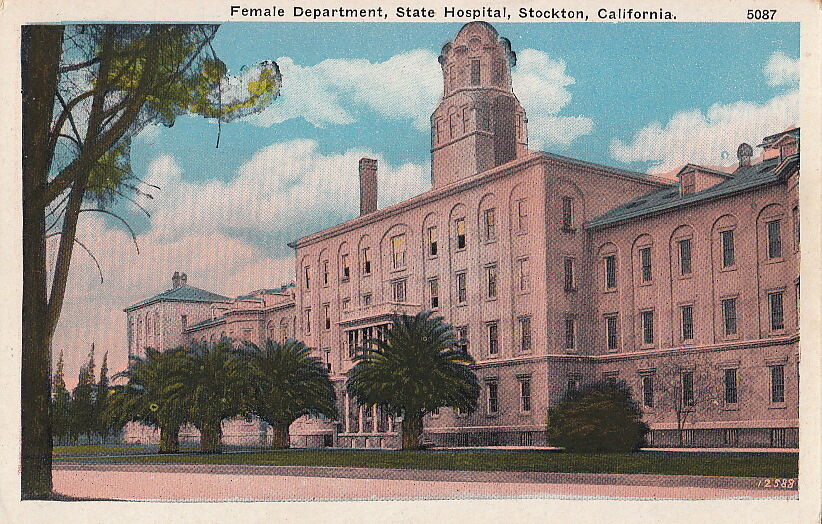
The year before, in 1920, Brennan was still an inmate of the California State Mental Hospital for Women at Stockton and there was at least one incident in her past that would explain her being institutionalized. In 1904, at the age of thirty-three, Miss Brennan had been arrested for desecrating the interior of St. Brigid’s Church in the Russian Hill neighborhood, where she had lived all her life and was a parishioner. On three previous occasions, she had tossed lamp oil at the walls and Stations of the Cross. She had also pushed over flower vases. The pastor, however, with whom she had quarreled, believed she suffered from “dementia” and could not help herself. Then she did something not only outrageous but newsworthy. She took a club to a statue of the Blessed Virgin—but the only breakage she accomplished was the leg she broke when she jumped out of a window while being pursued by the church sexton.
* * *
The next witness for the defense, Lois Harding Lancashire, while a minor one, came forward on her own to say that she was in room 1218 during the course of the party and heard nothing untoward from room 1219. She wrote a letter to the hotel management, incidentally, not to the District Attorney, Instead, Arbuckle’s lawyers enlisted Mrs. Lancashire to take down the other chambermaid, Mrs. Keza, who heard the voice of a man tell a woman to “Shut up!” as she pleaded “O my God!” over and over. The prosecutors wanted to think this was Arbuckle abusing Rappe.
But why would a society woman, ostensibly escorting her daughter to a convent school, want to help Arbuckle and testify at all three trials?
That remains to be seen. But her husband was one of the largest orange growers in Tulare County and the exclusive purveyor of citrus fruit for the St. Francis Hotel, which “only served the finest Unabest oranges.”

This might have something to do with his business and the San Francisco investors who financed his new packing house.
[1] People vs. Arbuckle, Second Trial, “Testimony of Kate Brennan,” 1438.
[2] E. O. Heinrich subject of Kate Winkler Dawson’s American Sherlock (Putnam, 2020), which is the only book about one of the witnesses who testified at all three Arbuckle trials. I have reached out to her . . .
[3] People vs. Arbuckle, First Trial, “Testimony of Kate Brennan,” 1159ff.
 Spite Work: The Trials of Virginia Rappe and Fatty Arbuckle