Inclusivity: the authentic and inauthentic working together

This is a progress report on the book and photo research.

Over the past few days, I have been reworking real story behind the so-called war nurse Irene Morgan, Virginia Rappe’s masseuse and personal nurse from March to October 1920. I discussed her in an earlier post and have new information about her that makes her all the more “sketchier.”

Miss Morgan, who was actually married and listed herself as a widow in the 1920 census, testified that she had to catheterize Rappe during her periods. She also inserted several episodes of drinking, clothes tearing, nudity, and hysteria in addition to a bladder issue. The defense posited such histories—or rather stacked the deck with them—to distance Arbuckle from having caused Rappe the distress she exhibited in a double bed in room 1219 of the St. Francis Hotel on Labor Day, 1921.

That Arbuckle’s lawyers relied on such persons of interest suggests the lengths they went to get the motion picture comedian acquitted. That often requires this author to dig up the stories that comes after the trial. And that is how I found out that Miss Morgan reinvented herself as a “Doctor of Kinesiology” at the College of Applied Science in Los Angeles, an institution peculiar to California—and the brainchild of the notorious charlatan Edward Oliver Tilburne.

Back in the 1920s, everything that became the wellness culture that grew up alongside the film industry, was already in motion. Yoga was becoming a “thing,” but kinesiology, imported from Sweden, was the way to achieve wellness through motion and massage.

Finding the authentic amid the inauthentic has made my work both intriguing and a labor of love. This is true in regard to the photographs, some of which are worth more than a thousand words and what I am willing to pay for images now in the public domain.

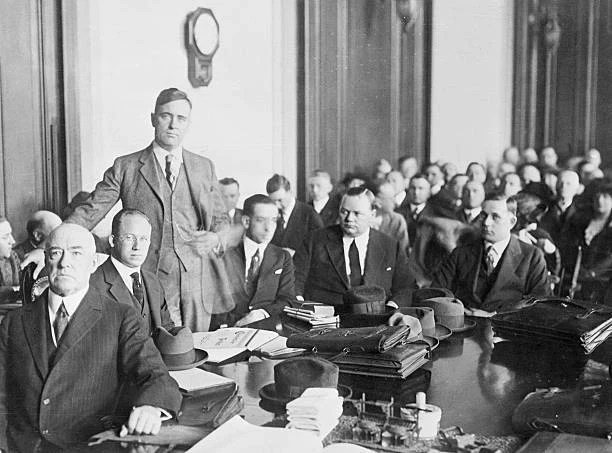
One such photograph has been hard to find. For the first Arbuckle trial of November–December 1921, a group portrait was taken of both the defense lawyers and prosecutors, who sat at the same long table before the bench and witness chair.

This photograph exists in two versions. One has the prosecutors cropped out entirely using the Photoshopping of the day, a pair of scissors. You can find this one in books:

A few, a very few newspapers printed the entire original image:

The above grainy image and caption is on the reverse of another image that had been spliced together from two different takes. It was recently for sale on eBay. At first, I found it unsatisfactory for the book and passed. But given all the tension between what is truth in my book and what is not, I might reconsider it. Notice that no one cared that the courtroom wall clock appears twice in the background.

Virginia and a “victor”: Adela Rogers St. John

“History is written by the victors” and so is writing about Hollywood in the Silent Era. But we should probably paraphrase here, just a little, and say that “History is written by the defenders.” And if one scores by the number of defenders, then Virginia Rappe lost the contest with Roscoe Arbuckle, regardless whether she put up a fight in room 1219.

One of the earliest defenders was the Hollywood writer and memoirist Adela Rogers St. John. as mentioned in an earlier post, she interviewed Arbuckle for “Love Confessions of a Fat Man,” which was published in Photoplay during the early weeks of the Arbuckle scandal in the September 1921 issue.

Arbuckle, by hosting a party that flaunted its defiance of Prohibition laws and moral standards—it was essentially a party of married men cavorting with single showgirls—had ruined the innocence of St. John’s tongue-in-cheek portrayal of Arbuckle as a lady’s man, a virtual eligible bachelor. Her resentment eventually fell not on him but on Virginia Rappe. And St. John lived long enough to write it up in her autobiography Love, Laughter and Tears: My Hollywood Story (1978).

St. John, whose career got its start working for William Randolph Hearst—the bête noire of so many Arbuckle narratives—devotes several pages (60ff) to the Arbuckle scandal.

Perhaps St. John is less a defender and more the apologist, especially in regard to Arbuckle’s being in San Francisco in the first place.

St. John recalls a conversation with her father, Earl Rogers. Although she described him as “still the Coast’s leading criminal lawyer,” he had been in poor health since the death of his second wife in January 1919 and was more often hors de combat and no longer the feared trial lawyer who served Earle Stanley Gardner as the model for Perry Mason.

According to St. John, her father discussed why he had to refuse a request made by Arbuckle’s producer, Joseph Schenck, to represent the comedian. Although Rogers assumed Arbuckle wouldn’t be convicted, he would nevertheless be seen as a monster given his weight. His career would be ruined. “Tell Joe,” Rogers said to his daughter, “I can’t take the case; the doctors won’t let me, but to prepare Hollywood for tornadoes.”

The news would have been a disappointment, for Rogers was considered preeminent as a criminal attorney in cases that involved medical expert evidence. In his prime, he would have been perfect for the Arbuckle case given that his alleged victim had died from ruptured urinary bladder. But by early 1920, his health, mental, and legal problems had come to a head. He had assaulted a deputy sheriff sent to arrest him for making threats against members of his own family, which was attributed to “excessive use of stimulants and drugs.”

The “statement” St. John quoted in her memoir may have been paraphrased to make Arbuckle look innocent from the beginning. But her version isn’t what Arbuckle said in the Los Angeles Times the day after Rappe’s death. But let’s get back to why Earl Rogers wasn’t to be Arbuckle’s Perry Mason.

Frank Dominguez, Arbuckle’s original defense attorney, had resigned from the defense team in early October 1921, leaving Milton Cohen and the San Francisco attorney Charles Brennan shorthanded for November’s manslaughter trial. Several names appeared in the press, but not Earl Rogers. While it is true that his doctors allowed him to return to work in November and form a new practice, he restricted himself to Los Angeles and his health only deteriorated. He died in February 1922. However, one of Arbuckle’s prosecutors, Milton U’Ren, made it a point to ask prospective jurors if they knew Milton Cohen’s law partners—Frank Dominguez and Earl Rogers. If the answer was yes, presumably that talesman could be excused. Did U’Ren suspect that Rogers was giving his fellow lawyers advice? That might be a more reasonable explanation for what his daughter reimagined.

She also opined that Arbuckle, Fred Fishback, and Lowell Sherman went to San Francisco because it had “the best restaurants on the North American Continent” and

for a few days of fun probably partly on the Barbary Coast, a well-known section where night clubs and honky-tonks and cafes clustered together and produced the first-floor shows, the first new dances such as the Bunny Hug and the Turkey Trot, and much of the best music of our times. During this vacation an extra girl named Virginia Rappe got some alcohol in her system, stripped off her clothes, and plunged Fatty and Hollywood into a major scandal.

The resentment here is hard to miss. To St. John, a Hollywood insider, Virginia Rappe was a nonentity who had spoiled the much greater party that was the motion picture industry before the arrival of Will H. Hays.

“At that time,” she continues, “Miss Rappe had been living only a few blocks from me in Hollywood.” By “a few blocks” St. John means one of two places where Rappe lived—in 1920, not 1921. It is the distance to Henry Lehrman’s house, where Rappe lived for the greater part of 1920, at 6717 Franklin Ave., or 1946 Ivar Ave., which was fewer blocks away, where Rappe roomed briefly for the first two or three months of 1921. This can be documented. If we go by the 1920 federal census, St. John and her family lived miles away on Toberman St. and far from Hollywood. However, the 1921 city directory, which was compiled in the latter half of 1920, has Rappe living at the Ivar Ave. address and Adela and her husband, W. Ivan St. John, just as close as she states—to 5873 Franklin Ave.[1]

Memory can be tricky writing decades later, and if it’s a gossipy story that has been told repeatedly there’s a good chance the version that prominently places the narrator in the story will come to be accepted as true. So, we should be accepting that the St. John’s account isn’t airtight though it’s likely too odd of a coincidence to have been completely invented.

The day after Fatty had been indicted on the testimony of several girls [i.e., Zey Prevost and Alice Blake] and Virginia Rappe’s own deathbed statements, the man who did my cleaning came and told me: “I did Virginia Rappe’s cleaning. I see where one side says she was a sweet young girl and Mr. Arbuckle dragged her into the bedroom, the other witnesses say she began screaming and tearing off her clothes. Once I went in her house to hang up some cleaning, and the first thing I knew she’d torn off her dress and was running outdoors, yelling, “Save me, a man attacked me.” There I was standing in the kitchen with my hands still full of hangers with her clothes on them and she was running out hollering I’d tried to attack her. The neighbors told me whenever she got a few drinks she did that. I hated to lose a good customer, but I thought it was too dangerous so I never went back.”

I asked those neighbors and they confirmed the story. But you couldn’t put that kind of evidence into court! The girl was dead. To blacken her character would only increase public indignation against Fatty, for trying to save himself at her expense. (63–64)

St. John, ever the lawyer’s daughter, seems to suggest such evidence would have been dismissed as hearsay. But Gavin McNab, Arbuckle lead counsel through three trials, put as many witnesses on the stand as he could find to testify to Rappe’s frequent hysterics and disrobing. An example was Irene Morgan, who had served as a nurse, masseuse, and maid in the Lehrman household for several months in 1921. She was both deposed and examined on the stand by Milton Cohen at the first Arbuckle trial.

Cohen had the advantage of knowing Lehrman and Rappe—he was their personal lawyer as well as Arbuckle’s. He knew Rappe was suffering from what was described as a “nervous condition,” which, in part, had less to do with alcoholic beverages than with her self-image: she was overweight in early 1919 and losing weight was necessary to be considered for future movie roles.

Paradise Garden - Rappe and 1917 swimwear

She was no extra: Virginia Rappe looking like herself in 1917 swimwear. The still is from her first film, Paradise Garden (1917) (IMDb)

According to the trial reportage, Morgan described her service as it concerned Rappe, which included massages and treatments described as hydrotherapy. Morgan also knew that Rappe had been advised by a doctor to adhere to a bland diet and not drink alcoholic beverages. Morgan, however, testified that Rappe disregarded the advice. When she drank, “Miss Rappe often “tore her clothing in frenzy.” During one of these incidents, she said she ran nude from Lehrman’s house into Highland Ave. (See also our blog post about Morgan about her problematic testimony.)

Cohen did the spade work of finding and interviewing witnesses to similar episodes in Los Angeles. But there is no evidence that he met with the man who cleaned the clothes of Virginia Rappe and, coincidentally, Adela Rogers St. John. So, we have to ask, was he a real person or a strawman made up—or to be generous again, a composite—created to give St. John a role in the story. If he was real, one has to wonder how Cohen overlooked him. Perhaps the laundry man had sympathy for Rappe despite the aborted cleaning contract and chose to give no aid to the Arbuckle camp.

The story St. John tells here, of course, is one of many that turned Rappe from being “the best dressed girl in Hollywood” to the most self-undressed during the three Arbuckle trials and in much of what has been written about her ever since. Despite the bias, however, such an account reinforces just how much Rappe was resented in death and that, again, is the takeaway.

St. John mentions in passing Rappe’s former landlord, studio boss, dance partner, and boyfriend. She disparagingly refers to him as “a man named ‘Pathé’ Lehrman, claiming to be the dead girl’s sweetheart”—while knowing he wasn’t called that in the newspapers during the Arbuckle case. He was always Henry Lehrman and St. John well knew he was a key figure of early Hollywood history. Lehrman directed and mentored both Arbuckle and Charlie Chaplin in their first comedies for Keystone Studios. But we mustn’t lose sight that St. John is a victor in the sense that she outlived everyone who could challenge her stories. She got to write that history and cast Lehrman as she pleased. But it is from Lehrman that we find something that suggests that St. John’s memory of “the man who did her cleaning” touched on a recurring theme, that Rappe feared being sexually assaulted.

In an interview with Louis Fehr of the New York American, Lehrman said, “I remember once when there was a terrible assault case in the newspapers. She said to me quietly: ‘Henry, if anyone tried to do a thing like that to me, he’d have to kill me.’ Well, she’s dead.”

So, perhaps St. John’s story has a grain of truth to it, that Rappe’s hysteria may have been histrionics—theater of a kind—intended as self-defense, to startle or frighten a potential rapist. We still have a possible hypothesis in our work-in-progress.

Women are still advised to disrupt the idea or fantasy of their attacker, that they should “fight like a furious cat” and “yell loudly and strongly.” Perhaps Rappe removed one facet of the male fantasy: the forcible disrobing, the tearing off the victim’s clothes, and so on. Perhaps, too, a good lawyer like Milton Cohen knew how to frame such episodes into what was needed to get Arbuckle acquitted. Maybe we can only leave that to the reader.

3c26480u

Adela Rogers St. John, 1966 (Library of Congress)


[1] In 1921, W. Ivan St. John served as personal secretary to the new mayor, George E. Cryer. He had been elected to on a platform to close the city’s vice dens and supported efforts to establish a censorship board. He also wholly supported the ban on Arbuckle’s films—which surely put Mr. St. John in an awkward position vis-à-vis Mrs. St. John.
100 Years Ago Today: Irene Morgan, one of the sketchier defense witnesses, December 2, 1921

Roscoe Arbuckle’s personal lawyer, Milton Cohen, found a number of witnesses in Los Angeles County who could testify that Virginia Rappe routinely suffered fits of female hysteria. These bore a marked resemblance to how she was found in room 1219 of the St. Francis Hotel on Labor Day 1921. Among those witnesses was Irene Morgan. In March 1920 she had been hired by Henry Lehrman to serve as an in-home nurse, masseuse, and domestic.

Morgan was seen as a rebuttal witness to challenge Rappe’s adoptive aunt, Kate Hardebeck, who asserted that Rappe was in perfect health. The reporter Chandler Sprague billed the young woman as the star witness:

Miss Morgan has been kept “under cover” as much as possible by defense counsel, but it is understood that the district attorney’s office learned a few days ago that she would be a tremendously important cog in the defense machinery.  

She is a nurse and masseuse who lived with Virginia Rappe for seven months. She will tell the jury that the dead girl suffered with chronic bladder trouble and that she was on a diet for the ailment. Miss Morgan will say also that Miss Rappe had been warned against drinking liquor and will detail several occasions on which, having disregarded that warning she became hysterical and tore off her clothes in the same fashion as at the Labor Day party in the St. Francis. The entire statement which Miss Morgan is prepared to give is said to be extremely sensational and will include allegations that certain interests have sought to prevent her testifying in Arbuckle’s favor. She will also, it is believed, make charges of brutality against a male associate of Miss Rappe.[1]

Morgan was a former Canadian Army nurse. She spoke with a pronounced lisp. Her face bore the scars of an ambulance accident suffered during the Second Battle of the Marne in 1918. Given her commendable service, she was seen as a reliable witness and took the stand on November 25 as the first of several witnesses who had seen Rappe drink, tear at her clothes, and suffer attacks. Morgan claimed to having seen five such attacks. During one of these, Rappe allegedly ran out of the house naked.

If Morgan played as well for jurors as she did for reporters, the prosecution’s case against Arbuckle was in trouble. The news stories tended to see the former nurse as convincing and the headlines now cast Virginia Rappe in a new and darker light. Even a newspaper sympathetic to Rappe, the Los Angeles Herald ran “BARE RAPPE GIRL’S PAST” in a typeface just a shy of the size used for a declaration of war. 

Morgan bore up well under cross-examination and remained in San Francisco should Arbuckle’s lawyers need her to take the stand again. During the last week of November 1921, she befriended another defense witness from Los Angeles, a Miss Pearl Leushay, a former “floor women” in a department store who had also seen Rappe have a fit but never took the stand. Leushay and Morgan likely hit it off because Leushay was a Frenchwoman as well as single, or, at least single in San Francisco, for she was still Mrs. Leotta Pearl Ortega, the estranged wife of an oil field worker and, before that, a young widow, going by Leotta Pearl Wright.

On November 30, Morgan and Leushay went to the Winter Garden, a dance hall and ice rink in the Tenderloin district. There Morgan, who didn’t dance, met a man who had been following the pair in a sea-green automobile.

The next day, Morgan was found by Miss Leushay laying across her bed in an adjoining hotel room. Morgan’s clothes were ripped in the “manner in which Virginia Rappe’s clothing was torn,” according to the San Francisco Examiner on December 2. A stenographer recorded Morgan’s statement (see below) and although seemingly incoherent, bits and pieces of her real backstory emerge. Like other witnesses who saw Rappe’s histrionics, they posed problems for Arbuckle’s defense—especially if the prosecution saw such witnesses as obviously coached and parroting much the same story about the victim.

What goes unreported is that Rappe’s Aunt Kate took the stand and rebutted Morgan’s testimony in kind. Morgan had stood up and blocked Aunt Kate after she left the witness stand and began to stare the other down. But Aunt Kate sidestepped her antagonist. This event may have triggered the incident Morgan was involved in, presumably drugged or poisoned, on November 30. Another trigger, perhaps the real one, was that Morgan may have learned that the District Attorney had secured a rebuttal witness for the next day, a Captain Rayward, a decorated veteran of the Canadian Expeditionary Force during the First World War. Whatever he might say posed the risk of a perjury charge brought against her.

Arbuckle’s lawyers stood by their “star” witness after the event and insinuated that the prosecution was behind Morgan’s “mystery man.” A doctor however determined that she had overdosed on nine aspirins and some kind of opiate.

Morgan was expected to testify again at Arbuckle’s second trial in January 1922. However, when District Attorney Matthew Brady threatened to impeach her, Morgan disappeared, reportedly abroad, to the Netherlands.

A year later Morgan reemerged on the faculty of the College of Applied Science in Los Angeles  as a Doctor of Kinesiology. This new institution in January 1923 was founded by Edward Oliver Tilburne, a former minister, actor, lecturer, conman, and snake-oil salesman, self-proclaimed medical doctor, embezzler, and shady real estate broker known by a number of aliases, including “Nevada Ned” before he remade himself into a Christian psychologist. Tilburne was also the author of short story about the Jack-the-Ripper murders that speculated on “Jack” being under the control of a hypnotist.[2]

This is, of course, a tangent for others to follow. For our purposes, Morgan’s reinvention as a practitioner of alternative medicine likely began in part in 1920 when Rappe pursued both a wellness program as well as a diet and exercise regimen for her figure. Here Arbuckle’s lawyers and prosecutors alike saw her fitness program as evidence to support their opposing narratives, on one hand to show that Rappe was prone to spontaneous rupture of the bladder and conversely that she was robust and healthy at the time of the Labor Day party.


Here is the complete statement given to a stenographer yesterday afternoon [1 December 1921] by Miss Irene M. Morgan after she was found in her hotel room suffering from poison which she declares was administered to her in candy by a “mystery” man who had been following her for days: 

Miss Graind and I came to the United States. I didn’t want them to know I was Dutch. I am going home in four months. I don’t want anyone to know who I am in the United States. My grandfather’s name is Bornidot. My name is Irene Morgan. My ancestors go back four or five hundred years. 

Golondit Bornidot. Don’t tell the Swedish country anything about me. I worked in the United States as a servant. I love one man in the United States. I shall search from country to country, from state to state. He don’t know me, but I know him. When a lady has a title—lived with a man I love. I can’t live with a man in this country. Can I have one drink of moud? 

The United States don’t know who I am. I want to go back home and no one will ever find me. Can you speak French-Danish, Spreg Deutsche. (To Doctor [Julien L. Waller]) Talk French, why yes, German, yes. Educated in five languages. I going for a ride today with the Duke from Spelice. He is coming over. Do you know what Miss Rappe said to me? If you tell on me I am going to kill you, Irene. 

Mrs. Hardeback say I lie. Where is Mr. Lehrman now? Where is Miss Rappe? I never seen him, or never for a long time. (To doctor) Spreg Deutsche. 

You can never learn the language. Please telephone to the Senator I came in on the steamer and my grandfather was here to meet me. My heart. 

“When did you first meet this man?’ she was asked. 

I don’t know. 

Bobbie. 

Met the man at dance. I got to go home. He gave me candy. You can’t poison me. 

Mrs. Hardeback has lied and lied to me. She called the doctor and she would never let me sit in room. She shot me out and she was afraid I would tell on her. 

I was subpoenaed to come to San Francisco. But did not want anyone to know. Did not want my grandfather to know. I am going back to my grandfather. He lived five miles out of Stockholm. My mother was Swedish—my father American. My mother died when I was born. The name of the town I lived in was Guttenberg. I never have been notorious. I have always tried to keep my body and my mind clean. I never have been to a public dance hall until I was in Los Angeles. 

“Do you remember going to San Francisco in the Arbuckle case?” she was asked. 

Yes, yes, yes. I never met the man. They tried to make me tell a lie on the witness stand. I would not lie. Mrs. Hardeback came up and lied to me and she lied and lied and I got up to hit her in the face. They said, Olga Reed Morgan, sit down, sit down. They took me to San Francisco and made me go through hell and fire. 

“Who?” she was asked. 

Well, I was subpoenaed in the case and when I got there, there was a man with white hair and brown eyes and he stared at me and then he said he would put it in the paper. 

Some people took me down here and at San Francisco every one was so good to me. 

We walked and walked and walked a long time. The man did not go with me into the drug store. He said, “I’ll wait outside.” He said, “Take some orange juice and another piece of candy. It will make you feel fine.” 

I said, “Give me orange juice. Will it be good for me. I am so dizzy?” 

“Did he wait outside the drug store?” she was asked. 

Yes, he took me to the hotel, and he said, “I got you now. Go to hell.” I thought he was from the District Attorney’s office. I do not know. I presumed so. He looked like a man who had been around the Hall of Justice and talked to me day after day. I turned my back on him. He had been to my house several times in South Pasadena. The man with gray hair gave me candy. Let me sleep because I want to go home. 

Source: “Here’s Statement of Poisoned Girl in New Arbuckle Case Sensation: Talks Incoherently of Mystery Man Who Gave Her Candy, Urged to Drink Orange Juice,” San Francisco Examiner, 2 December 1921, 4. See also, “Nurse Who Aided Arbuckle Defense Near Death from Mystery Poisoning,” San Francisco Examiner, 2 December 1921, 1, 4.

The Winter Garden was the new name of the Dreamland Rink shown here. These structures later demolished for the Dreamland/Winterland auditorium. (Calisphere)

[1] Chandler Sprague (Universal Service), “Sensational Testimony from L.A. and Santa Ana Nurses Is Expected at Arbuckle Trial,” [Pomona] Bulletin, 25 November 1921, 1.

[2] See Donald Hartman, Edward Oliver Tilburn (aka N. T. Oliver, Ned Oliver, Nevada Ned, and Edward Tilburne): The Profile of a Con-Artist (N.p.: Themes & Settings in Fiction Press, 2021).