We have been toying with incorporating certain contextualized documents in the book as interpolations or as parts of a conventional appendix. This piece, now in public domain, is inserted between the end of the first Arbuckle trial and the beginning of the second.
Intermezzo: The True Story About My Husband[*]
Mrs. Minta Durfee Arbuckle
In late December 1921, both Minta Durfee and Roscoe Arbuckle “penned” exculpatory pieces for Movie Weekly on December 24 and December 31, respectively. Both were couched as frank and open justifications of the Labor Day party and its aftermath for the moviegoing public—but still vetted by Arbuckle’s lawyers as well as his manager, Lou Anger, who answered to Joseph Schenck, Arbuckle’s producer and the deep pocket for his costly defense.
Arbuckle’s was a public recap of his testimony of November 28, when he took the stand at his first trial. He restated that he had been “morally acquitted” and that “organized propaganda” had made impossible for him to secure an impartial jury and a fair trial. But Movie Weekly was no less a propaganda organ to serve in Arbuckle’s defense in the weeks before the second trial began and before the jury was sequestered and their newspapers excised of any content related to the Arbuckle case. A similar propaganda campaign occurred in October, when news of Rappe’s adolescent past, promiscuity, and pregnancies appeared in the nation’s newspapers.
Minta Durfee, intriguingly, disowned any intentional defaming of Rappe’s character below in what was her confession for being Arbuckle’s estranged wife. After the first trial ended in a hung jury, she said that the humbling experience renewed her faith in God, that He works in mysterious ways and that the setback temporary. One of those mysteries was her marriage, that she had now been reunited with “Mr. Arbuckle” so as to stand by him against an unjust charge.
Durfee admitted that the couple lived separate lives for five years but in terms of something little more than a marital spat, “nerves,” rather than Arbuckle’s seeing her as sexually unfulfilling and a hindrance to the “movie star” lifestyle that his first contract with Paramount afforded.
Undoubtedly, even readers in 1921 and ’22, weren’t fooled, certainly not the jaded ones among the film colony. That Durfee implied that she saw her husband unclothed surely drew knowing smiles if not peals of laughter. She was practically saying her marriage was a sham from the beginning—or complicated or something else, something that did require her to pretend to be a saint—and a wife—to “service” her husband.
Nevertheless, to sound this naïve must have taken real nerve on her part. That Durfee was really disconcerted that some saw her presence in San Francisco as public relations, as no more than a theater engagement, an “added attraction” like her “Mrs Roscoe ‘Fatty’ Arbuckle” comedies that had already come and gone before Arbuckle and Rappe films were pulled. But Durfee was self-aware enough to know how weird it looked for her to sit and practically spoon in court with a man who had kept her thousands of miles away in Manhattan, to say nothing about his five years of living an unmarried man’s life that ended with having to publicly admit that he was only in San Francisco to drive Mrs. Mae. (Notice that Durfee studiously avoids any mention of Mae Taube.)
Those who smiled and laughed, of course, also understood that Durfee was expected to do what she had to do and eat whatever peck of dirt was necessary to profess her love and faith in Arbuckle, to temporarily leave her doorman building on Riverside Drive, her chauffeur-driven motorcar, her golf clubs, and the like. She wasn’t just there for Arbuckle but for her own movies in which she was billed “Mrs. Roscoe Arbuckle. She was also in San Francisco and Los Angeles for powerful men already luring away Postmaster General Will Hays for a new office to oversee the motion picture industry.
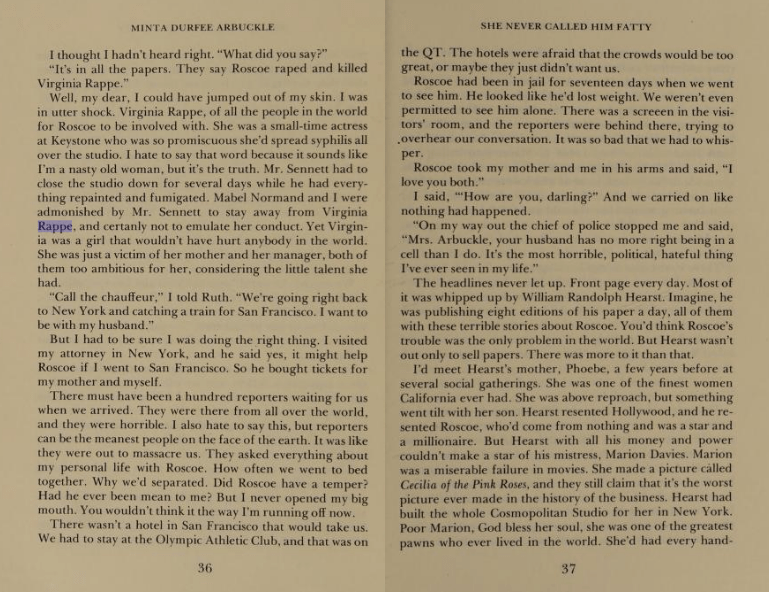
The other thing she had to do for the industry rather than herself—although there is a hint of jealousy here—was the mischaracterize Virginia Rappe. Unlike the stand Durfee took in her dotage, that Rappe was a whore on the Keystone lot, she couldn’t make things up in Movie Weekly in 1921. Rappe was known in Hollywood and she had a coterie of friends who thought highly of her—even if she was the kind of woman, as opposed to the quiet, mousy, overdressed Minta Durfee, who made the party a party when things got boring.
But Durfee displays a certain magnanimity in exonerating Rappe from being part of “a conscious factor in any maneuver” against Arbuckle, suggesting that he had been entrapped in some kind of blackmail plot. But later in the piece, she only sees Rappe’s crisis as a purely accidental opportunity—a hypothesis that ended when Arbuckle’s first lead counsel, Frank Dominguez was threatened with a defamation suit and subsequently resigned from Arbuckle’s “million-dollar defense.”
Regarding the lawyer’s fees, Minta Durfee’s claim that Arbuckle would be paying them is the egregious falsehood, especially coming on the heels below of saying he was foolish with his money.
As surely as God is above me, and I believe in Him very sincerely, I know that Roscoe Arbuckle did not do the thing for which he has been made to face trial.
My reasons are as powerful as they are simple. He has told me what happened and what did not happen in that hotel room, and I believe him. And I know, after thirteen years of married life, that he is not that kind of a man. He simply could not do such a thing.
I first heard of his trouble when I walked into a hotel parlor and saw a newspaper with the name “Arbuckle” in great headlines. It was a terrible shock. My first thought was that he had been killed in some motion picture stunt. Then the fear came that perhaps there had been an automobile accident—perhaps he had killed someone with his car, but I knew that he is such a splendid driver that that could hardly have happened.
Then I learned what really was the matter, and my first thought was to get to him as quickly as I could. I knew that he could not be guilty, but I wanted to hear the from his own lips the true story of the affair, and I wanted to be with him in his trouble. It was for that reason and no other that I traveled three thousand miles to San Francisco, and it is because I believe implicitly and firmly that what he has told me is the absolute truth, confirming my own trust in him, that I have been with him ever since. The moment that I learned he was in trouble, I knew there was only one place in the world for me, and that was with my husband, for he is my husband, although differences of temperament—and nothing more, except perhaps a little stubborn pride on both sides—have kept us apart for five years. When this affair happened, the little things over which we had disagreed seemed utterly unimportant.
Perhaps I have old-fashioned beliefs about marriage, but it always seemed to me that a real wife must be as much sweetheart, friend, pal, and even mother, as wife. I’m not pretending to be a saint, and I like a good time as well as anybody, but being a wife has always appealed to me as a life’s work.
When we like anyone, we Durfees, we like them for a long long time. My faith in Roscoe Arbuckle is too great to be shaken by any attacks upon him, even if they were supported by real proof.
It hurt me when the rumor spread that I had come to him because I was looking for notoriety or because I had been paid to do it, as was intimated in some places. I am his wife, and my place was with him. I believe that even if we had been divorced I would have come, just the same. I could not have seen the man I know to be the victim of unjust accusations, face his trouble and not have me with him.
As for the party itself, knowing Roscoe Arbuckle as I do, I can very easily understand his share in it. Mr. Arbuckle is just a big, easy-going, good-natured boy. I can understand just how he found himself the host that afternoon, without ever intending to invite anybody there. As a matter of fact, he did not invite any of the guests. The party was not his suggestion. Other people got the crowd together, and simply used his rooms.
Mr. Arbuckle has told me that so far as the liquor that was there is concerned, he actually does not know where it came from or how it got there.
Perhaps the best proof of that is that with all the bills he has had to pay, he has never paid one cent for the liquor that was served—and in these days, no one gets liquor without paying for it.
I can picture him that afternoon as the involuntary host at a party not of his invitation or suggestions; perhaps enjoying it, for although he scarcely ever starts a party himself, he likes company and enjoys being with people. Certainly no one can blame him, if the party became noisy and too lively. As a matter of fact, he has told me that he did complain of the actions of certain members of the party and told them that they were going too far. Perhaps that very thing aroused a spirit of revenge that was responsible for the charges made against him.
As for Virginia Rappe, the minute I saw her name in connection with the case it made me more sure than ever that my husband was being made the victim of circumstances. I do not want to say anything against her; in fact, both Mr. Arbuckle and myself urged from the very beginning that nothing be brought into the case that would tend to besmirch her character if it could possibly be kept out. We were not responsible for published statements attacking her. That was done by other persons, evidently fearing that we would try such measures and wishing to forestall us. They were very much mistaken. Nothing has been farther from our thoughts.
I knew Virginia Rappe as long as Mr. Arbuckle did. Henry Lehrmann [sic], her manager, was also my director at one time. I knew the girl, not only from personal acquaintance but from acquaintance with many of her friends. I do not believe that Virginia Rappe was a conscious factor in any maneuver directed against Mr. Arbuckle. If there were a deliberate plot against him, I do not think that she knew anything about it. She was in Los Angeles, financially hard up, out of work and unable to get help from her friends. She came to San Francisco, I believe, merely on a pleasure trip. She went to that party, not because Mr. Arbuckle invited her, but because she was asked to meet Ira Fortlouis, a gown designer and salesman, who had seen her and thought she would make a good model. That we know from the words of Fred Fishback, who told us that Mr. Fortlouis had seen Miss Rappe, had admired her possibilities as a model, and finding that she was in San Francisco, asked to meet her.
If Miss Rappe had not died, I believe that nothing would ever have been heard of the affair, because there would have been nothing to talk about. There are hundreds and hundreds of just such impromptu parties all the time. People drink and dance and have a good time, and no one is the worse for it. I believe that the whole trouble started when someone who thought that Mr. Arbuckle would be an “easy mark” and perhaps was further moved by anger against him for some reason, seized on Miss Rappe’s death as the reason for wild statements and unfounded charges. It is difficult to discuss that point without making direct accusations, and that I prefer not to do, but it seems perfectly evident to me that this motive was back of the whole thing.
Ever since he was a boy—and he practically grew up with our family— Mr. Arbuckle has been careless with money. He never considered expense. Money simply meant the means of getting what he wanted, of enjoying himself, of helping other people. Incidentally, helping other people is the way a great deal of his money has gone. He has been most generous with me, even since our separation. He has supported relatives. He has always been ready to help anyone who needed it. He has half a dozen pensioners about whom nobody but his own people know. Even during his trial, when he knew that the tremendous expenses he was under and the loss of the salary he had always had were making him actually a poor man, I have known him to give $5 bills to beggars who stopped him on the street.
And speaking of expenses, I want to say that Mr. Arbuckle and no one else has been paying the costs of his trial and all the rest of it. It has been said that the motion picture interests were behind him. They were not. Every cent has come out of his own pocket or out of mine. As a matter of fact, so far from receiving support from the picture interests, Mr. Arbuckle has been out of a job since the day after he was arrested—out of work for the first time since he began his motion picture work. He did not know it until after I came to him. I learned it just before I left New York; learned that as soon as the news reached the East, he fter him for what they could get, to put it bluntly.
I know of many cases: men who have persuaded him to give them money, girls with whom he was friendly who have actually made him a joke because it was so easy to get money away from him. Everyone thought of him as an easy- going fellow, ready to accept people at their own valuation, and not at all difficult to manage. I can see just how a clever and unprincipled man or woman who was looking for an easy victim would select him.
Moreover, Mr. Arbuckle has been not only financially successful but prominent in his work. There is something about success and prominence, particularly in the theatrical world, that makes men and women targets for the malice of others. As soon as an actor becomes known in his profession, it seems to inspire lies and slander and scandal about him, started by those strange people who believe that the theatre and good morals cannot go together, and helped along by people who should know better, but who seem to take a delight in repeating unproved gossip, and the more scandalous gossip, the better.
I was not surprised, then, when the moment the news of his trouble became known, the newspapers were filled with the most malicious attacks on him. It hurt me terribly, of course, as it hurt him, but it is one of the penalties of being well-known; there is always someone waiting for the chance to do just that thing.
Mr. Arbuckle and I want just two things: first, of course, that he be cleared of these charges, and then that the public we love so much will take him back into favor, not because of any material interests, but because it will mean that the public recognizes that he is the innocent victim of a malicious attack rather than the terrible creature he has been painted. He wants, particularly, to have the women and children of the theatre- going public know his innocence and receive him again as they have always received him. He always has the children in mind when he makes a picture; he never does a scene that could offend or that would be harmful for a child to see. In all the many pictures he has made, he has never appeared in a scene that has been censored.
A great deal was said when the trial began about there being women on the jury. Some people expressed surprise that our attorneys did not try to get a jury entirely of men. They thought, I suppose, that women would be unwelcome because of the traditional stand of a woman in judging a case involving such charges as are brought in this case.
Absolutely the contrary was true. We did not try to keep women off the jury. We all hoped that women would be drawn, and Mr. Arbuckle and I were delighted when the final selection left five good sensible women in the jury box. Both of us have great faith in a woman’s intuition, and we were perfectly confident that the women would give us a fair deal.
And speaking of women, I do want the women of the country to know that in spite of all the insinuations and ugly stories that have been circulated since this thing began, Roscoe Arbuckle is the most modest of men. Certainly I should know. I have been his wife for thirteen years. For eight of those years we were hardly out of each other’s sight, and in all those eight years I never remember a single action or a single word that, by the farthest stretch of the imagination, could be called even immodest, to say nothing of vulgar or lewd. He is minutely careful about his dress. Even in our own home, he is as particular with the members of his own family as he is with strangers. It is an actual fact that in all the years I have been his wife, I have never seen him when he was not clothed.
A great deal has been made of the fact that on the afternoon of this party, Mr. Arbuckle was wearing pajamas and a dressing gown. On the face of it, without any explanation, it sounds odd—that a man should receive guests, including women and some women who were strangers to him, in such a costume. As a matter of fact, the explanation clears up everything. Not long before the trip to San Francisco, Mr. Arbuckle was accidentally burned with muriatic acid. It was a serious burn and very painful, and he had to wear a thick cotton dressing. He always had his clothing made rather tightly fitting in order to keep him from looking any fatter than he is, and tight clothing over the burn was anything but comfortable. Whenever he could, he wore loose clothing, and that was why he was dressed in pajamas on the day of the party. Remember, he did not suggest the party; it simply moved in on him, as they say, and the whole thing happened so unexpectedly that he let his costume go. And I wish the people who have criticised his attire could see the pajamas and the dressing gown. The pajamas were of the thickest silk he could buy, as heavy as the heaviest linen. The dressing gown was of thick brocade, lined with heavy silk, and it was long enough to reach to his ankles and double-brested. Actually, although his costume was informal, he was much more thoroughly covered than any man on the tennis court or the beach. In line with his modesty regarding dress, I want people to understand Mr. Arbuckle’s personal modesty, particularly with women. As a matter of fact, he prefers to be with men. He likes nothing better than to get a crowd of men together and sing and laugh and enjoy themselves like a crowd of college boys. All his life, Mr. Arbuckle has been embarrassed by his size. He has believed that women could not like a fat man, and for that reason he has hesitated even more than might be natural about developing friendships among women. He is not the type of man who caresses a woman. If he likes a girl, he will tease her or make her presents or generally be nice to her, but he will never think of putting his hands on her. In fact, he carries it so far that it is almost an obsession.
Knowing that trait of character, I cannot imagine him doing what it has been said he did. I have known all about his affairs, and I know that he never forced his acquaintance on a woman. If she were friendly, and he liked her, he could be good friends, but he has always been so conscious of that traditional “nobody loves a fat man” idea, that it has influenced him in his friendships.
For eight years I was constantly with Mr. Arbuckle, and in all that time I never heard him use vile language or tell disgusting stories or do anything of that sort. He likes a good time, but he likes a clean good time. He likes machinery, and loves to tinker with the cars. He is fond of dogs, and likes nothing better than to take a day off and wash our three dogs. He and the big St. Bernard have wonderful times. Mr. Arbuckle gets into his bathing suit, and puts a tub in the garage, and he and the dog are perfectly happy there for half a day.
In the eight years that followed our marriage, I came to know my husband in every particular. Few married couples are together as much as we were in those years. We met at Long Beach, where he was principal comedian in a musical comedy company and I was in the chorus. We were married in 1908, and for the next eight years we were hardly out of one another’s sight. Not very long after our marriage, we went to Los Angeles, where motion pictures were just beginning to become a great industry. We found work at the same studio, doing comedy pictures.
Every morning we rode to the studio together. All day long we worked in the same studio and the same picture. In a year and [a] half I played with Mr. Arbuckle in forty-seven pictures.[†]
If either of us went anywhere in the evening, the other always went along. I was brought up in the belief—they call it old-fashioned now—that a wife’s place was to suit herself to her husband’s wishes, and to go where he wanted to go. In fact, I so thoroughly fitted myself into Mr. Arbuckle’s life, that I almost lost my own interests. He does not care for reading, and I am very fond of it. I love books, and I love to find my own problems solved in them. However, he did not care particularly for reading, so I let my books go. It was the same with other things. His interests became mine, absolutely. Perhaps we made a mistake by being so much together. It is the safest thing for married couples to take an occasional vacation from each other.
I know that now, but you couldn’t make me believe it then. We had our careers. Roscoe was on the way to becoming a star, and I was doing well with my work. We were both busy, and busy people are often nervous and irritable. Two busy people in a family frequently clash, not because of any dislike, but simply because they get on each other’s nerves, and neither one, because of the continual strain of work, has the time to acquire sufficient calmness to meet the other’s needs.
Roscoe has no great faults; that I know. But he is human and like other men, he has his minor difficulties. He has always been inclined to be stubborn in spite of his easy-going nature. It sounds like an impossibility, but every wife will know that it can be true.
Well, if he can be stubborn, so can I. Probably our separation was as much my fault as it was his. We began to clash a little, probably over some very unimportant thing. He wouldn’t admit that he was wrong, and neither would I. He is like a boy; he wants to be coaxed; and as for myself, I cannot force myself on anyone, least of all a man, if I have the slightest feeling that I may not be welcome.
So, we simply got on one another’s nerves, and it never got properly straightened out, until this thing happened, and all our little disagreements were swept out of sight.
Even during the years that we were separated, we were friends. We corresponded frequently; Mr. Arbuckle often called me up over the long distance telephone when I was in New York and he was in Los Angeles; and whenever he was in New York, he came to see me. That doesn’t sound much like being enemies, does it?
All during the trial, I have sat in the courtroom and prayed over and over a little prayer that Mr. Arbuckle would be cleared and that the real truth would become known. I dislike to make direct charges concerning anyone, but I can simply say that the circumstantial evidence that was brought out against Mr. Arbuckle sounded to me very weak indeed, and as for direct accusations, I do not believe them. It seems perfectly clear to me that every circumstance developed in the case can be explained as effectively in Mr. Arbuckle’s favor as against him, and as for anything further, it must be remembered that Mrs. Delmont, who first made the charges and who was really the only one to accuse Mr. Arbuckle directly, was not put on the stand by the prosecution. Surely they would have insisted upon her testimony, unless they did not believe her story after all, or unless they feared that we could discredit her.
I know that Roscoe Arbuckle is innocent, and that he will be acquitted, but I hope that the case will go so that he is clearly acquitted on the facts and not simply by legal technicalities. As much as he wants his freedom from these charges, and as much as I want it, it will mean little if he is still under a cloud. He has been deeply hurt in many ways during this affair. He has seen fair-weather friends fall away from him, and he has learned the value of his true friends.
Roscoe Arbuckle looks on every man, woman and child who has ever enjoyed him in the films as his friend, and those friends he wants to keep.

San Francisco, January 1922 (Calisphere)
[*] pp. 000–000: Minta Durfee, “The True Story about My Husband,” Movie Weekly, December 24, 1921; Roscoe Arbuckle, “Roscoe Arbuckle Tells His Own Story,” 31 December 1921, https://www.silentera.com/taylorology/issues/Taylor28.txt.
[†] This number is likely honest since Durfee frequently performed in Keystone comedies as an uncredited extra.





 Spite Work: The Trials of Virginia Rappe and Fatty Arbuckle