On Saturday, April 8, which was a short session for the third and final Arbuckle trial now entering its third week, Assistant District Attorney Leo Friedman called Gavin McNab, Arbuckle’s lead attorney, to take the stand. According to the Associated Press reporter, McNab “absentmindedly” did so without being sworn in.[1] More accustomed to examining witnesses rather than being questioned as one himself, McNab was asked how he obtained the deposition of Mrs. Helen Madeline Whitehurst taken by Albert Sabath, the Chicago attorney.
Earlier in the week, she had taken the stand and claimed to have seen Virginia Rappe drinking in her Chicago cafés and her own home in 1914 and 1915, becoming ill and tearing off her clothes—the behaviors that she exhibited in Arbuckle’s hotel bedroom on Labor Day 1921.
During her examination, McNab confronted her about a discrepancy found in her deposition regarding how many times she saw Rappe fall ill in her home: a “number” of times versus only two.
Whitehurst claimed her deposition had been altered and McNab then offered the deposition as an altered document. This seemingly minor detail, however, prompted the prosecution to expose the true nature of Sabath’s relationship to the defense—as a purveyor of tainted evidence and witnesses all designed to damage the reputation of Virginia Rappe.
McNab said that Sabath wasn’t a defense attorney and that his office didn’t correspond with him. If Sabath had acted as a defense attorney, McNab said, those arrangements had been made “in the east,” adding that he didn’t know who sent him the deposition, stating that it merely came to him “from the east.”
The prosecution’s strategy here was simple: to reveal that Sabath had really been in the employ of the defense during the time that he had been commissioned by the court to take depositions in Chicago. In that capacity, Sabath should have been answerable to the court and expected to be impartial. Logically, such a strategy put jury members in the strange position that if any of them voted to acquit Arbuckle, it would be with the knowledge that there might have been false testimony presented. By placing the burden of guilt on the jury, Brady and his assistants hoped to bolster their case against Arbuckle made entirely on circumstantial evidence and also parry the defense’s attacks on Rappe’s character—to restore the victim to her victim status.
McNab expressed a certain plausible deniability by stating that his colleague on Arbuckle’s so-called “million dollar” defense team, Charles H. Brennan handled the “eastern agents” of the defense. But that was as far as Friedman got before McNab’s chief assistant, Nat Schmulowitz objected—and Judge Louderback sustained. McNab left the chair and Friedman called Brennan to the stand. He testified—this time under oath—that he knew Sabath, having met him in October 1921. He also admitted that Sabath handed him the deposition in Chicago in late February but denied that Sabath worked for the defense. In contrast to the AP Night Wire, Oscar Fernbach of the San Francisco Examiner reported that Brennan said that Sabath, “in the time of procuring a statement for the defense from Mrs. Helen M. Whitehurst, was not a commissioner of the court.”[2]
A cursory look at the reportage from October 1921 and February 1922 reveals that Sabath, indeed, had been working closely with the defense. This, of course, put Judge Louderback in a more uncomfortable position than the jury. The judge could now be seen as having favored the defense. He had commissioned a lawyer who obviously worked for Arbuckle’s defense since October if not earlier—and Sabath himself wasn’t the least bit covert about it. He had offered to defend Arbuckle at the third trial in the wake of the second trial. He had personally dispatched one of his Chicago witnesses for the defense, Nurse Virginia Warren, to San Francisco so that she was well prepared to take the stand and say that Rappe gave birth to a premature infant in 1908.
This small but bold move by the prosecution ended the rebuttal phase of the third Arbuckle trial. It was followed by a brief surrebuttal, in which Harry Barker, although sick from a cold or flu, repeated his testimony from November 1921, in which he, as Rappe’s former Chicago sweetheart, suffered her hysterics vis-à-vis a drink or two. Ironically, Brady and his associates were aware that Sabath was Barker’s friend, business partner, and fellow litigant in a long-standing lawsuit that already made its way to the California Supreme Court. But they had thus far made nothing of this curious connection. Time was running out. The public was impatient. Hundreds of thousands of dollars, if one adjusts for inflation, had been spent by the state to prosecute Arbuckle.
Gavin McNab (l to r) making a point at the defense counsel table to Milton Cohen, Roscoe Arbuckle, Charles Brennan, and Joseph McInerney (Newspapers.com)
[1] Associated Press Night Wire, in various newspapers, 9 April 1922.
[2] Oscar H. Fernbach, “M’Nab Poor Witness for Prosecution,” San Francisco Examiner, 9 April 1922, 2.
The comedy director Fred Fishback[1] was one of Roscoe Arbuckle’s two traveling companions who arrived at the St. Francis Hotel on the evening of September 3, 1921. The other was one of the first Hollywood actors who specialized in “heavy” male roles, Lowell Sherman. But unlike Sherman, Fishback had testified at the previous two trials and had made himself available for Arbuckle’s defense. The resulting notoriety temporarily interrupted his work as a director and forced him to work under the name of Fred Hibbard.
A tall and athletic man—Fishback was a swimmer—who neither smoked nor drank made an unusual participant in Arbuckle’s revels as well as Arbuckle’s roommate in room 1219. He made for an even stranger roommate for Virginia Rappe’s manager, Al Semnacher, when he moved from the Palace Hotel to the St. Francis during the late afternoon–evening of September 5. Fishback and Semnacher slept on another floor.
Fishback, naturally, didn’t want to return to 1219 given what had happened there in the mid-afternoon, when Rappe was found going in and out of shock given the true nature of her injury. He was, like the women at the party, a first responder. He had handled Rappe’s body twice. The first time was corroborated by prosecution witnesses: Fishback had lifted Rappe up on one side, while Maude Delmont and Zey Prevost had taken the other arm and leg, and carried Rappe into the bathroom and placed her in a bathtub filled with cold water. The object of this treatment was to bring Rappe back to her senses so that she could explain what was wrong with her.
The second time as Fishback testified was when he took Rappe by the ankles and held her upside down vertically. To do this, he claimed to have stood on the bed so as to allow blood to flow back into her brain and thus bring her back to consciousness.
That he could hold a woman up like this wasn’t questioned. Fishback appeared to be physically capable of doing so. The more curious feat was the act of standing and balancing on a mattress that was supported only by bedsprings rather than a modern box spring mattress. Thus, we can imagine Fishback’s act of first aid akin to a trampoline gag worthy of a comedy director. Fishback, too, stated that his big hands had likely caused the bruises on Rappe’s arms, which the prosecution had to Arbuckle.
What seemed like an act of mercy, however, worked well for the defense. The jury would have to consider that Fishback might have accidentally caused her ultimately fatal bladder rupture. That and Fishback’s dogged loyalty to his friend, Arbuckle, made him an effective prosecution witness. He was unshakable on the stand. His loyalty to Arbuckle began early, when he refused to sign a statement that, ironically, quoted him accusing Lowell Sherman of trying to “upstage” when Sherman and Arbuckle conspired to to rid themselves of his company after Rappe’s crisis.
Still, the whole exercise with Rappe’s limp body seemed too opportune. And no one else witnessed such a robust display despite the other accounts of what was done to help Rappe.
Fishback also served to deflect the direction of the accusations that Rappe was said to have uttered—“I am dying” and “He hurt me”—which the prosecution contended were aimed at Arbuckle. Gavin McNab, Arbuckle’s chief counsel, said if Rappe had said anything like this, it was directed at Fishback.
Fishback previously stated and restated that he never heard Rappe say anything. But on April 1, 1922, he recalled that he only heard her say one word, “Don’t”—but who was the recipient of this simple, human request goes unmentioned in the reportage.[2]
There was also a light moment as the Saturday session came to an end, which suggests that the two prosecutors didn’t believe that Fishback had stood on the bed and held Rappe up. McNab, undoubtedly reflecting the upbeat mood at the defense table, asked Assistant District Attorney Milton U’Ren if he would like to subject himself to a demonstration. But U’Ren declined being held upside down by his ankles, saying that he did not care to be “manhandled.“
A rare photograph of the man behind the camera: Fred Fishback (l) serving Edith Roberts (c) sparkling grape juice on the set of A Baby Doll Bandit (Exhibitor’sHerald, August 2, 1919)
[1] Fishback is the conventional Americanized spelling but newspapers in 1921 and ’22 also spelled his name in keeping with his Romanian Jewish ethnicity (e.g., Fischbach or Fischback).
[2] Associated Press, “Fischbach on Stand in Arbuckle Trial,” Los Angeles Times, 2 April 1922, I:4.
In the wake of the second Arbuckle trial, Chicago lawyer Albert Sabath told the Chicago Tribune that he intended to leave for San Francisco to take part in the upcoming third trial. Undoubtedly, he was waxing in his importance to Arbuckle’s defense. In October 1921, a month before the first trial began, Sabath had deposed a doctor and two nurses on behalf of the Arbuckle defense team, and allowed for highlights of their statements to reach the press. Given other stories out of Chicago at the time, Sabath, too, may have been looking for witnesses who could support the contention that Rappe had a child out of wedlock. San Francisco District Attorney Matthew Brady called this pre-trial reportage propaganda.
The first trial had been a hung jury: 10 to 2 for acquittal. The more that Rappe’s purported past was heard in court, the greater the doubt was among jury members that Arbuckle had committed a crime. If Rappe had cystitis and other gynecological complications caused by being sexually active since adolescence she would seem more of a victim of her own lifestyle. For any rumors or uncorroborated hearsay to have an effect they needed to be published before the jury was chosen. Once selected the jurors would be sequestered in a hotel and any mention of the Arbuckle case would be scissored from their copies of the San Francisco papers.
Sabath had been retained since September 1921, probably by Arbuckle’s personal lawyer, Milton Cohen, soon after Arbuckle’s arrest. Sabath was in a position to help Arbuckle. His law partner was his uncle, U.S. congressman Adolph Sabath, his father, Joseph Sabath, was a Chicago judge, and Albert was well connected in Chicago society and its underbelly given the people his law office represented. Albert Sabath likely also knew Rappe in life. Her one-time fiancé, Harry Barker, had been one of Sabath’s groomsmen at his January 1914 wedding.
Rappe had no living family and few willing to step forward to contradict anything Sabath’s witnesses said. As the Tribune put it, the defense could “tear to fragments the character of Virginia Rappe, who is dead and cannot speak in her own behalf.” Barker, a friend and business partner in the Sabath family’s real estate holdings in California before and during the Arbuckle case, would have known about some of the blank spots in Rappe’s history, which could then be creatively filled to raise doubts among the jury.
“The vote of 10 to 2 for conviction by the last jury,” Sabath said on February 7, “ended the defense polity of shielding the name of Virginia Rappe. It appears impossible to free Arbuckle and at the same time steer the testimony clear of the facts about Miss Rappe’s condition. We must show the kind of life she led. We must lay bare every shred of information on her past.”[1]
Arbuckle’s lead attorney Gavin McNab, concerned about keeping the defense under his control, declared “Sabath’s sole service for the defense is the gathering of depositions in Chicago. We know nothing of his intended visit to San Francisco or the witness he is supposed to have found. The defense counsel list will remain the same as in the two previous trials.”[2] But Sabath did arrive in San Francisco and brought with him Virginia Warren, one of the nurses he had deposed in October.
Warren’s story—or rather stories—were already being floated in the press during the third week of October 1922. But now, for the third trial, she would be groomed to take the stand.
We will discuss her again in a post marking the hundredth anniversary of her testimony. For the present, we want to editorialize briefly on the quality of Sabath’s witnesses and why McNab consented to having them deposed.
One reason was to replace Harry Barker, who had testified on behalf of Arbuckle at the first trial (see Bit Player #5: The Sweetheart). District Attorney Matthew Brady had already brought charges of perjury against two defense witnesses and was threatening to do the same to Barker, who had faced a withering cross-examination during the first trial which left him looking like a cad if not an outright liar.
To fill this void, Sabath located three more doctors to add to Dr. Maurice Rosenberg. Rosenberg’s deposition was allowed to be read at the first trial. He said he had treated Rappe for cystitis in 1913. One thing the prosecution skipped over during the cross-examination of Dr. Rosenberg’ was his role as a house physician for an infamous Chicago brothel.
An angle that Brady could exploit was that Chicago was known for corruption and organized crime and any defense witnesses from there would be easy to denounce. Arbuckle’s defense understood this as well so they had to be wary of the quality of witnesses Sabath deposed. One such case was John “Butch” Carroll, whose criminal background went back at least to an 1896 murder during a burglary attempt gone wrong.
“Butch” Carroll’ was best known for the saloons he operated on the “levee” of the Chicago River or “West Side.” These were known haunts of Chicago’s underworld, where one risked life and limb, as in the 1908 case of a salesman from Cincinnati who was killed by a stray bullet meant for another man’s wife in a domestic argument.
Carroll’s bars also offered entertainment, typically young, pretty singers wearing short skirts. His Palm Garden, at 948 W. Madison St., also featured a “house of ill repute” on the floors above. One Chicago police chief lost his job because of the payoffs that Carroll and other bar owners arranged so that no one shut them down. Chicago newspapers are rife with criminal cases in which Carroll’s name surfaces, sometimes as a defendant. What they don’t report is the names of their attorneys. Even so, one can assume they had the backing to afford the best lawyers, such as Albert Sabath’s firm.
When Sabath showed “Butch” Carroll photographs of Virginia Rappe, he recognized her. He said she sang in his bar in 1911—which would have been the Palm Garden. It was not the kind of establishment that Harry Barker described taking Rappe to during their courtship, but we can’t discount Carroll’s claim out of hand. Although Rappe wasn’t known for her voice, she could dance. Our research shows that she had an early theatrical career that would have required her to sing as well. Conversely it’s known that her mother, Mabel Rapp, a familiar face among Chicago’s demimonde, had steered her daughter away from this kind of life.
Although he identified Rappe in photographs, whatever else “Butch” Carroll added to Rappe’s history or legend is unknown. His deposition wasn’t used. But what he succeeded in doing for Sabath and for Arbuckle was further assert in newspapers that Rappe was an immoral young woman years before she arrived in the comedian’s suite in the St. Francis Hotel. Achieving the effect of tarnishing her reputation would require more than just one witness and one angle. It also required the temporal space in which to work. Sabath found 1914 to be particularly useful for it is the one year in which Rappe disappears from newspapers after her arrival from Europe in early January 1914. (The last reportage being about her dress, which exposed her underwear from the ankles to just above her knees as she danced the tango with her female companion in an ocean liner’s ballroom.) In that year Dr. Fred A. Van Arsdale claimed he delivered Rappe’s baby. Sabath also deposed two more doctors who claimed to have advised Rappe to stop drinking alcoholic beverages because of abdominal pain. Sabath also found two witnesses who attended a drinking party at which Rappe went into hysterics—rather than anything to do with obstetrics.
Another Sabath witness—or phantom witness—was Estelle Wyatt, described as a “negress” and the “widow of a preacher”. She was quoted, before boarding a train in Cincinnati for Chicago, as having “nursed” Rappe in a South Side Chicago hospital twelve years earlier. She said that Rappe was so grateful for her service that, “up until five years ago, she frequently sent her presents to show her appreciation.”[3]
We took interest in Wyatt since we, the authors, are both from Cincinnati and this is one of two connections that the Arbuckle case has to our hometown. (The other is the resting place of Albert Royal Delmont, Maude Delmont’s first husband.) People of color are mostly absent from the Arbuckle case., except for Wyatt and a contingent of African American clubwomen who had attended the preliminary investigation and may have attended Arbuckle’s subsequent trials. Also, as we noted in a previous blog entry, Virginia Warren was possibly an African American who passed for white given her census data.
Mrs. Wyatt, however, doesn’t have a verifiable Chicago connection and that would make “her” claim about Virginia Rappe suspect. But Wyatt’s existence isn’t. An Estelle Wyatt lived in Cincinnati in 1922 given her real estate transactions in College Hill, which is still a largely middle-class African American suburb a century later. She was a widow according to U.S. Census records from 1930 onward. Her occupations were listed as nursemaid (1930) and seamstress (1940). Her two sons were born in Ohio in 1911 and ’13, respectively and their World War II draft cards indicate Cincinnati as their birthplace.
Our reason for the “scare quotes” is the possibility that the identical stories published in hundreds of newspapers about her leaving Cincinnati to be deposed in Chicago was likely planted—perhaps without her knowledge, consent, or the payoffs that Matthew Brady believed were used to create the battery of Chicago witnesses and depositions he faced.[4]
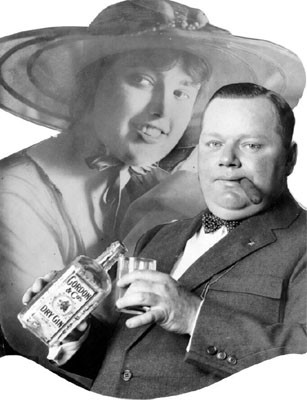
Photomontage of Roscoe Arbuckle pouring himself (or a revenant Virginia Rappe) a glass of gin, ca. 1921 (Calisphere)
[1] The original wire story appeared variously credited to the Associated Press, Hearst International News Service and the Chicago Tribune-New York Times, idated February 7, 1922.
[2] “New Artuckle Case Witness,” Salt Lake Tribune, 9 February 1922, 14.
[3] “Negro Woman Going to Testify Behalf ‘Fatty’ Arbuckle: Negress Says She Nursed Virginia Rappe and That Actress Grateful,” York Daily News-Times, 11 March 1921, 1. This is just one example of many.
[4] An Illinois state attorney and commissioner were present for Sabath’s depositions. We are currently investigating the possibility that these still exist in the state’s archives.
The reportage for the third trial was not as detailed as the first trial. The legion of reporters had been cut back as public interest in the Arbuckle case waned. Oscar Fernbach of the San Francisco Examiner soldiered on though and noted some important turning points as the trial unfolded—mostly lost opportunities for the prosecution.
As we pointed out in yesterday’s blog post, District Attorney Matthew Brady’s star witness, Zey Prevost, had fled to New Orleans beyond the reach of his subpoena power. She and showgirl Alice Blake were in roughly the same place at the same time while at the Labor Day Party. Both women had entered room 1219 after Roscoe Arbuckle had exited while Virginia Rappe was lying semiconscious in one of the room’s beds. Blake had heard Rappe “accuse” a male of hurting her and that she felt like she was dying. Her earliest statements are hardly ambiguous. But whether her statements had been fine-tuned by her interrogators has to be scrutinized. Nevertheless, like her friend Zey Prevost, Blake was less than enthusiastic about testifying against the comedian and was almost declared a hostile witness during the second trial. Like others who attended the party, Blake was in the “in crowd” and probably felt some kindred loyalty to the group. As an entertainer she would have also been aware of the possible impact her cooperation with the prosecution could have on her career.
Until March 23, 1922, Alice Blake had maintained her composure but her reluctance to testify was often apparent in the way she spoke almost in a whisper and, by degrees, ceased remembering details of what happened on Labor Day 1921—with the exception of being one of Rappe’s first responders.
Girl Checks State Attack upon “Fatty” Alice Blake Denies She Heard Virginia Rappe Say “He Killed Me”; Breaks Under Fire
Oscar H. Fernbach, San Francisco Examiner, 24 March 1922
With every inch of the battle ground hotly contested, the fight being waged in Judge Louderback’s court to establish Roscoe Arbuckle’s guilt or innocence of the manslaughter of Virginia Rappe proceeded yesterday.
Tears and temper, accusations and recriminations, insults and apologies all contributed to the sensational features of the trial.
Alice Blake, star witness for the prosecution, broke down under the grilling cross-examination of Gavin McNab, became hysterical, and was led weeping from the witness stand, while an enforced recess was taken to give her time to compose herself. She could not stand the strain of McNab’s attempt to expose what he termed “fabricated testimony, produced under duress,” his accusations being directed more against the district attorney’s office than against the girl on the stand.
It was all about Alice Blake’s direct testimony to the effect that she had heard Virginia Rappe exclaim as she lay in agony upon the bed in Arbuckle’s room: “I am dying; he hurt me.” By producing the original statement, which the witness had given to the police on the day following the death of Virginia Rappe [September 10, 1921], McNab established the fact that Alice Blake at the time had not included the words, “He hurt me,” and the attorney proceeded to insinuate that District Attorney Brady and his assistants had subsequently tried to compel the witness to testify as she did. The girl explained yesterday [March 22, 1922] that when she was questioned in Brady’s office she was told that Zey Prevost had declared that Virginia Rappe had used the words, “He killed me,” and had informed Brady and [Assistant District Attorney] U’Ren that Alice Blake had heard her so exclaim.
“I told them I did not hear her say so,” was the emphatic testimony of the witness yesterday. And she went on to say that at the time she had expressed the belief that Virginia Rappe, if anything, might have said, “He hurt me.”
[Assistant District Attorney] Leo Friedman, who conducted the direct examination, had a hard time with his witness. The value of her statements to the prosecution seemed to have become inversely proportional to the number of trials to which Arbuckle is being subjected. She reached a strage yesterday where she “could not remember.” In vain did Friedman show her the record of her testimony in the police court and at two preceding trials. It merely refreshed her memory to the extent that she could recollect nothing.
On cross-examination, however, Alice Blake made a startling announcement. She confessed that she had left the sitting room of Arbuckle’s suite before either Virginia Rappe or Arbuckle had gone into the bedroom, and did not actually see either of them enter that apartment. This was news—and McNab made the most of it.[1]
True, the witness admitted that before she left to enter the third room [1221] of the suite, she had seen both the comedian and the actress walking toward the door of the bedroom [1219]. But she [Blake] further declared that she had been absent less than fifteen minutes when, upon her return to the sitting room [1220], she found Mrs. Delmont knocking on the bedroom door and calling to Arbuckle to open it. This testimony placed the comedian and Virginia Rappe alone in the bedroom for fall less period of time than hitherto had been inferred from all the testimony.
The story of how Virginia Rappe was found in agony in Arbuckle’s rooms, and the ministrations that were given her, was repeated in detail by Alice Blake. McNab, in turn, sought to convince the jury that the actress had been injured while being given a cold bath, or while being held upside down by Fred Fishback and that her cry, “He hurt me,” referred to the latter and not to Arbuckle. [. . .]
Alice Blake, September 19, 1921 (Underwood & Underwood)
[1] In reality, her initial statement indicates that she left room 1220 for room 1221—Lowell Sherman’s bedroom—as Rappe and Arbuckle entered room 1219. Blake didn’t disclose whether Sherman accompanied her. But this can be inferred from Prevost’s early statements and testimony, where she, Prevost, is alone in room 1220 with Maude Delmont. Here Blake mentions that fifteen minutes passed before she saw and heard Delmont kicking the door and demanding that she be allowed to speak to Rappe. While this seems to fit the defense’s assertion that Arbuckle and Rappe were alone for less than ten minutes, as Fernbach suggests here, it doesn’t. Blake omits here that she returned to room 1221. She was there when Arbuckle finally opened the door of room 1219 and didn’t see him exit. Keeping up with these details and nuances is not only difficult for authors and readers. Imagine what it was like for the prosecutors in 1921 and ’22!
To theorists Jacques Derrida and Roland Barthes, photos of individuals have a spectral quality where it’s the photograph that is looking at us from a fixed moment in the past. A photo of Virginia Rappe with two of her friends provides a good example of that quality.
The more prominent of the two is the actress Louise Glaum, who, when The Picture Show published the photo in November 1919, had just made or was making such motion pictures as The Lone Wolf’s Daughter (1919), Sex (1919) and Love (1920). These and other films made Glaum Theda Bara’s rival for the title of Hollywood’s leading vamp.
During this time, too, Glaum, was also seen around Los Angeles in Rappe’s company. That they were friends is known from the reporting of the first Arbuckle trial, when prosecutors tried to get “Miss Glaum“ to testify to Rappe’s health and wellbeing. This required Glaum that come from New York, where she had retired to enjoy her private life and file lawsuits against her former studio.
What she might have said as a rebuttal witness will never be known. But it is not hard to guess. She likely would have told the jury that in all the time she spent with Rappe, she hadn’t seen her drink alcoholic beverages, fall into hysterical fits, tear her clothes off, and the like. Glaum, too, who enjoyed hiking in the Hollywood Hills like Rappe, would have said that Rappe’s physical health was robust.
Being a rebuttal witness, however, would have required subjecting Glaum to cross examination by Gavin McNab or, more likely, Milton Cohen among Arbuckle’s battery of lawyers. This would have exposed her personal life to some degree. Glaum was single, having divorced at an early age. Her nickname was “Weirdy” among the other women in the studio. The lawyers would also probe the depth of her friendship with Rappe. It may have been so casual as to make Glaum out to be a weak witness who really wouldn’t know about Rappe’s wellbeing. Or Rappe may have been closer, like a “lady-in-waiting” in Glaum’s entourage. (Glaum could have known her in Chicago, where Glaum was a stage actress around 1909–11 and Rappe was both a model and aspiring actress herself.) Or Glaum and Rappe may have been—and this is more likely—equal partners in whatever acquaintance they had.
One thing they did have in common were dogs. Glaum had rescued a Boston terrier that she named “Runtie” and Rappe had “Jeff,” her brindle Staffordshire, rescued from director Henry Lehrman’s studio menagerie. In the photo, Rappe’s dog is the center of attention with Rappe flanked by Glaum and the former actress Jean Darnell.
Darnell, too, could have made a good rebuttal witness. She was an actor-turned-gossip-columnist and privy to many Hollywood lives and secrets. Unfortunately for the work of biographers and historians, her own life was kept private. At the time of Rappe’s death, she had already returned to her native Texas as an “exploitation” agent for Goldwyn.
The second trial jury was finalized on January 16, 1922 and their names published in the newspapers on the following day. Unlike the first trial’s jury, the new jury was composed of more men, eleven altogether, and one woman. Instead of a thirteenth juror, there were two alternates, one man and one woman.
Gavin McNab, the lead defense attorney, rejected several women on the basis of their eagerness to serve on the Arbuckle jury. Although four women on the first trial voted to acquit Arbuckle of the charge of manslaughter for the death of Virginia Rappe, his thinking had likely changed. After all, the men on the first jury voted to acquit, even the lone male juror who didn’t, Thomas Kilkenny, had for the most part sided with the majority.
We think Kilkenny changed his vote not so much because he believed in Arbuckle’s guilt. When it was clear that his vote didn’t matter, for a hung jury was inevitable, Kilkenny sided with the one woman who consistently cast ballots to convict out of—we think—Irish solidarity and, perhaps, chivalry. After all, the woman who voted to convict, Helen Meany Hubbard, was the daughter of Irish immigrants.
Women serving on juries in California was neither new nor could it be attributed to the passage of the Nineteenth Amendment. California already had suffrage since 1911 and women frequently served on juries. The exceptions, however, were the more “indelicate” cases involving murder and sex. But that exception was also falling by the wayside. Indeed, nine women served on a high-profile murder case in Los Angeles—that of Arthur Burch for the love-triangle murder of J. Belton Kennedy, a wealthy insurance broker—which overlapped the first Arbuckle trial and competed for headlines.
The Burch jury also couldn’t come to a consensus and proved, if anything, that women jurors hardly voted as a bloc. They didn’t for the first Arbuckle trial. Four women voted to acquit, three of whom consistently voted Arbuckle as not guilty. In contrast, the men nearly voted in lockstep save for one and only in the end.
As it turned out, the men on the second trial’s jury, although more “traditional” in makeup, would have its own surprises rather than the expected outcome.
Second trial jury, January 1922 (Underwood & Underwood)
Haley’s pieces are more editorial than strict reportage and here he discusses the role of the woman jurors in the trial and the problem they presented for Arbuckle’s lead attorney, Gavin McNab.
Ultimately, the first Arbuckle trial ended in a hung jury when one woman, Helen Meany Hubbard, refusing to cast a ballot for acquittal. Over and over again she voted to convict Arbuckle of manslaughter in deliberations that dragged from December 2 to December 4, 1921. She might have been alone had not a fellow juror, Thomas Kilkenny, eventually joined her in the vote to convict.
Haley is prescient in regard to the kind of modern juror McNab faced. Mrs. Hubbard, the wife of a lawyer, attributed her decision to the prosecution’s logical presentation of the circumstantial evidence, especially the fingerprints that indicated a struggle between Arbuckle and Rappe. Hubbard, too, found Arbuckle’s “Good Samaritan” testimony to be false. But it was Gavin McNab’s courtroom performance that she found particularly offensive. (For more on Hubbard, we suggest reading Joan Myer’s “Virginia Rappe & the Search for the Missing Juror.”)
Arbuckle Jury Split; Is Locked Up Over Night
Two of Women Jurors Reported Holding Out for Conviction of Comedian Acquittal May come When Court Meets Today Fatty and Friends Worried by Delay—Had Hoped for Speedy Liberty His Wife Breaks Down Prosecutor Arranges to Guard Actor from Violence in Case He Is Freed
By Bart Haley
San Francisco, Dec. 3.—The jury before which Fatty Arbuckle has been on trial for manslaughter is split and temporarily deadlocked.
Two of the five women members were reported this morning to have been holding out for the conviction. After seven hours of deliberation and seven ballots, the foreman reported at 11:10 last night that no agreement had been reached.
The court had remained in special session. The jury was locked up with orders to go to work again today. The court will reconvene at 10 o’clock. Fatty and his counsel and his friends, who had been hoping and laboring for an immediate and spontaneous acquittal, were shocked.
(It will be 1 o’clock in Philadelphia when the court meets today.)
The big comedian, whose troubles, the first real ones of his life, began with the Labor Day gin-and-orange juice party which Virginia Rappe was carried with mortal injuries, was badly shaken for the news from the jury room. For hours he had waited in an agony of anxiety which he could not quite conceal.
The building was invaded by a curious mob. Judge Louderback had informed the jury that he would wait until 11 0’clock. This decision followed the failure of the jury to reach a verdict in two hours of wrangling that preceded the dinner hour. At 11 o’clock there was no sign of life from the jury room. A deputy sheriff was sent to make inquiries. He returned with the news that a verdict had not been reached and that the jury wanted ten minutes of grace to try again. It tried again and failed.
Fatty stood up in the brilliantly lighted courtroom and reached wearily for his hat. Even the anti-Fattys felt a momemt of pity. Mrs. Arbuckle, who was sitting behind her husband, arose, sat down again, opened her handbag, got out her handkerchief and began to cry.
Only Gavin McNab, chief of Fatty’s counsel, appeared unmoved. The other lawyers looked dismal, but resigned.
“I’m not worried,” said Fatty, “it’ll be all right. But I wish they would hurry.”
There were good reasons why hurry seemed desirable. Doubts and wrangling and delays and the dim possibility of a permanent disagreement were not likely to help toward a calf-killing in the land of films or to make the way easy for the return from Elba, which, to Fatty, is almost as important as liberty itself.
A verdict of acquittal is expected today. Arbuckle, his sisters, his wife, his counsel and the friends who were with him when he went unhappily through the jammed corridors on the way to his hotel felt so sure of an acquittal on the first ballot that they were prepared to leave for Los Angeles this afternoon.
District Attorney Brady and his assistants were not in court last night. They left with the manner of men washing their hands of the whole business at the close of their final arguments and after a day of extremely bitter interchanges with the lawyers for the defense.
But Brady has provided a strong guard to protect the tragic funny man from cranks who have been sending him violent and threatening letters.
The ground over which the battle for Fatty’s liberty and rehabilitation has raged furiously and without rest since November 11 was strewn with strange wreckage last night. Mrs. B. Maud Delmont, who was the most conspicuous of the women guests at the fatal Labor Day party, was taken from her hotel last night and placed in jail under a bigamy charge registered by the authorities of Madera County. It was Mrs. Delmont who first accused Arbuckle of being the direct cause of Virginia’s injuries.
Irene Morgan, who was found poisoned in her hotel here on Thursday, returned, still very ill, to Los Angeles this morning. She had been brought into court as a witness for the defense. The police and private detectives, after working for twenty-four hours without sleep in an effort to find a man who was presumed to have poisoned Irene, quit the search in disgust.
They had sought high and low for a vehicle called, in the bright idiom of the police, “the poison taxicab”—a taxicab in which Miss Morgan said she rode just before a mysterious gentleman, “appearing much like one of District Attorney Brady’s detectives,” gave her deadly orange juice and poisoned candy. Physicians who were called in frantic haste to the Clift House [Hotel], where Irene was found, said last night that so far as they could determine, the young woman took a great overdose of headache powders, accidentally or otherwise.
The ante-mortem statement obtained by the physicians when they thought Irene was going to die glistens with the strange poetry of delirium. It is all about love and a noble past and proud ancestors in Sweden and a Duke from Spelice and the dead Virginia.
Mrs. Minnie Neighbours, of Los Angeles, another of the women who gave some of the most helpful evidence for the defense, is waiting here to answer formally to a perjury charge on Monday. District Attorney Brady caused Mrs. Neighbours’ arrest and said that her evidence was wholly false.
Fatty and his counsel have found time from all their other troubles to stand manfully by the refugees. Their doctors treated Miss Morgan. The lawyers will defend Mrs. Neighbours. Mrs. Delmont, who started all the trouble, will seemingly see the last of it. She will be left to shift for herself.
The mill of the trial ground on unhindered by these reports from the outside world or news of stragglers overcome by the wayside. The jury retired at 4:10 after Gavin McNab and Assistant District Attorney U’Ren finished their respective appeals. The courtroom and the corridors were packed and there was a mob in the street. McNab assailed District Attorney Brady by name and the District Attorney assailed McNab.
“No innocent man,” said Mr. U’Ren, “would have kept still as Arbuckle did, until he was driven by the collapse of his counsel’s case to stand in this court and tell a story that is obviously untrue. Through perjury and hypocrisy, he is seeking his freedom.”
McNab again bitterly charged Brady with maintaining a system of organized terrorism in his office. When he was not addressing himself particularly to the women of the jury. McNab made masterly use of the material at his disposal. When he addressed himself to the women, he made it clear, perhaps for the first time, that equal rights of citizenship have created a new dilemma for lawyers.
Should you appeal to the minds or to the emotions of women in the jury box? Mr. McNab appealed proudly to their emotions, to their emotions only, and the experiment—which may become historic—didn’t terminate auspiciously.
Judge Louderback’s charge to the jury sounded almost like a recommendation for conviction. And the first rumors from the jury room indicated that all five women members desired ardently to send Mr. Arbuckle to jail. Stephen Hopkins, a thirteenth juror, who was held as an alternate until the deliberation of the jury began and then released, reflected the other side of the jury’s mind when he said he could see no reason for a conviction.
About the state of mind of the five women of the jury there were from the first differences of opinion as wide as the seas. They were among the first women who ever sat in judgment on a case of the sort which, involving spectacular crimes or spectacular misfortunes of one of their own sex, would normally be decided by the blundering and purely masculine code known in courts as the unwritten law.
The jury had a wide, an almost limitless, latitude for the exercise of its sympathies or its prejudices. Neither the prosecution nor the defense pleaded a clear case. To an impartial eye it was plain that the State’s direct evidence was not sufficient to prove Fatty guilty, in a court or out of it. Neither did Mr. McNab and his associates demonstrate Fatty’s innocence. Only Fatty himself knows what went on in the room from which Virginia Rappe was carried to die.
When, after all the noise and clamor of the closing arguments was over, the lawyers admitted that they had felt, addressing the women of the jury, as if they were talking into a void or appealing to a granite wall. But the jury women toward the last were not merely inscrutable. They were more obviously bored and weary—weary of Fatty and the wrangling of McNab and Brady, of the doctors and the lingo of the clinics, of everybody in the courtroom, of the repeated loud references to gin and orange juice.
When at last the jury left the courtroom at 4 o’clock in the afternoon, Fatty looked after them forlornly and his lawyers crowded about to make cheerful prophecies. Women, they told themselves and their client, were not fools about these things. Women could not be swayed by the befuddling sentimentalism that might cause men to do crazy things in cases like this. Women might be tender-hearted about all the rest of the world, but they were hard-boiled in relation to one another.
So the minutes passed. Fatty’s lawyers watched the clock anxiously and returned to the fear that was rending with them within. McNab, they were sure, had got to the jury. They felt that his address had been very moving. But it was not moving. Upon McNab it fell to initiate the long, long series of experiments which may have to be continued for years before lawyers of the present schools are able to talk effectually to mixed juries.
And upon the site of the Hall of Justice, lawyers of the future may yet erect in gratitude a monument in memory of Fatty’s chief of counsel and inscribe upon it: “On this spot Gavin McNab first demonstrated for posterity the manner in which a jury of the new age should not be addressed.”
McNab was Victorian. He begged the ladies of the jury to have no illusions. Yet he himself seemed full of them. McNab, the winner of a thousand great suits, the wise guide of a political party and mentor of a multitude of young lawyers, floundered when he sought to touch the consciousness of five average women and behaved like a mariner in uncharted waters at night. He began with Bethlehem and ended with “suffer the little children to come unto Me.”
He talked of the millions of children who had laughed at this most unfortunate man and dwelled long and tenderly upon the tradition of an unerring child’s instinct which he recommended as culminating proof of Fatty Arbuckle’s innocence and the cold brutality of the District Attorney’s office. McNab told of the need for a continuous reverence for all women.
At about the same moment, Irene Morgan in a mild delirium was telling them at the Clift Hotel to prepare for Duke of Spelice, who was coming to take her riding, and begging to be told where Virginia Rappe was. Mrs. Neighbours, another Arbuckle witness, was waiting to face a charge of perjury and Mrs. Maud Delmont, the third troubled woman in the case, was being taken to jail.
Fatty’s big car—someone said casually the other day it cost as much as a good-sized church—was waiting outside at the curb. It was not going to hang around the Hall of Justice a moment longer than was absolutely necessary. It was gassed and chauffeured for swift departure from this scene of trouble.
The jury had been out about twenty minutes when one of the Arbuckle counsel, who had passed a door that leads almost directly into the jury room, sat down among his associates and in almost inaudible whisper uttered one word:
“Wrangling!”
Had McNab trusted too greatly to the woman of bright legend, to the woman of books written by sentimental men who make the unwritten law and not enough to the woman who votes? The thought may have occurred to some of the watchers.
It clearly did not occur to Fatty. He was not thinking. The blood was beating in his temples and upon his face fell the look of a man falling endlessly through space. There ensued a period of harrowing suspense until the jury disappeared stolidly to its hotel for dinner.
And the big car turned and rolled slowly down the street, but only to return at 8 o’clock. One salient had been lost. The battle waged for three weeks was not only for the Arbuckle of the present but for the Arbuckle of the future as well. A quick, unhesitating acquittal by the jury had been hoped for by the defense.
After the shock of the first disappointment, Fatty recovered and seemed to feel better. He loafed for a while in the corridor, when he returned, and smoked cigarettes, leaning comfortably against the wall.
“It’ll be all right,” said he. “I’m not a bit worried now, but I wish they’d hurry.”
Roscoe Arbuckle in court, December 1921 (Calisphere)
Milton U’Ren grinned, his teeth crooked and sharp in the long, lean face.
—Ace Adkins, Devil’s Garden
The hiatus in our blog entries is, of course, due to the holidays. But we are drafting one of the key chapters in the book, with the working title “Spontaneous Rupture of the Bladder.” What follows is the final argument of the first trial given by one of Roscoe Arbuckle’s most dogged prosecutors, Assistant District Attorney Milton U’Ren. Arbuckle case narratives—with the exception of Greg Merritt’s—don’t give U’Ren his due as an important figure in the three Arbuckle trials. Typically, if there is a mention of him, he is demonized, albeit as a minor demon. While many writers attribute some personal animus for Arbuckle on the part of District Attorney Matthew Brady, it is evident in the transcripts that it was U’Ren who was most determined to see Arbuckle brought to heel.
This hostility was noted during the first week of the Arbuckle trial, when U’Ren routinely referred to Arbuckle as a has-been.
Having no real political aspirations or agenda, U’Ren likely saw Arbuckle as an avatar of the sins of the motion picture industry. U’Ren was a Progressive Republican who shared Theodore Roosevelt’s belief that an unhealthy body betrayed unhealthy behavior. (Roosevelt, as a boy, took to heart being diagnosed as “suffering from a handicap of riches.) Then there is also the possibility that U’Ren wanted to avenge Virginia Rappe—a task that could hardly be left to Maude Delmont, a woman he saw as just another debauchee. But, lastly, and more likely, U’Ren was the father of two young daughters, aged five and seven. That motivation also applied to two others who regarded Arbuckle as an uninhibited predator. Matthew Brady’s only child was a daughter and Captain of Detectives Duncan Matheson also had two daughters.
On December 1, 1921, Milton U’Ren’s fellow prosecutor, Assistant District Attorney Leo Friedman, presented the first half of the prosecution’s closing argument. He was followed by Arbuckle’s lead defense attorney Gavin McNab, whose closing argument continued into the next day.
Otis M. Wiles of the Los Angeles Times thought “the dynamic and youthful prosecution attorney” had an effect on the jury. “For one hour and forty-six minutes,” Wiles wrote, “Friedman literally dragged Roscoe up and down before the jury of five women and seven men, nailed him to the cross of justice and pelted him with the defilements of his mental makeup.” Indeed, without using a rather new word for 1921, Friedman presented Arbuckle as a sociopath. But any “wounds” he delivered on the comedian, according to Wiles, “soon were alleviated by the healing power of McNab’s soothing syrup voice”, his “mellow Scotch accent,” and his “genial smile.”
A natural orator like fellow Democrat William Jennings Bryant, McNab could sway a jury with the force of his voice, figures of speech, and frequent allusions to American decency and the Bible. Most journalists at the trial sided with him and devoted more column space to his exposition.
Milton U’Ren’s was treated as footnote in most newspapers. We wanted to present as much of it as possible because the prosecution of Roscoe Arbuckle was very much U’Ren’s project and his contribution deserves to be restored. The following is taken from our work-in-progress. Without a transcript of the first Arbuckle trial—which exceeded 2,200 pages or 525,000 estimated words—we extracted quotations from the extant reportage, compared them, and harmonized them to render a narrative that comes close to the original language and order of each speaker’s address to the jury. This method is provisional and comes with caveats that all the quotations used are based on contemporary reporters’ notes. Their objective was to get the feel and intent of the original. So have we. But our objective is to pull as much together of the Arbuckle trial experience as possible.
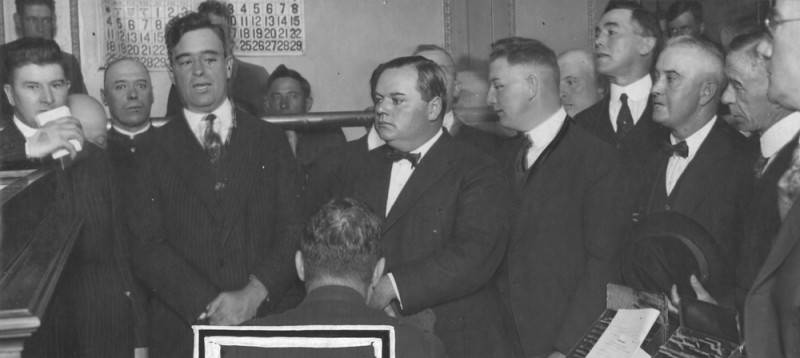
From left to right, Milton T. U’Ren sitting next to Roscoe Arbuckle and his criminal defense lawyer, Frank Dominguez, September 1921 (San Francisco Public Library)
Gouverneur Morris was a regular attendee at the Arbuckle trial and published his occasional vignettes.[1] Like other journalists behind the rail of Judge Louderback’s courtroom, he had taken sides. Morris believed that Arbuckle had “spoken the truth” on the stand. Morris questioned nothing and took to task the person responsible for the comedian’s long ordeal. “[Frank] Dominguez,” he wrote, “lost his head, forgot that it was his client who was the million-dollar actor, assumed the role himself, ranted, mistook friends for enemies, antagonized everybody in sight and imposed absolute silence upon Arbuckle.”
Morris had good reason to take sides. He had just enjoyed a year of success as a scriptwriter and hoped to enjoy another, as well as the perquisites and status of the film colony in Los Angeles. No doubt, too, Morris represented the feelings of not only the press but many in the motion picture industry, that what happened to Virginia Rappe should be put behind them. Nothing would bring her back and there was barely enough of her on screen to remember, to fill a couple of matinees.
As to the closing arguments, in the last piece Morris posted from the Arbuckle trial, he hardly looked forward to them. “[W]e shall listen to Friedman and U’Ren saying absolutely nothing for four mortal hours.”
* * *
Gavin McNab would be a hard act to follow. Even fair-minded observers had to admit that Arbuckle’s lead attorney had the ladies and gentlemen of the jury, as well as the press, in the palm of his hand. That Matthew Brady had chosen not to speak was noticed. To his harsher critics, Brady’s not taking “the splendid opportunity to deliver an address to the jury,” wasn’t a result of exhaustion or burnout but that he was distancing himself from an impending acquittal.
All that remained was for the prosecution to go through the motions of a challenger falling behind on points and trying to avoid a knockout. Nevertheless, the “challenger” had the irrefutable fact that two people entered room 1219 and one came out.
Around 2:15 p.m., Assistant District Attorney Milton T. U’Ren rose to speak, picking up where the defense had left off—the image of Arbuckle’s adoring young fans—and with a voice that rivaled McNab’s at least in volume. Taking umbrage at McNab’s comparing Arbuckle to Christ and praise for simply not dropping Virginia Rappe on the way to room 1227, U’Ren responded:
What would the millions of little children say if they could have seen “Fatty,” the modern Belshazzar, dressed in pajamas, surrounded by his lords and ladies, drinking, dancing, and “kidding around?” What would these children say if they could have seen him putting the ice on the nude body of Miss Rappe as she writhed in pain? And what would their mothers say? The great Belshazzar saw the handwriting on the wall and quaked as it was interpreted. “You have been weighed in the balance and found wanting. Your kingdom shall be divided among the Medes and Persians. That night Belshazzar was killed and the city overrun with enemies.
“The modern King Belshazzar has also seen handwriting on the wall,” U’Ren continued, alluding to the fingerprints on the hotel door in the same breath as he alluded to the ill-fated King of Babylon in the Book of Daniel. “The king is dead, and his kingdom is divided. He will never make the world laugh again. The king is dead. Thank God!”
Described like a cartoon character, Edward Doherty of the Chicago Tribune simply wrote a “little man, U’Ren, red faced, spectacles, bald—but he can shout.” But those familiar with Milton U’Ren from other trials knew that he, while not the orator, could sway juries “by talking quietly and reasoning logically.” And in a calmer voice, U’Ren explained that the defense had based its case upon “perjury and hypocrisy rather than upon facts. [. . .] Arbuckle’s story cannot withstand your scrutiny,” he said, “nor can it weaken the chain of circumstances against him.”
Arbuckle’s testimony was what the prosecution had been waiting for, having been limited to nothing but circumstantial evidence. In Arbuckle they surely believed they had the ultimate perjurer—one who had foolishly testified on his own behalf when he wasn’t required to do so. McNab wanted to credit Arbuckle for that. But he knew the day before he agreed to letting Arbuckle take the stand that it could work against him. U’Ren only needed to present it as a fabrication. Then, at best, only one juror was needed to keep the case alive and so move past this jury, which U’Ren, like Brady, like his other deputies, saw as tampered, an impression reinforced by the jurors nodding, smirking, winking, and their rapt attention to McNab this morning.
U’Ren declared that the defense had been opportunists, having no basis for their case and having proposed no theory for Rappe’s death until they heard the prosecution’s evidence. Here, of course, U’Ren exaggerated, given that Frank Dominguez had already introduced the argument that Rappe had a preexisting condition that made her bladder prone to spontaneous rupture.
“It was then” he said, “that they manufactured the story that Arbuckle told—manufactured it to meet the evidence presented by the prosecution.” McNab’s argument yesterday and today “was not a summary of the case but merely an attack upon the District Attorney.” Then U’Ren cannily reminded that Matthew Brady had been a reform candidate who had beaten Charles Fickert, a man the defense presumably would have preferred. “The present District Attorney is not Mr. McNab’s District Attorney,” U’Ren continued. “Attacking this public officer is merely throwing dust in the jury’s eyes.”
After excoriating Arbuckle for his silence and testimony, U’Ren refuted the defense’s clever dismissals of the fingerprints as the ghostly hands of “spooks” and turned the incessant ridicule of Professor Heinrich against them. U’Ren, too, should have been credited with the cleverest allusion of the day, besting his comparison of Arbuckle to Belshazzar.
Another writer fascinated by the science of criminology and fingerprinting in the late nineteenth century was Mark Twain. U’Ren returned to the prosecution table and picked up a copy of Twain’s 1894 satire of penny-dreadfuls, Puddin’head Wilson, to illustrate that such an admired American author, familiar to everyone, understood the reliability of fingerprints in criminal cases.
Sitting at the defense table, Nat Schmulowitz, a bibliophile of satirical works who prized the issues of Century Magazine in which Twain’s novel had been serialized, knew where U’Ren was headed. Twain’s hero, an eccentric small town Missouri lawyer, David Wilson, could be seen in the person of Professor Heinrich during the presentation of the fingerprints on the hotel door. Deemed soft in the head by fellow townsfolk for his then-obscure use of fingerprints in crime detection, Wilson solves a murder with by distinguishing between the fingerprints of twins. Comparing him to Heinrich, who had been made out to be an egghead, a fool, and an innocent fraud by the defense’s fingerprint experts and many in the press, was a master stroke by U’Ren and not too obscure for the jury. Twain’s novel was still popular twenty years later and had been adapted into a stage play and motion picture. The maxims of Puddin’head Wilson’s Calendar were and still are pearls of Twainian wisdom (e.g., “It was wonderful to find America, but it would have been more wonderful to miss it.”).
Schmulowitz objected to U’Ren’s attempt to read from the book but was overruled by Judge Louderback (a personal decision, perhaps, since the novel centers around the murder of a judge). The “offending” passage is unknown, but it was likely from the penultimate Chapter XXI, Doom, in which Wilson, much like Heinrich, describes the criminal act in a courtroom with white sheets of cardboard with pantographic enlargements of “bewildering maze of whorls or curves or loops,” a person’s “natal autograph.”
Just after three o’clock, U’Ren closed in a long speech, excoriating Arbuckle before the jury much as he had in the beginning of his argument.
He sat there surrounded by his lords and his ladies, this man who Mr. McNab says has made the children of America laugh. He appeared in his pajamas before this mixed audience, this world’s comedian, this Good Samaritan who Mr. McNab says was merely helping a sick girl. A Good Samaritan! I proclaim him a moral leper!
This man who made the world laugh—my God!—who made the world laugh. I wonder what the children and their mothers would have though could they have seen him as he placed the ice on this poor girl’s body. He may have made them laugh before, but thank God! He never will make the world laugh again!
Do your duty so that when you go home and you can look your fellow citizens in the face. Do your duty so that you may take your children to your breast with the full knowledge that they will be protected from this man and others like him. Do your duty so that this man and all the other Arbuckles in the world will know that the womanhood of American is not their plaything.
U’Ren ended his argument at 3:20 in the afternoon. Not long afterward, the trial entered its third phase as Judge Louderback instructed the jury on coming to a verdict.
[1] This passage is based on Gouverneur Morris, “‘Fatty’s’ Story Late but True, Thinks Morris,” Des Moines Tribune, 29 November 1921, 3; Gouverneur Morris, “Rebuttal Adds Little to Case against Fatty,” Des Moines Tribune, 1 December 1921, 17; ; James Gordon, “Minister Tells Highlights in ‘Fatty’ Case,” Los Angeles Evening Herald, 1 December 1921, 1; Oscar H. Fernbach, “Woman Votes Actor Guilty, Says Report,” San Francisco Examiner, 3 December 1921; Marjorie C. Driscoll, “Arbuckle Jury Retires at 4:10 to Deliberate,” San Francisco Chronicle, 3 December 1921, 7; ; Otis M. Wiles, “No Verdict Returned,” Los Angeles Times, 3 December 1921, I:1, I:2; and other corroborative sources.
Bart Haley covered the first Arbuckle trial for Philadelphia’s Evening Public Ledger, one of the few newspapers in the east to assign its own reporter. His pieces delved into the personalities of the men and women who figured in the trial.
The following piece captures the atmosphere of the San Francisco courtroom as the trial was about to go into jury deliberation.
The enmity between the defense lawyers and prosecutors is palpable. So, too, are the indirect ways that the prosecution undermined the performance of Arbuckle’s lead attorney, Gavin McNab, who used his Scottish accent and sarcasm to great effect during all three trials.
District Attorney Matthew Brady’s animosity, however, isn’t only directed at Roscoe Arbuckle. Another reason he pursued justice for Virginia Rappe was to punish the monied interest behind Arbuckle. Hence, the Arbuckle trial can be seen as an exercise in social justice, in step with the progressivism of the era. That is why we find Will Hays and the Production Code as the end result.
The Howard Street Gang rapes, referenced in the article, occurred in 1920 and the trial that followed in early 1921 became a cause célèbre for feminists and Matthew Brady, the newly elected D.A. The trial was noteworthy for the reluctance of the victims to speak out against the men who assaulted them. Their reluctance is what influenced Brady to put two of Arbuckle’s female guests, Zey Prevost and Alice Blake, in protective custody—albeit against their will. As entertainers always looking toward their next gigs, it’s presumed that if they could they would have avoided testifying against “Fatty” and, by proxy. the movie industry.
Regarding Haley, he began as an illustrator for such publications as The Saturday Evening Post. In 1919, together with another writer for the Evening Public Ledger, the humorist Christopher Morley, Haley coauthored the Prohibition Era satire In the Sweet and the Dry(1919). Haley died in 1932 at the age of fifty-one.
Arbuckle’s Fate Hinges on Report on Girl’s Health; Both Sides Anxious as to What Commission of Physicians Will Disclose; Free Gangsters If Fatty Is Cleared, Cries Brady; Comedian’s Case Expected to Be Placed in Jury’s Hands by Tomorrow
By Bart Haley
San Francisco, Dec. 1. – The case of the people of California and the pursuing fates and the Women’s Vigilant Committee of San Francisco against Fatty Arbuckle will be given into the hands of a weary jury of five women and seven men tomorrow.
Before Saturday morning Mr. Arbuckle should know whether he is to be out of the trenches by Christmas or tragically and irretrievably out of what, in the language of the superstitious, is called luck.
It is considered probably that the lawyers will struggle to the bitter end without hurling their leather-bound books at each other. But the air about the counsel tables is heavily weighted with thunders and lightnings that seem to be held in check with increasing difficulty.
Yesterday, for example, Matthew Brady, the District Attorney, uttered the bitterest comment ever heard west of the Rockies from a prosecutor in the midst of a criminal case.
“If this jury acquits Arbuckle,” he said, “I shall at once formally ask the Parole Board to release the Howard street gang. I can see no reason why the Howard streeters should stay in jail if Arbuckle is to go free.”
In San Francisco, where for a whole week the Howard street gang made headlines a foot thick and caused groans in all editorial columns, the afternoon newspapers fled gasping to press hours ahead of schedule time to give this news to the eager people. The gang to which Brady referred is generally supposed to be the toughest in the known world.
About ten of its leaders got fearfully drunk not long ago, dragged two young girls into a shack, assaulted them and turned them half dead into the street. The gang is now in San Quentin Prison, and it was Brady who put it there.
The reaction of Fatty’s lawyers to this pronouncement from the prosecution was suggestive of a cataclysm of nature. They fled into a special conference. When they emerged it was only Gavin McNab who would trust himself to speak at first. He was just in time to read the corrected version of Brady’s statement.
“The first report,” said Brady in print, “does not properly reflect what I said—”
“Aha,” murmured McNab. “He’s taking it back.”
“What I said,” proceeded the District Attorney’s revised communique, “was not that I’d free the Howard street gang if Arbuckle is turned loose. I haven’t power to free anybody. But I can ask for the release of the Howard street gang and I shall do so if there is a failure to convict in this case.
“There are many points of similarity in the crime charged against Arbuckle and that charged against the Howard street gang. Heavy drinking was the primary cause of the trouble in both cases. The Howard streeters came into court without a cent. Arbuckle arrived here with a million-dollar array of counsel.
“I’ve been around this Hall of Justice for seven or eight years and I have been forced by experience and observation to believe that it is a serious crime in this country to be poor. I want to feel that this view is not justified and that is one of the reasons why I want to see Arbuckle convicted. Convicted he will be if I can help it. Moreover, I intend to put a stop to the use of manufactured and perjured evidence in cases of this sort.”
“I shall be glad indeed,” said Mr. McNab in a low and terrible voice, “if Mr. Brady, ‘putting a stop to manufactured and perjured evidence,” begins his admirable work in his own office. He impounded Zey Prevost and Alice Blake, did he not? Yet I was unable to see that that work helped him in the least to manufacture a case against Roscoe Arbuckle.”
“I’ll tell you,” said Mr. Schmulowitz, of Fatty’s counsel, knowingly, “he’s merely trying to get black headlines in the newspapers, which the jury will be able to read at a distance when it goes to the hotel or to lunch.”
Brady, hearing of this, laughed sarcastically.
“They know what I’m trying to do,” said he. “I’m trying to put their little Mr. Arbuckle in a jail and they aren’t so sure that I’m not going to succeed.”
It is hardly fair to say that Brady is trying merely to make headlines. The lights in his office and in the offices of his assistants have been burning until 1 o’clock in the morning since the trial of Arbuckle began and his detectives have been sleeping in their clothes.
[. . .]
No one here is disposed to take “Fatty’s own story without a lot of salt. It is doubtful whether the jury’s mind is not yet wide open. Neither the District Attorney nor the defense has established what is ordinarily known as a “strong case.” The evidence against Fatty is merely circumstantial. Virginia Rappe entered one of the rooms of his suite apparently in normal health. Half an hour or an hour later Arbuckle unlocked the door of the room from the inside and admitted others of his guests, who found the girl in an agony of partial delirium and, as it proved later, fatally injured.
[. . .]
So the cause of the girl’s death is still a matter of doubt which neither the prosecution nor the defense has been able to explain or demonstrate away. In the light of all this the final report of the medical commission which is to appear today may be the deciding factor of the whole case.
Eight hours of oratory will follow the commission’s report, and then the jury will retire. It was agreed before the end of yesterday’s sessions that the defense and the prosecution shall each have four hours for the closing addresses to the jury. Mr. McNab suggested that the case be permitted to go to the jury without argument. He informed the Court that the defense was willing to enter into such an arrangement if the prosecution would agree.
“Doubtless,” said Brady, coldly, with a lift of his eloquent eyebrows toward the jury, “but the prosecution will enter into no such plan.”
“He’ll dislocate that eyebrow of his one of these days,” hissed Mr. Schmulowitz to one of his colleagues, “and then he’ll have to have it set.”
A moment later the emotional stress that prevails among all lawyers engaged in the case of Fatty was oddly revealed. There was a long interval of silence and whispered conferences. Fatty was peaceably rolling his little paper balls and appearing more lightsome than he has appeared since his travail began. Mr. Schmulowitz leaped suddenly to his feet and in a voice of great emotion asked that if it pleased the Court the District Attorney and his assistants be ordered to cease heckling the counsel for the defense.
“Heckling?” murmured Judge Louderback, staring hard at Brady’s table for signs of misbehavior.
“I desire formally to object, if it pleases the Court,” cried Schmulowitz in a voice that was like tragic music, “to the various asides indulged in by the State. I mean that there are words and gestures indulged in by the prosecution which are obviously meant to annoy counsel for the defense, and, what is more, to have an effect upon the mind of the jury.”
Mr. U’Ren, one of Brady’s assistants, rose nobly to his feet to observe in a sleety drawl that surely it was no intention of the defense to deny the right of conference to the people.
The fact is that there was something to be said on the side of Mr. Schmulowitz, but he didn’t say it. Perhaps no one could say it. The causes of his outburst are almost too subtle for analysis. Brady uses his shrugs to enormous effect. And Mr. Friedman, his youngest assistant, has a way of looking up and staring with an expression of awe and wonderment and seeming to be transfixed and diverted immeasurably at whatever lawyer of Fatty’s tried by devious methods to turn a tide of evidence of circumstance to the advantage of the accused.
So he looks at McNab and so he looks at Schmulowitz for half an hour at a time, only to turn now and then to smile at the jury as one who would let it participate in the enjoyment of a spectacle, spectacular and humorous.
Somehow or other the weight of the trouble seems to have passed mysteriously from Fatty to his lawyers. Fatty is cheerful at last. He is almost himself again. The change may be due to the succession of mysterious visitors who have been appearing in court to whisper in his ear—spatted and opulent individuals who sit and listen eagerly for a while and vanish as they appear, almost without a sound.
They come from that country from which for the time being the big comedian is exiled. Things, they think, are looking up. Yes, they represent some of the important movie people, one of them remarked. He added that for all one knew this unfortunate business might prove to be the best thing that ever happened to Arbuckle.
You see, Fatty has been getting a lot of publicity. Now, if that publicity can be turned to good account, if it can be shown that the children’s favorite comedian was a victim of most unhappy circumstances, why, this Fatty will be bigger than he ever was before. So it runs, this word from the world of Fatty’s former triumphs.
“Well,” you remark, to change the subject, “he seems to be standing it pretty well. He is far from being a wisp of himself.”
“No,” says the scout of the promoters whose money is tied up in Arbuckle pictures and Arbuckle contracts and Arbuckle plans. “He is not standing it so well as you might think. He’s nervous and wrought up. You see, he’s crazy to get back to work again. When he gets to work, he’ll be all right.”
While working on the corpus of our narrative, we have neglected to add some timely sidebars to this blog. So, we shall observe the end of the first week of the first Arbuckle trial with this mock theater review by George Warren, a theater critic for the San Francisco Chronicle.
Unlike the Examiner and the Call, the Chronicle didn’t give the Arbuckle trial first-page coverage. The editors saw it as local news and restricted the front page to more serious stories, like the naval disarmament conference in Washington. Even this “review” didn’t appear in its pages. It was distributed by a press syndicate to newspapers such as the Salt Lake Telegram,Chattanooga News, and other out-of-town papers where it ran the week of November 20-26, 1921.
Datelined November 19, the Sunday feature is based on the initial days of jury selection. But it captures the theatrics that many observers thought characterized the defense. Here, Arbuckle played an important part that may not have been passive but well planned, like shooting a comedy. So did his estranged wife, Minta Durfee.
What Dramatic Critic Thinks of Arbuckle: Frisco Writer Sees Fatty’s Biggest Drama Being Enacted in Court
By George Warren
Life, the greatest dramatist of them all, has written a rather involved piece in that much discussed tragedy, “The Death of Virginia Rappe.”
I have seen but the prologue and find that, as usual, this master of the drama makes one wait through tedious routine in order to catch the fine climaxes and thrills. There has been more of action than of drama. For the most part, the lines run too long to sustain dramatic interest.
This may explain why, in spite of the worldwide publicity, the tragedy has received, the first-night audiences were slim. There was no rush for admission and those who attended were mostly students of life’s dramas or professionals who came in on complimentaries.
While the product was being prepared, I had heard so much of the lead character, Roscoe Arbuckle, that I was a bit disappointed at the manner in which he was shoved into the background in the earlier scenes. A newcomer had been secured,[1] almost on the eve of the first presentation, and had been given all the “fat speeches.”
He is Gavin McNab, a veteran actor who plays the role of attorney for Arbuckle. He gives a fine and finished performance. In his past roles of a political dictator, clubman, and public figure, he has handled himself almost equally well, but he is best known for the performances in which he plays the part of defense counsel.
His stage presence is perfect and he becomes at once a dominant figure. His long and sometimes tiresome lines are forgotten in his excellent facial expressions and suave command of situations.
Arbuckle is doing tremendously fine work in his unhappy role. He is presumed, in the play, to have brought about the death of a beautiful actress, Virginia Rappe, during a revel staged in a fashionable hotel suite.
Here is an actor who, a few months back, was presumed to be fit only for slapstick comedy. Never have I seen a player who so completely reversed his type. His expression is frequently that of a hurt and troubled victim of circumstances, perplexed by what is going on about him, appealing to all eyes for sympathy. Again, he is the tense observer of the figures that pass before him, as though disinterested in all else but that upon which his eye centers. It is an impressive performance, having a tendency to make one forget the lack of drama and center upon this characterization of the man who plays the “heavy.”
Quite an interesting a performance is given by Minta Durfee Arbuckle, the wife. It has been customary in drama of this sort for the accused and his wife to appear side by side, but here we have the wife in a more or less inconspicuous part of the stage. Accustomed to the ingénue, the soubrette of light opera roles, she now appears in a semi-emotional part—that of a wife helping her husband in his fight for freedom. My chief criticism would be that she overdresses a bit for the part.
The district attorney and his assistants are handled with fine restraint by Matthew Brady and Milton U’Ren. Assurance and confidence, rather than spectacular stagecraft, marks their work.
Comedy relief was furnished for the most part by several dozen men and women who had bits as prospective jurors. They acted as “feeders” for the lines of the attorney characters.
Altogether it gets away to a fair start and, as the plot later proceeds, may prove as interesting a drama of life as had been done in some years.
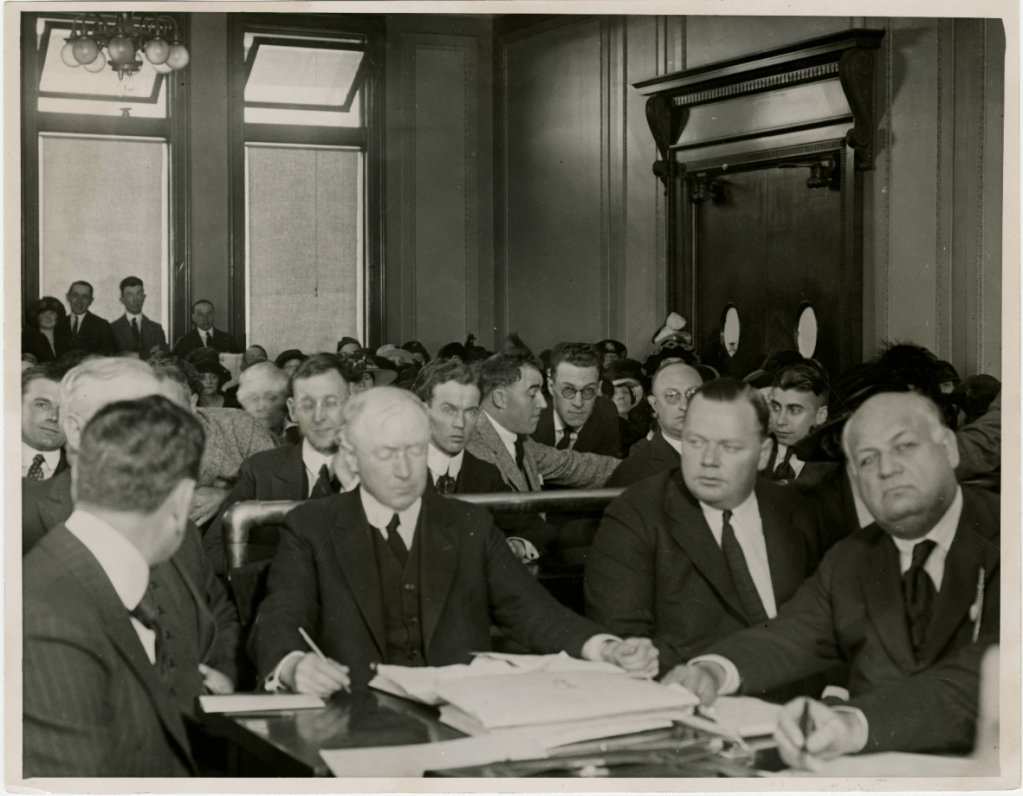
San Francisco Hall of Justice, the site of all three Arbuckle trials (Calisphere)
[1] A reference to Gavin McNab having taken over as lead defense counsel from Frank Dominguez.





 Spite Work: The Trials of Virginia Rappe and Fatty Arbuckle