Arbuckle renews his pep: a ms. cutting

The first iteration of the work-in-progress is seeing drastic cuts. I hate to lose some of this material, especially where it foreshadows what happened on Labor Day, September 5, 1921. The following passage was intended to document Roscoe Arbuckle’s career in parallel with that of Virginia Rappe’s.


While Virginia Rappe’s career lay dormant in the first months of 1918, Roscoe Arbuckle directed such comedies as Out West, The Bell Boy, and Moonshine despite the wartime fuel shortage that forced the closing of two Los Angeles studios. With his manager Lou Anger overseeing the budget, Arbuckle’s company, Comique Film Corporation, took advantage of the financial straits of the Balboa Studio and leased its lot in Long Beach, much to the delight of the city’s politicians and Chamber of Commerce, which wanted no interruption in the benefits of such a large business venture. And here Arbuckle, Al St. John, Alice Lake, Buster Keaton, and others did some of their best work. Such visitors as Charlie Chaplin came to see their work, for he wanted his own plant as well and hoped to exert the kind of artistic control Arbuckle had.

Its members were suitably impressed and took as gospel that Comique would probably develop into one of the largest units of the industry in the country. Nevertheless, to Arbuckle’s surprise, he inherited the remnants of Balboa’s bad reputation, for its employees left many unpaid bills among Long Beach merchants such that Arbuckle’s people were refused credit. Things got so bad that Arbuckle published disclaimers in the local newspapers to inform readers Comique pumped $300,000 into the local economy. But he didn’t wait for Long Beach to show its appreciation. Anger always looked for better, cheaper facilities and after Arbuckle completed Good Night, Nurse! and The Cook, Comique moved to the Diando Studio in Glendale.

Roscoe Arbuckle with baseball hat

Roscoe Arbuckle as a Vernon Tiger (Calisphere)

No matter where Arbuckle lived and worked, he loomed across Los Angeles and its environs. Their hotels, restaurants, nightclubs, stadiums, racetracks, the infamous Vernon Country Club—and the traffic courts—were venues graced by his largeness and largesse. Together with his growing entourage, he had become known as “the Fat One” and something of a force of nature in Hollywood. So much did Arbuckle’s reputation as well as value soar in 1918 that it was necessary to issue a warning to anyone trying to capitalize on having worked with him, that he was the sole author and director of his comedies and responsible for all stories, intertitles, gags, stunts, and so on.

Unlike other directors, Arbuckle didn’t make a propaganda film in 1918. He did, however, do much charity work for morale, such as donating heavily to the United War Work Fund and the Tobacco Fund, which supplied doughboys with cartons of cigarettes. Arbuckle, too, made personal appearances at Liberty and Salvation Army events, and so on. He even “adopted” Company “C” of the 159th Infantry Regiment at Camp Kearny—and the regiment, in kind, made him its “godfather.”

Not long afterward, Arbuckle visited the Marines training on Mare Island, just north of San Francisco on San Pablo Bay. There he proved to dubious leathernecks that despite his belly, he was no less athletic than recruits. He held his own in a round of “pushball.” Arbuckle also played baseball and exerted himself in other ways, including leading a marching band around the parade grounds. He attributed his ability for such physical exertions to the locale and promised reporters “that this visit to San Francisco is to be one in a regular series,” which included a wink at Los Angeles banning liquor sales one year before Prohibition became the law of the land:

The climate of the southland is declared to be too trying on him and following the completion of each picture he makes he plans to come here to renew his “pep.” Other film artists are making the same declaration, which may not be surprising when it is realized that within another month the city of the angels is to become as dry as the proverbial bone.[1] 


[1] “Arbuckle Renews Pep among Marines,” Moving Picture World, 30 March 1918, 1805.

Did Virginia Rappe “help” cancel Arbuckle?

What was always difficult to reconcile about Zukor in his lifelong quest for greatness was his intractable moral authority,
which he evidently identified with the genteel, and his lust for power, which was anything but genteel.

—Neal Gabler, An Empire of Their Own: How the Jews Invented Hollywood

When I see myself on film, I can’t laugh from the heart. There is always too much that’s disturbing [. . .]

—Roscoe Arbuckle, “Fatty über sich selbst,” Kino-Journal, 1923

As another thought experiment for our work-in-progress, we considered the factors that led Adolph Zukor of Paramount Picturesand Famous Players–Lasky Company, to cancel the release of three finished Arbuckle motion pictures. 

In the wake of Arbuckle’s acquittal for having caused the death of Virginia Rappe on April 12, 1922, the press began to quote Zukor and Arbuckle’s manager, Joseph Schenck, that the three Arbuckle films that had been withdrawn when the scandal erupted in September 1921 would soon be released to American theaters. In the case of the New Garrick Theater in Los Angeles, posters were ready to go up overnight.

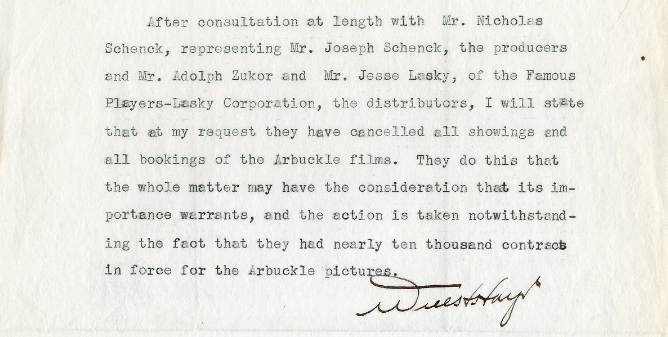
But within days, that decision was reversed. A permanent ban was announced by Will H. Hays, the new chairman of the Motion Picture Producers and Distributors of America. It was done at the behest of Zukor, according to Hays’ autobiography, and it was a business decision that Zukor made without much resistance from his partner Jesse Lasky and other stakeholders in the comedian. To abandon three completed films ready for release at a time when Arbuckle films were earning millions at the box office sounds counterintuitive, but as it will become clear, Zukor was no fool.

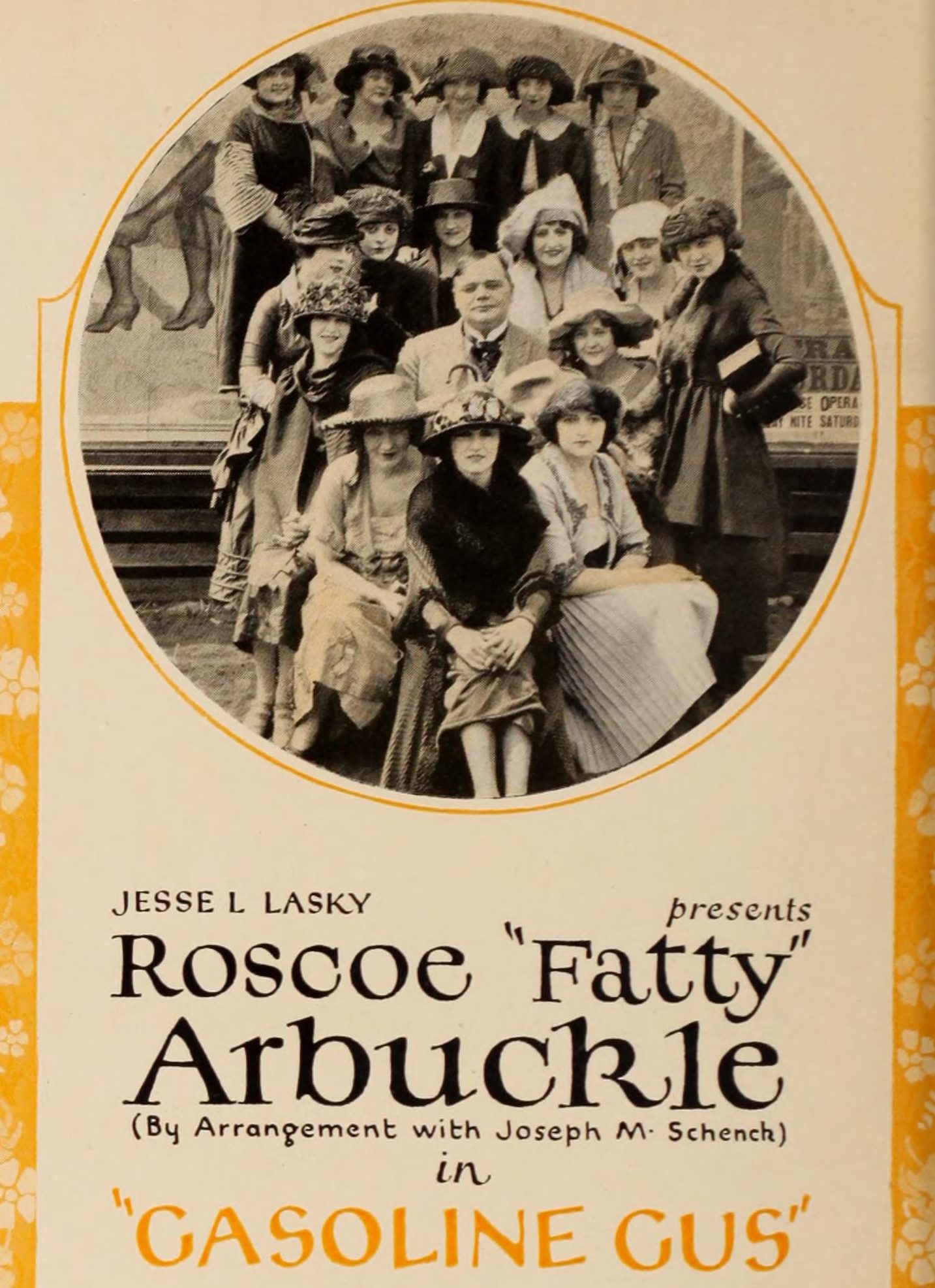
One of these films, Gasoline Gus, was to usher in Paramount Week on September 4, a week of major new releases that began at the start of the Labor Day weekend. Zukor, as president of the studio, counted on actors and actresses, especially those in California and New York City, to make themselves available for personal appearances.

Arbuckle, possibly feeling he had earned a reprieve from the publicity campaign, didn’t appear at Grauman’s Million Dollar Theater in downtown Los Angeles for the world premiere of Gasoline Gus. Instead, he hosted two private partiesin his San Francisco hotel suite. The first was on Sunday, September 4, a more sedate affair, and the next day, Labor Day, September 5, an all-day affair that promised food, alcoholic beverages, and young showgirls from San Francisco’s demimonde.

Arbuckle had arrived in San Francisco on September 3 and, given his testimony from his first and third manslaughter trials, he had a purpose in mind. The first was to test out a new car on a long-distance journey. But his famous Pierce-Arrow was hardly new. He had taken delivery of it a year earlier. He changed his story. He was in San Francisco to meet up with a catered dinner cruise aboard the SS Harvard on its voyage to Los Angeles, a cruise that was loosely tied to Paramount Week. Arbuckle claimed he purchased his tickets soon after he took his rooms at the St. Francis Hotel. But in a cross-examination, he had yet another itinerary. Arbuckle wanted to drive on from San Francisco on September 6 to attend the California State Golf Championship, which began that week in Del Monte. 

Had Virginia Rappe not fallen ill at his Labor Day party, she would have been in Del Monte a day ahead of him. But Arbuckle did sail on the SS Harvard along with his automobile prominently parked on the promenade deck. He made no public appearances in Los Angeles during the rest of the week. However he did make it to Grauman’s theater by Friday night, September 9, for an emergency meeting in Sid Grauman’s office. The news had broken that morning that Rappe had died and there was a need to meet with his lawyer and the other men who attended the ill-fated party to decide how to approach the matter.

The Arbuckle case soon began to make headlines and Gasoline Gus was withdrawn as were Freight Prepaid and Leap Year, which still had working titles and release dates in the future. All three were longer, romantic comedies and, for Arbuckle, a departure from his energetic “Fatty” character. There would still be a fat man, still be some physical comedy. But now the comedy was built on gags related to a philandering man and his pursuit of young women. Naturally, he would eventually marry the girl. This had been a common theme of his comedies from 1920, after he parted ways with Buster Keaton.

Meanwhile, the September 1921 issue of Photoplay hit the stands. One of the feature articles took on a whole new meaning. Adela Rogers St. John and Arbuckle collaborated on an interview, “Love Confessions of a Fat Man,” a publicity piece to display his intelligence and sophistication which we featured in an earlier blog post). The photograph that went with this piece, which was published in depicted Arbuckle with his hair combed over, looking up, as though into a woman’s eyes, as though he might present her with an engagement ring. Another photograph, that was published in trade magazines aimed at motion picture distributors and theater owners, showed Arbuckle surrounded by young women, not as a clownish innocent but as a ladies’ man.

Roscoe Arbuckle’s rakish image in “Love Confessions of a Fat Man” (Lantern)
Arbuckle in his element? (Lantern)

We looked at this new, carefully crafted, image that was folded into the real person accused of murder at an “orgy” in the St. Francis Hotel, whose indiscretions threatened an entire industry. The sudden change of Arbuckle’s public persona from light to dark is the one obvious reason for Adolph Zukor to withdraw his motion pictures and disassociate Arbuckle from Paramount entirely. Though the comedian had been handed an unprecedented apology from the jurors for what the prosecutors had done to his reputation, the gesture was wasted on Zukor. 

This brings us back to Will Hays. Zukor and his peers felt it was necessary that Hays be seen as an authority to be feared. Hays was to police the content of movies as well as the personal lives of actors. That he was essentially an employee of Adolph Zukor didn’t mean that he was subservient. Zukor delegated responsibility and Hays provided the proper image and insight to not only manage the morality of Hollywood but promote its image among the various women’s clubs and religious communities across the country. He was a church deacon from Indiana and , as such, he was the antidote for any blatant (or latent) antisemitism that might be felt toward the men who ran the studios. 

The timing of Arbuckle’s trials couldn’t have been worse. Hollywood scandals in one form or another had been mounting and concerns were growing among politicians and investors that it was an industry getting out of hand. The need for a powerful spokesperson had become obvious. So when Hays was hired, he needed to set an example and Arbuckle served that purpose. Hays knew that a large contingent of American pastors and clubwomen weren’t happy with the acquittal. They had to be appeased—but it wasn’t to honor the memory of Virginia Rappe. Though she was the victim, she was also seen as a symbol of Hollywood’s immorality. The prosecutors didn’t succeed in their effort to present her as a sympathetic and innocent victim. As one doctor said, she had the sexual organs of a “married woman”—a euphemism meaning she wasn’t a virgin.

In Arbuckle’s eyes, Rappe was the antithesis to the roles played by his recent co-stars, like Lila Lee and Mary Thurman. Rappe, like the other women at the Labor Day party, was attainable, consumable, and off-screen, where making eyes, honeymoons, flirting, and a little spooning wasn’t consummation, but rather coitus. Rappe may not have realized that her status changed the moment she walked into the Arbuckle suite. She was undoubtedly there to get back on-screen. But off-, she was a creature of other possibilities not limited to talking and dancing with her host, possibilities the other young women at the party were expected to service. Rappe also had to know she had as good a chance as any of being Arbuckle’s girlfriend, with all its rewards, even being the next Mrs. Arbuckle, since his publicity as this eligible bachelor might need to be grounded in fact one day. 

While his career may have required that he stick with the body-shaming moniker “Fatty,” Arbuckle had contemplated losing weight. He was also no longer directing his own films. His past specialty, the frenetic succession of dazzling, often acrobatic, sight gags, appealed to all ages. But audiences were becoming more sophisticated and wanted to see longer films, five to six reels, and the sweet, naïve, fat boy character was aging well enough, the boy had to grow up and Arbuckle knew it. Scripts and direction were being handed specialists, like the seasoned director James Cruze, whose work on the latest Arbuckle vehicles was intended to keep the comedian a close second to Charlie Chaplin, whose latest film, The Kid (1921), was the bar to meet, and ahead of Keaton, Harold Lloyd, and other rivals.

Then there was the growing perception that Arbuckle’s work in 1921 suffered from uneven quality. This had to trouble Paramount’s executives, all the way up to Adolph Zukor in his Manhattan skyscraper. In speculating what Arbuckle and Rappe might have talked about if they talked shop during the early afternoon of September 5, she had to be aware of the comedian’s immediate situation. She had a good source of information: her manager, Al Semnacher, who drove her to San Francisco. He was a veteran press agent and knew Arbuckle was getting panned on a regular basis. The Dollar a Year Man (1921) was called a “dismal effort,” “hokum,” “weak humor,” and so on in Motion Picture News for weeks in the spring. Theater owners said it fell short of fans’ expectations. Ticket sales were off. The Traveling Salesman (1921), which didn’t have the slapstick and chase scenes, made up for this lapse. But Arbuckle, in Crazy to Marry (1921), according to Wid’s Daily in early August, opined that he “seemed to be getting away from the sort of stories necessary to make his five-reel comedy offerings go over the way they should.” There wasn’t “sufficient genuine comedy” to make the laughs consistent or frequent enough. Such an overview cast a pall on everything. It didn’t bode well for the future, when his contract came up for review.

Arbuckle’s next film, had the Labor Day party not ended the way it did, was to have been Thirty Days, after a popular 1915 Broadway play. This was Jesse Lasky’s project, to be directed by Cruze. Arbuckle would have played a character in keeping with the new image, this composite of on- and off-screen—a wealthy, young society lion. But, in Thirty Days, his philandering becomes the central plot driver. The thirty days was a probation period requested by his fiancé, to be played by Wanda Hawley, in which Arbuckle’s character would work alongside her in a settlement house. The role might have opened opportunities for dramatic roles. Unfortunately, his ongoing trials forced Lasky to cast Wallace Reid, a true dramatic lead with an athletic build. Reid managed to play the comedic role but without Arbuckle’s deft touch. Thirty Days (1922) would be his last film, but not because it was panned. Reid had a morphine addiction that resulted in his death in January 1923—yet another problem for Paramount to contend with.

That same month, songwriter and theater owner Arthur Hammerstein offered a million dollars for the last three completed Arbuckle films—Gasoline GusFreight Prepaid, and Leap Year—but Zukor refused. Gasoline Gus had proved itself during its aborted run in late August/early September 1921 and for a brief run in April 1922. In the January 1922 issue of Paramount Pep, a special west coast representative M. H. Lewis reported screening Freight Prepaid. He called it Arbuckle’s “best picture since Brewster’s Millions.” But he cautioned that this would be the case “under ordinary circumstances.” He noted it would be a “knockout” in event of an acquittal. A film about Arbuckle and Lila Lee as newlyweds on a boxcar honeymoon was, to the Paramount stringer, a “great comedy” and “absolutely clean [. . .] Mr. Lasky deserves great credit for uniform high-quality present and future releases.”

Despite the glowing endorsement from inside Paramount, Freight Prepaid (1922) was only released in 1923 in France, Germany, and other European countries. The titles, unlike the intended American releases, almost always included the inescapable “Fatty.” A handful of other Arbuckle vehicles, both released or unreleased, were also exported. So, if Americans traveling in Europe during the Roaring Twenties weren’t discomfited by, say, the German, they could have seen Gasoline Gus as Der Benzinkönig. But comedy aside, part of the experience of seeing these films was what Hays and Zukor didn’t want: to feed a kind of morbid fascination in a man’s downfall. Hays was there for the moral argument and Zukor the law of diminishing returns, for a large proportion of Arbuckle’s audience would walk away once they had enough of his train wreck. 

To the Weimar film journalist Egon Jacobsohn, writing in his aptly titled magazine Filmhölle (Film Hell) after the second trial’s hung jury of ten to two for conviction in February 1922, the lust murder dynamic of Arbuckle’s case was a given. Rappe was perceived as the victim of a rape (“Notzucht”), a sex killer (“Lustmörder”) by the lack of proof itself that by the same token made him an innocent bystander, a victim of circumstances.

“Fatty is already finished,” Jacobsohn observed from Berlin. “American motion picture audiences are shouting we don’t want to have to watch a murderer! Every comedy in which Fatty appears lies unexploited, like garbage. Even if he is acquitted, if his innocence is proven: Fatty, the beloved movie star, is dead, remains dead!” Zukor didn’t need this prophetic pronouncement from abroad. He could be on the same page of Filmhölle—which he could read in the original—the moment Arbuckle turned himself into police. Other stakeholders held out hope and a lot of money was spent to defend the comedian.

French and German posters for the export version of Fast Freight (1922),
which didn’t need a train wreck scene but it did need a scarlet lady.

Nothing would shake Zukor from sitting on Arbuckle’s films. Even the classic Keystone shorts with Mabel Normand, which still got laughs in 10-cent movie houses, were pulled from distribution after a few trial runs. In December 1922, Hays lifted the ban to at least allow Arbuckle the opportunity to work behind the camera rather than in front of it. But the films remained in their cans.

So, was this a marketing decision on Zukor’s part? Milton U’Ren grandstanded repeatedly during jury selection that Arbuckle was washed up in November 1921. Since assistant district attorneys aren’t film critics but rather the “bad cops” of their high-toned district attorneys—we had to consider whether U’Ren had evidence of his claim, that Arbuckle’s popularity was declining. Was he just predisposing the jury to view Arbuckle as a decadent entitled has-been? U’Ren’s animus toward Arbuckle probably began the night Arbuckle turned himself into police. Arbuckle was evasive in answering his questions and finally assented to his lawyer’s request that he say nothing more. U’Ren visibly scoffed during Arbuckle’s courtroom testimony.

Adolph Zukor trusted his instincts for making financial decisions but he also had accountants who could reassure him he was doing the right thing. Arbuckle’s salary was in the stratosphere and though he had earned his employers exponentially more he had the potential for trouble. He had a drinking problem and was a womanizer. He was also rumored to have a drug addiction. 

Zukor, going by his balance sheets, knew that if the law in San Francisco didn’t catch up with Arbuckle’s indiscretions, the law of diminishing returns could. As gifted as Arbuckle was, would a character actor with limited range survive as a leading man in feature films? Would he be able to keep up with audience tastes? Zukor wasn’t ignorant of the risks Arbuckle posed and he wasn’t sentimental about the salad days of the past. 

Although Arbuckle wasn’t directly involved in the 1917 Mishawum Manor scandal. It was, to use a contemporary phrase, a “girl-and-wine” afterparty that followed a formal dinner given in a Boston hotel in honor of Arbuckle. He had just joined Paramount. Zukor and his top brass spent the night in a brothel and the underage girls who entertained the men talked. This led to hush money, a corrupt prosecutor, a trial, and years later, just weeks before the Labor Day party, it finally surfaced in the press. Zukor, a man who had been meticulous about his public reputation for propriety, was embarrassed by the attention he was getting. The Mishawum scandal sent a message of caution to everyone at Paramount. Everyone save Arbuckle. So when he flaunted his entitlement as one of Paramount’s moneymakers by hosting an afternoon party with booze and showgirls, just weeks after Zukor’s public shaming, he crossed a line. 

Virginia Rappe just wanted her hospital bills paid. There was pathos in that. Would a little kindness and what was probably a $75 hospital bill have saved Arbuckle’s career? By the time of the trials, all the world had discovered that Arbuckle still had a wife, Minta Durfee. Durfee would stand by him throughout the trials and until the Hays ban at which point she promptly returned to New York City. Durfee didn’t leave him because they had another falling out or because he could no longer be the highly-paid star he had been. She was under no delusions about the state of their relationship, though she continued to defend Arbuckle for attention in her dotage. As for Arbuckle, upon Durfee’s departure, he picked up where he left off with Doris Deane, the young actress he had met aboard the Harvard twenty-four hours after he had been seen tête-à-tête with Rappe. 

Just prior to the Labor Day party, Zukor and Paramount had agreed to a multimillion dollar multiyear contract with Arbuckle and cancelling it after Arbuckle had been acquitted would pose legal problems. Yet Zukor, who had felt squeezed by Arbuckle’s lawyers during the contract negotiations, had had enough. He needed to cut his losses and protect the Paramount brand. Hays was well aware of this contract and 10,000 others with companies and individuals who had a stake in making good on the banned motion pictures. He mentioned this sacrifice when he made the ban public one week after Arbuckle was acquitted.

Will Hays’ press release of April 19, 1922 (Margaret Herrick Library)

Paramount, the biggest studio at the time, had scores of actors and actresses under contract and all posed an existential threat to his company. What better way to get their attention than to erase one of them off the books with a mysterious, indefinable, legally defensible blackballing—where the economic rationale could be concealed behind the moralistic kabuki of Will Hays. And was there a moral or sentimental one on the part of Zukor that made it difficult for him to square Arbuckle? Perhaps. Zukor had a daughter. She was the mogul’s favorite.


P.S. Zukor’s problem with Arbuckle does have its book. But the problem isn’t quite the one imagined in Andy Edmond’s 1991 tell-all, Frame Up! That book is unsourced and what is quoted in her text has a lot of fairy dust and special sauce that makes it yet another “good read,” which it is. There is a lot about Zukor’s motivations, a lot of his wires and letters, but without sources—sources that we have to think are factoids at best—Edmonds is a dead end for us, a bad influence like many good reads on the Arbuckle shelf.

A note on Virginia Rappe’s sexuality

One of the preconceived notions that we had to shed—at least temporarily and more than once—was that Virginia Rappe was heterosexual. We left her sexuality open for discussion for the present and beyond if there is a future interest in the hoary notions that surround this mysterious woman whose death ended the career of Roscoe Arbuckle.

Previous Arbuckle case narratives, even Kenneth Anger’s gay eye, see Rappe as “straight” and that she slept with the comedy director Henry Lehrman during her years in Hollywood from 1916 to 1921. That was, of course, enough time for her to marry him or move on to someone better, hypergamy being Hollywood’s way then as now. But something about her being with just the one man raised our eyebrows. Was it love or something else? Then we took a hard look at the way Rappe referred to him, as “Mr. Lehrman.” While it seems like nothing, here she implied a certain professional distance, that she was just one of his performers, an employee. Only after her death was he seen as her “sweetheart,” that they were to marry. In reality, when Rappe accepted Roscoe Arbuckle’s invitation to a party in the St. Francis Hotel suite on September 5, Labor Day 1921, she had long since parted ways with Lehrman. Rumors in the film colony suggested Lehrman had even encouraged her to attend the party.  Could there have been a less obvious dynamic to their relationship? Did Arbuckle test or cross a boundary that had been in place for Lehrman as well?

Lastly, we took another hard look at her female friends. Some seemed to be “beards” of another species. The friendships seemed same sex so as to fool the opposite.


Virginia Rappe was raised by women. There was her birth mother, Mabel Rapp, considered a beauty but also a “tough girl” in Chicago’s South Side during the 1890s, variously called the “Queen of the Night” and the “Queen of Chinatown.” But her daughter had been raised believing Mabel was her older sister. Both had the same guardian, an older woman with a heavy Irish accent, who went by Virginia Rapp. Her real surname was Gallagher and she wasn’t related to either Virginia or Mabel and her taking the name Rapp was likely to explain away the strange family dynamics before anyone asked questions given the mores of the 1890s.

When Mabel died on January 7, 1905, her New York City death certificate had been informed with the name she used in her last years—Mabel Rappé—and the names of her real parents. Yet another rabbit hole for the curious to explore. Another notice—more about her absence from Chicago than her passing—appeared a few months later in The Club-Fellow: The Society Journal of New York and Chicago. The author of the spicy “Audacities” column recalled Mabel working a Wisconsin lake resort’s ballroom like a proper courtesan of the Gay Nineties.

It is only a few years ago that the Johnstone Bennett-like Mabel Rapp (who was supposed by many to be the daughter of Partridge of dry goods fame) used to frequent a certain Chinese laundry on State street near Sixteenth street kept by a Celestial known as “Chollie,” and there forget all troubles in the “long draw” [a hit off an opium pipe]. Mabel has disappeared from State street and “Chollie” has also vanished and returned to the land of flowers and hop [opium].

The last time the fair Mabel was seen was at a German [formal dance] at Fox Lake, when several of the men made up a pool to see whom the lady would favor. George Holyoke (who, by the way, married Mrs. Elmer Flagg of Thursday Club recollection after she had lowered Elmer to half-mast), George, who was a forty-to-one shot, got the prize. Several of the married men present were much perturbed for fear the identity of Mabel might become known and cause friction in the domestic circle. “Billy” Lyford, was conspicuous by his absence, and most the “papas” sough the veranda, it being too warm to dance.[1]

The names mentioned above belonged to subaltern society people who belonged to various social clubs in Chicago. The men, whether single, married, or divorced, knew Mabel had a reputation for fun . She made herself available as a dance partner to the well-heeled gents of Chicago and opened the way to other forbidden pleasures, such as opium and a dalliance with a beautiful woman from across the tracks,  a real habitué of the South Side demimonde.

What is interesting, however, is the comparison made to Johnstone Bennett. Bennett who was a well-known stage actress and male impersonator hardly resembled a fallen Gibson Girl as Mabel had been made to be as she cruised Fox Lake.

Johnstone Bennett had an unusual past. Her name was derived from the two women who raised her. She started playing “tough girl” roles early and was considered the epitome of the New Woman by the novelist Willa Cather, especially in regard to her dress on- and offstage. Bennett in the photographs found at the New York Public Library’s special collection was boyish in appearance, which may have actually made her more risqué to her male admirers as much as she appealed to women who preferred same-sex relationships with a more “butch” partner.

Johnstone Bennett (New York Public Library)

Bennett’s career flourished in the 1880s and 1890s and could have served as role model for Mabel, who had more than one opportunity to study Bennett on the stage in plays such as The Amazons, a comedy that was a great success in Chicago in 1894.[2]


Three years after Mabel Rapp’s death, her daughter first came to the public’s attention in the Chicago Tribune as a kind of sleeping beauty, with the potential to be

one of the world’s famous models after the years have mellowed her and taken from her posing the sight touch of childish gaucherie which still remains. [. . .] She is a simple little girl of 15 years who looks out on the world with the clear, dewy eyes of a child just awakened from sleep.[3]

The “tough girl” mask wasn’t right for Virginia Rappe though, her style and path were closer to that of an ambitious ingenue. By 1908, Rappe was being mentored by a woman she first knew as “Dot” Nelson but whose married name was Catherine Fox. She saw Rappe’s potential as an artist’s model and as an entertainer. Mrs. Fox paid for dance lessons and likely pushed Rappe toward the theater and vaudeville stage. Both vocations—model and performer—were seen as morally risky for a young woman still in her teens. The prettiest ones attracted a male following. Lovers, however, were discouraged. Traveling vaudeville and theater companies made women sign contracts that forbade them from seeing men without being chaperoned. This protected their employers from losing girls to marriage, an unintended pregnancies, and like pitfalls of being intimate with men, such as venereal disease, drug addiction, alcoholism, and the various forms of duress attributed to rejection.

Rappe undoubtedly understood that appearing virginal if not an actual virgin protected her career and her person. This meant having established boundaries with any male companions.

Rappe’s only known long-term courtship in Chicago was with a real estate broker named Harry Barker, but whether this included a sexual element is questionable. Any suitors were screened by her putative grandmother and the former neighbors who acted as de facto guardians: Mrs. Fox and Kate Hardebeck. Both witnessed Rappe refusing an engagement offer from Barker after what had to have been a frustrating crush–courtship. But he and Rappe remained friends during her lifetime.

Other than Barker, Rappe was most often reported in the company of women her own age. Winifred Burkholder, the owner of an early modeling agency, was an exception.

Burkholder met Rappe first as a model, after the latter had set aside any stage ambitions, and later as a fellow student at the Art Institute of Chicago between 1908 and 1911.

Like Rappe’s guardians,  Fox and Hardebeck, Burkholder was also married. But she had left her husband and son in rural Wisconsin to pursue a career in fashion design. And to avoid any indelicate questions about her marital status, she claimed to be a widow or unmarried.

In late 1912 Rappe and two sisters from Chicago, with whom she shared a hotel room on a trip to New York, made the news when they announced they had made a pact never to marry.

While the sisters eventually broke their promise, Rappe kept hers and joined Burkholder’s traveling Promenade des Toilettes of 1913—a fall fashion revue that toured department stores in the Midwest and South, which also featured six other young women billed as the “Troupe of the Wonder Models of Fashion.”

Burkholder was an imposing figure shepherding her models from city to city. She sported a monocle and a cane—and, as a model herself, wore matronly outfits to appeal to the older, more demure customers.
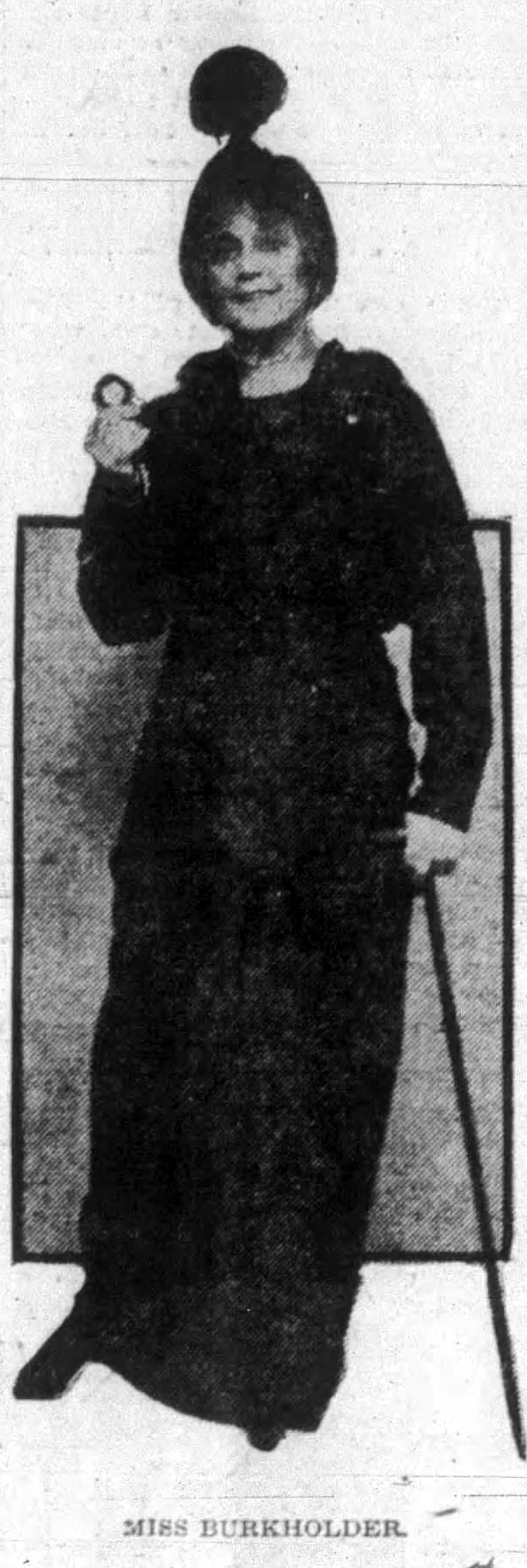
The_Omaha_Evening_Bee_Wed__Sep_17__1913_

Winifred Mills Burkholder in Omaha, cane and monocle, September 1913 (Newspapers.com)

Rappe’s role in the review was to promote the “tango dress,” Daring because the skirt showed glimpses of her ankles and calves up to her knees, the dress was also intended to titillate men more than to appeal to the conservative tastes of the American heartland. When interviewed about the show for the Atlanta Constitution, Rappe teased about her disappointment in the men of Atlanta.

“When it comes to speed,” spoke Virginia, “this town is on the ‘Fritz!’ See? ‘F-R-I-T-Z!’ The combined speed of the whole of it would put ginger into a grasshopper. We’ve been here three days—think of it–and the only entertainment we’ve had the entire time had been . . . I hate to mention it, but you girls remember that little taxi ride we paid for out of our own dear, hard-earned bank accounts?

“True, we gave a tango party to ourselves. The management stopped it. Even locked up the ballroom. Did you ever? Shameful? No! Certainly not! Outrageous!”[4]

When one of the other models decried the lack of attentive male company—who might be willing to entertain them—Rappe chimed in, “Search me, they haven’t been around here.”

To Mrs. Burkholder this was the desired outcome, that the women got attention with their sassiness yet kept to themselves.

The_Atlanta_Constitution_Sun__Oct_12__1913_

The Troupe of the Wonder Models of Fashion, October 1913 (from the Atlanta Constitution accessed in Newspapers.com). Rappe lies supine in the front. Mrs. Burkholder is on the left. 

Following the Promenade des Toilettes, and with the money they had earned during the tour, Rappe and another model, Helen Patterson, sailed to Europe to spend most of December in Paris and New Year’s Eve in England before departing from Liverpool.

On their return journey, the friends made an impression on the first-class passengers and crew of the RMS Baltic, dancing the tango together and wearing their bloomers exposed at the ankles, making for “four pink puffs” as they walked arm in arm on the promenade deck. Photographs of the pair were printed in newspapers in January and February 1914. The woman made an impression with the “tango bloomers,” their appearances in the ballroom, and as partners during the shipboard bridge games.

None of this conduct—either in Atlanta or aboard the Baltic, would have raised an eyebrow in the early twentieth century, no more so than in a cotillion at a boarding school for girls. But the tango was seen as an erotic dance, a courtship dance—and the pairing of Rappe and her girlfriend, nevertheless, made for body language that discouraged men from making advances.

The_Anaconda_Standard_Sat__Jan_24__1914_

Helen Patterson and Virginia Rappe, January 1914 (Newspapers.com)


If one puts out of mind the testimony of the two Chicago abortionists and a bordello physician who claimed Rappe had bore a child, indeed, more than one, a case could be made that Rappe might still be a virgin and remained “intact” into 1915, when, at the Panama–Pacific International Exposition in San Francisco, she was briefly touted in the press as being engaged to an Argentinian diplomat Don Alberto M. d’Alkaine, vice consul and secretary to the commissioner of his country’s exhibit.

The_Day_Book_Sat__Aug_7__1915_

Virginia Rappe, 1915 (Newspapers.com)

Most Arbuckle case narratives accept this engagement as authentic because it was newsworthy in 1915. But the San Francisco Call attributed Rappe as the source of the rumor in late July. Soon after newspapers from coast to coast picked up on the romance and included a photograph of Rappe in profile, wearing the hat of a pajama suit that she likely designed and repurposed in this photograph to make it seem more bridal.

A month later, the Examiner reported that the couple had parted ways, noting that when the engagement was announced neither party denied it. Don d’Alkaine returned to Buenos Aires and a long diplomatic career. Rappe returned to Chicago and didn’t stay long at all.[5]

Like the pronunciation and spelling of Rappe’s surname—variously Rapp, Rappé, Rappi, Rappe, or even Rappee as it was heard and spelled in Atlanta—her sexuality lacks fixity. While leaning toward a preference for the company of men, when the question of marriage and conjugal relations became a reality, Rappe seemed to have baulked again.

It’s possible that up to that time Rappe had had no real or lasting relationship with a man that was consummated.

While newspapers from Green Bay to Muskogee to Shreveport to Omaha printed fashion photos of her and framed her as a kind of ur-influencer of women’s wear, not one photograph showed her with Don d’Alkaine. He only appears in group photographs of various dignitaries and it is hard to tell what he looked like.

Nor did she ever appear in a photograph with the next man in her life, Henry Lehrman.

As we have it in our work-in-progress, Lehrman could have met Rappe during the second half of 1915. Both had worked for Mack Sennett and belonged to the same circle of friends around a San Francisco power couple, Jack and Sidi Spreckels.

In the early spring of 1916 at a fashion parade around a Los Angeles racetrack for the Actors’ Fund Memorial Day benefit. Rappe drove a FIAT representing Lehrman’s L-KO Kompany.

At the time, Rappe was living at the Hollywood Hotel, a popular residence among those in the motion picture industry. Indeed, the perfect setting for an aspiring young woman who had “gone West” to become a movie star. But according to another resident, Anita Loos, who befriended Rappe, the latter lacked the ambition of the other young women who would do anything to get into pictures—including sleeping around. Instead, her focus was on getting Lehrman to pay more attention to her.

What Rappe did to pay for her room and board at that time remains a mystery. She likely had savings from her modeling career and allegedly had been hired for a few film roles though so small as to be uncredited. Instead, Rappe positioned herself to play another kind of role, one that was off-screen, that of a sophisticated “society girl” and as such found her way into the film colony. But where her mother had balanced multiple companions over the years, Rappe had become attached to just one man, one dance partner.

Prior to Rappe, Lehrman was thought to prefer visiting prostitutes so her presence probably gave him an air of respectability around the men who bankrolled his films, such as William Fox, who funded his new company, Sunshine Comedies. Not only did two-reeler comedies have to be “clean,” so did the men and women who made them—and Lehrman was entrusted with million-dollar budgets. Thus, Rappe served to make Lehrman more respectable and less of a workaholic and loner, as he was made out to be in the Los Angeles Times, however, the “couple” went virtually unnoticed in the press until September 1921.

My, my, how these satellites do blaze for a time! Now it’s a certain Henry Lehrman, who is cultivating the smart set. He looks like one of those suave gentlemen you’ve read about in French novels—quite an objet d’art, as it were. And he wears his little waxed mustache just so, and his hair bandolined[7] so tight and his feet in such snug pumps and himself in steinblochian[8] attire and with a Miss Rappe, who’s quite the season’s best-looking New Yorker. This Mr. Lehrman is occasionally seen at the Alexandria or at Vernon, and people who know him say he’s quite exclusive. Perhaps so; he’s quite often alone.[9]


Rappe was still living in the Hollywood Hotel in the fall of 1917 when Roscoe Arbuckle, having separated from his wife, actress Minta Durfee, lived there and lorded over the dining room with his entourage and practical jokes played on various unsuspecting fellow guests. By that time, Rappe had received a credit in just one film, Paradise Garden (1917), in which she played a “junior vamp” alongside Harold Lockwood. If the script was true to the best-selling novel on which it was based, Rappe’s character, the wealthy Marcia Van Wyck, also had a female companion, described as a poor relation who didn’t like men.

Although she took the part as a lark, the result of visiting the set one day with friends, Lehrman probably had some influence in her being cast. He knew the director, Fred J. Balshofer, from the time when both had learned their trade at the Biograph Company in New York.

Balshofer cast Rappe again in 1918 with newcomer Rudolph Valentino, pairing both as conspirators and lovers in a vehicle starring female impersonator Julian Eltinge. What footage survives shows that both had rapport in this propaganda picture set in occupied France and Germany during the First World War. But their characters suffered the vicissitudes of three different recuts and as many titles: Over the Rhine (1918), The Adventuress (1920), and The Isle of Love (1922).
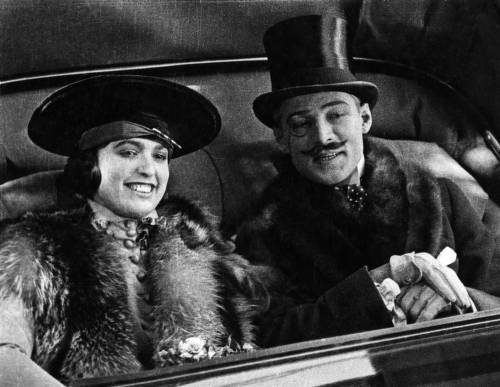
p15759coll36_10_medium

Virginia Rappe with Rudolph Valentino (Margaret Herrick Library)

Rappe’s being cast in Paradise Garden was evidence that she had the looks and presence to get a career going but she seemed to be content being at the side of Henry Lehrman and didn’t seek acting jobs outside of bit parts she did for him.

Zaza in The Adventuress/Vanette in The Isle of Love (YouTube.com)

Lehrman produced comedies and, whatever his intentions were, he could save money by casting Rappe in his own films though she had none of the experience or training for comedy. Lehrman just needed her to be an appealing face. In one of her first roles, as the love interest for the film comedian Lloyd Hamilton in His Musical Sneeze (1919), she was given little to work with besides tired gags.

Lehrman continued to miscast Rappe at the Culver City studio, which he built in 1919 and shared with Arbuckle during the summer and fall of that year. By then Rappe was also Lehrman’s tenant—a sort of “rent girl” in his home at 6717 Franklin Avenue, where she was simply listed as a “boarder” in January 1920 according to census data.

There Lehrman provided her with a car and driver and his servants. Members of the film colony assumed that they were a couple but appearances can be deceiving—even to the jaded eyes of Hollywood people. If Rappe had to provide Lehrman with “benefits,” she was certainly inhibited from doing so by cystitis. Indeed, coitus for Virginia Rappe was likely uncomfortable if not painful. She would have known, too, that having sex with a man who also had had multiple partners would probably not aggravate her condition and probably give her something worse.

The relationship between Lehrman and Rappe was not so simple as boyfriend and girlfriend, she seemed to be obligated to pay him back with a number of motion picture appearances. The most prominent of these was in a role as a wholesome country girl in A Twilight Baby (1919), another vehicle for Lloyd Hamilton.

There was little news of Rappe following A Twilight Baby save that she wanted more serious roles. She and Lehrman seemed not to appear in public. In July, she was in San Francisco during the week of the Democratic National Convention. While she was listed as a guest in two hotels, Lehrman was making a film elsewhere. When he hosted a dinner for the Democratic candidate for president, James M. Cox, in Los Angeles in September, Rappe wasn’t present. Although she had a few more roles that only demanded she smile or bat her eyes, by the end of 1920 she and Lehrman split up. He was having financial difficulties. A creditor had filed lien on his house. As for Rappe, she had already moved out by midsummer. We know this because her telephone number, which she published in a July classified advertisement for her lost brindle bull terrier, was used by the landlady and boarders at 1946 Ivar Avenue. That is the address she used for her entry in the 1921 Los Angeles City Directory.

While living on Ivar, Rappe, in need of income, had taken on the management of a few rental homes on Canyon Drive, including one owned by actor Francis X. Bushman. This makes for a rather tangental episode in our work in progress and certainly speaks to the resolve and independence of Rappe.


That Rappe had an unusual arrangement with Lehrman doesn’t eliminate the possibility that they once loved each other. It can’t be ignored though that it would have been convenient for Lehrman to romanticize their relationship following Rappe’s death. He didn’t deny that he was her fiancé. To abandon her post-mortem would have made him appear to be a heel. Fortunately, he still had a photograph of her to show in his New York City apartment and helped the public imagine a loving couple suddenly destroyed by tragedy. What he didn’t admit to was the presence of a new girlfriend in his life, Jocelyn Leigh, a Ziegfeld Follies girl who was more ambitious and probably more willing to give him an escort in Manhattan if he would open doors for her in Hollywood (which didn’t turn out well for her).

For Arbuckle’s lawyers, his chances of acquittal rested on their narrative that Rappe was promiscuous and possibly a prostitute so they had to discount any evidence that she was a faithful partner, a frigid woman, or anything close to a lesbian.

During the comedian’s three trials, they made an issue of Rappe’s Chicago past. Prominent among them—and the only lawyer not to sit at the counsel table, was Albert Sabath, a personal friend and business associate Rappe’s alleged sweetheart, Harry Barker. Sabath deposed on two midwives and abortionists as well as a brothel physician to show that Rappe had suffered from bladder disease that could be attributed to being a promiscuous teenager and giving birth to at least two illegitimate children.

What was missing in the witness testimony—and Barker was one of those witnesses for Arbuckle—was any parallel conduct on Rappe’s part in Hollywood. Instead, these witnesses only saw Rappe have a few drinks that resulted in episodes of hysteria, including disrobing and tearing at her clothes.

These episodes resembled what Arbuckle and his other Labor Day guests saw when Rappe was discovered on his bed, writhing in pain. Naturally, we were suspicious that a person would have somehow made a routine of such extreme behavior. Arbuckle’s prosecutors were also incredulous. But it’s unlikely the witnesses would have repeatedly committed perjury with little to gain so it’s likely there was a kernel of truth in their stories. Though they were indeed defense witnesses so a little bit of exaggeration  would not have been surprising.

One hypothesis we considered was that Rappe’s episodes—her acting “crazy” as Arbuckle called it—were a defense mechanism, indeed, a very ancient one that is still used to counsel women to prevent sexual assault and rape: “You may be able to turn the attacker off with bizarre behavior such as throwing up, acting crazy”—that is, behaviors that will depress sexual arousal.

What is so ancient about that? By feigning madness, of being touched by the gods or demons, superstitious rapists of a besieging army might have been more inclined to just pillage a conquered city rather than risk being possessed themselves. So, did Rappe act crazy when she thought she was being sexually threatened? Did Arbuckle encounter this—even when semiconscious as she was going into shock from a ruptured bladder?

That said, according to Lehrman, Rappe did worry about being assaulted, especially on her long walks in the Hollywood Hills. For that reason, she was accompanied by the aforementioned brindle bull terrier named “Jeff” over which she had much control. (He was ultimately found, by the way, and enjoyed one more year with his mistress’s companionship.)
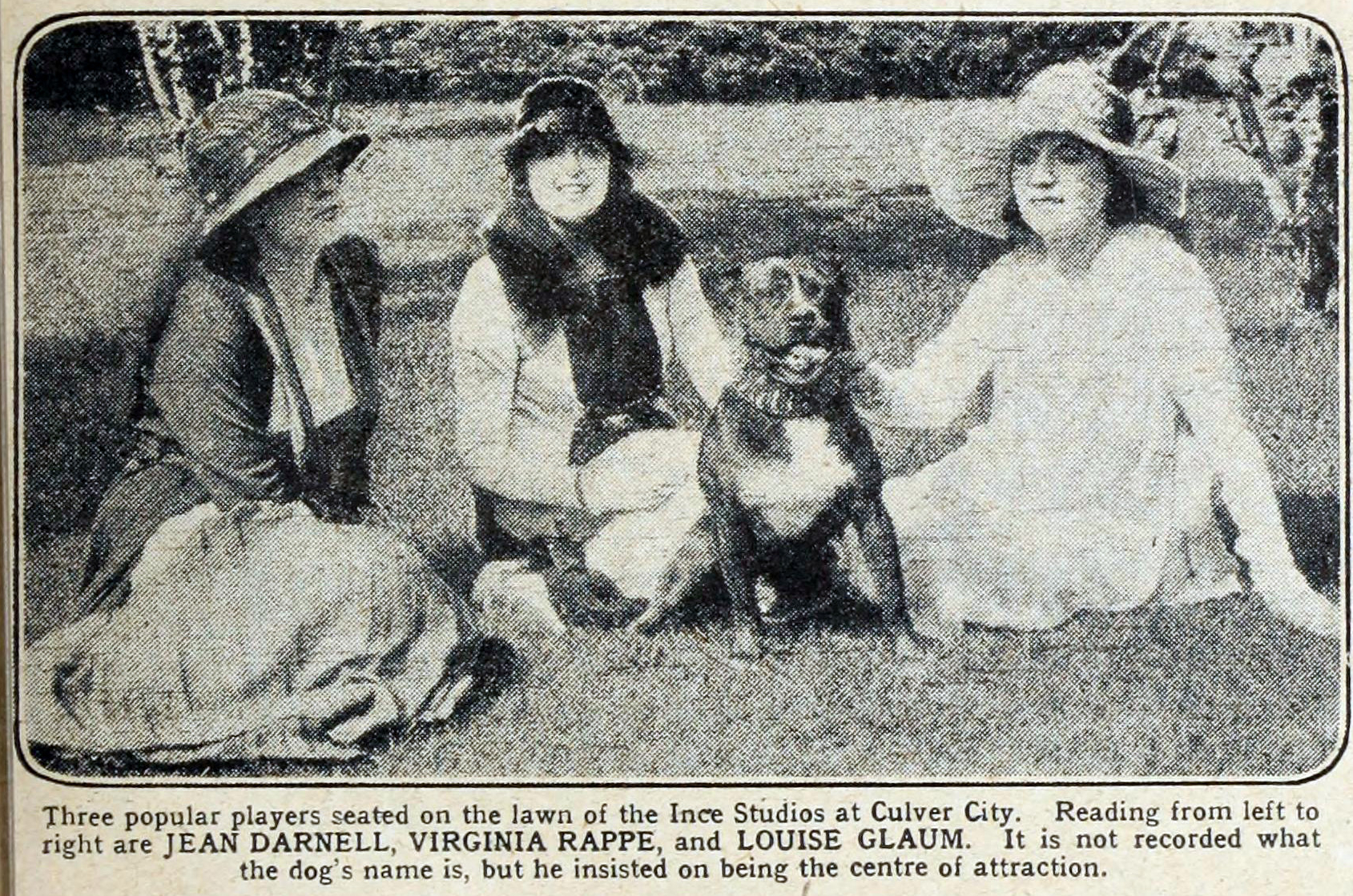
pictureshow1919102unse_0095

Rappe and friends in Picture Show, 1920 (Lantern)

Ultimately, we wouldn’t have meditated this much over a woman who was ostensibly heterosexual and probably avoided being penetrated for hygienic reasons—not frigidity—in addition to the professional contingencies of keeping one’s figure, maintaining the illusion of being desirable and unattached to the movie-going male, and so on. Unlike her mother, Rappe never did anything like the cross-dressing Johnstone Bennett. But Rappe did leave for San Francisco dressed in what was called a “riding habit,” which consisted of riding pants, boots,  jacket, and a jaunty cap. This was an outfit she often wore for her long walks.
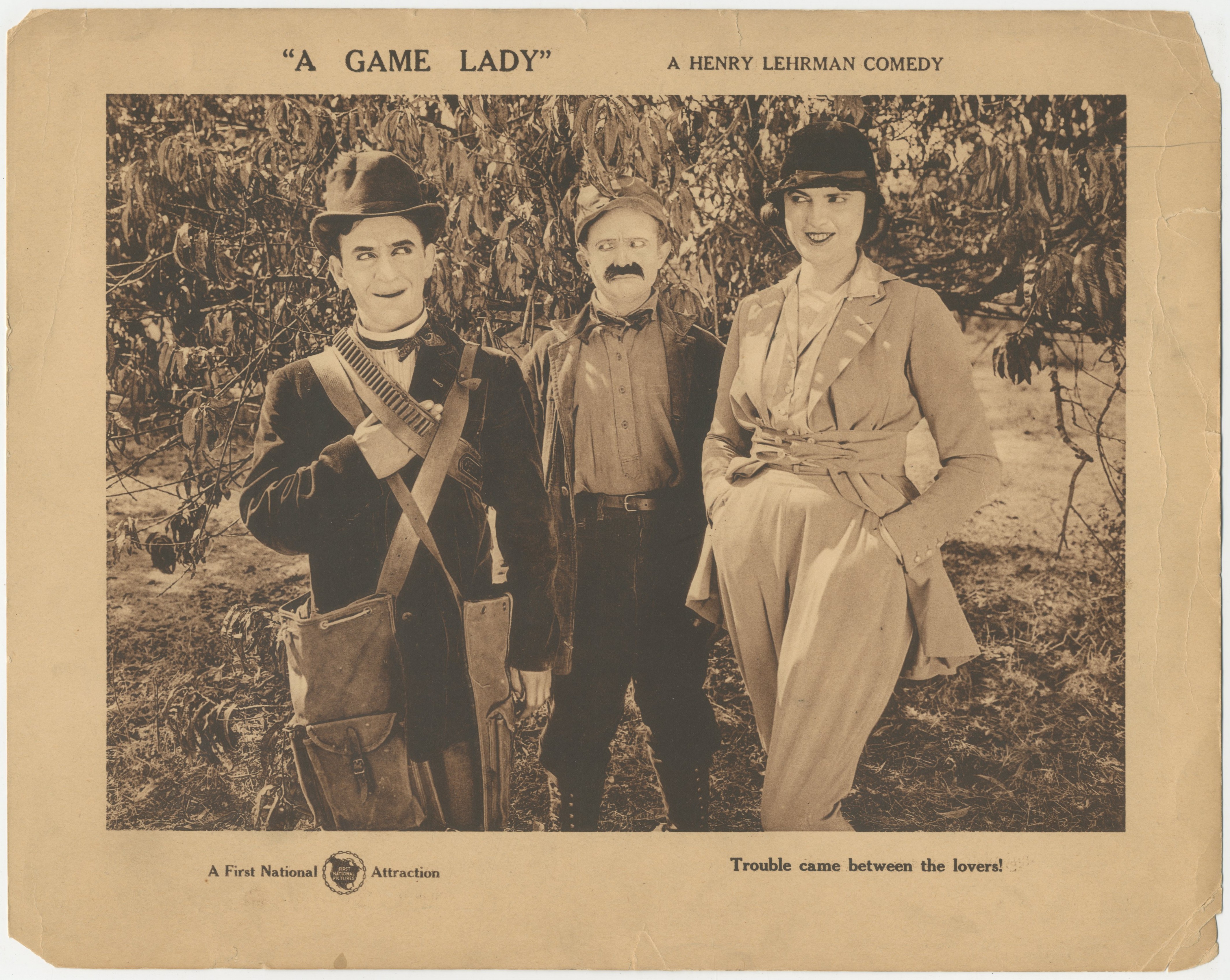
lc_game_lady_a_WC31406_B

Rappe’s riding habit and pants that anticipate Katherine Hepburn’s preferences (Authors’ collection)

What made us look twice and thrice thus far at her sexual aspect were the reports of some of the unmarried women who attended her her visitation and funeral on September 18 and 19, 1921, respectively. Mildred Harris was given the special privilege of being allowed to pray alone at the bier of “someone I loved.” This is the same young actress who had divorced Charles Chaplin the year before. Allegedly, the Little Tramp complained that, throughout their three-year marriage, Harris was more often with actress Alla Nazimova and her girlfriends, the so-called “sewing circles.” He allegedly said as much as well in responding to Harris’s accusations of cruelty during their contentious divorce proceedings. The source for this, however, is the notoriously unreliable Hollywood Babylon, in which Harris is made out to be unequivocally bisexual.

Grace Darmond was also present at the Rappe funeral. She was the girlfriend of Rudolph Valentino’s lesbian wife, Jean Acker, who was also close to Nazimova. And if either Nazimova or Acker attended Rappe’s funeral, no one noticed. But only a few weeks earlier, Acker and Darmond were vacationing in the Monterey–Del Monte–Carmel area during the long Labor Day holiday. They were still there on September 9, 1921, They hosted a dinner party at the Blue Bird Café for the actress Truly Shattuck on the day that Rappe died, September 9. Coincidentally Del Monte was where Rappe intended to stop for the night after her one day in San Francisco.

Another person of interest at the funeral was Kathleen Clifford, who accompanied beside Darmond, an actress who had established her early reputation in vaudeville as a male impersonator and was once billed as the “Best Dressed Man on the American Stage.” She was described in the press as a “dear friend” of Rappe’s in newspaper accounts.

Finally there was one other person,  never identified by name, who seemed to have some attachment to Rappe. It’s unknown if she was at the funeral but our awareness of her existence is based on the testimony of Eugene Presbrey, a founder of the Screen Writers Guild and a resident at the Hollywood Hotel in 1917 when Rappe was living there.  He, too, saw Rappe having a hysterical episode after drinking two cordials. But she was already “an abnormal character and good copy,” he recalled before this.

She traveled about the hotel with a constant companion, he said knowingly, a woman whom he described as “an unattractive ash-blonde.”[10]

N.b. Notice that we provide no convenient links to Rappe. Her Wikipedia page is woefully inaccurate and its minder(s) are welcome to borrow from us to revise and correct it.


[1] “Audacities,” The Club-Fellow, 12 April 1905, 5.

[2] Johnstone Bennett was forced to retire at the height of her career in the early 1900s and succumbed to tuberculosis in 1906—the same disease that killed Mabel Rapp.

[3] “Are the Artists’ Models of Chicago More Beautiful Than the Famous Models of Paris?” Chicago Sunday Tribune, 22 November 1908, 7:4–5.

[4] Britt Craig, “Gee, But Young Men of Atlanta Are Slow, Say Pretty Models Who Wanted Good Time,” Atlanta Constitution, 12 October 1913, 5.

[5] See “Argentine Official Wins Girl,” San Francisco Examiner, 29 July 1915, 5; “D’Alkaine Engagement Off,” San Francisco Examiner, 1 September 1915, 8. See also “Art Model Has Exposition Romance—Soon She’ll Be a Bride,” Day Book [Chicago], 7 August 1915, 15, for an example of the wire photo and caption published in various American newspapers.

[6] See “Chicago Best City for Girls,” Chicago American, 3 January 1913, 3; and “New Jobs Await Working Women,” Los Angeles Times, 3 January 1913, 4.

[7] Slicked back with bandoline hair dressing, cf. pomade.

[8] A suit made by Stein-Bloch Company, the maker of “Smart Clothes” for stylish men in the 1910s and ’20s.

[9] The Bishop of Broadway, “Men of the Town,” Los Angeles Time, 13 January 1919, II:2.

[10] Associated Press, “Says Rappe Was ‘Abnormal,’” Los Angeles Evening Express, 31 March 1922, 6.

A magic lantern slide for A Twilight Baby, Virginia Rappe’s only star billing

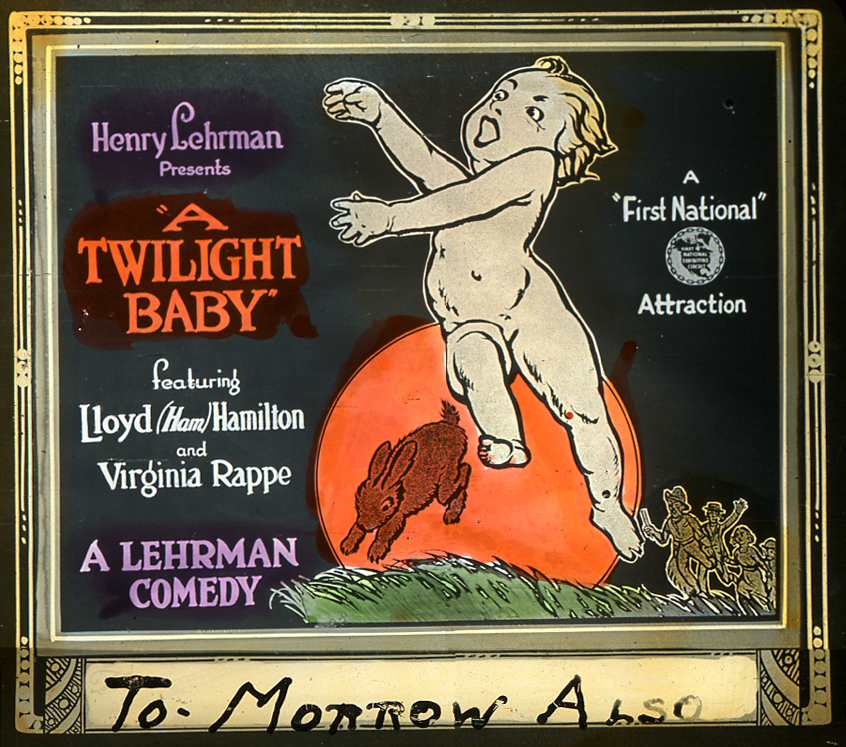
As we have been writing and editing our work-in-progress on Virginia Rappe and Roscoe Arbuckle, our blog entries have been fewer in number but hardly pushed aside. We were recently alerted to the object depicted below, an artifact from a critical turning point in the life of Virginia Rappe.

Glass slide advertisement for A Twilight Baby (Authors’ collection)

Of course, many things we do and decisions we make can be regarded as turning points. It’s called the “butterfly effect.” What immediately comes to mind is Rappe’s decision, during a late breakfast in the Garden Room of the Palace Hotel in San Francisco, to accept Roscoe Arbuckle’s invitation to join his Labor Day party at the St. Francis Hotel. A decision that began a chain of events that led to her death several days later. The artifact described here represents an earlier turning point but also one that put her on the path to the ill-fated Labor Day party.

The ”artifact” in question is a specially prepared glass slide by the Excelsior Illustrating Co. obtained from a film memorabilia dealer in Australia. Typically, before the current feature and the comedy short or newsreel, the projectionist used a patented slide projector or “magic lantern” to advertise the upcoming features. In this case, it was A Twilight Baby, which premiered during the Christmas 1919 holiday, and had its run during the winter and spring of 1920. The art is by the comic book artist R. M. Brinkerhoff.

A Twilight Baby is one of the only films Henry Lehrman made at his Culver City studio, which he shared with Roscoe Arbuckle during the spring, summer, and autumn of 1919. Arbuckle made The Hayseed (1919) and The Garage (1920) there. He also enjoyed the platonic company of Virginia Rappe, who was Lehrman’s mistress at the time.

Contrary to other Arbuckle case narratives, Rappe didn’t consider herself a full-time motion picture actress. She was regarded by others as a Hollywood “society woman” though a member of the film colony “in crowd”. She preferred to model clothes. But even this vocation had become a sideline. She was literally “kept” by Lehrman, and perhaps as a small quid pro quo she was willing to lend herself to his over-the-top physical comedies.

In 1919, Lehrman planned to make an ambitious, four-reel comedy (later cut to three to appease exhibitors), his first produced on his new Culver City lot which began operating that summer. He enlisted comic actor Lloyd “Ham” Hamilton for A Twilight Baby. Lehrman envisioned a masterpiece, that would raise his profile to that of protégés, such as Arbuckle and Charlie Chaplin.

Hamilton was a popular but second-tier actor in a bowler hat who also aspired to the fame and wealth of Arbuckle and Charlie Chaplin. He had appeared in a previous Lehrman comedy, His Musical Sneeze, made for Fox Film Corporation in late 1918. Virginia Rappe also appeared in that film though there wasn’t much onscreen interaction between the two. That changed with A Twilight Baby.

Rappe had acted in a handful of motion pictures before, including her first, Paradise Garden (1917), in which she played a vamp. She also appeared alongside Rudolph Valentino in a 1918 war propaganda film-turned-comedy retitled The Isle of Love. But she likely did these out of curiosity or even for a bit of fun rather than ambition. And during the making of both films, she was in a relationship with Lehrman.

Rappe had met Lehrman no later than the spring of 1916, upon her arrival in Los Angeles and when he was at his most productive churning out slapstick two-reelers. Had she wanted to be a comedienne, he could have done that for her early on. It wasn’t until he broke with Fox a few years later that Lehrman made an obvious effort to boost Rappe’s film career.

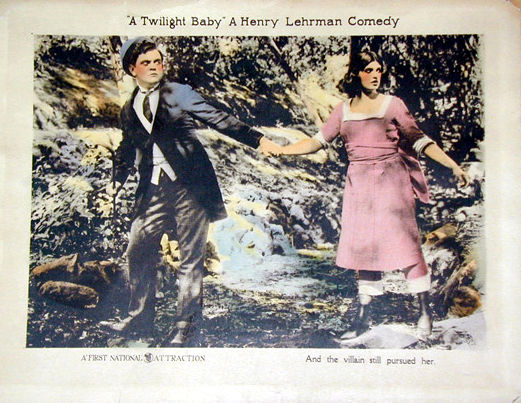
Color-tinted lobby card (IMDb)

We say that because Lehrman had so overextended himself in 1919 and 1920 that he may used Rappe to save money. That is, he was making good on his investment in her. And Lehrman was clearly cutting costs at that time. Before he went bankrupt in late 1920, he reincorporated his company and had his accountant and “office girl” doing double-duty as directors.

Now, back to the butterfly effect. A Twilight Baby was a strange film with a strange title. The term itself seems to be original and not a reference to slang or jargon of that era. We suspect Lehrman was alluding to newborns whose mothers had taken sedatives to ease their labor. “Ham” Hamilton is the titular baby whose birth, however, was from a saxophone played by a woebegone jazz musician at sunset. As to the plot, let’s just say Hamilton is an ex-con bootlegger who finds himself at odds with a variety of characters, from outlaws to federal agents to what look like nightriders. Hamilton’s love interest is Rappe, made to look like a healthy farmer’s daughter, a part for which she may have gained weight or exploited the pounds she had gained as a society girl-turned-actress, as she was billed in publicity literature.

Trade magazine advertisement with art by R. M. Brinkerhoff (Moving Picture World)

Given the number of animals used, the elaborate stunts undertaken, the use of expensive special effects, the publicity, the costs of running the Culver City plant, and the poor return on the few productions he eked out, Lehrman’s attempt to be an independent comedy filmmaker failed in late 1920. Unsurprisingly, in the wake of this, he and Rappe began to part ways for she was a luxury he could no longer afford.

By July 1921, Henry Lehrman left Los Angeles to work under contract for Lewis J. Selznick at Ft. Lee, New Jersey, and Rappe found her own manager. She now faced either the harsh reality of surviving as an actress or finding a suitable replacement for Lehrman. (More information and images can be found at IMDb.)