The first iteration of the work-in-progress is seeing drastic cuts. I hate to lose some of this material, especially where it foreshadows what happened on Labor Day, September 5, 1921. The following passage was intended to document Roscoe Arbuckle’s career in parallel with that of Virginia Rappe’s.
While Virginia Rappe’s career lay dormant in the first months of 1918, Roscoe Arbuckle directed such comedies as Out West, The Bell Boy, and Moonshine despite the wartime fuel shortage that forced the closing of two Los Angeles studios. With his manager Lou Anger overseeing the budget, Arbuckle’s company, Comique Film Corporation, took advantage of the financial straits of the Balboa Studio and leased its lot in Long Beach, much to the delight of the city’s politicians and Chamber of Commerce, which wanted no interruption in the benefits of such a large business venture. And here Arbuckle, Al St. John, Alice Lake, Buster Keaton, and others did some of their best work. Such visitors as Charlie Chaplin came to see their work, for he wanted his own plant as well and hoped to exert the kind of artistic control Arbuckle had.
Its members were suitably impressed and took as gospel that Comique would probably develop into one of the largest units of the industry in the country. Nevertheless, to Arbuckle’s surprise, he inherited the remnants of Balboa’s bad reputation, for its employees left many unpaid bills among Long Beach merchants such that Arbuckle’s people were refused credit. Things got so bad that Arbuckle published disclaimers in the local newspapers to inform readers Comique pumped $300,000 into the local economy. But he didn’t wait for Long Beach to show its appreciation. Anger always looked for better, cheaper facilities and after Arbuckle completed Good Night, Nurse! and The Cook, Comique moved to the Diando Studio in Glendale.
Roscoe Arbuckle as a Vernon Tiger (Calisphere)
No matter where Arbuckle lived and worked, he loomed across Los Angeles and its environs. Their hotels, restaurants, nightclubs, stadiums, racetracks, the infamous Vernon Country Club—and the traffic courts—were venues graced by his largeness and largesse. Together with his growing entourage, he had become known as “the Fat One” and something of a force of nature in Hollywood. So much did Arbuckle’s reputation as well as value soar in 1918 that it was necessary to issue a warning to anyone trying to capitalize on having worked with him, that he was the sole author and director of his comedies and responsible for all stories, intertitles, gags, stunts, and so on.
Unlike other directors, Arbuckle didn’t make a propaganda film in 1918. He did, however, do much charity work for morale, such as donating heavily to the United War Work Fund and the Tobacco Fund, which supplied doughboys with cartons of cigarettes. Arbuckle, too, made personal appearances at Liberty and Salvation Army events, and so on. He even “adopted” Company “C” of the 159th Infantry Regiment at Camp Kearny—and the regiment, in kind, made him its “godfather.”
Not long afterward, Arbuckle visited the Marines training on Mare Island, just north of San Francisco on San Pablo Bay. There he proved to dubious leathernecks that despite his belly, he was no less athletic than recruits. He held his own in a round of “pushball.” Arbuckle also played baseball and exerted himself in other ways, including leading a marching band around the parade grounds. He attributed his ability for such physical exertions to the locale and promised reporters “that this visit to San Francisco is to be one in a regular series,” which included a wink at Los Angeles banning liquor sales one year before Prohibition became the law of the land:
The climate of the southland is declared to be too trying on him and following the completion of each picture he makes he plans to come here to renew his “pep.” Other film artists are making the same declaration, which may not be surprising when it is realized that within another month the city of the angels is to become as dry as the proverbial bone.[1]
[1] “Arbuckle Renews Pep among Marines,” Moving Picture World, 30 March 1918, 1805.
What was always difficult to reconcile about Zukor in his lifelong quest for greatness was his intractable moral authority, which he evidently identified with the genteel, and his lust for power, which was anything but genteel.
—Neal Gabler, An Empire of Their Own: How the Jews Invented Hollywood
When I see myself on film, I can’t laugh from the heart. There is always too much that’s disturbing [. . .]
—Roscoe Arbuckle, “Fatty über sich selbst,” Kino-Journal, 1923
In the wake of Arbuckle’s acquittal for having caused the death of Virginia Rappe on April 12, 1922, the press began to quote Zukor and Arbuckle’s manager, Joseph Schenck, that the three Arbuckle films that had been withdrawn when the scandal erupted in September 1921 would soon be released to American theaters. In the case of the New Garrick Theater in Los Angeles, posters were ready to go up overnight.
But within days, that decision was reversed. A permanent ban was announced by Will H. Hays, the new chairman of the Motion Picture Producers and Distributors of America. It was done at the behest of Zukor, according to Hays’ autobiography, and it was a business decision that Zukor made without much resistance from his partner Jesse Lasky and other stakeholders in the comedian. To abandon three completed films ready for release at a time when Arbuckle films were earning millions at the box office sounds counterintuitive, but as it will become clear, Zukor was no fool.
One of these films, Gasoline Gus, was to usher in Paramount Week on September 4, a week of major new releases that began at the start of the Labor Day weekend. Zukor, as president of the studio, counted on actors and actresses, especially those in California and New York City, to make themselves available for personal appearances.
Arbuckle, possibly feeling he had earned a reprieve from the publicity campaign, didn’t appear at Grauman’s Million Dollar Theater in downtown Los Angeles for the world premiere of Gasoline Gus. Instead, he hosted two private partiesin his San Francisco hotel suite. The first was on Sunday, September 4, a more sedate affair, and the next day, Labor Day, September 5, an all-day affair that promised food, alcoholic beverages, and young showgirls from San Francisco’s demimonde.
Arbuckle had arrived in San Francisco on September 3 and, given his testimony from his first and third manslaughter trials, he had a purpose in mind. The first was to test out a new car on a long-distance journey. But his famous Pierce-Arrow was hardly new. He had taken delivery of it a year earlier. He changed his story. He was in San Francisco to meet up with a catered dinner cruise aboard the SS Harvard on its voyage to Los Angeles, a cruise that was loosely tied to Paramount Week. Arbuckle claimed he purchased his tickets soon after he took his rooms at the St. Francis Hotel. But in a cross-examination, he had yet another itinerary. Arbuckle wanted to drive on from San Francisco on September 6 to attend the California State Golf Championship, which began that week in Del Monte.
Had Virginia Rappe not fallen ill at his Labor Day party, she would have been in Del Monte a day ahead of him. But Arbuckle did sail on the SS Harvard along with his automobile prominently parked on the promenade deck. He made no public appearances in Los Angeles during the rest of the week. However he did make it to Grauman’s theater by Friday night, September 9, for an emergency meeting in Sid Grauman’s office. The news had broken that morning that Rappe had died and there was a need to meet with his lawyer and the other men who attended the ill-fated party to decide how to approach the matter.
The Arbuckle case soon began to make headlines and Gasoline Gus was withdrawn as were Freight Prepaid and Leap Year, which still had working titles and release dates in the future. All three were longer, romantic comedies and, for Arbuckle, a departure from his energetic “Fatty” character. There would still be a fat man, still be some physical comedy. But now the comedy was built on gags related to a philandering man and his pursuit of young women. Naturally, he would eventually marry the girl. This had been a common theme of his comedies from 1920, after he parted ways with Buster Keaton.
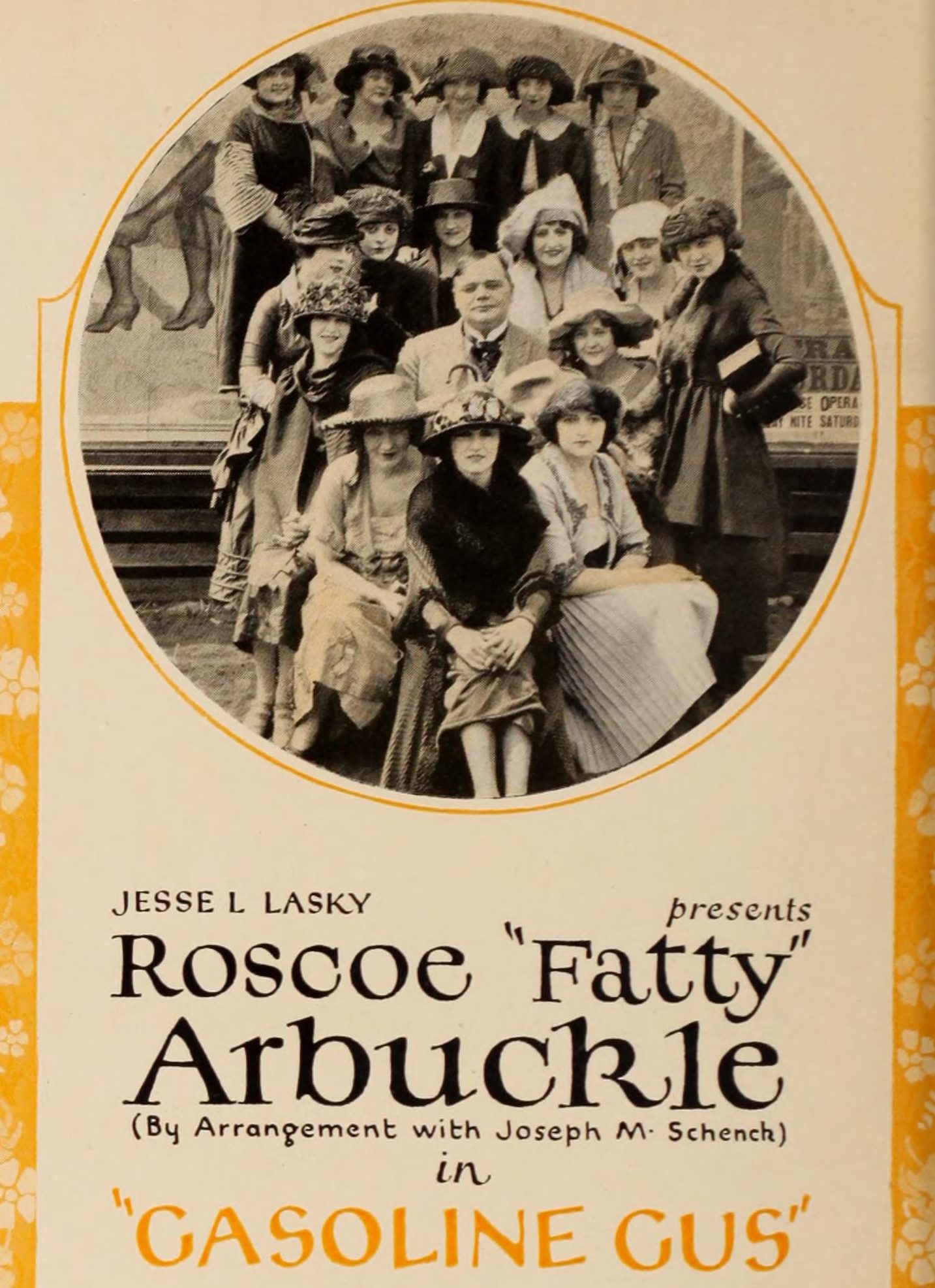
Meanwhile, the September 1921 issue of Photoplay hit the stands. One of the feature articles took on a whole new meaning. Adela Rogers St. John and Arbuckle collaborated on an interview, “Love Confessions of a Fat Man,” a publicity piece to display his intelligence and sophistication which we featured in an earlier blog post). The photograph that went with this piece, which was published in depicted Arbuckle with his hair combed over, looking up, as though into a woman’s eyes, as though he might present her with an engagement ring. Another photograph, that was published in trade magazines aimed at motion picture distributors and theater owners, showed Arbuckle surrounded by young women, not as a clownish innocent but as a ladies’ man.
Roscoe Arbuckle’s rakish image in “Love Confessions of a Fat Man” (Lantern)Arbuckle in his element? (Lantern)
We looked at this new, carefully crafted, image that was folded into the real person accused of murder at an “orgy” in the St. Francis Hotel, whose indiscretions threatened an entire industry. The sudden change of Arbuckle’s public persona from light to dark is the one obvious reason for Adolph Zukor to withdraw his motion pictures and disassociate Arbuckle from Paramount entirely. Though the comedian had been handed an unprecedented apology from the jurors for what the prosecutors had done to his reputation, the gesture was wasted on Zukor.
This brings us back to Will Hays. Zukor and his peers felt it was necessary that Hays be seen as an authority to be feared. Hays was to police the content of movies as well as the personal lives of actors. That he was essentially an employee of Adolph Zukor didn’t mean that he was subservient. Zukor delegated responsibility and Hays provided the proper image and insight to not only manage the morality of Hollywood but promote its image among the various women’s clubs and religious communities across the country. He was a church deacon from Indiana and , as such, he was the antidote for any blatant (or latent) antisemitism that might be felt toward the men who ran the studios.
The timing of Arbuckle’s trials couldn’t have been worse. Hollywood scandals in one form or another had been mounting and concerns were growing among politicians and investors that it was an industry getting out of hand. The need for a powerful spokesperson had become obvious. So when Hays was hired, he needed to set an example and Arbuckle served that purpose. Hays knew that a large contingent of American pastors and clubwomen weren’t happy with the acquittal. They had to be appeased—but it wasn’t to honor the memory of Virginia Rappe. Though she was the victim, she was also seen as a symbol of Hollywood’s immorality. The prosecutors didn’t succeed in their effort to present her as a sympathetic and innocent victim. As one doctor said, she had the sexual organs of a “married woman”—a euphemism meaning she wasn’t a virgin.
In Arbuckle’s eyes, Rappe was the antithesis to the roles played by his recent co-stars, like Lila Lee and Mary Thurman. Rappe, like the other women at the Labor Day party, was attainable, consumable, and off-screen, where making eyes, honeymoons, flirting, and a little spooning wasn’t consummation, but rather coitus. Rappe may not have realized that her status changed the moment she walked into the Arbuckle suite. She was undoubtedly there to get back on-screen. But off-, she was a creature of other possibilities not limited to talking and dancing with her host, possibilities the other young women at the party were expected to service. Rappe also had to know she had as good a chance as any of being Arbuckle’s girlfriend, with all its rewards, even being the next Mrs. Arbuckle, since his publicity as this eligible bachelor might need to be grounded in fact one day.
While his career may have required that he stick with the body-shaming moniker “Fatty,” Arbuckle had contemplated losing weight. He was also no longer directing his own films. His past specialty, the frenetic succession of dazzling, often acrobatic, sight gags, appealed to all ages. But audiences were becoming more sophisticated and wanted to see longer films, five to six reels, and the sweet, naïve, fat boy character was aging well enough, the boy had to grow up and Arbuckle knew it. Scripts and direction were being handed specialists, like the seasoned director James Cruze, whose work on the latest Arbuckle vehicles was intended to keep the comedian a close second to Charlie Chaplin, whose latest film, The Kid (1921), was the bar to meet, and ahead of Keaton, Harold Lloyd, and other rivals.
Then there was the growing perception that Arbuckle’s work in 1921 suffered from uneven quality. This had to trouble Paramount’s executives, all the way up to Adolph Zukor in his Manhattan skyscraper. In speculating what Arbuckle and Rappe might have talked about if they talked shop during the early afternoon of September 5, she had to be aware of the comedian’s immediate situation. She had a good source of information: her manager, Al Semnacher, who drove her to San Francisco. He was a veteran press agent and knew Arbuckle was getting panned on a regular basis. The Dollar a Year Man (1921) was called a “dismal effort,” “hokum,” “weak humor,” and so on in Motion Picture News for weeks in the spring. Theater owners said it fell short of fans’ expectations. Ticket sales were off. The Traveling Salesman (1921), which didn’t have the slapstick and chase scenes, made up for this lapse. But Arbuckle, in Crazy to Marry (1921), according to Wid’sDaily in early August, opined that he “seemed to be getting away from the sort of stories necessary to make his five-reel comedy offerings go over the way they should.” There wasn’t “sufficient genuine comedy” to make the laughs consistent or frequent enough. Such an overview cast a pall on everything. It didn’t bode well for the future, when his contract came up for review.
Arbuckle’s next film, had the Labor Day party not ended the way it did, was to have been Thirty Days, after a popular 1915 Broadway play. This was Jesse Lasky’s project, to be directed by Cruze. Arbuckle would have played a character in keeping with the new image, this composite of on- and off-screen—a wealthy, young society lion. But, in Thirty Days, his philandering becomes the central plot driver. The thirty days was a probation period requested by his fiancé, to be played by Wanda Hawley, in which Arbuckle’s character would work alongside her in a settlement house. The role might have opened opportunities for dramatic roles. Unfortunately, his ongoing trials forced Lasky to cast Wallace Reid, a true dramatic lead with an athletic build. Reid managed to play the comedic role but without Arbuckle’s deft touch. Thirty Days (1922) would be his last film, but not because it was panned. Reid had a morphine addiction that resulted in his death in January 1923—yet another problem for Paramount to contend with.
That same month, songwriter and theater owner Arthur Hammerstein offered a million dollars for the last three completed Arbuckle films—Gasoline Gus, Freight Prepaid, and Leap Year—but Zukor refused. Gasoline Gus had proved itself during its aborted run in late August/early September 1921 and for a brief run in April 1922. In the January 1922 issue of Paramount Pep, a special west coast representative M. H. Lewis reported screening Freight Prepaid. He called it Arbuckle’s “best picture since Brewster’s Millions.” But he cautioned that this would be the case “under ordinary circumstances.” He noted it would be a “knockout” in event of an acquittal. A film about Arbuckle and Lila Lee as newlyweds on a boxcar honeymoon was, to the Paramount stringer, a “great comedy” and “absolutely clean [. . .] Mr. Lasky deserves great credit for uniform high-quality present and future releases.”
Despite the glowing endorsement from inside Paramount, Freight Prepaid (1922) was only released in 1923 in France, Germany, and other European countries. The titles, unlike the intended American releases, almost always included the inescapable “Fatty.” A handful of other Arbuckle vehicles, both released or unreleased, were also exported. So, if Americans traveling in Europe during the Roaring Twenties weren’t discomfited by, say, the German, they could have seen Gasoline Gus as Der Benzinkönig. But comedy aside, part of the experience of seeing these films was what Hays and Zukor didn’t want: to feed a kind of morbid fascination in a man’s downfall. Hays was there for the moral argument and Zukor the law of diminishing returns, for a large proportion of Arbuckle’s audience would walk away once they had enough of his train wreck.
To the Weimar film journalist Egon Jacobsohn, writing in his aptly titled magazine Filmhölle (Film Hell) after the second trial’s hung jury of ten to two for conviction in February 1922, the lust murder dynamic of Arbuckle’s case was a given. Rappe was perceived as the victim of a rape (“Notzucht”), a sex killer (“Lustmörder”) by the lack of proof itself that by the same token made him an innocent bystander, a victim of circumstances.
“Fatty is already finished,” Jacobsohn observed from Berlin. “American motion picture audiences are shouting we don’t want to have to watch a murderer! Every comedy in which Fatty appears lies unexploited, like garbage. Even if he is acquitted, if his innocence is proven: Fatty, the beloved movie star, is dead, remains dead!” Zukor didn’t need this prophetic pronouncement from abroad. He could be on the same page of Filmhölle—which he could read in the original—the moment Arbuckle turned himself into police. Other stakeholders held out hope and a lot of money was spent to defend the comedian.
French and German posters for the export version of Fast Freight (1922), which didn’t need a train wreck scene but it did need a scarlet lady.
Nothing would shake Zukor from sitting on Arbuckle’s films. Even the classic Keystone shorts with Mabel Normand, which still got laughs in 10-cent movie houses, were pulled from distribution after a few trial runs. In December 1922, Hays lifted the ban to at least allow Arbuckle the opportunity to work behind the camera rather than in front of it. But the films remained in their cans.
So, was this a marketing decision on Zukor’s part? Milton U’Ren grandstanded repeatedly during jury selection that Arbuckle was washed up in November 1921. Since assistant district attorneys aren’t film critics but rather the “bad cops” of their high-toned district attorneys—we had to consider whether U’Ren had evidence of his claim, that Arbuckle’s popularity was declining. Was he just predisposing the jury to view Arbuckle as a decadent entitled has-been? U’Ren’s animus toward Arbuckle probably began the night Arbuckle turned himself into police. Arbuckle was evasive in answering his questions and finally assented to his lawyer’s request that he say nothing more. U’Ren visibly scoffed during Arbuckle’s courtroom testimony.
Adolph Zukor trusted his instincts for making financial decisions but he also had accountants who could reassure him he was doing the right thing. Arbuckle’s salary was in the stratosphere and though he had earned his employers exponentially more he had the potential for trouble. He had a drinking problem and was a womanizer. He was also rumored to have a drug addiction.
Zukor, going by his balance sheets, knew that if the law in San Francisco didn’t catch up with Arbuckle’s indiscretions, the law of diminishing returns could. As gifted as Arbuckle was, would a character actor with limited range survive as a leading man in feature films? Would he be able to keep up with audience tastes? Zukor wasn’t ignorant of the risks Arbuckle posed and he wasn’t sentimental about the salad days of the past.
Although Arbuckle wasn’t directly involved in the 1917 Mishawum Manor scandal. It was, to use a contemporary phrase, a “girl-and-wine” afterparty that followed a formal dinner given in a Boston hotel in honor of Arbuckle. He had just joined Paramount. Zukor and his top brass spent the night in a brothel and the underage girls who entertained the men talked. This led to hush money, a corrupt prosecutor, a trial, and years later, just weeks before the Labor Day party, it finally surfaced in the press. Zukor, a man who had been meticulous about his public reputation for propriety, was embarrassed by the attention he was getting. The Mishawum scandal sent a message of caution to everyone at Paramount. Everyone save Arbuckle. So when he flaunted his entitlement as one of Paramount’s moneymakers by hosting an afternoon party with booze and showgirls, just weeks after Zukor’s public shaming, he crossed a line.
Virginia Rappe just wanted her hospital bills paid. There was pathos in that. Would a little kindness and what was probably a $75 hospital bill have saved Arbuckle’s career? By the time of the trials, all the world had discovered that Arbuckle still had a wife, Minta Durfee. Durfee would stand by him throughout the trials and until the Hays ban at which point she promptly returned to New York City. Durfee didn’t leave him because they had another falling out or because he could no longer be the highly-paid star he had been. She was under no delusions about the state of their relationship, though she continued to defend Arbuckle for attention in her dotage. As for Arbuckle, upon Durfee’s departure, he picked up where he left off with Doris Deane, the young actress he had met aboard the Harvard twenty-four hours after he had been seen tête-à-tête with Rappe.
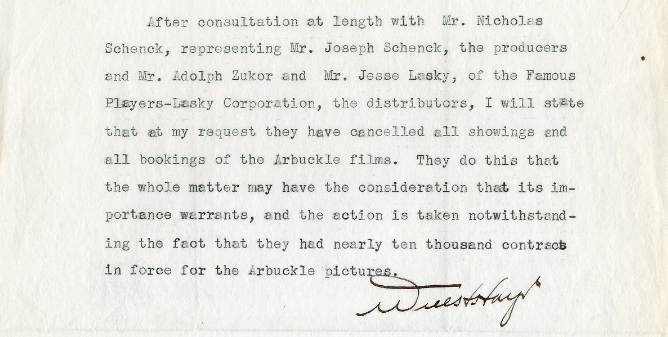
Just prior to the Labor Day party, Zukor and Paramount had agreed to a multimillion dollar multiyear contract with Arbuckle and cancelling it after Arbuckle had been acquitted would pose legal problems. Yet Zukor, who had felt squeezed by Arbuckle’s lawyers during the contract negotiations, had had enough. He needed to cut his losses and protect the Paramount brand. Hays was well aware of this contract and 10,000 others with companies and individuals who had a stake in making good on the banned motion pictures. He mentioned this sacrifice when he made the ban public one week after Arbuckle was acquitted.
Will Hays’ press release of April 19, 1922 (Margaret Herrick Library)
Paramount, the biggest studio at the time, had scores of actors and actresses under contract and all posed an existential threat to his company. What better way to get their attention than to erase one of them off the books with a mysterious, indefinable, legally defensible blackballing—where the economic rationale could be concealed behind the moralistic kabuki of Will Hays. And was there a moral or sentimental one on the part of Zukor that made it difficult for him to square Arbuckle? Perhaps. Zukor had a daughter. She was the mogul’s favorite.
P.S. Zukor’s problem with Arbuckle does have its book. But the problem isn’t quite the one imagined in Andy Edmond’s 1991 tell-all, Frame Up! That book is unsourced and what is quoted in her text has a lot of fairy dust and special sauce that makes it yet another “good read,” which it is. There is a lot about Zukor’s motivations, a lot of his wires and letters, but without sources—sources that we have to think are factoids at best—Edmonds is a dead end for us, a bad influence like many good reads on the Arbuckle shelf.
The following text is an excerpt from Buster Keaton’s 1960 autobiography My Wonderful World of Slapstick (written with Charles Samuels) from the chapter “The Day the Laughter Stopped.” Keaton was probably Arbuckle’s closest friend in show business and in life. Arbuckle mentored Keaton when he started in Hollywood and in turn Keaton was there for Arbuckle after the latter was banned from the screen.There are a few factual errors in Keaton’s account, for instance Arbuckle was born in Smith Center not Smith Corners and the car he drove to San Francisco was a Pierce Arrow rather than a Rolls Royce, though these are relatively insignificant details as they relate to the case of Arbuckle and Rappe.
“But one day in September 1921, all of the laughter in Hollywood stopped. Overnight what had been innocent fun was suddenly being denounced as “another Hollywood drunken orgy” or “one more shocking example of sex depravity.” The day our laughter stopped was the day Roscoe Arbuckle was accused of having caused the death of Virginia Rappe, a Hollywood bit player and girl about town, in his suite at the St. Francis Hotel, in San Francisco. They’d had several weekend dates together, but there had been no arrangements made for this one [our italics]. She just happened to be up in San Francisco at the time.
“The full poignancy of what followed can be grasped only when one considers how touched with magic Arbuckle’s life had been during the years he had been a movie actor. Roscoe was born in Smith Center, Kansas, on March 24, 1887, which meant he was only thirty-four when catastrophe overwhelmed him. He was a small child when his family moved to California and at eight made his stage debut in San Jose with the stock company of Frank Bacon. If he ever went back to school after that it was not for long. He did anything he could to stay in show business: was a ticket taker at one theatre, sang sentimental ballads in a nickelodeon, worked as a smalltime vaudeville blackface monologuist up and down the West Coast.
“Roscoe got his first movie job by dancing up the steps to a porch where Sennett was standing with Mabel Normand and casually doing some back flips. Sennett, thinking a policeman that fat might be very funny, put him on as a Keystone Cop at three dollars a day. His fame started shortly afterward when he appeared with Mabel Normand in a series of shorts called Fatty and Mabel. Roscoe had been with Sennett for four years when producer Joseph Schenck gave him his own unit. Yet it was only when he started doing features for Famous Players-Lasky that Roscoe Arbuckle got into the big money. Then it became very big money indeed, $7,000 a week. Jesse Lasky was in charge of that studio which later became Paramount. In his autobiography, Blow My Own Horn, he calls Arbuckle “conscientious, hard-working, intelligent, always agreeable and anxious to please,” and adds, “He would invent priceless routines and also had a well-developed directorial sense.”
“Once Lasky handed Roscoe the tough assignment of doing three feature pictures in a row without a day’s rest in between. “I don’t know of another star,” said Lasky, “who would have submitted to such exorbitant demands on his energy. But Fatty Arbuckle wasn’t one to grumble. There were no temperamental displays in his repertoire. He went through the triple assignment like a whirling dervish, in his top form. They were the funniest pictures he ever made. We were sure they would reap a fortune. . . .”
“It was on finishing that backbreaking triple assignment that Roscoe drove up to San Francisco in his $25,000 Rolls Royce for the Labor Day weekend. With him were the actor Lowell Sherman and Fred Fischbach, a comedy director. San Francisco always has been a high-rolling good-time town but never more so than in the early twenties when flouting Prohibition became the new competitive sport. Roscoe checked into a large suite at the St. Francis. Friends and free-loaders, including several of San Francisco’s most important officials flocked there the moment news got around that Arbuckle, that prince of a fat man, was in town. Roscoe liked nothing better than playing host to all comers. He ordered three cases of the best whiskey and gin obtainable and all sorts of food sent up to his suite.
“in a police court. Then the district attorney demanded that the charge be changed to murder. On the plea of Dominguez this was refused. The official charge became “involuntary manslaughter,” and Roscoe was released in $5,000 bail. Realizing the seriousness of Roscoe’s situation, Joe Schenck tried to get the fabulous courtroom spellbinder Rogers to take over the case himself. But Rogers, old and sick and near death, begged off. He told Schenck, “Arbuckle’s weight will damn him. He will become a monster. They’ll never convict him. But this will ruin him, and maybe motion pictures also for some time. I cannot take the case but prepare Hollywood for tornadoes.”
“The tornadoes were already exploding all around us by then. Along with other friends of Roscoe’s, I offered to go to San Francisco to testify. Among the nasty rumors circulated was one that Arbuckle had pushed the piece of ice into the girl’s private parts, thus contributing to her death. As Roscoe’s intimate friend I knew that any such obscene act would have been beyond him. I was eager to tell the jury this and also to explain. The day was hot, and he had put on pajamas with a dressing gown over them. Among his guests that weekend was Virginia Rappe, the twenty-five-year-old Hollywood bit player. She had a reputation for getting hysterical and tearing off her clothes after taking a few drinks.
“On hearing Roscoe was in town, Virginia joined Arbuckle’s party with an older woman and her own manager, Al Semnacher. After her death, everyone in Hollywood who knew Virginia was surprised to read newspaper descriptions of her as a frail little flower, a starlet whom death had robbed of the chance to achieve the heights on the silver screen. The truth is that Virginia was a big-boned, husky young woman, five feet seven inches tall, who weighed 135 pounds. She was about as virtuous as most of the other untalented young women who had been knocking around Hollywood for years, picking up small parts any way they could [our italics].
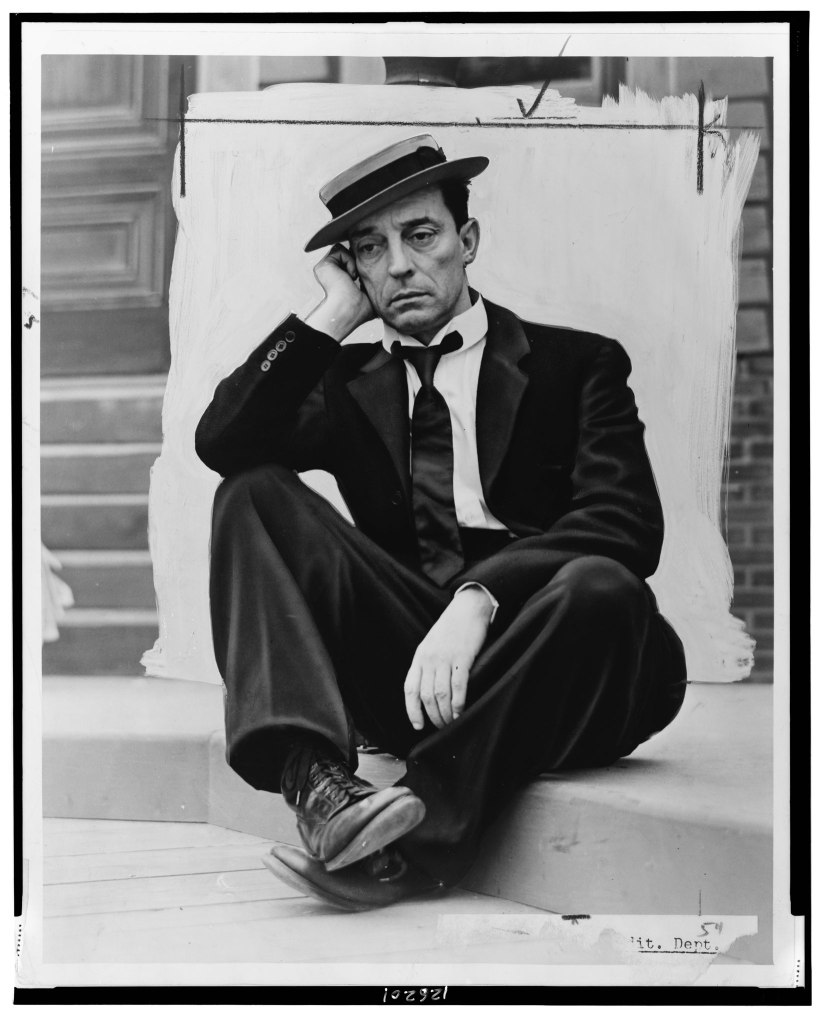
Buster Keaton (Library of Congress)
“After taking a couple of orange blossoms, a cocktail made of orange juice and gin, Virginia got sick. Most of the persons present testified later that she had started to tear off her clothes. She also complained of feeling ill. Roscoe had a couple of girls—one was the woman Virginia had arrived with—take her into the bedroom. He joined the three of them a little later and found Virginia in bed. Suspecting she might be faking he placed a bit of ice against her thigh. She failed to react, and he asked the women in the room to undress her and put her in the tub. When Virginia continued ill, Roscoe sent for the St. Francis’s house physician.
“Virginia was removed to a hospital where she died a few days later. According to her woman friend, she had kept moaning just before she died, “He hurt me. Roscoe hurt me.” It was largely on the basis of this statement that Roscoe was requested to come back to San Francisco for questioning by District Attorney Matthew Brady. He returned immediately, accompanied by Lou Anger and Frank Dominguez, an associate of Earl Rogers, California’s most famous criminal attorney.
“On September 12, a Coroner’s Jury returned a true bill against Arbuckle charging manslaughter. He was jailed, held without bail until he was arraigned that it was I who had first told Roscoe that ice held against a person’s thigh was the quickest way to discover whether they were faking illness.
“Mr. Dominguez talked us out of going to the trial. He said that there was bitter feeling in San Francisco even against him for taking a case that local people felt should have gone to one of their own lawyers. “They would resent you fellows even more,” he said, “and discount your evidence, feeling you were merely Arbuckle’s front men.”
“Meanwhile an unprecedented storm of hatred and bitterness was sweeping the country against Arbuckle. Before he even was tried his films were barred in many communities including New York City. Reform groups everywhere threatened to boycott any theatre which exhibited Roscoe’s movies. Churches of many denominations rocked with their preachers denunciations of the famous funny man. At a meeting of the League of Nations in Geneva, Switzerland, a Danish delegate, Mrs. Forchhammer, dragged Arbuckle’s name into a discussion of international white slavery.
“Adolph Zukor and other producers of Arbuckle films received such a flood of abusive and condemnatory mail from Roscoe’s former fans that they were frightened into promising that none of his pictures would ever be shown again. With all of this came persistent threats of national censorship. The studio heads, hoping to avoid that, decided to ask Will Hays, United States Postmaster General, to become czar of their industry and to censor themselves. They chose Hays, who had also been President Harding’s campaign manager, because he was the most influential politician in the United States.
“In all, there were three trials of Roscoe Arbuckle in San Francisco for manslaughter. The first two resulted in hung juries. In the third he was acquitted by a jury that said he deserved an apology from those who had wrecked his career with the baseless charge of contributing to the death of Virginia Rappe. Before his first trial started, he had returned to Los Angeles to await the start of court proceedings. With some other of his close friends, I went to meet him at the old Santa Fe Railroad Station in Los Angeles.
“So did a hate-frenzied mob of 1500 men and women who seemed to want only to get close enough to tear him to pieces. And they yelled at the fat man they had loved so much a few weeks before, “Murderer!” “Big, fat slob!” “Beast!” and “Degenerate bastard some in the crowd had come to cheer him, but they were drowned out in the din.
“Roscoe never got over that experience. He never could forget how those people had looked at him and cursed him, how it had been necessary for the police to rush to protect him from them. People everywhere in the world seemed to feel the same way about him as that mob. By then the letters of abuse and vilification were flooding in from every country in the world.
“However, there was one spot on earth where nobody hated Roscoe Arbuckle or thought he was guilty. That was Hollywood. the town so often pictured as turning on its own people whenever they get into trouble. What Hollywood did later on to encourage this bewildered, baby-faced fat man to stand on his feet and face the terrifying outside world might well be remembered, I think, by all of us.”
Buster Keaton with Charles Samuels, from the chapter “The Day the Laughter Stopped,” in My Wonderful World of Slapstick (Garden City, NY: Doubleday, 1960), pp. 156ff.




 Spite Work: The Trials of Virginia Rappe and Fatty Arbuckle