Alfred Semnacher was called Virginia Rappe’s manager during the Arbuckle case, but it was a hat he wore reluctantly. His testimony, too, came reluctantly. Imagine the frustrated press agent Sidney Falco in Sweet Smell of Success. If a motion picture had been made of the Arbuckle case in the late 1950s or early 1960s, when the Code was giving way and introspective Hollywood films had become a genre, Burt Lancaster would have looked the part of Virginia Rappe’s so-called manager, the “gray man” as one newspaper reporter called him.
Alfred Louis Semnacher was born in Stuttgart, Germany, in 1878 to musical parents. His German father, William Magnus Semnacher, had been living and working in New York City since 1865, where he had been a piano teacher for young women from well-to-do families. In the late 1860s, he founded his own school, the National Institute of Music, which was typically his residence. In the 1870s, he married Alfred’s mother, Louise Walter, who was much younger and likely one of the elder Semnacher’s students.
William Semnacher was a great believer in phrenology, a pseudoscience that advanced the premise that a person’s mental traits, aptitudes, personality, and future could be predicted by the careful measurements of bumps and depressions occurring on their subject’s heads and correlating them with regions of the human brain. Those findings would be compared to various charts—and specially numbered busts of human heads (that are still in production though mostly used as nostalgic pieces by interior decorators these days)—to assess “propensities,” such as causality, cautiousness, combativeness, concentrativeness, secretiveness, and so on. “Sentiments” such as self-esteem and truthfulness, and various intellectual and reflecting “faculties,” were also mapped.
The elder Semnacher had his head read by prominent American phrenologist, Orson Fowler in 1866 and placed so much faith in phrenology that he required that his students receive phrenological readings, among them the concert pianist and ethnomusicologist Natalie Curtis Burlin.
The younger Semnacher married one of his father’s students, a southern belle named Lucille Nowland and they eventually settled in Los Angeles in 1909. There Semnacher served as secretary to the utopian socialist Alfred Dolge, who pioneered social security and profit sharing for the workers at his factory in Dolgeville, NY. By 1919, Semnacher worked for the John Lancaster talent and publicity agency before going out on his own in 1921.
Semnacher was also separated from his wife that year. It wasn’t the first time the couple had separated, having already been divorced and reconciled. But in 1920 he had to endure living alongside her lover as a permanent house guest, a man who eventually usurped Semnacher in the husband’s role. To add to the humiliation, this unhappy arrangement was witnessed by Semnacher’s three sons.
A month before his second and final divorce proceeding, he drove Virginia Rappe and Maude Delmont from Los Angeles to San Francisco—and ultimately to the entrance of the St. Francis Hotel on September 5, 1921 – the focal point of our work-in-progress. Rappe had accepted an invitation from Roscoe Arbuckle to attend an informal Labor Day party there .
In the following deposition, it’s clear that the district attorneys had asked Semnacher to help them establish a timeframe (interpolated in bold below) for what happened to Rappe. Fortunately for them, he was mindful of the time as a businessman and, perhaps, as an impatient man as well.
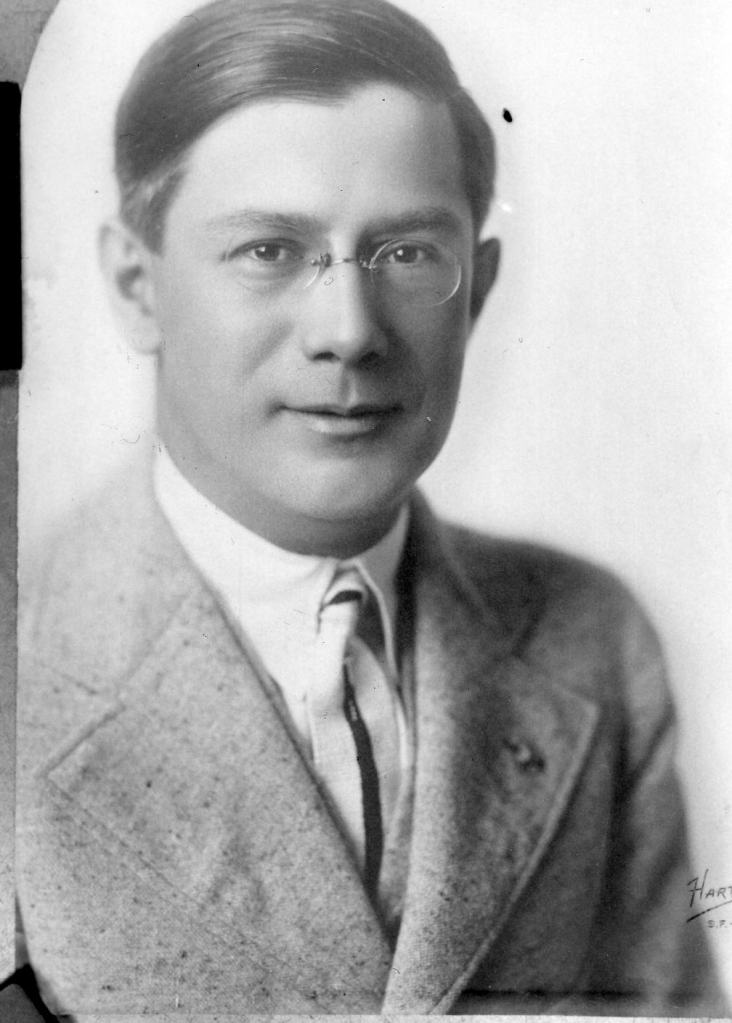
Al Semnacher, 2001 Pinehurst Road, Los Angeles, manager for motion-picture stars, who attended the party given by Roscoe (Fatty) Arbuckle in his apartments at the Hotel St. Francis last Monday afternoon, yesterday, in a deposition before Assistant District Attorney Milton U’Ren, disclosed what he knew of the alleged assault by Arbuckle upon Miss Virginia Rappe. He deposed:
About 11:30 a.m. on the 5th day of September, 1921, Miss Rappe received a telephone message from someone [i.e., Fred Fishback] at the St. Francis Hotel, the person who telephoned saying that Roscoe Arbuckle was going to have a party there and inviting her to come up; that Miss Rappe then said for me to drive her and Mrs. Delmont up there and that I could wait outside and that maybe they would only stay in there a few minutes, if the party did not suit them [my italics]; that I drove them up there to the St. Francis hotel [after 12 noon]; then parked my car and visited with friends until about 2 p.m. when I returned to the hotel and ‘phoned up; that when I did phone up Mr. Fishbeck [sic] told me to come up and join the party.
That when I went upstairs to room 1220; that there were about four tables filled with food; that Arbuckle was sitting at the end of the table in a big chair; that Miss Rappe was sitting on a couch about one foot from him. Miss Rappe was fully dressed. Mrs. Delmont was standing in a doorway between rooms 1220 and 1221. Other persons in the room were Ira Fortlouis, Fred Fishbeck, Miss Alice Blake and a girl named “Zey” [i.e., Zey Pryvon, whose real name is Sadie Reiss] and one or two other girls [i.e., May Taube], also Lowell Sherman. All the men, with the exception of Sherman and Arbuckle, had on their street clothes. All the women, with the exception of Mrs. Delmont, had on their street clothes. I stayed there about a half an hour and then with Miss Blake left for a rehearsal [after 2:30 p.m.].
I then returned to the St. Francis hotel [i.e., he leaves Alice Blake at Taits and returns after 3:15 p.m.]. I then stayed there about a half hour; immediately thereafter I drove to No. 846 Bush street with Ira Fortlouis [my italics] to locate friends [after 3:45 p.m.]. I returned again to the St. Francis hotel [i.e., after 4:30 p.m., which would allow for Rappe’s crisis in room 1219 to take place at or just after 4:00 p.m. The same people were in the room together with two other ladies, one of whom was Miss Jeanne Clark, but the name of the other lady I do not know [i.e., May Taube]. At this particular time [about 4:45 p.m.], though, Miss Rappe was not in the room. About ten or fifteen minutes later two of the girls went to the bathroom of No. 1219, and said the girl, “Miss Rappe,” was very sick [before 5:00 p.m.].
That this statement was made after the girls had returned from the bathroom; that as soon as the girls made that remark we all went in there where Miss Rappe was, and saw her lying on the bed in the room and heard her moaning; that Roscoe Arbuckle was in the room I was in when the girls went into the room where Miss Rappe was lying on the bed; that I did not hear Roscoe Arbuckle say to the girls, “Go in and attend to her”; that when the girls came out and said that Miss Rappe was so ill we all went in the room that Miss Rappe was in; that there was a great deal of confusion there; that it seemed that everybody there seemed to want to wait on her at the same time; that there must have been about a dozen people there.
That then Mrs. Delmont took charge of Miss Rappe and had several of the girls there help her lift Miss Rappe into the bathtub in an endeavor to revive her; that Roscoe Arbuckle was in the room where I was and all the other people were. When the girls returned to the room that Miss Rappe was in and announced that she was sick, Roscoe Arbuckle said, “Get a doctor”; that Roscoe Arbuckle was in the room with all of us where Miss Rappe was lying on the bed and did not do anything for Miss Rappe; that all the men left the room in which Miss Rappe was, leaving the women.
When Mrs. Delmont put Miss Rappe into the bath tub Miss Rappe was unconscious; that then when they took her from the tub they wrapped up her clothes and put her into another bed. When they put her into the bed she began vomiting.
When she began vomiting Roscoe Arbuckle said that another room had better be secured for Miss Rappe. I do not know who phoned for this room. Mr. Boyle, who is connected with the St. Francis hotel, came up and said she could be taken to room 1227. I do not know who it was that carried her out. I went into room 1227 about twenty-five minutes later to see how Miss Rappe was getting along. I then found Mrs. Delmont with her. There was no nurse with her at this time. About two hours later I went to this room again and saw a doctor there. I saw this doctor give Miss Rappe a hypodermic injection of something. I do know the name of this doctor.
That on my second visit to the room to see how she was, she was moaning and did not want anyone to even touch the bed upon which she was laying and was saying, “I am going to die. I am going to die.” She also said she had pains and that her chest hurt her. I remained in the room altogether during these visits about fifteen or thirty minutes. I did hear her mention Roscoe Arbuckle’s name, and she said, “Roscoe hurt me”; that after she was given this opiate, or whatever it was, she slept for a few hours; and when she awoke she recognized me. I told her she was in no condition to go to Los Angeles then, but that she might be well enough to leave for Los Angeles the next morning; and if she was we would leave at 9:30 o’clock. Virginia Rappe said that would be all right.
The last time I saw Virginia Rappe was about 1 o’clock Tuesday afternoon, September 6, 1921. I left San Francisco for Los Angeles at about 1:30 or 2 o’clock p.m., Tuesday, September 6, 1921. It was after she was given this opiate and slept for about two or three hours that I had the talk with her about our returning to Los Angeles. Fishbeck was to return with Miss Rappe, Mrs. Delmont and myself [our italics].
 Spite Work: The Trials of Virginia Rappe and Fatty Arbuckle