The transcripts were the personal copies of Arbuckle’s lawyers. (Courtesy of San Francisco Public Library)
The transcripts of the three Arbuckle trials proved to be revelatory. I have spent the past six days working with them. And I will have weeks of reading ahead of me as well as an entirely new narrative to consider. It’s like having all the bones of a museum’s brontosaurus in the entrance hall. The transcripts release me from depending too much on the newspaper reportage of the period, on reporters who came of age during the heyday of yellow journalism.
What I also learned was that every book and article previously written about the Arbuckle case and his alleged victim, Virginia Rappe, put their “bones” together wrong. To be continued . . .
The opening argument of the second trial asserts that Virginia Rappe’s presence at Arbuckle’s :abor Day party was hardly a coincidence but rather prearranged by her manager. (Courtesy of San Francisco Public Library)
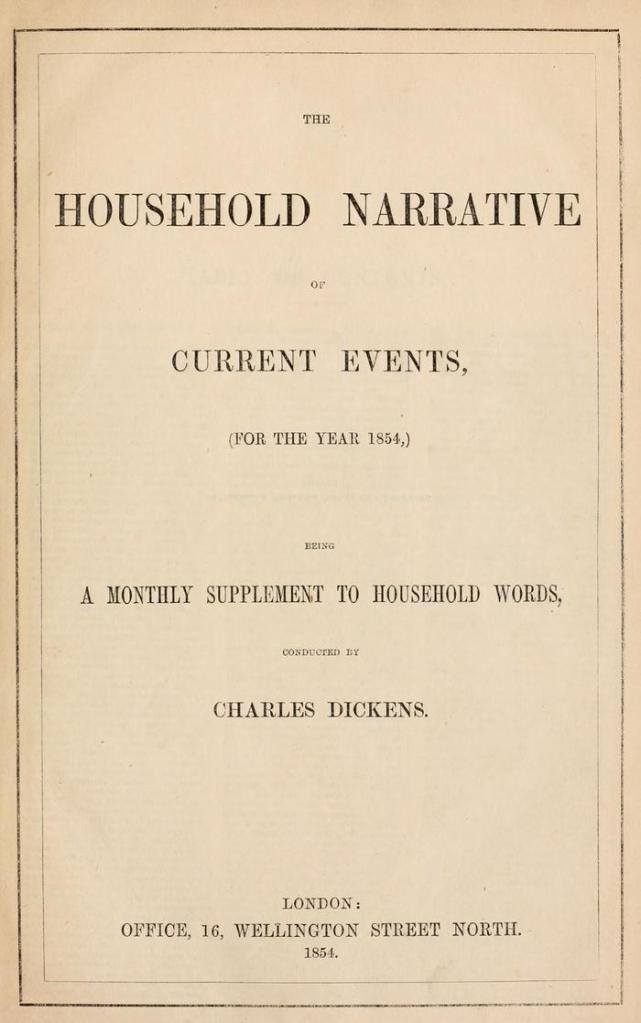
This is an addendum to our previous post. Newspaper archives can also be a valuable source for medical and legal precedents as they relate to the Arbuckle case. We found one source that is worth noting. It further supports the hypothesis that the fatal injury that Virginia Rappe suffered had to involve violence or, at least, physical mistreatment approximating the same. And this nineteenth-century case is one that so far comes closest to People vs. Arbuckle. We found it in The Household Narrative of Current Events by Charles Dickens.
The author of A Christmas Tale, David Copperfield, Oliver Twist and so many other classics also published magazines in the 1850s. Bound annual volumes existed. But you wouldn’t find them in Dickens’ collected works. So, as well-read as some of the Arbuckle trial reporters and lawyers were—Gavin McNab, Arbuckle’s chief counsel, was an autodidact who could quote Shakespeare from the vast library his father amassed—we can’t expect anyone in 1921 to know about Dickens very Victorian reportage from seventy years in the past.
But it can be found with the right keywords. In the October 1854 number The Household Narrative, Dickens described a case of spontaneous rupture of bladder in a female victim. The young woman, Matilda Jane Lodge, had been invited aboard the hulk of the HMS Victorious, a former ship-of-the-line reduced to a floating barracks for the Royal Marines, by a lieutenant serving aboard the steamer HMS Dauntless, also at anchor on the Thames.* Miss Lodge and her friend Emma White had spent the day drinking brandies and water with the lieutenant. He eventually lured them to the Victorious, and took them to his quarters. There the two women drank brandy—without water. Miss Lodge had port wine as well. Thinking that port might be drugged, Miss White departed, while Miss Lodge continued to drink. She eventually entered the gun room and entertained the lieutenant and his friends. She sang songs. She recited Shakespeare. She began to scream. She felt sick. She became hysterical. She was carried back to the lieutenant’s bedroom, from which she was said to have fallen.
The next day she was rowed back ashore, with the sleeves and front of her dress torn off. She was virtually topless as a ferryman pushed her in a wheelbarrow to the police station
The constables could see the many bruises on her arms, legs, and torso. She had a pronounced black eye. She had been severely beaten. But she was evasive. What she did say over and over again was that “I am dying”; “I am a murdered woman.” She was right. In a few days, she was dead and the criminal investigation began.
An autopsy was performed. Her bladder had ruptured at the fundus (the “crown”). Lodge had died of rupture attributed to a distended bladder.
You can read Dickens’ version below. His narrative is so close to what confronts us in People vs. Arbuckle that it must serve admittedly as too-clever, too-consciously literary, as poignant indirection to set up the story we tell over many more pages, a like “disgraceful scene.” But we do use paragraphs unlike our eminent Victorian below.
*A careful reading of the original accounts in the London newspapers archived in the British Museum reveals that Dickens had elided over this and other details in digesting the story from various and conflicting sources.
NARRATIVE OF LAW AND CRIME
A Disgraceful Scene attended with Fatal Consequences, took place on board the hulk Dauntless, in Portsmouth Harbour. On Sunday evening, the 17th ult., two young women of loose character, Matilda Lodge and Emma White were taken on board the vessel by two officers, one of whom was Lieut. Knight, of the marines; arrived on board, they went into Mr. Knight’s cabin, and were supplied by him with wine and brandy and water, through the half open door leading from the gun-room where the officers were drinking. The girl Lodge became intoxicated, and ran singing into the gun- room among the officers. Afterwards she became violently ill, and after remaining for some hours, screaming in great agony, she was put into a boat and sent on shore, her companion having previously left the ship. Lodge was found by her mother at the police station in a dying state, and expired two days afterwards. An inquest was held on her body. Her companion detailed the circumstances till she left the ship at one o’clock in the morning. A marine on duty stated that the deceased screeched fearfully and lay screaming on the floor, until she was carried into Knight’s cabin and placed on his bed. She continued screeching at intervals up to four o’clock. The officer in command had wished to have her removed from the ship; but the surgeon thought this dangerous. Lieutenant Jervis, who had gone to bed early, was waked up by her screeching and the knocking she made against the bulkheads: he visited her twice, and behaved with great kindness: Lieutenant Knight was sleeping, with his head on a pillow, on the table. Matilda Lodge fell twice out of bed. The boat- man who rowed her ashore, said that her hair was hanging all about; her dress was torn at the shoulder, and in a terribly ruffled state. She was not sensible. The police inspector stated that when brought to the station she was insensible, and smelt strongly of port wine; her dress was much disordered, and she had nothing but her shift sleeve on her arm; her hair was hanging loose down her back. Her mother gave the following evidence: “I found Matilda in the station- room, her clothes much disordered, the sleeve torn out of her gown, and her scarf very dirty. I said to her. ‘My dear girl, where have you been to get served like this?’ She appeared to be very ill. I tried to lift her up. She said, ‘Don’t mother; I cannot move. Mother, I am dying; I shan’t live long. I have received my death-blow.’ I said, ‘You must go home.’ She said, ‘I can’t.’“ She took her home, however. “I said to her, ‘You have been cruelly ill treated.’ She rejoined, ‘Yes, mother, I have; I shall die.’ She said something to me besides concerning the outrage, but I told her to lie quiet, and when she got better we would talk it over. I told her, ‘I hear you were on board of a ship.’ She said, ‘Yes, mother, and Emma was there too; we went together.’ She said, ‘After Emma left I was unconscious.’ I said, ‘I think you must have been drugged.’ She replied, she did not recollect anything about it. Her arms were black in places, one of her eyes was blackened, her cheek was all colours, and she had a bruise under her chin. She was sensible from the time I first saw her at the station house until the time of her death, between twelve and one o’clock on Wednesday last. My daughter was about twenty-two, a single woman.” Lieutenants Seymour, Knight, and Jervis, and Assistant- Surgeon Roche, tendered their evidence; and it would lead to the belief that the girl having got drunk, hurt herself by falling about. They declared positively that there was no fighting in the gun-room, and no violence of any kind offered to the young woman. The medical evidence, after a post-mortem examination, was to the effect that her death had been caused by rupture of the bladder. The coroner’s jury returned the following verdict—”We find that, according to the evidence given by the medical men, we are bound to return a verdict that Matilda Jane Lodge died a natural death from rupture of the bladder; but we also find, from the evidence given before us, that death was mainly accelerated by ill-treatment which she had received on the night of Sunday the 17th of September 1854, in the ward-room on board of the hulk of her Majesty’s ship Dauntless, lying in Portsmouth Harbour; to which we respectfully call the attention of the authorities.” A further inquiry took place before the Portsmouth magistrates on a charge of manslaughter against Lieutenants Knight and Seymour. The result was, that both the prisoners were acquitted of that charge. In announcing the judgment of the magistrates, the mayor carefully went over the whole case; dismissing the charge against Lieutenant Seymour with the remark, that he left the court without his character being affected by the charge; but censuring Lieutenant Knight, while he dismissed the criminal charge against him,—for having taken the woman on board, and for having shown so little interest in her fate as to allow her to be put in a boat without seeing her off. There was not, he said, evidence sufficient to justify the sending of Lieutenant Knight for trial. Mr. Knight was therefore discharged by the magistrates; but he remained under arrest, awaiting the pleasure of the Lords of the Admiralty, on his own application for a court-martial.—Courts-martial were held on the 10th and 11th inst., on Lieutenant Knight, Lieutenant Jervis, and Lieutenant Elphinstone, who was in command of the vessel when the affair happened. The charges against Mr. Knight were: 1. That on the 17th September he brought “on board her Majesty’s hulk Dauntless two improper women; and did act improperly towards such women, in supplying them with wine and spirits in immoderate quantities when so on board the said hulk; the same being scandalous actions, in derogation of God’s honour and in corruption of good manners;” 2. that he suggested to Mr. Robert Hancock, Midshipman, falsely “to inform the chaplain of her Majesty’s ship Dauntless, that the women which he, the said first lieutenant Frederick Charles Knight, had so brought on board the said hulk, were sisters of him, the said first lieutenant; he the first lieutenant well knowing at the time that such was not true; the same being a scandalous action, in derogation of God’s honour and in corruption of good manners;” 3. that he appeared without “his proper uniform; and without having obtained the requisite permission, dispensing with the wearing of such uniform;” 4. that he was drunk on the night of the 17th and the following morning.—Lieutenant Knight was acquitted of the second and fourth charges, and found guilty of the first and third; but, in consideration of his previous high character, the sentence of the court- martial was, that his name should be placed at the bottom of the list of the lieutenants of the Royal Marines. The charge against Lieutenant Jervis, was, that he, being in command at the time, had suffered two women of improper character to remain on board after sunset; and that, having become aware of their presence between one and four o’clock, he did not report the same to the commanding officer. Lieutenant Jervis was acquitted of these charges. The charges against Lieutenant Elphinstone, were, that he, while senior officer on board the Victorious hulk, did permit the women to remain on board after sunset; did not report the fact to his superior officer; and allowed wine and spirits to be supplied to the women from the ward-room in immoderate quantities. After evidence had been heard on the three charges, Lieutenant Elphinstone read a brief address in defence. He pleaded that he was ignorant of his responsibility at the time, not knowing he was senior officer; that the liquor was passed to the women too quickly for him to prevent it, after he had protested against it; and that it was only after he had left the ward-room, and while undressing, that he found from what fell from Lieutenant Woodman, that he himself had been the commanding officer while in the ward-room. Lieutenant Woodman deposed to the last fact.—The Court deliberated for an hour, and then pronounced this decision—”The Court is of opinion that the charge is partly proved against Lieutenant Buller Elphinstone, inasmuch as, although he remonstrated against the disgraceful proceedings mentioned in the charge, he did not with sufficient promptitude ascertain whether he was or was not the senior officer at the time he was applied to by the chaplain; and that he did not, as such senior officer, prevent by the exercise of his authority, such disgraceful proceedings. And the Court doth adjudge that the said Lieutenant Elphinstone be admonished; and the said Lieutenant William Buller Elphinstone is hereby admonished accordingly.”
There are several provisional passages in the work-in-progress that advance this or that hypothesis in regard to what really happened in room 1219. The most controversial—and the most likely—is developed and is expressed best below. But it might only see the “director’s cut” in this form. Returning to an earlier blog post about the real room 1219 on Labor Day 1921, we can see where Virginia Rappe likely suffered a hard landing and object, surely much harder and far more injurious than the Coke bottle in Kenneth Anger’s fable.
Forensic photograph of room 1219, St. Francis Hotel, mid-September 1921 (Edward O. Heinrich Collection, University of California-Berkeley Library)
Surprisingly, there were applicable cases involving women of Rappe’s age and alleged condition in nineteenth-century medical literature—and in the literature of medical jurisprudence. These cases seemed relevant to the prosecution. If Arbuckle’s lawyers had been apprised, avoiding any mention of such cases and the dots a juror might connect were paramount.
Alfred Swaine Taylor, “Accidental Ruptures of the Bladder,” The Principles and Practice of Medical Jurisprudence, (London: Churchill, 1865), i:676.
“Rupture of the Female Bladder—Death,” New Orleans Journal of Medicine 22 (1869): 359–59.
“A Mirror of Hospital Practice, British and Foreign [. . .] St. Bartholomew’s Hospital [. . .] Rupture of the Female Bladder [. . .],” Lancet, February 25, 1893, 413–14.
One didn’t need Google Books a century ago. They were special cases, rare and worthy of special interest during what was the Golden Age of Spontaneous Bladder Ruptures.
Finding the above short list and citing it in court shouldn’t have been so hard. Such literature would have been accessible to urologists, perhaps even on the office shelves. But no urologists took the stand. The photograph of 1219 that was a big clue for us may not have been shown to the jury. Nevertheless, we had to go there even if the prosecutors didn’t.
This passage prefaces the second trial testimony of Dr. George Franklin Shiels, whom we discussed in our previous post.
When the prosecution put their heads together at the beginning of January, they had much precedent to go on. The hung jury—a jury Matthew Brady saw as tainted—only meant waiting for a fair, open-minded jury and staying on course. The devil was now in the details and that could prove to be a problem for winning this case. Despite more nuanced and pointed examinations intended to trip up the most effect witnesses for the defense, the press wasn’t taking notice. Reporters were fewer in number and had less column inches to fill. They could put their feet up on the desk sooner and it was galling how often they summarized the work of Milton U’Ren and Leo Friedman with a stock phrase with so and so’s testimony was more or less “the same as the first trial.”
What should have grabbed the attention of the newspapermen and -women were the medical experts for both sides. But it wasn’t happening. Not one physician had ventured into room 1219, where the prosecutors believed Rappe had suffered such a rare and fatal injury. Why hadn’t Friedman led these men there. He could well see why his opposite, Nat Schmulowitz, had to lead them away. He had to keep Arbuckle apart from Rappe. Friedman had to put them together, indeed, had to press them together in some way that was the “fatal embrace” no matter the pathos or bathos of this scene to a juror. A well-read urologist or pathologist could have plied Friedman with cases of spontaneous bladder ruptures not unlike Rappe’s in Arbuckle’s bedroom.
The case of Julia G. had been printed in dozens of medical journals in 1869 like some cause célèbre in the medical world. At twenty-six, this married woman, the mother of six children, was admitted into a Dublin hospital. She claimed she had retired to bed under the influence of drink. She woke to pass water, but failed to do so, and as she returned to her bed, she fell over the footboard and fainted. All Friedman had to do was show that photograph of the brass beds in room 1219 and weather a storm of objections from Schmulowitz. Julia G. had been autopsied. Her bladder had been torn at the fundus. There were other grisly details and maybe her tumble—these were Victorian physicians—was due to the act of conceiving her seventh child.
The Principles and Practice of Medical Jurisprudence, a classic in print since 1865, asked a very relevant question: “Can the bladder be ruptured by an accidental fall, and if so, by what kind of fall?” The answer began with a Mr. Syme, who showed “that this accident may readily occur” in 1836. A woman, aged twenty-six, fell forward over the edge of a tub, and fainted immediately.” She lived for less than a week. And like Rappe, her peritoneum being “extensively inflamed.” Friedman could show that photograph to Dr. Shiels or just point to the diagram of room 1219. Shiels had to know this book. Had he kept his promise to produce a bibliography to the court, it might have been listed right there.
Rappe had a precedent for the violence done to her as well, in an 1893 issue of the Lancet. A woman aged thirty-four, while intoxicated, was “kicked in the abdomen and roughly used” on the evening of August 2, 1892. Her symptoms, her fatal peritonitis, and her autopsy resembled Rappe’s. Had Friedman known of this case—he just needed a finger running through various bound indexes in a good medical library, like Stanford’s, a finger belonging to, say, Dr. Ophuls—then questions could be posed never asked at the first trial. The only thing holding the young prosecutor back were sensibilities and stomach of the jury to see the belly or the knee or the foot or the fist applied to Miss Rappe’s person.
In a few weeks, we plan to spend five days visit the San Francisco Public Library to conduct our first on-site inspection of the transcripts for the three Arbuckle trials as reported in our blog entry of September 17. Since that posting, we have made further “core samples” using the testimony of Dr. George Franklin Shiels. He was a lecturer in medical jurisprudence and advised physicians on how to conduct themselves as medical experts on the stand as well as expect a fee commensurate with what they charged their patients. Dr. Shiels also lectured on the surgery of combat wounds based on his experience in the Spanish–American and Philippine–American wars—and he was hardly limited by these specializations.
Volume 2 of the second Arbuckle trial testimony (San Francisco Public Library)
During the early 1900s, general surgeons like Shiels could call themselves gynecologists, as he did, without a specific degree. He also felt he could speak as a urologist and a pathologist. He was a consulting alienist (i.e., psychologist) at the 1907 trial of Harry K. Thaw for the murder of the famous New York City architect Stanford White (reenacted in the film Ragtime with Norman Mailer, in a cameo performance, taking the bullet atop Madison Square Gardens in 1906). As such, Shiels saved Thaw from the electric chair by overcoming Thaw family’s reluctance to go along with the insanity plea by calling White’s murder a case of dementia Americana.
Dr. Shiels’ testimony at the three Arbuckle trials for the defense was considered persuasive by the press if not the jurors. He came up with the “toy balloon” hypothesis to explain away the fragility of Virginia Rappe’s bladder, such that a cough, a sneeze, and the like might cause it to “pop”—as he put it—spontaneously.
What we wanted to see was the difference between the reportage in 1921 and ’22 and the testimony. The former suggested that Dr. Shiels cited medical journals and textbooks to validate this hypothesis. To our surprise, however, neither was he prepared to cite the literature, nor was he up to speed on relevant testimony. He relied on his eminence and was caught on his cursory knowledge of Rappe’s mild cystitis at the second trial. At the third, he described the symptoms that she suffered in room 1219 not unlike Bladder Pain Syndrome (PBS) today and so mischaracterized a woman going into shock from a dire internal injury.
The testimony also revealed something else that reporters didn’t report, given the sensibilities of their readers a century ago. Dr. Shiels made special mention of Rappe possibly bearing down to urinate. Under cross-examination, Assistant District Attorney Leo Friedman took great interest in the “bearing down.” But Arbuckle’s lawyer, Nat Schmulowitz, managed to interrupt this line of testimony—perhaps because it strayed too close to what the comedian was doing outside of the bathroom door when he allegedly found Rappe on floor of room 1219’s bathroom. That is, to keep the jurors from asking themselves what happened before. Was he listening to Rappe? Asking her to hurry up? Making a joke of her predicament? (You have to realize that the defense lawyers took great pains to distance their client from the victim. It’s something we think about a great day. Previous Arbuckle narratives don’t really appreciate that Rappe and Arbuckle had paired off during the Labor Day party.)
Ultimately, what we saw in Dr. Shiels’ testimony supports our contention that the prosecutors and there performance in court took second place to Arbuckle’s lawyers. Oftentimes, the prosecution’s efforts weren’t even being reported or disparaged. Friedman, however, was quite careful and nuanced as we expected him in tress-testing the assertions made by Dr. Shiels. We were only disappointed in that Friedman didn’t go harder on Shiels. Perhaps he feared embarrassing a witness who was seen as pillar of the medical community.
In one case, Dr. Shiels claimed that he had contributed to the pioneering text, Urology, the Diseases of the Urinary Tract in Men and Women (1912) by Ramon Guiteras. Shiels not only wasn’t acknowledged by Guiteras, Shiels took the stand as if he hadn’t cracked the book. “I don’t remember just what Guiteras’ classification was, but I am pretty well certain that he did not believe very much in spontaneous rupture of the bladder,” he testified on the fly. “I have had conversations with him on the subject.” In reality, the late Dr. Guiteras would have made a better expert. In regard to spontaneous rupture, he wrote on p. 20 of Urology that a “rupture of this type depends primarily on a disease of the bladder wall [. . .] especially if in such cases a great effort is made by the bladder or abdominal wall to force out the contained urine.”
George F. Shiels and his Congressional Medal of Honor (Wikipedia)
Joan Myers, as she prepared to embark on writing her own revisionist history of the Arbuckle trials, saw that the primary sources, as of 2013, would be newspaper accounts.* At the time, searchable databases provided by the Library of Congress, Newspapers.com, the California Digital Newspaper Collection, and so on were game-changers for researchers. Nevertheless, Ms. Myers warned against relying on the reportage of the early 1920s, meaning, of course, that such accounts as they related to such a controversial event as the death of the actress Virginia Rappe were often unreliable, impossible to corroborate, and biased.
Myers knew then that to write anything further, anything revisionary, required the Arbuckle trial transcripts. These were lost or destroyed by the San Francisco County. This is certain. But one author claimed to have used these documents and his claim is suspect.
In 1976, David Yallop’s The Day the Laughter Stopped: The True Story of Fatty Arbuckle was published. He insisted that he had access to the transcripts for all three trials through the official court reporter, William A. Foster, whose name appears in the acknowledgments. Yallop, however, writes as an apologist for Roscoe Arbuckle and sees the District Attorney of San Francisco and his assistants as bent on destroying one of the world‘s most beloved silent film comedian.
Based on our research, which until recently relied on voluminous newspaper accounts, Yallop undermined his agenda for the sake of being entertaining. A case in point is his recreation of the Labor Day party in the St. Francis Hotel and an imaginary conversation between Virginia Rappe and Arbuckle in which she begs him to pay for an abortion. This is really Kenneth Anger–Coke bottle stuff. And since Yallop doesn’t couch this in any trial testimony, one would have to suspect that he also imagined what little of the examinations he does quote at any length.
Yallop also claimed that Rappe had been diagnosed with gonorrhea before her death. That factoid is something that should be in the transcripts, in the medical expert testimony. Newspaper reporters and editors were writing for the delicate sensibilities of American readers in 1921. This passage from Yallop would never happen.
At 10:30 P.M. that Friday evening [i.e., September 9, 1921], Roscoe Arbuckle sat quietly studying the script for his next picture. The doorbell rang and his butler opened the door. Two dozen reporters charged past the butler, knocking him over. They poured all over the house, taking photographs, and looking for Roscoe. Surrounding him, they began to fire questions based on the statements that had already been made in San Francisco by Maude [Delmont] and Alice [Blake].
“Who else was at this orgy you gave?”
“Did you rape her or was she agreeable?”
“How much did you pay the San Francisco police to keep it hushed up.”
“Is it true that you screwed five women during the afternoon?” (132)
This is the bricolage of a “good read” for the late twentieth century. It’s filmic. It’s noir. But there was no mob of hardboiled newspapermen. There was only one reporter and he arrived in the late afternoon. Indeed, the transcripts from the second and third trials would prove that. For some time, we had to disregard Yallop and the long shelf of Arbuckle narratives that rely on him.
The irony, of course, is that this British author, the kind American readers tend trust, really did have access to the transcripts and could have provided a provenance for them decades ago. As it appears, he only used a little of the 10,000 pages bound in brown cloth, in several volumes neatly divided into all three trials, with volumes devoted to the examination of the potential jurors. This was and is a daunting largesse of proof, of authenticity. So, what we get in The Day the Laughter Stopped are a few dialogues quoted from the first trial transcripts. A side-by-side comparison bears this out. However, the better book Yallop could have written, even for a general audience meant asking his publisher for more time, for more length. And there was his agenda, which gave us a heavily curated defensio in extremis of poor “Fatty.”
We must delay submitting our work-in-progress and revise accordingly. We must pore over the records of all three trials in the San Francisco Public Library, which quietly—but not too quietly—acquired the transcripts a year ago as a donation. We will read them without a blind eye for Arbuckle, Rappe, and others. Lastly, we can now delete a nota bene, a head note at the beginning of our trial narrative. It cautioned the reader that we had to use reportage in place of the transcripts to recreate the life of the trials. That said, we shall retain some of the editorial color of the newspapermen and -women in this form, for they are still part of the real story, which started like so in a courtroom over a century ago:
“We expect to prove on the third day of Saturday, September of the present year,” Friedman began, facing the jury, a young lady named Virginia Rappe, in the prime of womanhood, of about 24 or 25 years, left the City of Los Angeles for the City of San Francisco.” He spoke matter-of-factly for the most part, which made for poor copy. Where he dryly named Rappe’s traveling companions, “one Al Semnacher and one Maude Bambina Delmont,” Oscar Fernbach inserted some drama, “a third invisible companion, the Angel of Death.” (msp. 481)
The epilogue, like the introduction, is always in flux and won’t be finalized until we finish the next two trials. For the most part, the text feels sound—and much is devoted to the denouements of various principal and some minor witnesses. We have traced, for example, some of Maude Delmont’s life to the end. And we have much devoted to Arbuckle’s post-trial career with a certain emphasis on the incidents of misconduct that continue after Virginia Rappe.
The following passage may need to be shortened or cut. But what happened may have been more than what we have been previously told. The Merritt book, Room 1219, for example, devotes a vanilla paragraph to the incident and attributes Arbuckle’s injury to slipping and falling down a stairwell. Our treatment more relies on the eyewitnesses among the Japanese crew who spoke to reporters in Yokohama.
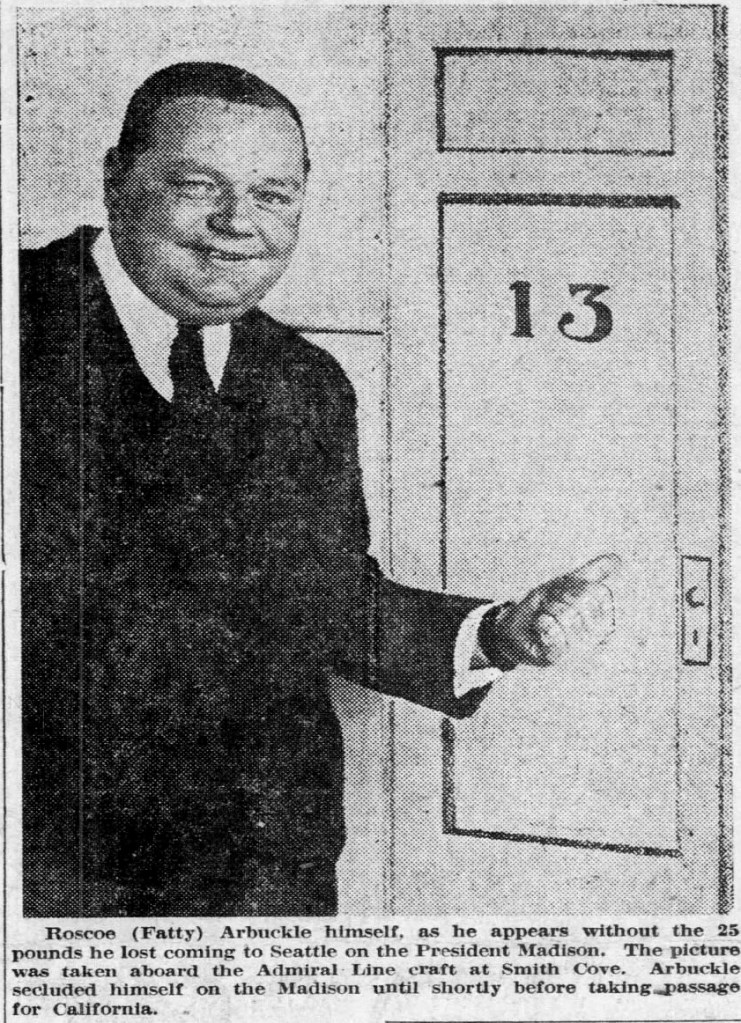
<rbuckle smile and pointing at his “hoodoo” number (Newspapers.com)
In late July, Hays traveled to Los Angeles and couldn’t avoid The Sins of Hollywood, with its lurid red Mephistopheles and his camera on a startled flapper and her beau. A respected Los Angeles minister handed him a copy at the behest of the author. Hays was appalled but didn’t change his glad tidings in the speech he gave at the new Hollywood Bowl. He declared, “The one bad influence in Hollywood is talk. And for the life of me I cannot see the horrors of Hollywood.”
Arbuckle’s reaction to the pamphlet and the grim presence of the motion picture czar is unknown. Still, his subsequent misadventure to remove himself from Los Angeles and the public eye may have been connected given the timing.
Not long after Hays returned to New York, the disgraced comedian applied for a passport for himself and his new secretary and minder, Harry R. Brand, a young publicist in the employ of Joseph Schenck. Their itinerary was to sail around the world with stops in Honolulu, Japan, China, the Philippines, India, and Egypt, where Arbuckle was to meet up with Schenck and his wife, Constance Talmadge, before continuing on to France, England, and New York. The voyage was to take months and invited much speculation. Did Arbuckle intend to resume his career abroad? Will he accept offers from Japanese and French producers?
Arbuckle was guarded about his plans. He only said he wanted to “rest.” Schenck was more explicit. He told reporters that Arbuckle was “jumpy and nervous” and in “poor personal health.” This was code to cover for Arbuckle and the real reason, which may have been a reward for the comedian’s good behavior. Arbuckle had certainly suffered not only being unable to work but to play—and the late summer had always been set aside his vacations and carousing.
Seen off by his lawyer Milton Cohen—and without Brand—Arbuckle boarded the SS Siberia Maru in San Francisco on July 16. On the first or second night at sea, Arbuckle was seen drinking sake in the company of friends. According the Japanese press, he got into a braw and threw a punch at a British passenger, cutting his hand on the other man’s teeth.
Arbuckle quickly denied the incident in a radiogram to Schenck. Then things got worse. The comedian contracted blood poisoning and a hospital room in Tokyo was quickly arranged. There Japanese doctors considered amputating Arbuckle’s arm at one point. But the comedian eventually recovered and returned via Seattle four weeks later. His arrival was intended to be “incognito.” But he was discovered and photographed outside his stateroom, number 13.
Our narrative doesn’t overlook rumors of Virginia Rappe’s alleged wealth reported after her death in 1921. We rely on its poignancy for what such rumors can say about the real person as well as the personal mythology that Rappe cultivated—and others did for her.
Two years before she set out for San Francisco and Roscoe Arbuckle’s Labor Day Party, in September 1919, Rappe must have smiled—or cringed—at how her boyfriend, the comedy director Henry Lehrman, wanted her described in the motion picture press. Despite being from Chicago—and a personal preference for identifying as a New Yorker—Rappe was reinvented as a “lovely western society girl,” as Grace Kingsley of the Los Angeles Times drolly put it, “who wearied of the gay round and decided to settle down and be serious. So, she went into comedy making![1]
Of course, Kingsley knew better. Rappe was Lehrman’s live-in girlfriend and he let her, at his expense, play the young Southern California society woman whose name was never published in a society column. Kingsley, too, was in a position to know that Rappe had exercised the same noblesse oblige already in her 1917 motion picture debut, namely Paradise Garden(which was a serious film, incidentally).
But a hundred years ago the American public memory wasn’t expected to answer for the ephemeral productions of Hollywood. That is to say, there was no such thing as “trivia night” in the tea rooms and speakeasies. But what about Rappe’s money? Lehrman or someone in his employ saw to that by a further embellishment: Rappe’s oil gushers, albeit without the black rain falling on James Dean in Giant.
With the announcement of the engagement of Miss Virginia Rappe to appear in a forthcoming series of Henry Lehrman comedy productions for the First National Exhibitors’ Circuit, Mr. Lehrman this week signalizes the successful culmination of negotiations which have extended over the past seven months, and which have finally assured the screen appearance of one of the wealthiest and most beautiful young women of western America.
It was only after the utmost persuasion that Miss Rappe was induced to forswear the intense social activities of a debutante and devote her attention to acting before the motion picture camera, but to Mr. Lehrman she represented the ideal of fresh American girlhood, and he consistently refused to take “no” for an answer. Miss Rappe, in addition to being an heiress in her own right, is the owner of more than eight hundred acres of the richest oil lands of Texas, and her wells and leases in this territory yield what is reported to be a fabulous income. Since her wealth is computed in the millions, it may be gathered that financial considerations had little bearing on her decision to make at least a temporary entry into the field of motion pictures.
Among her friends, Miss Rappe’s predilection for stunning gowns is well known, and it is promised that in her coming pictures she will display a sartorial splendor which will make them particularly attractive to feminine theatre patrons. But it is her fresh and wholesome beauty which forms her greatest asset, and it is stated that the Henry Lehrman comedies in which she appears will afford every opportunity for the display of this richest girl of stage or screen.[2]
Virginia Rappe, 1919 (Hoover Studio)
[1] Grace Kingsley, “New Fun Factory: Lehrman Starts Production of Comedies,” Los Angeles Times, 29 August 1919, III:4.
[2] “Wealthy Young Woman to be Screen Actress,” Fort Wayne Journal-Gazette, 21 September 1919, IV:7
The criminologist Edward Oscar Heinrich (1881–1953) was an expert witness enlisted by the prosecution for People vs. Arbuckle. He was pitted against Roscoe Arbuckle’s chief counsel, Gavin McNab, and rebuttal witnesses, all rival experts drawn, for the most part, from Los Angeles.
The following passage is from our working draft, a narrative that covers Heinrich’s first appearance on the stand in November 1921.
Heinrich also discussed in a previous blog entry about the way to properly “see” room 1219 of the St. Francis Hotel on September 5, 1921.
Arthur Conan Doyle’s “The Adventure of the Norwood Builder” in which Sherlock Holmes solves a murder by using his magnifying glass to compare the wax impression of a thumb to a thumb stain on a wall, was inspired by a real crime. A decade earlier, in 1892, a young Argentinian woman murdered her two children so that her boyfriend would marry her. Instead, she became the first person convicted of a capital offense based on a finger print, a single bloody thumb mark left on a wall. But this revolutionary way of solving crimes had begun even earlier, when, ironically, two Indian civil servants needed a way to identify people of color in criminal cases for the British Raj because “they all look alike.” This became the Henry system of finger print classification that was adopted by Scotland Yard and subsequently by police departments in the United States during the first decade of the twentieth century.
In 1910, the first American criminal case to be decided solely on the basis of finger print evidence occurred when Thomas Jennings, an African American, was convicted for the murder of a white homeowner during a botched burglary attempt. For the next ten years, police departments in the United States further perfected their methods of finger print identification—dactyloscopy—and the routine taking of finger prints from criminal suspects and crime scenes.
By 1920, finger print evidence became as much a sensation as DNA evidence is today in solving seemingly unsolvable crimes, especially when there was no other witnesses than the alleged perpetrator, as in the case of Roscoe Arbuckle. Proving that he had fatally injured Virginia Rappe provided a challenging test of the scientific method and the District Attorney of San Francisco took advantage of what was then the epicenter of modern criminology and forensics just across the bay at the University of California in Berkeley.
The first Chief of Police of Berkeley, California, August Vollmer, was already known around the world for his progressive innovations in creating one of the first modern police forces in the country. He had also encouraged the University of California to establish the first program in criminology in the United States, where Brady’s expert witness, Edward O. Heinrich, was hired as the first lecturer in 1919.
Known as “Oscar” to his friends and students, Heinrich started out as a self-trained pharmacist in his native Tacoma, Washington. With nothing but a high school diploma, he earned a degree in chemistry at Berkeley as a special student in 1908.
Edward O. Heinrich, ca. 1919 (Carnegie Library, Denver)
Over the next decade, Heinrich worked as a chemist in Tacoma, a police chief in Alameda, California, and as the city manager of Boulder, Colorado. He returned to Berkeley in 1919 at the invitation of Chief Vollmer to take over the laboratory of the late Theodore Kitka, a handwriting expert and authority on inks and ink stains. Kitka, obsessed with freeing Tom Mooney from prison for the 1917 Preparedness Day bombing, had made important strides in the science of finger print analysis—and Heinrich continued this work.
For Kitka, Heinrich, and other handwriting experts, going from the loops of and downstrokes of a subject’s handwriting to the loops, whorls, and tent arches of finger print analysis was a logical progression. Both disciplines required a practiced eye, patience, an inquiring mind—and a good microscope. In his advertisements in San Francisco’s legal newspaper, The Record, he billed himself as a “Legal Chemist and Microscopist.”
Heinrich’s work had made news when William Hightower was arrested for the kidnapping and murder of a Catholic priest in August 1921. He had shown the court how the word “tuberculosis,” stenciled on Hightower’s tent to ward away the curious from his campsite, was obviously the work of a cake decorator—and matched the lettering of a ransom letter for the dead priest. Although Hightower was a drifter, he was also an itinerant baker. As further proof, Heinrich employed soil analysis, forensic geology, and the microscopic examination of rope and tent fibers as well as nicks on Hightower’s pocketknife.
While Heinrich was still involved in the Hightower case, he was already at work in the Arbuckle suite and had two doors from 1219—the one that connected to the hotel corridor and the one innermost door of the two that connected to room 1220—removed and taken to his Berkeley lab. In a matter of days, between September 17 and 21, he had a general idea that a crime had been committed in the room based on enlargements of finger prints of Arbuckle and Rappe taken by the San Francisco Police.
That the Arbuckle case was Heinrich’s first as a finger print expert wasn’t lost on the defense team but he had to be taken seriously in another way, given that high-profile cases involving finger print evidence were being lost by criminal defense lawyers. Juries that had an ear for the Cross of Gold oratory of the 1890s were now being swayed by science in the courtroom. Nevertheless, a William Jennings Bryan could still beat evolution at the Scopes Monkey Trial—and McNab could be said to have had it easier than his fellow Democrat did in 1925. Milton U’Ren, relying on finger prints alone, was no Clarence Darrow in 1921—and Heinrich was no Darwin. The scientist from Berkeley resembled a solemn-looking young man with a high-forehead and lock of hair falling over it. He spoke in a quiet and reasoned voice, as though to a room full of students rather than jurors already growing bored with the trial, already making up their minds.
Shortly after the Tuesday afternoon session convened, the bailiffs moved two oblong objects, covered with sheets, from behind Judge Louderback’s desk. Spectators gaped at them, including the jury as they filed in and took their seats in the jury box. An easel was set up to display enlarged photographs and placards. Matthew Brady himself, for the first and only time, conducted the examination after Heinrich was sworn in. But reporters barely noticed the rare appearance as the chief prosecutor ceded the floor to the man who had made it possible to visualize what happened in room 1219 on the afternoon of September 5.
Heinrich described himself as a “consulting criminologist,” according to Oscar Fernbach, “declaiming to the jury his many accomplishments like some Pied Piper of Hamelin.” But what Heinrich had learned from room 1219 was extensive and as yet unknown to everyone save the prosecutors. They wouldn’t see the hundreds of notes and equations for probability distribution that Heinrich had made. He had also identified many of the hairs found in room 1219. Under the microscope, he could tell which ones came from men and women, which had been “barbered” or pulled out by the root.
He had pored over her clothes in the evidence room and his lab in Oakland. The “sport suit,” as he called her green outfit, had been torn in various ways. The left arm of her green coat had been torn at the seam for a distance of five inches. The cuff links had been torn out of their cuffs, one of which hung by a few threads. The right sleeve of her shirtwaist had been ripped to the elbow from the back. The white silk underpants of Rappe’s “teddy bear” had been torn down the left side. In his final notes, Heinrich had no opinion about the clothes that Rappe wore into room 1219.
Heinrich had found some stains on the double bed’s quilted pad. Most of these he described these as “seminal in character” but had passed through the hotel’s laundry. When he turned the quilt over, however, he found a fresh blood stain one-quarter of an inch in diameter and near it a semen stain about three-fourths of an inch long and almost as wide. But he decided that these couldn’t be attached to the case even though he suspected a maid had just turned the mattress pad over.
One of the doors that Heinrich had brought from the hotel to his laboratory and to the courtroom was the outer door from room 1220 to 1219. He had found the impressions left by Maude Delmont’s shoes. He found scuffs from their toes but, more importantly, the impressions left by the nails and center screws of her French heels. After he conducted his own test with the shoes, strapping them to wooden handles so that they could be pounded like hammers in doors that were, like those of Arbuckle’s suite, either oak or birch. These tests revealed that Maude Delmont had kicked the door as she had said.
By Thursday, September 22, as the preliminary investigation got underway, Heinrich met with Brady, U’Ren, and Golden at the Hall of Justice. He had provisionally identified Rappe’s and Arbuckle’s finger prints on 1219’s bathroom door as well as the door leading into the corridor. Heinrich photographed Delmont’s heel marks on the door between 1220 and 1219 and collected hair samples and bobby pins. Semen stains were found on the comedian’s mattress. But Heinrich deemed them too old. U’Ren agreed to leave them out of the case. Lastly, Heinrich found nothing to suggest Delmont’s claim that Arbuckle had ripped off Rappe’s clothes, a hypothesis that the prosecutors let go.
As a criminologist, Heinrich risked being imprinted by the suppositions of the men who would pay for his meticulous list of expenses and his fee. It was a matter of ethics and academic discipline. Given the prints he had taken from the bathroom door and the inside of 1219’s room door and the hair he had found on the floor, Heinrich wrote in his notes as early as September 17, that
the action under investigation in this case may be interpreted as an opening of the [bathroom] door from without by a push of the man’s hand and an increase of the opening by the shoving aside of the door by the woman running out toward the hallway door; the woman at the time standing at the end of a rug adjusting clothing from which hairs dropped.
As the trial date approached in November, the evidence and testimony would be mostly limited to the prints on the hallway door. The conjectured image of Rappe escaping from the bathroom and making her way to leave room 1219 via the hallway, of turning to face Arbuckle, frantically straightening out her clothes and brushing herself off, wouldn’t find its way into testimony—at least not yet.
As Heinrich unveiled one of the hotel doors, he moved like a photographer positioning it “so that it catches the light at the right angle,” reported Walter Vogdes of the Examiner.
Visible on the door was a brilliant coat of aluminum dust spattered over one of the upper panels. He pointed out two hand prints, one on top of the other. Then, using a series of photographs and diagrams, he explained to the court what he believed these indicated.
First Heinrich revealed where Rappe’s palm had been pressed against the door. Superimposed, as though the fingers were interlaced, were the fingertips of Arbuckle’s hand. Heinrich had also made drawings that methodically, mathematically identified the owner of each set of prints.
As Heinrich spoke, a rival handwriting expert, Chauncey McGovern, and Ignatius McCarthy, a former investigator for the Department of Labor, looked on from the defense counsel’s table. They were not only there to observe and take notes for when they took the stand, but as supernumeraries for McNab’s theater of incredulity.
McGovern and McCarthy expressed their disagreement with Heinrich’s findings. They made faces for the jurors to see. They rolled their eyes and shook their heads. Arbuckle, too, got in on the act. In a courtroom caricature, a cartoonist for the San Francisco Call depicted the comedian studying his hand in mock skepticism. Heinrich is also depicted, engrossed by his own demonstration, working away with a drawing on a large sheet of paper.
Sitting next to the cartoonist, the reporter Edgar T. Gleeson jotted down the notes that later described Heinrich stepping from exhibit to exhibit, pointing out the various differences in the curves, broken contacts, lifelines, and ridges of the prints made by Rappe’s palms and fingers and then compared them to Arbuckle’s. With his eyes “peering, hands clasped, and brow rising and falling,” Gleeson compared Heinrich to “a man from Mars” and a “human thinking machine” on par with “Professor Craig Kennedy,” the popular pulp novel scientist detective.
In the end, Heinrich told the court that his evidence suggested the possibility of a struggle between Rappe and Arbuckle, that the comedian had the young actress pinned to the door leading out to the corridor. This theory neatly fit the voices that Josephine Keza heard, of a woman begging as though for her life as much as her virtue, and the cruel voice of the man’s telling her to shut up. Thus, with a ring of circumstantial evidence closing around the defendant, Matthew Brady handed Heinrich over to Gavin McNab for cross-examination.
The defense counsel didn’t take long to get to a simple question.
“If that door had been wiped would not these finger prints have been obliterated?”
“Surely,” answered Heinrich.
“They can be rubbed out, can’t they?” McNab continued. “Otherwise, in a long period of time, I suppose they would protrude into the room. They don’t have to be taken off with an axe, do they?”
Despite McNab’s sarcasm, Heinrich gave him a proper answer. He said the finger prints could be rubbed off. But he had proved to himself—and likely colleagues as well to stress-test his opinion—that prints he found on the door were Arbuckle’s and Rappe’s. He explained that there were thirteen points of identification in the prints of the dead girl’s fingers and seventeen in those of the defendant. The chances of her finger prints being duplicated by another woman were 393,000 to 1. The chance of any man having the same points as Arbuckle were 3,300,00 to 1.
To begin the part that narrates—and documents—the first Arbuckle trial, we begin with an anecdote. This is, admittedly, formulaic. You know, what we learn in the writing seminar, the way a piece should begin with the indirect, something that seems beside the point but has an ulterior meaning that “haunts” the reader as the rest of the text unfolds.
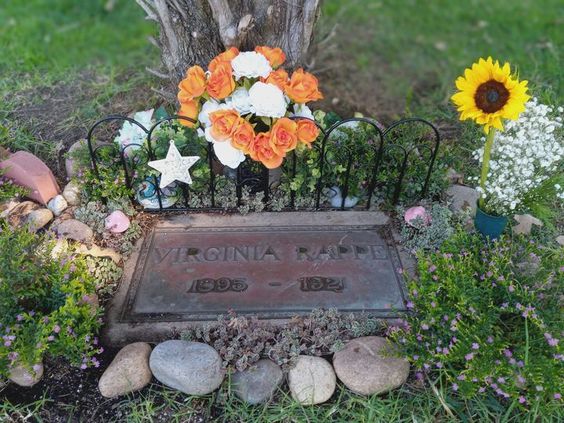
The burial site of Virginia Rappe is an early example of the interments that helped to make the unique funerary culture of Hollywood Forever Cemetery. Eventually, over time, the plots became more and more attractive nuisances—at least to the cemetery’s groundskeepers—by intention, when it was seen the celebrity can continue into this quiet afterlife.
As for Crystal Rivers, toward the end of his life, in the late 1930s, he began to write letters to the editor of the Santa Barbara newspapers, expressing a certain pacifism as another world war loomed.
Update: We are still revising the 200+ pages that cover the first trial and its aftermath. We may, as we do here, reveal the sections of the work-in-progress.
The First Trial Begins
The forthcoming trial of Roscoe Arbuckle, the celebrated film comedian, on the charge of manslaughter, is of interest and significance to the whole civilized world.
Gouverneur Morris
In the weeks after the funeral of Virginia Rappe, “the Littlest Cowboy,” Master Breezy Reeves Jr., the son and namesake of director B. Reeves Eason, was laid to rest.[1] The six-year-old had been killed by a runaway truck as he rode his bicycle to a piano lesson. His interment added another player to those who died too young, well before Rudolf Valentino’s vault made Hollywood Forever Cemetery a shrine visited by legions of devotees and the curious. Their pilgrimages, their attendant rites were still in the future. Rappe’s modest plot by the reflecting pool, however, anticipated who was to come in the person of her lone mourner.
Cemetery employees observed the same man in his forties almost daily. He often put fresh flowers in the urn on her grave and removed the withered ones. On a nearby palm tree, he hung a framed picture of a bouquet of roses that bore a legend in verse and a humble request to leave the offerings undisturbed.
You fought for the honor God gave to you A beautiful bridal flower. And through the years your heart beat true| Till the day and the fatal hour.
This is a promise delayed, Crystal P. Rivers. Please do not remove this from the grave of Virginia —Semper Fidelis (always faithful) from C. P. R.
The police were consulted. The poet broke no laws. But with Roscoe Arbuckle’s trial date of November 7 fast approaching, the newspaper editors saw a human-interest story. They printed the poem appended to the rose bouquet and sent reporters to lie in wait for the mysterious visitor. Finally, one of them confronted Rivers on his way to Rappe’s grave and with much persuasion, he consented to talk.
Rivers said nothing about his curious name for a man, at once feminine yet paean in keeping with the poetry of the American frontier. He said very little about his vocation—he worked in a factory—but admitted to being an artist, inventor, and a widower. Living in virtual seclusion, he devoted much of his time to study and writing. And with tears beginning to brim, his voice trembling with emotion, he said he knew Rappe well. Her friends had introduced him in 1917. “I loved Virginia Rappe,” he confessed,
for her innocence, her beauty and her gracious charm. The memories of my meetings with her are the most precious of my life. I loved her as a father does his only daughter. She was the embodiment of all I have missed in life—a child on whom I might lavish my affections.
Rivers claimed to have an “unusual platonic romance” with Rappe. But it didn’t last the winter. His poem faded in the rain. A cemetery employee removed his decorations. Eventually, a new visitor took up the rite and filled the urn with sprays of black acacias.
As Crystal Rivers mourned his imaginary daughter, newspapers continued to publish stories speculating in the existence of Virginia Rappe’s real daughter. Since such hearsay could prejudice the jury pool for People vs. Arbuckle, Matthew Brady spoke from the bully pulpit of the District Attorney’s office. “We are getting ready to fight tooth and nail for the conviction of Arbuckle,” he declared. “The propaganda being spread by the press is not worrying us a particle.” [. . .]
A recent image of the Rappe gravesite maintained by the Silent Film Cemetery Project
[1] pp. 000–000: John Berryman, “Dream Song 222,” The Dream Songs (New York: Farrar, Straus, Giroux), 241; Gouverneur Morris, America and Arbuckle Trial, San Francisco Call, 7 November 1921, 1,2; “Grave of Girl Daily Visited,” San Francisco Examiner, 3 November 1921, 12; “Mystery Visitor Decorates Grave of Virginia Rappe,” Los Angeles Evening Herald, 3 November 1921, A12; “Identify Grave Visitor,” Los Angeles Evening Herald, 5 November 1921, A3; “Solve Rappe Grave Puzzle, Los Angeles Record, 5 November 1921, 2; “Mystery Suitor of Rappe Girl Tells of Affection,” San Francisco Examiner, 5 November 1921, 9; “Mystery Suitor Tells of Love for Rappe Girl,” Buffalo Times, 11 November 1921, 5; [, , ,]
We are finalizing our draft manuscript and not slacking off. Although some wags say it is too biblical in proportion, creating readable and engaging narrative is the priority. That said, this blog won’t be neglected for very long. We’d like to show some sample passages—teasers, if you will.
The title page for that part of the book devoted to the first Arbuckle trial. The epigraph is from “Dream Song 222,” by the poet John Berryman.







 Spite Work: The Trials of Virginia Rappe and Fatty Arbuckle