“The American Sherlock takes the stand,” published here last August, is still quite informative about the pioneer criminologist Edward O. Heinrich. This new note simply shares some first impressions after reading his testimony in the transcripts of People vs. Arbuckle. These show how the science of dactyloscopy—of taking and identifying fingerprints—contributed to the prosecution of Roscoe Arbuckle for causing the death of Virginia Rappe. They also invite a long-overdue reinvestigation.
Heinrich obviously relished the opportunity to explain what fingerprints were, that the pattern of ridges in the form of loops and whorls on fingers and palms were unique to every person from cradle to grave. He explained how fingerprints were lifted from a surface and compared to those taken from a living or dead subject. Heinrich even lectured the jurors on the history of fingerprints. He also described how fingerprints were developed using aluminum powder and the tedious process of using different kinds of microscopes, enlarging photographs, and performing mathematical computations to rule out any doubt. Ultimately, the process came down to probability and points of similarity. Ten or more points were considered a match, based on Scotland Yard’s standard adopted by the identification bureaus of virtually every American police department.
Heinrich also described his work in various police departments, his summer session lectures at the University of California-Berkeley, his memberships in applicable professional organizations, and so on. He provided a list of books by fingerprint “authorities.” But, like many criminologists in the early twentieth century, fingerprint analysis was not his specialization. More often than not, these early practitioners were called upon to analyze handwriting samples. Nevertheless, for Heinrich, a proper criminologist had to make the jump from examining the downstroke of a lowercase f, say, and the hypnotic whorl in a fingertip.
Such evidence wasn’t new to American courts in 1921. Police departments, federal and state governments, even businesses were collecting and keeping fingerprint files. But to the layperson, the science behind them was almost as controversial as natural selection. To criminal defense lawyers and defendants, circumstantial fingerprint evidence was hard to overcome if jurors found it convincing.
Heinrich—and the assistant district attorney who was his handler, Milton U’Ren—had to convince juries that he had been long at work on his own methodology and that fingerprints were hardly a sideline for him. He was presented as a professor, even though he his real title was lecturer at the University of California-Berkeley. He reeled off everything he had done professionally, including taking the fingerprints of enemy aliens during the First World War. He also conducted many experiments, including the application and detection of fake fingerprints. But Heinrich’s work on identifying the faded latent fingerprints of Roscoe Arbuckle and Virginia Rappe on a hotel door was his first real test as an expert witness. The defense quickly apprehended this and that he was mostly self-taught. They pulled out all the stops to discredit not only his findings but his person as well.
During the first trial, Arbuckle’s chief counsel, Gavin McNab, tried to convince the jury that the fingerprints were “spooks,” inferring that criminologists who dealt in fingerprints were as phony as Victorian spiritualists. McNab and his colleagues also never missed a chance to note that Heinrich wasn’t a tenured professor, forcing him to admit that he was only a lecturer at Berkeley.
The defense lawyers scored points with the press for their entertaining cross-examinations, which turned Heinrich into an “egghead”—his pattern baldness made him look the part. But after the first trial ended in a hung jury, in part due to Heinrich’s thoroughness in revealing that room 1219 had not been thoroughly cleaned and wiped down, new tactics were adopted in the second trial.
Arbuckle’s longtime personal lawyer, Milton Cohen, took over grilling Heinrich. He was better prepared. He had pored over the literature and cleverly cherrypicked paragraphs to assert that Heinrich had violated protocols and standards in taking fingerprints, photographing them, and developing them using aluminum powder. The most heinous thing that Heinrich and the prosecution did was not handing over the hotel room door to the police and storing it in the property (i.e., evidence) room. This line of attack, however, only revealed that the district attorneys didn’t trust the police, that some members of the department, even the chief, were cooperating with Arbuckle’s lawyers. (Heinrich also disclosed that he had been followed in the St. Francis Hotel.)
Other avenues of attack included the way that Heinrich glibly introduced his assistant and secretary, Salome Boyle, a senior at Berkeley, to the St. Francis deskman. Heinrich called her “my Watson,” implying that he was some sort of Sherlock Holmes. But Heinrich wasn’t being vain but rather self-deprecatory, indeed, self-conscious of his own appearance and what he looked like in the company of a young woman. Cohen also tried to bait Heinrich with an insinuations that wasn’t reported in the newspapers: the seeming impropriety of a professor locking himself away with a coed in a hotel bedroom well into the night, leaving the jurors to think she couldn’t just be there to hold his flashlight.
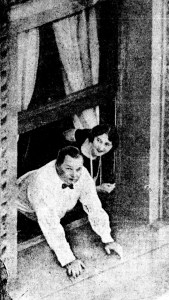
Heinrich attempting to deflect misspeaking about Miss Boyle at the third Arbuckle trial. (Courtesy of the San Francisco Public Library)
The alleged “struggle” between Arbuckle and Rappe, entirely based on circumstantial evidence, was an important theme in the unsuccessful prosecution of the comedian. Most books about the Arbuckle case place little credence in Heinrich’s work. But, given today’s sophisticated scanning technology and computer analysis, perhaps a latter-day criminologist might stress test Heinrich’s results. It would provide a puzzle piece that certainly would force one to take every version of events apart and start over again.
The first iteration of the work-in-progress is seeing drastic cuts. I hate to lose some of this material, especially where it foreshadows what happened on Labor Day, September 5, 1921. The following passage was intended to document Roscoe Arbuckle’s career in parallel with that of Virginia Rappe’s.
While Virginia Rappe’s career lay dormant in the first months of 1918, Roscoe Arbuckle directed such comedies as Out West, The Bell Boy, and Moonshine despite the wartime fuel shortage that forced the closing of two Los Angeles studios. With his manager Lou Anger overseeing the budget, Arbuckle’s company, Comique Film Corporation, took advantage of the financial straits of the Balboa Studio and leased its lot in Long Beach, much to the delight of the city’s politicians and Chamber of Commerce, which wanted no interruption in the benefits of such a large business venture. And here Arbuckle, Al St. John, Alice Lake, Buster Keaton, and others did some of their best work. Such visitors as Charlie Chaplin came to see their work, for he wanted his own plant as well and hoped to exert the kind of artistic control Arbuckle had.
Its members were suitably impressed and took as gospel that Comique would probably develop into one of the largest units of the industry in the country. Nevertheless, to Arbuckle’s surprise, he inherited the remnants of Balboa’s bad reputation, for its employees left many unpaid bills among Long Beach merchants such that Arbuckle’s people were refused credit. Things got so bad that Arbuckle published disclaimers in the local newspapers to inform readers Comique pumped $300,000 into the local economy. But he didn’t wait for Long Beach to show its appreciation. Anger always looked for better, cheaper facilities and after Arbuckle completed Good Night, Nurse! and The Cook, Comique moved to the Diando Studio in Glendale.
Roscoe Arbuckle as a Vernon Tiger (Calisphere)
No matter where Arbuckle lived and worked, he loomed across Los Angeles and its environs. Their hotels, restaurants, nightclubs, stadiums, racetracks, the infamous Vernon Country Club—and the traffic courts—were venues graced by his largeness and largesse. Together with his growing entourage, he had become known as “the Fat One” and something of a force of nature in Hollywood. So much did Arbuckle’s reputation as well as value soar in 1918 that it was necessary to issue a warning to anyone trying to capitalize on having worked with him, that he was the sole author and director of his comedies and responsible for all stories, intertitles, gags, stunts, and so on.
Unlike other directors, Arbuckle didn’t make a propaganda film in 1918. He did, however, do much charity work for morale, such as donating heavily to the United War Work Fund and the Tobacco Fund, which supplied doughboys with cartons of cigarettes. Arbuckle, too, made personal appearances at Liberty and Salvation Army events, and so on. He even “adopted” Company “C” of the 159th Infantry Regiment at Camp Kearny—and the regiment, in kind, made him its “godfather.”
Not long afterward, Arbuckle visited the Marines training on Mare Island, just north of San Francisco on San Pablo Bay. There he proved to dubious leathernecks that despite his belly, he was no less athletic than recruits. He held his own in a round of “pushball.” Arbuckle also played baseball and exerted himself in other ways, including leading a marching band around the parade grounds. He attributed his ability for such physical exertions to the locale and promised reporters “that this visit to San Francisco is to be one in a regular series,” which included a wink at Los Angeles banning liquor sales one year before Prohibition became the law of the land:
The climate of the southland is declared to be too trying on him and following the completion of each picture he makes he plans to come here to renew his “pep.” Other film artists are making the same declaration, which may not be surprising when it is realized that within another month the city of the angels is to become as dry as the proverbial bone.[1]
[1] “Arbuckle Renews Pep among Marines,” Moving Picture World, 30 March 1918, 1805.
I shouldn’t be so glib with the double entendre, but that is often the best way to think about disturbing things. The critical difference between the transcript of Roscoe Arbuckle’s first trial testimony published in newspapers in late November 1921 and the real thing is vomit. According to Arbuckle, he found Virginia Rappe in bathroom of room 1219 lying on the floor in front of the toilet bowl. She had already vomited and had not missed the bowl. Then the comedian assisted her in another bout. So that she didn’t miss the bowl, he lifted her up by the waist. Then, from behind her, with one hand still around the waist and the other pulling back Rappe’s hair back and head to keep it centered over the toilet bowl, he let her finish.*
The defense’s contention, based on their medical experts, was that Rappe had suffered a spontaneous rupture of her bladder due to any number of causes separate from any sexual assault on the part of Arbuckle. Yet, in one of the penultimate moments in his first trial, they allowed him to posit himself in such a way that one could see that he had caused the fatal injury while being such a Good Samaritan. But the prosecutor didn’t go there. Assistant District Attorney Leo Friedman took as much interest in Rappe’s copious vomit and its odor as I have in writing my book.
He questioned Arbuckle at length, who repeated what he said during his direct examination. Arbuckle had given Rappe two glasses of water and helped her to the smaller of two beds in the hotel room. Then he returned to the bathroom to do his business. He flushed his—and Rappe’s—away.
When he exited the bathroom, he found Rappe on the floor between the two beds in room 1219. He lifted her up and put her on the larger bed, whereupon she vomited again on the pillow and down the side of the mattress.
The vomit testimony wasn’t published in newspapers as a matter of taste. Indeed, not one reporter mentioned how “wet” the cross-examination was, not even euphemistically. No one knew that Friedman never let go of the subject.†
Nevertheless, dispensing with any squeamishness on the part of the jury, Friedman kept asking about whether the vomit had spattered the tile floors, had it gotten on Rappe’s clothes, Arbuckle’s, the odor, the stains, and so on. They had to have disappeared by the time the Labor Day party guests entered the comedian’s bedroom to help the fatally injured Rappe. And not one of them mentioned the presence of vomit or its distinctive smell, which can induce one to vomit sympathetically.
There was, in a manner of speaking, nothing for the school janitor to mop despite the puke buckets Arbuckle’s lawyers coached their client through.
Friedman, while diligent on the above, danced around the major theme of Arbuckle’s testimony to disassociate himself from Virginia Rappe: taking Mrs. Mae Taube for a drive. As you can see, my Juror Number 0, whose inquisitiveness informs some of my PDF notes, finally asks the really big question that was never asked at the Arbuckle trials.
Juror Number 0’s rather run-on question betrays some personal knowledge about this blog entry, “The woman in the window.”
*What Arbuckle says here fits the hypothesis that his testimony had a scaffold based in reality on which to project his testimony. This is discussed in the book. But for rarified minds, it’s not hard to imagine.
†Rappe also frothed at the mouth and Friedman made Arbuckle demonstrate for the jurors. He did.
During the second Arbuckle trial of January 1922, the District Attorney of San Francisco, Matthew Brady, subpoenaed a witness who shed light on the comedian’s conduct in the immediate aftermath of Virginia Rappe’s during the early afternoon of September 9, 1921. This was Warden Woolard, a reporter for the Los Angeles Times. His purpose was to contradict Arbuckle’s testimony from the first trial in November on two points: (1) whether he had been alone in his hotel bedroom with Rappe; and (2) whether he had locked the doors. Although Woolard no longer had his notes, he had a good memory and was on the stand with much to tell.
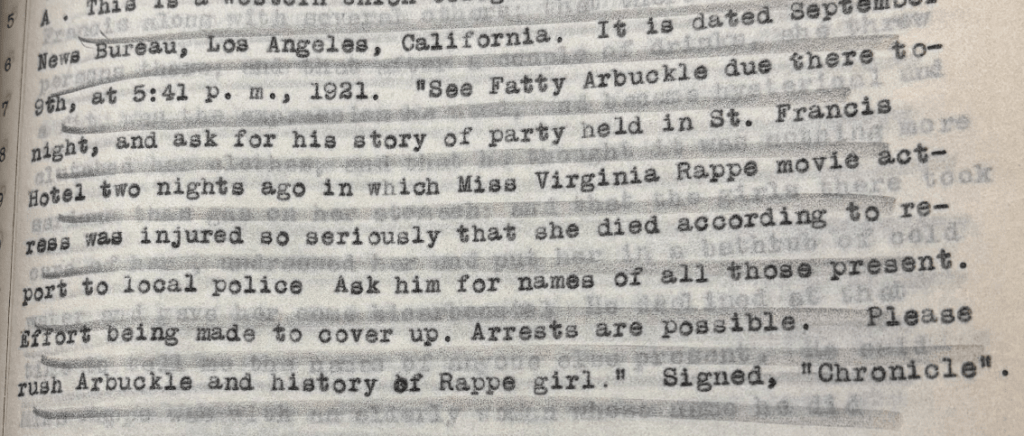
He was prompted to meet Arbuckle by a telegram from the San Francisco Chronicle. It was hard not to ignore its urgency—and both newspapers would sell plenty of copies by sharing information. The Chronicle wanted answers from Roscoe Arbuckle about his Labor Day party of September 5.
The Times sent Woolard to Arbuckle’s Tudoresque mansion on W. Adams Street. The reporter arrived arrived just after 7:00 in the evening. He rang the bell and was met at the front door by an attractive woman who identified herself as Arbuckle’s secretary. This was Catherine Fitzgerald (see “Arbuckle’s housekeeper, secretary and escort: Catherine Fitzgerald”). He gave her his card and she told him to wait outside.
If you are familiar with The Day the Laughter Stopped (1976) by David Yallop, who claimed to have used the trial transcripts to write his book, he describes a rather different scene on p. 132 that was surely intended for a screenplay that any assiduous research would have spoiled.
At 10:30 p.m. that Friday evening, Roscoe Arbuckle sat quietly studying the script for his next picture. The doorbell rang and his butler opened the door. Two dozen reporters charged past the butler, knocking him over. They poured all over the house, taking photographs and looking for Roscoe. Surrounding him, they began to fire questions based on the statements that had already been made in San Francisco by Maude and Alice. [. . .] “Is it true that you screwed five women during the afternoon?”
That is not how it went. According to Woolard, Arbuckle soon appeared. The comedian asked Woolard to follow him away from the house, so that they could talk in private. Arbuckle did not need to be told about what happened in San Francisco earlier in the day. Friends had informed him of Rappe’s death.* And, as their conversation began in earnest, the actor Lowell Sherman joined the two men on the sidewalk. He had apparently come from a back door. Arbuckle denied hurting Rappe. He had only pushed her down on a bed to keep her quiet. And so on. This is in Wallop, all taken from Woolard’s reportage the next day, September 10, as well as that of George Hyde of the Chronicle.
Arbuckle wasn’t “studying” the script for a silent film. Instead, Lowell and other partygoers were getting on the same page and had been getting on that page during the afternoon of September 9. And this continued into the night, when Woolard attended a meeting held in the office of Grauman’s Million Dollar Theater. What Woolard curiously omitted from his testimony was the presence of Arbuckle’s first lawyer, Frank Dominguez. The first thing he did was school Arbuckle with the understanding that anything he said needed to be made only with the advice and consent of counsel. So, I will attempt to square this in the work-in-progress. It may have simply been a courtesy extended by the journalist to one of the most important criminal defense lawyers in Los Angeles during the 1910s and ’20s, the kind of man you heard when he said, “I’m not here,” and you wanted to keep your job.
Warden Woolard did. He went on to enjoy a long and storied career, including assigning reporters to the Black Dahlia case. George Hyde, who likely wired the Times for the initial scoop and wrote the first columns about the Arbuckle case for the Chronicle, either resigned or was released soon after. He went on to testify at the third trial. But offered very little in substance. He came and went from the stand in minutes. His career took another direction. For a time, he worked for various newspapers in Los Angeles, including the Times. But he was never assigned to anything like the death of Virginia Rappe again. For a time he the publicity agent for the evangelist Aimee Semple McPherson. Eventually, he returned to San Francisco, where he poisoned himself in July 1932, “in a fit of despondency,” after a long period of unemployment.
Woolard read the text of the Chronicle’s telegram in open court. The underlining, suggesting its importance, was made by Arbuckle’s lawyer Nat Schmulowitz. (Courtesy of the San Francisco Public Library)
*This was really one “friend,” Rappe’s manager Al Semnacher. He may have monitored her decline, which provided more lead time for damage control. The problem for Arbuckle was his own hubris and the absence of his personal lawyer, Milton Cohen, Dominguez’s law partner, who was en route from New York during this critical time.
Toward the end of the third trial in late March 1922, Milton Cohen, one of Arbuckle’s five defense lawyers, cross-examined Kate Hardebeck at length. She was a rebuttal witness for the prosecution and had been Virginia Rappe’s longtime foster mother and housekeeper known as “Aunt Kitty.”
Cohen had a special place in Arbuckle’s defense. Not only was he the comedian’s personal lawyer, he had once been Rappe’s. He knew her, had been a friend. However, now that she was deceased and Arbuckle accused of having causing her death, Cohen was no longer bound by lawyer-client privilege. Thus far, he had used his personal knowledge of Rappe’s time in Los Angeles to procure witnesses who vouched for her alleged episodes of hysteria triggered by the smallest amounts of alcohol.
Cohen also knew that Rappe had left a paper trail over the years. She traveled a great deal and sent letters, postcards, and telegrams to not only the one foster mother, but the other who testified to Rappe’s good health and morals, namely Katherine Fox. Both women proved to be effective rebuttal witnesses, who painted a sympathetic portrait of their former charge. The prosecutors, especially Assistant District Attorney Milton U’Ren, wanted this idealized image of the victim preserved and to counter the “unfortunate” but fallen woman advanced by Arbuckle’s “million-dollar team” of lawyers.* So, the two foster mothers were undoubtedly encouraged not to mention any correspondence and stonewall where necessary, especially if that might intrude on the happy, girlish creature they described on the stand. And they may have done better than what was asked for. They told the defense lawyers that they had destroyed their foster daughter’s letters—this despite how precious she had been to them.
But one such document still existed. It lay on prosecution side of the shared consuls’ table. Cohen fixed on it. Was that the “diary” Al Semnacher, Rappe’s putative manager, had mentioned during his testimony a few days ago?
“Mr. U’Ren,” Cohen asked, “will you be good enough to let me have Miss Rappe’s diary?” Then Cohen turned to the witness. “By the way, did you deliver Miss Rappe’s diary to Mr. U’Ren.”
U’Ren started to object but Cohen cut him off. “I beg your pardon, just let her answer.” And Hardebeck answered in the negative.
When U’Ren handed the tiny book to Cohen, the latter saw that it wasn’t the diary. It had tabbed pages from A to Z. Nevertheless, he continued his fishing expedition.
COHEN: Q. Mrs. Hardebach (sic) have you ever see a book about six inches long by three inches wide, the sheets being gold edged?
A. No.
Q. And a black leather cover?
A. This is the book Miss Rappe had besides her address book, and we discarded that when we left Ivor Avenue, because it was full and had come apart.
Q. You say you discarded that book?
A. Miss Rappe discarded it before we left Ivor Avenue; and after that we had no telephone, and it was not necessary to keep the book.
Q. This is the only book, then, that you have?
A. Yes.
Aunt Kitty responded in a way that suggests there are two books: one for addresses, one for telephone numbers. While such items could be discrete objects in 1921, this didn’t sound convincing. So, Cohen continued to grill the witness. He needed a diary—or just a simple daybook, a proto-planner—with dates and jottings that might put Rappe where she had an episode, one that anticipated the fatal one ascribed to Arbuckle just two weeks before the Labor Day party of September 5, 1921.
In the end, Cohen let the matter go. U’Ren, however, did not. During the redirect examination, he took the precaution of burying the issue of a diary once and for all.
U’REN: Q. Mrs. Hardebach (sic) did Virginia Rappe keep a diary?
A. Not to my knowledge, no, I am sure she did not.
*In the revised narrative, a more accurate version will fall between these two contrived ones created for Arbuckle’s trials.
The Arbuckle case narrative, while seeing some judicious cuts in the coming weeks, will not lack for fine detail. A case in point is Virginia Rappe’s modeling career, which began early, in 1905, at the School of the Art Institute of Chicago, given what is found in the trial testimony.
Rappe was certainly young for such work. Those who knew her insisted that she was no more twelve at the time and still in grade school—the Moseley School—at E. 24th and Wabash.*
While girls her age might have learned to sew after school, help with supper, take care of younger siblings, and the like, Rappe posed for aspiring commercial artists and photographers. And it’s possible that even at her tender” age she posed for figure drawing and life studies at a time when Georgia O’Keefe and Thomas Hart Benton were students as well as other notable alums.
The young woman is hardly shy about being photographed au natural among the Art Institute’s class of 1905.
Rappe’s image was commodified early, as well. She appeared in newspaper illustrations, wearing “sweaters and hats,” according to one of her foster mothers. But it would be hard to pick her out. Like her later magazine covers, such illustrations were highly stylized. They all look like Gibson Girls.
The sweater girl of 1908 (Newspapers.com)
In any event, in some attic, an old sketchbook, a tattered portfolio, perhaps even a crude first sculpture, Virginia Rappe’s likeness still exists in sublime anonymity.
*My reading of the transcripts has cast some doubt on the 1891 birth certificate first cited in Greg Merritt’s Room 1219. That said, as an adult, Rappe’s was rather petite as an adult. Without her French heels, she was 5’4”.
The transcripts were the personal copies of Arbuckle’s lawyers. (Courtesy of San Francisco Public Library)
The transcripts of the three Arbuckle trials proved to be revelatory. I have spent the past six days working with them. And I will have weeks of reading ahead of me as well as an entirely new narrative to consider. It’s like having all the bones of a museum’s brontosaurus in the entrance hall. The transcripts release me from depending too much on the newspaper reportage of the period, on reporters who came of age during the heyday of yellow journalism.
What I also learned was that every book and article previously written about the Arbuckle case and his alleged victim, Virginia Rappe, put their “bones” together wrong. To be continued . . .
The opening argument of the second trial asserts that Virginia Rappe’s presence at Arbuckle’s :abor Day party was hardly a coincidence but rather prearranged by her manager. (Courtesy of San Francisco Public Library)
This is an addendum to our previous post. Newspaper archives can also be a valuable source for medical and legal precedents as they relate to the Arbuckle case. We found one source that is worth noting. It further supports the hypothesis that the fatal injury that Virginia Rappe suffered had to involve violence or, at least, physical mistreatment approximating the same. And this nineteenth-century case is one that so far comes closest to People vs. Arbuckle. We found it in The Household Narrative of Current Events by Charles Dickens.
The author of A Christmas Tale, David Copperfield, Oliver Twist and so many other classics also published magazines in the 1850s. Bound annual volumes existed. But you wouldn’t find them in Dickens’ collected works. So, as well-read as some of the Arbuckle trial reporters and lawyers were—Gavin McNab, Arbuckle’s chief counsel, was an autodidact who could quote Shakespeare from the vast library his father amassed—we can’t expect anyone in 1921 to know about Dickens very Victorian reportage from seventy years in the past.
But it can be found with the right keywords. In the October 1854 number The Household Narrative, Dickens described a case of spontaneous rupture of bladder in a female victim. The young woman, Matilda Jane Lodge, had been invited aboard the hulk of the HMS Victorious, a former ship-of-the-line reduced to a floating barracks for the Royal Marines, by a lieutenant serving aboard the steamer HMS Dauntless, also at anchor on the Thames.* Miss Lodge and her friend Emma White had spent the day drinking brandies and water with the lieutenant. He eventually lured them to the Victorious, and took them to his quarters. There the two women drank brandy—without water. Miss Lodge had port wine as well. Thinking that port might be drugged, Miss White departed, while Miss Lodge continued to drink. She eventually entered the gun room and entertained the lieutenant and his friends. She sang songs. She recited Shakespeare. She began to scream. She felt sick. She became hysterical. She was carried back to the lieutenant’s bedroom, from which she was said to have fallen.
The next day she was rowed back ashore, with the sleeves and front of her dress torn off. She was virtually topless as a ferryman pushed her in a wheelbarrow to the police station
The constables could see the many bruises on her arms, legs, and torso. She had a pronounced black eye. She had been severely beaten. But she was evasive. What she did say over and over again was that “I am dying”; “I am a murdered woman.” She was right. In a few days, she was dead and the criminal investigation began.
An autopsy was performed. Her bladder had ruptured at the fundus (the “crown”). Lodge had died of rupture attributed to a distended bladder.
You can read Dickens’ version below. His narrative is so close to what confronts us in People vs. Arbuckle that it must serve admittedly as too-clever, too-consciously literary, as poignant indirection to set up the story we tell over many more pages, a like “disgraceful scene.” But we do use paragraphs unlike our eminent Victorian below.
*A careful reading of the original accounts in the London newspapers archived in the British Museum reveals that Dickens had elided over this and other details in digesting the story from various and conflicting sources.
NARRATIVE OF LAW AND CRIME
A Disgraceful Scene attended with Fatal Consequences, took place on board the hulk Dauntless, in Portsmouth Harbour. On Sunday evening, the 17th ult., two young women of loose character, Matilda Lodge and Emma White were taken on board the vessel by two officers, one of whom was Lieut. Knight, of the marines; arrived on board, they went into Mr. Knight’s cabin, and were supplied by him with wine and brandy and water, through the half open door leading from the gun-room where the officers were drinking. The girl Lodge became intoxicated, and ran singing into the gun- room among the officers. Afterwards she became violently ill, and after remaining for some hours, screaming in great agony, she was put into a boat and sent on shore, her companion having previously left the ship. Lodge was found by her mother at the police station in a dying state, and expired two days afterwards. An inquest was held on her body. Her companion detailed the circumstances till she left the ship at one o’clock in the morning. A marine on duty stated that the deceased screeched fearfully and lay screaming on the floor, until she was carried into Knight’s cabin and placed on his bed. She continued screeching at intervals up to four o’clock. The officer in command had wished to have her removed from the ship; but the surgeon thought this dangerous. Lieutenant Jervis, who had gone to bed early, was waked up by her screeching and the knocking she made against the bulkheads: he visited her twice, and behaved with great kindness: Lieutenant Knight was sleeping, with his head on a pillow, on the table. Matilda Lodge fell twice out of bed. The boat- man who rowed her ashore, said that her hair was hanging all about; her dress was torn at the shoulder, and in a terribly ruffled state. She was not sensible. The police inspector stated that when brought to the station she was insensible, and smelt strongly of port wine; her dress was much disordered, and she had nothing but her shift sleeve on her arm; her hair was hanging loose down her back. Her mother gave the following evidence: “I found Matilda in the station- room, her clothes much disordered, the sleeve torn out of her gown, and her scarf very dirty. I said to her. ‘My dear girl, where have you been to get served like this?’ She appeared to be very ill. I tried to lift her up. She said, ‘Don’t mother; I cannot move. Mother, I am dying; I shan’t live long. I have received my death-blow.’ I said, ‘You must go home.’ She said, ‘I can’t.’“ She took her home, however. “I said to her, ‘You have been cruelly ill treated.’ She rejoined, ‘Yes, mother, I have; I shall die.’ She said something to me besides concerning the outrage, but I told her to lie quiet, and when she got better we would talk it over. I told her, ‘I hear you were on board of a ship.’ She said, ‘Yes, mother, and Emma was there too; we went together.’ She said, ‘After Emma left I was unconscious.’ I said, ‘I think you must have been drugged.’ She replied, she did not recollect anything about it. Her arms were black in places, one of her eyes was blackened, her cheek was all colours, and she had a bruise under her chin. She was sensible from the time I first saw her at the station house until the time of her death, between twelve and one o’clock on Wednesday last. My daughter was about twenty-two, a single woman.” Lieutenants Seymour, Knight, and Jervis, and Assistant- Surgeon Roche, tendered their evidence; and it would lead to the belief that the girl having got drunk, hurt herself by falling about. They declared positively that there was no fighting in the gun-room, and no violence of any kind offered to the young woman. The medical evidence, after a post-mortem examination, was to the effect that her death had been caused by rupture of the bladder. The coroner’s jury returned the following verdict—”We find that, according to the evidence given by the medical men, we are bound to return a verdict that Matilda Jane Lodge died a natural death from rupture of the bladder; but we also find, from the evidence given before us, that death was mainly accelerated by ill-treatment which she had received on the night of Sunday the 17th of September 1854, in the ward-room on board of the hulk of her Majesty’s ship Dauntless, lying in Portsmouth Harbour; to which we respectfully call the attention of the authorities.” A further inquiry took place before the Portsmouth magistrates on a charge of manslaughter against Lieutenants Knight and Seymour. The result was, that both the prisoners were acquitted of that charge. In announcing the judgment of the magistrates, the mayor carefully went over the whole case; dismissing the charge against Lieutenant Seymour with the remark, that he left the court without his character being affected by the charge; but censuring Lieutenant Knight, while he dismissed the criminal charge against him,—for having taken the woman on board, and for having shown so little interest in her fate as to allow her to be put in a boat without seeing her off. There was not, he said, evidence sufficient to justify the sending of Lieutenant Knight for trial. Mr. Knight was therefore discharged by the magistrates; but he remained under arrest, awaiting the pleasure of the Lords of the Admiralty, on his own application for a court-martial.—Courts-martial were held on the 10th and 11th inst., on Lieutenant Knight, Lieutenant Jervis, and Lieutenant Elphinstone, who was in command of the vessel when the affair happened. The charges against Mr. Knight were: 1. That on the 17th September he brought “on board her Majesty’s hulk Dauntless two improper women; and did act improperly towards such women, in supplying them with wine and spirits in immoderate quantities when so on board the said hulk; the same being scandalous actions, in derogation of God’s honour and in corruption of good manners;” 2. that he suggested to Mr. Robert Hancock, Midshipman, falsely “to inform the chaplain of her Majesty’s ship Dauntless, that the women which he, the said first lieutenant Frederick Charles Knight, had so brought on board the said hulk, were sisters of him, the said first lieutenant; he the first lieutenant well knowing at the time that such was not true; the same being a scandalous action, in derogation of God’s honour and in corruption of good manners;” 3. that he appeared without “his proper uniform; and without having obtained the requisite permission, dispensing with the wearing of such uniform;” 4. that he was drunk on the night of the 17th and the following morning.—Lieutenant Knight was acquitted of the second and fourth charges, and found guilty of the first and third; but, in consideration of his previous high character, the sentence of the court- martial was, that his name should be placed at the bottom of the list of the lieutenants of the Royal Marines. The charge against Lieutenant Jervis, was, that he, being in command at the time, had suffered two women of improper character to remain on board after sunset; and that, having become aware of their presence between one and four o’clock, he did not report the same to the commanding officer. Lieutenant Jervis was acquitted of these charges. The charges against Lieutenant Elphinstone, were, that he, while senior officer on board the Victorious hulk, did permit the women to remain on board after sunset; did not report the fact to his superior officer; and allowed wine and spirits to be supplied to the women from the ward-room in immoderate quantities. After evidence had been heard on the three charges, Lieutenant Elphinstone read a brief address in defence. He pleaded that he was ignorant of his responsibility at the time, not knowing he was senior officer; that the liquor was passed to the women too quickly for him to prevent it, after he had protested against it; and that it was only after he had left the ward-room, and while undressing, that he found from what fell from Lieutenant Woodman, that he himself had been the commanding officer while in the ward-room. Lieutenant Woodman deposed to the last fact.—The Court deliberated for an hour, and then pronounced this decision—”The Court is of opinion that the charge is partly proved against Lieutenant Buller Elphinstone, inasmuch as, although he remonstrated against the disgraceful proceedings mentioned in the charge, he did not with sufficient promptitude ascertain whether he was or was not the senior officer at the time he was applied to by the chaplain; and that he did not, as such senior officer, prevent by the exercise of his authority, such disgraceful proceedings. And the Court doth adjudge that the said Lieutenant Elphinstone be admonished; and the said Lieutenant William Buller Elphinstone is hereby admonished accordingly.”
There are several provisional passages in the work-in-progress that advance this or that hypothesis in regard to what really happened in room 1219. The most controversial—and the most likely—is developed and is expressed best below. But it might only see the “director’s cut” in this form. Returning to an earlier blog post about the real room 1219 on Labor Day 1921, we can see where Virginia Rappe likely suffered a hard landing and object, surely much harder and far more injurious than the Coke bottle in Kenneth Anger’s fable.
Forensic photograph of room 1219, St. Francis Hotel, mid-September 1921 (Edward O. Heinrich Collection, University of California-Berkeley Library)
Surprisingly, there were applicable cases involving women of Rappe’s age and alleged condition in nineteenth-century medical literature—and in the literature of medical jurisprudence. These cases seemed relevant to the prosecution. If Arbuckle’s lawyers had been apprised, avoiding any mention of such cases and the dots a juror might connect were paramount.
Alfred Swaine Taylor, “Accidental Ruptures of the Bladder,” The Principles and Practice of Medical Jurisprudence, (London: Churchill, 1865), i:676.
“Rupture of the Female Bladder—Death,” New Orleans Journal of Medicine 22 (1869): 359–59.
“A Mirror of Hospital Practice, British and Foreign [. . .] St. Bartholomew’s Hospital [. . .] Rupture of the Female Bladder [. . .],” Lancet, February 25, 1893, 413–14.
One didn’t need Google Books a century ago. They were special cases, rare and worthy of special interest during what was the Golden Age of Spontaneous Bladder Ruptures.
Finding the above short list and citing it in court shouldn’t have been so hard. Such literature would have been accessible to urologists, perhaps even on the office shelves. But no urologists took the stand. The photograph of 1219 that was a big clue for us may not have been shown to the jury. Nevertheless, we had to go there even if the prosecutors didn’t.
This passage prefaces the second trial testimony of Dr. George Franklin Shiels, whom we discussed in our previous post.
When the prosecution put their heads together at the beginning of January, they had much precedent to go on. The hung jury—a jury Matthew Brady saw as tainted—only meant waiting for a fair, open-minded jury and staying on course. The devil was now in the details and that could prove to be a problem for winning this case. Despite more nuanced and pointed examinations intended to trip up the most effect witnesses for the defense, the press wasn’t taking notice. Reporters were fewer in number and had less column inches to fill. They could put their feet up on the desk sooner and it was galling how often they summarized the work of Milton U’Ren and Leo Friedman with a stock phrase with so and so’s testimony was more or less “the same as the first trial.”
What should have grabbed the attention of the newspapermen and -women were the medical experts for both sides. But it wasn’t happening. Not one physician had ventured into room 1219, where the prosecutors believed Rappe had suffered such a rare and fatal injury. Why hadn’t Friedman led these men there. He could well see why his opposite, Nat Schmulowitz, had to lead them away. He had to keep Arbuckle apart from Rappe. Friedman had to put them together, indeed, had to press them together in some way that was the “fatal embrace” no matter the pathos or bathos of this scene to a juror. A well-read urologist or pathologist could have plied Friedman with cases of spontaneous bladder ruptures not unlike Rappe’s in Arbuckle’s bedroom.
The case of Julia G. had been printed in dozens of medical journals in 1869 like some cause célèbre in the medical world. At twenty-six, this married woman, the mother of six children, was admitted into a Dublin hospital. She claimed she had retired to bed under the influence of drink. She woke to pass water, but failed to do so, and as she returned to her bed, she fell over the footboard and fainted. All Friedman had to do was show that photograph of the brass beds in room 1219 and weather a storm of objections from Schmulowitz. Julia G. had been autopsied. Her bladder had been torn at the fundus. There were other grisly details and maybe her tumble—these were Victorian physicians—was due to the act of conceiving her seventh child.
The Principles and Practice of Medical Jurisprudence, a classic in print since 1865, asked a very relevant question: “Can the bladder be ruptured by an accidental fall, and if so, by what kind of fall?” The answer began with a Mr. Syme, who showed “that this accident may readily occur” in 1836. A woman, aged twenty-six, fell forward over the edge of a tub, and fainted immediately.” She lived for less than a week. And like Rappe, her peritoneum being “extensively inflamed.” Friedman could show that photograph to Dr. Shiels or just point to the diagram of room 1219. Shiels had to know this book. Had he kept his promise to produce a bibliography to the court, it might have been listed right there.
Rappe had a precedent for the violence done to her as well, in an 1893 issue of the Lancet. A woman aged thirty-four, while intoxicated, was “kicked in the abdomen and roughly used” on the evening of August 2, 1892. Her symptoms, her fatal peritonitis, and her autopsy resembled Rappe’s. Had Friedman known of this case—he just needed a finger running through various bound indexes in a good medical library, like Stanford’s, a finger belonging to, say, Dr. Ophuls—then questions could be posed never asked at the first trial. The only thing holding the young prosecutor back were sensibilities and stomach of the jury to see the belly or the knee or the foot or the fist applied to Miss Rappe’s person.
In a few weeks, we plan to spend five days visit the San Francisco Public Library to conduct our first on-site inspection of the transcripts for the three Arbuckle trials as reported in our blog entry of September 17. Since that posting, we have made further “core samples” using the testimony of Dr. George Franklin Shiels. He was a lecturer in medical jurisprudence and advised physicians on how to conduct themselves as medical experts on the stand as well as expect a fee commensurate with what they charged their patients. Dr. Shiels also lectured on the surgery of combat wounds based on his experience in the Spanish–American and Philippine–American wars—and he was hardly limited by these specializations.
Volume 2 of the second Arbuckle trial testimony (San Francisco Public Library)
During the early 1900s, general surgeons like Shiels could call themselves gynecologists, as he did, without a specific degree. He also felt he could speak as a urologist and a pathologist. He was a consulting alienist (i.e., psychologist) at the 1907 trial of Harry K. Thaw for the murder of the famous New York City architect Stanford White (reenacted in the film Ragtime with Norman Mailer, in a cameo performance, taking the bullet atop Madison Square Gardens in 1906). As such, Shiels saved Thaw from the electric chair by overcoming Thaw family’s reluctance to go along with the insanity plea by calling White’s murder a case of dementia Americana.
Dr. Shiels’ testimony at the three Arbuckle trials for the defense was considered persuasive by the press if not the jurors. He came up with the “toy balloon” hypothesis to explain away the fragility of Virginia Rappe’s bladder, such that a cough, a sneeze, and the like might cause it to “pop”—as he put it—spontaneously.
What we wanted to see was the difference between the reportage in 1921 and ’22 and the testimony. The former suggested that Dr. Shiels cited medical journals and textbooks to validate this hypothesis. To our surprise, however, neither was he prepared to cite the literature, nor was he up to speed on relevant testimony. He relied on his eminence and was caught on his cursory knowledge of Rappe’s mild cystitis at the second trial. At the third, he described the symptoms that she suffered in room 1219 not unlike Bladder Pain Syndrome (PBS) today and so mischaracterized a woman going into shock from a dire internal injury.
The testimony also revealed something else that reporters didn’t report, given the sensibilities of their readers a century ago. Dr. Shiels made special mention of Rappe possibly bearing down to urinate. Under cross-examination, Assistant District Attorney Leo Friedman took great interest in the “bearing down.” But Arbuckle’s lawyer, Nat Schmulowitz, managed to interrupt this line of testimony—perhaps because it strayed too close to what the comedian was doing outside of the bathroom door when he allegedly found Rappe on floor of room 1219’s bathroom. That is, to keep the jurors from asking themselves what happened before. Was he listening to Rappe? Asking her to hurry up? Making a joke of her predicament? (You have to realize that the defense lawyers took great pains to distance their client from the victim. It’s something we think about a great day. Previous Arbuckle narratives don’t really appreciate that Rappe and Arbuckle had paired off during the Labor Day party.)
Ultimately, what we saw in Dr. Shiels’ testimony supports our contention that the prosecutors and there performance in court took second place to Arbuckle’s lawyers. Oftentimes, the prosecution’s efforts weren’t even being reported or disparaged. Friedman, however, was quite careful and nuanced as we expected him in tress-testing the assertions made by Dr. Shiels. We were only disappointed in that Friedman didn’t go harder on Shiels. Perhaps he feared embarrassing a witness who was seen as pillar of the medical community.
In one case, Dr. Shiels claimed that he had contributed to the pioneering text, Urology, the Diseases of the Urinary Tract in Men and Women (1912) by Ramon Guiteras. Shiels not only wasn’t acknowledged by Guiteras, Shiels took the stand as if he hadn’t cracked the book. “I don’t remember just what Guiteras’ classification was, but I am pretty well certain that he did not believe very much in spontaneous rupture of the bladder,” he testified on the fly. “I have had conversations with him on the subject.” In reality, the late Dr. Guiteras would have made a better expert. In regard to spontaneous rupture, he wrote on p. 20 of Urology that a “rupture of this type depends primarily on a disease of the bladder wall [. . .] especially if in such cases a great effort is made by the bladder or abdominal wall to force out the contained urine.”
George F. Shiels and his Congressional Medal of Honor (Wikipedia)