“Rupture of the Female Urinary Bladder” by K. Sellers Kennard, M.D.
N.b. This article appeared in the May–June 1923 issue of the Medico-Legal Journal, vol. 11, no. 3, pp. 71ff. The author, Dr. K. Sellers Kennard, was Assistant Medical Examiner for New York City as well as an instructor in anatomy at Fordham University Medical School in the 1910s and 1920s. This document is cited in our forthcoming book and, we think, for the first time in relation to the Arbuckle Rappe Case. Notice the editor’s note at the end of the article that posits a “consensual” theory. Notice, too, that he doesn’t disagree with the “lithotomy position.” In addition to meaning on one’s back with knees up—and clasped together in self-defense, as Dr. Kennard means below—the lithotomy position can mean knees parted, dorsal recumbent (the so-called “missionary” position) as well as knee-to-chest on a flat surface such as a mattress, or standing, supported by a table, bathroom sink, and so on.
Traumatic rupture of the urinary bladder is a condition which in the great majority of cases is of surgical interest only. The injury though of considerable frequency has its most obvious legal relations to civil actions in suits for negligence or of claims under accident insurance policies or Compensation Acts and Employers’ Liability statutes. Apparently where the rupture of the bladder is the sole competent producing cause of death, it is of extreme rarity as the result of criminal acts. When the bladder is ruptured, most often fractures of the pelvis as the result of great crushing force is the cause; or punctured or incised wounds of the abdominal wall may extend into the bladder and injure it.
But this is not rupture per se, for that form of bladder rupture which we desire to note here is produced by force applied directly to the abdominal wall and the injury is unaccompanied by any other evidence of disease or of force to related parts. The mechanics by which a healthy bladder is ruptured by force applied to the anterior or lateral lower abdominal wall is no doubt well understood by the physician. The writer’s views on this subject were expressed in an article published in the Medico-Legal Journal, vol. 38, No. 1, p. 5. The method there discussed applies equally to the bladder with the exception that it is necessary for the bladder to be distended with fluid, otherwise in the empty or slightly distended condition the rules of transmitted force applicable to other organs would not strictly apply.
This was done not for the purpose of any surgical instruction, but primarily for medico-legal interest, for counsel may be very persistent, and rightly so, as well as exacting, in his desire to be informed how and why some given injury of an internal organ occurred. The medical testimony as to how an injury occurred anatomically may have important bearing on a case, for it can be used to prove or disprove an alleged cause of an injury.
Putting aside all those instances of rupture of the bladder occurring by obvious means and in the presence of witnesses, or by apparent accidents of trade, occupation or travel, it is hardly to be questioned that rupture of the female urinary bladder is of prime investigative importance. Hardly is it secondary in importance to rupture of the uterus and it seems to the writer that it may be accepted as a medico-legal axiom that a case of rupture of the urinary bladder of a woman, occurring under circumstances which do not admit of ready explanation either by verbal testimony or apparent circumstantial evidence, is homicidal per se. The degree of homicide is not in question in this presumption, but homicide as distinguished from accident or suicide under the circumstances is the intended use of the term. These cases are most likely to fall under constructive murder, at least in New York (Penal Law, 1044- sub. 2), which provides that an act by a person engaged in the commission of, or in the attempt to commit, a felony either upon or affecting the person killed though without design to effect death is guilty of murder in the first degree. (P[eople]. vs. Schermerhorn 203 N. Y. 57, P. vs. Wolter 26 N. Y. Cr. 519), and while it is possible that excusable homicide by misadventure may explain such an affair, such causation should be of ready explanation and that most likely by the party at fault.
More than rupture of the uterus is rupture of the female bladder presumptive of homicide, for in the former the probability exists that manipulations of the woman herself, though denied, may have caused the injury and this presumption cannot be exluded in spite of denial unless the character and extent of the wound excludes self-infliction and the circumstances of injury admit of possible solution by investigation. Never could this be applied to the urinary bladder alone. This view certainly narrows the field of urinary bladder ruptures, but within these limits the rule of presumptive homicide will be the safer course for the medical examiner to follow.
If the presumption is overthrown by subsequent evidence so much the better for some possible defendant. But if the rupture be tagged as accident even after investigation it will be necessary to determine how an unexplained accident caused, without witnesses or bodily evidence, a rupture of the bladder of sufficient extent to result in death.
Anatomically, these injuries are of two kinds, extra- and intra-peritoneal, the latter having particular interest for us here. Extra-peritoneal ruptures could not likely be caused in the manner we assume the injury to have been produced in the cases noted here. One of the reasons for and one of the points in question for this being the fact that the portion of the bladder which lies behind the symphysis pubes is below the line of reflection of the peritoneum over the fundus and sides of the viscus. Consequently this portion of the bladder could not be subjected to the application of force un less the symphysis were first broken down. As the empty bladder lies wholly behind the symphysis, pressure upon the woman’s abdomen would not rupture the organ in this position, and as the neck of the bladder does not rise with distention, its relation to the line of peritoneal reflection is not materially altered.
The distended bladder lies against the posterior surface of the anterior abdominal wall, usually confining itself without serious discomfort to the hypogastric region. The female bladder does not rise above the pubes until more distended than that of the male, a fact that formerly led to the opinion of its greater capacity. But it is probably due to a more capacious pelvis and thus a second fact is met with in considering the cause of these injuries. The lower half of the female sacrum being more curved than in the male, provides a larger space for a distended bladder to occupy, but renders it more likely to be brought in contact with the projecting sacro-vertebral angle. The sacral curvature also provides a more prominent over hanging sacral promontory against which the bladder can be pushed, a possibility rendered much easier if the female be recumbent and with the thighs flexed or partially so upon the abdomen. This position brings a distended, receding bladder and an advancing body of great resistance in close relationship, and should force or weight be applied to the abdomen intra-peritoneal rupture could result.
Unless surgical intervention is early the injury is almost uniformly fatal from peritonitis. Bartels collected ninety-eight cases, all of which died but four. It has been said that the bladder may rupture spontaneously from over-distention and is a defense. The medico-legal axiom that “healthy tissue does not rupture spontaneously” may well govern this assertion. If the bladder so ruptures there is disease somewhere in its walls. Prolonged over distention from causes outside the bladder may so affect healthy walls that abnormal changes result and permit rupture. This is probably what is meant by spontaneous rupture by hyper-distention but the qualifications should never be omitted, and particularly since it is stated in the most recent authority on Legal Medicine, that “the bladder may rupture spontaneously from over distention without being diseased”—a statement as such which is most misleading.
The autopsy will disclose the state of the bladder walls, and if in a ruptured bladder we exclude unhealthy tissue, we need not be perturbed by a defense of spontaneous rupture.
Coats (Br. Med. Journ. July 21, 1894) reports two cases of uncomplicated rupture of the male urinary bladder. No history of injury could be obtained. One patient was a maniac and the other was intoxicated. The absence of history seems obvious. At autopsy no peritonitis or inflammatory reaction about the bladder wound was disclosed. It was not recorded if microscopic sections were made. If these organs were healthy and with the facts of the personal condition of the patients before us, it does no violence to the imagination to believe that both these injuries were caused by force applied to the bladder through the abdominal wall in some manner.
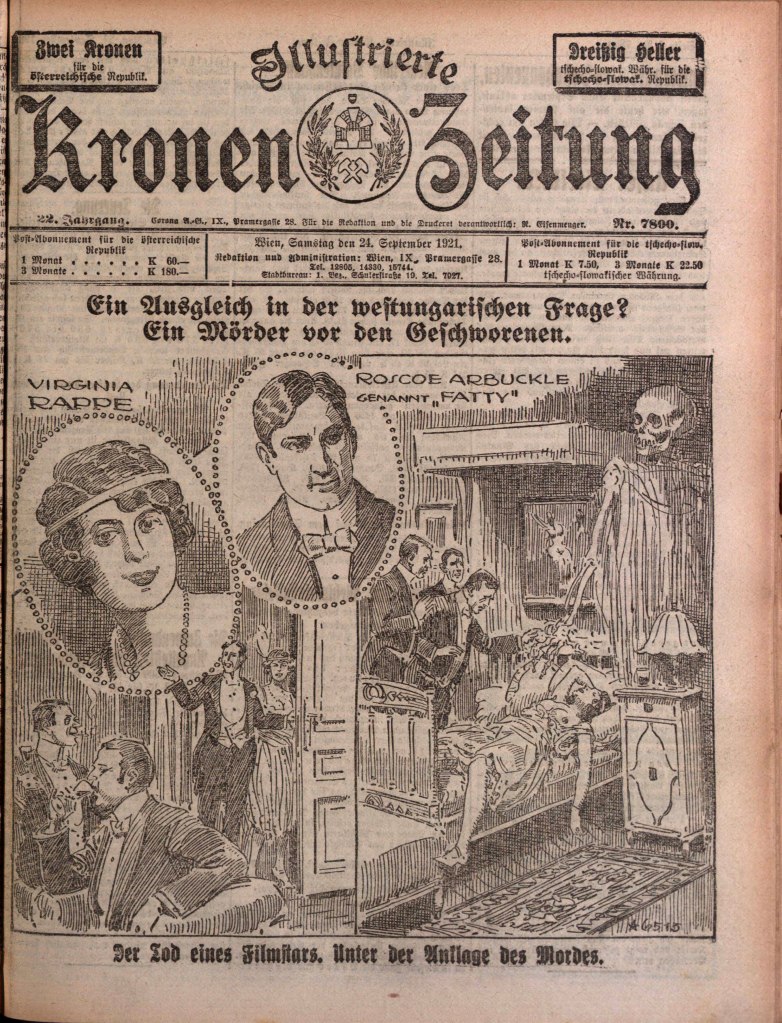
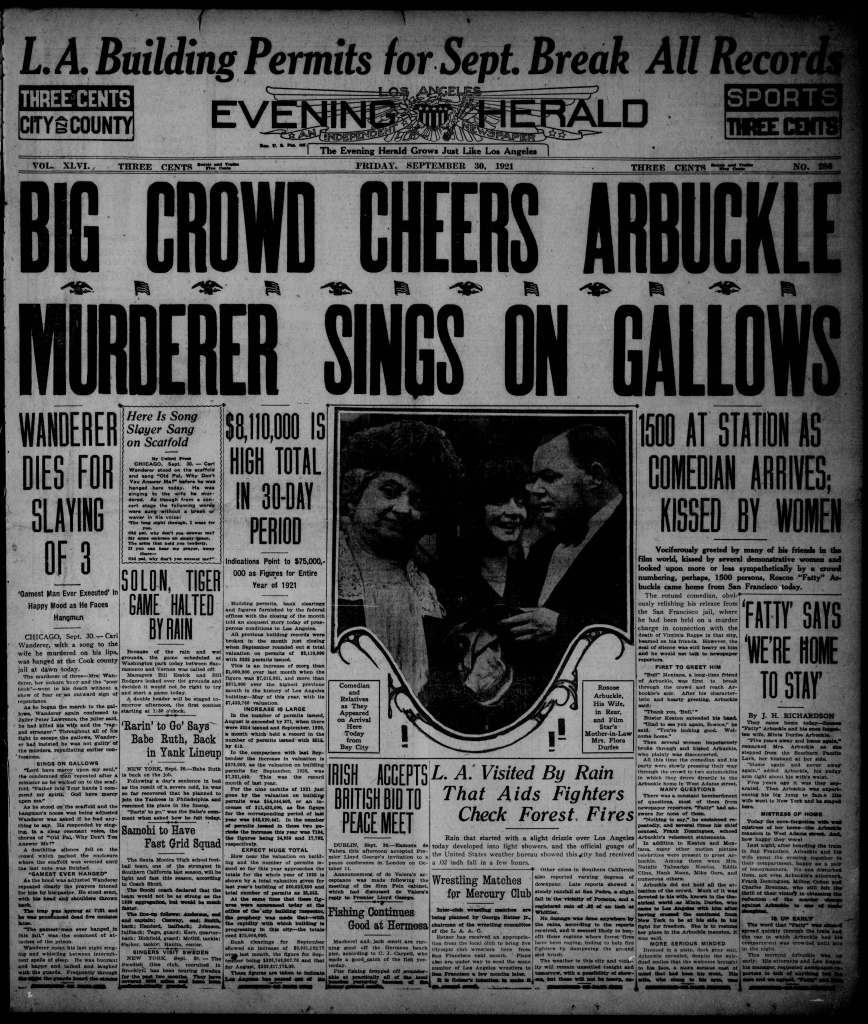
Two cases of rupture of the female bladder have recently occurred in which the injury was assumed to have been caused by the weight of a human body applied to the abdomen of the female during forcible attempts at sexual intercourse. The most famous, and indeed the only case of which apparently there is any record, is the Arbuckle case in San Francisco in September, 1921. The circumstances of this affair as we gather them from the trial notes and reports of the incident are that on September 5, 1921, and at about three o’clock in the afternoon, a sociable gathering was in progress in the apartments of the defendant on the twelfth floor of the Saint Francis Hotel in San Francisco, Cal. A member of the party was one Virginia Rappe, a motion picture actress, two other women, a man and the defendant. The gathering was quite hilarious, considerable intoxicants having been consumed, or so reported, and about the hour stated the defendant forced, induced or followed the Rappe woman into an adjoining room and there committed or attempted to commit a sexual assault upon her.
The statements upon this point of how the two entered room 1219 are conflicting as is much of that which marks the opening of the case. It is reported that after one-half an hour to an hour’s absence screams from room 1219 attracted the attention of one of the other women and upon demanding and finally obtaining entrance, the deceased was found lying upon a bed, clothes much disarranged, writhing in pain and said, “I am dying. He hurt me.”
Such attention as was possible was given; ice was applied to some portion of the body; she was carried to a bath and immersed therein.
A physician, Doctor Karhoe [i.e., Olav Kaarboe], was then called and states that the woman appeared intoxicated; did not seem to be in need of medical attention and on examination at that time saw no bruises.
The next physician called was Doctor [Arthur] Beardslee, who saw the patient at 7 P.M., about four hours after the occurrence; had severe pain in the lower abdomen; could not palpate until after hypodermic of morphia had been given; pain was so great that is over shadowed any evidence there may have been of intoxication; no definite diagnosis at this time. Was called again at 11 P.M.; condition about the same as at first; writhing about and complaining of pain in lower abdomen; did not give rational answers; said very little to her; by this time I felt she was suffering from some internal injury; gave hypodermic of morphia. Called between 4 A.M. and 5 A.M. again September 6; more severe pain; catheterized the patient under ordinary surgical technique. (Small metal catheter exhibited.) The result of this confirmed my suspicions of an internal injury and also assisted in localizing the lesion; immediately knew the bladder was complicated in whatever injury there was; external violence applied to lower abdomen most usual cause of rupture of the bladder; rupture of bladder has occurred with very slight fall; that vomiting itself I don’t believe would rupture the bladder, but the contortions gone through during the vomiting might be a cause or effect; saw black and blue marks on left arm.
The patient was subsequently transferred to Wakerfield’s [i.e., Wakefield] Sanatorium, where she died Friday, September 9, 1921, at 1.30 P.M. An unofficial autopsy was performed at the request of friends of the deceased the same day at 1.30 P. M. by Doctors [William] Ophuls and [Melville] Rumwell. Doctor Ophuls states two spots on inside of upper right arm; bruise on front of left leg; similar superficial bruise on one of thighs, don’t remember which; these were the only abnormal signs I found on the body; bruises on right arm were discolored; none on left arm; continued inspection of bladder; the tear in the bladder did not seem quite fresh nor very old either; the tear was possibly a day or two old at least and not over ten or twelve days; investigated other internal organs and found them entirely intact and perfectly normal.
Q. Going back to the bladder did you find any deposit in it?
A. Yes; there was a small clot of blood evidently there for a day or two; tear in bladder was a clean break; evidence of peritonitis; organs other than bladder perfectly healthy; cause of death was rupture of the bladder.
Q. What in your opinion was the cause of rupture of the bladder?
A. Presumably from a medical view the bladder had been over dis tended and probably exposed to some force from the outside.
The official autopsy was performed by Doctor [Shelby] Strange on September 9, at 8.15 P.M. He states height 5 ft. 5 in., weight 140 pounds. On right arm between elbow and shoulder were three bruises ; two bruises on the lower abdomen and others on thigh and shin; there was a large area 2 in. above the right elbow 1/2 in. in width and 4 in. long, extending around the arm; an inch above this was an area on the external surface of the arm 1-1/2 in. x 1/2 in.; another 1/2 in. from the insertion of the right deltoid, circular and 1/4 in. in diameter; on the left arm noticed a vaccination mark which I used as a landmark; two circular areas, 1/4 in. in diameter, 1/2 in. forward (in front of) and 1/4 in. below this mark; believe hypodermic needle caused these marks.
Q. Any other marks?
A. On the right and left leg and left thigh; on right leg there was a large bruise on the outside of the middle third over the shin bone; this was 7 in. long and 2-1/2 in. wide at its widest point, oval in shape; over the shin bone and extending on either side it began 3/4 in. above the instep; was surrounded by several other smaller marks practically contiguous 1/2 in. above the ankle.
Q. Is that all on the right leg?
A. Yes. On the left leg there was a smaller mark 6 in. long and 3 in. wide at its widest point and oval.
Q. Any other marks on the left leg?
A. Several others. Small areas around the large bruise and almost connected; on the left thigh there was an area 3/4 in. x 3 in. beginning in front at the lower third of the left thigh and extending downward and outward; there were no marks on the back at all or others on the trunk or limbs.
Q. In your judgment, doctor, were these bruises ante-mortem or post-mortem, made before or after death?
Objection: not qualified as expert.
Overruled.
A. The two on the left arm near the vaccination mark were apparently made by a hypodermic needle, each had a little central point where a sharp instrument had been inserted. I assumed the others were made by a blow or a — Objection. Discussion by counsel.
Allowed.
A. Just ordinary bruises which would seem—
Objection; discussion.
Question repeated.
Allowed.
A. My opinion at the time was that the smaller bruises on the right arm were due to finger marks. But as to the other bruises on the body I am unable to say just what had caused them. (Bruises identified by photographs introduced as diagrams.) There was an area in the groin, circular, 1/4 in. in diameter to the left of the central junction of the pubic bones, and another nearer the middle of the body, in. above the first. Both were irregular, circular. Brain negative, as were other organs. Lungs, hypostatic congestion. Stomach given to city chemist. Peritoneum was roughened from inflammation. Bladder and female organs had been removed.
Q. Did you subsequently get possession of them?
A. Yes. Doctor Ophuls brought them to me in a sealed jar.
Q. Describe the condition.
A. Normal.
Q. Absolutely normal?
A. Yes, except for an incision that had been made.
Q. Was it of a normal, healthy person?
Objection.
Overruled.
Q. Did you examine the bladder?
A. Yes.
Q. What was the condition?
A. There had been an operation by incision. (This evidently refers to the previous autopsy as there seems to be no evidence of surgical procedure, but there is no certainty there was not) upon its anterior surface. On the upper and posterior surface I observed a rent in the bladder, a rent or lesion of the wall; it measured fully 3/4 in. in length.
It was testified that microscopic examination of the bladder wall showed a chronic inflammation, but not necessarily of a nature to produce a fatal condition.
The statement of Miss Briggs [i.e., Mrs. Virginia Breig], secretary to Wakerfield Sanatarium, was admitted in evidence over objection and motion to strike out as hearsay that the patient had stated to her “Arbuckle took me by the arm, threw me on the bed and put his weight on me.”
Upon evidence submitted to the Coroner’s Jury, its verdict read as follows: We, the Coroner’s Jury, find the said Virginia Rappe, aged 25 years, residence Los Angeles, came to her death September 9 at Wakerfield Sanatarium from a ruptured bladder, contributory cause peritonitis. And we further find that said Virginia Rappe came to her death from peritonitis caused by a rupture of the urinary bladder, caused by the application of some force, which from the evidence submitted was applied by one Roscoe Arbuckle. We therefore charge Roscoe Arbuckle with manslaughter.
The indictment was for murder in the first degree. The legal aspect of the case is not under discussion, but it may be stated that the defense seems to have been (1) The bruises were produced by carrying the patient to immerse her in a cold bath. (2) That the rupture of the bladder was caused by vomiting. (3) By muscular contraction consequent upon vomiting and immersion in cold water. (4) The application of force by falling from a bed to the floor.
The usual conflicting medical testimony was given. The three trials, jury disagreements and final disposal of this case is no doubt familiar to all. But I would be cheating the forensic physicians of generations yet to come if I failed to remark the following medico-legal gem. It is recorded that an expert for the defense, “Flatly and repeatedly” testified that three drinks of gin in orange juice, followed by immersion in a cold bath, has repeatedly caused rupture of the urinary bladder. Caveat aqua frigida cum succus aurantii![1]
The other case referred to occurred in New York City in March, 1923. On March 17, at 9.30 P.M., Mrs. Frances Cone Beckwith, an actress in company of three men and two girls, attended a party and dance, she having been previously called for by one of the men at 7 P.M. the same day and promised to meet them at the time stated. Some drinking was indulged in and about 12.30 A.M. one of the men and the two girls left the gathering and went home. The Beckwith woman refused to go, or was un able to do so on account of intoxication and rather than create a scene the two men took her to a room on the second floor of the place where the dance was held and laid her, fully dressed, upon the bed. The men then went to a room on the third floor and there spent the night. At 9.30 A.M. March 18 she was found by one of the men, in bed, and still apparently intoxicated. They got her into a taxicab and took her to her residence, 144 E. 61st street. When they reached this address they met a friend of Mrs. Beckwith and he seeing that she was intoxicated and was complaining of colicky pains in the abdomen took her to his own apartment at 308 W. 82d street, as her own apartment was not in a suitable condition for her to remain in owing to neglect of it, and there was no one to care for her. A private physician was called and who treated her until the afternoon of March 19, on which date she was transferred by private ambulance to Roosevelt Hospital, being admitted at 5.30 P.M.
While at the hospital her parents, who had been notified, visited her. They found her conscious, suffering with pain in the lower abdomen; admitted to them that she had been drinking heavily; that she had fallen against objects while intoxicated, but when questioned if any assault or forcible attempt at rape had been made upon her, she refused to make any comment. She admitted that two illegal abortions had been performed upon her in August and in November, 1922. She died March 20, at 3.25 P.M. No definite diagnosis seems to have been arrived at as to the cause of her physical condition.
What transpired on the night of March 17 and the morning of the 18th is according to the statement of the two men in question and pertains to occurrences after the third man and other woman had left the party. There were no bruises on the woman’s chin when she went to the dance. They were when she was seen the following morning.
Autopsy March 21. Frances Beckwith, 22 years, 5 ft. 4-1/2 in. in heighth, weight 126 pounds. Body adult female, white. rigor mortis complete, no colostrum in breasts, vagina large, abdomen markedly distended.
Contusion over left side of chin, 1/2 in. in extent and a superficial scratch mark over the left side of the lower jaw, about 1 in. in length, extending from the contusion. There is a small area of ecchymosis [i.e. bruising], about 3/4 in. in extent, over the crest of the left ilium, which on section shows a small amount of hemorrhage. There are a few superficial scratch marks on the anterior surface of the left thigh, running transverse for about 1-1/2 in. in extent There is a small blue spot on the upper and inner aspect of the right thigh with a needle puncture in its centre. (Saline transfusion.)
Peritoneal cavity is filled with red-stained fluid which has the odor of urine. The small intestines are distended markedly and are covered with fibrin and somewhat adherent in places, but can be easily separated. There is no hemorrhage in the skin or muscles of the lower abdominal wall. There is a mass of clotted blood in the right lumbar region in front of the kidney, in the peritoneal cavity, occupying an area about the size of the kidney.
Heart negative. Lungs, terminal broncho pneumonia. Other abdominal organs negative. Urinary bladder— there is a hole in the bladder over the middle of the posterior surface, extending into the fundus and measures 1 in. in diameter. The bladder is markedly thickened about this area and there is hemorrhage about the margins of the opening.
Uterus measures 2-3/5 x 1-3/4 x 7/8 in. The external os is closed; endometrium normal; surface covered by fibrin; ovaries, tubes and vagina normal. Gastro-intestinal tract negative. Cause of death: Peritonitis, following traumatic rupture of the urinary bladder.
These cases present some very interesting medico-legal points. Both are bare of direct evidence and while we have a statement of the deceased in the former case it does not carry any legal weight, as it is not of the character of a dying declaration. In both these affairs ecchymosis and their kindred, scratches, form from the medico-legal standpoint the entire case, as these show intention to overcome resistance to some objective act. Medically we may dismiss all the defense claims in the Arbuckle case, for microscopic examination shows the bladder normal, and we know that vomiting, bathing or sneezing or muscular exertions would never alone rupture a healthy bladder. The muscular exertion attending these acts, by exerting pressure by the abdominal walls upon a distended, healthy bladder would be most apt, and in fact I think experience proves it to be true, to cause relaxation of the sphincters with an involuntary discharge of urine.
A fall would certainly cause the ruptures in both cases, even a fall from a bed to the floor, if the organ were full, but a fall does not explain either the distribution of the bruises or scratches in either case. For value and interpretation of such marks in cases occurring under circumstances similar to those noted here, the reader is referred to “People vs. Fritz,” Medico-Legal Journal, vol. 37, Nos. 5 and 6, 1920.
Unless plainly demonstrable that they are due to infection or constitutional disease, ecchymosis mean force. Force means resistance by the person who bears the marks, and under the circumstances attending cases presumptive of sexual attacks, the defendant must offer some better explanation of the production of the bruises, if he is to be believed, than one, which upon its face bears the impossibility of competent cause. When a witness testifies he produced bruises upon the left leg and arm of a person by carrying them to a bath tub, holding the said leg and arm, he cannot include bruises on the right leg and arm as contingent to the same act, when there is no further testimony on the point. It has been my invariable experience that when an accused tells the truth, bruises will substantiate him to the most minute particular.
It is possible that the large bruises noted on the right and left legs in the Rappe case may have been produced by striking the limbs against the bed fixtures in pain contortions, but this assumption does not explain the small, isolated bruises contiguous to the larger bruise. Falls do not make bruises circular in extent, though they may be circular in shape, and that on the right arm was of such type. Small, numerous, regularly circular bruises, scattered, yet in relation to each other, are finger marks and when occurring about the ankles or thighs or upon the arms of a female, under circumstances pointing to sexual as saults, have a very significant and restricted meaning. In the Beckwith case the location of the bruises and scratches are equally significant as in the Rappe case. On the chin they indicate an attempt to hold the head down or to stifle cries. In both cases the marks on the body and limbs all bear circumstantial relation to the genital organs of the female.
In neither of these cases is there any doubt from the reports that both women were drunk. Assuming a sexual attack made upon them, each were recumbent. In the Rappe case the thighs were most likely flexed upon the abdomen in lithotomy position, which may readily account for the bruises just above both ankles. There is no such evidence in the other case. Crile (Keen’s Surgery, 1910-1-90) denies that the drunken person is under a special protection of Providence. “In deep alcoholism muscular tone is greatly reduced, and in this state the viscera are sometimes subjected to serious trauma. The muscular tone of the abdomen and lower thorax is such as to protect the heart fairly well against mechanical violence.”
Daily experience in medico-legal practice amply verifies this statement. Force has no special respect for the organs of a drunken person. So it does not seem difficult to assume the reconstruction of these two cases from what medical signs we possess. Both these women were under similar circumstances prior to the critical moment. Both lived about the same length of time after the injury. Both died from peritonitis. In both the wound of the bladder was in the same location and approximately the same character and extent. Organ was normal in either case. The lesser extent of markings upon the body of the Beckwith case was probably due to less degree of resistance on account of greater intoxication.
We readily admit that in both cases the internal injury could have been produced by force applied to the abdominal wall by a fall or otherwise, and that without any external mark to indicate the point of impact. But the very fact that there were marks on the body, and marks not correlative to force as the result of falls alone; marks of such character as to predicate voluntary resistance to something on the part of the recipient, makes the cause of these injuries something entirely different from accidental means or of causative factors residing within the deceased.
These are the things which circumstances must explain away and the circumstances of both these cases admit of no other reasonable explanation than that the ruptured bladder was the result of a more or less forcible attempt at sexual assault.
If either of these women consented to intercourse, what was the reason for the marks found upon their bodies, distributed as they were and indicating a force, quite unnecessary for the accomplishment of any act from consent.
Women under the influence of alcohol, with muscular tone much lowered to the extent that the reflex spasm of resistance of the abdominal wall to mechanical attack is wanting; a recumbent position, with thighs more or less flexed upon the abdomen; a distended bladder from consumption of that which produced the intoxicated condition; force, in the form of weight from a human body suddenly applied to a non-resisting abdomen, and if such weight be productive of sufficient force, the internal wounds found in both these cases seems to be a necessary resultant.
Note by the Editor
In view of the fact that the Jury brought in a verdict of “Not Guilty,” let us assume the following as likely: That the victim of the accident was under the influence of alcohol and had a distended bladder; that she went with the accused willingly for the purpose of sexual intercourse. That during the consummation of the act, and after the penis had entered the vagina with her consent, she complained of severe pain, due to an overdistended bladder and the weight of the accused. That some of the bruises were caused during the consummation of the act. for, as accused could not be assumed to have had the necessary medical knowledge to know that the bladder was being ruptured, and if, as must be assumed, the deceased consented to the sexual act at the beginning, the accused could not have been expected to desist during the act and the result could at most be construed as involuntary manslaughter and the accused must be considered as innocent, both as to criminal intent and act.
ALFRED W. HERZOG
[1] Beware of cold water with orange juice!






 Spite Work: The Trials of Virginia Rappe and Fatty Arbuckle