100 Years Ago Today: “Fatty” leaves L.A. for S.F., September 2, 1921

Roscoe Arbuckle and his companions set out from Los Angeles on Friday, September 2, the day before Al Semnacher left with his party of Virginia Rappe and Maude Delmont. Arbuckle, his chauffeur, and, perhaps, the director Fred Fishback took turns driving. The actor Lowell Sherman enjoyed the view from the backseat.

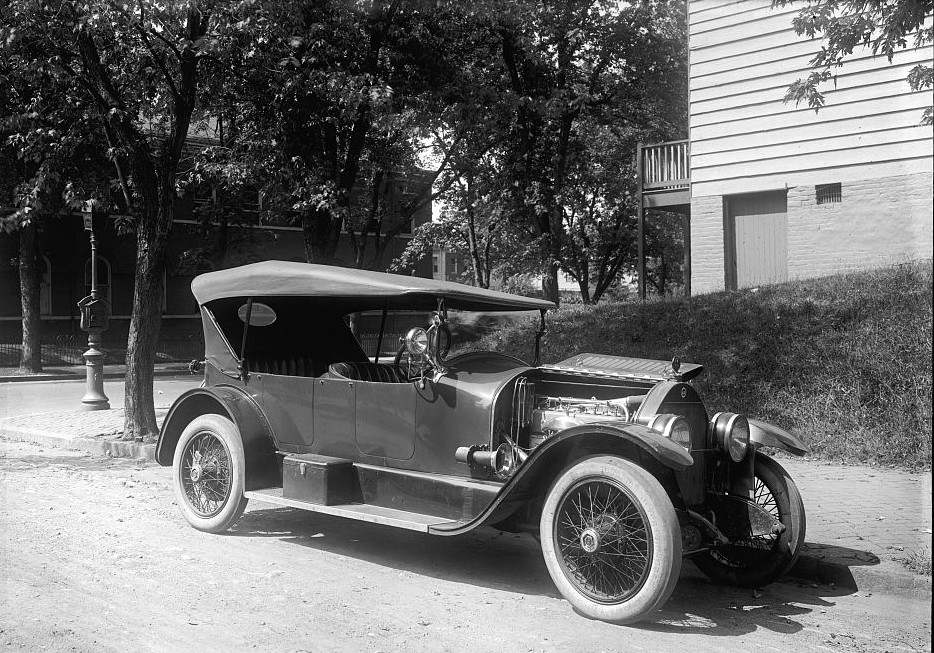
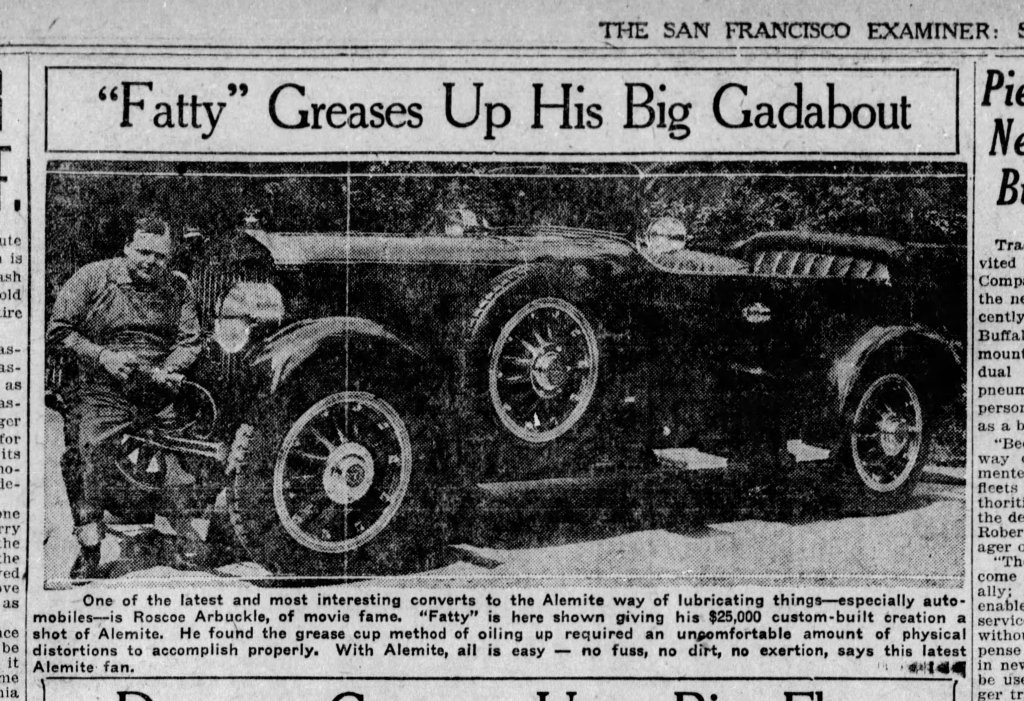
Greg Merritt, in Room 1219, was the first to posit this route, which began on Highway 2 North, the future U.S. Route 101, built atop the old Spanish royal road known as the Camino Real. But this route is conjectural. Arbuckle could have taken the more picturesque coastal route or the quicker inland route to the east that Semnacher took (present-day I-5). The Camino Real, however, would have allowed him to spend the night in Paso Robles, the approximate halfway point between Los Angeles and San Francisco, as he had done in June when he drove his custom purple Pierce-Arrow for display in the new San Francisco showroom of its builder, Don Lee.

Such a layover was quite different from the humble Selma ranch where Semnacher’s entourage stayed. Paso Robles boasted a beautiful hotel and curative hot springs. Arbuckle and Sherman could also sample some of the booze they’d packed for the trip. (Fred Fishback didn’t drink. He was, however, a kind of “cheerleader” to paraphrase Malcolm Lowry’s Consul in Under the Volcano.)

Roscoe Arbuckle using a grease gun on his Pierce-Arrow, ca. late 1920 (Newspapers.com)

Bit Player #5: Harry Barker: The “Sweetheart”

. . . a man and a gentleman who tried to clean himself and keep all around him clean.

Gavin McNab, Chief Defense Counsel[1]

Harry Beaconsfield Barker was one of the most effective witnesses called by Roscoe Arbuckle’s defense lawyers during the first Arbuckle trial. His testimony, too, resulted in their first defeat. Two jury members, including its only woman, wouldn’t vote to acquit.

Barker knew Rappe “intimately” for almost five years, from 1910 to 1914, and had not lost touch with her, even after he had moved to San Francisco in 1918 and married in July 1920. For a time, he even lived in the St. Francis Hotel and may have seen her there, a year later, when his wife was about six or seven months pregnant—that is, about June or July 1921. In other words, they were on good terms.

Barker was considered a surprise witness. Arbuckle’s lawyers, led by California’s Democratic kingmaker, Gavin McNab, surely learned of the connection between Rappe and Barker from their colleagues in Chicago. Best of all, Barker was conveniently in San Francisco.

Barker, like Rappe, had gone West. He was called a “Stockton rancher.” Barker, however, had already made a considerable fortune in northern Indiana real estate and, together with other investors from Chicago, hoped to make more speculating on farmland in the San Joaquin Valley.

Barker was no stranger to courtrooms. He was mired in another legal battle at the time he was called to the stand to describe his relationship with Virginia Rappe. He and his close friend Albert Sabath, the Chicago lawyer who worked for Arbuckle’s defense, were named in a lawsuit and accused of fraud and conspiracy by a group of Chinese American investors over a large tract of farmland on Mildred Island in the San Joaquin River delta. Their lawsuit amounted to $400,000 in damages (over $6 million adjusted for inflation). The case had progressed from the lower courts and would soon make its way to the California Supreme Court. Making this problem go away may have induced Barker to take the stand and discuss his personal life with Rappe.

Barker’s testimony substantiated the assertion that Rappe had a long history of becoming hysterically ill after only a few drinks, that she suffered excruciating abdominal pains, and, of course, tore her clothes off. He described a handful of incidents. These as well as similar episodes of Rappe’s past behavior that other defense witnesses described seemed to follow the same script, a predictable formula not unlike that of slapstick comedies, such that Rappe’s drinking and stripping and going wild uncannily foreshadowed what happened in room 1219 of the St. Francis Hotel on Labor Day 1921.

Harry Barker dated Virginia Rappe on and off those years in Chicago. He was about twenty-six years old when he met Rappe in the spring or early summer of 1910, after her brief foray as a chorus girl and vaudeville performer. At the time, he still lived with his widowed mother Rebecca on Michigan Avenue in Groveland Park. She and Barker’s late father were both Russian Jewish emigrants who still spoke Yiddish in the home. The son, however, was born in Chicago in 1885 and had already established himself at the age of twenty-one in 1906 as a real estate broker whose business was largely based in and around the Indiana Harbor region. There he was responsible for many of the new homes “for workers,” as the newspapers described them, built for The Gary Works, the massive steel mill on Lake Michigan. His attention to detail and price almost resulted in his being lost at sea. In 1916, he had traveled into the interior of Panama to inspect the timber holdings of a Chicago syndicate. On his return, however, his motor launch sailed too far out into the Pacific Ocean, ran out of fuel, and went adrift for eighteen hours.[2]

Barker would have appealed to Rappe’s grandmother–guardian. He was the kind of prosperous, middle-class man Rappe might have been attracted to if she were to “settle down” in Chicago rather than pursue a career of her own. But Barker’s appeal to Virginia may have been that he wasn’t so settled and was willing to move to where the opportunities were including having lived out of a suitcase “for a time at the Gary Young Men’s Christian Association.”[3]

It could be said that he lived dangerously and took risks, which also appealed to Rappe. He drove fast cars. He attended the early Indianapolis 500s and drove a fast car himself, described as a “40 horsepower flyer.” In all likelihood, it was in his car that Rappe learned to drive and compete in auto races herself. He also had nothing against the drinking of alcoholic beverages.

Barker’s business partner was Adolph Joachim Sabath, the powerful Chicago Democrat who represented the 5th District in Chicago and chaired the Alcoholic Liquor Traffic Committee. Legal and illegal alcohol sales were no mystery to Congressman Sabath, who, with his brother, Judge Joseph Sabath, once operated a saloon in Chicago. Adolph was, unsurprisingly, a “wet” congressman and was a leading opponent of making Chicago and the country “dry”. He rightly predicted that Prohibition would only lead to bootlegging on a national scale—and some of his knowledge came from Harry Barker who, in 1916, served as one of Sabath chief agents in monitoring illicit alcohol sales in the border region between Indiana and Illinois. Adolph’s nephew, the son of his brother, Judge Joseph Sabath, Albert, was his law partner and Arbuckle’s chief lawyer in Chicago. He had likely been retained in the last week of September 1921, if not earlier, to begin the discovery process into Virginia Rappe.

Although none of Barker’s original testimony of November 25, 1921, is preserved in any length, the content and tenor can be pieced together from the reportage.

The surprise witness of the entire case was Barker [“one-time ‘sweetheart’ of the dead girl”]. It revealed a romance of the early days of Virginia Rappe in Chicago. Barker, who now has a ranch in California, and a real estate business in Gary, Ind., was then “on the road.” He met Virginia Rappe, he said, in 1910—when the state contends she was but 13 years old—and “a warm friendship sprang up which lasted four and a half years.”

Barker “made Chicago often” and when he did he “went with Virginia.” Her grandmother usually accompanied them to dinner and the theater, he said. He described dinners ranging from an Italian restaurant where Virginia partook of too much red wine, to the LaSalle hotel, where he met her the last time he saw her in Chicago. He declared [that] he had seen her the last two months before [her] death.

At that time, he admitted on cross-examination, “she was looking her old self—always bright, high spirited and full of fun.”

Barker underwent a grilling cross-examination. The state scored when they brought out that all the times to which he testified that Virginia tore her clothes were while she lived with her grandmother, now dead, and none of them after she went to live with her “aunt,” Mrs. Hardebeck, now living. Barker will likely be questioned further today.[4]

Despite Rappe’s seeming intolerance for alcoholic beverages, despite the “high maintenance” of dating her, Barker still took her out drinking hundreds of times.” In addition to the wine incident, he also described seeing Rappe become hysterical and tear her clothing when she had partaken of liquors in small quantities.

“She had one attack after dinner at Rector’s café in Chicago,” he said.

“Virginia and I were dining together. It was about 7:30 p.m. She drank gin and orange juice.

“Another attack occurred at South Haven, Mich. Her grandmother was with us at the summer resort there. I had not seen her drink anything.

In Chicago I frequently took her to dinner. She often drank liquor at these dinners.

“I took her several times to the Bismarck gardens in Chicago.”

He was asked if he took her with a Mrs. Katherine Fox of Chicago and a “gentleman from Australia” in the Bismarck gardens in 1913.

“I don’t remember,” he said.

“I tried to keep Virginia from drinking,” he said when asked if he had refused to permit Virginia to drink at that party.

In answer to a question as to his visits to cafes with Miss Rappe[,] he declared he had taken her “hundreds of times.”

He denied he had been engaged to Miss Rappe and [that] she had terminated the engagement.

Reverting to the question of liquor[,] he said he could not remember any Chicago café refusing to serve Miss Rappe liquor.[5]

Katherine Fox, for whom Rappe served as a “protégé,” as Gavin McNab sarcastically put it, was Barker’s chief foil for the prosecution. In the following reportage, she responds to Assistant District Attorney Milton U’Ren here, while tracing Rappe’s life at the time of her association with Barker.

Mrs. Fox repeatedly denied she had ever seen her in pain or in the care of a physician, and had never seen her tear her clothing nor take an intoxicating drink. Mrs. Fox testified she was intimately associated with Miss Rappe during all that time.

“Do you know Harry B. Barker?” U’Ren asked her. She did.

“Was he engaged to Virginia Rappe?”

“Yes, he was.”

“Was that engagement broken?”

“Yes.”

“She broke it?”

“Miss Rappe did.”

“How do you know she broke the engagement?”

“I was present.”[6]
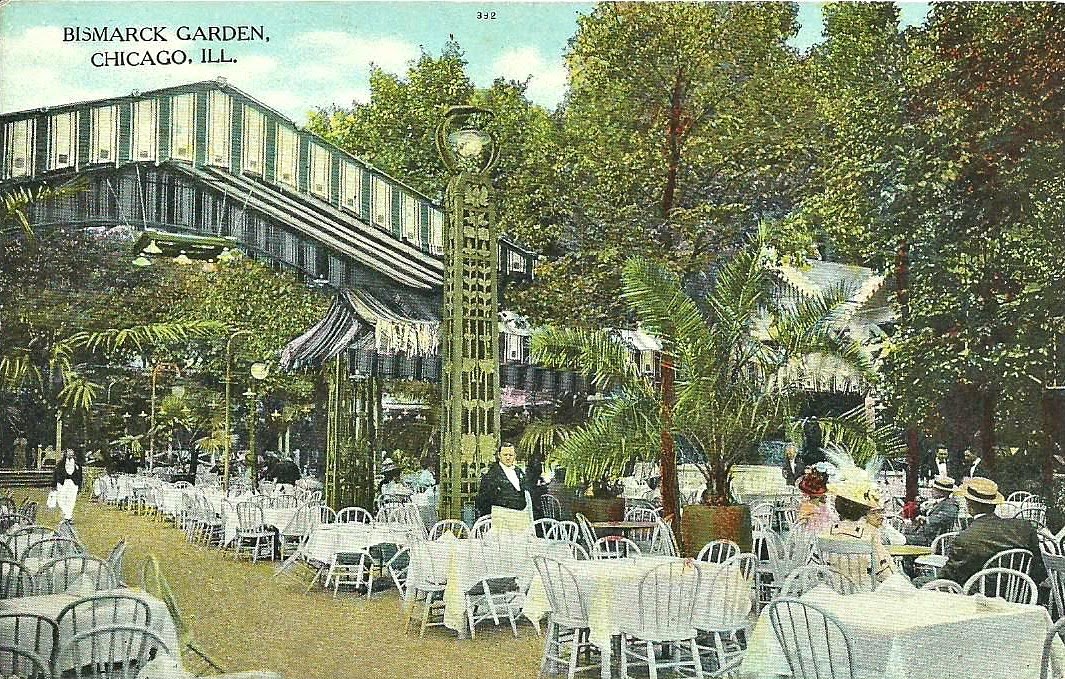
bismarck-gardens-postcard-frontIn addition to denying Fox’s assertion of an engagement, Barker also denied that he had said what Fox overheard in a restaurant ten years before, that “Miss Rappe has not taken a drink yet.”[7] The reportage doesn’t include the context for this remark—also via Mrs. Fox—but it implies that Rappe didn’t drink at the time and may have only started while in Barker’s company, that he introduced her to alcoholic beverages and continued to ply her despite her alleged bizarre behavior that so clearly resembled what happened to her at Arbuckle’s party.

Barker “enumerated at least six occasions where, in his presence, the dinner was disturbed by Virginia becoming hysterical, shrieking in pain and tearing her clothing.”[8] That she had even had two gin and orange juices—the same concoction, coincidentally, that she allegedly imbibed at Arbuckle’s party—surely must have seemed to the prosecution too good to be true for Arbuckle.[9] Such detail surely incited the heated “wrangle between Deputy District Attorney Milton U’Rren and Attorney Milton Cohen, whom the prosecutor charged with ‘coaching’ defense witnesses.”[10]

Coaching aside, the picture that Barker paints shows a man who had invested much time and money into enjoying Rappe’s company hundreds of times. The restaurants he did mention—Bismarck Garden at Broadway and Lake, and Rector’s, an oyster house at Clark and Monroe—were popular, fashionable, and expensive. Barker obviously “courted” the grandmother by attending Thanksgiving Day dinner at her Fullerton Avenue apartment and having her in tow for dinner “usually” means a certain commitment if not patience and suffering on the man’s part.

The South Haven incident would have been an expensive vacation, which included two long day cruises across Lake Michigan and the expense of putting Rappe and her grandmother up in a hotel as well as entertaining them at the town’s many attractions, including theaters, a casino, an opera house, and an amusement park. Even if it wasn’t an engagement ring in testimony, Barker had given Rappe a diamond ring. He did everything that a man might do if he were in love.

Barker’s testimony as to the length of their relationship suggests that it began to fade in 1913, when Rappe’s modeling career was at its height and she had sailed to Europe to attend the autumn fashion shows in Paris. When Rappe returned to Chicago in January 1914 and the LaSalle Hotel, she and Barker distanced themselves further. The Chicago Tribune reported on the marriage of Albert Sabath later that same month. Harry Barker was in the wedding party. If he attended the reception with Virginia Rappe, her name wasn’t mentioned.

Barker’s testimony had a profound effect on the only woman juror, Mrs. Helen Hubbard, who apparently took offense at what probably seemed his caddish betrayal. The resulting hung jury forced a new trial for late January 1922.

Barker was not called to testify at that trial or the third one. The defense found other witnesses who had seen Rappe’s drinking and striptease. Instead, Barker went back to running his businesses. Nevertheless, his name was often invoked during those trials and, especially, the last one, when Arbuckle was acquitted in April 1922.

What Barker had said on the stand at the first trial was not lost or forgotten by Milton U’Ren. In a fiery address to the jury, in which he blasted that they would be just as guilty as Arbuckle if they voted to acquit, he referred to Barker “as a ‘buzzard, snake, skunk and blackguard.’”[11] To this, Gavin McNab responded that Barker was

a man and a gentleman, who tried to be clean himself and keep all around him clean. This man whom the prosecution calls a blackguard was the only mourner at the funeral of Miss Rappe’s mother [sic] and he sacrificed himself financially to pay the expenses of that funeral. Where were Mrs. Fox and others who professed in this court to be such good friends of Miss Rappe? They were not there.[12]

In late December 1921, Barker and the Sabath family enjoyed a small legal victory in the California Supreme Court. But the Mildred Island case, due to the tenaciousness of the plaintiffs, dragged on in the courts until 1932.

[1] “Arbuckle Case Near Jury,” Sioux City Journal, 12 April 1922, 2.

[2] “Harry Barker Home from Panama,” Munster Times, 14 February 1916, 2.

[3] “Says Arbuckle Not Accused by Movie Star,” Fresno Morning Republican, 26 November 1921, 1.

[4] “Arbuckle Case Closes Monday, M’Nab Declares: Rancher and Former Friend of Miss Rappe on Stand,” Oklahoma City Times, 26 November 1921, 16.

[5] “The Past of Virginia Rappe Inquired Into,” Stockton Daily Evening Record, 26 November 1921, 1.

[6] “Impeachment of 2 Arbuckle Witnesses Looms,” Philadelphia Inquirer, 30 November 1921, 1.

[7] “Defense Will Close Monday for Arbuckle: Stockton Rancher Resumes Testimony,” Sacramento Bee, 26 November 1921, 1.

[8] “Booze Parties Hold Stage in Arbuckle Case: Former Sweetheart of Virginia Rappe Testifies Woman Would Tear Clothing after Drinking Liquor,” Salt Lake Telegram, 27 November 1921, 1.

[9] Some narratives use the term “orange blossom” to describe “Rappe’s drink.” She herself called it a “Bronx Cocktail,” which she preferred made with very little gin as she did not like its taste. See A.P. Night Wire, “Defense Is Contradicted,” Los Angeles Times, 7 April 1922, 1.

[10] “Miss Rappe Often Crazed with Pain, Witness Asserts,” Philadelphia Inquirer, 27 November 1921, 1.

[11] Oscar H. Fernbach, “Arbuckle’s Fate Is with Jury Today: Closing Argument in Third Trial of Comedian Now Under Way; McNab Yet on Argument,” San Francisco Examiner, 12 April 1922, 15.

[12] “Arbuckle Lawyers Flay Alleged Bully Methods Used by Prosecution,” Billings Gazette, 12 April 1922, 8.
The Game Lady: Lobby card images

One of the last films in which Virginia Rappe appears and which was in theaters in the summer of 1921, was A Game Lady (1921), directed by Henry Lehrman for First National Pictures. Like other photographs, these publicity photos from that film tell a story.

There is no extant copy of A Game Lady, but Rappe likely appeared in as many scenes as needed to show that she was the hunters’ quarry rather than game birds. There is no synopsis, but the two-reel comedy likely was formulaic, like other Henry Lehrman films, in which the sheer momentum of the action—scenes of the hunters’ misadventures as they seek the hand of Rappe’s “game lady” — was the point rather than story or character development. These photographs are from a series of lobby cards that were included in a Los Angeles Record article in the days after her death. Rappe doesn’t appear to be a comic performer in these photos but rather an object of desire.

A Game Lady lobby card image, Jimmy Savo (l), Virginia Rappe (c), and Billy Engle (r) (IMDb.com)

The actor on the left is Rappe’s uncredited costar, the comic Jimmy Savo in hunting attire. Savo was making the transition from vaudeville to motion pictures at the time. The actor on her left (in the middle in the second photo) is Billy Engle, an old Lehrman standby.

A Game Lady is one of the films that shows Rappe after she had regained her figure following a regimen of diet and exercise that was supervised by her masseuse at the Los Angeles Athletic Club. She is dressed in a “riding habit” like the one she wore when she accompanied her manager Al Semnacher and his friend Maude Delmont on the drive to San Francisco and Arbuckle’s ill-fated Labor Day 1921 party.

A Game Lady was still showing in theaters as late as the third and fourth week of September. But like Roscoe Arbuckle’s films, it too was pulled from screens for cultivating the morbid curiosity of American moviegoers.

A Game Lady lobby card, 1921 (Private collection)

Two photographs of Maude Delmont

A photo insert in a nonfiction book provides a visual reference for readers. They have a face in mind—or faces as the subject evolves throughout the text. But very often one image will serve as the emblem for that person.

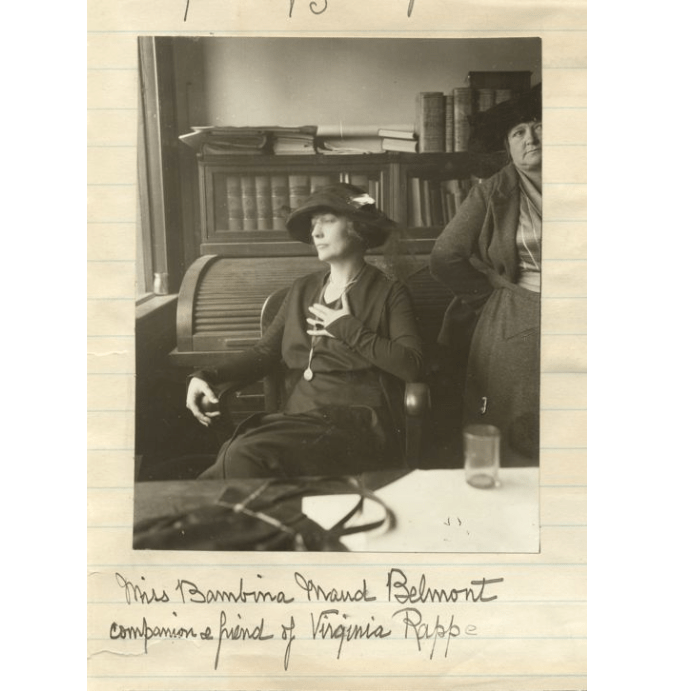
Maude Delmont, Rappe’s companion at “Fatty” Arbuckle’s Labor Day party, is a case in point. We are fairly certain that she sat for newspaper photographers twice, before and after her testimony at the San Francisco Coroner’s inquest on Wednesday, September 14, 1921. No other photographs of Delmont were used to identify her, as far as we know (save for an ersatz photograph used in Kenneth Anger’s Hollywood Babylon that is really of Arbuckle’s estranged wife Minta Durfee).

Maude Delmont with Policewoman Katherine Eisenhart (Calisphere)

In the above photo we see Delmont, presumably in the office of District Attorney Matthew Brady or the Detective Bureau.. She is in a black outfit, worn in mourning for Rappe, as described by reporters. There are also details that suggest this image, with the water glass and the police matron, was taken before her testimony. This testimony would be the only time she faced Arbuckle in a courtroom setting. While on the stand Delmont asked for warm water and a coffee cupful was procured, thus delaying the proceedings. The image below, from the Daily News, credited Underwood, has a coffee cup near Delmont’s left hand. Apparently, she brought the cup back with her to this office setting afterward.

Maude Delmont, originally published in the Daily News, September 1921 (Newspapers.com)

Each image can be read differently. The first image features a gesture with the left hand that seems staged, theatric, connoting a “troubled heart” and the like. (That Delmont worked as an extra in motion pictures still needs to be confirmed.)

The second image shows a more relaxed woman, who looks as though she were falling asleep. If one knows that she had been given an injection to help her remain calm through her morning testimony before a coroner and his all-male jury, this photograph may have caught Delmont at the moment the drug was wearing off.

What occurred immediately following the taking of this photo is revealing and worth telling. In the Detective Bureau, Delmont confronted Rappe’s manager, Al Semnacher, and hit him in the face with her purse (visible on the table in the first image). She berated him for not bringing Rappe’s adopted aunt to San Francisco to accompany her “niece’s” body back to Los Angeles. She further embarrassed him by shouting that he wasn’t a man if he didn’t pay her $250 hotel bill ($1,600 adjusted for inflation), which may have included Rappe’s final expenses at the same hotel.

As she weakened in her hospital bed, Rappe repeatedly expressed her wish that Arbuckle take responsibility for paying her expenses. It seemed to be the only thing she held against him. The wish never reached Arbuckle. If it did, even having an inkling or intuition that she wanted money, Arbuckle likely discharged himself from any debt, doing what any good lawyer or manager would advise. To admit any responsibility invited “notoriety.”

Both Rappe and Delmont were of limited means at the time and were financially unprepared for the events that unfolded. Neither woman ever received money from Semnacher or Arbuckle.

[Needless to say, we are looking for additional photographs, especially original or reproductions suitable for our work-in-progress. We would enjoy hearing from anyone with leads to relevant materials and images.]

Intermezzo: Enter Minta

[The following is an extract from our work-in-progress—one in a series of short features or en·tr’actes that allow the authors and readers to take pause. Almost all Arbuckle case narratives share DNA from Minta Durfee’s sometimes cynical memories, which are largely responsible for how the story has long been framed.]

Minta Durfee made a career out of being Mrs. Roscoe “Fatty” Arbuckle. It was a saleable commodity for her, and if you don’t believe me check her contracts filed at the [Academy’s] Herrick Library. She was lying relentlessly and grandiosely, of course . . .

Joan Myers [1]

Minta said she was asked often about having sex with a fat man. She said “I wasn’t going to answer a question like that. Besides I knew Roscoe wasn’t capable of anything beyond simple petting.”

Timothy Dean Lefler [2]

Toward the end of her long life—long for a Silent Era actor—Minta Durfee shared a memory of her former husband Roscoe Arbuckle and his frequent costar, the comedienne Mabel Normand. “They were such water dogs,” Durfee recalled, “they loved the water, they did everything under the sun in the water.”[3]

Durfee’s memory was a happy one, of the house Arbuckle rented on Venice Beach in 1915 and ’16. The weather was often warm, even at night, so they slept on a screened in porch and woke to breakfast served by a Japanese servant, hired with the modest but adequate income each made at Keystone Studios.

On Sundays in the summer, Normand was a frequent guest. She was an excellent swimmer as was Arbuckle, whom she nicknamed “Big Otto,” after a zoo elephant in nearby Lincoln Park. While Durfee watched from shore—she didn’t like to swim—Normand and Arbuckle swam from the front of the house south toward the Venice Pier. The pair’s long swims became a routine for a time and sometimes included a third member, a dolphin, that swam alongside Normand. As much a fearless person in real life as she was on camera, Normand would put her arm around the animal’s back and let it pull her along.

Durfee wasn’t always alone on the beach waiting, the odd woman out. Sometimes a crowd formed, from anonymous onlookers to friends who came to see Normand, Arbuckle, and the tame dolphin “perform,” before they emerged from the water dripping wet, toweling themselves off. Durfee’s embroidered memory captured this innocent moment in the lives of these two actors who died young. Another who died young, Virginia Rappe, was denied such innocent anecdotes but hardly the emobroidery.

“I knew her well,” Durfee said.

Mabel Normand and Roscoe Arbuckle, Catalina I., 1914 (Private collection)

Minta Durfee may have known what Virginia Rappe faced behind the closed door of room 1219. In a series of taped interviews for Robert Young Jr.’s “bio-bibliography” of Roscoe Arbuckle, Durfee described intimate details about what it was like sleeping with her husband far removed from the screened-in porch on Venice Beach.[4] In March 1917, not long after Arbuckle had been feted in Boston after signing his contract with Paramount Pictures and Famous Players-Lasky, he and Durfee returned to New York and the Cumberland Hotel at 54th and Broadway. During the early morning after their first night there, Arbuckle tried to have intercourse with Durfee. The way it is described suggests that such intimate relations may have been performed in the bathroom, perhaps in the shower, perhaps over the bathroom sink for support. Arbuckle, however, failed to maintain an erection. Frustrated, he wrapped a towel around his waist and began to tear the room apart. “His color was almost purple,” Minta recalled in 1958, “and he went through the dresser drawers and emptied them. Threw everything in the air—drawers which didn’t come out so easily he yanked out completely and threw them around the room.” Despite her best attempts to calm him down and reassure him, Durfee watched in terror. Arbuckle had been drinking. He was addicted to his painkillers—morphine and heroin—and he had been partying for days. He had been traveling for weeks. He had also changed toward her.

“To hell with you,” Durfee remembered her husband saying as he rampaged tearfully about their hotel room. “To hell with the apartment, to hell with my clothes, to hell with everybody in the world! I’m a star! I was told I’m a star and I shouldn’t be tied down! I shouldn’t have a wife because they always do this to you!”

When Durfee attempted to call the desk for the hotel doctor, Arbuckle screamed, “Don’t you dare touch that! I’ll do all the telephoning that’s going to be done in this little place.” With that Arbuckle yanked the telephone off the wall.

“Nothing I said had any effect. Every once in a while he would stand in the middle of the room like a little child and jump up and down with rage as sweat poured off him. ‘I won’t have it! I won’t have it!’ he yelled. ‘I’m a star! I’m not supposed to be married! I can’t be hampered by a wife!’ I never heard a man cry so hard in my life. It was terrible.”

Hotel Cumberland, Broadway and 54th Street, New York City (NYPL)

After her husband left Keystone for Paramount, Durfee’s film career suffered a hiatus. Although she enjoyed financial rewards of being married to one of the most popular movie stars in the world, she had to stand by and watch as her husband was transformed into a virtual bachelor and she was forgotten. She also had to give up her role as the maternal influence that Arbuckle depended on until his vast wealth convinced him he no longer needed it. She was jealous of the power his new manager, Lou Anger, had over him. That Arbuckle had parroted Anger’s views on stardom on that fateful morning in the Cumberland Hotel may have been the most grating thing of all to Durfee along with Arbuckle’s growing coterie of male friends, many of whom she saw, rather unselfconsciously, as parasites.

Durfee accepted what was essentially a quasi-salary to be Arbuckle’s faithful wife, should he need to reference her as such. This was also hush money, since her silence and cooperation in the arrangement were necessary. With this arrangement, Arbuckle was given existential elbowroom, a freedom to roam.

The perquisites for being invisible and the silent woman included a luxurious apartment on Riverside Drive with her mother and sister. Although a native of Southern California, Durfee acclimated to her life as a Manhattan socialite and returned to making movies in 1920. She still had Mabel Normand as a nearby friend. Normand had grown up on Staten Island started her career as an artist model and actress in Manhattan, and now divided her time between the West and East coasts.

It was through Normand that Durfee learned of Arbuckle’s troubles in San Francisco when Normand tried to reach Durfee by telephone and got Durfee’s sister Marie instead. The latter promptly wired Durfee, who was vacationing with their mother on Martha’s Vineyard. Durfee was on the green of an ocean-side golf course when she received the telegram and undoubtedly understood the likely impact on her own lifestyle and tenuous career.

When reporters located her, Durfee was back in the spotlight for the first time in years and played her role as Mrs. Arbuckle in a way far different from that of being in her husband’s shadow at Keystone. She relished the attention and assumed a kind of maternal authority over her long wayward husband, making it known that she and Arbuckle’s mother-in-law would depart for San Francisco without delay.

“I have not been reading the newspapers,” Durfee told a reporter while packing a suitcase in their apartment at W. 97th Street and Riverside Drive. But she certainly knew more than she let on. Sticking to the faithful wife script, Durfee continued. “Roscoe Arbuckle is just a big, lovable pleasure loving, over grown boy, whose success and prosperity have been a little too much for him, but he is not guilty of the hideous charge made against him in San Francisco.”

Durfee had nothing to say about Rappe, at least nothing that was or could be printed. She also didn’t let on that she had been in communication—not with Arbuckle himself—but with his lawyers, Milton Cohen and Frank Dominguez, and, perhaps, with Lou Anger and others about shoring up Arbuckle’s deteriorating public image. This wouldn’t be a passive role for her. Whether at her suggestion or another’s, Durfee pledged to gather information on Rappe’s earlier life during the layover in Chicago.

“I felt intuitively that my husband was not guilty of murder—anyone who knows him will tell you that,” Durfee continued, still in her apartment living room. “Why, already I’ve received many letters and telegrams from friends in the theatrical world, each expressing that he could not be guilty of the impossible charges.”

There was only one point where Durfee didn’t censor herself, recalling the low company Arbuckle kept, which was, apparently, a sore point with her. “My husband has hundreds—thousands of friends. Some of the messages I’ve received came from gangsters and ‘roughnecks,’ who worked with him in pictures, but most of them were well-known actors and actresses.” Of these, only Mabel Normand was mentioned by name.

When asked about her living so far from Arbuckle, Durfee attributed it to their having married young. “Five years ago,” Durfee said of their estrangement, “we agreed to disagree.”

Minta Durfee and Roscoe Arbuckle tête-à-tête in September 1921 (San Francisco Library)

Before dismissing the press, Minta Durfee also commended Arbuckle for the recent gift of a new town car and the generous monthly allowance he gave her, which freed her from having to find work. That’s not to suggest she was content not working. In 1920 and ’21, she appeared in five two-reelers for Rialto Productions with their now ironic titles—Wives’ Union; He, She and It; When You Are Dry; Whose Wife?; and That Quiet Night—shot in nearby Providence, Rhode Island. Prominently billed in trade magazines as the “Minta Durfee Series,” the comedies were advertised with “Mrs. Roscoe Arbuckle.” Meanwhile, gossip columnists, who rarely mentioned her being Mrs. Arbuckle over the previous three years, began refreshing the public’s memory of her status in early 1921. One of the more waggish made light of their living arrangement as “fashionable.”

On Wednesday evening, September 14, Durfee and her mother boarded the New York Central’s Twentieth Century Limited, at Grand Central Station. Mabel Normand was there to see them off and seconded Durfee’s assertion that Arbuckle was innocent. The next morning, Durfee stepped off the train in Gary, Indiana, where she and her mother were whisked away by “detectives” and driven into Chicago. These men were likely private investigators working for Albert Sabath, a Chicago attorney who had been engaged by Milton Cohen and who was a close friend of Rappe’s former boyfriend, Harry Barker. Durfee spent the next ten hours “interviewing acquaintances” and “calling on friends of Miss Rappe.” How Durfee found these friends is a mystery. But she likely had help from Sabath, who knew a lot about Rappe through Barker.

Durfee made good use of her Chicago layover. But it has received scant attention in Arbuckle case narratives even though it suggests that she took an active role “to clear Roscoe’s name,” actively defaming Rappe rather than just passively being there for Arbuckle as his suffering wife. She had reason to topple Rappe from the pedestal of victimhood. Not only was the monthly income that supported her, her mother, and her sister threatened, so was her career. That Arbuckle’s films were being pulled from theaters all over the country had to have shaken Durfee. His fall could certainly take her down. Some theaters were showing her new comedies and still billing her as “Mrs. Roscoe Arbuckle.” Durfee knew that the public’s imagination would draw a triangle between Arbuckle, Virginia Rappe, and herself.

Durfee spoke to reporters again in Chicago, just before she boarded the Union Pacific’s Overland Limited to San Francisco. “Our marriage wasn’t wrecked,” she said, using words that likely had been peppered at her by the press, “only warped. Eight years of togetherness is bound to put a blight on any union, no matter how ideal to begin with. We never really were angry with each other—we just each got on the other fellow’s nerves.”—yet another vague canned expression.

To some, Durfee’s explanation of her marriage rang hollow. “It took a booze party and a murder charge to get Mrs. Arbuckle, staged as ‘Minta Durfee,’ to realize that she ought to be near her husband,” wrote one small-town editorialist. “Mrs. Arbuckle has set an example which all boozily inclined movie people ought to follow. Let the old man drink and skylark as much as he likes till he gets in trouble, then go to his assistance when he is arrested. No press agent could possibly offer such a good chance for notoriety as this.”

Reno depot (Private collection)

Minta Durfee received a telegram when her train arrived late into Reno, a layover that had a certain poignancy given Nevada’s liberal divorce laws and the recent case of Mary Pickford. (Her botched divorce from the actor Owen Moore to marry Douglas Fairbanks almost resulted in “America’s Sweetheart” facing a charge of bigamy.) The telegram likely alerted her not to speak about the Arbuckle case and to get off the train one stop early, as she had on the Chicago leg of her journey. As the Overland crossed the state line between Nevada and California, Durfee and her mother locked themselves in their state room to avoid the reporters that boarded at Roseville, California, one stop before Sacramento.

The Durfee party was subsequently intercepted by Milton Cohen and Arbuckle’s San Francisco-based attorney, Charles Brennan, so as to prevent reporters from having any access to their client’s wife. Instead, they drove her and her mother into San Francisco in the backseat of Arbuckle’s Pierce-Arrow. This allowed Cohen and Brennan to discuss Durfee’s role in the narrative, groom her for the sake of public relations, and debrief her of what she had learned about Rappe while in Chicago.

Early Sunday morning, September 18, Durfee arrived in San Francisco. Before being reunited with her husband—whom she had not seen since the autumn of 1919, she issued a prepared statement. Once more she spoke of her husband’s innocence and asked that he get a “square deal” in court.


[1] Qtd. in Andre Soares, “Fatty Arbuckle Virginia Rappe Trial: Researcher Joan Myers Discusses Scandal,” Alt Film Guide, 2009, https://www.altfg.com/film/fatty-arbuckle-virginia-rappe/.

[2] Facebook message with author, 22 January 2021.

[3] This passage is based on Minta Durfee to Don Schneider and Stephen Normand, Excerpts of an Interview with Minta Durfee,” 21 July 1974, https://www.angelfire.com/mn/hp/minta1.html; Robert Young Jr., Roscoe “Fatty” Arbuckle: A Bio-Bibliography (Greenwich, CT: Greenwood Press, 1994); Betty Harper Fussell, Mabel: Hollywood’s First Don’t Care Girl (Ticknor & Fields, 1982), 135; “Mrs. Arbuckle Defends Actor,” San Francisco Chronicle, 14 September 1921, 1, 6; “Arbuckle’s Wife Gathers Evidence for Him in Chicago,” San Francisco Examiner, 16 September 1921, 1. “Good Press Agent Stunt,” Hanford (California) Sentinel, 17 September 1921, 2, and other corroborative sources.

[4] See Robert Young Jr., Roscoe “Fatty” Arbuckle: A Bio-Bibliography (Westport, CT: Greenwood, 1994), 55.

Bit Player #4: Nurse Jean Jameson

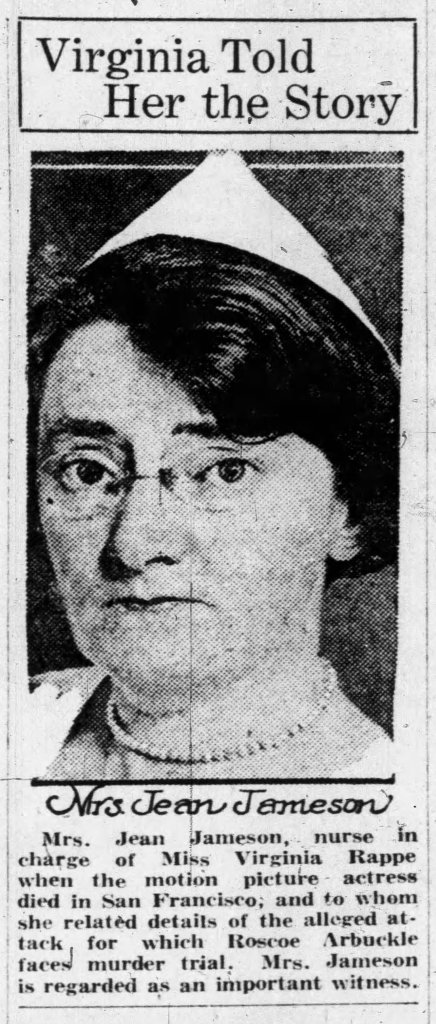
Nurses are a factor throughout the case of People vs. Arbuckle.  Some testify for the prosecution, some for the defense.  All claimed to have known Virginia Rappe at different times in her life. But only two definitely spoke to her and they only testified before a grand jury and a coroner’s inquest. They also spoke to the press within 72 hours of Rappe’s death. Jean Jameson, the day nurse at the Wakefield Hospital, spent the most time with Rappe and had the most credibility. The night nurse, Vera Cumberland, who also claimed to be a granddaughter of the late Queen Victoria, had less. However neither took the stand at Roscoe Arbuckle’s three trials. Both nurses knew each other and cooperated in caring for Rappe, though Cumberland asked to be relieved from her shift on what turned out to be Rappe’s final night. She likely feared that the doctor’s decision to leave the hospital to attend a party was negligent and blame might fall on her should Rappe take a turn for the worse. .

Source: Los Angeles Record, 14 September 1921 (Newspapers.com)

Jean Jameson, in her pince-nez, with her flinty, no-nonsense expression, made several poignant statements during the first week following Rappe’s death on September 9, 1921. “I am used to seeing people die,” she said. “That is my business. I see them die all the time.” Jameson was present when Rappe accused Arbuckle of causing her injury and insisting he should pay for her hospital stay. Jameson, too, had been one of Rappe’s duty nurses when she died.

She didn’t want me out of her sight for a moment. From the time I took the case to the instant of her death she was continually calling me to listen to what she had to say. And all her talk was about “Roscoe,” as she

called him, and the injury he had done to her. The things I have told the police in my statement were said by the girl at the times when she was apparently in full control of her mind. At other times she rambled. She was in great pain throughout. When her condition was at its worst, she made statements more extreme than the things she said when she was quieter. I shall tell those latter statements only at the trial, if there is one, and under the qualification that they were made in delirium. But the things I have told so far were said when her mind, as far as I could judge, was clear. She wanted to get in touch with Arbuckle so that he would pay the expenses of her illness The girl was far more worried over the money side of her plight than over other aspects. She said:

“It wouldn’t be right for me to have to pay for all this, when it’s Roscoe’s fault.”

When she said, “Get Roscoe,” I understood her to mean: “Get him and make him pay the bills.” The thing that worried her most, apart from the money, was the wrong done to her fiancé, Henry Lehrman, Los Angeles motion picture director.

“I don’t want publicity about this, because I don’t want Henry to know of it,” she said repeatedly. “If he knows of it, he will throw me down.”

The thought that hurt her most of all, perhaps, was that Lehrman and Arbuckle had been fast friends for years, but that Arbuckle had treated her wrongly despite his friendship for her fiancé.

“It wasn’t right for him to act this way toward me, when Henry was so fond of him and trusted him so,” the girl said.

She repeated this in various ways. “What kind of way was that for him to treat a girl that was engaged to his best friend?” she said.

As to the exact way in which she got her fatal injury, the girl’s mind was a blank. I think she had been too intoxicated to remember it. At any rate she never described clearly what happened in her room. But she did say:

“He crushed me and broke something inside me.”[1]

A few days after Jameson repeated what she had told the authorities, she testified at a juried coroner’s inquest intended to ascertain whether Rappe’s death, from a medical standpoint, was a criminal matter.  “She never thought she was going to die,” Jameson said as she repeated, expanded, and clarified much of what she had already stated. “She had been on a party with Fatty Arbuckle and the others that she named,” the nurse recalled. “She said they were all drunk.”

Jameson, too, gave her professional opinion of her patient after her initial conversations. “Miss Rappe was still somewhat hysterical and my diagnosis was that she was hysterical after a drunken party.” Rappe, the nurse observed, was “in a good deal of pain, particularly in the region of her abdomen.” Speaking freely and answering questions, Rappe told Jameson

that she had had three drinks and the three drinks made her helpless. At one time she would say she could not remember whether Arbuckle had dragged her or pulled her into the bedroom, and at other times, she said definitely that he had done so. She frequently asked me, “What could be broken inside of me?” She asked me several times whether I would examine her to see whether Arbuckle had assaulted her. She made many statements about “getting Arbuckle.” So far as I could learn she had money in New York City, which she said Henry Lehrman gave to her. She said, however, that if it were to be a long case [hospital stay], she must get the money from Arbuckle or Lehrman would turn her down. She had very little money with her at the St. Francis. I asked her for some money to buy her a night gown as she did not have a stitch of clothing after I got her in bed. She did not seem much concerned and told me that lots of times she did not sleep in a night gown.

Though Rappe appeared to speak candidly with Jameson, the nurse said Rappe had been reluctant to talk “about a certain phase of her condition.” We can suppose this meant she didn’t want to be on record for accusing Arbuckle of anything specific. “Miss Rappe,” Jameson continued,

was very anxious that the party and what took place there be kept from Lehrman for fear, as she expressed it, that he would throw her down. “Will you be my witness if I sue Arbuckle for the money it is going to take?” she said to me at one time. “I am going to make Arbuckle pay for this as it is all his fault.”[2]

Ironically, following Jameson’s testimony, one of Arbuckle’s lawyers was heard to say “Our case is won.” Despite how damning the nurse made it sound for Arbuckle, Jameson had let on that Rappe had a preexisting condition for six weeks, an illness that could be attributed to the comedy director Henry Lehrman, Rappe’s mostly-vacant boyfriend, who made a show of savaging and threatening Arbuckle in the press for having killed his beloved “Virginia.” Incidentally Lehrman, living across the country in New York, had already moved on to a new girlfriend, a Ziegfeld Follies dancer.

An even greater and sadder irony to consider is that Rappe feared Lehrman learning about her and Arbuckle together, consensual or otherwise—possibly more than death itself.


[1] “Girl Rational When She Named Actor, Says Nurse,” San Francisco Examiner, 11 September 1921, 1, 3.

[2] Associated Press, “Arbuckle Indicted: Manslaughter Grand Jury Says,” Des Moines Register, 14 September 1921, 1, 2.

Bit Player #3: Ira Fortlouis, the gown salesman

Ira Gustav Fortlouis saw Virginia Rappe for the first time in the Palace Hotel on Labor Day morning, September 5, 1921. According to the accepted story, he later mentioned this sighting in the presence of Roscoe Arbuckle and his companions, film director Fred Fishback and actor Lowell Sherman. Thereupon, a telephone call was placed to Rappe and she was invited to Arbuckle’s suite. Her afternoon in San Francisco, for which she had made no other known plans, was set

Fortlouis’s sighting of her has long been regarded as a “meaningful coincidence,” to use Carl Jung’s phrase. The first of a sequence of coincidences that suggest a pattern but may have been nothing more than chance. The first is that Fortlouis happened to cross paths with Rappe at the Palace Hotel; the second is that he happened to know the director Fred Fishback personally and knew he was in town; the third is that he got to know Rappe’s manager Al Semnacher well enough to accompany him on some business on Bush Street during the course of the party; and finally that on the day Rappe died, he, until that week unknown to Maude Delmont, was beckoned by her for an evening tête-à-tête.

This last coincidence is the most curious. Fortlouis would seem an unlikely choice to be comforting Delmont. But though they had only recently become acquainted, Delmont had been with Fortlouis at the party at the time of the incident (perhaps, locked in the bathroom of room 1221 when Rappe wanted to use it and was denied entry by Delmont—one of those details an editor would have censored at the time). So rather than a conversation with a friend, the late night meeting might have been an effort by either Delmont or Fortlouis to discuss what they remembered of the event in case they were subpoenaedThis sounds speculative until one learns that Fortlouis later made a statement to District Attorney Brady claiming Delmont couldn’t have heard Rappe screaming because he was with her in Room 1221 at the time and heard nothing. It was a statement that would jeopardize Delmont’s credibility and the foundations of the charges.

Save for an appearance before a grand jury and a coroner’s inquest, Fortlouis never took the stand—no doubt a relief to him as this wasn’t the first sex scandal in which he was associated. (In a January 1914 trial in Portland, Oregon, Fortlouis had to admit to having intimate relations with a married woman in shared staterooms aboard steamships plying up and down the Pacific Northwest coast.) Instead, he was left alone to watch the Arbuckle trials as a spectator, Zelig-like, the silent witness who innocently set the tragic event in motion. He was even interviewed at one point and said that his motivation for getting Rappe to Arbuckle’s suite was that he could see she needed work, that she was down on her luck.]

Guest Tells Police Party Was ‘Noisy’

Ira G. Fortlouis, Traveling Salesman, “Heard No Screaming” and “Knew of No Injuries”

Here is the statement of Ira G. Fortlouis, traveling salesman, as made to Detective Sergeant John Dolan and Detective Thomas F. Reagan at the Hall of Justice yesterday [September 10, 1921]:

I got in town Sunday, September 4, 1921. Somebody told me that Fischbach was in town. I called him up at the St. Francis and left word for him to call me. He did not call me up and I called him up Monday at 8:30 a.m. He told me to come and say “Hello.”

I was walking out of the Palace Hotel about 11 a.m. and saw a very stylish girl. I asked somebody who was standing there who she was. He said she was Miss Rappe, the moving picture actress.

I went up to the St. Francis and called up Freddy Fishbach [sic] and he introduced me to Arbuckle and Sherman.

We sat there and talked for a long time and in the course of the conversation I mentioned the fact that I had just seen Miss Rappe and asked the boys if they knew her. Someone of the party said he knew her and asked when I had seen her. I told them I had seen her in the lobby of the Palace Hotel.

Someone in the party phoned to Miss Rappe.

Miss Rappe phoned a little later and asked for the room number. She thought they were stopped at the Palace Hotel [my italics]. Miss Rappe came up to the room some time in the afternoon. I think this was about 12:30 p.m. This was Monday, September 5, 1921.

I was introduced to her and Sherman was introduced. There were four of us in the room at the time—Fischbach, Arbuckle, Sherman and myself.

Shortly afterward Mrs. Delmont came in the room. Miss Rappe introduced her to everybody. We had lunch and drinks were served. I had Scotch highballs. Miss Rappe had nothing to drink at that time that I remember of. Mrs. Delmont had a drink at the same time. The women ate none of the lunch.

I know of no injury that occurred to Miss Rappe while I was in the room and the first I heard of her injuries was the following day.

I could not say that Miss Rappe and Arbuckle were in the room all the time I was present.

Fischbach left about 2:30 p.m. I asked him if I would see him again and he said he would be back in about an hour.

They all had drinks and someone telephoned downstairs to send up a phonograph. the phonograph came up. I went into the bathroom in Sherman’s room and Sherman came in the bathroom and pounded on the door and told me to hurry up and get out of the room, as reporters were coming up to interview Arbuckle.

I wanted to go into the other room. They told me to go through the hallway, and in going through the hallway I asked where Fred Fischbach was. He came to the door and I told him I was going down to the club and would meet him down there. I didn’t understand the object in rushing me out that way. I judge the time I left the room between 2:30 and 4 p.m.

While I was in the room, Arbuckle and Miss Rappe were sitting near each other and kidding one another. Miss Rappe was drinking gin and orange juice. The party was drinking considerable liquor. There was considerable noise, but I heard no screaming.

I phoned from my room to Miss Rappe, having heard that the party ended disastrously and she was ill in her room at the Palace Hotel and was informed that she had left the hotel. This was the next day. Then I phoned the St. Francis and got Mrs. Delmont on the phone and she told me that Miss Rappe was injured internally and was very sick.

Last night [September 9] I was in the St. Francis Hotel. Somebody said the girl had died. I heard that there was something wrong as regards her death. Mrs. Delmont said that.

During the time I was in the room Arbuckle was dressing. He was wearing pyjamas, and when the girls came in he put on a dressing robe.

When I got back to the Palace Hotel last night there was a phone call from room 1227, St. Francis Hotel, and I called up and Mrs. Delmont answered. She asked me what I thought of the affair, what a terrible thing it was, and I asked her if there was anything I could do for her. She said a couple of the young ladies were with her. She asked me to come up and see her, as she could not sleep. She wanted me to sit up with her until they came back. I said I would not come up alone, but if allowed to bring a friend I would come. I brought a friend and went there and sat there waiting for her friends to come back. I advised her to get a nurse. I made arrangements at the hotel office for a nurse and when she arrived, I left.

I make this statement freely and voluntarily; no threats or promises were made to induce me to give and sign this statement.

(signed) IRA G. FORTLOUIS

Source: San Francisco Examiner, 11 September 1921, p. 3.

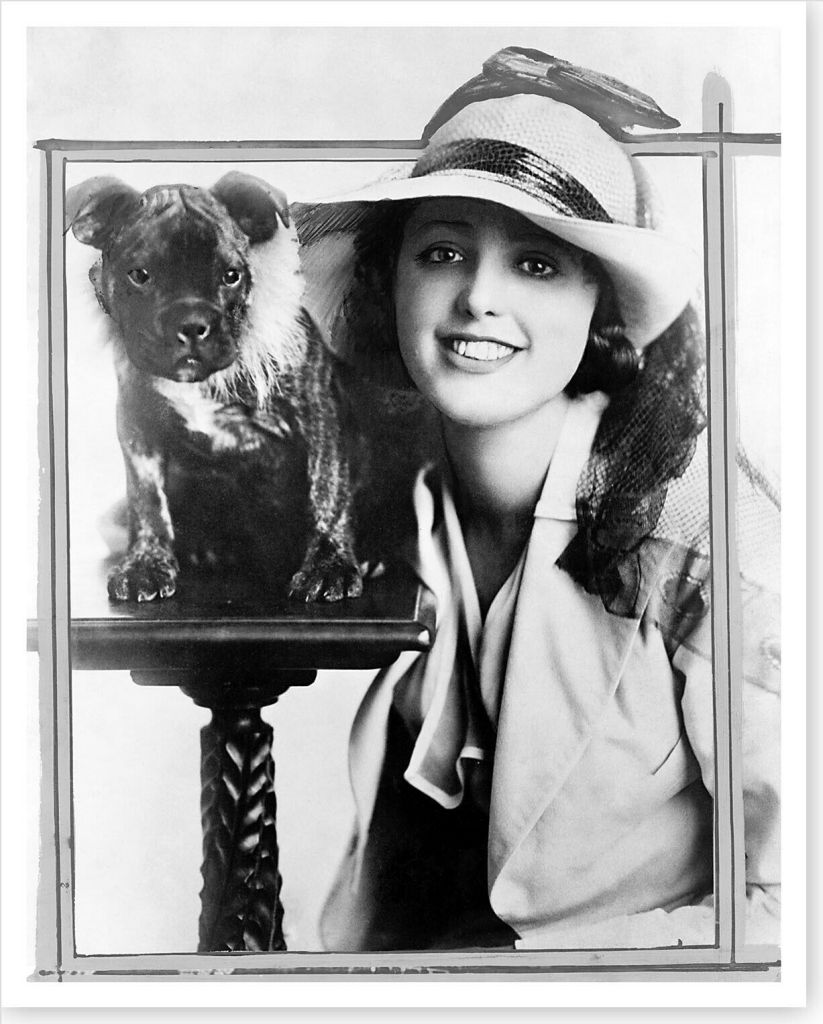
“Jeff,” Virginia Rappe’s brindle bull terrier pup, and Rappe wearing an outfit similar to the one she wore on September 5, 1921 (Library of Congress)

Did Virginia Rappe sit for Harrison Fisher?

Routinely, we search newspaper archives for anything related to Virginia Rappe’s past, a past Roscoe Arbuckle’s lawyers made out to be sordid. They turned up individuals who described knowing her in Chicago when she was younger. These witnesses asserted that the adolescent Rappe had undergone abortions, given birth to illegitimate babies, and contracted the diseases that usually came with a promiscuous lifestyle. These witnesses were intended to counter the character witnesses found by the prosecuting attorneys. Despite Arbuckle’s earlier request to his counsel that Rappe’s past not be used in his defense, it is not known whether he objected as this strategy was played out.

On the flip side, a woman the prosecutors could have called to the witness stand but didn’t was Helen Jackson Banghart, a fifty-one-year-old nurse from Portland, Oregon, who was president of that city’s Mayflower Club and “active in Catholic circle,” according to the Oregon Daily Journal. Mrs. Banghart also knew Virginia Rappe when both were in Chicago in earlier days and her memories were of an altogether different tone:

The family spelled their name Rapp in those days and Virginia was known to every one as “Tootie.” She was left an orphan when 5 or 6 years of age and came to live with her grandmother, who resided in a rooming house opposite the boarding house where I lived. The grandmother was subject to mental lapses, so Tootie was a sort of general charge. Miss Catherine Nelson, who lived in the same house that I did, and a personal friend of mine, befriended the child on many occasions.

I remember that she took her downtown one fall and outfitted her from her skin out and from head to foot. The child almost burst with pride over her new red coat and her red hat with black ribbon streamers. Catherine would often hand me 50 cents or a dollar and say, “If Tootie comes over, ask her if she is hungry, and if she is, get her something to eat,” which I always did.

Tootie was an unusually pretty child, agreeable, appreciative of all that was done for her and withal a very ladylike little miss. Her eyes were a deep hazel; at night they were almost brown. When you looked at her you looked again and then you kept on looking.

At the age of 15 years she posed for Harrison Fisher and his picture of her showed her with her little fox terrier. This picture was later reproduced on the cover of the Saturday Evening Post. I moved from that neighborhood about that time and so lost track of her, but have always read with interest concerning her theatrical work.

I must confess that the tears came to my eyes when I read of her tragic end. Her early life was so hard. She scarcely knew a mother and then to think that she should meet death in such a terrible way. It seems that she had more than her share of the seamy side of life.[1]

Rappe’s unusual pet name was corroborated by a pillow of small roses, labeled “Tootie”, that was among the flower arrangements at her funeral.

Typically, for girls in the 1890s, “Tootie” was short for Gertrude. If looked at as a word describing a person’s appearance and conduct, as Nurse Jackson did, toot as slang has among its various meanings “to stand out,” “to be noticed.” (Ironically, another slang meaning that gained more currency in the 1890s and endured meant “to go on a drinking spree.”)

But was Virginia Rappe a model for Harrison Fisher? The one Saturday Evening Post cover, for August 28, 1909, that meets Mrs. Banghart’s criteria is shown below. But capitalist realism artists such as Fisher rarely individualized their models. They share the phenotypes of an idealized everywoman, for they were meant as commodities and not people to be recognized on the street.

You be judge. But this lady is blonde and has blue eyes. She lacks that juvenile vamp quality that Rappe had.

Virginia Rappe and friend, 1909? (Flickr)
Rappe and friend baring their teeth, 1907 (Chicago Tribune)

[1] “Miss Rappe’s Early Life Hard, Says Portland Woman,” Oregon Daily Journal, 14 September 1921, 2.

The voyage out

[There are few points during the Arbuckle case that could serve as a set piece. The backstories, sideshows, and the Labor Day party and everything that flowed from it undulated in the press, in the American conscience, and the San Francisco courts for months. Aside from the brief time when Arbuckle and Rappe were alone in Room 1219 where what transpired remains a mystery, there are few logical places in the story where, say, a filmmaker might find a poignant event that encapsulates the whole. If there was such an episode in the case, it might be one that centered on Arbuckle after he left the St. Francis and left Virginia Rappe, alone and dying in room 1227. That event was Arbuckle’s night voyage back to Los Angeles on September 6, 1921. The following text is taken from our manuscript with only minor emendations for clarity.]

Roscoe Arbuckle, when he took the stand at his first trial in November 1921, claimed that he had booked passage aboard the SS Harvard in advance. The assertion was likely made to dissuade anyone from thinking that he had left San Francisco with a less than clear conscience about his Labor Day party and Virginia Rappe. He kept to this story and only diverged once, toward the end of his third trial in April 1922, when he explained that he came to San Francisco two days before the party for pleasure according to an AP wire story. “I had a new car to try,” he said, even though he had had his 1919 purple Pierce-Arrow for over a year. “Later I was going to the golf tournament at Del Monte.”[1] The coincidence that Al Semnacher had wanted to take Virginia Rappe to Del Monte the day before seems to have gone unnoticed until now.

Arbuckle and his entourage were indeed expected aboard the Harvard and delaying his travel during Paramount Week, an important publicity event, would have risked disappointing and insulting those who could cause trouble, among them Paramount chief Adolph Zukor.

The SS Harvard (r) and the SS Yale (l), San Pedro Harbor (Calisphere)

The Harvard, along with its sister ship, the Yale, provided daily passenger service between San Francisco and Los Angeles, and was scheduled to depart for Los Angeles at 4:00 p.m. For this particular voyage, Los Angeles restaurateur, Al Levy, owner of the famed Oyster Bar and Levy’s Cafe, was personally in charge of catering the trip—and Arbuckle, a regular at Levy’s, surely availed himself of what promised to be a sumptuous spread. There were also a number of important film people sailing to Los Angeles for Paramount Week, among them Sanford L. Walter, the San Francisco manager of the Paramount Film Exchange, and, perhaps, other familiar faces who happened to be in San Francisco for the holiday.

There was little chance that Arbuckle could leave town without being noticed. He had to be at pier 7 in time to have his Pierce-Arrow lifted by crane and lowered onto the rear deck of the Harvard, where it attracted attention throughout the voyage. A brief article in the San Francisco Chronicle poked fun at his person, calling him “considerable cargo.”[2]

“Elaborate arrangements,” it was reported, had been “made by Al Levy to provide a mirthful voyage, with “Fatty” as jester”—which suggests Arbuckle was expected along with his entourage. If the arrangements were as much business as travel, perhaps the comedian’s presence aboard the Harvard was the real purpose behind his brief stay in San Francisco, to position him for his on-board appearance.

This is the kind of information that Al Semnacher could have taken note of weeks beforehand and might have shared with Rappe. By this point though, Semnacher himself, was well on his way back to Los Angeles, driving his Stutz and without his two female passengers. Unlike Arbuckle or his companions, Fred Fishback and Lowell Sherman, Semnacher took the time to visit Rappe in Room 1227 on Tuesday morning. He spoke to Maude Delmont—but made no mention of Dr. Rumwell—and departed unworried for the time being. Delmont asked him to tell Rappe’s people—meaning the Hardebecks—that their adopted niece wasn’t coming home any time soon.

Semnacher had also gone to her room to retrieve her damaged garments and cheap jewelry to bring home. His explanation for doing so would become one of the mysteries of the Arbuckle case. Semnacher, also didn’t leave any money for the two women or, at least, not enough worth mentioning.

Doris Deane and Roscoe Arbuckle and their marriage license, May 1925 (Calisphere)

The sailing time from San Francisco to Los Angeles was eighteen hours with no ports of call in between. A troopship during the war, the Harvard had been fully restored into a luxury liner with luxurious staterooms and a new army of stewards, stewardesses, pages, and bellboys to serve her passengers. The brilliantly lit Veranda-Café Ballroom featured an orchestra and all-night dancing. On the port side of the ship, passengers could watch the California coast slip by and, if Arbuckle cared to notice the beautiful scenery lit by the setting sun followed by the twinkling lights on shore, it surely helped him to leave what happened on Labor Day behind. Another thing that helped him to forget was meeting a young woman to whom Fred Fishback had arranged an introduction, another striking dark-haired actress, Doris Deane. Fishback had some advance knowledge that she would be aboard the Harvard in the company of her mother.[3]

If Fishback was informally acting as Arbuckle’s wingman, arranging for him to meet eligible and attractive women, he had come through—perhaps for the second time in twenty-four hours. Arbuckle had a chance to see Deane on boarding and was immediately smitten. He invited both her and her mother to his stateroom after the Harvard unberthed. Later Deane sat with Arbuckle at the captain’s table. When he wasn’t playing “Fatty” for the other guests, he spoke with her with the same enthusiasm that he did with Rappe the day before.

Barely twenty years old, Deane had made her debut as representing the city of Los Angeles at the Pershing Victory Ball in January 1920. She was a skilled dancer and had already appeared in a few films, including Mabel Normand’s forthcoming Head over Heels (1922). Hired by Universal, she starred in the new South Seas romance, The Shark Master (1921), which had opened the first week of September. But she had left Universal and was looking for new prospects. Arbuckle, who was always on the lookout for new leading ladies, could hardly resist the opportunity to woo Miss Deane over to comedy. That evening, according to her, he was charming. He purchased her a box of Melachrino cigarettes—which featured cork or straw tips so as not to stain one’s fingers—and they talked of music, theatre, and books.

Melachrino cigarettes (Etsy)

Uninhibited by the thought of his estranged wife Minta Durfee thousands of miles away in New York City, Arbuckle asked Deane out for Saturday performance of a new stage comedy, The Ruined Lady (for which the young Humphrey Bogart was road manager) at the Majestic Theater. But Arbuckle and Deane didn’t go on their date. Instead, he made an unscheduled appearance at the Grauman’s Million Dollar Theater, which was showing his film Gasoline Gus for Paramount Week. From that day on, Deane would have to wait before she could safely appear in Arbuckle’s company again.


[1] Associated Press, “Arbuckle, Denying Evil Intent, Lays His Troubles to an Act of Mercy,” Minneapolis Morning Tribune, 6 April 1922, 18.

[2] “Arbuckle on Harvard,” San Francisco Chronicle, 7 September 1921, 18.

[3] Deane herself is the source for her first encounter with Arbuckle. See Yallop.

Document Dump #5: Al Semnacher’s deposition of September 12, 1921

Alfred Semnacher was called Virginia Rappe’s manager during the Arbuckle case, but it was a hat he wore reluctantly. His testimony, too, came reluctantly. Imagine the frustrated press agent Sidney Falco in Sweet Smell of Success. If a motion picture had been made of the Arbuckle case in the late 1950s or early 1960s, when the Code was giving way and introspective Hollywood films had become a genre, Burt Lancaster would have looked the part of Virginia Rappe’s so-called manager, the “gray man” as one newspaper reporter called him.

Alfred Louis Semnacher was born in Stuttgart, Germany, in 1878 to musical parents. His German father, William Magnus Semnacher, had been living and working in New York City since 1865, where he had been a piano teacher for young women from well-to-do families. In the late 1860s, he founded his own school, the National Institute of Music, which was typically his residence. In the 1870s, he married Alfred’s mother, Louise Walter, who was much younger and likely one of the elder Semnacher’s students.

William Semnacher was a great believer in phrenology, a pseudoscience that advanced the premise that a person’s mental traits, aptitudes, personality, and future could be predicted by the careful measurements of bumps and depressions occurring on their subject’s heads and correlating them with regions of the human brain. Those findings would be compared to various charts—and specially numbered busts of human heads (that are still in production though mostly used as nostalgic pieces by interior decorators these days)—to assess “propensities,” such as causality, cautiousness, combativeness, concentrativeness, secretiveness, and so on. “Sentiments” such as self-esteem and truthfulness, and various intellectual and reflecting “faculties,” were also mapped.

The elder Semnacher had his head read by prominent American phrenologist, Orson Fowler in 1866 and placed so much faith in phrenology that he required that his students receive phrenological readings, among them the concert pianist and ethnomusicologist Natalie Curtis Burlin.

The younger Semnacher married one of his father’s students, a southern belle named Lucille Nowland and they eventually settled in Los Angeles in 1909. There Semnacher served as secretary to the utopian socialist Alfred Dolge, who pioneered social security and profit sharing for the workers at his factory in Dolgeville, NY. By 1919, Semnacher worked for the John Lancaster talent and publicity agency before going out on his own in 1921.

Semnacher was also separated from his wife that year. It wasn’t the first time the couple had separated, having already been divorced and reconciled. But in 1920 he had to endure living alongside her lover as a permanent house guest, a man who eventually usurped Semnacher in the husband’s role. To add to the humiliation, this unhappy arrangement was witnessed by Semnacher’s three sons.

A month before his second and final divorce proceeding, he drove Virginia Rappe and Maude Delmont from Los Angeles to San Francisco—and ultimately to the entrance of the St. Francis Hotel on September 5, 1921 – the focal point of our work-in-progress. Rappe had accepted an invitation from Roscoe Arbuckle to attend an informal Labor Day party there .

In the following deposition, it’s clear that the district attorneys had asked Semnacher to help them establish a timeframe (interpolated in bold below) for what happened to Rappe. Fortunately for them, he was mindful of the time as a businessman and, perhaps, as an impatient man as well.

Al Semnacher, ca. 1919 (Calisphere)

Al Semnacher, 2001 Pinehurst Road, Los Angeles, manager for motion-picture stars, who attended the party given by Roscoe (Fatty) Arbuckle in his apartments at the Hotel St. Francis last Monday afternoon, yesterday, in a deposition before Assistant District Attorney Milton U’Ren, disclosed what he knew of the alleged assault by Arbuckle upon Miss Virginia Rappe. He deposed:

About 11:30 a.m. on the 5th day of September, 1921, Miss Rappe received a telephone message from someone [i.e., Fred Fishback] at the St. Francis Hotel, the person who telephoned saying that Roscoe Arbuckle was going to have a party there and inviting her to come up; that Miss Rappe then said for me to drive her and Mrs. Delmont up there and that I could wait outside and that maybe they would only stay in there a few minutes, if the party did not suit them [my italics]; that I drove them up there to the St. Francis hotel [after 12 noon]; then parked my car and visited with friends until about 2 p.m. when I returned to the hotel and ‘phoned up; that when I did phone up Mr. Fishbeck [sic] told me to come up and join the party.

That when I went upstairs to room 1220; that there were about four tables filled with food; that Arbuckle was sitting at the end of the table in a big chair; that Miss Rappe was sitting on a couch about one foot from him. Miss Rappe was fully dressed. Mrs. Delmont was standing in a doorway between rooms 1220 and 1221. Other persons in the room were Ira Fortlouis, Fred Fishbeck, Miss Alice Blake and a girl named “Zey” [i.e., Zey Pryvon, whose real name is Sadie Reiss] and one or two other girls [i.e., May Taube], also Lowell Sherman. All the men, with the exception of Sherman and Arbuckle, had on their street clothes. All the women, with the exception of Mrs. Delmont, had on their street clothes. I stayed there about a half an hour and then with Miss Blake left for a rehearsal [after 2:30 p.m.].

I then returned to the St. Francis hotel [i.e., he leaves Alice Blake at Taits and returns after 3:15 p.m.]. I then stayed there about a half hour; immediately thereafter I drove to No. 846 Bush street with Ira Fortlouis [my italics] to locate friends [after 3:45 p.m.]. I returned again to the St. Francis hotel [i.e., after 4:30 p.m., which would allow for Rappe’s crisis in room 1219 to take place at or just after 4:00 p.m. The same people were in the room together with two other ladies, one of whom was Miss Jeanne Clark, but the name of the other lady I do not know [i.e., May Taube]. At this particular time [about 4:45 p.m.], though, Miss Rappe was not in the room. About ten or fifteen minutes later two of the girls went to the bathroom of No. 1219, and said the girl, “Miss Rappe,” was very sick [before 5:00 p.m.].

That this statement was made after the girls had returned from the bathroom; that as soon as the girls made that remark we all went in there where Miss Rappe was, and saw her lying on the bed in the room and heard her moaning; that Roscoe Arbuckle was in the room I was in when the girls went into the room where Miss Rappe was lying on the bed; that I did not hear Roscoe Arbuckle say to the girls, “Go in and attend to her”; that when the girls came out and said that Miss Rappe was so ill we all went in the room that Miss Rappe was in; that there was a great deal of confusion there; that it seemed that everybody there seemed to want to wait on her at the same time; that there must have been about a dozen people there.

That then Mrs. Delmont took charge of Miss Rappe and had several of the girls there help her lift Miss Rappe into the bathtub in an endeavor to revive her; that Roscoe Arbuckle was in the room where I was and all the other people were. When the girls returned to the room that Miss Rappe was in and announced that she was sick, Roscoe Arbuckle said, “Get a doctor”; that Roscoe Arbuckle was in the room with all of us where Miss Rappe was lying on the bed and did not do anything for Miss Rappe; that all the men left the room in which Miss Rappe was, leaving the women.

When Mrs. Delmont put Miss Rappe into the bath tub Miss Rappe was unconscious; that then when they took her from the tub they wrapped up her clothes and put her into another bed. When they put her into the bed she began vomiting.

When she began vomiting Roscoe Arbuckle said that another room had better be secured for Miss Rappe. I do not know who phoned for this room. Mr. Boyle, who is connected with the St. Francis hotel, came up and said she could be taken to room 1227. I do not know who it was that carried her out. I went into room 1227 about twenty-five minutes later to see how Miss Rappe was getting along. I then found Mrs. Delmont with her. There was no nurse with her at this time. About two hours later I went to this room again and saw a doctor there. I saw this doctor give Miss Rappe a hypodermic injection of something. I do know the name of this doctor.

That on my second visit to the room to see how she was, she was moaning and did not want anyone to even touch the bed upon which she was laying and was saying, “I am going to die. I am going to die.” She also said she had pains and that her chest hurt her. I remained in the room altogether during these visits about fifteen or thirty minutes. I did hear her mention Roscoe Arbuckle’s name, and she said, “Roscoe hurt me”; that after she was given this opiate, or whatever it was, she slept for a few hours; and when she awoke she recognized me. I told her she was in no condition to go to Los Angeles then, but that she might be well enough to leave for Los Angeles the next morning; and if she was we would leave at 9:30 o’clock. Virginia Rappe said that would be all right.

The last time I saw Virginia Rappe was about 1 o’clock Tuesday afternoon, September 6, 1921. I left San Francisco for Los Angeles at about 1:30 or 2 o’clock p.m., Tuesday, September 6, 1921. It was after she was given this opiate and slept for about two or three hours that I had the talk with her about our returning to Los Angeles. Fishbeck was to return with Miss Rappe, Mrs. Delmont and myself [our italics].