In San Francisco, Roscoe Arbuckle had another woman to consider beside Virginia Rappe.
Minta Durfee woke to spend her first full day in the city as the comedian’s wife. For some people, who may have forgotten Arbuckle had a wife, Durfee must have seemed like a revenant.
Meanwhile, to the south, in Los Angeles, a brief service was conducted in the Strother & Dayton mortuary chapel. Some of Rappe’s film colony friends were observed among the celebrity mourners. Kathleen Clifford, termed “a dear friend of the dead girl,” came with Canadian actress Grace Darmond and her mother. Although Lloyd Hamilton couldn’t make it, his wife Ethel was present as was the future Mrs. Oliver Hardy, Myrtle Reeves, and her sister May, also a Vitagraph actress.
Many of Rappe’s friends had sent flowers, which required an open hearse to bring to the cemetery. Maude Delmont, sent a bouquet of Cecile Brunner roses with a note that read “To Virginia: You know I love you as though you were my sister.” Norman Taurog and Larry Semon provided a loving cup filled with roses and inscribed in Rappe’s memory. Aunt Kate and Uncle Joe Hardebeck contributed a pillow of rosebuds decorated with a ribbon that read, “Tootie,” her childhood nickname.
The most curious thing about the arrangement was the card, which read “from a friend,” an indication that the Hardebecks didn’t pay for it. Of all the flowers, however, nothing compared to Lehrman’s tiger lilies.
Rev. Frank Roudenbush, Rector of St. Thomas Episcopal Church—known in Hollywood as “the little church around the corner” on Sunset Blvd.—performed the burial rites from the Book of Common Prayer. Virgie Lee Mattoon, the celebrated contralto soloist and wife of a Los Angeles district attorney, sang “Abide with Me” and “There Is No Night There,” accompanied by Jessie Pease on the funeral chapel’s organ.
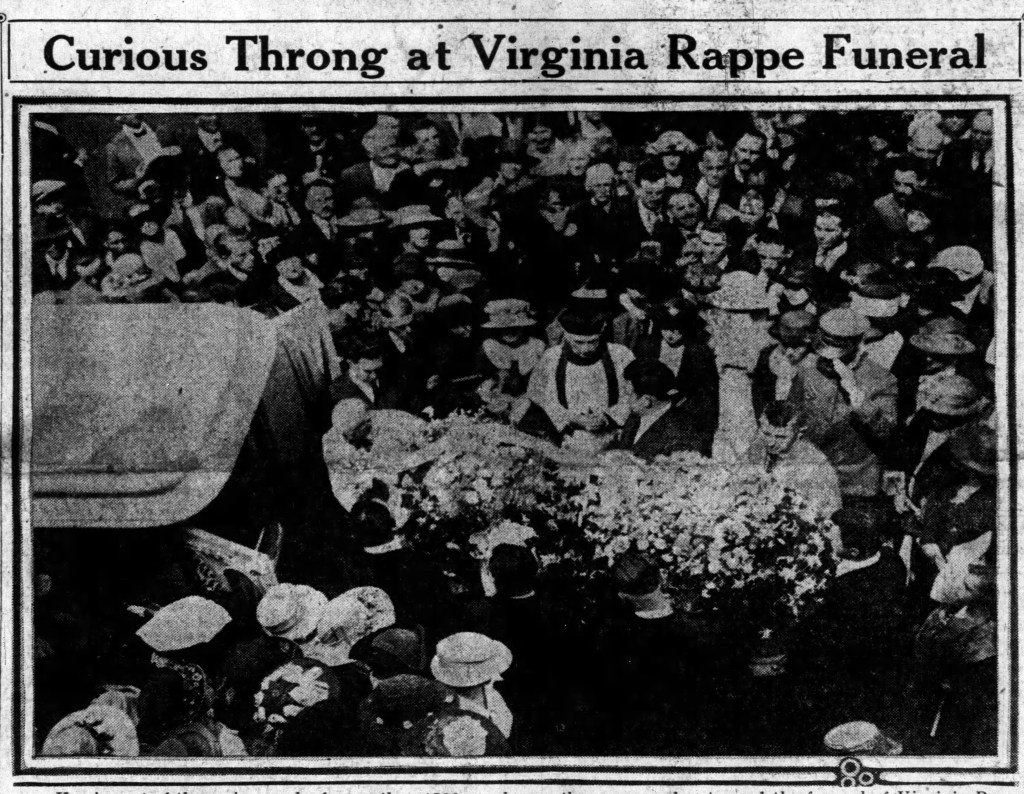
Outside, a mostly female crowd estimated to be as large as 1,500 attempted to force their way inside in what was called a “riot.” The police came in squad cars and on horseback. They made a path so that the pallbearers could shoulder their burden to the hearse. On each side of the flower-decked coffin slowly walked Rappe’s retinue of pallbearers, dwarfed by how high they carried it on their shoulders. Among them were not only Taurog and Semon, but Oliver Hardy, Al Herman, Dave Kirkland, and Frank Coleman.
As they slid the silver casket inside a white hearse, a mob closed in, some shouting questions for directions, the name of the cemetery, and if Rappe’s casket would be opened there one last time. “Can we see her there?”
After the cortege traveled the few blocks east to Hollywood Cemetery, followed by a parade of cars and people on foot, the mourners and the curious and those who could say “I was there” made their way toward Lehrman’s plot near the edge of a pond. They trampled the grass, stepped on gravesites, and sat on monuments. Many pushed their way to the front. Rev. Roudenbush offered one last prayer “with orthodox comfort of Christianity”—regardless of Rappe’s true faith if, indeed, she had one.
“Whosoever believeth in Me shall have everlasting life,” from John 3, was heard and one more body was added that made its later name, Hollywood Forever, a little more insistent, believable.
We welcome other acknowledgements of the centenary of the Arbuckle scandal, especially the piece at Silentology and its sequel and the credit extended to the pioneering work of Joan Myers. Silentology’s new entries remind us of another centenary being observed, the hundredth anniversary of the philosopher Ludwig Wittgenstein’s Tractatus Logico-Philosophicuss (1921) and its limitation, that “what can be said at all can be said clearly” and “what cannot be said must be passed over in silence.” This problem very much exists for the Arbuckle case, for it is hard to be silent about it and hard to know when to shut up.
What is he doing in this blog? Ludwig Wittgenstein and his chalkboard, early 1930s
This thought may appear as a nota bene (regard well in Latin) or headnote for a chapter provisionally titled “The Life of the Party.” Here we reimagine Arbuckle’s Labor Day party as it evolves and devolves following Virginia Rappe’s crisis in room 1219. We believe that witness descriptions of events were self-censored so often the number of voids and circumlocutions left the prosecution few stable details with which to piece together a consistent narrative for the jury.
There are clues, indeed, one specific word that gives a hint at what was being covered up in the testimony. That word was “rough” and it was the term chosen by the state’s chief witness, the so-called “Avenger,” Maude Delmont to describe the party. It was used again by a minor witness, Betty Campbell, who was dismissed early but was rather loquacious about the latter half of the party. In the parlance of the early twentieth century, this wasn’t just sexual harassment, that women tolerated. It was aggressive touching, disrobing, grabbing breasts and crotches, giving in to dancing topless or even nude, and relenting to being pulled into side bedrooms for foreplay and sex.
Women were expected to go along with this and not be “party poopers,” so to speak. If a woman didn’t want to be dragged into a room, she shouldn’t be at the party. The testimonies about the Arbuckle party make it sound less licentious than this but at least two woman, Mae Taube and Joyce Clarke, were uncomfortable enough to get out of there.
One need only look at the blue movies and photographs from this era to know what Delmont and Campbell meant: coitus with men still wearing their garters, stockings, and shoes. (This is almost de rigueur in Roaring Twenties pornography). The testimony of every eyewitness tiptoes around this. It is the story that Maude Delmont might have been willing to tell but couldn’t. Graphic details were censored from her published statement.
District Attorney Matthew Brady’s surprise witness at the preliminary investigation in September (the Police or Women’s Court session), was the hotel maid Josephine Keza. She could see into room 1220 and watch men and women in a state of undress. This is what a “rough” party looks like, a sex party.
So, what do we say before one delves into “The Life of the Party”? Given what we have to work with, Occam’s Razor must be tossed out or used in a different way. Three of the principal attendees had excuses for not being there at the crucial moments. Were these excuses scripted and practiced? Was Semnacher indeed elsewhere at the opportune times such that he saw, heard, and said nothing. (He was compared to an evil little monkey by a S.F. clergyman writing for the Examiner.) Did Fishback really go off looking for seals to include in a future movie? He was on hand for most of the party up till then. Lowell Sherman’s testimony that he was too busy on the phone discussing a theater engagement to pay attention to what was happening around him, was proven false when it surfaced that he was with Delmont in a bathroom during the period Arbuckle and Rappe were alone together. Even Ira Fortlouis who was allegedly kicked out of the party earlier made a statement that he was with Delmont at the time that Rappe was allegedly screaming for help.
What we have seen in some of Arbuckle’s offhanded and callous remarks, made before his lawyers silenced him, was this disappointment in Rappe, that she had spoiled his party, that she wasn’t fun anymore, like some broken toy. Therein lies part of the mystery of what happened between these two.
Here, of course, there are several ways to speculate what happened including some that haven’t been raised yet. For example, during his first trial, Arbuckle took the stand and explained that he found Rappe on the floor of room 1219’s bathroom and proceeded to help her to his bed. Is it possible her bladder ruptured when she fell from the toilet or rolled off of his bed, etc.?
Reading the medical journals of the early twentieth century on cystitis and bladder rupture, there are rare instances when, if one cannot urinate readily and tries to force him- or herself to do so, bears down, his or her bladder can burst from the effort, go into shock, be unable to walk.
Imagine Arbuckle waiting on his bed, his potency on the wane, his sweaty back leaching into the sheets, and calling out, “Virginia, please hurry!”
Don’t laugh. This may seem in keeping with the feverish mind of Kenneth Anger, who tried to stick a Coke bottle where it didn’t belong, but it can’t be ruled out that this began as a consensual encounter and was interrupted by a medical emergency unrelated to Arbuckle altogether. Had Rappe’s crisis come purely from excessive fluid retention, it might explain why Arbuckle didn’t express remorse or accept blame for what happened to her.
So, we must have a headnote that tells the reader that the party that Zey Prevost, Alice Blake, Al Semnacher et al. describe reads as too innocent, as if sex wasn’t on the minds of any of these unchaperoned, lubricated attendees. Was the party little more than an afternoon open house or was it something more uninhibited? The possibility of the latter is the first of many “thought experiments,” a term we liberally borrow as well from Dr. Wittgenstein.
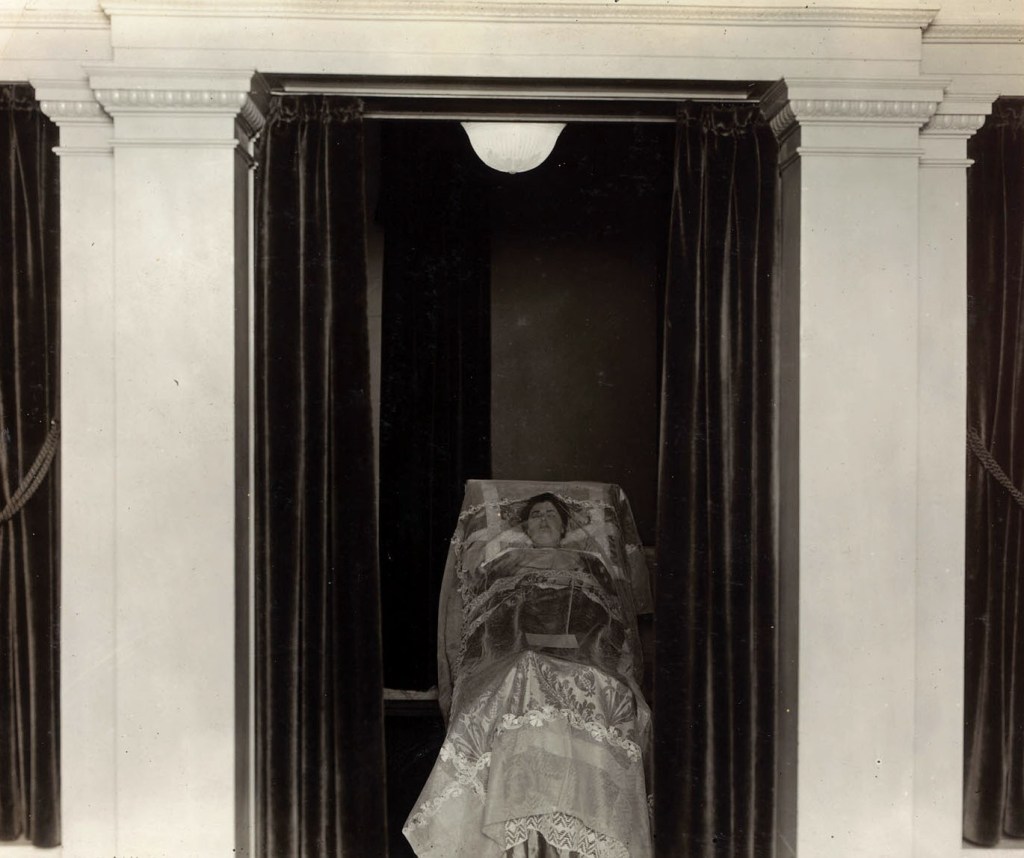
On Sunday morning, September 18, a line began to stretch from the entrance of Strother & Dayton, Argyle Avenue and Hollywood Boulevard. The Los Angeles Times estimated that 3,000 people filed past Rappe’s open casket. The San Francisco Examiner rounded the number to 8,000 people!
The most accurate estimate was kept by mortuary employees. Writing home to his parents in Iowa, Leonard Collenbaugh, a young undertaker who prepared Rappe’s body, described how he and his coworkers, on seeing all the people outside, posted a man at the entrance of the chapel to keep a head count. Another was posted at the exit to keep the nearly 4,000 mourners moving in an orderly fashion.[1]
At some point, however, Rappe’s manager, Al Semnacher, the man who had chauffeured her to San Francisco for her fatal Labor Day holiday, thought that not enough Hollywood people were there, especially people who knew Rappe. One exception was the the actress Mildred Harris, the estranged first wife of Charlie Chaplin.
At Arbuckle’s Labor Day party, the guests noticed that he and Rappe were virtually tete-a-tete most of time, talking and laughing. Perhaps during their conversation, the Chaplins’ divorce made for some of their bright conversation. Harris demanded $100,000 in alimony from Chaplin, who had just left for Europe after escaping being served papers by jumping onto a moving train with the nimbleness he showed on screen.
Arbuckle’s friend and onetime protege Charlie Chaplin had married Harris when she was still sixteen and their public parting of ways made for amusing stories in the newspapers in early September, that is, until the news about Rappe’s death dwarfed any interest in the Little Tramp’s personal life.
Mildred Harris (Calisphere)
When Mildred Harris arrived at the funeral home, the crowd was held back so that she could approach Rappe’s body. Harris observed the corsage bouquet of roses, lilies, and orchids placed in Rappe’s hands. Harris had sent the arrangement, Still addressed as “Mrs. Chaplin,” the young actress was allowed to kneel and pray by the coffin in private. After five minutes, she rose and said that she wanted Rappe’s body dressed in something other than a shroud for the burial the next day. She went home and brought back an evening gown, designed by Rappe for Harris to wear, of white georgette, over crepe de chine, with white lace and green silk ribbon. “It is the last gift I can make to one I loved,” Harris said to reporters.
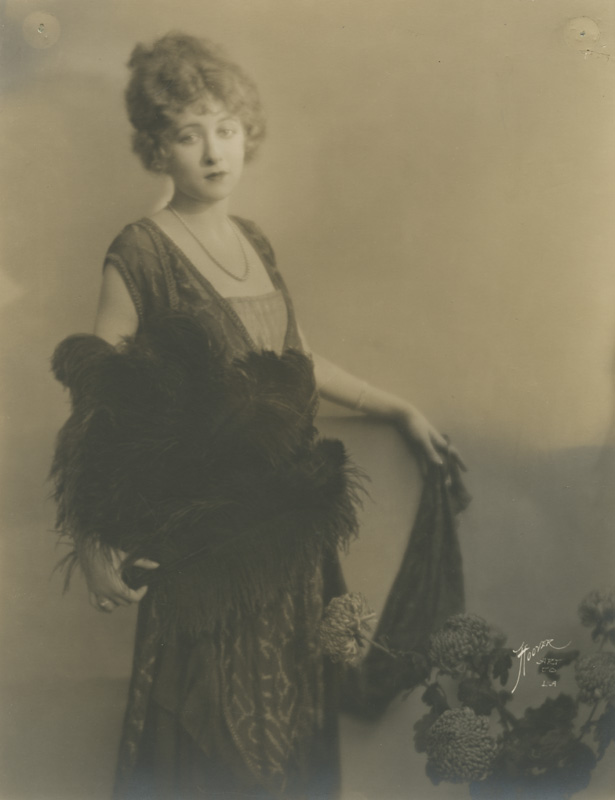
Virginia Rappe, September 18, 1921 (Calisphere)
[1] “Iowan at Rappe Funeral,” Webster City (Iowa) Freeman, 24 October 1921, 3.
On Saturday morning, September 17, 1921, Arbuckle woke once more inside cell no. 12 of San Francisco’s Hall of Justice, having been denied bail the day before. A murder charge still hung over his head as he sat on the edge of his cot. It would be determined over the coming days at a preliminary investigation in a special Police Court session the known as the “Women’s Court,” which limited the intimidating number and often rude behavior of male spectators.
Meanwhile, on that same morning, in Los Angeles’ Central Station, a reporter witnessed the lid removed from the crate in which Rappe’s silver coffin had been shipped. But what he saw first was the striking orange blanket of a thousand tiger lilies.
The casket of Virginia Rappe and the tiger lily blanket (American Florist)
The flowers had been ordered by Rappe’s putative fiancé, Henry Lehrman, from San Francisco’s master florist, Albert O. Stein at the cost of $150 (over $2,200 adjusted for inflation).[1] The choice of such flowers had been deliberate—and, perhaps, at the suggestion of Mr. Stein whose work in floral arrangements for funerals, public events, table decorations, altar pieces, chuppahs for Jewish weddings, and the like made him the go-to for making the best impression.
As Lehrman said to the press more than once already, Virginia Rappe had fought off Arbuckle “like a tiger.”
Two weeks later, in early October, Lehrman still neglected to pay the $150 invoice. But his checkbook was open for a mink coat, which he gave to his new girlfriend, a Ziegfeld Follies girl and aspiring actress, Jocelyn Leigh, who, like Rappe, was another Chicago native.
The check for $75 bounced, as Miss Leigh learned when she returned to the furrier to buy some accessories on credit.
Albert O. Stein was still trying to collect his fee on the day Arbuckle was acquitted in April 1922.
Jocelyn Leigh (Tattler, May 1922)
[1] See “Arbuckle Fate Up to Jury, Belief,” San Francisco Chronicle, 12 April 1922, 3.
Before Virginia Rappe’s coffin was sealed, Lehrman sent his final instructions. “Tell her,” he wired, “Henry said that he still loves you; she will hear.”[1] One of Halsted’s morticians took care of whispering the sentiment into the dead woman’s ear.
This privilege might have gone to Maude Delmont, but her role as Rappe’s caregiver no longer extended to Rappe’s corpse, whereas Lillian Gatlin offered to accompany Rappe’s coffin on the trip back for the honor of doing so. Nevertheless, Delmont was miffed that she had been denied the chance to chaperone Rappe’s body given the devoted attention she had provided when she was alive. She quoted a tactful telegram from Lehrman thanking her for the courageous manner in which she had “defended unfortunate Virginia” and that it was his most sincere wish that she go with Rappe’s body.[2] But, as the state’s star witness, Delmont was stuck in San Francisco and the District Attorney’s office could hardly risk her disappearing.
Outraged at Lehrman’s last minute decision to ask Lillian Gatlinto accompany the body on the trip, one made behind her back, Delmont shouted at reporters, “She shall not go”. “There will be serious trouble if she tries to. She did not know Virginia Rappe.”[3] But Delmont’s willingness to sign a murder complaint against Arbuckle now meant it was impossible for her to leave San Francisco for the immediate future. A policewoman had been assigned to watch her, not only to prevent witness tampering but to prevent the witness from disappearing.
On Friday afternoon, September 16, Rappe’s coffin was taken by hearse to the Southern Pacific’s Third and Townsend Depot.[4] There Gatlin purchased a first-class ticket for herself and one for the body to be stamped corpse. For the deceased to travel by first class was not an extravagance but rather a railroad regulation. But the corpse’s accommodations were hardly that of a Pullman car. The silver coffin was placed inside a large pinewood crate, which was nailed shut, and loaded into one of the dark green baggage cars of Owl, the Southern Pacific’s night express to Los Angeles.
For most of the journey south, the train lacked the scenery that the coastal route took and mostly traveled in darkness before it pulled into Los Angeles’ Central Station by mid-morning. The Los Angeles Examiner found a headline (“Tears, Flowers, Friends, All Are Missing”) in what little ceremony there was to sliding Rappe’s coffin, enclosed in a plywood box, from a baggage wagon into the back of a waiting white hearse. The mortuary workers did take the trouble to display Lehrman’s blanket of 1,000 tiger lilies. The choice was deliberate—for he said to the press more than once that Rappe had fought off Roscoe Arbuckle “like a tiger.”
In gold letters, a white ribbon draped across the lilies read: “To My Brave Sweetheart, From Henry.” The poignancy of Rappe’s neglect—and penury—was also taken up by a brief editorial in the Los Angeles Times, which noted that a “flood of light is shed on the lives of the pretty, highly dressed movie-picture stars by the fact that when Virginia Rappe died as the result of her injuries in San Francisco, there was not a penny in sight to prepare for her burial. She was absolutely broke.”
Thirty minutes after Rappe’s coffin arrived, Arbuckle’s manager, Lou Anger, and his lead defense lawyer, Frank Dominguez stepped off the Lark, the train that took the Southern Pacific’s coastal route. If they saw Rappe’s body being picked up at the train station, no one would know anyway, for they refused to answer any questions directed at them.
Virginia Rappe’s coffin being loaded into a hearse (Calisphere)
[1] Burton L. Smith, “Arbuckle to be Tried on Charge of Murder [. . .] Body of Virginia Rappe Is Being Brought to Los Angeles,” Los Angeles Times, 17 September 1921, 1.
[3] Ernest Hopkins, “Tragic Return of Body Marks End of Trip Virginia Rappe Planned for Pleasure,” Akron Beacon Journal, 16 September 1921, 25.
[4] The following is corroborated in Arthur Turney, “Unescorted Body of Virginia Rappe Is Received in L.A.,” Los Angeles Evening Express, 17 September 1921, 1; “Rappe Girl’s Body to be Shipped to Los Angeles Today: Will Be Accompanied by Lillian Gatlin, Scenario Writer and Friend,” San Francisco Chronicle, 16 September 1921, 6; “Pen Points by the Staff,” Los Angeles Times, 18 September 1921, 20; “8,000 at L.A. View Body of Virginia Rappe,” San Francisco Examiner, 19 September 1921, 3; “Thousands Pass Before Bier of Virginia Rappe,” Wichita Daily Eagle, 19 September 1921, 1; “Mob Blocks Traffic at Hollywood,” Los Angeles Record, 19 September 1921, 1, 2; “Virginia Rappe in Final Rest,” Los Angeles Times, 20 September 1921, 2.
[An intractable WordPress coding error had required us to repost this entry from 9/15.]
When Henry Lehrman put Virginia Rappe on a pedestal, remembering her as “clean, decent, high-spirited,” he could ill afford to step off his moral high ground in Manhattan and return to the West Coast. It would take him three days to reach San Francisco, longer than it would take to bury Rappe, and then another three days to return. Even at a whirlwind pace, Lehrman would need nearly two weeks for the trip as well as the funds on hand. He could afford neither. His contractual obligation to finish an Owen Moore comedy in New York gave him cover to avoid making the expected public appearance to mourn his erstwhile lover.
Still, Lehrman could “direct” Rappe’s final appearance via long-distance telephone calls and Western Union telegrams. He could take advantage of the sympathy extended to him by Sidi Spreckels, Maude Delmont, and people in Hollywood who had worked with Rappe and admired her, including his protégé, Norman Taurog, who offered to interrupt the directing a motion picture to handle the funeral arrangements in Los Angeles.
While Rappe’s body laid in a morgue and in the cold storage of a mortuary, Arbuckle made headlines, some ink was spared for Rappe’s memory and her status as a victim, a woman who died young, in the prime of her life. The newspapers reported that her body was still unclaimed as the new week unfolded despite her having “friends numbered by the scores” and being “one of the prettiest members of the Los Angeles film colony”—whose beauty the embalmers and cosmeticians of Halsted & Co. had restored as best they could because such matters couldn’t wait for instructions or payment.[1]
Fortunately for Lehrman, the spectacle of Rappe’s seemingly unwanted and orphaned corpse was avoided when someone unexpected stepped forward to represent him and give his “loved one” her due, the writer and aviatrix Lillian Gatlin, the first woman to fly across the United States and the “bird girl” of San Francisco.
Gatlin may have associated with Rappe in Los Angeles, where Gatlin once worked as a scenario writer. They met earlier, however, at the Panama-Pacific Exposition in 1915. That same year, Gatlin lost her lover and flight instructor, Lincoln Beachey, when he crashed into San Francisco Bay before thousands of horrified onlookers. On the first anniversary of his death, Gatlin flew over the spot where Beachey died and dropped a bouquet of roses. She made her rose drops an annual event and these became the centerpiece of San Francisco’s Aerial Days, which Gatlin expanded to honor American airmen killed during the First World War.
Lillian Gatlin (Calisphere)
Gatlin may have regarded Rappe as an honorary bird girl herself for being the first Vin-Fiz girl. But Gatlin’s motivations for caring about Rappe’s body were really in keeping with her favorite charity, the Silent Big Sisters, which assisted young unmarried mothers and their babies. Although Rappe wasn’t a mother, there was something no less pathetic about her situation in death.
When Gatlin learned that no flowers had been displayed around Rappe’s body, she had two long-stemmed roses placed like guards at either side of Rappe’s bier. With that and a large bouquet from a person who wished to remain anonymous, a public viewing of Rappe’s body could take place and soon women and girls filed past the open casket. The visitation, however, quickly came to an end as the long lines and crowds outside Halsted’s forced the mortuary to close its doors.
[1] “Tragedy Victim Is Sent Home,” Los Angeles Times, 17 September 1921, 2.
After three days of testimony, including the only time that Maude Delmont took the stand, San Francisco Coroner T. B. W. Leland instructed eight jurors to render a verdict. Doctors who treated Rappe or conducted the autopsy performed on her body testified as did eyewitnesses who attended Roscoe Arbuckle’s Labor Day party.
On the afternoon of September 14, 1921, the jury deliberated for hours and issued the following verdict.
We find that the said Virginia Rappe, female, white, aged about 25 years, single, residence Los Angeles, Cal., nativity unknown, occupation unknown, came to her death on September 9, 1921, at the Wakefield Sanatorium, from rupture of the bladder, contributory cause, acute peritonitis.
And we further find that said Virginia Rappe came to her death from peritonitis caused by a rupture of the urinary bladder. Said rupture was caused by the application of some force which, from the evidence submitted, we believe was applied by one Roscoe Arbuckle. We, the undersigned jurors, therefore charge said Roscoe Arbuckle with the crime of manslaughter.
We, the jury, recommend that the district attorney of San Francisco in conjunction with the grand jury, the chief of police, and the federal probation officials, take steps to prevent the recurrence of affairs similar to the one in which this young woman lost her life, so that San Francisco shall not be made the rendezvous of the debauchee and gangster.
Colbert Coldwell
A. T. Hunter
Eugene Simmons
R. J. Goff
W. Garner Smith
James Ging
W. E. MacPherson
Roscoe Arbuckle sharing some make-up with Lila Lee, 1921 (Library of Congress)
An eighth juror, Ben Boas, a bond broker, provided a minority verdict that agreed with his fellow jurors on all points save that “from the evidence submitted I am unable to determine who was responsible for the application of said force.” Eventually, his minority opinion would become the majority in subsequent venues of the Arbuckle case.
Source: “Manslaughter Charged against Arbuckle by Coroner’s Jury,” San Francisco Examiner, 15 September 1921, 1.
[The following is taken from our work-in-progress, in which we describe the testimony at the second session of the Coroner’s Court, conducted by San Francisco County Coroner T. B. W. Leland before an all-male jury. Following her appearance, her importance to the prosecution of Arbuckle quickly faded. Nevertheless, District Attorney Matthew Brady kept open the possibility that she might appear in court again as late as March 1922, during the third Arbuckle trial.
We have various theories about why Delmont wasn’t put on the stand again at any subsequent venue related to the Arbuckle case. One of these is that much of what she stated behind closed doors and even in the Coroner’s Court was “unprintable.” It is usually assumed that her account of events differed so greatly from others’ statements that it was deemed unreliable and too much of a risk to the prosecution.
When the defense had an opportunity to call her to the stand, they refused. Of course, the risk of her describing the real nature of Arbuckle’s party may have been the cause. By having his Labor Day party in a hotel suite, Arbuckle may have thought he’d found a loophole in a Hollywood maxim cited in Evelyn Waugh’s The Loved One, to wit, “never do before the camera what you would not do at home and never do at home what you would not do before the camera.”]
Still dressed in black, Maude Delmont was again aided by a policewoman who, beside her, made Delmont appear taller. Delmont looked tense, fragile, ten years older than her real age (late thirties), and hardly what one would imagine of a flinty, hard-drinking daughter of a frontier dentist. The corners of her mouth drooped, her dark hair showed strands of gray. Kinder reporters saw her crow’s feet as “lines of sorrow” that suggested an “intimacy of years” spent with Rappe. The intimacy was quickly revealed to be less than a week. “But friendship,” Delmont said, “cannot be reckoned by the clock. The moment I met Virginia I felt there was a real bond between us. We were together every minute almost after we met, and it seems to us now as though I’d always known and loved her.”[1]
Delmont faced a packed courtroom, including Arbuckle sitting between two policemen and wearing a new blue Norfolk jacket with a pair of knickerbocker trousers. His bloodshot eyes were fixed on Delmont while he squeezed and twisted his green golf cap in his fists and leaned forward in his chair just behind the railing that separated him from the defense counsel’s table. At times he yawned, either tired or bored, and said nothing to his lawyers
After identifying herself and where she lived, Delmont drank deeply from a glass of cold water. She put the glass down, asked for warm water, and the inquest was held up while a coffee cupful was brought to her. As though by rote, with lines almost certainly rehearsed beforehand, Delmont repeated much of the same story she had told in her original statement, as it appeared in the press albeit with changes that were hardly negligible, which got the attention of everyone at the defense table.
With trembling hands, Delmont took sip after sip of warm water so as not to lose her voice or composure. She described everything in “minutest detail” from the trip to Selma to the Palace Hotel breakfast, where a bellhop handed Rappe a note inviting her to Arbuckle’s suite at the St. Francis Hotel. Delmont said the note read, “Come on up and say hello.” It bore Arbuckle’s signature.
Delmont made no mention of Fred Fishback or Ira Fortlouis playing any role in the invitation. Instead, she went on to the Labor Day party and once more reporters were forced to censor themselves rather and give only the gist. Instead of being forced into room 1219, Delmont no longer would say that Arbuckle had dragged Rappe by the wrist. Nor did she repeat that he had always wanted Rappe since 1916. Delmont made it seem as though Rappe entered that room of her own free will to use its bathroom. Then Arbuckle immediately followed Rappe. When she came out of the bathroom, Delmont saw them talk for a moment in the middle of the bedroom. “I can’t say if he went into the bathroom with her,” she said at one point. I guess he dragged her in.” But this last statement was not allowed to stand. Delmont, however, said she saw Arbuckle walk past Miss Rappe and close the connecting doors between 1220, the parlour room, and his bedroom. When a juror asked Delmont if she had verbally objected to when Arbuckle locked the door on himself and Rappe, Delmont said no.
Fifteen minutes passed before Delmont began to worry about Rappe. “I didn’t see why Virginia would not come out,” Delmont said. “I didn’t think it was nice for her to be in there with Mr. Arbuckle.”
Other accounts of the same testimony suggested that Delmont was alerted to something wrong not by Rappe’s silence but by her scream at one point.
“What was the nature of the scream,” Leland asked.
“As a woman in agony,” replied Delmont.
There was no response from inside room 1219 as Delmont tried to get Rappe’s attention. “Then I became angry,” Delmont said, “and I kicked ten or twelve times on the door of the room, but there wasn’t a sound.” After more time passed, Delmont called the desk. Harry Boyle took the call and came up at once and his presence in room 1220 prompted Arbuckle to open the door of 1219.
Touched-up and discarded photograph of Maude Delmont, September 13, 1921 (Calisphere)
Delmont continued, describing what happened after she, Zey Prevost, and Alice Blake entered Arbuckle’s bedroom up until Rappe was carried out. Throughout her testimony, however, Dr. Leland could hear that Delmont had changed her original story. Perhaps getting looks from Arbuckle’s lawyers, Dr. Leland interrupted Delmont and lectured her on the significance of her testimony as a complaining witness.
“I am here to tell just the truth,” she protested. Nevertheless, Leland warned the witness to “consider her statements well.”
“Maybe I am leading you,” he continued, attempting to tease additional details from Delmont, whom he presumed to be fatigued from a night of Grand Jury testimony.
“Sometimes people go to sleep and just say yes,” Leland said.
“I’m not asleep,” Delmont replied and candidly added, “for I had a little hypodermic before I came here, and I am all right.”
Observers took her to mean an injection of morphine, of which dry mouth is a tell-tale side effect. Her drinking, too, raised eyebrows and made for the logical impression that she was an alcoholic—morphine being a temporary palliative for the side effects of alcohol abuse, including delirium tremens. Delmont admitted to drinking on the way up from Los Angeles to San Francisco—six whiskies while in Selma alone.
Dr. Leland asked about her prodigious capacity on Labor Day afternoon. Delmont admitted to drinking “eight or ten drinks of Scotch whisky.”
“Were you beginning to feel the effect of the drinks?” Leland asked.
“Undoubtedly,” Delmont answered. She had been dancing, as well, and getting very hot in her black dress. “So I asked Mr. Sherman if he would mind if I slipped on some pajamas and he said, ‘No, certainly not’ and he took me into his room, got a suit of his pajamas from a dresser drawer and went out while I put them on.”
Dr. Leland asked Delmont about what Rappe and Arbuckle had to drink. Rappe may have had two or three drinks, both gin and orange juice. Rappe, said Delmont, was more interested in dancing and having a good time. Leland pressed on, asking if it were possible that Rappe had been drinking before Delmont had been allowed to join the Labor Day party.
“She was there only five minutes,” Delmont said in disbelief, “and common sense will tell you that she couldn’t have had many.”
[1] The following passage is adapted from “Woman Witness Tells Why She Is Actor’s Nemesis,” Oakland Tribune, 13 September 1921, 2; United Press, “Arbuckle Sees Ray of Hope,” [Long Beach] Daily Telegram, 13 September 1921, 1; “Sensational Details of Party Told at Virginia Rappe Inquest,” San Francisco Chronicle, 14 September 1921, 7; and Robert H. Willson, “Stories Told Coroner Jury Conflicting,” San Francisco Examiner, 14 September 1921, 4; and A.P. Night Wire, “Proceedings of the Day,” Los Angeles Times, 14 September 1921, 1, 2.
Given that Arbuckle was the highest paid actor in 1921 and made millions more for hundreds of theater owners and others, District Attorney Matthew Brady grasped the magnitude of the case and his greatest fear was witness tampering. He knew that, as Roscoe Arbuckle waited for the Oakland Ferry for the last stretch of their trip, his lawyer Frank Dominguez had made a telephone call to the police, assuring that Arbuckle would turn himself in. But he suspected another call was made, to Arbuckle’s new lawyer in San Francisco, Charles Brennan, to learn of any developments that they would need to get ahead of.
What has gone under-appreciated in the early days of the Arbuckle case, indeed, in the hours after Rappe died on September 9, is how quickly Arbuckle responded to the possibility of his arrest and the accusation of murder against him. By midnight, a strategy meeting convened in the office of Sid Grauman’s Million Dollar Theater, attended by two lawyers, a friendly journalist from the Los Angeles Times as well as three men who attended the ill-fated party.
In the annals of crisis communications, what was accomplished for Arbuckle could be the first modern example.
One aspect of this was to neutralize the witnesses who might inflict the most damage to the defense by making them aware of the risk–reward of doing so.
For an aspiring entertainer, Zey Prevost was just such a person. She had made a statement to police on Saturday, September 10, the day Arbuckle and his team spent driving from Los Angeles to San Francisco. Two days later, on the day the Grand Jury was to meet, she asked to change her story and remove any testimony that could be used to make Arbuckle responsible for the injury that led to Virginia Rappe’s death. Later, she testified in another venue that she had been approached by another of Arbuckle’s lawyers, Charles Brennan, on Market Street in San Francisco.
Q: What did Mr. Brennan say to you?
A: Just asked me if I had a lawyer—if I needed a lawyer, to tell him. I said “Sure.”
Q: Did he ask you anything further about remaining in town, or going out?
A: He asked me about staying in town. I said “I may stay in town a few days until this thing is over.”[1]
This was all she said of her conversation with Brennan. But she went away from it committed to undermining Brady’s case against Arbuckle before it even got off the ground. Only a threat of perjury and jail time convinced her to keep to her original statement. In any event, the defense, over time, was able to convince jury members to vote for acquittal in part because Brady allegedly coerced his witnesses to say what he wanted to hear.
If Prevost was somehow rewarded for her loyalty, it didn’t amount to much. She was signed as a vaudeville act a few weeks after the third trial. But that was short-lived and her career as a comedienne was soon over.
Alice Blake, a friend of Zey Prevost, was also seen as a “coerced” witness (Calisphere)
Sunday, September 11, 1921, was a day of preparing for the next evening’s Grand Jury session. The preparation and ongoing investigations were overseen by Duncan Matheson, San Francisco’s long-serving Captain of Detectives. Unlike his subordinates, he was cast from a different mold and hardly the Irish American stereotype of Dashiell Hammett’s novels.
Born in 1865 in Nova Scotia, Matheson was of Scottish ancestry. As a young man, he emigrated to the United States and began working as laborer for the Southern Pacific Railroad. By 1900, he had married and was roadmaster for the Mojave District and in charge of track maintenance through the California desert. Then, in 1901, Matheson joined the San Francisco Police Department at the relatively advanced age of thirty-six and began working as a patrolman along the Mission Street wharves, where he was feared for the way he would swing a nightstick in breaking up fights and the like. His exploits were often newsworthy, including a time he crashed through a skylight while jumping from one building to another in pursuit of a gang of juveniles.
Over the first decade of the new century, Matheson became a real-life Untouchable—his resemblance to Sean Connery’s Frank Malone, is striking—rising in rank from sergeant to lieutenant by 1911. That year Matheson was put in charge of policing Chinatown, where he had been given the task of curbing its illegal gambling, lotteries, narcotics, and notorious tongs (gangs). Perhaps because the “Chinese were more afraid of him” than they were of the police chief, Matheson was promoted to Chief of Detectives by 1916.
Matheson gained notoriety for his role in the investigation that led to the arrest and conviction of the radical labor activist Tom Mooney for the Preparedness Day Bombing of July 22, 1916, along San Francisco’s Market Street. American socialists organized numerous protest rallies across the country in support of Mooney and Matheson is still recognized in historical accounts for the part he played in allegedly framing him.
One can imagine Matheson seeing himself as cut from the same cloth as the cowboys and others who settled the west. He was a skilled horseman, sometimes saddling up to lead a posse into the hill country around San Francisco in search of a suspect. And as the father of a teenage daughter, was protective and sympathetic to issues that would impact her as the 1910s came to a close and women’s suffrage and Prohibition loomed.
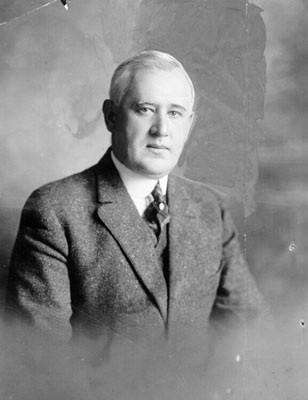
Duncan Matheson, S.F. Captain of Detectives (Calisphere)
A nondrinker and public speaker, Matheson once spoke before the Women’s Christian Temperance Union (WCTU) about how he intended to enforce the new Volstead Act. He spoke to the Housewives League on the need to protect girls and young women—from themselves, for, as he noted, seventy percent of all the juvenile cases he handled involved girls who had gone “bad.” In early 1921, when the state tried to reduce funding for the State Home for Delinquent Women, Matheson spoke against the defunding given the rise in girls and young women involved in criminal activities.
As much as Matheson took a grim view of radicals setting off bombs in his city, he also shut down at least two high-profile abortionists, Dr. Ephram Northcott in 1919 for the botched abortion and death of an army nurse, and the infamous Dr. Galen Hickok in 1920, whose victims remains were buried on the grounds of his so-called “castle of mystery” overlooking Salada Beach. In October 1920, Matheson and his detectives investigated the murder of a so-called “nightlife habitué” and prostitute Ruby Allen. She had checked into the Knickerbocker Hotel and was later found dead, bound and gagged, the victim of an apparent robbery by one of her johns. Although Matheson claimed he knew who the killer was, no one was brought to trial.
Matheson, too, took a prominent role in the investigation of the brutal gang rape of two girls in a shack on Howard Street by a gang of juveniles in November 1920 that became a cause célèbre for San Francisco’s women’s groups and clubs that packed the courtroom to see Arbuckle brought to justice for what many of them believed was a rape. Lastly, in April 1921, Matheson busted a white slavery ring and included two men charged with conducting orgies with three young girls and grooming them to appear in pornography films and photography.
Having learned firsthand what some men were capable of doing to women, Matheson was primed to act when he was told what happened to Virginia Rappe at Arbuckle’s Labor Day party and saw what was left of this beautiful woman in the city morgue.