The Celtic prose poem: Gavin McNab’s argument for the defendant

A new version of the arguments is being drafted (as I write) delivered before the jury near the end of the first Arbuckle trial of November–December 1921. The first draft had been based on very detailed reportage. The trial transcripts, however, differ markedly from the paraphrased versions in published in newspapers.

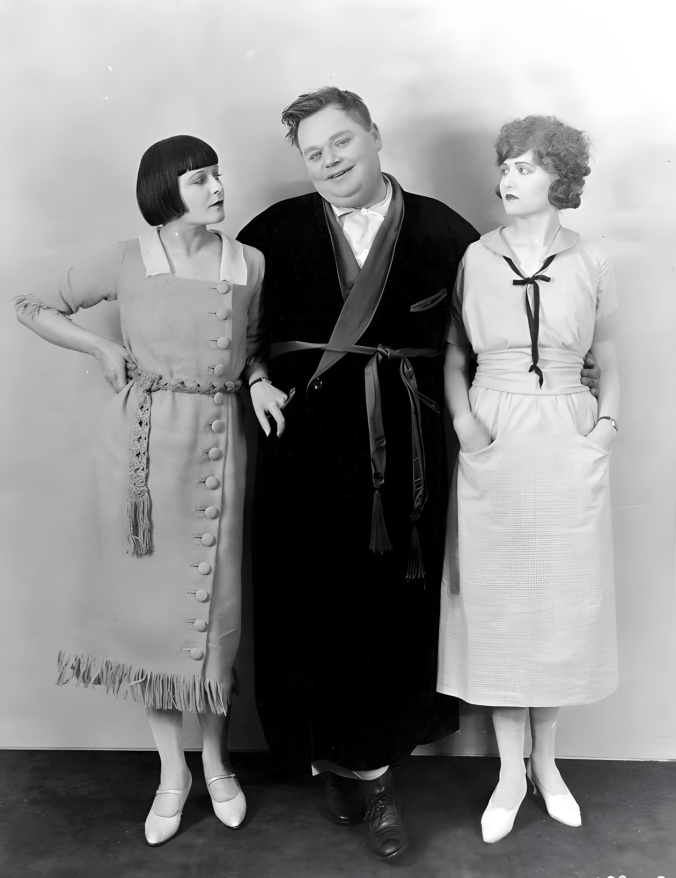
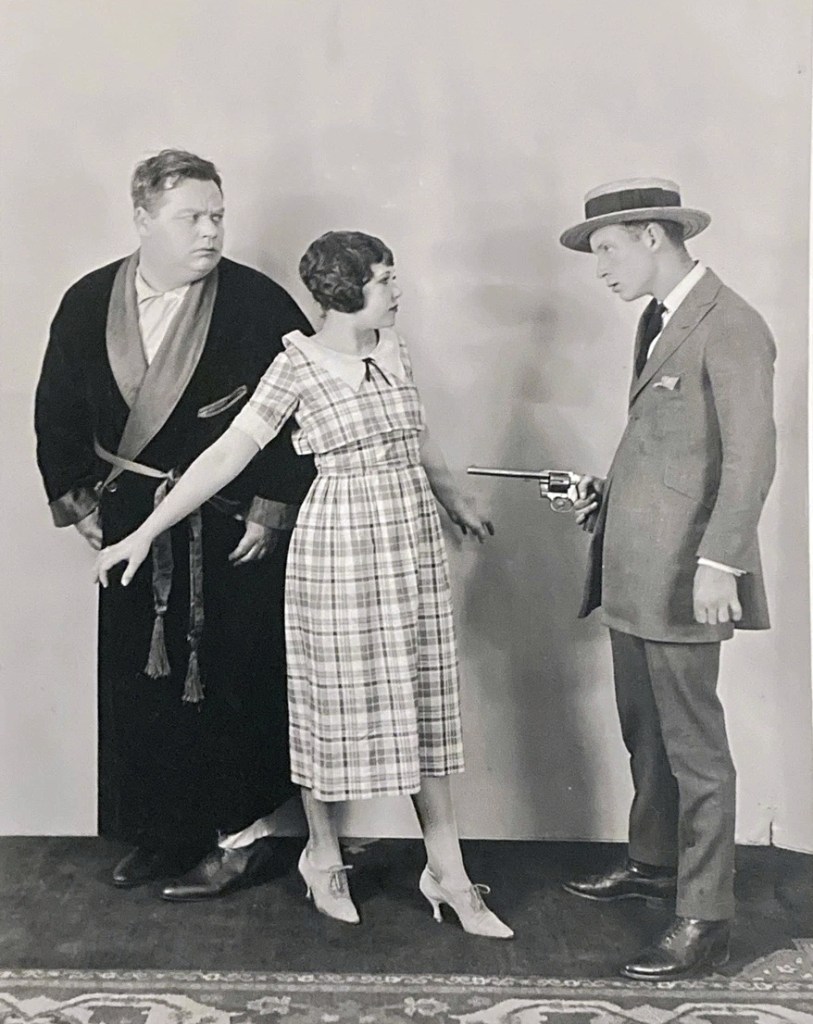
Roscoe Arbuckle with his female interest throwing herself in front of him. (He wears one of his capacious bathrobes, perhaps even the one worn at his Labor Day Party. As a further aside, the more militant feminists who panned Gavin McNab’s bible readings were far outnumbered in court by young women who, not unlike this one, stood up for the comedian.)

What follows is the end of the section devoted to Gavin McNab’s defense of “Fatty” Arbuckle.[1] Its title is derived from the Rev. James Gordon, the same Rev. Gordon whom Sidi Spreckels called to Virginia Rappe’s bedside. The clergyman, writing in his new column, described McNab’s speech as a “Celtic prose poem” after McNab’s rich Highland accent, which made him sound as much like a Presbyterian divine as a lawyer.[2] The man who followed McNab, with closing argument for the People, Milton U’Ren, was not as sanguine. To him the Good Samaritan described below was a “moral leper” and inspired another kind of outburst of faith: “Thank God, he will never make the world laugh again.”[3]


Had it not been for Maude Delmont being an unreliable witness, there would be no reliance on Zey Prevost or Alice Blake. All three women, for men who remembered the Preparedness Day bombing, always posed the risk of blowing up the People’s case. Every one of the district attorneys had a hand in planting those bombs in their own case, most of all Isadore Golden, who had come up with the compromise “hurt.” Still, that is what those showgirls undersigned. And, lest anyone forget, the “unfortunate circumstances,” the “wine party” as McNab put it, that event still resulted in murder to the prosecutors. They just needed to bide their time for a little longer and weather the dated lawyerly magniloquence of the 1800s autodidact showing off for the jury.

McNab’s had a working lunch. He met with his colleagues to discuss his performance and to go over the record and what had not been covered. There had been no mention of Jesse Norgaard, whose testimony suggested that Arbuckle had been obsessed with Virginia and that he disrespected her as well, and women in general, given whatever joke he intended to play.

Nat Schmulowitz surely and tactfully expressed a concern for the way medical evidence had not been exploited thoroughly. McNab had only burnished the reputations of Dr. Shiels and Collins brighter. And he had yet to draw on the Chicago affidavits, Albert Sabath’s contributions. One had been read into the record—and three doctors the day before certified that Miss Rappe was diseased. She had cystitis, which, to these conferees who had been holding back on leaving her reputation alone, was virtually a junior venereal disease in keeping with the late junior vamp.

And so, when the trial resumed at 1:45 p.m., McNab linked the medical commission’s report to “the testimony of Dr. Rosenberg of Chicago.” This evidence revealed that the defense had been right in contending that the young woman’s bladder had “defects,” that it was not the “perfect organ” the prosecution contended. Even that realization elicited another opportunity to preach to the jury as if it were the choir. “It would be an assurance trespassing on the domain of Divine Providence for any lawyer to intrude into the mysteries of nature and say what caused that rupture,” McNab intoned.

But the disease for which we have contended had been established. Whether that contributed materially to the disorder, we do now know, nor have any of the medical men on either side who have appeared before you pretended to tell you what did. All they could say to you was that many things might have done so. This leaves it with you of any direct testimony, outside of the medical and of the surgical demonstrations, to determine what probably brought about this young woman’s demise.

McNab, of course, did not want jurors to glance knowingly at Arbuckle’s girth—the District Attorney’s murder weapon that had been turned against the comedian. And so jurors who had already made up their minds, the reporters, as well as Arbuckle and Minta who knew better, now heard McNab deliver a paean, a panegyric devoted to the exercise of impartial judgement. “We do not ask you to give him any consideration because he is a great artist,” McNab said, without being ironic again, “or because he had brought joy into the world, or because he has made a success of his life. [. . .] This man without any disfigurement in this case, because there was not the slightest testimony reflecting on his character.”

The prosecution’s case, McNab reasoned, was based entirely on “conjecture.” As for the Arbuckle’s version of events, in response to all that had been made up about him, McNab made it a special point that his side made no objections during “two hours and twenty minutes of crucial cross-examination.” That was unheard of. That only proved Arbuckle’s candidness before the people of San Francisco and the nation. Then McNab waxed into a Cross of Gold speech made of diamonds.

That is the story. And you heard the story in its simplicity of how he tried to help this woman in the distress that had come upon her, and which was a common experience in her life, as is established without a contradiction, and how actuated by the spirit of mercy, you see this picture of this man crucified before you as a wicked character, in speech but not in evidence, carrying the limp body of this injured girl down the corridor of the hotel, staggering with her weight. Was this an unkind man? Doesn’t that tell the story, open for the world there to look at what went on behind the closed but not locked doors? [. . .] And he has told you in simple words what happened, and it exactly corresponds with this great, big, warm-hearted man, this rough diamond, perhaps, but still a diamond, carrying that injured girl down thru the hall; a more pathetic and a more beautiful picture than he ever put on the screen.

“There is to my mind a beautiful thought in connection with this thought,” McNab said in afterthought, that counsel had “not asked about the pictures that this man produced, but has anybody ever suggested that anybody ever saw an unclean picture of Roscoe Arbuckle? I think sometimes that the instincts of childhood is the most accurate of all instincts of the human race.” And yes, McNab really did impress upon the jurors the notion that Arbuckle himself was a juvenile. That gave his lawyer a fitting way to end of his Celtic sermon. “I always am impressed,” McNab said sagaciously,

with that beautiful spiritual suggestion of the Savior, “Suffer little children to come unto me.” And the childhood of the world, the instinct of childhood, had been accurate from that day to this, and this man who has sweetened human existence by the laughter of millions and millions of innocent children comes before you with a story of a frank, open-heated, big American, and submits the facts of this case in your hands.

To this a bored Leo Friedman, speaking for the People, asked McNab if he were done.


[1] People vs. Arbuckle, First Trial, “Argument of Mr. McNab, on Behalf of the Defendant,” 2188ff.

[2] James Gordon, “Minister Tells Highlights in ‘Fatty’ Case,” Los Angeles Evening Herald, December 1, 1921.

[3] People vs. Arbuckle, “First Trial, Closing Argument for the People, by Mr. U’Ren,” 2269ff.

A note on Aunt Kate Hardebeck

Those who followed the Arbuckle case from the beginning were surprised that Virginia Rappe had no family members—or even an extended family. No one came forward to claim her body in a San Francisco mortuary. By the time she was buried in Hollywood Forever Cemetery on September 19, 1921, ten days after her death, Virginia had an adoptive aunt, Kate Hardebeck. Those who attended the funeral noticed that she and her husband, Joseph Hardebeck, had supplied a pillow of roses for their late “niece.”

Although her presence on the stand saw some of better reportage, using the trial transcripts have brought to light the nature of the curious relationship between Virginia—called “Tootiie” in Hardebeck household—and her “Aunt Kate” or “Aunt Kitty.”

At this writing, I have no photograph of Aunt Kate for my book. Although very likely more of a facilitator than a guardian, Aunt Kate was fiercely loyal to Virginia and proved that on the stand. When she appeared as a rebuttal witness to vouch for Virginia’s good health and sensible lifestyle. Then there was Aunt Kate herself, whom Cohen could not intimidate. According to Bart Haley of the Philadelphia Evening Ledger, Mrs. Hardebeck seemed to be “a self-possessed and clever-looking woman, who in a quiet way had been doing considerable damage to his client’s position”—meaning Milton Cohen. He was not only “Fatty” Arbuckle’s personal lawyer, but Virginia’s as well. Cohen and his partner Frank Dominguez—who was Arbuckle’s first lead counsel—made the legal and financial arrangements for Virginia’s alleged paramour, Henry Lehrman and his Culver City studio in 1919. This allowed for Arbuckle to advance Lehrman the money to actually build two studios in one, thus allowing Arbuckle’s Comique Company to use one half as payback on the loan. This is, of course, a revealing rabbit hole down which to plunge—and something to save for the book.

Cohen, of course, knew a lot about Rappe’s household. He used that to exaggerate what may have been some isolated theatrics, the kind of thing expected of a “wild girl,” a “junior vamp,” to amuse the other film colonists when their parties needed some life, that someone, that is to be the life of the party. Such innocent escapades were transformed into bouts of hysteria that replicated and anticipated the fear if dying, loss of control and distress Virginia exhibited before losing consciousness in room 1219 of the St. Francis Hotel, after being alone with Arbuckle on the Labor Day afternoon of September 5, 1921.[1]

Cohen was very careful with Aunt Kate. Only during the third trial did he come close to revealing that “Uncle Joe” Hardebeck was an ex-convict and, like his wife, dependent on Virginia. But Cohen never did. Instead, he tried to exploit the curious dependence that Aunt Kate had on Virginia, that she was no blood relative, no aunt, but nothing more than Virginia’s housekeeper in Los Angeles, first at her apartment on Ivor Avenue and later at N. Wilton Place. It did not serve Cohen’s narrative to reveal too much about Aunt Kate’s other function, that of companion and chaperone when Virginia, that is, someone to intimidate the “boys,” the category under which Arbuckle fell. But Aunt Kate knew when to step aside, too, and not ask too many questions, like why was Virginia packing a lot more for an overnighter in Selma, just outside Fresno. Aunt Kate surely knew that her “niece” had to make some money, to get work, so that she could keep the Hardebecks and herself under the same roof. Virginia was no less loyal to the couple. This, perhaps, went back to a dire time in Virginia’s early life, after the death of her mother, Mabel Rappe, in 1905, which forced Virginia and her grandmother to move from New York back to Chicago and intermittent homelessness.

“I saw her two or three times a week,” Aunt Kate recalled on the stand, “and she and her grandmother would come out and stay overnight.”

The most current view of Virginia Rappe’s N. Wilton Pl. residence beset in Google “fog.”

Although very little is known about Aunt Kate’s early life, according to census data, she was born near Philadelphia in 1862 and was known as Kate Williams in 1900 and a widow. Her 1910 entry also reveals that she bore at least one child, whose absence might explain her connection to Virgina, which began on the South Side of Chicago, where Aunt Kate once worked as a housekeeper for a boarding house.

In 1903, in Covington, Kentucky, Kate married Joseph Hardebeck (b. 1863), a lawbook salesman. And this vocation certainly explained his title “the Judge,” as the leader of a gang of swindlers whose bad checks cost banks in the United States and Canada over $100,000 in 1909. When he was apprehended in the following year, Hardebeck was sentenced to four years in Missouri’s state penitentiary. Naturally, Aunt Kate told reporters she had no idea and believed her husband would be found innocent. And she stuck by him much as she did Virginia—until he barricaded himself in a bathroom in May 1923, a little over a year after the last Arbuckle trial, and shot himself to death. After that, Aunt Kate got by as a seamstress, something she also did for Virginia, whose outfits made her “the best dressed girl in Hollywood.”


[1] The “wild girl” can be compared to the Hollywood “bad girl” as personified by Bebe Daniels, whose best friend hovered inside the Arbuckle suite and downstairs in the Fable Room of the St. Francis. Arbuckle, incidentally, was a close friend of Bebe and I have a theory that she may have been hovering along with her friend.

Inclusivity: the authentic and inauthentic working together

This is a progress report on the book and photo research.

Over the past few days, I have been reworking real story behind the so-called war nurse Irene Morgan, Virginia Rappe’s masseuse and personal nurse from March to October 1920. I discussed her in an earlier post and have new information about her that makes her all the more “sketchier.”

Miss Morgan, who was actually married and listed herself as a widow in the 1920 census, testified that she had to catheterize Rappe during her periods. She also inserted several episodes of drinking, clothes tearing, nudity, and hysteria in addition to a bladder issue. The defense posited such histories—or rather stacked the deck with them—to distance Arbuckle from having caused Rappe the distress she exhibited in a double bed in room 1219 of the St. Francis Hotel on Labor Day, 1921.

That Arbuckle’s lawyers relied on such persons of interest suggests the lengths they went to get the motion picture comedian acquitted. That often requires this author to dig up the stories that comes after the trial. And that is how I found out that Miss Morgan reinvented herself as a “Doctor of Kinesiology” at the College of Applied Science in Los Angeles, an institution peculiar to California—and the brainchild of the notorious charlatan Edward Oliver Tilburne.

Back in the 1920s, everything that became the wellness culture that grew up alongside the film industry, was already in motion. Yoga was becoming a “thing,” but kinesiology, imported from Sweden, was the way to achieve wellness through motion and massage.

Finding the authentic amid the inauthentic has made my work both intriguing and a labor of love. This is true in regard to the photographs, some of which are worth more than a thousand words and what I am willing to pay for images now in the public domain.

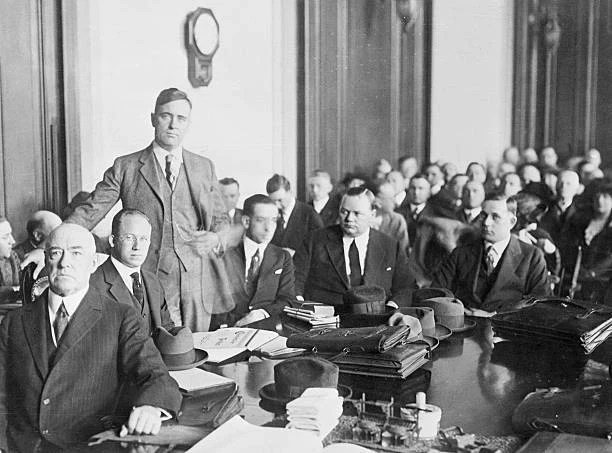
One such photograph has been hard to find. For the first Arbuckle trial of November–December 1921, a group portrait was taken of both the defense lawyers and prosecutors, who sat at the same long table before the bench and witness chair.

This photograph exists in two versions. One has the prosecutors cropped out entirely using the Photoshopping of the day, a pair of scissors. You can find this one in books:

A few, a very few newspapers printed the entire original image:

The above grainy image and caption is on the reverse of another image that had been spliced together from two different takes. It was recently for sale on eBay. At first, I found it unsatisfactory for the book and passed. But given all the tension between what is truth in my book and what is not, I might reconsider it. Notice that no one cared that the courtroom wall clock appears twice in the background.

Arbuckle’s “girlie,” Kate Brennan

Imagine, if you will, having a little editorial voice in the back of your mind, looking over the first 300 manuscript pages and complaining about the size of my tableau,

“Why are you painting the ‘Creation’ around a clown?”

I will let that question hang there and discuss one of the pleasures of my work, exorcising the devils in the details, which the 300-page trade paperback standard can easily overcome by cutting the problems out the way one might cut out a worm hole in an apple. (I get to oranges below.)

I am currently revising my treatment of the First Arbuckle trial of November–December 1921 and, at this writing, beginning the chapter on the various defense witnesses, including Kate Brennan. There is no photographs of her and I wish there was to do her more justice.

Miss Brennan had originally been slated to testify for the prosecution—and to corroborate the testimony of a fellow chambermaid, Josephine Keza. Both had been assigned to the 12th floor of the St. Francis Hotel on September 5, 1921, and heard what the prosecution alleged were the cries of Virginia Rappe emanating from room 1219 both during and after being alone with “Fatty” Arbuckle. The prosecutors expected Miss Brennan to repeat her initial statement made to Assistant District Attorney Milton U’Ren on September 16. The gist is in her cross-examination from the second trial. “What is a matter with her?” exclaimed. “Is she spifflicated?” (the italicized word 1920s slang for being very drunk).

And I said, “What is it, a booze party? She [Keza] says, “I don’t know.” And I said, “What is it, a booze party? She had got on a glorious one. Who is she anyhow?” She says, “I think it is a movie crowd.” And I said, “Well, is that going on long? We ought to tell the inspectress.” She said, “I think it is a movie crowd,” and with that I saw Mr. Arbuckle and another gentleman come out and ask to be let into 1221, from 1220. I said, “Of course it is a movie bunch, there goes Fatty Arbuckle.”[1]

Eventually, Arbuckle’s lawyers encouraged Brennan to testify for the defense. Incredibly, in her testimony of November 23, Brennan stated that she entered the Arbuckle suite just before 4:00 p.m. and after Rappe had been removed to another hotel room. Then she proceeded to clean the entire suite while the party went on around her. But Arbuckle had her start in 1219. Not only did Brennan change the bedclothes and turn over the mattress on the bed—where Rappe had been found in agony, suffering from a ruptured bladder—the chambermaid also wiped off all the woodwork with a cheesecloth.

The comedian’s lawyers faced a very real problem in that Milton U’Ren had engaged the criminologist Edward O. Heinrich.[2] He had found fingerprints that, based on his comparison, matched those of Arbuckle and Rappe on 1219’s exit door. Given how thoroughly Brennan wiped down the door, those fingerprints should not have been there. The implication, of course, was that Heinrich faked them.

Naturally, I wanted to do a close reading of Brennan’s testimony—and not just dwell on that wonderfully authentic period word “spifflicated.” She had a few interactions with Arbuckle that suggest just how spifflicated he was as his Labor Day party sailed into the late afternoon. But there was one word, three letters long, that made it very hard to parse what he was trying to convey to her when he offered her a drink as she worked in 1219.

Throughout her cross-examination, Brennan revealed snatched of her small talk with the comedian. Obviously, he was very jolly about getting Virgina Rappe well behind him. When Arbuckle stepped into 1219 at one point—“lunged” is the other word she used—he gave the chambermaid a generous tip, adjusted for inflation, and prefaced with “This is for you, little girlie.”

That may sound like an endearment for 1921. Yet it was no less demeaning then as now to say to a woman who was fifty years old, which was hardly the “new thirty.” People often looked older a century ago—and Arbuckle would rub that in as the prosecutor took interest in this largesse.

Q. Now, when you say he tipped you, what did he do?

A. He just gave me two dollars and half.

[. . .]

Q. And did he say anything else to you at that time?

A. Then he went out into room 1220 and he was fooling, dancing up and down there, and he came back and he stood with his shoulder up against the door of 1219, and he had a glass in his hand, and broken ice, it sounded like ice, and a straw, and he said, “With that map, would you have a drink of whiskey?”[3]

“I don’t when I work,” Brennan continued. Now, take a closer look at this other italicized word. It is “mat” in the first trial transcript. Normally, I would accept that, thinking it was short for mattress? After all, Arbuckle’s “punch list,” so to speak, included the wet bed in which Rappe was found after he opened the locked door between 1219 and 1220. And, at his behest (“Girlie, turn that mattress over, will you, please? The last girl that slept on that bed had a weak stomach.”), I thought that Arbuckle may have been impressed by her feat of strength. 

In certain contemporary reportage, however, Arbuckle is quoted as saying “With that map,” which is corroborated by Brennan during the second trial, when the court reporter had a better ear. “Map,” however, doesn’t quite have much context to work with unless you realize that it’s short for something too, for a common expression, one especially applicable to longtime alcoholics. Arbuckle meant that Brennan’s face resembled “the map of the world,” for its lines and broken blood vessels. 

I have more on Kate Brennan. Like other witnesses, especially those for Arbuckle’s defense, while they might have scored points with the reporters covering the trial (they tended to favor Arbuckle to a man), Brennan may have taken an offer she could not refuse. She had a past that could be used against her. Indeed, her job at the St. Francis Hotel was one in a series of second chances. She had just started in late July 1921, this after just two weeks at the Hillcrest Apartments. Before that she had worked in an industrial laundry, the Key Route Inn in Oakland, the Fairmount Hotel, and so on.

The year before, in 1920, Brennan was still an inmate of the California State Mental Hospital for Women at Stockton and there was at least one incident in her past that would explain her being institutionalized. In 1904, at the age of thirty-three, Miss Brennan had been arrested for desecrating the interior of St. Brigid’s Church in the Russian Hill neighborhood, where she had lived all her life and was a parishioner. On three previous occasions, she had tossed lamp oil at the walls and Stations of the Cross. She had also pushed over flower vases. The pastor, however, with whom she had quarreled, believed she suffered from “dementia” and could not help herself. Then she did something not only outrageous but newsworthy. She took a club to a statue of the Blessed Virgin—but the only breakage she accomplished was the leg she broke when she jumped out of a window while being pursued by the church sexton.

* * *

The next witness for the defense, Lois Harding Lancashire, while a minor one, came forward on her own to say that she was in room 1218 during the course of the party and heard nothing untoward from room 1219. She wrote a letter to the hotel management, incidentally, not to the District Attorney, Instead, Arbuckle’s lawyers enlisted Mrs. Lancashire to take down the other chambermaid, Mrs. Keza, who heard the voice of a man tell a woman to “Shut up!” as she pleaded “O my God!” over and over. The prosecutors wanted to think this was Arbuckle abusing Rappe.

But why would a society woman, ostensibly escorting her daughter to a convent school, want to help Arbuckle and testify at all three trials?

That remains to be seen. But her husband was one of the largest orange growers in Tulare County and the exclusive purveyor of citrus fruit for the St. Francis Hotel, which “only served the finest Unabest oranges.”

This might have something to do with his business and the San Francisco investors who financed his new packing house.


[1] People vs. Arbuckle, Second Trial, “Testimony of Kate Brennan,” 1438.

[2] E. O. Heinrich subject of Kate Winkler Dawson’s American Sherlock (Putnam, 2020), which is the only book about one of the witnesses who testified at all three Arbuckle trials. I have reached out to her . . .

[3] People vs. Arbuckle, First Trial, “Testimony of Kate Brennan,” 1159ff.
Fred Fishback: carrying Arbuckle’s water

What has challenges anyone giving serious thought to the Arbuckle case—from lawyers and reporters in 1921 to this writer over a century later—is to reimagine the sequence of events that comprise Virginia Rappe’s crisis in room 1219 of the St. Francis Hotel as well as Roscoe Arbuckle’s culpability or innocence. The trial transcripts provide some answers if one is patient enough to read them. There you can see that District Attorney Matthew Brady and his assistants were confronted with how to arrange that sequence to advance their case against the comedian. His lawyers, to counter this, rearranged the sequence and provided an alternate to defend their client. That said, neither sequence is necessarily faithful to what happened seamlessly and without self-serving jump cuts of courtroom economies.

The most important of these discrete events concerned Virginia Rappe’s utterance: “I am dying, I am dying, he hurt me.” Prosecutors massaged these phrases from witness testimony so that a jury might conclude that Rappe had accused Arbuckle, an accusation fundamental to the charge of manslaughter. In response, the comedian’s lawyers found a convincing way to redirect Rappe’s accusation at Arbuckle’s roommate at the St. Francis Hotel, namely the comedy director Fred Fishback, whose role in organizing the 1921 Labor Day party, procuring women, and, despite not being a drinker, ensuring the supply of liquor, is very much discussed in my book. He is very much a person of interest.

Neither strategy on the part of the prosecution and the defense factored in that Rappe couldn’t have said those words so easily, so plainly, if at all. Nor was she very alert as her medical emergency progressed. Indeed, she went into shock and lost consciousness soon after Arbuckle left her fatally injured in his bedroom.

The ministrations of the first responders among the party guests were intended to learn what was wrong with Rappe. They found her writhing in the middle of a wet, disheveled bed. She was still fully clothed, still wearing her high heels. She clutched her lower abdomen. She was still verbal when she saw or sensed the presence of others in 1219. Then she kept complaining of her pain, saying over and over, “I am dying, I am dying.”

Being reassured that she was going to live gave Rappe little consolation. Her pain was excruciating enough to frighten her and anyone looking on. She became increasingly hysterical and started to tear at her clothes, which I attribute to going into shock while simultaneously exhibiting many of the symptoms associated with panic disorder.

Seeing this horrified Arbuckle and he immediately disassociated himself. He had two of his guests, both call girls, Zey Prevost and Alice Blake, try to dress Rappe and take her back to the Palace Hotel. But it was too late for that. So, Blake took it upon herself to pull Rappe up and off the wet bed after she had been undressed. Then, walking backward two or three steps, Blake let herself fall with her burden still on top of her. Unable to get out from under Rappe, whose body had gone slack, Fishback stepped up and lifted Rappe off of Blake. This was the first time Fishback handled Rappe.

At some point after Rappe’s “first” lift, Blake tried to get Rappe to drink bicarbonate of soda from a glass of hot tap water. But she could not swallow and the solution dribbled from her lips. Meanwhile, Prevost noticed that Rappe’s eyes were rolling backward.

From this point on, the prosecutors and defense lawyers were arbitrary in where to place events in a straight line. Blake, Prevost, Fishback, and other witnesses provided jigsaw pieces that almost fit but had to be forced together. Thus, a juror could see Arbuckle standing by an open window overlooking the light shaft outside room 1219. There he was within earshot when Rappe accused him, an important feature of being charged not only with manslaughter but with murder, too, if a woman is raped and dies as a result. And by that window, he responded to her. He told her to “shut up.” He threatened to throw her from the twelfth-floor to make her stop. Then he approached her with an ice cube, which he inserted into her vagina—ostensively to “come to” (pun and double entendre aside). A juror paying more attention, however, could see the problem. The victim was unconscious. So, how could Miss Rappe speak or pick someone out in the room to accuse him of hurting her?

The prosecutors never backed down from the paradox of the accusation—and never got over how it devolved from Prevost having heard “he killed me.” They could only go back to their signed statements, which had been extracted by compromise if not duress. As for Arbuckle’s lawyers, they could assert that Rappe meant someone else and Fishback served that purpose, given how much he had handled Rappe. They didn’t have to stretch the truth. Early on, Fishback admitted to the District Attorney’s men that he had tried to help Rappe. “They told me to pick her up by the feet,” he said in an unsigned statement made a few days after Rappe’s death. “One of the girls told me that, so the blood would rush down to her head. I got her up—held her up. She seemed to be a little relieved.”[1]

Not only did Fishback handle Rappe twice so far. He took responsibility for the following acrobatic feat, which is recreated in this scene from the working manuscript:

[. . . ] the only heavy lifting that Zey, Alice, and Maude agreed on followed the abortive attempt to make Virginia drink the bicarbonate of soda. Once more Alice tried to lift her up on her own and walk her toward 1219’s—this after someone, possibly Fishback himself, had suggested that a cold bath might better revive Virginia.

     After enough water had been drawn, he grabbed Virginia’s arm and leg and carried her bodily sideways through the narrow bathroom door. Alice followed, cradling the head in the awkward task of dropping Virginia into the water.

     Instead of regaining consciousness, Virginia began to scream in pain again and writhe about, sloshing cold water over the sides. So, Fishback pulled Virginia out. Alice toweled her off on the toilet seat. Then they carried her back to the dry bed.

     Seeing he could do no more, the comedy director left 1219 and took the elevator back downstairs to find his friend Ira Fortlouis playing cards in the Frontier Room—and no worse for wear, despite Lowell Sherman’s ruse to get him out of the Arbuckle suite.

(msp. 97)

None of above solves the crime of another century. Too much of the original chronology has been spliced together and lost. There will be no director’s cut. That said, the unintended slapstick of the Arbuckle–Rappe tragedy still remains: Fred Fishback, by holding her up by the waist, by the ankles, and like a side of meat, started an iatrogenic catastrophe. Rather than restore her, Fishback unwittingly decanted more urine into her abdominal cavity from a ruptured bladder, which Virginia Rappe still suffered under Arbuckle’s watch.

There was no scapegoat for that initial injury and the prosecutors relied on this rather atomic fact.

Fred Fishback, who served as Arbuckle’s dog on the stand, was a master at directing children and trained animals for Universal Pictures in the early 1920s.


[1] People vs. Arbuckle, Second Trial, “Testimony of Howard Vernon,” 2061. Vernon, a police department stenographer, transcribed the statement made by Fred Fishback on September 12, 1921.

“Bad People”: Did an eminent San Francisco physician have a book in mind?

Slipped between the pages of the Arbuckle trial transcripts are some folded sheets of papers. One letter caught my eye. The letter writer seemed like a very serios fellow given his strong opinions on the Arbuckle case. Miley B. Wesson (1881–1981) was a pioneering urologist, especially new field of urologic roentgenology in the treatment of cancer during the 1920s and ’30s. He also received a Carnegie Hero award in 1932 for saving a woman’s life during an operation. She had grabbed hold of a copper wire attached to an X-ray machine with current of 30,000 volts. Dr. Wesson managed to knock it out of her hands. He not only electrocuted himself. He stood up and finished the operation. By then he was already an author of many articles on urology, including rupture of the human bladder. Indeed, Dr. Wesson would have made a perfect medical expert for the Arbuckle trials, namely for Nat Schmulowitz, the defense lawyer who specialized in examining and cross-examining the physicians who took the stand—and the recipient of Dr. Wesson’s letter of December 3, 1953.

Nat Schmulowitz and friend, Phyllis Diller[1] (Courtesy of the San Francisco Library)

Dr. Wesson was hardly ambiguous about which side he took. “Your understanding of the medical side of the case is most interesting,” he wrote. This is true. Even the prosecutor, Assistant District Attorney Milton T. U’Ren, whose sarcasm in the transcripts is hard not to miss, admitted that Schmulowitz had virtually become a medical expert himself in defending Arbuckle. And Wesson’s next sentence could almost have been directed at U’Ren himself, who, in kind, became something of an expert in dactylology, given how much faith he had in H. O. Heinrich in identifying the Arbuckle’s fingerprints superimposed over those of Virginia Rappe, suggesting that she had struggled with him as she tried to leave his bedroom in the St. Francis Hotel through hall door.

“The criminologist, Heinrich, I believe,” Wesson continued, “was a big faker. I have been interested in two cases in which he testified at great length and was 100% wrong in all ways.”

So much for the “American Sherlock.” I have written Heinrich’s biographer. Perhaps she can shed some light on this controversial man. My book, of course, sees him as a very serious man—and one would think that Dr. Wesson, too, is a very serious fellow.

What caused me to take pause—and, perhaps, Nat Schmulowitz over seventy years ago—was the paragraph that follows his remarks about Heinrich. I have read a lot of nineteenth-century medical literature on ruptures of the human bladder, especially in the rare instances when a woman suffered this injury that in the past always resulted in peritonitis and death. The cases that stood out were those caused by falling over a footboard or the edge of a washtub. Arbuckle’s bedroom in the St. Francis, room 1219, had such rocks and hard places, made of brass rails and cast iron, respectively.

What follows suggests that Wesson was intimate with the physicians who not only treated Rappe (Arthur Beardslee and Rumwell), but conducted her autopsy (Dr. William Ophuls). I can almost see them getting together, no longer beholden to a criminal trial and the rules of evidence. But Wesson gets two names wrong. Rappe was never diagnosed with the clap.

Mel Rummell [sic] gave me his notes of the case, and I discussed it with Drs. Ophuls and Beardsley [sic]. I have reported this case on two occasions without mentioning any names. The girl had a urethral discharge, and the doctors jumped at the conclusion that she had gonorrhea. She was catheterize when first seen, and her bladder contained 6 ounces of urine. For that reason the doctors and pathologists were amazed when they found that there was a hole in the bladder. It was a pinpoint opening in the dome of the bladder which had been sealed by a tag of omentum. Dr. Ophuls said that he caught the partially filled bladder in his hands and squeezed it as you would a rubber bulb, and the tag separated form the bladder, and there was a pinpoint stream of urine ejected.

The omentum refers to a fold of peritoneum, that tissue that protects the internal organs, which is attached to the bladder. Presumably, the pathologist, Dr. Ophuls, had already removed the bladder and a piece or “tag” of this tissue. Dr. Wesson makes it sound rather playful as to what happened next, as if Dr. Ophuls was squirting the dead woman’s pee from a defective water balloon.

Dr. Ophuls never described such conduct on the stand. The pinhole, in testimony, was a tear that allowed Rappe’s urine gush inside the peritoneum, where it caused the massive infection that killed her.

The urine, according to the physician who catheterized her, Dr. Beardslee, was described as “scant.”

Of course, Milton U’Ren—the irony of that name!—could have “encouraged” Drs. Ophuls and Beardslee to be cooperative state’s witnesses in ways we will never know. (Rumwell testified for the defense.) I do consider U’Ren’s highhandedness in my book. But both physicians agreed that a very real insult to Miss Rappe’s bladder had taken place. Dr. Wesson doesn’t get into that. He goes on to blame the tumblers the St. Francis Hotel provided in keeping with Prohibition and in lieu of glassware for cocktails—and Rappe herself.

The girl had drunk 3 pint glasses of equal parts of gin and orange juice without going to the bathroom. She was thought to have fallen on the side of the tub. A sudden jar will rupture a bladder. A slow steady pressure will not. This woman had lived an active sexual life for many years. For that reason it was stupid to talk about Fatty Arbuckle hurting her with intercourse. She came to San Francisco with her gigolo. He left a bill of about $150.00 for flowers, and she bought him a pair of cuff links which were not paid for. They were bad people.

Dr. Wesson, a urologist, should not be unfamiliar with the undulating motion of coitus and the effort of a man, Arbuckle, who suffered from episodes of ED. Had he been a veterinarian, he would know that many a cow and ewe suffer ruptured bladders due to the animal exertions of their partners. Something like this, purely a misadventure, between humans—albeit very rare—is what animated Mr. U’Ren and the other prosecutors.

The “bad people” he means here, in addition to Rappe, include Al Semnacher, a booking and talent agent, who could be seen as a pimp if he had steered one of his actresses into a situation where she needed to “close her eyes” and think of anything-but-Central-Casting. The flowers and cufflinks refer to another man, Rappe’s boyfriend, the comedy director Henry Lehrman. It is true that Lehrman didn’t pay for the many tiger lilies that served as a drape over her coffin and grave. As for the cufflinks that were gifted to Lehrman, Rappe paid for those with her own money.

I have to wonder if Dr. Wesson wanted to write about the Arbuckle case. He had traveled to Los Angeles to ask people about Arbuckle. There someone told him that Arbuckle had been “ruined by this trial and ended as barker in a midway in one of the nearby towns,” which is in keeping with other legends (such as the one Randall Jarrell invented for his famous poem “The Player Piano,” in which Jarrell imagines Arbuckle having once “drove the El Molino bus” up and down Pasadena.) Schmulowitz’s annotations are “Not true” in regard to the comedian’s sideshow career and “True” in regard to his being ruined. Yet how does this explain the 1923 Mercer belonging to Jay Leno that once belonged to Arbuckle? 

I wonder if Schmulowitz considered Dr. Wesson just another crank, the kind who will never make that uphill climb of the learning curve that is the Arbuckle case. Inideed, a postscript suggests something personal about his animus toward Rappe. Wesson had lost a bitter alimony suit between him and the first Mrs. Wesson. Despite documenting his wife’s drinking, he still had to pay her.

P.S. Fatty Arbuckle and Bill Hart were probably two of the cleanest movie actors ever in Hollywood, and both ruined by mercenary lying women.


[1] Ms. Diller was a gracious contributor to my biography of the poet Weldon Kees, Vanished Act (University of Nebraska Press, 2003).

First thoughts on my second visit to the San Francisco Public Library

Last week, I worked on the Arbuckle trial transcripts at the San Francisco Public Library, filling in the gaps from my December 2024 visit. My familiarity with the course of all three trials, including every participant and their background, has served me well. It’s a kind of meta-understanding that makes everything in the transcripts intelligible, which you cannot get reading them cold. But that doesn’t mean I’m not surprised at the latest revelations.

In my book, two people are on trial for rape, although it is called “manslaughter”: Roscoe Arbuckle and Virginia Rappe. And they must be presented in a way that is dualistic. Arbuckle is still the famous, smiling comedian, suitable for the children in the audience. He is also a man with an appetite, not only for food and liquor, but female company. His reason for being in San Francisco on Labor Day 1921 was for casual sex with an escort, a “call girl.” He does play a part in his own misadventure. So, too, Virginia Rappe. She got her telephone call in the Garden Court of the Palace Hotel.

I don’t think she misunderstood what was expected of her—and she did not live up to expectations. I see her trying to frustrate them, buying for time as she engages in conversation with Arbuckle—keeping him talking and joking. So, too, Rappe’s wanting a piano when it came time to dance. Arbuckle said no one knew how to play. Rappe did. She played a good “party piano.” But he overruled her and ordered up a victrola from the front desk of the St. Francis Hotel. She would have no excuse not to be a dance partner as the midafternoon approached and well before she could be—what?—extracted by her manager for the 130-mile road trip to Del Monte before nightfall. Then she had to use the bathroom in room 1219 and was cornered.

Virginia Rappe in a painter’s beret (Hoover Art Co.)

Then she had to be either a “good fellow,” as Maude Delmont, the companion provided for her by her manager (who may very well have pimped his women to get them work and his percentage). Or Rappe could choose not to be so “good.” My working hypothesis is that Rappe had learned to keep a certain distance from men so as not to be sexually exploited or abused. The defense mechanism had been imprinted in her youth. Nevertheless, she still wanted the benefits, so to speak, of the comedian’s good will. The risk was worth taking. After all, there were other women at the party when sex raised its ugly head.

Such a hypothesis requires as much background as possible about Rappe and that begins with her childhood and who served as her earliest influences. She had a grandmother who served as “Mama” to both her and the adult sister who was, in fact, her birth mother. The grandmother wasn’t related to either of them. She had interceded in some way. So, what kind of family breakdown or tragedy led to this arrangement? And how did that affect the course of Virginia Rappe’s life? We get so close here in the following extract from the third trial. But it has nothing to do with the res gestae.

Milton Cohen, one of Arbuckle’s lawyers, is very methodically and respectfully cross-examining Kate Hardebeck, Rappe’s adoptive “Aunt Kittie.” Here he is trying to get at the mystery of Rappe’s origins in order to present to the jury anything dubious about her character, something that will exonerate Arbuckle and redirect the blame. There is nothing new in that. It is perfectly lawyerly. But there is more context. This trial takes place in the heyday of social Darwinism, when considerable emphasis was placed on genetic factors as well as environment in determining one’s morality or lack thereof.

Alert to the possibility of seeing the victim pushed from her pedestal, the prosecutor, Milton U’Ren, waits for the right moment to object.

Q. Do you remember how you happened to meet Virginia’s grandmother, or I mean Mrs. Virginia Rap[p]?

A. I knew the grandmother some years before and her mother, Mabel Rap[p], and I had lost track of them, and I had friend who had met them in the meantime, A Mrs. Tomlee, who had known me for years, and she took me their home again.

Q. How did her grandmother pronounce her name, Rap[p]?

A. Rap[p]?

MR. U’REN. Of course, if your Honor please, this family history is very interesting but I think it is entirely immaterial, irrelevant and not proper cross-examination.

MR. COHEN. They have gone back, if your Honor please, to the history—

MR. U’REN. No, we have just gone back to the acquaintance of this witness with Virginia Rappe, in regard to her health, and while it may be very interesting to find out the family branches of all the witnesses that appear upon the stand, I do not think that it can add anything to the knowledge of the jury as to how Virginia Rappe came to her death.

A brief consideration of a tales(wo)man: Mrs. Helen Hubbard

The new manuscript is now well informed by the trial transcripts. The next part of the book still needs to be written, devoted to the Arbuckle–Rappe trials—and they are both on trial in this book. But any verdict will be handed over to the reader with some new ideas to consider. This, I guess, makes the reader a metajuror and, in keeping with that duty, we might look at how one of the original jurors was selected in November 1921. I cannot devote a lot of space to this, even though I am a trial junkie now. You can see how virtually everything is played out in advance of the first day of testimony. Indeed, writing about them will be like writing about a formality.

Let’s look at Mrs. Helen Hubbard. Her single vote of guilty caused a hung jury and forced the Arbuckle case to continue into 1922 and two more trials. The film historian Joan Myers took special interest in Mrs. Hubbard in her essay, “Virginia Rappe & The Search for the Missing Juror,” which, I believe, dates back to before 2013. But Ms. Myers could only go by newspaper accounts.

That Mrs. Hubbard served on the first Arbuckle trial jury stands out because she was the wife of a lawyer. She had once worked for a law office in Toledo, Ohio, before her marriage and worked for her husband’s growing practice, which dealt mostly in civil law. By 1921, however, she preferred to be a homemaker and bridge player. She was good enough to teach other women how to play as well and participate in bridge tournaments.

Mrs. Hubbard proved to be competent on the stand when first examined by Assistant District Attorney Milton U’Ren, her answers were quick and without hesitation, even when tested. She surely knew how to answer a question in such a way as to be disqualified and so avoid such an interruption to her life.

Q. Now, Mrs. Hubbard, if Mr. Hubbard were the District Attorney of the City and County of San Francisco, entrusted with the prosecution of this case, would you like to have him try the case before twelve jurors who were in your present frame of mine?
A. Yes, sir.
Q. You would think in that cast that he would have a fair and impartial jury?
A. I think he would.
Q. And if, on the other hand, some person near and dear to you were charged with a crime and placed upon trial, would you be willing to have them—be willing to have that person tried by twelve persons in your present state of mind.
A. I would.[1]

Although Mrs. Hubbard later professed a reluctance to serve as a juror, her crisp replies to U’Ren suggest otherwise. Indeed, until her vote, she was seen by the prosecution and defense as an ideal witness. Reporters who kept an eye on her in the jury box couldn’t get a read on her. (The poker face, presumably, owing much to her preferred game.)

Arbuckle’s lead counsel, Gavin McNab, asked different questions, prefaced, interpolated with parentheticals, and more often wrapping around their point. His required much more concentration not only from the juror, from by the other lawyers. McNab, however, had to tease out any female talesmen who might sympathize with women’s groups that wanted “Fatty” Arbuckle punished, namely San Francisco’s Women’s Vigilant Committee.

This organization, in the context of the Arbuckle trials did not police the “immoral” behavior of women but rather served as observers of how female witnesses were respected on the stand. The WVC also wanted justice served if Arbuckle case revealed a high-profile example of violence toward women. Some members of the WVC wanted to see another amendment, as important as the eighteenth, that guaranteed “the right of every woman to become intoxicated in personal safety. [. . .] If a man gets drunk, it is regarded as his liberty. If a woman does the same thing, society, like the Romans of the Coliseum, is willing to turn the wild animals upon her.”[2]

Despite U’Ren best efforts to get in front of the “clubwomen” issue, McNab didn’t waste time with his first question and making them the issue.

Q. Mrs. Hubbard, the District Attorney has asked you somewhat extensively about women’s clubs and their part in the case. It does not create any prejudice in your mind because the defendant and his counsel prefer to be tried by a sworn jury, and his Honor presiding, rather than the emotions of any club?
A. No, sir.

U’Ren did not let this go. “Well, we submit that is an improper question, if your Honor please, and argumentized,” he said to Judge Harold Louderback. “We do not know what is in the heart or mind of the defendant. It is understood he is to be tried by a jury.” The judge allowed for the question but said it was “rather farfetched” and admonished McNab for not framing his inquiries “so as they could be answered with less trouble.”

McNab abided by this warning and simply asked questions about “the mechanics of a trial.” Then he asked her a question that was posed to every talesmen, which foreshadowed the strategy Arbuckle’s lawyers took. (The so-called “blackmail plot” involving Bambina Maude Delmont had long since been cast aside. I have a theory for canard in the book—and it is a canard.)

What McNab did here was to try the case in a set-piece, presenting the defense’s theory about Virginia Rappe’s fatal injury as self-induced over many years of illness and immorality, despite promises made to the contrary.

Q. In the trial of the case, Mrs. Hubbard, it may be the duty of the defense to present evidence as to the physical condition of this young girl at various times in her life. She came to her death through a ruptured organ, an ordinary physiological occurrence, and it may—the defense may present testimony covering many years, to show that her condition, that that might haven at any time—

“Just a minute,” U’Ren interrupted from his end of shared counsel table (which weren’t divided into two in 1921). “We are going to object to that question, because, first, it is involved and complex and in the second place, if your Honor please—”

Then U’Ren was interrupted himself by Nat Schmulowitz, McNab’s chief assistant. “If you will just wait until the question is completed—

“Mr. McNab is conducting the examination,” replied U’Ren condescendingly, “and I am attempting to make an objection, and I thought the question had been completed, but the vice of the question is apparent already, when counsel says that the ruptured bladder is an ordinary physiological condition. I do not know whether he really meant that, or not, but that is assuming something that is not true.”

And so it went for Mrs. Hubbard. The examination of the jurors was, as many reporters pointed out, had all the hallmarks of the trial to come. There were also many curiosities for us to parse. McNab used the words “wine party” to describe the drinking of good scotch and questionable gin at Arbuckle’s Labor Day party. The word “wine” was a polite way to refer to the comedian’s violation of Prohibition. But the word, in an obsolete sense, also meant any fermented concoction. So, U’Ren would not have objected. He did question Mrs. Hubbard again in a brief redirect and one of his questions was no less longwinded than his counterpart’s—and McNab prompted it when he asked, “You understand that no one is supposed to own a witness, neither side, Mrs. Hubbard?”

This was in reference to the District Attorney Matthew Brady’s controversial policy of isolating his star witnesses, Alice Blake and Zey Prevost, for nearly two months prior to the trial, so as to prevent them from being influenced by Arbuckle’s lawyers through third parties. The prosecution had to ferret out problem jurors who might take to heart McNab’s statements “as evidence that these witnesses were put in cold storage or upon the grill”—yet another feature of all three trials, reaching a crescendo of sorts in the second trial, when much of the local press was aligned against the prosecution.[3]

Q. Now, if it should appear in this case, Mrs. Hubbard, that the District Attorney had certain information which led him to believe that certain of the witnesses who were to be called to testify for the State, were being approached by someone with propositions to change their testimony, and with their consent, he took the precaution of placing them in the care of an estimable lady in this city and count, would the fact that the District Attorney had taken such precautions prejudice you against their testimony?
A. No, sir.

Not all of Mrs. Hubbard’s answers were so yes and no. She did give a few personal details in some. She liked to go to the picture shows and was familiar with Arbuckle comedies, albeit not particularly a “fan.” That he played “funny parts” didn’t make her think that he was incapable of committing a criminal act on a woman.

I’m not so sure.

A still from Fatty’s Wine Party (1914)

[1] People vs. Arbuckle, First Trial, “Examination of Talesmen,” pp. 248ff.

[2] Alma Reed, “Right of Women to Personal Safety Urged by Club,” San Francisco Bulletin, September 15. 1921.

[3] There really should have been no controversy, for McNab himself was able to meet with Miss Blake after her mother took her home in early November. This forced Brady to let Prevost go home as well.

Roscoe Arbuckle’s suicidal ideation  or waxing philosophical?

A psychological portrait of Roscoe Arbuckle at this late date is all but impossible. One just has his “aw-shucks” remarks to go on and they are rather hard to take seriously or give a close-reading. But during a November 1920 interview, the comedian contemplated a weight loss regimen. “I’m going to train down for one thing,” Arbuckle said,

and then I’m going to tour the country, disguised in my thinness. I’ll visit all the big theaters and ask people what they think of that alleged funny man, Arbuckle. [. . .]  I’m going to see all of America first, and then, of course, I’m going to Europe. One place I look forward to is Monte Carlo. Sure, that’s the reason I’m rehearsing at Tia Juana![1]

He said this the same year that Virginia Rappe became obsessed with her own weight. She not only exercised, she used laxatives. She may have even purged.

But what might Arbuckle really be saying here, in keeping with in risu veritas (in laughter, truth)? Could he have been no less weight conscious? In his case, losing any weight would have been virtually a violation of his million-dollar contract with his employer, Paramount Pictures.

Then there is this: In the earliest statement made by Zey Prevost, the most reluctant witness against Arbuckle at his first two trials for manslaughter, she recounted a strange interlude at his Labor Day party on September 5, 1921. As the comedian and his guests enjoyed a drinking “brunch” in a reception room, 1220, on the top floor of the St. Francis Hotel, Arbuckle seemed to wax philosophical once more: but his method of escape had changed.

He undoubtedly intended his remarks to be heard by all his guests, including Virginia Rappe. She would have heard him. She may have even said something to prompt him.

After all, he and his friends were violating Prohibition. They were all married and had a roomful of young women to themselves. The comedian was certainly taking a career risk while playing hooky from Los Angeles and “Paramount Week,” when his company feted its latest motion pictures and actors.

Assistant District Attorney Milton U’Ren wanted to know from Prevost if Arbuckle had been intoxicated before he soon followed Rappe into his adjoining bedroom, 1219, and locked the door. But he got this answer instead.

Q. I mean was his speech coherent?

A. He was talking about jumping out of the twelfth-story window. He said, “Oh what is in life after all?” Really, it did sound funny. We were all sitting by the window. He said: I will jump out of the window with anybody who wants to jump out.

Q. Did anybody volunteer to go with him?

A. No, nobody. We all looked at him. He said something: If I would jump out of this twelfth-story window, they wouldn’t talk about me today and tomorrow. They would go to see the ball game instead. So, what is life after all?”[2]

Roscoe Arbuckle and Mrs. Mae Taube at the window of room 1220,
St. Francis Hotel, September 4, 1921
(Newspapers.com)

[1] “Flashes: Roscoe Arbuckle Plans,” Los Angeles Times, July 7, 1920, III:4.

[2] “Zey Pyvron Prevost Tells of Wild Orgy: Arbuckle “Got Mad” at Rappe Girl,” San Francisco Examiner, September 15, 1921, 3.

“S.B., what’s a matter with her?”: Josephine Keza, the fly on the walls of Arbuckle’s Labor Day Party[1]

Josephine Keza, 1921 (Collection of the author)

Assistant District Attorney Milton U’Ren interviewed Josephine Keza, a Polish immigrant and hotel maid, in room 1220 of the St. Francis Hotel on September 16, 1921, one week after Virginia Rappe’s death. Her statement, read into the record of the first Arbuckle trial, provides a different take on Virginia Rappe’s arrival at the Labor Day party. 

Mrs. Keza had been going in and out of all three rooms of the Arbuckle suite—1219, 1220, and 1221—throughout the late morning of Monday, September 5. Arbuckle, Fred Fishback, and Lowell Sherman let her work around them. Missing in her account is Ira Fortlouis, the gown salesman, whose sighting of Rappe in the Palace Hotel resulted in her invitation to Arbuckle’s suite and what happened to her during the course of the afternoon.

Keza noticed Arbuckle shaving in room 1219’s bathroom. She paid special attention to a man named “Freddie,” the comedy director Fred Fishback, Arbuckle’s roommate in 1219. She heard him trying to telephone Rappe from the room’s telephone and getting no answer. If so, it adds another link in the chain of events. It means that (1) Fishback didn’t need Fortlouis to tell him what he already knew, that Rappe was staying at the Palace; and (2) Fishback tried her room first before having her paged in the hotel dining room.

Keza also saw that Fishback was in charge of the liquor supply, keeping it under lock and key in room 1221’s closet. In her rambling account, she may have seen him drinking, too. (During the three Arbuckle trials, Fishback was adamant about shunning both alcohol and cigarettes.)

U’Ren, of course, wanted to know what Arbuckle did, which wasn’t easy, given Keza’s Polish accent and command of English. She was, nevertheless, observant. The party proved to be a rich source of gossip for her workmates below.

To Keza, the comedian and the actress were on familiar terms when she entered the reception room, 1220, shortly after Rappe’s arrival. She knew Fishback and Arbuckle’s friend, the actor Lowell Sherman, who had also come from Los Angeles for the long weekend in San Francisco. At first, they were the only ones in the room.

Q. And then Mr. Arbuckle came in?
A. Yes, sir, then he came out from the bathroom and he come right straight to Miss Virginia and he talked to her very closely. I can’t say if he kissed her, or he spoke to her. They were talking very quiet. I didn’t listen.
[. . .]
Q. Did you hear the sound of a kiss?
A. No.

Whether Arbuckle planted a kiss is moot. But other guests saw that he and Rappe paired off and that she enjoyed his company.

Understanding Keza was one thing. Getting the sequence of events from her must have been maddening. U’Ren wanted to hear what the other witnesses had told him. Arbuckle had been disturbed in whatever he was doing to Rappe on his bed in 1219. As soon as he left the room, his guests tried to help Rappe. As she eavesdropped from an adjacent room, Keza only heard a certain disregard, even resentment.

Q. Did you hear a crowd in 1219 while you were in 1218?
A. Yes. I was in 1218. There was a whole bunch talking and hollering and they go back to the parlor and holler and were dancing and that girl was crying.
Q. Did you hear anybody knocking on the door [of 1219] before the crowd went into the room.
A. No, sir.
Q. Did you hear anybody say, “Open the door”?
A. No, I didn’t hear that.

This had to frustrate U’Ren, who was, perhaps, more than just enthusiastic about taking on the Arbuckle case. Keza wasn’t corroborating what the other guests were saying, especially the women he intended as state witnesses.

Keza heard people laughing as Rappe screamed “Oh my God! No, no, no!” Continuing to listen to the hubbub of the guests inside Arbuckle’s suite, Keza caught a glimpse of a partially clad couple running between one room and another.

A. [. . .] I couldn’t catch it quick, because I was taking my towels, or something, from the closet, but I saw a man come through the room [i.e., the hallway], but I couldn’t say whether from 1219 or 1220, but he came out from one of those two rooms, and then I saw a woman, undressed, go out and run quick to number 1220. She was undressed, she had nothing on, just a combination suit, what you call it.[2]
Q. She could have come from 1220 and run in[to] 1221?
A. She didn’t go to 1221, she go to 1220, the parlor. I didn’t see where she came from, but I saw her right in the hall. She sneaked as quick as she could. First the fellow get up, then she was the next one, then they slammed the door.
Q. First a fellow, then a girl?
A. The fellow first.
Q. How was the fellow dressed?
A. I didn’t see. I just saw the bare feet of a man. I saw the shoes—
Q. (Interrupting) Was the girl in her bare feet?
A. She had her shoes and stockings on.

U’Ren intended to leave the mysterious couple out of his direct examination of Josephine Keza. He had also left out other details so that he could make Rappe’s utterances into a single one, more like a woman suddenly afraid of being hurt, of being raped, after Arbuckle had her cornered in his bedroom, on the other side of 1219’s hallway door. This was how a messy case was cleaned up by district attorneys, to make the crime easy to understand for a jury.

Arbuckle’s lawyers knew what U’Ren did. They considered him a dirty prosecutor for his neat work. And U’Ren hardly protested when Gavin McNab, the comedian’s lead counsel, had him hand over Keza’s statement to be read aloud to jurors. They had more evidence to consider, not only did Rappe’s cries of pain extend over a period of time. They had a few snapshots of what the real Labor Day party was like along with the straightened versions on the part of both the prosecution and the defense.

(See also “I heard a man’s voice say ‘Shut up.’”)


[1] This is from Keza’s statement, where she quotes an exchange she heard between two women in room 1221. “S.B.” was likely the stenographer’s abbreviation for “stupid bitch,” in reference to Rappe.

[2] A “combination suit,” a single undergarment, consisting of a camisole and panties.