The following passage is from the narrative of the second Arbuckle trial of January–February 1922, which gets little attention in other books. In Spite Work, however, this trial is the pivot between the first and third trial in regard to defending Arbuckle and defaming Virginia Rappe. There are also witnesses who took the stand only at the second trial. The actress Helen Crawford Hansen, whom Virginia met through Al Semnacher, either as a talent manager or in a more risqué capacity. Although Miss Hansen is a footnote in the contemporary reportage, the trial transcript provides a glimpse of her and the real Virgnia Rappe, as well as their Los Angeles in 1921. The following passage might end up on the cutting floor. (For more about Miss Hansen, there is an earlier post.)
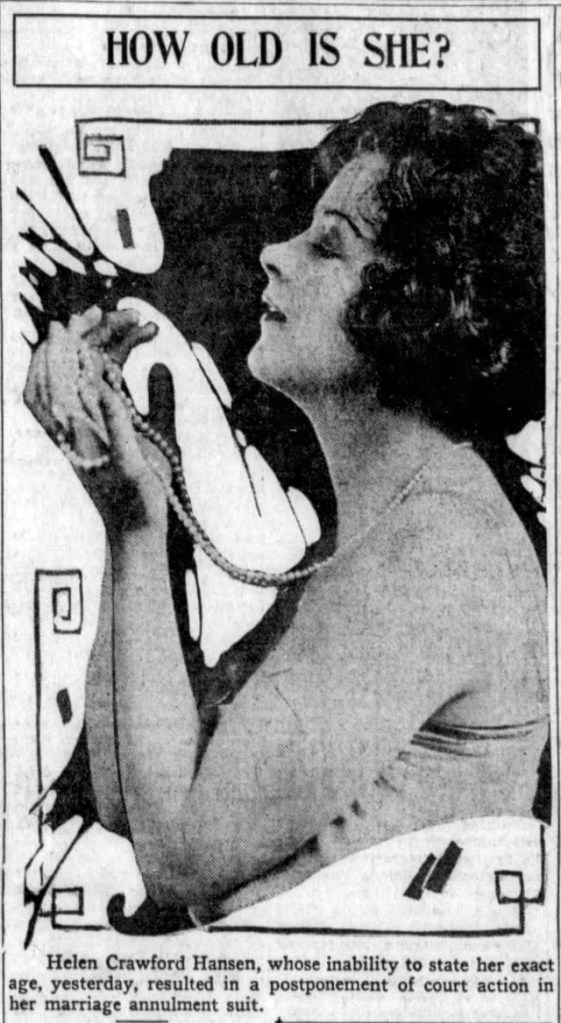
Virginia Rappe’s temporary companion Minnie Buck of 1920 missed her train. This left Helen Hansen as the only witness who arrived in time from Los Angeles ready testify on Saturday morning.13 She gave her married name to the court reporter, not her real and professional name of Helen Crawford. She had to consider the casting directors, as well as her association with Al Semnacher, who no longer could do anything for his clients as long as he was tied to Arbuckle’s fate. Fortunately, Milton U’Ren did not ask about her motion picture career, only about Virginia’s health during the eight weeks that they were “besties,” from July 1 to September 2, 1921. But he did not use our latest word for such instant friendships. He asked if their “acquaintanceship” had been “casual or intimate.”
A. Intimate.
Q. How often did you see her?
A. Every day.
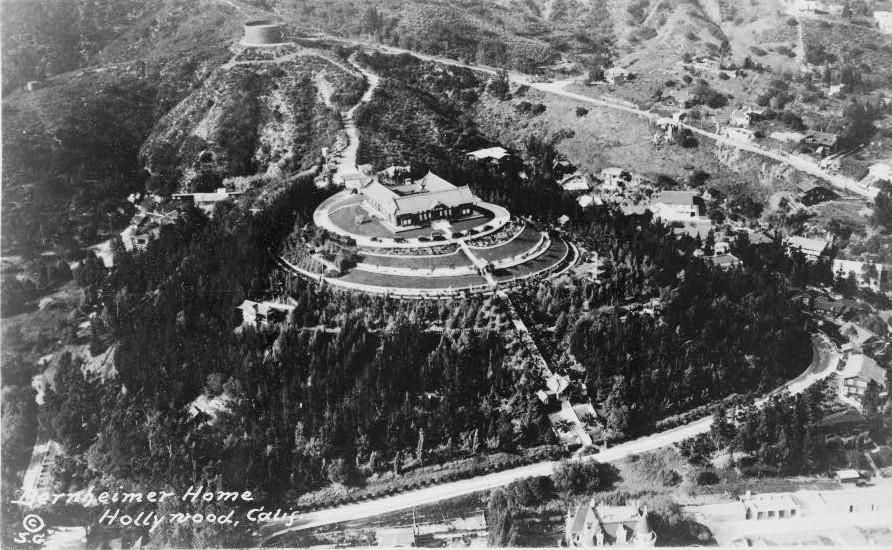
During that time, Helen never knew Virginia to be ill. Her health was very good. Then Helen described the eight-mile walks they took together up into the Hollywood Hills, that they went as far as the Bernheimer Gardens, when it was still a private estate in the Pacific Palisades. Helen did not need to say anymore, that Virginia had a long affinity for those hills when she could see them from the Hotel Hollywood. Helen did need to mention that she and Virginia could have charmed their way onto the grounds, to admire the bronze statues, the waterfall, the pools, the swans, as well as the Japanese pavilion and garden that would be lost to a landslide in 1936. U’Ren only wanted to make sure the walks sounded real in the summer heat of Los Angeles..
A. From about six in the morning until some time between eight and nine.
Q. Were they confined to the level?
A. No, sir.
Q. Just describe to the jury the paths that you took, as being upon the
level upon the hills, or whether it would be steep or otherwise.
A. Well, we went uphill mostly—anything that was a hard walk.
Q. Did Miss Rappe appear to you to be fatigued after these walks?
A. No, she did not.
U’Ren did not ask any personal details reported in the newspapers in September, that Helen was supposed to go with Virginia to San Francisco. Nor did he ask anything about the crepe silk French underwear that Helen helped Virginia sew together. For this trial, Virginia could only be this picture of health rather than a bladder in a jar of formaldehyde. Nevertheless, the jury surely apprehended something about the real person. Finally, U’Ren asked his standard questions about convulsions, fainting spells, shrieking with pain, and so on, to which Helen answered no, no, no . . .
Gavin McNab passed on cross-examining this witness of whom he knew very little, who probably knew more about those weeks before Miss Rappe left Los Angeles without Helen—and what they had to do to get in front of a camera. As for Helen Crawford, she was newsworthy again in San Francisco, when she sued her husband for an annulment. But she could only get bit roles, that petered out by 1925, when she played a maid in The Little Firebrand, an Edith Thornton vehicle. (By that time, using her own name would have been eclipsed by the rising stardom of Joan Crawford.)
13 People vs. Arbuckle, Second Trial, “Testimony of Miss Helen Hansen,” 2052–58.
 Spite Work: The Trials of Virginia Rappe and Fatty Arbuckle