This is a progress report on the book and photo research.
Over the past few days, I have been reworking real story behind the so-called war nurse Irene Morgan, Virginia Rappe’s masseuse and personal nurse from March to October 1920. I discussed her in an earlier post and have new information about her that makes her all the more “sketchier.”
Miss Morgan, who was actually married and listed herself as a widow in the 1920 census, testified that she had to catheterize Rappe during her periods. She also inserted several episodes of drinking, clothes tearing, nudity, and hysteria in addition to a bladder issue. The defense posited such histories—or rather stacked the deck with them—to distance Arbuckle from having caused Rappe the distress she exhibited in a double bed in room 1219 of the St. Francis Hotel on Labor Day, 1921.
That Arbuckle’s lawyers relied on such persons of interest suggests the lengths they went to get the motion picture comedian acquitted. That often requires this author to dig up the stories that comes after the trial. And that is how I found out that Miss Morgan reinvented herself as a “Doctor of Kinesiology” at the College of Applied Science in Los Angeles, an institution peculiar to California—and the brainchild of the notorious charlatan Edward Oliver Tilburne.
Back in the 1920s, everything that became the wellness culture that grew up alongside the film industry, was already in motion. Yoga was becoming a “thing,” but kinesiology, imported from Sweden, was the way to achieve wellness through motion and massage.
Finding the authentic amid the inauthentic has made my work both intriguing and a labor of love. This is true in regard to the photographs, some of which are worth more than a thousand words and what I am willing to pay for images now in the public domain.
One such photograph has been hard to find. For the first Arbuckle trial of November–December 1921, a group portrait was taken of both the defense lawyers and prosecutors, who sat at the same long table before the bench and witness chair.
This photograph exists in two versions. One has the prosecutors cropped out entirely using the Photoshopping of the day, a pair of scissors. You can find this one in books:
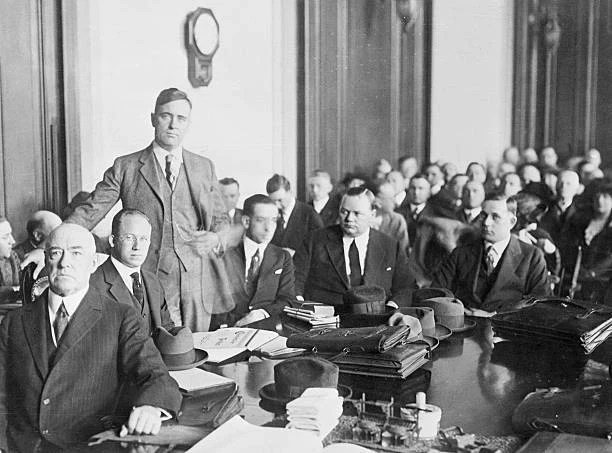
A few, a very few newspapers printed the entire original image:

The above grainy image and caption is on the reverse of another image that had been spliced together from two different takes. It was recently for sale on eBay. At first, I found it unsatisfactory for the book and passed. But given all the tension between what is truth in my book and what is not, I might reconsider it. Notice that no one cared that the courtroom wall clock appears twice in the background.

 Spite Work: The Trials of Virginia Rappe and Fatty Arbuckle