A psychological portrait of Roscoe Arbuckle at this late date is all but impossible. One just has his “aw-shucks” remarks to go on and they are rather hard to take seriously or give a close-reading. But during a November 1920 interview, the comedian contemplated a weight loss regimen. “I’m going to train down for one thing,” Arbuckle said,
and then I’m going to tour the country, disguised in my thinness. I’ll visit all the big theaters and ask people what they think of that alleged funny man, Arbuckle. [. . .] I’m going to see all of America first, and then, of course, I’m going to Europe. One place I look forward to is Monte Carlo. Sure, that’s the reason I’m rehearsing at Tia Juana![1]
He said this the same year that Virginia Rappe became obsessed with her own weight. She not only exercised, she used laxatives. She may have even purged.
But what might Arbuckle really be saying here, in keeping with in risu veritas (in laughter, truth)? Could he have been no less weight conscious? In his case, losing any weight would have been virtually a violation of his million-dollar contract with his employer, Paramount Pictures.
Then there is this: In the earliest statement made by Zey Prevost, the most reluctant witness against Arbuckle at his first two trials for manslaughter, she recounted a strange interlude at his Labor Day party on September 5, 1921. As the comedian and his guests enjoyed a drinking “brunch” in a reception room, 1220, on the top floor of the St. Francis Hotel, Arbuckle seemed to wax philosophical once more: but his method of escape had changed.
He undoubtedly intended his remarks to be heard by all his guests, including Virginia Rappe. She would have heard him. She may have even said something to prompt him.
After all, he and his friends were violating Prohibition. They were all married and had a roomful of young women to themselves. The comedian was certainly taking a career risk while playing hooky from Los Angeles and “Paramount Week,” when his company feted its latest motion pictures and actors.
Assistant District Attorney Milton U’Ren wanted to know from Prevost if Arbuckle had been intoxicated before he soon followed Rappe into his adjoining bedroom, 1219, and locked the door. But he got this answer instead.
Q. I mean was his speech coherent?
A. He was talking about jumping out of the twelfth-story window. He said, “Oh what is in life after all?” Really, it did sound funny. We were all sitting by the window. He said: I will jump out of the window with anybody who wants to jump out.
Q. Did anybody volunteer to go with him?
A. No, nobody. We all looked at him. He said something: If I would jump out of this twelfth-story window, they wouldn’t talk about me today and tomorrow. They would go to see the ball game instead. So, what is life after all?”[2]
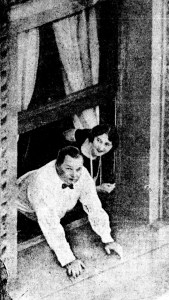
Roscoe Arbuckle and Mrs. Mae Taube at the window of room 1220,
St. Francis Hotel, September 4, 1921 (Newspapers.com)
[1] “Flashes: Roscoe Arbuckle Plans,” Los Angeles Times, July 7, 1920, III:4.
[2] “Zey Pyvron Prevost Tells of Wild Orgy: Arbuckle “Got Mad” at Rappe Girl,” San Francisco Examiner, September 15, 1921, 3.
 Spite Work: The Trials of Virginia Rappe and Fatty Arbuckle