The epilogue, like the introduction, is always in flux and won’t be finalized until we finish the next two trials. For the most part, the text feels sound—and much is devoted to the denouements of various principal and some minor witnesses. We have traced, for example, some of Maude Delmont’s life to the end. And we have much devoted to Arbuckle’s post-trial career with a certain emphasis on the incidents of misconduct that continue after Virginia Rappe.
The following passage may need to be shortened or cut. But what happened may have been more than what we have been previously told. The Merritt book, Room 1219, for example, devotes a vanilla paragraph to the incident and attributes Arbuckle’s injury to slipping and falling down a stairwell. Our treatment more relies on the eyewitnesses among the Japanese crew who spoke to reporters in Yokohama.
In late July, Hays traveled to Los Angeles and couldn’t avoid The Sins of Hollywood, with its lurid red Mephistopheles and his camera on a startled flapper and her beau. A respected Los Angeles minister handed him a copy at the behest of the author. Hays was appalled but didn’t change his glad tidings in the speech he gave at the new Hollywood Bowl. He declared, “The one bad influence in Hollywood is talk. And for the life of me I cannot see the horrors of Hollywood.”
Arbuckle’s reaction to the pamphlet and the grim presence of the motion picture czar is unknown. Still, his subsequent misadventure to remove himself from Los Angeles and the public eye may have been connected given the timing.
Not long after Hays returned to New York, the disgraced comedian applied for a passport for himself and his new secretary and minder, Harry R. Brand, a young publicist in the employ of Joseph Schenck. Their itinerary was to sail around the world with stops in Honolulu, Japan, China, the Philippines, India, and Egypt, where Arbuckle was to meet up with Schenck and his wife, Constance Talmadge, before continuing on to France, England, and New York. The voyage was to take months and invited much speculation. Did Arbuckle intend to resume his career abroad? Will he accept offers from Japanese and French producers?
Arbuckle was guarded about his plans. He only said he wanted to “rest.” Schenck was more explicit. He told reporters that Arbuckle was “jumpy and nervous” and in “poor personal health.” This was code to cover for Arbuckle and the real reason, which may have been a reward for the comedian’s good behavior. Arbuckle had certainly suffered not only being unable to work but to play—and the late summer had always been set aside his vacations and carousing.
Seen off by his lawyer Milton Cohen—and without Brand—Arbuckle boarded the SS Siberia Maru in San Francisco on July 16. On the first or second night at sea, Arbuckle was seen drinking sake in the company of friends. According the Japanese press, he got into a braw and threw a punch at a British passenger, cutting his hand on the other man’s teeth.
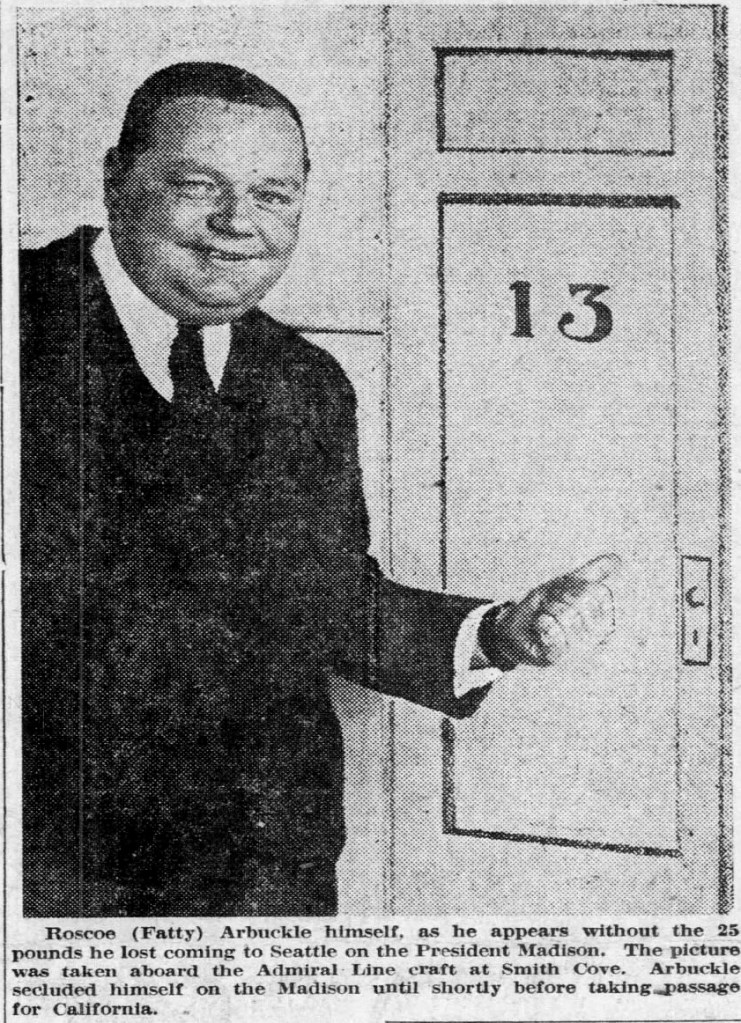
Arbuckle quickly denied the incident in a radiogram to Schenck. Then things got worse. The comedian contracted blood poisoning and a hospital room in Tokyo was quickly arranged. There Japanese doctors considered amputating Arbuckle’s arm at one point. But the comedian eventually recovered and returned via Seattle four weeks later. His arrival was intended to be “incognito.” But he was discovered and photographed outside his stateroom, number 13.
 Spite Work: The Trials of Virginia Rappe and Fatty Arbuckle