To begin the part that narrates—and documents—the first Arbuckle trial, we begin with an anecdote. This is, admittedly, formulaic. You know, what we learn in the writing seminar, the way a piece should begin with the indirect, something that seems beside the point but has an ulterior meaning that “haunts” the reader as the rest of the text unfolds.
The burial site of Virginia Rappe is an early example of the interments that helped to make the unique funerary culture of Hollywood Forever Cemetery. Eventually, over time, the plots became more and more attractive nuisances—at least to the cemetery’s groundskeepers—by intention, when it was seen the celebrity can continue into this quiet afterlife.
As for Crystal Rivers, toward the end of his life, in the late 1930s, he began to write letters to the editor of the Santa Barbara newspapers, expressing a certain pacifism as another world war loomed.
Update: We are still revising the 200+ pages that cover the first trial and its aftermath. We may, as we do here, reveal the sections of the work-in-progress.
The First Trial Begins
The forthcoming trial of Roscoe Arbuckle, the celebrated film comedian, on the charge of manslaughter, is of interest and significance to the whole civilized world.
Gouverneur Morris
In the weeks after the funeral of Virginia Rappe, “the Littlest Cowboy,” Master Breezy Reeves Jr., the son and namesake of director B. Reeves Eason, was laid to rest.[1] The six-year-old had been killed by a runaway truck as he rode his bicycle to a piano lesson. His interment added another player to those who died too young, well before Rudolf Valentino’s vault made Hollywood Forever Cemetery a shrine visited by legions of devotees and the curious. Their pilgrimages, their attendant rites were still in the future. Rappe’s modest plot by the reflecting pool, however, anticipated who was to come in the person of her lone mourner.
Cemetery employees observed the same man in his forties almost daily. He often put fresh flowers in the urn on her grave and removed the withered ones. On a nearby palm tree, he hung a framed picture of a bouquet of roses that bore a legend in verse and a humble request to leave the offerings undisturbed.
You fought for the honor God gave to you
A beautiful bridal flower.
And through the years your heart beat true|
Till the day and the fatal hour.
This is a promise delayed, Crystal P. Rivers.
Please do not remove this from the grave of Virginia
—Semper Fidelis (always faithful) from C. P. R.
The police were consulted. The poet broke no laws. But with Roscoe Arbuckle’s trial date of November 7 fast approaching, the newspaper editors saw a human-interest story. They printed the poem appended to the rose bouquet and sent reporters to lie in wait for the mysterious visitor. Finally, one of them confronted Rivers on his way to Rappe’s grave and with much persuasion, he consented to talk.
Rivers said nothing about his curious name for a man, at once feminine yet paean in keeping with the poetry of the American frontier. He said very little about his vocation—he worked in a factory—but admitted to being an artist, inventor, and a widower. Living in virtual seclusion, he devoted much of his time to study and writing. And with tears beginning to brim, his voice trembling with emotion, he said he knew Rappe well. Her friends had introduced him in 1917. “I loved Virginia Rappe,” he confessed,
for her innocence, her beauty and her gracious charm. The memories of my meetings with her are the most precious of my life. I loved her as a father does his only daughter. She was the embodiment of all I have missed in life—a child on whom I might lavish my affections.
Rivers claimed to have an “unusual platonic romance” with Rappe. But it didn’t last the winter. His poem faded in the rain. A cemetery employee removed his decorations. Eventually, a new visitor took up the rite and filled the urn with sprays of black acacias.
As Crystal Rivers mourned his imaginary daughter, newspapers continued to publish stories speculating in the existence of Virginia Rappe’s real daughter. Since such hearsay could prejudice the jury pool for People vs. Arbuckle, Matthew Brady spoke from the bully pulpit of the District Attorney’s office. “We are getting ready to fight tooth and nail for the conviction of Arbuckle,” he declared. “The propaganda being spread by the press is not worrying us a particle.” [. . .]
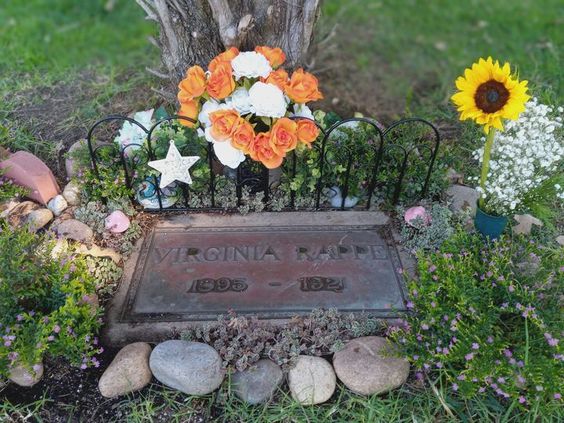
A recent image of the Rappe gravesite maintained by the Silent Film Cemetery Project
[1] pp. 000–000: John Berryman, “Dream Song 222,” The Dream Songs (New York: Farrar, Straus, Giroux), 241; Gouverneur Morris, America and Arbuckle Trial, San Francisco Call, 7 November 1921, 1,2; “Grave of Girl Daily Visited,” San Francisco Examiner, 3 November 1921, 12; “Mystery Visitor Decorates Grave of Virginia Rappe,” Los Angeles Evening Herald, 3 November 1921, A12; “Identify Grave Visitor,” Los Angeles Evening Herald, 5 November 1921, A3; “Solve Rappe Grave Puzzle, Los Angeles Record, 5 November 1921, 2; “Mystery Suitor of Rappe Girl Tells of Affection,” San Francisco Examiner, 5 November 1921, 9; “Mystery Suitor Tells of Love for Rappe Girl,” Buffalo Times, 11 November 1921, 5; [, , ,]
 Spite Work: The Trials of Virginia Rappe and Fatty Arbuckle